


Erhalten Sie Zugang zu diesem und mehr als 300000 Büchern ab EUR 5,99 monatlich.
- Herausgeber: Nick Hern Books
- Kategorie: Poesie und Drama
- Serie: NHB Modern Plays
- Sprache: Englisch
Late-night taxis, teen discos, home nurses, Jewish launderettes, vigilantes, babies, immigrants, seagulls. Citysong is a play, a poem and a chorus of voices showing three generations of a Dublin family on one day. Intimate and sweeping, joyous and ridiculous, it's modern-day Dublin's Under Milk Wood via Metamorphoses (not the book about the cockroach). It's different things at different times, which makes sense seeing as it's about change. Carys D. Coburn's Citysong was winner of the 2017 Verity Bargate Award, and premiered at the Abbey Theatre, Dublin, in May 2019, before transferring to Soho Theatre, London. The author was named Most Promising New Playwright at the 2020 Off-West End Theatre Awards for Citysong.
Sie lesen das E-Book in den Legimi-Apps auf:
Seitenzahl: 75
Veröffentlichungsjahr: 2019
Das E-Book (TTS) können Sie hören im Abo „Legimi Premium” in Legimi-Apps auf:
Ähnliche








Dylan Coburn Gray
CITYSONG
NICK HERN BOOKS
London
www.nickhernbooks.co.uk
Contents
Introduction
Acknowledgements
Original Production
Voices
Performance Notes
Citysong
About the Author
Copyright and Performing Rights Information
Introduction
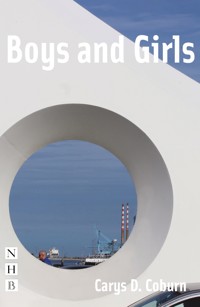
Boys and Girls opened in 2013, Drawing Crosses on a Dusty Windowpane was written throughout 2014 and 2015, and Citysong was written at the end of 2015. These three plays sum up two very important years of working out what and how and why I wanted to write. (Then MALAPROP – the collaborative outfit I make work with – came along, and everything got a lot more complicated.)
Citysong is the single play I’ve written so far that most embodies everything I’m about as a writer. But you can find the seeds in Boys and Girls. There are things in Boys and Girls too that I would not write now: pop-culture references that were dated the moment I wrote them down, jokes in the voices of young men that can only be so ‘ironically’ sexist if they require you, the audience, to sit there and listen to them. I’m still proud of it as a document of a time in young Irish adulthood. I’m still proud of it for having a kind of nerdy compassion at its heart. I still think there are worse things to aim for than stylish sincerity.
There’s an arc to these three plays. It’s not scale, even though the four people of Boys and Girls become six in Citysong with a detour through monologue for Crosses. I think the arc is me learning to be other people, and the journey is further each time. The work I love is all about truth, moments of unexpected recognition or realisation. The leap into someone else’s experience that all at once takes you home. That said, I’m not mad on writing that is self-consciously #relatable, funnily enough, because I think it often has a conspiratorial subtext.
Don’t we all do this?
Aren’t we all like this?
Which invites the punchline to the old joke:
Who’s ‘we’, white man?
It’s sameness without difference, the leap without the chasm.
If the un-looked-for truth is what you look for, it would be stranger if your writing didn’t sooner or later spiral out from the world you know best and find easiest to write. Meaning writing itself gets harder, but that’s to be expected. The further you want to leap, the more of a run-up you need. Someone once said to me you get one good work out of doing what comes naturally, and from there it’s all learning to be someone else. I think about that a lot. I like that a lot. The idea that the means is the end: connection, which is always a transformation, working at turning ourselves into ourselves who are new.
In art as in life. The one great task! To reach the point where performance becomes.
Dylan Coburn Gray
April 2019
This is the Introduction to Citysong and other plays; the collection in which this play first appears.
Acknowledgements
Thanks to Róise and Kris and Ruth and Cian and Steve and Jen and Sarah and Neil and Graham, Colm and Kalle and Stephen and Erin and Linda, Robbie and Emma and Aisling, Sophie Jo and Aoife and Ben and Jim, Brian and Mark and Áine and Erica, Soho and Fringe and Project and ITI and Fishamble and Culture Ireland and Dublin Youth Theatre, Madeline Boughton, Aoife and Leah, Jasmine and Holly, Breffni and Claire and John and Maeve and Molly, the Galvins, my mother, my father, my sister, Carla. And a shout out to Paul. Wish you were here.
D.C.G.
Citysong was co-produced by the Abbey Theatre, Dublin, and Soho Theatre, London. It was first performed at the Abbey Theatre on 25 May 2019 and transferred to Soho Theatre on 12 June 2019, with the following cast:
Amy Conroy
Bláithín Mac Gabhann
Clare McKenna
Dan Monaghan
Daryl McCormack
Jade Jordan
Director
Caitríona McLaughlin
Set and Costume Design
Sarah Bacon
Lighting Design
Paul Keogan
Composer and Sound Design
Adrienne Quartly
Movement Director
Sue Mythen
Voice Director
Andrea Ainsworth
Associate Sound Designer
Jennifer O’Malley
VOICES
VOICE
KATE
ROB
BRIGID
FRANK
MICHAEL
FIONN
RADIO
FARE 1–4
TAXIDAD
DRIVER 1–4
TAXIMAM
RIDER 1–2
TAXIKID
DOCTOR
BIRD 1–4
INDAD 1–4
OUTDAD 1–2
ROLL-CALL
YETUNDE
3B 1–4
NEIGHBOUR 1–4
FRIEND
SOUND DOCTOR
SHIT DOCTOR
GREAT-GRANDMA
CROSSWORD
IRISH NURSE
IAN
LOUISE
BRONAGH
CHRISSY
BUSINESS PRICK 1–4
LUSH 1–4
SWORDS NEIGHBOUR 1–4
MS BUTLER
ÁINE
BEN
SAM
MS BELTON
MS RUANE
MR O’DONOGHUE
PRIYA
INTERNET
NIAMH
AMNESTY 1–4
PARTY ANIMAL 1–4
CONCERNED PARENT 1–4
ROUGH SLEEPER 1–4
GABRIEL
JUDE THE GIRL
MUTTERER 1–4
SEÁN
STEPHEN
LAD 1–4
MATCHMAKER
DANCER 1–4
Performance Notes
An em dash (–) at the end of a line means you prepare the next line. No punctuation at the end of a line means the moment keeps going out of our sight.
There are a lot of words. There is a lot of imagery. If you – the performer – try to enjoy all of it, you will run out of feelings. If they – the audience – try to get all of it, they will run out of brain. Probably the approach to text should embrace this fact. I’m not saying piss through it, but it can be fast. I’m not saying be casual or flippant, but what I am saying is that it works best when the logic is cumulative. Some thoughts you pass through and some you arrive at. The engine of the text is how well you feel you’re doing at getting the audience to understand. Not well, look harder for the right thought to offer them; well, enjoy the moment of shared understanding.
If a line is convoluted you know it’s convoluted. There is a quality Steve Marmion generously calls The Irish Twinkle, which I would call Embracing The Fact You’re A Wanker. It’s self- aware but sincere. It’s good panto! Commentary without ridicule.
There are rhymes and rhythms, but there’s not a lot of end rhyme or coupleting. I encourage you to look for patterns that give you momentum. Sound A’s recurrence begins the thought containing Sounds B and C’s recurrences which leads inevitably to the thought beginning with Sound D’s recurrence…
The audience is always there.
Some of the jokes are in working-class Dublin accents; ideally, the audience should never think the Dublin accents are the joke.
Because there are so many characters, most of the time the performer’s age/gender/race/whathaveyou will be ‘wrong’.
It’s probably best not to sweat those things too much in the first place, but not in the way where not sweating it means everyone in the cast is a hot young white man.
ZERO
VOICE. It is night and here is the city, sleeping.
Riversplit and seakissed and roadrunneled and concrete brick stone steel and glass formed and typeset.
Look: the spire’s a spindle or axis and while it’s not vinyl the city is a record of all that has happened to us, is happening, or will. It spins as the world does and a godlike needle could read its spaces, how it bumps and juts and dimples and cavities, as pages or notes in the book or the symphony of us.
It is a legible palm, a singable psalm, ringable changes, irreducible word of the language that speaks us like Genesis or crucible whose heat both begins and then ends us.
So let’s begin with an ending.
Night has lightened until it isn’t, and day breaks into wholeness.
Like an egg cracked into a cakebowl and cakedom, or a wave into licks of foam on rock, or the heart of a roaming dad who yellowsignedly and oh-so-resignedly taxis through the less but still blackness.
He and the moon are waxers, lyrical and big respectively, and they wane and wain as well. The nightly, monthly and silvery moon to the horizon and an eyelashlike slivereen of its milklike, fullfat, self.
The stubbly, the weary, the double and bleary-visioned man not a shrinker but a carrier: he rubs his eyes hard as chastisement for failing him and wains in the sense – or guise – of a chariot.
Each night he’s on nights he slaloms from outstretched palms into suburbs and estates where his radio awakens –
RADIO (incoherentnoises).
VOICE. and cracklingly beckons him back into town for some short-haul transit. Like tonight, when he stopped for the hailing hands of George’s Street –
FARE 1. to North Strand?
VOICE. The Five Lamps –
FARE 2. to The Ivy House?
VOICE. Gardiner –
FARE 3. to Liffey street?
VOICE. and Eden Quay –
FARE 4. to my house, please?
TAXIDAD. Which is where?
VOICE. He says, gruff, though he quite likes these oneshots, mirrorlooking at these not-much-more-than-ten-minute-or-a-fiver fares and inferring their life affairs from their from, their to, their demeanour. Is it a date or a breakup, a catchup with the once-close-now-once-a-year faces?




