


44,99 €
Mehr erfahren.
- Herausgeber: John Wiley & Sons
- Kategorie: Wissenschaft und neue Technologien
- Sprache: Englisch
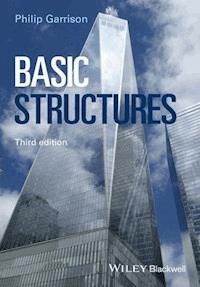
Basic Structures provides the student with a clear explanation of structural concepts, using many analogies and examples. Real examples and case studies show the concepts in use, and the book is well illustrated with full colour photographs and many line illustrations, giving the student a thorough grounding in the fundamentals and a 'feel' for the way buildings behave structurally. With many worked examples and tutorial questions, the book serves as an ideal introduction to the subject.
Sie lesen das E-Book in den Legimi-Apps auf:
Seitenzahl: 552
Veröffentlichungsjahr: 2016
Ähnliche



















Table of Contents
Cover
Title Page
Acknowledgements
Introduction
The purpose of this book
The intended readership
A word about computers
The website
An overview of this book
How to use this book
Let’s keep it simple
1 What is structural engineering?
Introduction
What is a structure?
What is an engineer?
The structural engineer in the context of related professions
Structural understanding
Safety and serviceability
The composition of a building structure
A few words for students on architecture courses
2 Learn the language
Introduction
3 How do structures (and parts of structures) behave?
Introduction
Compression
Tension
Bending
Shear
Structural elements and their behaviour
Cross-sectional types
Appraisal of existing structures
What you should remember from this chapter
4 Force, mass and weight
Introduction
The relationship between weight and mass
Density and unit weight
Units generally
Relationships with other measuring systems
What you should remember from this chapter
Tutorial examples
5 Loading – dead or alive
Introduction: what is a load?
Nature of load
Load paths
6 Equilibrium – a balanced approach
Introduction
Vertical equilibrium
Horizontal equilibrium
The application of equilibrium
What you should remember from this chapter
7 More about forces
Introduction
The Underground analogy
Resolution of forces
The ‘Donald and Tristan’ analogy
Resultants of forces
Components of forces
What you should remember from this chapter
Tutorial examples
8 Moments
Introduction
What is a moment?
Practical examples of moments
Numerical problems involving moments
Moment equilibrium
What you should remember from this chapter
Tutorial examples
9 Reactions
Introduction
Moment equilibrium
Calculation of reactions
Calculation of reactions when uniformly distributed loads are present
What you should remember from this chapter
Tutorial examples
10 Different types of support – and what’s a pin?
What is a pin?
Different types of support
Restraints
Simultaneous equations
What you should remember from this chapter
Tutorial examples
11 A few words about stability
Introduction
Stability of structural frameworks
Internal stability of framed structures – a summary
Examples
General cases
Frames on supports
Examples
Stability of ‘real’ structures
What you should remember from this chapter
Tutorial examples
12 Introduction to the analysis of pin-jointed frames
Simple beams, lattice girders and trusses
What is a pin-jointed frame?
How are pin-jointed frames analysed?
13 Method of resolution at joints
Introduction
The rules
The general approach
Standard cases
The influence of diagonal members
Worked example 1
Worked example 2
Worked example 3
Tutorial examples
14 Method of sections
Introduction
Background to the method of sections
Example of method of sections
Summary of the method of sections
What you should remember from this chapter
Tutorial examples
15 Graphical method
Introduction
The van driver analogy
Calculation of the sense (compressive or tensile) of the internal forces in the framework
What you should remember from this chapter
Tutorial examples
16 Shear force and bending moments
Introduction
Deformation of structures
Shear and bending
Shear force and bending moment diagrams
There is an easier way
The relationship between shear force and bending moment
The shape of shear force and bending moment diagrams where uniformly distributed loads are present
What else can shear force and bending moment diagrams tell us?
What you should remember from this chapter
Tutorial examples
17 This thing called stress
Introduction
What is stress?
Stress and strain
Types of stress
What you should remember from this chapter
18 Direct (and shear) stress
Introduction
Direct (axial) stress
Shear stress
Strain
The relationship between stress and strain
How to predict change in length
The relationship between change in length and change in width
How to calculate change in width
What you should remember from this chapter
Tutorial examples
19 Bending stress
Introduction
Bending theory
The engineers’ bending equation
Calculation of second moment of area (
I
) for symmetrical sections
Calculation of second moment of area (
I
) for unsymmetrical sections
Centroids and how to locate them
Centroids of irregular shapes
Centroids of cross sections which can be broken down into regular shapes
Example
Parallel axis theorem
What you should remember from this chapter
Tutorial questions
Suggestions for further work
20 Combined bending and axial stress
Introduction
Combined stresses by formula
The formulas
Combined stresses in two dimensions
Pressure on foundations
What you should remember from this chapter
Tutorial questions
21 Structural materials
Introduction
Which is the best material?
Factors to be considered in material selection
Concrete
Masonry
Timber
Steelwork
Aluminium
So how do I decide what materials to use in a given building?
22 More on materials
Material selection for structural design
Alternative forms of construction
The choice between different construction types
Design from first principles and design standards
23 How far can I span?
Introduction
Long span structures
Steel
Concrete
Timber
Masonry
Spans and depths: some rules of thumb
24 Calculating those loads
Introduction
Dead load
Live load
25 An introduction to structural design
General
Loads
Load combinations
Concrete
Masonry
Timber
Steel
Structural glass
Graphene
26 More on structural types and forms
Folded plate structures
Arches
Vaults
Domes
Shells
Cable structures
Inflatable structures
Space structures
Bridges
Dams
Tunnels
27 An introduction to deflection
Basic calculus: a reminder
Equations for bending moment
Deflection in beams
Determination of maximum deflection
Summary of the use of Macaulay’s method
Maximum deflection for standard cases
Numerical example involving a UDL
Tutorial examples
28 Shear stress
Complementary shear stress
Shear Modulus
Shear stress in beams
Rectangular sections
I sections
Tutorial example
29 Buckling and torsion
Buckling
Torsion
What you should remember from this chapter
Tutorial questions
30 Frames and three-pinned arches
31 Virtual work
Tutorial examples
32 Squares and circles of stress
Combining these stresses
What you should remember from this chapter
Tutorial question
33 Trusses (no numbers)
Tutorial examples
34 Plastic analysis
Plastic modulus
s
x
Plastic moment
M
p
Shape factor
r
Collapse mechanisms
Principle of virtual work
Tutorial example
Further reading
Appendix 1: Weights of common building materials
Reinforced concrete
Blockwork
Brickwork
Steel
Aluminium
Timber
Glass
Water
Live loads
Appendix 2: Conversions and relationships between units
Inches, feet and metres
Yards and metres
Acres and hectares
Miles and kilometres
Litres and cubic metres
Pounds, kilograms and stones
Kilograms, kN and tonnes
Tons and tonnes
Appendix 3: Mathematics associated with right-angled triangles
Pythagoras’ theorem
Basic trigonometry
Appendix 4: Symbols
Appendix 5: A checklist for architects
Appendix 6: Getting more out of civil engineering
So what else should a student be doing besides studying?
Index
End User License Agreement
List of Tables
Chapter 11
Table 11.1 Is a structure stable?
Table 11.2 Stability of frames shown in Fig. 11.2.
Table 11.3 Stability of structures shown in Fig. 11.5.
Chapter 15
Table 15.1 Member forces in Example 15.1.
Chapter 19
Table 19.1 Calculation of second moment of area for Example 19.3.
Table 19.2 Calculation of second moment of area for Example 19.4.
Chapter 20
Table 20.1 Stresses derived from Example 20.1.
Chapter 23
Table 23.1 Span ranges and span/depth ratios.
Chapter 25
Table 25.1 Standard values of factors of safety for loads.
Chapter 31
Table 31.1 Results for Example 31.1.
Chapter 32
Table 32.1 Mohr’s Circle of stress: Example.
Chapter 33
Table 33.1 Progress of analysis for Fig. 33.2.
Table 33.2 Progress of analysis for Fig. 33.4.
Table 33.3 Progress of analysis for Fig. 33.6.
Table 33.4 Progress of analysis for Fig. 33.8.
List of Illustrations
Chapter 01
Fig. 1.1 Lower Manhattan skyline, New York City.This is one of the largest concentrations of high-rise buildings in the world: space limitations on the island of Manhattan meant that building construction had to proceed upwards rather than outwards, and the presence of solid rock made foundations for these soaring structures feasible.
Lesen Sie weiter in der vollständigen Ausgabe!
Lesen Sie weiter in der vollständigen Ausgabe!
Lesen Sie weiter in der vollständigen Ausgabe!
Lesen Sie weiter in der vollständigen Ausgabe!
Lesen Sie weiter in der vollständigen Ausgabe!
Lesen Sie weiter in der vollständigen Ausgabe!
Lesen Sie weiter in der vollständigen Ausgabe!
Lesen Sie weiter in der vollständigen Ausgabe!
Lesen Sie weiter in der vollständigen Ausgabe!
Lesen Sie weiter in der vollständigen Ausgabe!
Lesen Sie weiter in der vollständigen Ausgabe!
Lesen Sie weiter in der vollständigen Ausgabe!
Lesen Sie weiter in der vollständigen Ausgabe!
Lesen Sie weiter in der vollständigen Ausgabe!
Lesen Sie weiter in der vollständigen Ausgabe!
Lesen Sie weiter in der vollständigen Ausgabe!
Lesen Sie weiter in der vollständigen Ausgabe!
Lesen Sie weiter in der vollständigen Ausgabe!
Lesen Sie weiter in der vollständigen Ausgabe!
Lesen Sie weiter in der vollständigen Ausgabe!
Lesen Sie weiter in der vollständigen Ausgabe!
Lesen Sie weiter in der vollständigen Ausgabe!
Lesen Sie weiter in der vollständigen Ausgabe!
Lesen Sie weiter in der vollständigen Ausgabe!
Lesen Sie weiter in der vollständigen Ausgabe!
Lesen Sie weiter in der vollständigen Ausgabe!
Lesen Sie weiter in der vollständigen Ausgabe!
Lesen Sie weiter in der vollständigen Ausgabe!
Lesen Sie weiter in der vollständigen Ausgabe!
Lesen Sie weiter in der vollständigen Ausgabe!
Lesen Sie weiter in der vollständigen Ausgabe!
Lesen Sie weiter in der vollständigen Ausgabe!
Lesen Sie weiter in der vollständigen Ausgabe!
Lesen Sie weiter in der vollständigen Ausgabe!
Lesen Sie weiter in der vollständigen Ausgabe!
Lesen Sie weiter in der vollständigen Ausgabe!
Lesen Sie weiter in der vollständigen Ausgabe!
Lesen Sie weiter in der vollständigen Ausgabe!
Lesen Sie weiter in der vollständigen Ausgabe!
Lesen Sie weiter in der vollständigen Ausgabe!
Lesen Sie weiter in der vollständigen Ausgabe!
Lesen Sie weiter in der vollständigen Ausgabe!
Lesen Sie weiter in der vollständigen Ausgabe!
Lesen Sie weiter in der vollständigen Ausgabe!
Lesen Sie weiter in der vollständigen Ausgabe!
Lesen Sie weiter in der vollständigen Ausgabe!
Lesen Sie weiter in der vollständigen Ausgabe!
Lesen Sie weiter in der vollständigen Ausgabe!




