


2,49 €
Mehr erfahren.
- Herausgeber: Edizioni Sette Città
- Kategorie: Gesellschafts- und Liebesromane
- Sprache: Englisch
What happens to a Western country when it finds itself in the same situation as a country in the Far East, singled out as an infector, vilified yet pitied for a tragedy that will soon become the tragedy of all, literally of all the over seven billion people on our planet? That country will also be held up to public criticism as an infector, for the same unwitting misdeed, and it will also be pitied.
COVID-19 is still circulating among us, and yet 12 months have passed since the outbreak of the disease in Europe.
The time-lapse however has not interrupted the discourse on what happened because the unprecedented situation has still not been fully understood.
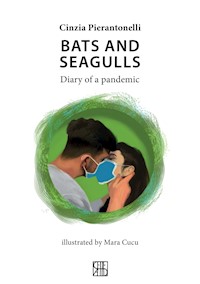
A short story in the form of a diary recounts all-western atmospheres, feelings and values plunged into a crisis by an unknown enemy, so invisible that no one can foresee the devastating impact it will have on our lives. However, it is the surrounding nature that will make us reflect, will call to mind lost values, harbingers of a new, ‘magnificent and progressive destiny’. The story is enhanced and enriched by narratives in the guise of illustrations, some in black and white, others in colour, which go to compose a variegated tapestry in which artistic fantasy and personal imagination are blended in the unfolding of the tragic events.
Das E-Book können Sie in Legimi-Apps oder einer beliebigen App lesen, die das folgende Format unterstützen:
Veröffentlichungsjahr: 2021
Ähnliche




















Cinzia Pierantonelli
Bats and
seagulls
Diary of a pandemic
illustrated by Mara Cucu
translated by Marilyn Scopes
Sette Città
isbn: 978-88-7853-907-5
Internal images and cover: Mara Cucu©2021
Sette Città
Via Mazzini 87 01100 Viterbo
t. 0761 303020
[email protected] www.settecitta.eu
Preface
What happens to a Western country when it finds itself in the same situation as a country in the Far East, singled out as an infector, vilified and pitied for a tragedy that will soon become the tragedy of all, literally of all the over seven billion people on our planet? That country will also be held up to public criticism as an infector, for the same unwitting misdeed, and it will also be pitied.
COVID-19 is still circulating among us, and yet 12 months have passed since the outbreak of the disease in Europe.
The time-lapse however has not interrupted the discourse on what happened because the unprecedented situation has still not been fully understood.
It all started far away.
As has often happened in the past, one area in the world was caught up in a tragedy that touched the hearts of everyone, a tragedy albeit displayed on our TV screens, swallowed, digested and then assimilated into the many sequential images of a series on Netflix.
On our side of the world, as often happens, we feel exempt from major catastrophes. With the arrogance of Western supremacy, of its ‘magnificent and progressive destiny’, accustomed to dominating, manipulating, overriding until adversity, disasters, and misfortunes are defeated, we feel victorious!
Nothing can stand in our way, not even nature itself.
For centuries, man rightly did everything in his power to progress in all fields, but when his quest for progress became too frenzied, it was no longer acceptable as it turned into a malaise for the earth; earth, our home, that is regulated by the laws of nature that we neither abide by nor understand.
Indeed, this time we really got it wrong and like rushing water breaking through a dam, the catastrophe struck our fortified basin and spread rapidly.
‘What goes around comes around’
First, the country that was as much pitied as vilified was China, then, in no time at all, it became ours, Italy.
This country is known across the world for its natural beauty, and its inestimable heritage drawn from the stratification of culture and civilization produced over the centuries; but also for its ‘Dolce Vita’, an unusual philosophy of life, adopted more in the south of the world but intrinsic to those who invented it, and essential to the Italian lifestyle. The Italians have also made a name for themselves thanks to their genius, creativity, and imagination, all be they qualities that often lead to individualism and in some cases even lapse into superficiality, indifference, or negligence.
Cultural stereotypes are internationally fixed, so they are difficult to change. A tendency to an anarchy dictated by the aromas and flavours of food rather than by political ideals and an innate aptitude for commotion and disorder then become the identification of an entire population.
How inaccurate and false can you get!
Actually, other nations were amazed at how the Italians faced an unprecedented and complicated situation rigorously and with great discipline; they even became an example for other populations to follow.
Some catastrophes can be marked down as a double defeat, and we are aware of this now. First, because when they strike like a surprise attack, as in this case, they can destroy; second because, notwithstanding advanced technologies and modern equipment operated by excellent minds, they cannot be tamed. Even highly sophisticated civilizations succumb. One simple single virus can affect entire cities; for years it can modify the rules of society, even compromise our very lives.
For example, we have imposed restrictions on ourselves regarding the most human of expressions such as hugs, caresses, and kisses.
Isolated and frightened, we have circumscribed our existence and begun to mistrust people, first of all strangers, and then gradually even those close to us. We have denied ourselves the hugs of our grandchildren, our parents, and our closest friends. Out of fear, respect, and duty, we have declined the unforeseen, which often marks our destinies by introducing us to new and unpredictable adventures.
The youngest, deprived of models to follow, will find it difficult to express affection spontaneously, to interact with tender gestures.
The youngest, fearful of emerging from the protective shells where they have discovered their comfort zone, will find themselves waiting for a long time, perhaps like their elders. While the daily lives of many others will turn sour.
If you are afraid, your sense of reality is distorted, wrote George Orwell.
The pandemic numbers are surging to the nth power as we prepare to re-establish clichés and learn new norms.
Re-establishing the pre-established order could become a long and painful process, and even some of those who were managing before the pandemic are now in difficulty. Hardship seems to be on the rise even where it was already rife.
Crushed by the sudden deaths of loved ones, of people close to us, of specialists on whom we relied; disorientated in our daily routines; alienated from our empathy and dazed by the constant bombardment of data, we are all struggling to find new ways of moving around the city.
Several months have gone by, but what the future has in store for us is still vague.
Luckily, we’ve got vaccines.
Much was said at the beginning of the lockdown about what the aftermath would be like.
Perhaps there will be no real aftermath, but rather an awareness of an irreversible mutation in the way we live on our planet.
Cinzia Pierantonelli




