


1,99 €
Niedrigster Preis in 30 Tagen: 1,99 €
Niedrigster Preis in 30 Tagen: 1,99 €
Mehr erfahren.
- Herausgeber: DigiCat
- Kategorie: Lebensstil
- Sprache: Englisch
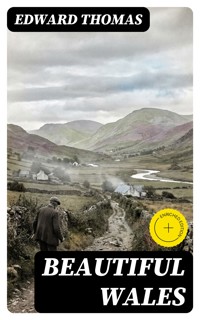
In "Beautiful Wales," Edward Thomas beautifully weaves an evocative narrative that captures the breathtaking landscapes, rich culture, and vibrant history of Wales. Through a combination of vivid imagery, lyrical prose, and reflective observation, the book presents a multifaceted exploration of the Welsh countryside, articulating both the physical beauty and the emotional resonance it holds for its inhabitants. Set against the backdrop of early 20th-century romanticism, Thomas's style bears the influence of nature poets, blending personal reflection with a profound appreciation for the natural world. Edward Thomas, a key figure in the English literary scene and a member of the Georgian poets, drew inspiration from his own deep connection to nature and the complexities of rural life. His experiences as a wanderer and writer were shaped by the tumultuous backdrop of pre-World War I England and the intricate interplay of personal and national identity, which prompted him to capture the essence of his surroundings with both sincerity and depth. His profound appreciation for the Welsh landscape is further accentuated by his own explorations into the deeper meanings of life, belonging, and memory. "Beautiful Wales" is highly recommended for readers seeking an intimate exploration of Wales that transcends mere travelogue. Thomas's insightful reflections invite readers to engage with the landscape in a deeply personal way, encouraging a mindfulness of both nature and self. Scholars, poetry enthusiasts, and those passionate about Welsh culture will find Thomas's work resonates with a timeless beauty, making this book a must-read for anyone interested in the interplay of place and identity.
Das E-Book können Sie in Legimi-Apps oder einer beliebigen App lesen, die das folgende Format unterstützen:
Veröffentlichungsjahr: 2022
Ähnliche




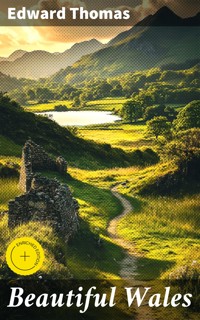



Beautiful Wales
Table of Contents
Introduction
To travel through a place in words is to test whether landscape can be faithfully seen, or only reimagined through the observer’s mind. Edward Thomas’s Beautiful Wales belongs to the tradition of British literary travel writing, presenting Wales as both a physical country and a field of perception shaped by attention, memory, and mood. Read today, it offers not a guidebook of fixed sights but a reflective itinerary, where the act of looking becomes as important as what is seen. Its central tension lies in balancing description with interpretation, and immediacy with the awareness that any portrait is partial.
Beautiful Wales is a prose work of place by Edward Thomas, a writer closely associated with nature-focused and travel-inflected literature. Set in Wales, it proceeds through locations and impressions rather than a single plotted narrative, using movement across countryside, towns, and cultural traces as the book’s organizing principle. Within its genre, it stands nearer to the literary essay and travel sketch than to fiction, aiming to convey atmosphere as much as information. The publication era is not stated here to avoid uncertainty, but the book reads as a product of an earlier phase of modern English prose, attentive to cadence and observation.
The premise is straightforward and spoiler-safe: a narrator’s journey through Wales becomes an occasion to register scenery, weather, sounds, and the human marks that sit within them. The reading experience is cumulative, built from successive encounters that deepen a sense of place rather than drive toward a climactic destination. Thomas’s voice is measured and contemplative, favoring close looking and a restrained lyricism that keeps sentiment in check. The tone can feel quietly intimate, as if the prose were inviting the reader to slow down and notice. What emerges is less a catalogue of attractions than a sustained practice of attention.
A defining feature of the book is its treatment of landscape as lived, not merely viewed. Valleys, hills, coasts, and roads are approached as environments that shape thought and feeling, and that carry histories without requiring the author to turn the work into an academic account. People appear as part of the texture of travel, but the emphasis remains on the interplay between human presence and the wider country. The result is a portrait that respects distance as much as familiarity, allowing Wales to remain itself rather than being reduced to a set of stereotypes or a single mood.
Among the book’s key themes is the ethics of seeing: how a visitor describes a nation without claiming to define it. Thomas’s method suggests that humility is a form of accuracy, and that honest travel writing admits what cannot be fully known. Another theme is time, sensed in layers, where natural forms and built traces hint at continuities and changes that exceed any one traveler’s stay. The prose repeatedly returns to how weather, season, and light alter perception, making each scene provisional. In this way, the work treats place as dynamic, resisting the notion of a definitive view.
Beautiful Wales also reflects on belonging and estrangement in a way that remains relevant. It considers how identity can be felt through language, names, and the grain of local life, yet still elude an outsider’s grasp. The book’s quiet seriousness offers an alternative to travel writing that seeks novelty or conquest, proposing instead that travel can be an education in limits. For contemporary readers navigating saturated media images of destinations, Thomas’s deliberate pace is instructive, reminding us that attention is not automatic. The text asks the reader to consider what it means to travel responsibly in imagination as well as in fact.
The book matters now because it models a way of reading landscape that is both aesthetic and conscientious. In an era of environmental anxiety and accelerated tourism, its focus on careful noticing can renew sensitivity to the nonhuman world without turning nature into a mere backdrop. It also speaks to questions of cultural representation, encouraging readers to value specificity over generalization. Beautiful Wales endures not as a source of practical itineraries but as a demonstration of how prose can hold a place in the mind with dignity and restraint. It invites readers to practice seeing more fully, and to accept complexity without forcing conclusions.
Synopsis
Edward Thomas’s Beautiful Wales is a short, descriptive prose work that presents Wales as a destination shaped by landscape, weather, and long-settled human presence. Rather than building a conventional plot, it moves by accumulation: place after place is introduced through travel impressions, scenic detail, and attention to everyday life. The governing question is how to see a country clearly when it is already thick with inherited images—romantic, picturesque, and national—and how a writer can register both the familiar and the unanticipated without turning experience into mere postcard sentiment.
paragraphs:ERROR_FIX_ONLY_PLACEHOLDER
The opening movement establishes the book’s method: a guided passage through representative scenes, where natural features and small human particulars are set in relation. Thomas’s focus falls on changes of light, the contours of hills and coasts, and the ways roads and paths lead a traveler into new perspectives. Alongside this, he attends to traces of history embedded in the environment and built spaces, suggesting that geography and memory are inseparable. The prose emphasizes observation over argument, inviting readers to weigh how much of a place is seen directly and how much is interpreted through prior expectation.
As the tour continues, the narrative energy comes from contrasts among regions and from shifts in mood as weather and season alter what can be perceived. Thomas returns to recurring tensions: beauty versus hardship, remoteness versus accessibility, and the pull between pastoral quiet and the realities of work and settlement. The text avoids treating Wales as an abstract emblem; instead it stresses particularity, whether in the character of terrain, the feel of a route, or the presence of local communities. This approach keeps the book grounded even when it gestures toward larger cultural associations.
A further development is the way Thomas balances admiration with restraint, resisting the impulse to overstate Wales as wholly “untouched” or purely scenic. The travel voice lingers on details that complicate easy romance, implying that the landscape is lived in and used, not merely admired. At the same time, the book maintains an appreciative steadiness that frames walking, looking, and listening as serious forms of engagement. The reader is led to consider how perception itself changes with patience and attention, and how a country’s character emerges through repeated, careful noticing rather than dramatic incident.
The middle passages deepen the sense of Wales as a layered place where nature, language, and custom can be felt indirectly through names, routes, and local textures. Thomas’s account remains primarily observational, but it carries a quiet inquiry into national identity and the way outsiders approach it. The work suggests that understanding comes not from collecting famous sights alone, but from encountering the ordinary and accepting partial knowledge. This sustained modesty of stance becomes a key element of the book’s progression, keeping the prose attentive to nuance and to the limits of a traveler’s perspective.
In later sections, Thomas’s writing tends toward synthesis, drawing together the book’s recurring motifs—distance, weather, the play of land and water, and the human marks on terrain—without turning them into a rigid thesis. The movement across Wales functions as a test of the picturesque: scenes are admired, yet the narration repeatedly checks whether admiration can coexist with accuracy. The conflict is subtle rather than dramatic, centered on how to honor a place’s beauty while acknowledging its complexity. The result is a portrait that values measured description and a disciplined imagination over sweeping claims.
Historical Context
Edward Thomas wrote much of his prose on travel and landscape in the years immediately before the First World War, when Wales was part of the United Kingdom and governed from Westminster. Railways, improved roads, and commercial guidebooks expanded domestic tourism, and Thomas often travelled by train and on foot while writing for London periodicals. His Wales was a country of industrial districts, farming communities, and long-established Welsh-speaking areas existing side by side. The work’s tone and observational method belong to early twentieth-century literary journalism, which combined description, social notice, and cultural commentary for a mass readership.
Wales in this period was shaped by rapid industrialisation since the nineteenth century, especially coal mining and heavy industry in the south, with ports such as Cardiff handling global trade. Industrial growth brought dense urban settlements, labour organisation, and recurring disputes over wages and conditions. At the same time, large areas of mid and north Wales remained predominantly rural, with small farms and seasonal labour. Such contrasts informed contemporary English perceptions of Wales as both “picturesque” and economically strategic. Thomas’s attention to scenery alongside working landscapes reflects this dual reality rather than an exclusively romantic vision.
The political and cultural setting also included the rise of Welsh national consciousness within the United Kingdom. The nineteenth-century revival of the National Eisteddfod, continuing into Thomas’s lifetime, promoted Welsh-language literature and music, while organisations such as the University of Wales (founded 1893) expanded higher education and scholarship. Debates about language, education, and representation were prominent, and Welsh identity was often expressed through chapel culture, local festivals, and historical memory. Thomas’s engagement with place-names, speech, and local tradition aligns with this wider period of cultural self-definition, even as he wrote primarily for English readers.
Religion and social life were strongly influenced by Nonconformity. Welsh Methodism and other chapel traditions shaped community institutions, moral discourse, and political attitudes, and Nonconformist strength helped drive campaigns for the disestablishment of the Church in Wales. The Welsh Church Act of 1914 legislated disestablishment, though implementation was delayed by the war. These developments mattered to observers because chapels were central gathering points, often linked to education, temperance, and civic organisation. Thomas’s depiction of everyday manners, communal rhythms, and local authority structures can be read against this well-documented dominance of chapel-based public life in many districts.
Land ownership and rural economy formed another key backdrop. Large estates, tenant farming, and questions of access to land had produced political agitation in the late nineteenth century, notably the “Tithe War” of the 1880s and continued debates over rents and rural poverty. By the early twentieth century, agricultural prices and employment patterns were changing, encouraging out-migration from some rural areas. Tourism and the marketing of “Celtic” landscapes also affected rural livelihoods. Thomas’s writing about walking routes, villages, and farms sits within these pressures, registering how landscape is lived and worked, not merely admired.
Transport and information networks framed how Britain encountered Wales. The expansion of the Great Western Railway and other lines connected English cities to Welsh resorts and towns, while newspapers and magazines circulated images of Welsh history and scenery. The period also saw the professionalisation of guidebook writing and the growth of clubs devoted to rambling and antiquarian interests. Such institutions shaped expectations about what counted as “beautiful” or “authentic.” Thomas’s prose emerges from and responds to this mediated travel culture, often resisting formulaic guidebook generalisations by grounding description in specific journeys and observed detail.
Thomas’s own career is part of the context. Before turning primarily to poetry, he was known as a critic and author of topographical and biographical prose, publishing with mainstream presses and writing under deadlines. His work shares features with contemporaries interested in English and British landscapes, while also anticipating modernist scepticism about received pastoral ideals. The years immediately preceding 1914 were marked by social reform debates, labour unrest, and international tension, all within a confident yet anxious Edwardian public sphere. Thomas’s careful, sometimes questioning attention to what travel writing leaves out reflects that atmosphere of reassessment.
The First World War, beginning in 1914, transformed British society and retrospectively coloured readings of pre-war writing. Wales contributed heavily to the war effort through coal and steel production and through enlistment, while wartime governance intensified state involvement in industry and daily life. Thomas enlisted in 1915 and was killed in action in 1917, making his earlier portrayals of landscape and ordinary routines appear as records of a world on the verge of rupture. “Beautiful Wales” reflects its era by balancing admiration for place with awareness of economic change and cultural complexity, implicitly critiquing simplistic, commodified visions of Wales.
Beautiful Wales
PREFACE
A few of my jests, impressions of scenery, and portraits in this book have already been printed in The Daily Chronicle, The World, The Week's Survey, The Outlook, and The Illustrated London News. I have only to add that the line of verse on p. 34 is by Mr. Ernest Rhys; the lines on p. 71 are by Mr. T. Sturge Moore; and those on pp. 130 and 178 by Mr. Gordon Bottomley: and to confess, chiefly for the benefit of the solemn reviewer, that I know nothing of the Welsh language.
CHAPTER I PRELIMINARY REMARKS ON MEN, AUTHORS, AND THINGS IN WALES
Among friends and acquaintances and authors, I have met many men who have seen and read more of Wales than I can ever do. But I am somewhat less fearful in writing about the country, inasmuch as few of them seem to know the things which I know, and fewer still in the same way. When I read their books or hear them speak, I am interested, pleased, amazed, but seldom am I quite sure that we mean the same thing by Wales; sometimes I am sure that we do not. One man writes of the country as the home of legends, whose irresponsibility puzzles him, whose naïveté shocks him. Another, and his name is legion, regards it as littered with dead men's bones, among which a few shepherds and miners pick their way without caring for the lover of bones. Another, of the same venerable and numerous family as the last, has admired the silver lake of Llanberis or blue Plynlimmon; has been pestered by the pronunciation of Machynlleth, and has carried away a low opinion of the whole language because his own attempts at uttering it are unmelodious and even disgusting; has fallen entirely in love with the fragrant Welsh ham, preferring it, in fact, to the curer and the cook. Others, who have not, as a rule, gone the length of visiting the persons they condemn, call the Welshmen thieving, lying, religious, and rebellious knaves. Others would repeat with fervour the verse which Evan sings in Ben Jonson's masque, For the Honour of Wales:
and so they would conclude, admitting that the trout are good when caught. Some think, and are not afraid of saying, that Wales will be quite a good place (in the season) when it has been chastened a little by English enterprise: and I should not be surprised were they to begin by introducing English sheep, though I hardly see what would be done with them, should they be cut up and exposed for sale. The great disadvantage of Wales seems to be that it is not England, and the only solution is for the malcontents to divide their bodies, and, leaving one part in their native land, to have the rest sent to Wales, as they used to send Welsh princes to enjoy the air of two, three, and even four English towns, at the same time and in an elevated position.
SUMMER EVENING, ANGLESEY COAST
Then also there are the benevolent writers of books, who have for a century repeated, sometimes not unmusically, the words of a fellow who wrote in 1798, that the beauty of Llangollen "has been universally allowed by gentlemen of distinguished taste," and that, in short, many parts of Wales "have excited the applause of tourists and poets." Would that many of them had been provided with pens like those at the catalogue desks of the British Museum! Admirable pens! that may be put to so many uses and should be put into so many hands to-day and to-morrow. Admirable pens! and yet no one has praised them before[1q]. Admirable pens that will not write; and, by the way, how unlike those which wrote this:—
"Caldecot Castle, a grand and spacious edifice of high antiquity, occurs to arrest the observation of the passing stranger about two miles beyond the new passage; appearing at no great distance across the meadows that lie to the left of the Newport road. The shattered remnants of this curious example of early military architecture are still so far considerable as to be much more interesting than we could possibly have been at first aware, and amply repaid the trouble of a visit we bestowed upon it, in our return through Monmouthshire by the way of Caldecot village. In the distance truly it does not fail to impress the mind with some idea of its ancient splendour, for it assumes an aspect of no common dignity: a friendly mantling of luxuriant ivy improves, in an eminent degree, the picturesque effect of its venerable mouldering turrets; and, upon the whole, the ruin altogether would appear unquestionably to great advantage, were it, fortunately for the admirers of artless beauty, stationed in a more conspicuous situation, like the greater number of edifices of a similar nature in other parts of the country."
The decency, the dignity, the gentlemanliness (circa 1778), the fatuity of it, whether they tickle or affront, are more fascinating than many better but less portentous things. There was, too, a Fellow of the Royal Society who said in the last century that, in the Middle Ages, St. Winifred's Well and Chapel, and the river, and Basingwerk, must have been "worthy of a photograph."
YACHTS, ANGLESEY COAST
Yet there are two others who might make any crowd respectable—the lively, the keen-eyed, the versatile Mr. A. G. Bradley, and George Borrow, whose very name has by this time absorbed and come to imply more epithets than I have room to give. From the former, a contemporary, it would be effrontery to quote. From the latter I allow myself the pleasure of quoting at least this, and with the more readiness because hereafter it cannot justly be said that this book does not contain a fine thing about Wales. Borrow had just been sitting (bareheaded) in the outdoor chair of Huw Morus[1], whose songs he had read "in the most distant part of Lloegr, when he was a brown-haired boy"; and on his way back to Llangollen, he had gone into a little inn, where the Tarw joins the Ceiriog brook. "'We have been to Pont-y-Meibion,' said Jones, 'to see the chair of Huw Morus,' adding, that the Gwr Boneddig was a great admirer of the songs of the Eos Ceiriog[2]. He had no sooner said these words than the intoxicated militiaman started up, and, striking the table with his fist, said: 'I am a poor stone-cutter—this is a rainy day and I have come here to pass it in the best way I can. I am somewhat drunk, but though I am a poor stone-mason, a private in the militia, and not so sober as I should be, I can repeat more of the songs of the Eos than any man alive, however great a gentleman, however sober—more than Sir Watkin, more than Colonel Biddulph himself.'
"He then began to repeat what appeared to be poetry, for I could distinguish the rhymes occasionally, though owing to his broken utterance it was impossible for me to make out the sense of the words. Feeling a great desire to know what verses of Huw Morus the intoxicated youth would repeat, I took out my pocket-book and requested Jones, who was much better acquainted with Welsh pronunciation, under any circumstances, than myself, to endeavour to write down from the mouth of the young fellow any verses uppermost in his mind. Jones took the pocket-book and pencil and went to the window, followed by the young man, scarcely able to support himself. Here a curious scene took place, the drinker hiccuping up verses, and Jones dotting them down, in the best manner he could, though he had evidently great difficulty to distinguish what was said to him. At last methought the young man said, 'There they are, the verses of the Nightingale (Eos), on his deathbed....'
BEAUMARIS—MOONLIGHT
"... A scene in a public-house, yes! but in a Welsh public-house. Only think of a Suffolk toper repeating the deathbed verses of a poet; surely there is a considerable difference between the Celt and the Saxon?"
But the number is so great of sensible, educated men who have written on Wales, or would have written if business or pleasure or indolence or dislike of fame had not prevented them, that either I find it impossible to visit the famous places (and if I visit them, my predecessors fetter my capacity and actually put in abeyance the powers of the places), or, very rarely, I see that they were imperfect tellers of the truth, and yet feel myself unwilling to say an unpleasant new thing of village or mountain because it will not be believed, and a pleasant one because it puts so many excellent people in the wrong. Of Wales, therefore, as a place consisting of Llandudno, Llangammarch, Llanwrtyd, Builth, Barmouth, Penmaenmawr, Llanberis, Tenby, ... and the adjacent streams and mountains, I cannot speak. At ——, indeed, I ate poached salmon and found it better than any preserver of rivers would admit; it was dressed and served by an Eluned (Lynette), with a complexion so like a rose that I missed the fragrance, and movements like those of a fountain when the south wind blows; and all the evening they sang, or when they did not sing, their delicate voices made "llech" and "llawr" lovely words: but I remember nothing else. At —— I heard some one playing La ci darem la mano: and I remember nothing else. Then, too, there was ——, with its castle and cross and the memory of the anger of a king: and I remember that the rain outside my door was the only real thing in the world except the book in my hand; for the trees were as the dreams of one who does not care for dreams; the mountains were as things on a map; and the men and women passing were but as words unspoken and without melody. All I remember of —— is that, as I drew near to it on a glorious wet Sunday in winter, on the stony roads, the soles began to leave my boots. I knew no one there; I was to reach a place twelve miles ahead among the mountains; I was assured that nobody in the town would cobble on Sunday: and I began to doubt whether, after all, I had been wise in steadily preferring football boots to good-looking things at four times the price; when, finally, I had the honour of meeting a Baptist—a Christian—a man—who, for threepence, fixed my soles so firmly that he assured me they would last until I reached the fiery place to which he believed I was travelling, and serve me well there. I distrusted his theology, and have yet to try them on "burning marl," but they have taken me some hundreds of miles on earth since then.




