


9,99 €
Mehr erfahren.
- Herausgeber: Atlantic Books
- Kategorie: Gesellschafts- und Liebesromane
- Sprache: Englisch
Natasha, a lonely congressional aide, meets Michael Faulk, a priest struggling with his faith. Love blossoms over the spring and summer of 2001. A month before their wedding, Natasha is on a trip in Jamaica and Michael is in New York when the World Trade Center is attacked. That same day, Natasha endures a private trauma of her own: she is raped by a young man on the shores of the Caribbean. She and Michael are soon reunited, but the horror of that day, and Natasha's inability to speak of it, means that there will forever be a sharp line that divides their relationship into before and after.
Das E-Book können Sie in Legimi-Apps oder einer beliebigen App lesen, die das folgende Format unterstützen:
Veröffentlichungsjahr: 2015
Ähnliche




















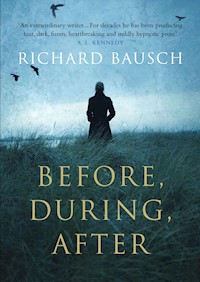
Before, During, After
Richard Bausch is the author of twelve novels and eight volumes of short stories. He is a recipient of many awards, including the PEN/Malamud Award, a Guggenheim Fellowship, the Lila Wallace–Reader’s Digest Writers’ Award, the Literature Award of the American Academy of Arts and Letters, the Dayton Literary Peace Prize, and, in 2013, the Rea Award for the Short Story. He is currently professor of English at Chapman University in Orange, California.
First published in the United States in 2014 by Alfred A. Knopf, a division of Random House LLC, New York, and in Canada by Random House of Canada Limited, Toronto, Penguin Random House companies.
First published in Great Britain in 2015 by Atlantic Books, an imprint of Atlantic Books Ltd.
Copyright © Richard Bausch, 2014
The moral right of Richard Bausch to be identified as the author of this work has been asserted by him in accordance with the Copyright, Designs and Patents Act of 1988.
All rights reserved. No part of this publication may be reproduced, stored in a retrieval system, or transmitted in any form or by any means, electronic, mechanical, photocopying, recording, or otherwise, without the prior permission of both the copyright owner and the above publisher of this book.
This novel is entirely a work of fiction. The names, characters and incidents portrayed in it are the work of the author’s imagination and not to be construed as real. Any resemblance to actual persons, living or dead, events or localities, is entirely coincidental.
10 9 8 7 6 5 4 3 2 1
A CIP catalogue record for this book is available from the British Library.
Trade Paperback ISBN: 978 1 78239 395 5
E-book ISBN: 978 1 78239 396 2
Printed in Great Britain
Atlantic Books
An Imprint of Atlantic Books Ltd
Ormond House
26–27 Boswell Street
London
WC1N 3JZ
www.atlantic-books.co.uk
This book is for Lisa and Lila
. . . do not understand me too quickly.
—ANDRÉ GIDE
Contents
Before
Ms. Barrett and Father Faulk
Love Life
Fire
During
Islands
After
Natasha and Michael
These Two
Do You Take This Woman
Mr. and Mrs. Faulk
Do You Take This Man
Acknowledgments
Before
Ms. Barrett and Father Faulk
1
Not to be lonely, not to look back with regret, not to miss anything, always to be awake and aware. And to paint. Beautifully.
Natasha Barrett had written this in her journal when she was seventeen.
Favorite watercolorists: Sargent and Gramatky. Favorite sculptors: Bernini, Donatello. Favorite book: The Age of Innocence by Edith Wharton. Favorite music: rock, particularly Men at Work, the Police, Dylan; and also for music: jazz, especially Chet Baker and Billie Holiday. Biggest fear: rejection. Biggest ambition: to travel and to know the world by heart.
Seventeen. And she had come upon it this past winter, years away. You could be a little proud, looking back. You could even find some comfort in the recollection.
In early April of the year she was to turn thirty-two, what she thought of as the chastened later version of that young woman attended a fund-raising dinner hosted by her employer, Senator Tom Norland of Mississippi, at his mansion in Arlington. The mansion was on a high bluff overlooking the Potomac River, and from the road it was just visible at its roofline after you crossed into Virginia—an immense redbrick Colonial. She had visited several times before, and there was always something warm and welcoming about it in spite of its imposing size. Behind the house was a flagstone patio, and walking paths wound through the tall oaks that stood at the edge of the bluff above the river. Along the paths, iron benches were placed decorously amid flower beds and statuary. People would gather in this wide shady space when the senator was entertaining guests.
This evening she arrived late and was greeted by Norland’s tall pretty wife, Greta. “Come right in, darling.” Greta smiled her white smile and then frowned. “Are you all right? You look a bit downhearted.”
“Oh, no, I’m fine,” Natasha said. “Just tired.”
“Well, good to see you, honey. Go right through.”
The younger woman reflected that there were people for whom cheerfulness was a trait, something they were blessed with like good bone structure and silky blond hair. She went along the polished hardwood floor of the hall and stepped out onto the patio. Cocktails and wine were being served to the left of the entrance, a young dark man standing behind a table there. Natasha asked for red wine, and his gaze went over her. She could have imagined this.
Moving away from the crowd and out onto the lawn, she walked among the statues—small, delicate-looking angelic figures in supplicating poses. Please, they all seemed to be saying.
The winter had been long, colored by the aftermath of the end of an affair. She was in no mood for a party and had wanted very badly to find an excuse not to come. But it was Friday, still part of the workweek, and her presence was required: the gathering was for the benefit of the Human Relations Conference, one of the senator’s pet projects. She was his chief organizer.
Wandering back to the patio, she stood sipping her glass of wine, surrounded by people whose evident curiosity about the senator’s “assistant”—two people actually referred to her that way—made her irritable and cross. She wasn’t there five minutes before she found herself desiring with adolescent fervor to disappear into the rooms of the house. She kept forcing a smile, listening politely to what was said to her. The guests, many of them local celebrities, were talking about the upcoming conference and about politics—the new president’s withdrawal from the Kyoto Protocol on global warming. It was a signal, someone said, about where things were headed with the Republicans back in power. Others speculated about all that. Someone else remarked on the perfect weather, trying to change the subject. To Natasha it all began to seem depressingly automatic, like the chatter of birds on a shoreline. Species noise.
The weather was indeed fine: clear and cool, breezes stirring like whispered secrets in the leaves of the oaks bordering the property, the new leaves gold daubed with sun, nearly translucent. The gravel and flagstone walks skirting the edge of the bluff afforded a lovely view of the dark green river far below, with its ranks of sculling boats from Georgetown. The air was flower scented.
Norland approached through the confusion of others, grasping the upper arm of a man who seemed reluctant to be handled in that way. She saw that the man wore a clerical collar. “Natasha,” Norland said. “You grew up in Memphis.”
The senator had a gift for tautology.
She nodded and smiled at him.
“I’d like you to meet Father Michael Faulk, pastor of Grace Episcopal Church in Memphis, Tennessee.”
Father Faulk was tall, solid looking, bulky through the shoulders. She saw his dark brown eyes and, when they shook hands, felt the roughness of his palm.
“Actually, I grew up in Collierville,” she said to him.
“Collierville. I don’t get out that way much.”
“In Memphis people decide not to go somewhere if it’s more than five minutes away. I had Memphis friends who would talk about Collierville as if it was Knoxville, four hundred miles down the road instead of fifteen.”
“You say you had Memphis friends.” His black hair was receding. He looked to be in his late forties or early fifties.
She said, “Former friends, yes.”
“I won’t ask.”
“They all moved to other cities?” she said in the tone of someone speculating.
“I’m still not asking.”
They talked a little about Graceland and other attractions. It was the usual informal kindness of social occasions. She did not feel up to it.
“I’ve never really thought about the distance to Collierville,” he went on. “Is it fifteen miles?”
“Fifteen miles from Beale Street to where I lived growing up.” She turned to acknowledge the greeting of a coworker, Janice Layne, who was the senator’s press secretary. Father Faulk moved off, having been pulled in another direction by one of the donors to the event—and perhaps having sensed her reluctance to chat. Janice frowned slightly. “Mmm. Who’s the one in the pretty collar?” That was Janice, boy crazy by her own account, and probably, secretly, nothing of the kind. Natasha had an indulgent sense of knowing affection for her.
“I’ve just been introduced. You don’t know him?”
“He does look a little familiar. And he’s hot. And Episcopal. I already got that much. And so if he’s single, he’s fair game. I’ll find out for us.”
“Go, girl,” Natasha said automatically. She was already beginning to forget him.
But they got seated next to each other at the dinner, and he turned a charmingly sidelong smile her way, talking about how he could never get used to the grandeur of places such as this—with its atrium and its wide entrances and the original Rembrandt on the wall in the next room. He had been raised in Biloxi, in a decidedly middle-class environment, though his mother, just after he turned seventeen, was the recipient of a large inheritance from a great-uncle who had made a lot of money building houses. “Most of my boyhood,” he said, “was spent so far from this. Anyway, I don’t think I’ll ever get used to it.”
The humor in his face and the rich timbre of his voice brought her out of herself. He asked, through the smile, if she liked Washington. “I do,” she told him. “Mostly.”
“Exactly how I feel about Memphis.”
“How long have you been there?”
“A long time, now. I went north out of high school. College in Boston—not Harvard.” The smile widened. “Went to seminary in Saint Louis, and then down to Memphis.”
“Your family still in Biloxi?”
“My mother died three years ago,” he said. “My father lives in Little Rock. I have an aunt here in Washington.”
She leaned toward him and murmured, “The, um, senator’s press secretary wants to know if you’re married.”
He looked down the table toward Senator Norland and Janice Layne. “You mean Ms. Layne.”
“The very lady.”
He grinned. “Divorced.”
“I’m sorry. But she’ll be glad to hear it.”
“Not interested.”
This occasioned a pause, and they watched the others talking and sipping their wine. She thought she might have stepped over some line. He was gazing at the room, evidently far away now, hands folded at his chin.
She said, “Did you like Biloxi?”
And he seemed to come to himself. “I did. Very much. Yes.”
Another pause.
“How about you?” he asked. “Does the senator’s press secretary want to know if you’re married?”
“Janice was just curious,” Natasha told him.
“I was joking.”
“She was, too—a little.”
He grinned. “Actually, my former wife is getting remarried. It’s happening in the next couple of days.”
“How’s that make you feel?”
“It’s—as we say—in everyone’s best interest.”
Natasha nodded, unexpectedly on edge now. She thought of excusing herself. But there wasn’t anywhere to go in this place without being seen leaving. She watched the senator talking to a big florid man about Virginia horse country and drank down her wine. It left an almost-syrupy aftertaste.
“I never feel comfortable at this kind of gathering.” Father Faulk spoke softly, only to her.
“I can’t help seeing it all as a series of gestures,” she said. “Makes me feel judgmental.”
“Not us. We’re too cool.”
It was pleasurable to be included in that way, even jokingly.
“Want to talk about Collierville?” he asked.
“Sure.”
He waited.
“Do you like bluegrass?”
“Don’t know much about it, but I like it.”
She described summer evenings when people would gather in the charming old town center to play music.
“I have seen that,” he said. “Wonderful. I like the antiques shops, too, and the old train station museum. I should go out there more often.”
“I guess it’s different if a person lives there.”
“You couldn’t wait to get away.”
“No,” she said. “Not really. It was just—you know—it was home.”
He had an appealing weathered look. Realizing her own growing interest in him, she experienced a surprising stir of anticipation. It had been months since she had felt much of anything but weariness. She sipped the ice water before her, and her hand shook a little when she set the glass down. She wanted more wine. He was talking across the table about the Rembrandt to a narrow-faced middle-aged woman who had spectacles hanging from a little chain around her neck. “I joked about all the cracks in the original painting,” he told her, “you know, going on about them to this fellow who—doesn’t seem to be here now. Hope I didn’t frighten him away. I told him that I have one just like it that has no cracks at all in it and that I bought it at Walgreens for less than five dollars. He was not amused. I’m pretty sure he thought I was serious.”
The woman across the table was not amused, either.
“Forgive me,” Natasha said to her. “I didn’t get your name.”
“I’m Mrs. Grozier. My husband is on the board.”
“Oh, yes, Mrs. Grozier. I’ve worked with your husband.”
Mrs. Grozier nodded civilly and then turned her attention to the other end of the table.
Father Faulk turned to Natasha and said, low, “I keep thinking it was funny about the Rembrandt.”
She smiled. It was as though the two of them were in cahoots, looking at all the others. She felt herself calming down. She saw warmth in his eyes, a sort of reassurance radiating from them.
“What about you,” he said. “You still have family in Memphis?”
“My grandmother. She’s responsible for my having this job. She worked in the mayor’s office in Memphis for years, and she knew a lady who came here to work for the senator.”
“Is the lady still working for him?”
“Retired a couple of years ago and moved to California. Somewhere near L.A. I didn’t know her very well.”
“And your grandmother? Do you still go to Collierville to visit her?”
“We moved into the city the year before I left home. A little house in the High Point district. I visit her there, of course.”
“I know a woman in High Point who used to work in the mayor’s office. Iris Mara.”
This gave her a pleasing little jolt. “That’s my grandmother.”
“I worked with her on a project to make books available to schoolkids in some of the poorer neighborhoods. Iris Mara from the mayor’s office. Retired. Right?”
“Yes. All that—but she never mentioned a project.”
“She comes to my church now,” the priest said.
“Church?” Natasha said. “Iris?”
Grinning, he said, “Hmm.” Then: “Yes. The very lady.”
“We talked on the phone two days ago. We talk a couple of times a week. She’s never said anything about going to church.”
He was silent.
“Well. I’ve been away so much since I left for college.”
At the head of the table, the senator stood and clinked the end of a fork against his wineglass until the room grew silent. He thanked everyone for attending and introduced some of the principal organizers of the event. He congratulated Natasha for her work on the project. Then he sat down, acknowledging the polite round of applause.
Faulk turned to her and said, “I didn’t know you were so important.”
“Hmm,” she said. “Sarcasm in a priest.”
His face betrayed no sign of amusement. “I wasn’t being sarcastic. Honestly.”
After a pause, he said, “So Iris didn’t mention going to church.” And they both laughed. There was something so incongruously familiar about the remark. His soft baritone voice when he laughed rose wonderfully to another register.
He held up his water glass and offered it, as for a toast. She lifted hers, and they touched them and drank.
“I’m probably slandering her by my reaction,” Natasha said. “But she’s always been so secular.”
“She’s been coming for several months now.”
“You notice when someone starts coming to your church?”
He gave forth another little laugh. “In her case, yes. She came to see me first.”
“It’s so strange—Iris going to church. She never went to any church. We never went to any church. As far as I know, my parents never did either.”
“You say as far as you know.”
“They died when I was three. I never knew them.”
“Oh, Lord—forgive me,” he said. “Of course. I should’ve remembered—I knew that Iris lost her daughter and son-in-law.”
“And Iris just goes on through the days being Iris.”
“She’s a brave lady.”
“I can’t wait to talk to her about you,” Natasha said. “And church. I’ll spring it on her. Be fun to hear her reaction.”
“Please don’t tell her I’m as stupid as I must have seemed just now.”
“Don’t be silly.”
The man on his left began talking to him loudly about the unseasonably hot weather in the south. And then the waiters were circling the table, pouring wine in everyone’s glass. Each held a bottle of white and a bottle of red.
Father Faulk asked for water. Natasha held her glass out and indicated that she wanted the red.
“When do you go back to Memphis?” she asked him.
“Probably tomorrow. I’ve been visiting my aunt Clara. She’s the senator’s mother-in-law.”
“Then maybe you’ll see Iris before I do,” Natasha said.
“Oh, well, in that case, I’ll remember you to her.”
The food was arriving. She felt a pull of nausea at the pit of her stomach. For months she had been miserable; and here, completely unforeseen, was something like light pouring in. And he would be gone tomorrow, and she would never see him again. She drank half her glass of wine, nearly gulping it. He was listening to the man go on about humidity. The man owned a bookshop in Leesburg, and business was slow. Finally he grew quiet; Faulk turned to her and asked how she liked the wine.
She held up the nearly empty glass. “Evidently too much.”
She was not thinking of him in a boy-girl way but simply as a possible friend. And she did not want him to go back to Tennessee. “You should have a glass,” she said.
“I think I will at that.” He signaled one of the servers.
“Is your aunt Clara here?”
“She was supposed to be—she knows this crowd pretty well, of course. But she developed a migraine this afternoon. She doesn’t get them often, but when she does they’re fairly incapacitating.”
The waiters were bringing the food. Two choices: a vegetable medley, with butternut squash and kale, or medallions of beef, with arugula salad, red potatoes soaked in olive oil and sprinkled with candied garlic. She asked for the beef, and he followed suit. Her glass had been refilled. He had a little wine, too, now.
“This is very jammy,” he said, with a slight smile.
She said, “Maybe too much so.”
2
Her parents were lost in the Meteor cruise ship fire near Vancouver in 1971, their remains sepulchered somewhere in the waters off that coast. The recitation of this history never failed to make her wish herself far away, and her grandmother still occasionally mentioned it as a reason that Natasha possessed such an old soul.
Natasha, in her early twenties, took to thinking of her own beginnings ironically. After all, it was just who she was. There seemed something faintly snobbish or even smug reporting the calamity to people like some sort of pedigree. But the accident was the dividing line of Iris’s life, so the fact of it would be mentioned in talk with new acquaintances, and often enough this would lead to Iris using the phrase “old soul,” meaning it in the best way, about her granddaughter. At times she would elaborate a little more, pointing to the watercolors Natasha did—depictions of faces from piles of photographs found in bins at antiques stores, families long gone, staring out in the light of those rainy-looking scenes.
Natasha felt like an old soul, all right, but not in the way Iris meant it. Through the past winter all the shifts of her mind and heart seemed frail and elderly to her, and she endured the purgatorial hours of each day, walking around in a haze of penitential worry about minutia, experiencing an immense lethargy and a recurring fearfulness. Fear of others, the sounds outside her apartment at night, the shadows in the cold streets when she walked home, all the possible harms of the world, and, most terrible, the fear that this darkness might last all her life. Night panics, dread wakefulness, fierce dreams when she could manage any sleep. During the days, nothing had any taste. Everything seemed dismally the same, the same. Her own thoughts oppressed her. The voices of others were demoralizing and dull. Friendships lapsed. The young women she had studied with in France and the group of friends and acquaintances she had made in Washington drifted to their own concerns, stopped calling or writing, acceding one by one to the silence. All but two: Marsha Trunan, a Paris friend with whom she had traveled in Italy and who was also from Memphis, and Constance Waverly, who lived in Maine now and was twenty years older than Natasha and sometimes treated her like a daughter. Marsha continued to call and leave messages, apparently having decided to ignore the difference between Natasha before and Natasha now. Marsha wanted to know what was wrong. Natasha kept insisting that nothing was wrong. She was overwhelmed with work. Just awfully busy. And this was partly true when you added to the daily responsibilities in the senator’s office the necessity of keeping up appearances.
Perhaps the thing that tormented her most was the banality of it all: a squalid little cliché of betrayal and being the other woman. Surely regret was supposed to be reserved for mistakes on some grander scale than this—yet regret was what she felt, so deep that it sat under her heart, a physical ache.
She had thought he was the love of her life.
His name was Larry Mackenzie, a photographer she met through her job arranging appointments with journalists and news services for the senator.
She had spent almost a year sneaking in and out of hotels with him, and taking trips to other cities for false reasons, lying to everyone, including herself, holding on to the hope that he would leave his wife for her, end an unhappy marriage, a loveless disaster. He had described the misery in his house: a wife sinking into fanatical pursuit of the supernatural, believing in her ability to read minds and predict the future. Natasha had felt sorrow for his pain, mingled with desire that he stop talking about it and do what he kept saying he would do: find a way to make the civil arrangements. No one had to remain in a marriage he no longer wanted.
The day after Thanksgiving, she got a phone call from the wife.
Mrs. Mackenzie was confident and strong and spoke from a great height of scorn and moral superiority. She had confronted her delinquent husband with what she had known “for some time,” and he’d told her the whole story, had answered all her questions, being courageously forthright, explaining everything to her satisfaction. “I’ve already forgiven him,” she said. “As my faith dictates I should.”
What Mackenzie had done, it turned out, was convince the poor woman that Natasha was the instigator of the affair and was now stalking him.
Ugliness all around.
Natasha confided this to Constance Waverly, and Constance responded in a tone that expressed how sordid she thought it was.
Well, Constance was right—no use denying the fact.
There had followed a series of blurry evenings, of being out by herself in Adams Morgan and Georgetown—boozy hours and instances of dalliance with unknown men. She had stopped painting altogether, and she began to drink alone, in the predawn, in her apartment, often going to sleep drunk, half clothed, on top of the blankets of her bed. This desperation had slowly turned into the interior gloom and ache that had brought her to a doctor and a prescription for bupropion.
She confided in no one else. When she spoke to Iris on the telephone, it was their usual pleasant back and forth. When Iris asked about her plan of saving money to go back to France and spend a year putting together enough work for a show, she pretended that things were still on track. Senator Norland, who kept a proprietary interest in her and saw her nearly every day, was nevertheless too absorbed to notice that anything was wrong, and somehow she continued to keep up with her work. She had in fact gotten better at it, had buried herself in it.
But the days were long, and filled with dejection.
Now, in the soft evening in the senator’s house in Virginia, she was surprised by her own lifted spirits. She finished the medallions of beef, sipped the last of the wine in her glass, and went with Father Faulk to look at the new flowers clinging to the trestle bordering the patio. Blessedly, she felt no pressure to speak. The two of them were quiet. They strolled contentedly together along the gravel path above the river.
3
Father Faulk had seen an intimation of gloom in the young woman’s eyes—not quite definable, yet there, like a shadow on water. Well, she was lovely, bracing up against something, and evidently not particularly eager to be introduced. Senator Norland, with characteristic, ham-handed, well-intentioned gregariousness, had barged through the moment like someone hoping to get them together as a couple. It was nothing of the kind, of course: Norland had merely realized the Memphis connection and, as was his nature, acted upon it, wanting everybody to be comfortable. Anyway, Faulk was grateful for having been pulled away in the middle of small talk. It was clear that this young, darkly beautiful woman had scarcely noticed him.
He was struggling with his own shadows.
The fact that his former wife, Joan, was getting remarried and was also expecting hurt him in a surprising, steady, aching way. He could not plumb the reason for it. The marriage ended three years ago. Joan had wanted a child and they had not conceived, but this was secondary: what bothered her most was what she called his moodiness; she believed that he had no sense of joy. Whereas she saw joy as an emotional goal and resting place, he had always looked upon it as something lovely that nevertheless contained awareness of the possible darkness all around—the rush of delight gazing at a sleeping baby, for instance, while also noting the little blue veins in the cheek, those minute tokens of mortality.
Moreover, the progress of her leaving had to do with her admission to herself that she found little rest in the daily rounds of work, of supporting the life, his ministry. Eleven years of the troubles of others, including his own peculiar form of darkness. She said everything drained her, his needs, his inability or refusal to see her, her, as someone separate from him. “First thing in the morning the calls and the needs and your needs and the work and more calls and I just can’t breathe. It’s driving me crazy.” The accusation surprised and weakened him. He did not know how to change things. It was like trying to change one’s skin and bones. And so she went to visit her mother, who lived in an old house in Portland. It was supposed to be a break, time and space to gather herself. But then the stay lengthened, and when she finally came home, it was to pack and leave for good.
In the end it wasn’t quite clear how much of her discontent came from his work and how much of it came from himself. She wanted to leave. She claimed she felt no anger. And since, now, he was indeed considering leaving the priesthood, he had come to imagine that her restlessness and her wish to depart were early reflections of his own trajectory.
In his vocation, he had lost something unnameable but necessary.
This came to him one afternoon not long after she left. He was visiting a man in the hospital who had fallen in his own kitchen and hit his head. Sitting at the foot of the man’s bed watching him go in and out of sleep, he had the unpleasant thought that this visit was his job. Across from where he sat with his half-conscious parishioner was a woman with a man whose demeanor showed that he hadn’t gone mentally past the age of three. Father Faulk saw the shape of her face in shadow, the devotion in her light blue eyes, her loveliness as a woman. He looked back to the sleeping patient, but the image of this woman played across the surface of his thoughts. He would speak to her, get to know her, offering solace, at which of course he was practiced enough. She turned into the light from the window, and the light showed the lines of her face. For some reason he hadn’t seen those lines before. She held the man’s hand—this man, her son, with some injury to his leg, and all the cost of her reality was in her features. Suddenly Father Faulk knew he had nothing to tell her that she would want to hear, and he experienced the strongest sense of having awakened from some dream of life.
For a time he resisted negative considerations like these. He put them away like temptations—that was what he thought they were—and went on. And on. There wasn’t anything else for it. You did your job and you accepted the bouts of despair as part of the normal run of experience in the life of a priest. Since the divorce he had settled into a zone of gray calm, performing the tasks of his calling—an efficient, uninspired servant of his vocation. Now and then he saw one woman or another and felt lonely even when he was with them. He was no longer fit for the work. Or so he expressed it recently to a friend, Father Andrew Clenon, the warden of the vestry for his parish. Father Clenon wasn’t yet aware that Faulk wanted to leave. The talk had been confined to the dissatisfactions of the life. Clenon thought the trouble was spiritual dryness and told him to pray about it and went on to speak about the perils to the spirit when one was suffering through some change, as Father Faulk was with the news of Joan’s pregnancy.
“It’s been three years, Andrew.”
“You’re going to sit there and tell me that her getting remarried—the baby—none of that’s bothering you at all?”
“I don’t think it has anything to do with Joan. Except that I think maybe she knew I wasn’t up to it before I admitted it to myself.”
“You’ve dealt with it, though. Haven’t you. You’re a fine priest.”
“I’m telling you it has nothing to do with Joan.”
But of course it did have to do with Joan. And it had also to do with that life he once thought he was building, the changed life he was leading now, a chain of barren habit and avoidance and all the complications of being only marginally present in situations that deserved more from him. Through the winter, he had been carrying around the conviction that he must leave, must break free. The journey to Washington and a visit with what was left of his family, the senator’s mother-in-law, had been something Father Clenon suggested.
It hadn’t helped, hadn’t changed anything. In fact it had strengthened the feeling that his priesthood was a failure.
But strolling along the gravel path above the river on that spring evening with Iris Mara’s granddaughter, Natasha, he saw the unselfconscious pleasure she took in the new flowers, tulips and daffodils and wisteria, and he sought to break out of his own self-absorption. The flowers were indeed lovely and sweet scented, and when she looked at him, her dark sad eyes took him in, and for the first time he thought of leaving the clergy not as a capitulation but as a chance at some kind of happiness.
He did not return to Tennessee the next morning. He got his aunt Clara to ask for Natasha’s number from the senator and called her to ask if she would accompany him for a stroll along the Tidal Basin, to the Jefferson Memorial.
4
She was curious, exhilarated, and even so she declined.
“Come on,” he said. “It’s just coffee and a stroll on a fine Saturday morning. What’s preventing you from that? I’m just going to call you tomorrow and ask you the same thing.”
“I thought you were going home.”
“I’m staying on for another week. Come on. A little walk.”
They met at a coffee bar on Wisconsin Avenue. He wore a white shirt rolled above the elbows and tan slacks, and she thought the civilian clothes made him look younger. She wondered if you called them civilian clothes and almost asked him, holding herself in check and smiling under her hands as they walked into the little café. They each had an Americano and pastry. His talk was gratifyingly fanciful. He wondered where she would live if she had unlimited funds, and what climate would be best for her, what countries—advantages and shortcomings of the several candidates for home, as he called it.
“France,” she said. “I’ve been trying to save money to go there for a year and live.”
They talked about Iris a little. He paid for the coffee, and they took their walk. An image came to her mind of clouds lifting. She paused to appreciate the quality of light through the cherry trees. He bent down to pick up a blossom and then tossed it.
“You didn’t name any of the states as a possible place to live,” she said.
His smile was slightly sardonic. “Somewhere far away. California? Alaska? Hawaii?”
“Not Alaska.”
“Too cold,” he said. “Right? I wasn’t serious.”
“My mother was a bit, well, crazy. I mean that’s the only way to describe it. She had an idea that my father and she should find some way for us to live in Alaska. Anchorage. Think of it.”
“A lot of nice happy people live there,” he said.
“I wonder if she would’ve been happy. I don’t know that I would’ve.”
They went on a little.
“So she got my father to get a job on this Norwegian cruise ship to Alaska. My father was a trained chef. They were going to make the money to move. But there was an explosion, and the ship caught fire, and they jumped into the ocean. Several people did that to get away from the flames.”
“Iris didn’t tell me any of this, of course.”
“She didn’t tell me the real specifics of it until I was out of her house a couple of years. All I knew was that they were gone, lost at sea off Vancouver. I never knew them. Iris is—well. I used to wonder sometimes what she was thinking. And she never complains. It could be pretty quiet in the house, and anybody might think we were angry, or sad, but it was both of us sitting within four feet of each other reading. Perfectly glad of the quiet. I used to imagine her raising my mother alone. What that was like. And I guess it must’ve been like it was with me.”
“And your mother wanted to live in Alaska.”
“She actually wanted the cold. Loved snow, Iris says. I don’t think much of her survives in me.”
“Do you think Iris would say that?”
“Probably not.”
Presently, she said, “But really, I’d like to go back to France. The southern coast. I went to school there. Let’s say I like to imagine living in France and—painting.”
“Making enough money to live on it?”
“Sure, why not?” She smiled.
“You paint every day?”
“I don’t paint at all just now. But I have done some watercolors. But this was about fantasy, right?”
“Did you study painting?”
“Studied art.”
“What would you say is your best trait?”
She had the feeling that he was talking now just to talk. “Doing the watercolors.”
“That’s your best trait?”
She decided to change the subject. “Is Clara your mother’s sister or your father’s?”
“My mother’s half sister.”
They were quiet for a few paces. The Tidal Basin was awash in blue shade with patches of sun, and on the fresh-cut grass shirtless young men threw a Frisbee back and forth. Only yesterday she would have seen them as cruelly separate from her, spending a carefree morning.
The day was growing lovelier by the minute. The white linen slacks she wore were comfortable and cool. She had tied her hair back in a chignon, and the breezes pleasantly brushed her neck. Butterflies flew around her.
“I think they’re drawn to your pink top,” he said.
At the water’s edge they stood, watching the ducks glide by and several geese that kept honking. He reached over and, in a way that seemed natural and uninvasive—like the gesture of an older sibling—undid her hair. “I didn’t know I was going to do that,” he said. “I was appreciating the shine of it in this light, and I wanted to see more of it. Sorry. I don’t usually do that kind of thing.”
“It’s fine.” She was a little surprised at how much his worry about it pleased her.
They walked along the bank of the river. Sailboats glided past out in the brightness, and one motorboat sped by heading the opposite way, creating a white wake that churned at the banks. He placed his hand gently at the small of her back as they moved to the lane, into the cooler shade. A woman came by, pulled along by two large black dogs whose panting and striving—long nails clicking on the pavement—were the only sounds in the stillness. At a stone bench near the memorial, with its classic circle of columns and the tall shadow of the statue inside, they sat together and talked idly about the dinner party the evening before and about Senator Norland.
“Ten years dry now,” he said about the senator’s famous alcohol troubles. “But when they handed the presidency to Bush, that was tough for him.”
“We’re not allowed to mention that.”
“I remember John Mitchell saying the country was going to go so far right it would hardly be recognizable. And here we are, not even three months out of the Clinton administration, and Mitchell, that crusty old bastard, looks like a prophet. It’s so strange that the very people who are hurt most by them are their most vociferous supporters. An unforeseen flaw. The Founding Fathers couldn’t have imagined television. What to do about a duped population.”
“Do you talk about any of this from the pulpit?”
“Actually, I’m leaving the, um, pulpit.”
She turned and waited for him to explain. But he sat back and sighed.
“You can’t just say that and leave it there.”
“Well, I’m not a very good priest. I feel like I’m lying.”
“You no longer believe in God.”
“No, I do. Very much. You don’t have to leave the religion, you know, if you renounce your vocation.”
They walked over to the memorial. Staring at the sculpted face, he murmured, as if out of respect for it, “This is one of my favorite places in the city. He’s actually an ancestor on my mother’s side, I’m told.”
“Tell me about your aunt Clara.”
Thinking about the woman gave him obvious pleasure. “She’s lived here all her life. My mother’s younger sister by twelve years. Got a big old pretty house in Cleveland Park, and it’s constantly filled with people. She’s not slightly involved in politics, either.”
“And you?”
“I’m fairly insulated in Memphis. My coming into town to see her and her husband is usually as close as I get.”
“I’ve lived here for years,” said Natasha, “and I’ve never come to this memorial. A lot of this town I’ve never seen. And these are places people travel thousands of miles to see.”
“What did you paint when you did the watercolors?”
“Not this.”
He was still gazing at Jefferson. “There’s a lot of places here I’ve never been in, too.”
“How old are you?” she asked.
“I won’t make you guess. I’ll be forty-eight in June. And you?”
“Thirty-two in July.”
They went back toward the Ellipse and on to the Lincoln Memorial. School buses were lined up, emptying out, children gathering to go in. The air was full of diesel exhaust.
“Tell me the happiest you’ve been,” he said.
She didn’t have to think. “When I was in France. Aix-en-Provence. One day I was standing in a little café waiting to order a baguette. I’d come on my bicycle down a long mountain road overlooking the Mediterranean, and it was cool and sunny and I realized I’d never felt so much at home, and I was happy. Really happy. And I’d been happy for weeks.”
“Ever been back?”
“Not to live. Had a few days there a couple of times, taking pictures.”
“Not painting them.”
“Working for a travel magazine. And now how about you? What’s the happiest you’ve been?”
“Actually, I’m pretty happy right now.”
“Not fair. Come on.”
“I don’t know. Maybe I’ve never been really happy. Maybe that’s why I asked the question. I’m still trying to figure out if it’s possible.”
“You’re a little old for that kind of questioning, don’t you think?”
“I know.” He laughed. “Even at my age, I’m incomplete.”
5
They spent the rest of the day together, looking at the famous sights of the city that neither of them had ever gotten around to—the Washington Monument, the National Archives, and some of the Smithsonian. It was a lark, a sweet game. For her it seemed a charm against having to part ways. In the evening they had dinner at a small French place she knew in Georgetown. The day’s experience had made clear to her—it was a disconcerting little revelation—how rarely she had been herself with any of the men she had known. It was as if she’d always had to labor through some unspoken contest of wit. The insight made her hesitate. Perhaps it was the age difference. She got quiet while they ate and thought about finding an excuse to go on her way. Suddenly the whole gloomy history of the past two years blew through her. She sat straighter, attempting to fight it off. She had taken to calling this feeling the white sustenance, except that now she felt anxiety, too. She took a long sip of her wine and finished it, keeping her eyes on him.
He ordered two more glasses, then said, “Be right back.” He rose and went toward the restrooms. The server, a long-faced, grouchy-seeming old man, set the glasses of wine down, and she took a small drink from hers and breathed deeply, wanting to calm down. It had been such a good day. She possessed the necessary detachment to admit that her emotions about it might be sentimental, that she could be producing them in some way, a self-deception born out of where she had been and what she had been through. She looked across the room at the bar, where a man and woman sat close, murmuring.
People got along in the world. People provided comfort for one another.
She took the rest of the wine and signaled the server for another. He brought the bottle over and poured more for her, without saying a word. She saw the wrinkles across the back of his neck as he moved away. Faulk came back to the table and sat down. He was an interesting man, and she could just enjoy him. He was not that much older: sixteen years. But they could simply be friends. She could leave it there.
He sipped his wine and looked at her, and she looked away.
“Something hurt you a minute ago. Did I say something wrong?”
She touched the back of his hand. “No.”
“This is fun,” he said.
She found herself talking more about Iris, how it had been growing up orphaned in that old house. “Of course I never thought about it then, but I was being raised by a woman who had lost everything except me. Her husband had gone off, and she never heard another thing from him or about him until news came from a cousin that he’d passed away on a street in San Antonio. I still don’t know what made him leave, except that she was pregnant with my mother. But, you know, I don’t feel deprived. Life was—well, itself. And then I went off to France. And of course we don’t—she doesn’t live in Collierville anymore. Not since my last year of high school. But I always had a sense of this—this sad past I couldn’t know about, and Iris has a thing about time. There’s a pillow she embroidered that she keeps on the piano bench. It says, The dark backward and abysm of time. I don’t have any idea where it comes from.”
“ ‘The dark backward and abysm of time.’ ”
“I was fourteen when she did it.”
“Strange thing to embroider on a pillow.”
“So tell me about you,” Natasha said. “Your parents.”
“My father’s Leander. Lee. From Gulfport, Mississippi. He used to practice what he calls small-town law. His joke is that all he’s ever missed in life is the n-e-r at the end of his name. Then we’d be Faulkners. We have what you might call a complex relationship, since he thinks the religion, um, makes me a fool. He and my mother argued about it and about me all the time, and finally they broke apart when I was in divinity school. Basically she believed and he didn’t. And in his mind she coddled me. And I guess she did. In his mind, anyway, that explains my being a priest. Her obsessive piety.”
Natasha took a little more of the wine. “Still?”
“I guess. He’s retired and he has a new wife I haven’t seen.”
“He doesn’t visit you in Memphis.”
Faulk shrugged. “Something about his peripheral vision makes it so he can’t drive anymore, but he talks of getting the new wife to drive him over one day. They were married this past fall, and of course he was glad to have me know it was a civil ceremony. Her name’s Trixie. I’ve talked to her on the phone. Soft, sweet voice. And I’ve seen her picture with him on the Christmas card.” Sitting back, folding his arms across his chest, he sighed. “I’d like one more glass of wine, I think.”
“Yes,” she said. “Let’s.”
As he signaled the server, he said, “By the terms of my mother’s last will and testament, I have a trust fund, really enough to live on if I don’t go crazy with it. So if I leave the priesthood I won’t—”
The server came and poured, still without saying anything, and they sipped the wine.
A little while later she said, “I think I’m getting blotto.”
So they ordered coffee and stayed until all the other patrons were gone from the place—the old grouchy server and the bartender talking quietly at the bar.
She was telling him about being eighteen years old and arriving in France with only the vaguest ideas of what she might do with her life. The world was wide and welcoming. As she talked she was suddenly aware of the coarseness of her hands, the bitten fingernails. She folded them under her chin and looked out at the street. Then, slowly, with a small soundless breath, set them down on the table between them, fingers spread, in plain sight. “Anyway, it was a good time. I felt like I’d found the place on earth where I belonged. I took a job as an au pair for a Dutch liquor wholesaler and his wife and two children after I graduated, because I didn’t want to come back to the States. I met my friend Constance Waverly working for them. My rich lady friend. She’s older. So you see, I have experience, I guess because of Iris, really, being friends with—” She stopped.
“You were going to say ‘with people who are so much older’?”
“With people who are a good deal older, sure.”
“That’s—reassuring.”
She sipped her coffee and sought something else to talk about.
“And how old is Constance?”
“Fifties. I’m supposed to spend some time with her in Jamaica in September. A little vacation she’s offered me. All I have to do is pay my way down.”
“Ever been there?”
“No.”
“Nice place.” He stared. “I hear.”
“I’m sorry if I said something wrong,” she said. “I didn’t mean anything by it.”
“It’s all right, really.”
Deciding to pretend that she’d already forgotten about it, she said, “What’re people saying about you leaving the priesthood?”
“Well, you’re the first person I’ve told other than the warden of the vestry about my—difficulty. And he doesn’t really know I want to leave.”
She said nothing.
“I’ve been thinking about it for a while. But you’re the first one to know all of it.”
“Not Aunt Clara?”
“No—not yet. But I don’t think it’ll matter much to her.”
“Why me?”
Something changed in his eyes, a very slight narrowing; it could’ve been the light. “I don’t know,” he said.
He walked her to her car, and they exchanged a hug before she got in behind the wheel.
“Good night,” he said. Then: “Let’s go somewhere else tomorrow.”
“Call me,” she said.
He stood under the streetlamp and watched her go, and she saw him in the side-view mirror.
In her apartment she had a whiskey, trying to offset the coffee and the nervousness she felt. Marsha Trunan had called twice and left two messages. Natasha reflected that her last remaining friend in the city might soon go the way of the others. She made herself return the call.
“What,” Marsha said, her voice thick with sleep.
“I woke you. I’m sorry.”
“I knew it would be you. I wasn’t asleep.”
“You called me today?”
“Where are you?” Marsha wanted to know.
“Home.”
“Want a visitor?”
“Marsha, I’m really fried. It’s so late.”
“Busy, busy.”
Natasha said nothing.
“I’ve got tickets to something called Hamlet at the National Theatre way in June. Way, way off in June. And I hear it’s a pretty good play by this English dude named Shakespeare.”
Natasha sighed. “Sounds interesting.”
“But you can’t say that far ahead.”
“I’m sorry, Marsha. I’m just so—”
The other interrupted her. “Busy, right. I get it. I’ll stop calling.”
“Please don’t do that.”
“Well, anyway, I’ve got news,” Marsha went on. “Guess who’s divorcing his insane wife and marrying some Ph.D. sociology student at GW.”
Natasha waited. She could not remember when the other would have learned about it all, and then she felt she knew: Constance.
“You remember your photographer friend. Mackenzie.”
She expected to feel a sting, but it didn’t come. “Why would that mean anything to me?”
“Oh, come on. I know all about it. And I haven’t divulged it, either, like someone else we know. But a lot of people saw that you were pretty thick with him.”
“Well, anyway. Good for him. I’m sure it was love at first sighting.”
Marsha laughed, and coughed, and said through her sputtering that she was going to steal the line.
“You can have it,” Natasha told her.
“God! I miss you. You are amazing. If it was me, I’d be a hopeless mess. But you—”
“Marsha, he’s so gone from me.”
“You’re strong. I wish I was strong.”
“Tell me.”
“Oh, things’re cool with me, really. I wish I had your troubles sometimes.”
“I’m supposed to go to Jamaica with Constance in early September. Why don’t you come with us? We could split the cost of a room ourselves.”
“Constance wouldn’t speak to us for decades.”
Natasha heard her light a cigarette. “Listen, Marsha, I really should get to bed. I’ll call you tomorrow, I promise.”
“Bye,” Marsha said, and hung up. Something like a song note sounded in her voice: two syllables. “Bye-eye.”
Natasha listened to the dial tone for a few seconds, feeling the separation. She would call her back, say she loved her. She punched the number, then felt too tired for the talk that would follow. She pressed the disconnect and put the handset down.
Sitting at her small night table, she opened a book. Nearly midnight. She heard sirens out in the night, someone shouted in the street a block or two over. It was the sound of a Saturday night in this part of the city. Without even quite attending to it, she put the book down, undressed and got into bed, and lay there in the light from her reading lamp, gazing at the ceiling and going over the day, afraid to think forward.
So the photographer was breaking up his marriage after all.
Willing herself away from any thoughts of him, she conjured the picture of Michael Faulk as he appeared in her side-view mirror, standing under the streetlight. She went to sleep with this image in her mind like a ghost outline after looking into bright light.
Love Life
1
The weather had been breezy and a bit cooler than usual, and then it warmed up, and you knew real spring had arrived. She took the week off and saw him every day, making sure they went to places where it was unlikely they would encounter anyone from her office. He showed that he had divined this when they were on their way to dinner at his aunt Clara’s, explaining that long ago he’d extracted a promise from her not to talk about his comings and goings.
Her tall old house in Cleveland Park was reminiscent of the house in Collierville where Natasha had grown up, with its wide front porch and its Italianate windows. Going up the sidewalk in front felt like coming home. Here were the same worn steps, the same spindle-shaped wooden supports for the railing. Aunt Clara stood in the doorway with arms extended in greeting as they came up the walk. She was thin, sharp featured, with dark auburn hair and brilliant light blue eyes. Natasha thought briefly of the daughter, the senator’s wife, Greta. The eye color was the same, and you saw something very similar in the jawline.
“Can I call you Tasha?” Clara asked. “When I was a girl I had a friend Natasha and we all called her that. Do any of your friends call you Tasha?”
“Well, no—but I don’t mind at all. If you want to.”
“Sorry I’m so forward.”
“No,” Natasha hurried to say. “Really.”
Aunt Clara’s husband, Jack, was Italian, and he kept a wine cellar and was proud of it, happy to show it off. At dinner, he told about being a young man ignorant of anything but the taste of beer and pouring down the sink a gift bottle of Château Lafite Rothschild 1956 because it wasn’t sweet. “Well, I was only twenty-four. Grand cru, worth about two hundred seventy-five dollars back then. I lied to the nice guy who gave it to me in gratitude for helping him get his car out of a ditch. Said it was excellent, and of course he was stunned that I’d opened it.”
Aunt Clara said, “The deepest regret of the man’s life.”
“That makes him very lucky,” said Natasha.
After dinner, they all sat out on the porch, and Jack smoked a pipe. They remarked about the hot weather that would arrive soon, the town’s unbearable humidity. Clara said her daughter had recently decided to take up yoga in order to help her relax.
“She always seems so relaxed,” Natasha said.
Clara smiled. “She’s as nervous as the very idea of nervousness. And I think I did it to her, too. I was such an anxious mom. Saw threats everywhere. The poor thing was bearing up under a catastrophic imagination way before she became the senator’s wife, no kidding.”
“I think a person’s character is probably there at birth,” said Jack, blowing smoke.
Clara turned to Faulk and said, “Have you spoken with your father lately?”
“Not too long ago. Couple weeks.”
“I wonder how he’s doing.”
“He said something about stopping to see me on their way to visiting Trixie’s family in Tuscaloosa next month. I’m pretty sure it’s Trixie’s idea.”




