


Erhalten Sie Zugang zu diesem und mehr als 300000 Büchern ab EUR 5,99 monatlich.
- Herausgeber: The Lilliput Press
- Kategorie: Gesellschafts- und Liebesromane
- Sprache: Englisch
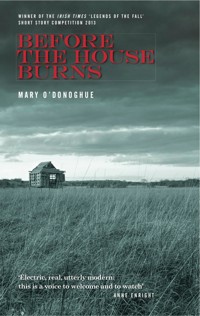
Set on Ireland's Atlantic coast, Before the House Burns is a tender, implosive first novel by an award-winning short story writer and poet. It concerns the lives of its three young narrators, children of a bereaved father and witnesses to a shared grief. This nuanced and heart-breaking account of one family's struggle – for work, shelter and happiness – enters the imagination through this braided, pitch-perfect tale of a family whose lives fracture around two tragic events. It is a story of what happens when self-sustenance turns to isolation, a story about the hard scrabble to find a home. Despite their sufferings, this is not yet another tale of an unhappy Irish childhood. What makes this novel unique is not only the calibre of the writing, but also its depiction of the love that binds the family together as they suffer blow after blow to their lives.
Sie lesen das E-Book in den Legimi-Apps auf:
Seitenzahl: 347
Veröffentlichungsjahr: 2010
Das E-Book (TTS) können Sie hören im Abo „Legimi Premium” in Legimi-Apps auf:
Ähnliche




















This book is formy parents and my sisters,nowhere in these pages,but whose goodnessI hope these pages honour.
BEFORE THE HOUSE BURNS
MARY O’ DONOGHUE
THE LILLIPUT PRESS DUBLIN
We used to call what ruined us the storm, Though that suggests we could have seen it break And barred the door.
—Clive James
It will be an island on strings
well out to sea and austere
bobbing as if at anchor.
—Maxine Kumin
His two-story house
he turned into a forest,
where both he and I are the hunters.
—Robert Bly
Contents
DedicationTitle PageEpigraphNewmarket-on-Fergus, 1998L. casei ImmunitasEffectsAdare, 1994Money and Cousins and FishFallingBarna, 1996Tinsel and HollyThe ShedGrandparents and PresentsStormAfterLeavingEnnis, 1997Carpets and Country and WesternCutbacks and False AppetitesCratloe and Bruff, 2001House in the WoodsAcknowledgmentsCopyright
Little, I used to think that family and house were one and the same thing. You had people under a roof, inside windows and walls. That was the big idea. That was how the world was planned and put together.
If you lifted the roof on any one of them you’d catch the people like dolls. Stock-still in their various rooms, standing, sitting, their bent arms frozen in gestures or stirring something on the cooker. I never had a dolls’ house, but a nearby girl, Ailbhe, did. She had me keep my eye to its dormer window for at least an hour one time. They’ll come alive, she said, when they think we’re not watching. They have a secret life, you know. That was how I knew I could steal one of the occupants. I took the badliest dressed doll, the one with yellow hair and some of her toes chewed off. Ailbhe said the dog did it. But I bet she did. I knew the temptation. Once you first put the little paddle of a doll’s foot in your mouth, it was hard not bite down on it. I jammed this doll in my dungaree pocket and from there into my schoolbag, and when Ailbhe came back I said that I hadn’t seen them move and maybe they only did it at night-time. She never said anything to me about it, not a word about the doll’s disappearance. And I never played with the doll, only stowed her under the beanbag in my bedroom.
We lived on the lip of the city then, in a housing estate where red-tiled white houses stood in a horseshoe turned round a green. In the middle of the grass was a huge tree. Its branches spread low and wide, making a whispering green roof in summertime. In winter, grey clouds showed between and you had to slow your mind enough to focus on the fact that the clouds and not the branches were moving. A swing hung from one branch; it was there for as long as I’d known the tree and the green and the houses. Two lengths of thick blue-snake rope; two fat knots under a piece of timber. The timber was old-coloured like the branches: softish grey. Like it had been rained on thousands of times.
The houses stood guard around the green, a hundred or more windows looking out for all the children who played there.
The tree was the centre of the world.
And if you were on the swing, flinging up to the sky and biting down on the air that rushed at your face, then you were the queen of everything.
All the houses were separated by hedges. Some were in better shape than others, neat and squared off at the outside corners where they met the footpath. The messier ones had soft skinny twigs growing out; they stroked your face like gentle fingers when you went past. Some had big dips in the middle where a person or a bicycle or sometimes even a car had crushed into them.
All the doors were brown with wavery pale-green glass in a square window at the top. The glass looked like the backs of leaves. The letterboxes were stiff silver mouths that would snap your hand trapped if you weren’t careful. Cats slunk to the back gardens through the narrow way between houses. There weren’t that many cats. One house had a dog that frightened them and the children. I never saw it, only heard its rackety barks in a kennel out the back. It shouted like a tyrant. Don’t. You dare. Come near me, it seemed to yell. But I came to think that maybe it did want someone to free it from where it was boxed at the bottom corner of a garden. Its outrage started when I went to bed, and I became used to it. Enough to be able to fall into sleep, the bitter cries dwindling down as I slipped beyond them.
Houses. I can remember leaving ours at the same time as other families left theirs a lot of mornings. Front doors crunked shut, then the doors of cars openedlike big wings. Some people backed out onto the street, having preferred to park the nose of their car touching their front door. In those backers’ cars you’d see the fathers’ arms stretched along the passenger seats and their heads turned far round, vexed-looking as they worked to turn out onto the horseshoe street.
Years later I saw a film that showed a neighbourhood in America: identical houses, lawns, cars, people. The women had the same hairdos, big and bubbled around their heads; they walked out to collect their letters at the same time; they walked back to the door in time. At each door were two children, a boy and a girl, the boy older than the girl, chubby-cheeked and gleaming. Then the husbands came out, leaving for work and swinging the same lunchboxes from the ends of their crisp white-sleeved arms. Their ties looked knitted. I now know that it was meant to be making fun of the 1950s cardboard cut-out life, of the kind of thing everyone supposedly wanted. The big dream.
But knowing this doesn’t impinge on the safety of the memory I’m sure I have, a memory of a time of things true and orderly. Being at the centre of a stripey blanket in the centre of the green. My father and mother sitting with their arms propping them from behind. Sitting this way made their arms look thin and hard, like gangly boys’ arms. Lemonade spilled on the blanket, collecting in a pool instead of draining through. Biscuit crumbs behind my knees. Other families were there. Everyone drifted back to the houses when the evening arrived suddenly like a chilly surprise. People closed their doors and put on lights and television. The swing on the tree on the green was left to dangle alone for another night, and you knew without thinking too much about it that it had been a nice day.
Families were houses. The walls and roofs held people together. You lived inside; you played inside and around it, never too far away from it. When a family changed, often so did the house, either by having a new room built on, or a room turned into two, or a garage turned into a room.
When my sister came along, and later my brother, we didn’t do any of those things.
Not long after my brother was born, all five of us were living in a house in another town. In a room in that house in that other town. There was a bathroom in the corridor and a correct time to use it; another family, connected to us by our mother, only we’d never met them before; two cats and a goldfish. It was only for a short time until things were supposed to come back to their right way. I think of it now as a collection of smells (cabbage, shoes, my baby brother’s Milupa) and the voices of cousins we dreaded to hear coming up the stairs.
And I can’t think of the word family without first considering the places that held us. And the secrets of our make-do life.
The house here now on this winter morning isn’t before me at all, except as a big patch of blackened gum. You don’t believe that buildings can burn to the ground, like the saying, until you can step over their tarry perimeter and walk on the innards.
The pile of car tyres my father kept inside the back door is gone, turned into bracelets of rusty wire. In more recent times he’d banked the tyres against the door to slow the progress of what he called ‘marauders’. No-one would know up here in the hills if marauders came and killed me. Who would know. No-one. I used to imagine him lugging the tyres and piling them man-high and three wide. His arms and chest would smell of rubber, his hands would be blackened.
He sat across from me over a plate of lamb chops and mashed potatoes in the only restaurant he’d eat in: the dark pokey one in the oldest hotel in the town where we went each year for my birthday. He’d suck the last flitters of meat clinging to the lamb bone. Last year was my eighteenth and he talked about the age of reason, the drinking age, the age your brain starts to harden, the age by which some poets and composers were already past their best work. It was depressing and inspiring all at once. I had no grand artistic ambitions; I’d been drinking covertly since I was fourteen. I wasn’t afraid of my brain hardening, as such, but maybe I’d prefer that it didn’t solidify certain memories so as to make them the only things I woke and slept with.
It was a good birthday lunch, and he even smiled a couple of times, the old one belonging to photos. A smile like a rare relic.
The smell of the burned house rises chokey into my nose, like a cigar. Smoke that’s still around, half a day later. As though the fire wants to prove to me how long it lasted. Fire is as greedy as anything; once it gains its first taste it won’tlet go without a fight. And there wouldn’t have been a fight, for this house was on scrubby grass inside walls of trees, with no neighbours to notice a strange orange flicker outside their curtains. My father didn’t have a telephone. He’d cut the line as soon as taking this place.
Then I heard the hens. He didn’t get rid of them, like he threatened to do. Except I never believed him on that. They’ve all turned into clockers. Sitting and crying on eggs, the eejits. He told me that he’d learned how to whammle them from someone in town. Great word, whammle. Fantastic word. And so he put three hens into enclosed spaces, one under a crate, one into each of two compartments of an old dresser, until they learned to give up their hopes.
And now I could hear them crying in that shed at the end of the grass behind the house. I couldn’t move to it, didn’t want to open the door and unleash their shrieking fear into the morning air.
They had been awake while my father slept.
The garda who drove me here, slowly and silently along the narrow persecuting back roads, stands facing the car. His broad shoulders look cut from the flinty sky.
I know he turns to see what’s going on when I run to the shed to shrug the tight bolt through. It seems to take an hour to free it. It gives up with a bitter yelp like fingernails on a chalkboard. The hens, who must’ve been batting themselves against the door until I arrived, are now shrinking in the corners. I hear their fluffed panic, smell their intimate stink. I scrabble the wall for a switch.
The shock of the sight sends me back a few steps. The hens are all perched on the huge dresser that takes up the back wall. Still and stunned and wide-eyed, they look like sculptures on an altar. They hold onto its shelves and edges like they’ll never let go.
I run towards them shouting and they don’t scatter until the last second, until I’m upon them, crying. I want to wring their necks for being alive and looking for attention while he is dead. All at once they disperse and move past me in a kind of stunted flight, like they don’t know whether to take to the roof or the floor. Their feeble wingbeats release more of their close scent and I’m sure that I’ll be sick.
Then I see that the dresser isn’t mottled with henshit. Just like my father to clean it religiously and leave his own bath clogged with hair, his shaving mirror shadowy as a rain puddle. Just because it’s an animal doesn’t mean it has to live in confinement and squalor. My father shouting at our neighbour who kept the dog with the big bark locked up. His fury comes to me suddenly, in one piece. I remember thinking that his words were the colour red that day. And I feel sure that he must’ve set that dog free one night.
I move my hand across the dresser’s greenish grain and imagine him wiping it yesterday or the day before. I pull on both drawers and they come out chock-full of bills and letters and clippings. I delve my hands into where his hands have been, I tousle through corners of paper that must’ve been smoothed by his fingers. He always hated flapped paper, corners turned down on library book pages or money.
A slim book at the back. I prise it loose. No; a notebook with a hard black cover. Covered in the sticky cellophane that we used to wrap our schoolbooks with for protection. Except I see that it’s covered all the way round, bound in plastic with the closing edge cut neatly and pressed so tightly that it’s hard to even make out the seam. I put it into my pocket. I know that I’ll have to come back to clean out the rest. Or have someone do it. I could hire a man with a van to make the entire contents of this shed disappear in an hour.
But there’s the problem of the hens. As I run out the door to try and gather them – cursing because I don’t even know the headcount – I see the garda trying to corral them out near the car. I almost laugh: he’s down low, nearly on his haunches, with his arms thrown wide. It’s exactly what someone stopping cows on a road would do, except they’d be standing at full height. But he’s very serious and hell-bent on not letting the battalion of hens pass.
Between us we manage to send two twaddling back to the shed and that done, the rest follow. I shut the door and make for the car.
There are things to do in the city, at the garda station. I have to do it, for I’m the eldest. I’m the one who got the phone call. I hope that the silent solid garda will come in with me.
There was no body found in the ruins getting smaller in the wing mirror.
But I could imagine a fire so ferocious that it might have turned him into a million black-paper iotas that flew away on the mountain breeze.
The telephone spoke of house and destroyed. I told them that I’d go there. They – that is, a woman with a Cork lift to her voice – seemed put out by my decision. Are you sure you don’t want to send the guards on ahead of you? My snippiest voice told her, No, no, I want to see the house immediately. It felt like the first time I’d ever used the word immediately in a conversation. She said that she’d send a car to collect me.
From the five o’clock phone call to my long stunned face in the bathroom mirror to my two shaking hands on the tea mug, it didn’t seem possible. I left the house without telling any of the nurses I shared it with what had happened. I walked to the car feeling like the last girl left on earth, being taken away in a garda car for her own protection.
But standing in the black mulch of the ruined house, among the powder of his dozens of books and jumble of clothes and the gee-gaws from markets and second-hand shops: that brought it all true.
There was no fight against this fire. It was powerful enough to heat the pine and perfume the woods like something that could anaesthetize you. The smell still spun in the morning air. It had leaped and danced and preened, and ate the little wooden house like a feast.
But what happens when the family burns before the house does?
Newmarket-on-Fergus, 1998
L. casei Immunitas
That’s what’s important this week. Since our father began the shopping list on Sunday night he’s mentioned it at each mealtime. We won’t be shopping until Friday. But he repeats its importance and takes out the list to put three stars beside what Maeve calls the drinkie yoghurt. His pencil is blunt and the stars are thickly scored, looking more like black explosions.
Bifidus Regularis. We need that. We need to be getting more of that into us. It’s the latest fruit of his research. He sits back and slats his hands behind his head. It’s alive when it goes into you. A culture, as they call it. And then it makes sure that your insides are looked after. I know that science will be my favourite subject at secondary school next year because I like thinking about the operations of things that work in anonymous armies inside us. In the case of my father’s new friend Bifidus Regularis I imagine a sensation of friendliness and triumphant waving as it makes its way through his pipes.
We’re at the kitchen table under a milk spill of light from the bare bulb.
Benny is under the table; it’s his new place. Before this it was behind the long coat hanging in the back hall. You’d think a four-year-old would be a bit afraid of standing inside the heavy folds of a stranger’s big coat. The abandoned coat, like the furniture and other things left around the house that’s not ours, only rented, has its own smell. Something long-ago and lonesome. I suppose it belonged to the old man who’d died and whose daughter rented the place in a rush. You’d think Benny would at least find it unpleasant. But no, he’d stand there for as long as it took one of us to pretend we’d found him and snatch him out. Maeve had an idea that if we told him the truth of the coat – a dead man’s coat with his ghost inside its pockets – he might give up hiding behind it. But there were things that Benny liked to do that it seemed unfair to stop him from doing. The way he liked to soften a biscuit in his mouth and then drop it into the palm of his hand and then lick it up again. Just because we found it creepy or disgusting didn’t mean we should make him feel that way.
Benny had his techniques for handling things. He got used to this house much sooner than Maeve or I did. We’d go in the wrong doors, or misgauge the number of steps in the second flight of stairs after the turn, ending up a step short, tripping, feeling cheated by our own feet. Maybe a four-year-old moves through a place differently anyhow. Since they’re smaller it’s like they swim around it.
In the first week or so, I found Benny sitting on the armchair in the front room looking like a little king, one hand on each of the worn tapestry arms. Gazing out the window so steadily and deeply that my arrival didn’t so much as produce a blink. I found myself suddenly frightened of whatever mysterious thing he was thinking. I sped over and lifted him out of the chair, a clumsy lift-cum-hug. He didn’t appreciate it and kicked his way free. Then I saw that he was wearing a necklace. Pearls. I was ashamed that I didn’t know if it was one of the house’s lost things or something of our mother’s. And so I couldn’t rightly take it from him. He stomped off out the door, and I haven’t seen the pearl necklace since.
While our father is detailing the benefits of L. casei Immunitas and Bifidus Regularis, reciting them like a list of features learned from a schoolbook, Maeve slides the shopping list toward herself and writes something on it. Probably something sweet. Or salty. Both together is the happiest time in her mouth: she loves to follow a crisp with a square of chocolate. My sister is eight. Last year she didn’t make her First Holy Communion. It was during that time when we could’ve gotten away with anything we wanted, anything, and Maeve decided that she didn’t want to eat something that the teacher said tasted like sweet cardboard. Nor did she want to wear a stiff white dress and veil. She didn’t give in even when the teacher was reduced to telling her that she’d get a lot of money from people.
What people? Her face was as bold as ever I’d seen it, chin jutting out and cheeks superbly red. I was brought in to try and make sense to her. I stood next to the teacher feeling both a traitor to my sister and embarrassed at her resounding boldness. Well, family people. Relatives. Friends of family. Maeve said, There are no such people, Miss. That’s when our father was brought into things. A phone call from school one evening. And that’s when we knew we could get away with anything, for he clattered the phone down after saying, If my daughter is opposed to this, then I don’t intend to force her, and neither will I let you.
Sometimes he spoke like another voice was coming through him. A voice from an old radio programme. Low and level and a bit snobby. Something set in motion by a button behind his ear: he always seemed to scratch there before the other voice began. It also happened at times when he was set on edge about something.
A squall in the vegetable shop about the price per pound on tomatoes. Do you mean, sir, that I can’t get these tomatoes for less at anotherseller? The sir was a man he’d known for years. It was during that time when our father could’ve gotten away with anything, too.
Last week in the teashop when a woman said something about Benny. She thought she wasn’t heard, but she had one of those loud old-person whispers. Would you look at the state he brought the child out in. Out in: it sounded strange. I concentrated on it to avoid my father winding up. The woman’s tea companion tried to pretend she hadn’t heard. Will we take another cup, I’d know? One of Benny’s dungaree straps dangled for want of a button. For want of a button the horseshoe was lost. I could see what the woman saw: the slack and stained dungarees, the haircut our father had given Benny that morning. Benny had tough, thick, fair hair, the kind of hair it’s fun to mess with and easy to twist into horns. It had been dampened from the kitchen tap for the cutting. Once cut and dried it sprang shorter than we’d anticipated. His blunt stunted fringe made him look like Friar Tuck.
Missus, I’ll thank you to keep your opinions to yourself. Your opinion, should I say. I imagine that you have only the one. The tables were already close, so he didn’t need to move in order to be heard. In fact, he didn’t even turn his head to face her. But the way the woman looked at our father, alarm making her mouth open on half-chewed yellow cake, you’d think he’d pushed his face into hers like bad guys on television do when they’re threatening people.
Poor Benny had gone under the table. He knew the trouble was about him. He had a fierce ability to gather embarrassment to himself and nurse it for all of us. He sat on our father’s shoes and wouldn’t come out until he’d seen the woman leave the teashop. When he did I could see that he’d tried to tug his fringe down, as Maeve had done that morning to stop our father from cursing at himself for being a stupid bugger, useless bugger with a scissors. She’d licked her fingers and applied them to Benny’s hair, just like she was wetting a thread before sending it through the eye of a needle. This gave a temporary improvement. And there was Benny, out from under the table with his fringe damp and spread flat to his skin.
D’ye think our small boy here would take some of that yoghurt with the Bifidus Regularis in it? Our father produces Benny from under the kitchen table like a magic trick. Benny curves into his arms like the baby of the koala bears Maeve still has in her room. I think he’d do well on it. Which worries me, for it reminds me of two months ago when he had all of us ‘on’ juice he made from crushed cabbage and spinach and a pile of other green things. He stewed it in batches in the biggest saucepan we had. The house smelled like something I remembered from a seaside trip: sewage coming from a pipe poking out of rocks. But it was good for us and it would prevent us from bad health. Being ‘on’ something meant eating or drinking rotten stuff to a schedule, lining up, no excuses. Down the hatch, do you the world of good.
Our father’s getting more afraid of the world’s random dangers every day. And more determined to make us immortal.
Maeve reads the list and thinks that her father should get one of the copybooks with the red and blue lines that teach Junior and Senior Infants how to write. Maybe it’s the stubby pencil, but his letters are a stampede, then a chaotic collision at the bottom of the piece of paper where he ran out of space. She makes out butter and milk and thinks that these are the things that should be at the top of the list. The ordinary stuff that lives in fridges week in, week out. But he’s got the Bifidus Regularis up there, and fennel (what?) and mackerel. Some time back she heard the weather announcer sounding very happy to tell everyone that they could enjoy a beautiful mackerel sky each evening for the next week. Her father sounded even more pleased to shout ‘altocumulus’ at the man standing as if propped by his elbow placed on County Clare. Altocumulus. Wouldn’t you at least use the proper term as well as the poetic one. Mackerel. Nothing like it, I always thought.
Maeve knew that she could learn a lot from her father, but it would be information that she would have to put into hibernation until she was older and it would be of use in some upper-level conversation or in a quiz like the one on television he watched all the time. Final answer? Arragh, come on now, missus, are you that big of a dope that you don’t know the capital of Colombia from your behind? Bogotá, for Jesus’s … He shouted at the people in the quiz chair like he shouted at the players in football matches. Maeve imagined that one day they might hear him and turn to look out and show him their middle fingers. Or, better still, come kicking out of the television like the soccer player who threw himself at someone who said something horrible in the crowd. Maeve remembered how he jumped feetfirst with no thought about the fact that he too would fall down, and hard.
So every time she felt strongly about discovering an historical date or the name of a disease she worked to stash it like squirrels did with nuts. Coming back for them when they needed nourishment.
Now she’s cross because there’s no room left for her to write her items on the list, and if she keeps fiddling with it he’ll notice and take it back. So she turns it and writes marshmallows along the side. Like a word that’s climbing up the wall of the other words. She tries to make her writing look like his. But that’s pointless, because her hand holds the memory of the teacher tightening her dry ringed hand around Maeve’s when she went above the blue line for her small as and cs and es. That was three classes ago. The teacher, Miss Hyland, had a hand that was more like a hen’s foot, red and rusky and with nails that looked like you would need garden secateurs to trim them.
Miss Hyland taught her how to write well and steadily, but she did so in a forceful way that Maeve was afraid she’d live with forever. Would her hand cramp up when she was writing a love letter to a boy? Would she sense Miss Hyland’s dry chalky fingerpads pressing on her knuckles? For now, she only thought of it scientifically. She liked to play with boys – was one of the few girls in Third Class who still did – but there was none that she’d want to kiss.
Not like when she was five and she couldn’t get enough of tasting Danny Connors’s face. She’d made a complete show of him and herself when she’d sit down on the play-shelter bench and plant a smacker on his soft fat cheek. It was only ever Danny. Maybe because he looked a bit like a seal: he had no chin and his face seemed smaller higher on his neck than other people’s. In the end Danny’s sister had to ask Maeve’s sister to sort it out. Laura Connors and Eva were in the same class. You wouldn’t want to mess with Laura Connors, but it was easy enough to placate her. Eva said it to Maeve on the way home from school, shortly after she’d nabbed Danny in a headlock and kissed the top of his head. It was to be their last one. Eva wouldn’t stand for any more of it; Laura Connors wanted it to stop: It was totally embarrassing. After the little speech was finished, Maeve began to recite, My mother and your mother were hanging out the clothes, and ran on ahead and threw loudly over her shoulder, MY mother gave YOUR mother a PUNCH on the NOSE!
Maeve imagined her sister and Laura Connors dressed in two aprons, pegging knickers on a line and then slapping each other on the shoulders and necks.
She knew what Laura and Danny’s mother looked like: like she wasn’t their mother at all, but some dainty little fairy woman who followed them around with permanently surprised eyes and trousers that billowed like parachutes in the wind and ended in tight cuffs at her ankles.
It didn’t seem fair to put her own mother into the drama of the punch on the nose. And anyway the business was carried between Eva and the large motherly Laura Connors. When she ran in the back door panting and tasting acid because she hadn’t wanted Eva to catch up with her, she collided with her father who grasped her by the shoulders and told her to take it handy. What’s all this sprinting for, hmm? Are we running from the hounds of hell today, is it? She gulped in the soupy air of the kitchen. He was cooking with a host of saucepans again.
So kissing boys had ended and her handwriting had improved and she had behaved herself quite well for a good while.
The business about the First Communion still hadn’t been fixed.
Maeve writes the word pink before the note on marshmallows. She has an idea for an experiment. She will melt the mallows and then mould them to her face in the shape of hideous scars. She will frighten Benny, and make Eva angry at her cleverness, by putting sticky ruckled skin all down one side of her face.
Under the table Benny studies everyone’s shoes.
He himself is barefoot. What nobody knows is that today he reached up and dropped his shoes into the barrel under the drainpipe at the side of the house. He even tied them together so that they would drop to the bottom together. And live down there forever. He couldn’t see the top of the water. But when he tossed the shoes in, some lapped out to thank him and ran black-green down the side of the barrel.
There is something about hiding things, burying them, mainly, that he likes the feeling of.
Eva has been looking for the necklace, he knows it, but she’ll never find it. It’s coiled in an empty shoe polish tin – he rescued it from the bin after seeing his father toss it there – and it’s under the sand. Not the part of the sand pile that looks like a place to hide things; not toward the front. No. Benny went round the back of the sand as far as he could get before the briars hanging like hair over the wall clutched and stabbed him with their thorns. The sand on that dark side was damp and colder. Easy to dig because it came out in solid chunks, not like the powdery falling-back-in of a dig at the front. It stuck to his hands and he thought if he tasted it it would be like thick black salt. He put the tin in at a good depth and clotted the sand back around and over it. He thought about marking it. But there was no need. If he wanted to go back and dig it up he’d just look for the farthest spot he could get to under the briars.
That’s where it would be. And Eva would never get to it.
He fixes on her shoes. They keep crossing and uncrossing. It’s like she doesn’t know whether to let the left one lead or the right one. This might be why she’s no good at dancing, even though she practises in the kitchen with Maeve all the time. Benny thinks he never wants to learn dancing. His sisters seem so afraid of getting things wrong. Sometimes they include him. If they need to practise turning and going back to where they started. They tell him to stand still, Don’t move a muscle, Benny, and they move around him and in and out through each other. One time they had him cross his arms so that he looked like he was hugging himself and they took a hand each and danced down to the back door, pulling Benny between them. Because they were laughing so much he started crying. It wasn’t funny to pull him along like he was tied up. It gave him a scary feeling, like he’d fall any second and never be able to get up.
Eva’s shoes are blue that used to be navy. He remembers how happy she was to get them. Converse All Stars, Converse All Stars! Everyone at school wants these. Dadda how did you know? The funny thing is, they make Eva’s feet look longer and wider at the toes than her feet really are. Clown’s feet, Benny thinks. But she loves them. He wonders what she would do if he took them to the barrel and sent them down to where his own shoes lay. Thinking about his shoes makes him shiver. It’s night outside now. Benny is very afraid of night. It’s when the boogie things come out. And his shoes are in more dangerous darkness than just night, for they’re under all that dark water. He wants to get them back. Why did he do that?
Eva has drawn a tiny smiley face on each of the white caps on the toes of her shoes. They’re so tiny that you might not see them at all if you were not as close as Benny is. Because the shoes were not new any more it was alright to do this, he supposed. Their father probably would not say anything if he noticed. Why did Eva draw these faces on her shoes? Maybe to make her smile when she saw them flashing back and forth when she walked.
Maeve is in sandals and socks. Sandals look strange with socks and the raggedy jeans she is wearing. The sole of one sandal is coming away and it gapes like the mouth of the plastic goldfish he brings to the bath. It looks like she could trip on it if she is not careful. Benny knows this because of the time their father spun forward and against the shelf of bread at the supermarket. He was ready to blame the floor until he saw that his shoe had burst at the front. When they all got back to the car, he pulled off his shoe and tore off the sole, the full sole, with his hands. It gave a nasty sound, lightly screaming as it came free. Benny wondered if to the shoe it felt like tearing a scab off. He knew what that was like: sharp burning, and then pain that fizzled down to pink. Take that, you bugger, said their father. Sounding like he had won something. But Benny could not understand being angry at the shoe and having to show it. For now he had an entirely broken shoe instead of one that he could have fixed with glue or nails or something from the drawer that held all the fixing things.
Maeve does not cross her feet like Eva. They simply sit there on the rung of the chair. Quiet and patient like cats on a wall. She must be busy doing something on the table.
His father’s shoes are the new ones he bought from the table of shoes in the town. Benny was with him that afternoon; the girls were gone up to the shop that sold magazines and sweets. The man who sold them had a van full of shoes and boots behind the table. Benny could see in to where shoes and boots were piled high in the back corner. Their lace holes looked like thousands of eyes. Like the empty eyes of the dead jackdaw under the wall where the sheep came to scratch themselves. He could see that the van shoes and boots were tied together by their laces; this was what gave him the idea before he pitched his own into the barrel. His father lifted him up to scan the shoes on the table. What do you think, Big Ben? He picked up a black pair, sort of more boots than shoes, but not quite fully boots. These’d be handy for work.
Which meant that in a short time their nice black sheen would be disappeared under a crust of dried mud. Work involves walking, lots of it; Benny knows that much. And it takes place after his sisters come home from school, so that they can look after the house and him while their father is out. But next year he, Big Ben, will be off to school. Sometimes he forgets that. Sometimes he wants to forget that such a thing as school is in the world. He would like instead to go to work with his father.
Benny nods yes to the black shoe-boots. And his father buys two pairs of yellow laces. One for his new shoe-boots and a smaller pair – on a second look, Benny sees that they are yellow with a black stripe – for Benny’s shoes.
As he looks at those laces now criss-crossing his father’s shoes under the table, he knows that he must get his shoes back from the barrel. The laces are on them, and the laces are special and unusual: they look a bit like bees. He runs his fingers down his father’s laces, tugging on the parts that seem too tight, and tightening the parts that look sloppy and loose.
Next thing he’s being brought up from the world of shoes under the table, his father rescuing him like the cat he pulled from far down inside the car engine. It is a good feeling, and Benny thinks that the cat must have felt so too.
Effects
It has taken a while, but now we know a lot of its corners.
The woman who rents it to us, the woman whose father died, we imagine, in the worn chair next to the fireplace, comes around once a fortnight to collect the brown envelope into which our father neatly places notes.




