


11,49 €
Mehr erfahren.
- Herausgeber: Atlantic Books
- Kategorie: Bildung
- Sprache: Englisch
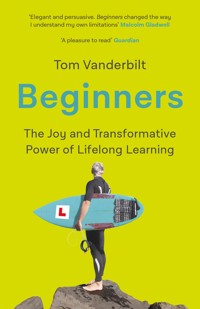
'Beginners belongs on the list of books that have changed the way I understand my own limitations.' Malcolm Gladwell For many of us, the last time we learned a new skill was during childhood. We live in an age which reveres expertise but looks down on the beginner. Upon entering adulthood and middle age, we begin to shy away from trying new things, instead preferring to stay nestled firmly in our comfort zones. Beginners asks the question: why are children the only ones allowed to experience the inherent fun of facing daily challenges? And could we benefit from embracing new skills, even if we're initially hopeless? Bestselling author Tom Vanderbilt sets out to find the answer, tasking himself with acquiring several new skills under the tutelage of professionals, including drawing, juggling, surfing and much more. Witty and often surprisingly profound, Beginners is an uplifting exploration of the science of brain plasticity and how we can learn how to learn anew.
Das E-Book können Sie in Legimi-Apps oder einer beliebigen App lesen, die das folgende Format unterstützen:
Veröffentlichungsjahr: 2021
Ähnliche












Praise for Beginners
‘A wonderful and inspirational book. The only thing that will make you put it down is a burning desire to try something new. It’s full of the sort of encouragement and wisdom that bridges the small, tricky gulf between enthusiasm and action. A book that will launch thousands of journeys that might not otherwise have happened and prove life-changing for many who take those first steps.’
Tristan Gooley, author of The Walker’s Guide to Outdoor Clues and Signs
‘Witty, well-researched, myth-busting and curiously of the moment. Vanderbilt tells a compelling tale. Eighty pages in, I joined a choir.’
Robert Penn, author of It’s All About the Bike: The Pursuit of Happiness on Two Wheels
‘You don’t have to try all the activities that Tom Vanderbilt took on in his heroic, self-sacrificial effort to persuade us of the benefits of learning throughout life. After you read this invigorating book, you might want to take a nap. But then you’ll get up, refreshed, ready to learn a new skill. You’ll be ready to begin.’
Carol Tavris, co-author of Mistakes Were Made (But Not By Me)
Tom Vanderbilt writes on design, technology, science and culture for numerous publications, including Wired, the Financial Times and the Wall Street Journal. He is the author of the international bestseller Traffic: Why We Drive the Way We Do (and What It Says About Us). He is based in Brooklyn, New York.
Beginners
Also by Tom Vanderbilt
You May Also LikeTrafficSurvival City
First published in the United States in 2021 by Alfred A. Knopf, a division of Penguin Random House LLC, New York.
Published in hardback and trade paperback in Great Britain in 2021 by Atlantic Books, an imprint of Atlantic Books Ltd.
Copyright © Tom Vanderbilt, 2021
The moral right of Tom Vanderbilt to be identified as the author of this work has been asserted by him in accordance with the Copyright, Designs and Patents Act of 1988.
All rights reserved. No part of this publication may be reproduced, stored in a retrieval system, or transmitted in any form or by any means, electronic, mechanical, photocopying, recording, or otherwise, without the prior permission of both the copyright owner and the above publisher of this book.
Portions of this work previously appeared, in different form, as “Learning Chess at 40” in Nautilus, Issue 36 (nautil.us) on May 5, 2016, and “My Family Vacation Swimming in the Open Sea” in Outside (outsideonline.com) on July 2, 2019.
Every effort has been made to trace or contact all copyright holders. The publishers will be pleased to make good any omissions or rectify any mistakes brought to their attention at the earliest opportunity.
10 9 8 7 6 5 4 3 2 1
A CIP catalogue record for this book is available from the British Library.
Hardback ISBN: 978 1 78649 309 5
Trade paperback ISBN: 978 1 78649 310 1
E-book ISBN: 978 1 78649 312 5
Printed in Great Britain
Atlantic Books
An imprint of Atlantic Books Ltd
Ormond House
26–27 Boswell Street
London
WC1N 3JZ
www.atlantic-books.co.uk
You must become a beginner.
—RAINER MARIA RILKE
CONTENTS
PROLOGUE
THE OPENING GAMBIT
CHAPTER ONE
A BEGINNER’S GUIDE TOBEING A BEGINNER
CHAPTER TWO
LEARNING HOW TO LEARN
What Infants Can Teach Us About Being Good Beginners
CHAPTER THREE
UNLEARNING TO SING
CHAPTER FOUR
I DON’T KNOW WHAT I’M DOING,BUT I’M DOING IT ANYWAY
The Virtues of Learning on the Fly with a Group
CHAPTER FIVE
SURFING THE U-SHAPED WAVE
The Agony and the Ecstasy of the Advanced Beginner
CHAPTER SIX
HOW WE LEARN TO DO THINGS
CHAPTER SEVEN
MEDITATION WITH BENEFITS
How Drawing Changed the Way I Saw the World, and Myself
CHAPTER EIGHT
THE APPRENTICE
or, What I Learned
Acknowledgments
Notes
Beginners
PROLOGUE
THE OPENING GAMBIT
One Sunday morning in a crowded room in New York City, I sat down to a chessboard with my heartbeat elevated and my stomach on the boil.
My opponent and I shook hands, as is the custom. Apart from stating our names, which we duly jotted in our notation pads, we exchanged no words. While I set the time on the clock—twenty-five minutes for each player—he methodically centered each piece on its square.
Nonchalantly, as if to appear faintly bored, I did the same. I tried to arrange my pieces even more symmetrically, as if seizing some minute advantage (a ploy undermined by momentary panic that I’d incorrectly placed the bishop and knight). An expectant hush fell about the room as we waited for the tournament director to give the start signal.
As we sat, I tried to size my opponent up. He idly rolled a pencil between his fingers. His eyes drifted to the neighboring tables. I peered at him with what I hoped looked like remorseless pity. I was trying to project as much feral menace as one could while sitting in a library chair. I wanted to channel a feeling that had been described to me by Dylan Loeb McClain, the former chess columnist for The New York Times, when, in 1995, he’d played the then world champion, Garry Kasparov, in an exhibition game.
“I didn’t feel like he wanted to beat me,” McClain said. “I felt like he wanted to reach across the board and strangle me.” He intuited that Kasparov, hunched like an angry bear and channeling “unbelievable psychic ferocity,” would not be happy gaining some minor positional advantage, or even simply winning. Something “more personal, more disturbing” seemed to be driving him.
This is a common sensation in the world of chess. “I like the moment when I break a man’s ego,” the mercurial champion Bobby Fischer once put it.
I looked again at my opponent. Could I, through tactical finesse and the withering power of my merciless gaze, slowly dismantle the core of his being?
Just then, a woman appeared at his side, bearing a small carton of chocolate milk. She kissed him on the head, said, “Good luck,” and flashed me an owlish smile. Ryan, my opponent, was eight years old. With admirable composure, and an occasional sniffle, he dispatched me somewhere after the thirtieth move. I congratulated him, and as I went to inform the tournament director of the result, I saw him in the hallway, ego intact, proudly relaying the news to his mother.
Ryan and I were among those gathered for a Sunday morning “Rated Beginner Open” at New York City’s Marshall Chess Club. Occupying several floors of a historic town house on one of Greenwich Village’s most handsome blocks, the Marshall is a delightful anachronism, a relic of the days when any number of chess teams, collegiate and otherwise, battled across the region, their exploits recorded in the sports sections of newspapers.
That it exists here today, nestled amid some of the most expensive real estate in the country, is only thanks to a plot twist worthy of Dickens.
In 1931, at the height of the Depression, a group of wealthy benefactors, chess enthusiasts all, bought the building on behalf of the club’s namesake, Frank Marshall. A grandmaster and U.S. champion who’d once operated an oceanfront chess emporium in Atlantic City—where he sometimes played passersby for money—Marshall had for decades piloted his eponymous club through a number of iconic Manhattan locales, from Keens Chophouse to the Chelsea Hotel. The Marshall now had a home for life.
The place has lost a bit of its old-school luster—there are no longer jacketed waiters to serve coffee or tea—but playing chess at the Marshall today, you still feel you’re in some Gilded Age temple to the Game of Kings. History envelops you: busts of famous grandmasters; vintage photographs of team champions; the very table that Magnus Carlsen, the current world champion, sweated over as he defended his title against Sergey Karjakin in 2016.
The Marshall is no museum, though. Entering the place on a weekend, during a big tournament, is like walking into a human-powered data center: rows and rows of processors, silently calculating, thrumming with intensity, generating heat and a persistent tang of nervous perspiration.
The Sunday Beginners tournament was strictly small stakes, for players rated under 1200, or having no rating at all. Most grandmasters have ratings above 2500; I had the newbie rating of 100.
My day had started promisingly. Against my first opponent, John, a gray-haired man with the look and quiet gravity of a scholar, I’d initially fallen behind on “material,” as pieces are called in chess. As the game drew on, he tried to press his advantage. And yet I kept fighting, finding inventive obstacles to his victory. To each of these he would respond with a small, tired sigh. I could feel his discomfort, and with each sigh I seemed to grow in strength.
Then, with my own king nearly surrounded, I spotted the chance for a checkmate. I just needed him to not see it. There is an old expression in chess that the winner is the player who makes the next-to-last mistake. And indeed, my opponent played offense when he needed to be playing defense, moving a pawn toward what he assumed was my demise. As I slid my rook into position, trapping his king along the “A file” (the first vertical row on a chessboard), a slow, queasy realization spread across his face.
My next opponent, Eric, was a serviceman on leave from Afghanistan, where he spent a lot of downtime playing online chess. He knew he’d be coming through New York on a visit stateside and had dedicated time for a Marshall pilgrimage. He looked a bit like the actor Woody Harrelson: buzz cut, grizzled, with a thousand-yard stare. Our match was tense and close fought, until he captured one of my rooks with a bishop pin. After I resigned, he looked relieved and said I had played much better than my rating would indicate—the first words he had uttered.
That morning’s grouping, everyone from U.S. Army Rangers to AARP members to fidgety kids, was typical of the Marshall’s Beginners tournament. The age range at the Marshall must have spanned six decades, but we were all, in the eyes of chess, beginners.
There is a wonderful purity to chess’s rating system, which renders distinctions like age largely irrelevant. Chess is one of the few skilled endeavors in which children can acquire a proficiency on par with adults—or above. There are twelve-year-olds who will innocently skin you alive.
There was one child in the Sunday tournament at the Marshall in whom I had a particular interest: my own daughter. We weren’t paired against each other—though that moment would come—and we took very different paths that morning. She placed near the top and collected a check for eighty-four dollars, money that was immediately plowed into Beanie Babies and glitter putty at the corner toy shop.
And as I heard her gleefully report to her grandparents on the phone, later that day, “My dad finished, like, fortieth.” Out of fifty-one.
What had I gotten myself into?
*
One day a number of years ago, I was deep into a game of holiday checkers with my daughter, then almost four, in the small library of a beachfront town. Her eye drifted to a nearby table, where a black-and-white board bristled with far more interesting figures (many a future chess master has been innocently drawn in by “horses” and “castles”). “What’s that?” she asked. “Chess,” I replied. “Can we play?” she pleaded. I nodded absently.
There was just one problem: I didn’t know how. I dimly remembered having learned the basic moves as a kid, but chess had never stuck. This fact vaguely haunted me through my life. I would see an idle board in a hotel lobby, or a puzzle in a weekend newspaper supplement, and feel a pang.
I had picked up a general awareness of chess. I knew the names Fischer and Kasparov. I knew that the game had enchanted historical luminaries like Marcel Duchamp and Vladimir Nabokov. I knew the cliché about grandmasters being able to look a dozen moves ahead. I knew that chess, like classical music, was shorthand in movies for genius—often of the evil variety. But I knew chess the way I “knew” the Japanese language: what it looks like, what it sounds like, its Japaneseness, without actually comprehending it.
I decided I’d learn the game, if only to be able to teach my daughter. Learning the basic moves was easy enough. It took a few hours, hunched over my smartphone at kids’ birthday parties or waiting in line at Trader Joe’s, to get a feel for the basic moves. Soon, I was playing, and sometimes even beating, the weakest computer opponents (the ones with catastrophic blunders abundantly programmed in). Yet it soon became apparent that I had little concept of the larger strategies.
I didn’t want to try to teach what I knew only poorly. And yet how to learn? The number of chess books was dauntingly huge. Sure, there was Chess for Dummies. But beyond that, the chess literature was enormous. It was filled with algebraic-looking thickets of chess notation, a quasi-language that itself had to be learned.
And the books were achingly specific: for example, A Complete Guide to Playing 3 Nc3 Against the French Defence. That’s right: an entire book devoted to the permutations of a single move—a move that, I should add, has been regularly played for a century. Yet people were still figuring out, one hundred years and many chess books later, 288 pages of new things to say about it.
A well-traveled fact one hears early in chess is that after only three moves there are more possible game variations than there are atoms in the universe. And, indeed, I felt cosmically stupefied as I tried to figure out how to boil down this exponentially complex game to someone whose favorite show was Curious George.
So I did what any self-respecting modern parent does: I hired a coach. The twist was that I wanted someone to teach my daughter and me at the same time.
Through some internet sleuthing, I’d found Simon Rudowski, a Brooklyn-based Polish émigré. He had an air of old-world formality, and a hint of tough-love sternness, that lent what I thought was an appropriate gravity to the task. When playing, he would move pieces with an emphatic, almost operatic flair. Simon, vegetarian, thin and hyperalert, preferred that the house be quiet, save for classical music playing quietly in the background. There were cups of tea and my wife’s fresh-baked pastries, which she had served to him during the first lesson out of politeness.
This meant-to-be-occasional treat had soon hardened, and even intensified, into an almost comic ritual. “We need to make pastries for Simon,” she would urgently announce the morning of the lesson (store-bought cookies would only be nibbled at, in a subtle sign of displeasure). The music, along with the refreshments and the intrinsic elegance of the board and pieces, turned our house, or so I liked to imagine, into a sort of feverish, caffeinated Viennese salon, filled with the heady ferment of chess theory.
*
Although it scarcely occurred to me at the time, my daughter and I were also embarking on a cognitive experiment, with a sample size of two: We were two novices, attempting to learn a new skill.
We were starting from the same point, but separated by some four decades. So far, in her young life, I’d been the expert—in knowing what words meant or how to ride a bike—but now we were on curiously equal footing, at least in theory. Would one of us get better faster? Would we learn in the same way? What were our respective strengths and weaknesses? Who would prevail in the end?
I soon stopped attending the lessons. My presence, for one, seemed distracting; I was getting between her and her teacher. Also, in the beginning at least, she was picking it up much more slowly. Simon and I would sometimes grin at each other, secret confidants, when she was on the verge of discovering a difficult move on a crowded board.
I drifted to the background. I regularly played online, struggled through YouTube videos that analyzed tournament matches, and leafed through books like Bent Larsen’s Best Games. And then my daughter and I, each armed for battle in our own way, would come together, at the kitchen table, over the chessboard.
Early on, I seemed to be doing better with the game, if only because I was more serious about it. I had an attention span, I had decades of experience with other games, I had my adult pride. When we played, she would sometimes flag in her concentration, and to keep her spirits up, I would commit disastrous blunders and hope she would see them. In the larger chess world, I was a patzer—a hopelessly bumbling novice—but around my house at least I felt like a sage, benevolent elder statesman.
Week by week, though, she improved. She would calmly explain to me some hidden intricacy in a puzzle, or tell me why the online game I was certain I was going to win was actually likely to end in a draw. She’d learned strategies and rules of thumb that were new to me. She’d started playing in tournaments: at first, small gatherings in the basement of the local library and, eventually, the big citywide competitions. She collected trophies and landed fairly high up on the list of the country’s top one hundred female players for her age. I suddenly had to work to beat her, and sometimes could not.
One reason, in retrospect, was obvious. Where I was just playing online game after online game, hoping to get better through sheer exposure—attributing wins to my talent and losses to bad luck—she was being drilled in opening theory and endgame tactics by Simon. When she lost a game, she would have to analyze, in painstaking detail, why she lost. Importantly, this often took longer than the actual match.
In the eyes of the psychologist Anders Ericsson, the man behind the now-familiar, often-misunderstood ten-thousand-hour rule, she was engaging in “deliberate practice.”
I, on the other hand, was settling for “mindless repetition,” trying to get better through brute force, without tangible goals. I was trying, in a way, to play like Alpha-Zero, DeepMind’s celebrated artificial intelligence engine. Given no more than the basic rules of chess, AlphaZero had mastered the game after playing itself forty-four million times.* It learned as it went along the whole way through, without the aid of a coach, becoming the most formidable opponent in the world.
But I didn’t have that much time or that much brainpower. “If you want to improve in chess,” wrote Ericsson, “you don’t do it by playing chess. You do it with solitary study of the grandmasters’ games.” In my crowded life, it was usually easier to play a five-minute blitz game while riding the subway.
In any case, my attention had largely shifted to her. She was the talent to be nurtured; she was winning the trophies. Her improvement was more important than mine. I had become the archetypal Chess Dad, waiting through the typical five or six hours of a scholastic tournament.
The experience is a bit like being stranded in a second-tier airport during a flight delay. You try to find a comfortable place to kill time, but you end up with the dust bunnies on the power-waxed tile floor, on some windowless lower level of a school, huddled near an electrical outlet to keep your devices alive. You graze Goldfish crackers scavenged from the parent-run concession stand and breathe stale air. You try to work, but you are hopelessly jittery and distracted.
Waiting for my daughter to return from a match, anxious about the result, I’d glance down the hall every few minutes, my senses so attuned that I could tell within a millisecond’s glance whether she’d won or lost. Each scenario—a bounding, smiling run or a stoop-shouldered shuffle often accompanied by tears—had the tendency to break my heart.
During those moments of tears, I would sometimes wonder why I was putting her—and, to be honest, me—through it all. What had started as a simple, playful exploration had become something more serious. But to what end? I’d mostly bought into the societal image that equates chess with intelligence and academic success, even though I knew, rationally, that the evidence was inconclusive. The studies were typically small, often filled with motivated chess players fully aware they were being studied, and often undertaken by chess organizations themselves. There was a big “direction of causality” problem: Did chess make kids smarter, or did smarter kids gravitate to chess? If chess were so tied to intelligence, one might think better chess players would be generally smarter than lesser players or non-chess players. Again, there’s no strong evidence.
Still, I tried to convince myself that there were tangible positives. I thought that chess, “as a way to teach thinking,” as one educator put it, was a useful proxy for the rigors of school—concentrating, solving, memorizing, applying—dressed up in a game.
As for those tear-inducing losses, I imagined that chess tournaments, with their poignant, mostly meaningless results, might be a good place to rehearse the larger challenges of life. And maybe the results weren’t so meaningless. Three times out of four, by my rough estimation, she was playing a boy. Despite efforts at change, an attitude of gender superiority persists in chess. Male players’ ratings tend to be higher, which may simply be, it’s been suggested, a statistical artifact of there being so many more male players.
But there’s something more to the story. A study looking at scholastic chess tournaments found that when female players played male players, they seemed to under-perform. As the researchers wrote, “Girls lose to boys at a rate that cannot be explained in terms of initial ratings strength.” The reason, they hypothesized, is the phenomenon of “stereotype threat”: Female players were battling not only male opponents but the perception that they weren’t as good. What’s more, female players who didn’t do as well as their rating would predict played in fewer tournaments the next year—an effect not seen in boys.
Life was going to be full of these vicious cycles, I reasoned. Let us tackle them head-on, right now. And, undoubtedly, my proudest moment as Chess Dad was when, at a big tournament, I overheard a boy telling his compatriots, all wearing the purple T-shirts of the elite Hunter College Elementary School chess squad, to “watch out for the girl in the pink bunny shirt.”
*
When my daughter first began competing in scholastic tournaments, I would chat up other parents. Sometimes, I’d ask if they played chess themselves. Usually, the reply was an apologetic shrug and a smile.
When I volunteered that I was learning to play, the tone was cheerily patronizing: Good luck with that! I thought, “If this game is so good for kids, why are adults ignoring it?” Seeing someone playing Angry Birds, I wanted to tap them on the shoulder and say, “Why are you having your kids do chess while you do that? This is the Game of Kings! There are chess games recorded from the fifteenth century!”
At chess tournaments, I saw a dynamic that was all too familiar from the world of children’s activities: kids doing the activity, adults like me staring into their smartphones. Sure, we parents had work to do, work that we allowed to spill into weekends, work that helped pay for the lessons our kids were enjoying (or enduring).
But I also wondered if we, in our constant chaperoning of these lessons, were imparting a subtle lesson: that learning was for the young.
Strolling down the hall during one tournament, I looked into a classroom and saw a group of parents, with what I took to be an instructor. They were playing chess! Just then, as if on cue, a group of kids passed me, peering in on the same scene. “Why are adults learning chess?” one asked, in a vaguely mocking tone, to the collective amusement of the group. They marched on while I slowly died in front of a cheery bulletin board.
I was tired of sitting on the sidelines. I wanted in. And that is how I got a membership card from the U.S. Chess Federation and started joining my daughter, not at the scholastic tournaments—where I would have cut an odd figure—but at the Marshall.
Early on, I was nervous, even though I really had nothing to lose, save my pride. “A master can sometimes play badly,” as one grandmaster put it, “a fan never!” And fan I was: the somber rituals, the pulse-pounding encounters, the tense atmosphere. It was three hours of sustained concentration and intense thinking, with my phone turned off. It felt like a gym for the brain.
The most striking thing was how hard it was to play against people. Playing online, at home, you were just moving pixels. In a real-life tournament, you were sitting across from a human, in all their humanness: their eyes, their scent, their body language, the strange sounds emanating from their deepest inner recesses.
This was an early lesson in learning: It is context dependent. You want to get good at online blitz? Play lots of online blitz. You want to get good at chess tournaments? Play at chess tournaments, against warm bodies.
And you never knew who was going to sit across from you on any given Sunday. I played—to a draw—a young girl with blue-framed eyeglasses who had the disconcerting, perhaps involuntary, habit of commenting under her breath on my moves as I made them (“thank you for bringing my king into the endgame”). There was the older man with shaking hands who set a towering, sloshing twenty-four-ounce cup of hot coffee on the table as he sat down to play me, drawing alarmed looks from the neighboring players, positioned mere inches away; rattled, I nearly threw the game away and only salvaged a draw because my opponent was unsettled by his dwindling clock. I sent an earnest kid in a charter school uniform to his doom—it took more work than I would have liked—and felt obliged to tell his father, who was watching a movie on his smartphone, how well his son had played. I checkmated a lank-haired, somewhat eccentric man I had seen there on many occasions, wondering, a bit darkly, how long he had dwelled in the “Beginners” section. I was paired against my daughter, who coolly delivered a back-rank checkmate, trapping my helpless king on the last row.
I was nearing fifty and getting beat by kids. I loved it.
* In terms of Ericsson’s formulation, assuming an average time of ninety minutes per chess match, this would entail some sixty-six million hours of experience for a human.
CHAPTER ONE
A BEGINNER’S GUIDE TO BEING A BEGINNER
A man . . . progresses in all things by making a fool of himself.*
—GEORGE BERNARD SHAW
BEGIN, AGAIN: A MANIFESTO
Beginners is a book for anyone who ever started out, who was unsure, who was afraid to ask a question in a roomful of people who all seemed as if they knew what they were doing. It’s for anyone who had to be shown the ropes, however many times, who didn’t know what they were doing but did it anyway. It’s for anyone who entered a race they weren’t even sure they could finish. It’s a catalog of errors, a celebration of awkwardness. To paraphrase the movie Repo Man, it’s about spending your life not avoiding tense situations but getting into tense situations.
It’s a handbook for the clueless, a first-aid kit for the crushed ego, a survival guide for coping with this most painful, most poignant stage: the awkward, self-conscious, exhilarating dawning of the novice. It’s not a “how to do” book as much as a “why to do” book. It’s less about making you better at something than making you feel better as you try to learn. It’s about small acts of reinvention, at any age, that can make life seem magical. It’s about learning new things, one of which might be you.
*
For me, it had all begun with the chess experiment. Something had been awakened in me, thanks, ultimately, to my daughter.
Becoming a first-time parent is one of the more fundamental experiences of being a beginner. You sail into the process having chatted with friends and maybe read a few books, and on day one you’re on the bunny hill of life.
“Perhaps you think that you can know what it’s like to have a child, even though you’ve never had one, because you can read or listen to the testimony of what it was like for others,” writes the Yale University professor of philosophy L. A. Paul. “You are wrong.”
It is, she writes, “an epistemically unique” experience. Meaning: You don’t know shit.
You barely know how to hold this breathing, blinking thing. You struggle to interpret its actions. You lie awake grappling with weird decision trees—forward- or rear-facing car seats? You wrestle with strollers. Life becomes a constant process of racing to the internet to watch You-Tube videos (a subject I’ll revisit later in the book). You find yourself talking to strange new people—those heretofore ghostly figures you would pass on the street known as parents—swapping information as you rapidly scramble toward some kind of expertise.
Being a good parent, like any learning process, requires thoughtful practice. Novice parents, to the extent that there’s any research on the subject, can certainly be found wanting. In one study, novice parents shown a sample household environment failed to identify half the child hazards that were present. Even something as basic as the way you speak to your young child can be done in a way that will ultimately make them more verbally proficient.
Beginner parents also become beginner teachers. And because we no longer remember, or have much access to, how we ourselves learned something, we may not be the best instructors. Playing catch with my daughter, I struggled to give more compelling instructions than “Throw the ball to me.” Could I write out instructions? That wouldn’t really do. Step one: Take ball. Step two: Throw ball. Maybe I could use metaphor or imagery, often so effective in sports instruction? Imagine that you’re throwing the ball. To me.
We have to learn how to teach. Sometimes we have to relearn what we are trying to teach. I made the mistake—as I now firmly believe it to be—of having put my daughter, at age three, on a bike with training wheels. She began happily riding around the park, until she took a corner too fast and tipped over.
Rather than teaching the actual skill needed in riding a bicycle, training wheels simply impart misplaced confidence. Such “errorless learning” may make the learner feel better, but it eliminates the huge part of learning that comes from mistakes. Like water wings in swimming, training wheels take away from the actual feeling of riding a bike.
So I took off the training wheels, stripped the pedals, and, presto, it was a “balance bike.” She had some wobbles, but those wobbles were more instructive than her seemingly steadier performance on the training wheels. A few weeks later, with a starting push from me, she was off.
Like any parent, I suddenly found myself surrounded, in a way I could scarcely remember, by the process of learning. It wasn’t just the chess. There was piano. Soccer. Tae kwon do. Choir. Skateboarding. Intro to Coding. Track and field. Indoor climbing. Not all of these things would “stick,” but it scarcely seemed to matter. They’re kids. They’re exploring. We should let them try as many things as possible. It’s good for them.
But something began to gnaw at me. As I became the full-time supervisor of my daughter’s learning career, as I sat in any number of waiting areas while she improved, I wondered, what new skills had I learned?
Each of us, of course, is constantly learning new things, in endless, small ways. “As adults,” write the authors of The Scientist in the Crib, “we at least sometimes retain our childlike ability to learn.” You just rented a car at the airport? Take a minute to learn the new cockpit configuration. You’re walking on a sidewalk that’s not usually covered in ice, or going down an unfamiliar set of wooden stairs in your socks? You’ve just subtly recalibrated your proprioception—that “sixth sense” of your body in the world—or you fell. Just switched from Android to iPhone? You’re going to have to retrain your fingers.
Had I, though, acquired any more substantial skills? In my job as a journalist, I am constantly learning new information. I am a “perpetual novice,” constantly helicoptering into some world I barely know of (nuclear waste, watchmaking) and meeting the key players, soaking up the terminology, reading the weird trade magazines—did you know the world of shipping pallets has two leading journals?—and otherwise geeking out. I still puff with pride when someone says, “You’ve really done your homework.” And then it’s on to the next thing.
I am brimming with declarative knowledge, or what is called “knowing that.” I have a lot of “knowing that”; hell, I was on Jeopardy! (I lost, to someone who knew more of “that.”)
But what about procedural knowledge, or “knowing how”? I was a quick study when it came to facts, but what had I actually learned to do lately? Compared with my daughter, I seemed to be coasting along on my professional plateau, fixed firmly in my comfort zone of competence.
This was brought home to me when, one day, her school featured a “Talent Day,” in which parents were asked to demonstrate some skill in front of a room of twenty-five first graders. I racked my brain. What talent did I have? I didn’t think the kids would be dazzled by the grace of my prose under deadline. I am, on the other hand, a pretty mean whistler. Or should I take them outside for a crack parallel-parking demonstration?
A thought began to emerge: I would try to learn, along with chess, a number of skills at once. Rather than just sitting on the sidelines while my daughter learned, I would join her—sometimes, as with chess, in the very same pursuit. This is a strangely novel notion. Type “learn with your child” into Google, and you get a lot of results on how to improve their learning. You are a foregone conclusion.
But what did I want to try to learn? Seeking inspiration, I posted an inquiry online: “What new tricks should this old dog learn?”
The first response came quickly: “Have you tried writing classes?”
Was the universe trying to tell me something?
*
In my quest to acquire skills, I had some rough criteria mapped out. First, I had to be a beginner in the activity. There were things I had done a bit of, and certainly wouldn’t mind getting better in (making pizza, fixing my bike), but I wanted real novelty.
Second, they had to be things I could learn in New York City. That semester at “gelato university” in Italy, suggested by a friend, was out (a decision not made easily), as was the mountain climbing course in Alaska.* Luckily, in a city of nine million, if you can imagine it, someone is teaching it.
The skills, furthermore, should not be too difficult or time-consuming. Learning Mandarin or how to fly a plane was out. Last, they should be things I actually really wanted to learn—not things that I felt I should learn.
The suggestion came several times to take coding classes. Coding is a fine enterprise, but I wanted to spend less, not more, time in front of a screen. I wasn’t necessarily looking for skills that represented some kind of professional development, as worthy as that endeavor is. I had a job; I wasn’t looking for another, or anything that much felt like work. More than looking to make myself more marketable to employers, I wanted to make myself more marketable to me.
I wanted the skills to be substantial. There are plenty of micro-skills out there—building a fire, driving a manual transmission—that are totally worthwhile and we’re all constantly tackling. I am all in favor of this “micro-mastery,” as it’s been called: Learning little things can embolden you to learn bigger things. But most of these skills are easily achievable. I wanted things that you never finished learning.
And I wanted to stick to a small number of skills. There were all sorts of people on the internet who had embarked on self-reported quests to pick up one new skill every month, or every week, or every day; one guy had the beginner’s hubris to play Magnus Carlsen after a month of learning chess. This is the Magnus who routinely defeats people who have been playing chess every day of their lives since age five. Not surprisingly,* the would-be challenger was handily dispatched.
I applauded the bravado spirit of such endeavors, and thought there were things I could certainly learn from them, but I wasn’t looking for bucket-list items to tick off. I wasn’t interested in rapidly “hacking” skills, Silicon Valley–style, so I could boast about them on social media and move on to the next one. I wanted things I could grow into slowly, taking time to appreciate the skill and how it is learned, to measure its impact upon my life. Why not just one skill? you might be asking. I worried about picking something I would not like. Because I was interested in the starting stages of things, tackling more skills simply meant I would be a beginner more often.
I eventually settled on a group of pursuits I’d long wanted to learn. In addition to chess, I chose singing, surfing, drawing, and making (in this case, a wedding ring to replace the ones I’d lose surfing). Oh, and juggling—as much for the thing itself as for the brain research that’s been done around it, which offers a fascinating window onto learning. There were all sorts of tempting things—free diving, improv theater—I put on a possible to-do list for the future.




