


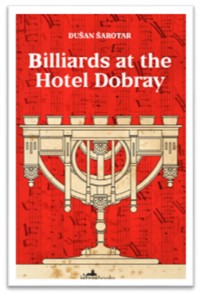
Erhalten Sie Zugang zu diesem und mehr als 300000 Büchern ab EUR 5,99 monatlich.
- Herausgeber: Istros Books
- Kategorie: Gesellschafts- und Liebesromane
- Sprache: Englisch
In the northern Slovenian city of Murska Sobota stands the renowned Hotel Dobray, once the gathering place of townspeople of all nationalities and social strata who lived in this typical Pannonian panorama on the fringe of the Austro-Hungarian monarchy. Due to its historical and geographical particularities, the town had always been home to numerous ethnically and culturally mixed communities that gave it the charm and melos of Central-European identity. But now, in the thick of World War II, the town is occupied by the Hungarian army. Franz Schwartz's wife, Ellsie has for the past month been preparing their son Isaac, a gifted violinist, for his first solo concert, which is to take place at Hotel Dobray. Isaac is to perform on his bar mitzvah and his 13th birthday on April 26, 1944. When the German army marches into town and forces all Jews to display yellow stars on their clothes, Ellsie advises her husband that the family should flee the town and escape to Switzerland. Schwartz promises her he will obtain forged documents, but not before Isaac performs his concert at the hotel. A year later, in March 1945, Schwartz returns, on foot, from the concentration camp as one of the few survivors.
Sie lesen das E-Book in den Legimi-Apps auf:
Seitenzahl: 341
Veröffentlichungsjahr: 2019
Das E-Book (TTS) können Sie hören im Abo „Legimi Premium” in Legimi-Apps auf:
Ähnliche




















CONTENTS
Imprint
A Lullaby
The Great Pannonian Music
Stalin’s Pipe Organ
The Author
The Translator
DUŠAN ŠAROTAR
BILLIARDS AT THE HOTEL DOBRAY
Translated from the Slovene by Rawley Grau
First published in 2019 by Istros Books (in collaboration with Beletrina Academic Press)
London, United Kingdom
www.istrosbooks.com
Originally published in Slovene as Biljard v Dobrayu by Beletrina Academic Press, 2007
© Dušan Šarotar, 2019 (2007)
The right of Dušan Šarotar to be identified as the author of this work has been asserted in accordance with the Copyright, Designs and Patents Act, 1988.
Translation © Rawley Grau, 2019
Cover design and typesetting: Davor Pukljak | www.frontispis.hr
ISBN:
Print: 978-1-912545-25-4
Ebooks: 978-1-912545-26-1
This Book is part of the EU co-funded project “Reading the Heart of Europe” in partnership with Beletrina Academic Press | www.beletrina.si
The European Commission support for the production of this publication does not constitute an endorsement of the contents which reflects the views only of the authors, and the Commission cannot be held responsible for any use which may be made of the information contained therein.
If anywhere there is an eye that is bigger than life, then its gaze must be able to embrace the entire universe, all visible and invisible worlds, both good and evil at once; people say that a person can see the whole, can glimpse the truth compressed in a single second, only at the moment of crossing between life and death. But the question remains: are all these crossings, these final seconds, also captured in the gaze of that great eye? In other words, does it only see them or does it also remember them? Does the eye ever shut and recall?
A LULLABY
1
A dull, hollow sky stretched down to the squat houses, which were wheezing shallow breaths into the damp, stifling air. These strange, colourless exhalations, rising from the dead earth and errant mists, had settled in front of the town – the varaš – like a mighty ghost from the past which not even children believed in any more. The secret that once lingered in these parts had again had to flee. It could be felt in the strange murmuring that hovered above the open plain. Now, at the hour of its departure, a sticky emptiness was opening. Somewhere deep down only oil stains and pillars of rock salt remained. Hidden in dense fog, which no wind would disperse for a long time, lay the last evidence that life could be any different.
The shine had faded long ago from the silver coffee spoons, and the determined clack of chessmen on chessboards, once intermingled with fervent conversations, had fallen silent. In the background of this genteel and seemingly well-mannered play of words and wit, the town lived its other, secret life. One sensed it as a devious, dire, even incurable disease that was slowing eating away at the idyllic façade. Perhaps it was only the spirit of the age, about which there had been so much discussion, but everyone agreed that the golden years they had shared were passing, the days when on the street, in coffee houses or at the cinema, the people of this small world, hidden from the world outside, would meet and greet each other as in a big communal garden.
Sadness, inexplicable melancholy and staring at dark landscape paintings and faded photographs, long solitary daydreaming and, especially, sinking into silence – these were all signs of the chronic disease that had been gaining power over the varaš.
At this hour, in late March, in the year 1945, all that could be heard from the cellar bars and illicit taprooms was an incomprehensible mix of half-drunken tongues struggling to keep up with the tuneless wail of violins and cracked drums. Now the only things in tune, playing with manful resolution, were the army bugles, which were summoning soldiers to the final march.
That night the story of good men and women could barely stand up to the devious wind dispassionately erasing the words on the faded monuments of the law. This mysterious force was stronger than the storms and deeper than the floods that were once talked about here. It came as a vague feeling, or a long, harrowing dream, which burrowed into people’s souls even before they fell asleep or drank themselves into a stupor.
All of this was pressing down from above on this forgotten, sleepy town, tired of contrived splendour and barren grandeur, too tired perhaps even to die, as hope had died – hope in the coming of the one who will judge by the letter of the law.
The wooden roller blinds on the tall windows of the middle-class houses and shops on Horthy Street were tightly shut; somewhere deep behind these windows, beneath the cool ceilings of drawing rooms, in sitting rooms that looked out on gardens still gripped by icy dew, words were few, wrenched out like a hacking cough for which no medicine existed.
‘Brandy taken with honey and bed rest – that’s the only thing that helps,’ people said on the street. But for timidity and especially the fear that comes from a chronic lack of will, there was no effective medicine. So the silence and the rare, awkward word uttered behind thick walls sank ever deeper into memories of earlier, better days. What was growing ever louder, and was, so to speak, already at the gates of this unwalled, sleepy varaš, which shook with every Pannonian breeze, only a very few saw in their sleep. It was something wild and destructive, yet at the same time liberating, like a strong home remedy for a bloody cough, which in large doses causes intoxication, madness and often even death.
The small windows, too, in the working-class and semi-farming houses, which stood in regular rows abutting long, muddy streets, were draped in thick, oft-mended curtains, which almost nobody took down, even during the day. In these low, dark little rooms, people spent entire days just sitting and waiting, the life slowly draining from their pale faces and watery eyes. For the past four years, the invisible river of time had been flowing through them, and was filled with all the hatred and despair its eddying current had picked up and carried from somewhere far away. In this peaceful, level terrain, where the river became more sluggish, where it almost came to a stop, it was slowly unloading this unbearable burden.
All of this lay on the souls of the silent, patient people who in this remote and hidden world were obediently sitting and waiting. In their humility and devotion they might well have been chosen by God himself. Devotedly they bore the senselessness of a world they knew only by hearsay, and did so for no other reason than to keep the world from collapsing on the muddy plain and falling forever into the universal abyss.
Thus had the town stood long years in isolation, gazing inwards and almost forgotten – by God, by grand politics and even by the slaughters of war. But now, as the war was approaching its denouement, an evil eye had suddenly started exchanging glances with this backwater world.
The end of the war was on the doorstep; one sensed it in the sordid peace in which the townspeople were so soundly asleep.
But every so often, from somewhere far away, from beyond the heights of Srebrni Breg, where the view opened onto the endless, rolling plain, across Hungary, Poland and all the way to the Baltic Sea, came the sound of muffled explosions.
It was not stars that were reflected on the Pannonian sea, but artillery fire. On a night such as the one that day in March, a night too dark for early spring and much too dark for the first red spring, of which there were already whispers, one might from a high balcony have seen the illuminated star of the Kremlin. But there were no high balconies here, and no one had climbed a church tower in a very long time, so everyone relied solely on rumours, half-truths, hopes and, especially, on fortune tellers, who from behind every corner were gazing into the future.
2
The muffled explosions were heard, too, by the man walking beside a road lined with poplars, which all these years had kept growing into the sky as though indifferent to the burgeoning madness in people’s heads, but to him the sounds were merely the sighs of the people of Sóbota, who were still falling out of bed in their sleep, as children do the first night they sleep alone.
The man, hunched over as he trudged along the ditch beneath the poplars, next to the road from Rakičan to Sóbota, only now realized, when he heard in the distance the almost simultaneous chiming of the Catholic and Lutheran bells, that he had nearly reached his goal.
‘That’s Sóbota,’ he murmured through cracked lips. His dry, ashen face, concealed by the rumpled, broad brim of his black hat, bore no signs of either joy or despair. His deep eyes, sunken in his bony skull, held a gaze that nothing could ever again excite. It was as if their light, coming from some inscrutable interior, had seen all the horror and beauty of this world. Now those eyes were staring, as if at rest, at the shape of the dreaming varaš, somewhere beyond the real world.
He leaned against a poplar, which was already sprouting its first green leaves on its long, thin branches. He hugged the tree to keep from keeling over. He was afraid of collapsing and falling asleep like Šamuel Ascher, his travelling companion, whose strength had given out in the park in Rakičan. This must have been only a little way back, no more than a hundred yards or so, but how much time, how many years had passed since then – this was impossibleto know.
The slender, upright trees had kept rising from the earth even when no one was watching. The poplars would still be growing by the side of the road even when there was no one left to step into their lengthy shadows. Those endless, dark bands, which touched the very edge of the limitless plain, might one day be the only things reaching across the horizon.
Wounded and weary from travelling, the figure stood benumbed in the middle of the plain, only an arrow’s shot from the town, over which the March sky was already turning red. He waited in vain for the gates of some mighty wooden tower to open. The poplars grew silently into the endless sky.
3
The dew on the old gravestones was sparkling in the morning sun. Lighter than fog and transparent as ether, the air was hung with shadows, which seemed to have just now separated from the names that remained in the gold Hebrew inscriptions. There were not many who could still read them, and even fewer who knew the law, but that morning it was as if the forgotten holy days had returned.
For it was said: Honour the holy days and you will see tomorrow as if it were today.
The sky above the Jewish cemetery had brightened. One felt the presence of souls hovering over the consecrated ground. It was still early; the town, on the other side of the railway tracks, was only now waking up, achingly, from its long doze.
In the shuffle of heavy footsteps on white gravel and the soft rustling of the poplars, the only other audible sound came from the first birds flying in small flocks across the sky. But whenever the footsteps stopped for a moment, as if the man had forgotten himself and was gazing at the faded names on the stone pillars, something else could be heard, as well. Something that was not the murmur of migratory birds beneath the blue sky or the clacking of the stiff joints of those who had just woken up. Perhaps it was a voice that had never yet been heard, although it was written that one day it would speak.
Whatever it was, Franz Schwartz heard something that morning that had long lain dormant inside him.
The light hung above the plain. The dew was slowly evaporating. The gravestones in the old cemetery were getting paler, as the last drops of moisture trickled down the black obelisks and obscured the names and dates. Gleam and glisten were now lost in sharp brightness. Franz Schwartz, fugitive and newcomer returning to his lost home, flinched at the long, shrill blast of a whistle. The ground in the cemetery trembled. He would have stood there much longer if the train, wheezing its way to the nearby station, had not disturbed him. In the distance he saw the thick cloud of smoke. It rose above the Catholic church and covered the sun over Sóbota. The refugee in the long black overcoat, which had once belonged to a soldier from God knows which army, stepped again onto the dusty road. Here, he hoped, his journey was coming to an end.
But now, when he was practically in the town, he was seized by dread. He felt that he was only at the beginning. That everything he had carried inside him over the past year, as he wandered across this bleak and alien land, had vanished in the morning dew. Everything was different here, he realized at the next whistle blast from the old locomotive, which had laboriously drawn to a stop at the small railway station. Franz Schwartz stood for a moment on the tracks he had just crossed and gazed at the station.
In the distance, the locomotive was releasing its steam, and the exhausted engine and the station buildings were swallowed in a white cloud. The whistling and rumbling of the heavy machine were enough to drown out even the bells tolling from both churches. The noise and the thunder of the bells must surely have woken every last person. Time seemed to have stopped. For an instant everything around him was still: the birds hung motionless in the air, the grass did not stir, the blood froze in his veins. Franz Schwartz now saw far behind him. In deepest darkness, images began to move.
He was watching the ordinary, everyday order of the arrival and departure of the train from Goričko, which was depositing students with books slung over their shoulders, village gentry in their best suits with large briefcases, workers in patched trousers and women with big kerchiefs on their heads and enormous straw bags in their hands. Hidden in the bags were jars of curd cheese, eggs and the occasional chicken. All of it these wives, mothers and housemaids would sell to the wealthy ladies of the varaš in a few brief circuits round the town.
The black-market trade had expanded greatly over the past four years. Hunger and the disintegration of the old order, both brought about by the war, had taken their toll.
Surreptitiously, at the back door, elderly gentlemen and ladies were selling small items of great value on the black market: silver, artworks, jewellery, even family heirlooms. Anything whose lack would not outwardly or too obviously compromise the visible lustre and trappings of wealth was slowly disappearing from display cabinets and from under pillows. Nothing was left on the walls but dusty frames; dust was collecting, too, in the empty, artfully decorated chests of drawers, while family photographs now stood alone on mantelpieces. Many of those who had once proudly posed in front of some respected photographer’s camera lens were by now long gone. Letters arrived only rarely, or a telegraph saying that the person was missing or in prison or dead.
This forbidden exchange, this black-market commerce – which was nothing but one great sadness, a struggle for sheer survival – best portrayed the reality here. Not death, terror, incitement to violence, the recruits or the quickly suppressed Partisan resistance, but buying and selling, the clandestine barter with reputation, power and envy – that was the great local war.
It must have been nearly a year ago at this same railway station that he last saw his wife and son. They were being herded with the others by Germans in pressed uniforms and polished boots, while Hungarians in hunting jackets trotted subserviently alongside them. The train from Goričko had been whistling and wheezing in the same lazy voice it did now. As soon as the Hungarians, with exaggerated, feigned fury, had unloaded everyone from the cold, sooty carriages, the Germans very meticulously divided them up. The men were lined against the wall of the station, while the women and children were packed into Černjavič’s pub, which stood on the platform. The bar was shut down for an hour. The pub’s few patrons – mainly labourers, who were normally found here first thing in the morning nursing a cider or brandy, and travellers without luggage – were banished to the garden, from where they were forced to watch the scene at the station.
It was the very same blast of a steam whistle, in this half-deserted and forgotten station, or alomaš, as people called it, that blared forth that April day in 1944 and so deadened all their bodies that they more or less automatically, almost mechanically and with no real expression on their faces, moved towards the platform; their eyes, swollen and white, would never close again but would only stare into an emptiness filled with whistling, shouting, wailing, weeping and sobbing – they would, in other words, be guided only by sounds and voices, which became unbearably louder and louder until all that remained, above the world and in their memories, was an attenuated, monotonous, almost supernatural soundscape, filled with smoke escaping from the boiler of a superheated locomotive.
Franz Schwartz again saw them, now after long years, as he gazed at the quiet, nearly forgotten station, with only poplars beside it looking down from above and, hovering just over their pointed crowns, white cumulous clouds; he saw them, people holding tight to their sleepy children, suitcases and hastily wrapped packages, from which protruded silk-embroidered tablecloths, big down-filled pillows, fur collars and books, with oils on canvas cut from expensive frames hanging from open handbags like long loaves of fresh bread.
No one was speaking, everything was unfolding so quickly, people showing a certain inborn submissiveness and attention, which is to be expected of those who have been taught that order must always be observed. They would, of course, complain later, when they had a chance to speak to the men in charge, the highest authorities, who sit in quiet offices – no, no, now isn’t the time, and anyway, what’s the point of talking to these people whose uniforms aren’t even of the proper rank; they look like mere workmen, carrying out explicit orders from above; you won’t get anywhere with them, they’re just doing their job. Of course, everything is documented, but the paperwork seems all right, in order, signed and stamped; there must have been a mistake, a big mistake, which these people certainly can’t understand, let alone resolve. Now they just had to be patient, to make sure nothing in their precious luggage went missing, and they had to watch the children, who were getting restless and curious – they don’t know what’s happening either, but somehow it will all work out in the end.
Franz Schwartz’s words had been lost forever in the unbearable thunder and groan of the old train. Even that lazy, temperamental machine must have felt something that morning. People departed without saying goodbye. They were swallowed by the fog and the steam.
The wind borne by the plain from the east was dispersing the smoke from the station and distributing it noisily among the houses. It was then that whatever hope Franz Schwartz still carried inside him collapsed. He knew that Ellsie and Izak would never again appear out of the fog. Here, for a long time to come, people would still be getting on and off trains, embracing each other and saying their farewells, but he would always be waiting. He alone would be walking across the tracks and watching for the train that would one day take him away, too.
As the train pulled out of the station he thought of Šamuel Ascher. The regular pounding of its wheels and the wheezing of the tired engine were coming closer and closer. The smoke that rose from the superheated boiler was now almost white as it trailed directly above the tops of the rickety carriages. The locomotive was accelerating.
Franz Schwartz continued to gaze at the monster, which was blowing its whistle louder and louder, since by now the driver had certainly seen him. And he, for his part, saw the fireman, whose black hand was gripping a small red flag and waving it at him. From the station to the cemetery, where the railway crossed the road, was less than two hundred yards, not far but still enough distance for the train to be approaching him at a hurtling speed.
Mainly, however, that minute was time enough for a decision. For a step that a short while before had seemed impossible. In that piercing whistle, which went right through his body, Franz Schwartz – shopkeeper, former proprietor of a general store, gentleman and, especially, husband – decided to take this step.
But he had promised Šamuel Ascher, who was lying somewhere in Rakičan Park, that he would get him home.
The train blew its whistle; hot, dense steam shrouded the crossing and, mixed with the dust of the road, rose into the sky. The crosses in the town cemetery and the black gravestones in the Jewish cemetery, forlorn beside the tracks, again trembled. The whistle was heard throughout the varaš, which was lounging with seeming indifference in the middle of the endless plain. It was as if a ram’s horn had sounded, to awaken at last the souls of this sleepy town.
4
The locomotive, with its wooden carriages jumping along the tracks like crates of potatoes, was already in the middle of farmland. The terrified recruits in the first two carriages crowded around the open windows. Through the smoke and the soot, with tears in their eyes, they were looking back towards the station, as it receded to an invisible dot. In the last car, drunken officers and their adjutants, in German and Hungarian uniforms, were sitting with rifles in their hands. For several days now their generals, bewildered and lost, had been shuffling them around, carting them back and forth across the plain. They were all making plans in their hearts to flee this godforsaken place. They suspected that the train wouldn’t get very far. Many of them would soon be sent back to the station on foot, the ones who already carried death inside them, only they did not know this. They were all just waiting for the moment when this hapless train would approach the Mura River. The Germans, who had begun to feel that time was running out, were desperate to cross it. The mighty wind that was driving them from the east like dry leaves would soon be here. For the others, it was by now clear that they would do better to stay. If the end was coming, it was best to wait for it here. The soldiers were counting on the train slowing down before it reached the garrisoned bridge; at that moment they would all leap through the open doors and take off in all directions across the fields. They would hide in the dead pools of the river and wait for night to come, wait even, perhaps, for the war to end. It was only the Germans who still shot at deserters, but maybe before the train reached the bridge they would be drunk on the liquor the recruits were offering them. These days nobody knew for sure who you had to be afraid of or who you had to shoot.
It was being said more and more out loud, even among ordinary soldiers, that the thunder and occasional explosions, originating somewhere in distant Russia, were getting closer and closer. Russian bullets could now reach even here. Gunfire was being heard in the Goričko forests, the Raba valley and the villages on the plain, and there had been a succession of small diversions as well, and the anxiety of the Arrow Crossists and local administrators was escalating. Partisans, it was said, had again infiltrated the region, although no one had yet seen them. But they knew they were dangerous. After all, they had ties with the Reds, who were advancing across the steppes.
A month ago, in the middle of February, Budapest had fallen. One of the Hungarian privates, a boy barely out of adolescence who was carrying a fiddle in his duffel bag, was already good and drunk, even at that early hour. He wasn’t used to the strong liquor, in which he had been drowning his fear and comforting his soul. They had been drinking it for several days on end. He stood up from the wooden bench and cried out that his Budapest had turned red. The snow, which had come down in great heaps in February and covered Buda and Pest in white – he explained, gasping for breath – was now, after the invasion of the Red Army, red with blood. Blood was falling from the sky. Saying this, he took another long draught of the liquor and then spat on the floor.
‘Play for us, István, play something,’ his mates started shouting. The boy pulled the fiddle out of the duffel bag and, with full concentration, as if instantly sobering up, he began to play. All of them – the Sóbota recruits, the Hungarian soldiers, the train driver, the fireman – everyone knew this sad Hungarian melody. It spilled from the creaking carriages into the dewy morning, somewhere between Sóbota and Beltinci.
They sang like a chorus of condemned men whose necks had just been sliced through. The train whistled on towards Beltinci station, where a new contingent of frightened boys, with unshaven cheeks and forcibly shaven heads, were waiting.
‘So where are we supposed to put them?’ the train driver yelled, with a cigarette pressed between his lips and his hand on the brake. The song and the plaintive wail of the fiddle had by now reached the approaching station. But the sound was blurred and no one could say if this was a song of despair, sadness or joy.
5
At the last possible moment, Franz Schwartz stepped across the tracks. The smoke and dust had still not settled by the time the train was approaching Beltinci. Then a shot rang out. Followed by a short burst of shooting. The sudden gunfire, which pierced the deafness of the morning, could be felt all the way to the town. Franz Schwartz heard it, too, as he ran towards the Catholic church and then, gasping for breath, turned at the intersection, right next to Bajlec’s house, into Church Street. He stopped for a moment opposite the Naday house, where some barrels of wine were being unloaded from a cart. That’s when the echo of a second burst of gunfire reached Sóbota. The Hungarian private lay dead on the floor of the carriage, his liquor glass under his neck. The fiddle, surrounded by hobnailed boots, was still reverberating beneath the bench.
Although one of the Hitlerites yelled that they should chuck the fiddle out of the window and the fiddler with it, no one could bend down and reach it because of the crush in the carriage. For it was then that the hapless train stopped and the new herd of recruits pushed their way on.
The plain stretched in long, evenly spaced ribbons from the creaking locomotive to the horizon, and across these taut furrows, like a bow across strings, the Pannonian river slithered and weaved. The earth was ringing, groaning and in slow, muted, minor chords, receding into the universe.
Although it had been nearly a year – from the end of the previous April to late March 1945, when Franz Schwartz returned to the town – everything was the same as always. It was as if during those eleven months, when he was walking on the brink of hell, which he had previously heard only the most fervent, God-fearing Catholics talk about, nothing whatsoever had happened here. Now he could assure those virtuous, pious men and women that everything that had been preached to them out of books was true. The only thing he could not understand was why their priests would be spared all this misery. For he had seen things that perhaps would never be written in books.
The tall, two-storey houses of the local elite, with commercial spaces and workshops below and residential quarters above, were still standing peacefully in a row. Nothing had been either destroyed or renovated. The façades with their tall windows and half-drawn blinds looked down on the empty streets with a weary and rather absent, almost musing, gaze.
The boys who were wrestling with the heavy barrels, which were filled with the highly valued wines of Lendava and Filovci, took one look at the ghost and fled into the cool corridors of the Naday house, leaving the merchandise in the street.
The only change here, which the newcomer noticed at once, was the sign above the door, which said: Mura Valley Wine Merchants – Proprietors J. Benko, A. Faflik, L. Bac.
Franz Schwartz, proprietor of a general store, property owner and building materials wholesaler, remembered these respectable gentlemen very well. Clearly, they had done excellent business during the time he was gone. That came to him quickly, as if he had cracked open a door no one had used in a long time.
He also had no trouble recognizing the Cvetič textile factory, which looked especially dreary. From its yard you would always hear the shouts of the supervisors driving the women to work faster. Clearly, the sewing machines were not rumbling today, devouring miles of sharp thread.
He walked on. Brumen’s shop on the corner was also closed. He glanced down Court Street; it was completely empty. He hurried past the courthouse and stopped in the middle of the big, wide intersection. Large teams of horses could easily make turns here. To his left he saw the Bac Hotel, whose owner was the same gentleman mentioned on the earlier sign. Not a living soul was in sight. Even the wine barrels were still sitting abandoned in the street.
What day is it? he wondered.
Days, months, almost years – he had long ago stopped counting them. At first, the Jews who were together in the internment camp had tried at least to remember which days were Saturdays, but in the labour camps the Germans and Hungarians soon managed to erase all sense of time. During the day they were transported in dark cattle wagons from worksite to worksite, where at night they dug trenches and moats. Later, they were often abandoned to the mercy and cruelty of the Allied bombers dropping bombs left over from the raids on Budapest. Muddy and hungry, they would lie there sometimes for days on end. After each air raid, the trenches were like poorly dug graves that needed to be reopened again and again. They were suspended between sky and earth, their feet in the graves, their heads among the stars. Days and dates lost all meaning. Living corpses, repeatedly buried and exhumed, as if rising from the dead and lying down with the dead, they now observed only the phases of the moon. At night in the ditches, they would watch its waxing and waning. But the moon, too, was often obscured by clouds, smoke and mortal weariness.
In the end, it was time that remained, duration without rhythm. Time, like a long, liberating but also destructive silence after music. A silence that opens into the interior.
6
The cold, gaseous sphere hung motionless over the town. The houses, the plane trees and poplars that lined the streets, the bell towers, the man – all were left without shadow. The sharp, blinding light had painfully imprinted an image of the morning on the consciousness of Franz Schwartz. In a succession of short exposures, one after the other as if he was blinking his eyes, the pages of a large photo album were being turned inside him. He stood in the middle of the intersection, entirely alone. He looked down Horthy Street, the former Main Street, past the rows of tall plane trees, behind which stood coffee houses, a pharmacy and shops. His eye reached all the way to Main Square, where he could see the green of the chestnut trees in front of the Hotel Dobray. He felt he could see even further, past the compact row of Jewish shops, as people called them. He knew every one of them; how could he not? His inner eye reached all the way to Lendava Road, beyond the bend on the right. The Hartner house was still standing on the corner, next to Kirbisch’s pub, and on the other side of the road was Benko’s meat factory and, a little further on, the synagogue. He knew all these houses and their occupants, every last one of them, all the way to Benkič’s pub and the Ledava Bridge.
He had crossed that bridge countless times coming into town. In good weather he had liked riding into town on his new motorcycle, to show it off; Mr Steiner had ordered it for him from Germany. Most often, however, he had come here by train, the same train that was now somewhere in the middle of the fields, full of recruits and soldiers. For him, the train was also very convenient. His building materials business was located by the train stop in the village of Šalovci. With larger orders he had to deliver the materials to Sóbota himself, where he would then dine with the customer – maybe just goulash and coffee in one of the better pubs. It all depended on the transaction. He had suppliers and customers in both Croatia and Hungary; new business routes were also opening up for timber from Gottschee and even Italian stone. There had been a lot of construction in the region in the years before the war, especially in the town. But the villages, too, were not to be dismissed: many innkeepers knew how to attract travellers, who often enough passed through these parts headed to Szombathely, Lake Balaton and all the way to Budapest, or south to Lendava, Čakovec, and from there to Zagreb, and they made good money from it. Another route that had again been gaining importance was the one to Graz, Vienna and Bratislava; here, too, there had still been plentiful opportunities for honest trade. Modern architects, distinguished customers – it all required effort, seeking out new partnerships, and a great deal of resourcefulness. The times, to be sure, had been changing.
It was, in fact, over the Ledava Bridge that the light now came, as if it had found its way here along all the routes and on all the winds of this unhappy world. It was spilling over the streets and the houses, colouring and reviving memories. Everything was as if on a well-preserved postcard, which you keep safe even though you have no desire to look at it a second time. You guard the picture in memory of the one who mailed it to you out of love. But now he is long gone and you remain alone. The picture of the varaš, safely pressed between the covers of a thick book, is all you have left. The sender’s smile is lost forever, and now his handwriting, too, is fading.
The fiddle was still reverberating. The soul of the Hungarian private, whose body had been tossed into a dead pool somewhere before the Veržej Bridge, would float above the plain for a long time. Its voice would be dissolving like salt until the water was as saturated as the sea. This mournful, deep singing was also heard by the man, still standing in the middle of the intersection looking somewhere far down the empty street. Or maybe by now it was a different song, the one that people here once said would never die.
At that moment a group of men came staggering out of Türk’s pub, which stood on the corner. They stopped in the doorway a moment, surprised, it seemed, by the morning light. There were five, maybe six, of them. Three were carrying musical instruments, either in their hands or strapped on their shoulders. The others had their arms around each other and were leaning against the door, which the exasperated publican was doing all he could to shut. Franz Schwartz watched them from the road. They were all somehow alike. All tired and wearing long, unbuttoned and rumpled overcoats. Their eyes were on fire. It was impossible to say if they had been taking leave of each other before going off to their separate fates, or if they had stayed up all night with the musicians out of sheer happiness. Maybe they knew that the slaughter would soon be over and they would remain here forever.
‘Play something, Lajči, play!’ the one in the middle shouted. He was standing on the highest step supporting himself on his two mates, who were struggling to keep him on his feet. The men with the musical instruments were slowly backing away. They were watching the drunken trio and roguishly bowing to them. They had had enough, and had certainly made good money off these drunks that night. Still, they knew it wasn’t over. These men would want more music. Now, with both their glasses and pockets empty, their hearts would burn all the more. They would want this music, this sad, endless music, which would ring out overhead even after they were gone. The ensemble was already in the street when one of its members, who was carrying an enormous double bass that reverberated even as he walked, looked back towards the pub. The three musicians leaned against the garden fence, as if resting, and then took off their hats. The gauntlet was thrown down. This was the men’s last chance for sadness and joy. The tall one, who a moment earlier had been stumbling and leaning on his mates’ shoulders, now instantly gathered his wits and was almost sober. He wriggled out of his friends’ safe grip and stepped forward. Holding himself erect, he walked towards the fence. For a brief second, by a table in the pub’s garden, which was anticipating the spring, he stopped and gazed past the heads of the musicians. It was then he must have seen Franz Schwartz, who was standing at the intersection looking right back at him.
Did the man recognize him? Or did that dark shape lit by the early-morning sun, in middle of the empty intersection, simply surprise and maybe frighten him, too? Or even remind him that life was not merely a nostalgic photograph in which we are captured by chance?
‘Come on, Lajči, play for us!’ he then said in a loud voice, too loud to be intended for them alone. ‘Play something for all of us, something sad,’ he added and, to the musicians’ obvious approval, took off his watch and dropped it in one of their hats. The ensemble began to play.
The fiddle on the train, which was just now crossing the Mura River, had nearly stopped reverberating. But now it started up again. The train was rumbling across the iron bridge without slowing down. Everybody was still on board. That morning, nobody had fled. The only one who remained on this side of the river, in a forgotten, stagnant pool, was the dead fiddler.
7




