


41,99 €
Mehr erfahren.
- Herausgeber: John Wiley & Sons
- Kategorie: Wissenschaft und neue Technologien
- Sprache: Englisch
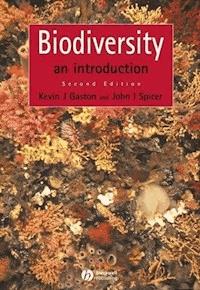
This concise introductory text provides a complete overview of biodiversity - what it is, how it arose, its distribution, why it is important, human impact upon it, and what should be done to maintain it.
- Timely overview of the serious attempts made to quantify and describe biodiversity in a scientific way
- Acts as an easy entry point into the primary literature
- Provides real-world examples of key issues, including illustrations of major temporal and spatial patterns in biodiversity
- Designed primarily with undergraduate students and course lecturers in mind, it will also be of interest to anyone who requires an overview of, and entry to, the vast literature on these topics.
- The figures from in the book may be freely downloaded from the book website on wiley.com
Sie lesen das E-Book in den Legimi-Apps auf:
Seitenzahl: 350
Veröffentlichungsjahr: 2013
Ähnliche



















© 1998, 2004 by Blackwell Science Ltda Blackwell Publishing company
350 Main Street, Malden, MA 02148-50120, USA108 Cowley Road, Oxford OX4 1JF, UK550 Swanston Street, Carlton, Victoria 3053, Australia
The rights of Kevin Gaston and John Spicer to be identified as the Authors of this Work have been asserted in accordance with the UK Copyright, Designs, and Patents Act 1988.
All rights reserved. No part of this publication may be reproduced, stored in a retrieval system, or transmitted, in any form or by any means, electronic, mechanical, photocopying, recording or otherwise, except as permitted by the UK Copyright, Designs, and Patents Act 1988, without the prior permission of the publisher.
First edition published 1998Second edition published 2004
Library of Congress Cataloging-in-Publication Data
Gaston, Kevin J.Biodiversity: an introduction/Kevin J. Gaston and John I. Spicer. – 2nd ed.p. cm.Includes bibliographical references and index.ISBN 1-4051-1857-1 (pbk.: alk. paper)1. Biological diversity. I. Spicer, John I. II. Title.QH541.15.B56G37 2004333.95′11–dc212003011788
A catalogue record for this title is available from the British Library.
For further information onBlackwell Publishing, visit our website:http://www.blackwellpublishing.com
Contents
Preface
Acknowledgements
1 What is biodiversity?
1.1 Marion Island
1.2 What is biodiversity?
1.3 Elements of biodiversity
1.4 Measuring biodiversity
1.5 Summary
Further reading
2 Biodiversity through time
2.1 Introduction
2.2 Sources of information
2.3 A brief history of biodiversity
2.4 How many extant species are there?
2.5 Summary
Further reading
3 Mapping biodiversity
3.1 Introduction
3.2 Issues of scale
3.3 Extremes of high and low diversity
3.4 Gradients in biodiversity
3.5 Congruence
3.6 Summary
Further reading
4 Does biodiversity matter?
4.1 Introduction
4.2 Direct-use value
4.3 Indirect-use value
4.4 Non-use value
4.5 Summary
Further reading
5 Human impacts
5.1 Introduction
5.2 Species extinctions
5.3 Populations, individuals and genetic diversity
5.4 Threats to biodiversity
5.5 The scale of the human enterprise
5.6 Summary
Further reading
6 Maintaining biodiversity
6.1 Introduction
6.2 Objectives of the Convention
6.3 General measures for conservation and sustainable use
6.4 Identification and monitoring
6.5 In-situ conservation
6.6 Ex-situ conservation
6.7 Sustainable use of components of biological diversity
6.8 Incentive measures
6.9 Responses to the Convention
6.10 Summary
Further reading
References
Index
Preface
This is the second edition of Biodiversity: An Introduction. Our goal in writing the first edition was to provide a text that both gave an introduction to biodiversity – what it is, how it arose, how it is distributed, why it is important and what should be done to maintain it – and present an entry point into the wider literature on biodiversity. That remains the goal here. However, much has occurred in the intervening years. First, understanding of many key issues has developed rapidly, with important new models having been developed, experiments having been conducted, and measurements made. Some controversies have been settled, and others have arisen. In short, the study of biodiversity remains vibrant and stimulating. Second, and as a consequence of these advances, the literature on biodiversity has continued to blossom with, for example, few issues of some of the major science journals (e.g. Nature, Science) now passing without containing one or more papers of relevance. Third, there has been a marked change in the structure of botanical, zoological and ecological courses taught in universities, away from inclusion of the more traditional taxonomically centred surveys of different groups of organisms, and towards an approach centred instead on the concept of biodiversity. Fourth, and most importantly, there has been little, if any, reduction in the degree of threat faced by the variety of life on Earth; if anything, there is now a sharpened awareness of how acute that threat is and how pervasive are its implications.
These developments have led us to revise Biodiversity: An Introduction substantially. Much of the book has been rewritten, updated and extended. The six chapters address the nature of biodiversity (Chapter 1), the history of biodiversity (Chapter 2), the spatial distribution of biodiversity (Chapter 3), the value of biodiversity (Chapter 4), human impacts on biodiversity (Chapter 5), and the future maintenance of biodiversity (Chapter 6). In each case, we have sought to draw out the major issues and provide actual examples. All the figures in the book can be downloaded from the Blackwell Publishing website (www.blackwellpublishing.com/gaston). Reference is made throughout the text to relevant papers and books, where possible with an emphasis on those that are more readily accessible. In addition, each chapter concludes with suggestions for further reading. These are sources, usually books, that we hope readers will find useful for exploring particular themes in greater detail, but which have often not been cited elsewhere in the chapter.
Many people have generously provided guidance in this endeavour, commenting on drafts of the first edition of Biodiversity: An Introduction, suggesting ways in which the published version could be improved and developed, commenting on drafts of chapters for the second edition, and responding to multifarious queries and requests. In particular, we are grateful to Dave Bilton, Steven Chown, Andy Foggo, Sian Gaston, Alison Holt, Rhonda Snook, Richard Thompson, Mick Uttley and Clare Vincent. We would also like to thank the students who have taken module APS215 Biodiversity at the University of Sheffield, Tim Caro and the students on his conservation biology course, Lee Hannah, Claudia Moreno and Ana Rodrigues. Rosie Hayden, Cee Pike, Katrina Rainey and Sarah Shannon of Blackwell Publishing cajoled, encouraged and helped steer this volume to its conclusion, with good humour and insight. We are grateful for their assistance.
As before, we dedicate this book to Megan, Ben, Ethan and Ellie, with the desire that their generation is kinder to biodiversity than our own has been.
K.J.G. & J.I.S.January 2003
Acknowledgements
The authors and publisher gratefully acknowledge the permission granted to reproduce the copyright material in this book:
Fig. 1.2: Fig. 1 from Avise, J.C. & Johns, G.C. (1999) Proposal for a standardized temporal scheme of biological classification for extant species. Proceedings of the National Academy of Sciences, USA 96, 7358–7363. Copyright © 1999 National Academy of Sciences, USA. Reprinted by permission.
Fig. 1.3: Fig. 1 from Purvis, A. & Hector, A. (2000) Getting the measure of biodiversity. Nature 405, 212–219. Reprinted by permission of the publisher and the authors.
Fig. 1.6a: Fig. 4b from Roy, K., Jablonski, D. & Valentine, J.W. (1996) Higher taxa in biodiversity studies: patterns from eastern Pacific marine molluscs. Philosophical Transactions of the Royal Society, London B 351, 1605–1613. Reprinted by permission of the Royal Society.
Fig. 1.6b: Reprinted from Biological Conservation 93, Balmford, A., Lyon, A.J.E. & Lang, R.M. ‘Testing the higher-taxon approach to conservation planning in a megadiverse group: the macro fungi’, pp. 209–217, Copyright © 2000, with permission from Elsevier.
Fig. 1.6c: Fig. 3.7a from Williams, P.H. & Humphries, C.J. (1996) Comparing character diversity among biotas. In: Biodiversity: A Biology of Numbers and Difference (ed. K.J. Gaston), pp. 54–76. Blackwell Science, Oxford. Reprinted by permission of Blackwell Publishing Ltd.
Fig. 1.6d: Fig. 5d from Petchey, O.L. & Gaston, K.J. (2002) Functional diversity (FD), species richness and community composition. Ecology Letters 5, 402–411. Reprinted by permission of Blackwell Publishing Ltd.
Fig. 2.2: Reprinted with permission from Fig. 1, Benton, M.J. (1995) Diversification and extinction in the history of life. Science 268, 52–58. Copyright © 1995 American Association for the Advancement of Science.
Fig. 2.3a: Reprinted with permission from Fig. 3a, Benton, M.J. (1995) Diversification and extinction in the history of life. Science 268, 52–58. Copyright © 1995 American Association for the Advancement of Science.
Fig. 2.3b: Reprinted with permission from Fig. 4a, Benton, M.J. (1995) Diversification and extinction in the history of life. Science 268, 52–58. Copyright © 1995 American Association for the Advancement of Science.
Fig. 2.4: Fig. 28.3b from Van Valkenburgh, B. & Janis, C.M. (1993) Historical diversity patterns in North American large herbivores and carnivores. In: Species Diversity in Ecological Communities: Historical and Geographical Perspectives (eds. R.E. Ricklefs & D. Schluter), pp. 330–340. University of Chicago Press, Chicago, IL. Reprinted by permission of University of Chicago Press.
Fig. 2.5: Fig. 1 from Niklas, K.J. (1986) Large-scale changes in animal and plant terrestrial communities. In: Patterns and Processes in the History of Life (eds. D.M. Raup & D. Jablonski), pp. 383–405. Springer-Verlag, Heidelberg. Reprinted by permission of Springer-Verlag.
Lesen Sie weiter in der vollständigen Ausgabe!
Lesen Sie weiter in der vollständigen Ausgabe!
Lesen Sie weiter in der vollständigen Ausgabe!
Lesen Sie weiter in der vollständigen Ausgabe!
Lesen Sie weiter in der vollständigen Ausgabe!
Lesen Sie weiter in der vollständigen Ausgabe!
Lesen Sie weiter in der vollständigen Ausgabe!
Lesen Sie weiter in der vollständigen Ausgabe!




