


6,99 €
Mehr erfahren.
- Herausgeber: Atlantic Books
- Kategorie: Gesellschafts- und Liebesromane
- Sprache: Englisch
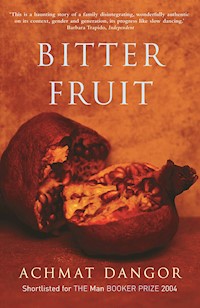
SHORTLISTED FOR 2003 THE MAN BOOKER PRIZE Shortlisted for the Dublin IMPAC Award 2003 'Dangor's writing, and the world he creates with it, exude a vibrant physicality... Dangor's vivid prose, narrative fluency and facility for literary experiment make Bitter Fruit a considerable achievement.'-- Shomit Dutta, Daily Telegraph The last time Silas Ali encountered the Lieutenant, Silas was locked in the back of a police van and the Lieutenant was conducting a vicious assault on Lydia, his wife. When Silas sees him again, by chance, twenty years later, crimes from the past erupt into the present, splintering the Ali's fragile family life. Bitter Fruit is the story of Silas and Lydia, their parents, friends and colleagues, as their lives take off in unexpected directions and relationships fracture under the weight of history.It is also the story of their son Mickey, a student and sexual adventurer, with an enquiring mind and a strong will. An unforgettably fine novel about a brittle family in a dysfunctional society.
Das E-Book können Sie in Legimi-Apps oder einer beliebigen App lesen, die das folgende Format unterstützen:
Veröffentlichungsjahr: 2012
Ähnliche




















Bitter Fruit
ACHMAT DANGOR was born in 1948 in Johannesburg. He has devoted much of his life to politics, including heading up the Kasigo Trust which, when created, was the largest black-led foundation in South Africa. Since laying down his duties as Director of the Nelson Mandela Children’s Fund, Dangor now writes full time. He is the author of Kafka’s Curse which has appeared in six languages. Bitter Fruit is his latest novel and was shortlisted for the International IMPAC Dublin Literary Award.
‘Dangor’s writing, and the world he creates with it, exude a vibrant physicality… [the] vivid prose, narrative fluency and facility for literary experiment make Bitter Fruit a considerable achievement.’ Shomit Dutta, Daily Telegraph
‘This South African novel tells a powerful story of how the toxins of apartheid seep into the life of one small ‘Coloured’ family… This is a haunting story of a family disintegrating, wonderfully authentic on its context, gender and generation, its progress like slow dancing.’ Barbara Trapido, Independent
‘The poet takes over from the political writer… Bitter Fruit has a shocking ability to surprise the reader with the persistence of racial feeling in South Africa.’ Gabriel Gbadamosi, Guardian
‘Bitter Fruit… is explicitly about South Africa confronting its own past… The unremitting intensity of Dangor’s focus is just as notable as its depth.’ Laurence Phelan, Independent on Sunday
‘In a series of fine characterisations, the dissonance and unease of South Africa are counterpointed with the inner lives of Silas, Lydia and Mikey. It is a textured piece of writing, redolent with the smells and sounds of close-packed living, and the hint that the violence and fanaticism are not likely to end provides a chilling coda.’ Elizabeth Buchan, Daily Mail
‘This dense, painful, and luxuriously written book carefully reveals itself… with a subtle but stinging pessimism.’ Claire Allfree, Metro
‘Bitter Fruit is a subtly layered tale of truth, reconciliation and redemption… Following in the great tradition of Richard Rive and Alex La Guma, he is a writer who gives texture and grace to the present lives and historical legacy of South Africa’s 500-year-old multi-ethnic society.’ Rachel Holmes, Literary Review
‘Meticulously written and perfectly paced, the story, while grim, hints at an escape from history’s tyranny.’ Giles Newington, Irish Times
Bitter Fruit
Achmat Dangor
First published in 2001 by Kwela Books, 28 Wale Street, Cape Town 8001 P.O. Box 6525, Roggebaai 8012.
First published in Great Britain in 2003 by Atlantic Books, an imprint of Grove Atlantic Ltd.
This paperback edition published by Atlantic Books in 2004.
Copyright © Achmat Dangor 2001
The moral right of Achmat Dangor to be identified as the author of this work has been asserted in accordance with the Copyright, Designs and Patents Act of 1988.
All rights reserved. No part of this publication may be reproduced, stored in a retrieval system, or transmitted in any form or by any means, electronic, mechanical, photocopying, recording, or otherwise, without the prior permission of both the copyright owner and the above publisher of this book.
1 3 5 7 9 8 6 4 2
A CIP catalogue record for this book is available from the British Library.
Paperback ISBN: 1 84354 264 1 eISBN: 978 1 78239 080 0
Printed in Great Britain by Mackays of Chatham
Atlantic Books An imprint of Grove Atlantic Ltd Ormond House 26–27 Boswell Street London WC1N 3JZ
‘It is an old story – ours.
Contents
Part One
Chapter 1
Chapter 2
Chapter 3
Chapter 4
Chapter 5
Chapter 6
Chapter 7
Chapter 8
Chapter 9
Chapter 10
Chapter 11
Chapter 12
Chapter 13
Chapter 14
Chapter 15
Chapter 16
Part Two
Chapter 17
Chapter 18
Chapter 19
Chapter 20
Part Three
Chapter 21
Chapter 22
Chapter 23
Chapter 24
Chapter 25
Chapter 26
Chapter 27
Chapter 28
Chapter 29
Chapter 30
Part One
Memory
I will teach you that there is nothing that is not divinely natural, … I will speak to you of everything.
André Gide,
1
IT WAS INEVITABLE. One day Silas would run into someone from the past, someone who had been in a position of power and had abused it. Someone who had affected his life, not in the vague, rather grand way in which everybody had been affected, as people said, because power corrupts even the best of men, but directly and brutally. Good men had done all kinds of things they could not help doing, because they had been corrupted by all the power someone or something had given them.
‘Bullshit,’ Silas thought. It’s always something or someone else who’s responsible, a ‘larger scheme of things’ that exonerates people from taking responsibility for the things they do.
Silas watched the man, the strands of thinning hair combed all the way across his head to hide his baldness, the powdery residue of dry and dying skin on the collar of his jacket, the slight paunch, the grey Pick ’n Pay shoes, the matching grey socks. The man leaned forward to push something along the check-out counter, and turned his face towards where Silas stood, holding a can of tomatoes in his hands like an arrested gesture. Yes, it was Du Boise. François du Boise. The same alertness in his blue eyes. A bit slower, though, Silas thought, as Du Boise moved his head from side to side, watching the cashier ring up his purchases.
Silas went closer, accidentally jostling a woman in the queue behind Du Boise. Silas watched him pushing his groceries along, even though the cashier was capable of doing this on the conveyor belt. Typical pensioner’s fare. ‘No-name brand’ cans of beans, tuna, long-life milk, sliced white bread, instant coffee, rooibos tea, denture cream.
So the bastard’s lost his teeth.
Silas pictured Lydia’s angry face, were he to return home without groceries. Today’s Sunday and the shops are open only until one o’clock. She’d suppose out loud that she’d have to do the shopping the next day, because his job was too important to allow him to take time off from work. All the same, he abandoned the trolley and followed Du Boise out of the store. Halfway down the length of the mall, past shop windows that Du Boise occasionally stopped to look into with familiar ease, Silas began to ask himself what the hell he thought he was doing, following a retired security policeman about in a shopping centre? What Du Boise had done, he had done a long time ago. Nineteen years. And Silas had learned to live with what Du Boise had done, had absorbed that moment’s horror into the flow of his life, a faded moon of a memory that only occasionally intruded into his everyday consciousness. Why did it matter now, when the situation was reversed, and Silas could use the power of his own position to make the old bastard’s life hell?
The man’s smell, a faint stench of decaying metabolism, was in Silas’s nostrils, as if he were a hunter come suddenly upon his wounded prey. Du Boise stopped at a café, pulled a chair out from under the table, ready to sit down. Silas stood close to him, facing him, and suffered a moment of uncertainty. Shit, this man looked so much older than the Du Boise he remembered. Then he looked – startled – into the man’s equally startled eyes.
Lesen Sie weiter in der vollständigen Ausgabe!
Lesen Sie weiter in der vollständigen Ausgabe!
Lesen Sie weiter in der vollständigen Ausgabe!
Lesen Sie weiter in der vollständigen Ausgabe!
Lesen Sie weiter in der vollständigen Ausgabe!
Lesen Sie weiter in der vollständigen Ausgabe!
Lesen Sie weiter in der vollständigen Ausgabe!
Lesen Sie weiter in der vollständigen Ausgabe!
Lesen Sie weiter in der vollständigen Ausgabe!
Lesen Sie weiter in der vollständigen Ausgabe!
Lesen Sie weiter in der vollständigen Ausgabe!
Lesen Sie weiter in der vollständigen Ausgabe!
Lesen Sie weiter in der vollständigen Ausgabe!
Lesen Sie weiter in der vollständigen Ausgabe!
Lesen Sie weiter in der vollständigen Ausgabe!
Lesen Sie weiter in der vollständigen Ausgabe!
Lesen Sie weiter in der vollständigen Ausgabe!
Lesen Sie weiter in der vollständigen Ausgabe!
Lesen Sie weiter in der vollständigen Ausgabe!
Lesen Sie weiter in der vollständigen Ausgabe!
Lesen Sie weiter in der vollständigen Ausgabe!
Lesen Sie weiter in der vollständigen Ausgabe!
Lesen Sie weiter in der vollständigen Ausgabe!
Lesen Sie weiter in der vollständigen Ausgabe!
Lesen Sie weiter in der vollständigen Ausgabe!
Lesen Sie weiter in der vollständigen Ausgabe!
Lesen Sie weiter in der vollständigen Ausgabe!
Lesen Sie weiter in der vollständigen Ausgabe!
Lesen Sie weiter in der vollständigen Ausgabe!
Lesen Sie weiter in der vollständigen Ausgabe!
Lesen Sie weiter in der vollständigen Ausgabe!




