


2,99 €
Mehr erfahren.
- Herausgeber: Wildside Press
- Kategorie: Fantasy und Science-Fiction
- Sprache: Englisch
Welcome to Black Cat Weekly #43. If this isn’t the best issue we had to date, it’s pretty darn close. Lots of great tales are packed into this one—including not one, but two mystery novels (by Edwin Balmer and Nicholas Carter), three shorter mysteries (including a major new novelet by Robert Lopresti, a great reprint by Victoria Weisfeld, and a solve-it-yourself puzzler from Hal Charles). On the science fiction side, we have an amazing set of stories by Daniel Marcus, Isaac Asimov, George O. Smith, Murray Leinster, and Robert Silverberg. It’s hard to get better than that. Oh, wait—we also have an interview with Robert Varley, courtesy of Darrell Schweitzer. This is another one of his “paleo-interviews,” going back to 1976, the time when Varley burst onto the scene and became one of this hottest writers in the field.
Here’s the complete lineup:
Mysteries / Suspense / Adventure:
“The Suicide Club,” by Robert Lopresti [Michael Bracken Presents short story]
A Wee Bit of Dough,” by Hal Charles [Solve-It-Yourself Mystery]
Evidence, by Victoria Weisfeld [Barb Goffman Presents short story]
Ruth of the U.S.A., by Edwin Balmer [novel]
An Uncanny Revenge, by Nicholas Carter [novel]
Non-Fiction:
“Speaking with John Varley” [Interview with Darrell Schweitzer]
Science Fiction & Fantasy:
“Jesus Christ Superstore,” by Daniel Marcus [Cynthia Ward Presents short story]
“Let’s Get Together,” by Isaac Asimov [short story]
“The Undamned, by George O. Smith [short story]
“Planet of Sand,” by Murray Leinster [short story]
“The Guest Rites,” by Robert Silverberg [short story]
Das E-Book können Sie in Legimi-Apps oder einer beliebigen App lesen, die das folgende Format unterstützen:
Seitenzahl: 898
Veröffentlichungsjahr: 2022
Ähnliche




















Table of Contents
COPYRIGHT INFORMATION
THE CAT’S MEOW
TEAM BLACK CAT
THE SUICIDE CLUB, by Robert Lopresti
A WEE BIT OF DOUGH, by Hal Charles
EVIDENCE, by Victoria Weisfeld
RUTH OF THE U.S.A., by Edwin Balmer
INTRODUCTION
CHAPTER 1
CHAPTER 2
CHAPTER 3
CHAPTER 4
CHAPTER 5
CHAPTER 6
CHAPTER 7
CHAPTER 8
CHAPTER 9
CHAPTER 10
CHAPTER 11
CHAPTER 12
CHAPTER 13
CHAPTER 14
CHAPTER 15
CHAPTER 16
CHAPTER 17
CHAPTER 18
CHAPTER 19
CHAPTER 20
CHAPTER 21
CHAPTER 22
AN UNCANNY REVENGE, by Nicholas Carter
INTRODUCTION
CHAPTER 1
CHAPTER 2
CHAPTER 3
CHAPTER 4
CHAPTER 5
CHAPTER 6
CHAPTER 7
CHAPTER 8
CHAPTER 9
CHAPTER 10
CHAPTER 11
SPEAKING WITH JOHN VARLEY An Interview with Darrell Schweitzer
JESUS CHRIST SUPERSTORE, by Daniel Marcus
LET’S GET TOGETHER, by Isaac Asimov
THE UNDAMNED, by George O. Smith
PLANET OF SAND, by Murray Leinster
THE GUEST RITES, by Robert Silverberg
COPYRIGHT INFORMATION
Copyright © 2022 by Wildside Press LLC.
Published by Wildside Press, LLC.
wildsidepress.com | bcmystery.com
*
“The Suicide Club,” is copyright © 2022 by Robert Lopresti. Published for the first time by permission of the author.
“A Wee Bit of Dough” is copyright © 2022 by Hal Blythe and Charlie Sweet. Reprinted by permission of the authors.
“Evidence” is copyright © 2007 by Victoria Weisfeld. Originally published in Ellery Queen’s Mystery Magazine, August 2007. Reprinted by permission of the author.
Ruth of the U.S.A., by Edwin Balmer, originally appeared in 1923.
An Uncanny Revenge, by Nicholas Carter, originally appeared in Nick Carter Stories No. 120, December 26, 1914.
“Speaking with John Varley” is copyright © 1980 by Darrell Schweitzer. Originally published in Paragon #1, May 1980. Reprinted by permission of the author.
“Jesus Christ Superstore” is copyright © 2020 by Daniel Marcus. Originally published in EconoClash Review. Reprinted by permission of the author.
“The Undamned,” by George O. Smith, was originally published in Astounding Science-Fiction, January 1947.
“Let’s Get Together,” by Isaac Asimov, was originally published in Infinity, February 1957.
“Planet of Sand,” by Murray Leinster was originally published in Famous Fantastic Mysteries, February 1948.
“The Guest Rites,” by Robert Silverberg, was originally published in Infinity Science Fiction, February 1957.
THE CAT’S MEOW
Welcome to Black Cat Weekly #43.
If this isn’t the best issue we had to date, it’s pretty darn close. Lots of great tales are packed into this issue—including not one, but two mystery novels (by Edwin Balmer and Nicholas Carter), three shorter mysteries (including a major new novelet by Robert Lopresti, a great reprint by Victoria Weisfeld, and a solve-it-yourself puzzler from Hal Charles). On the science fiction side, we have an amazing set of stories by Daniel Marcus, Isaac Asimov, George O. Smith, Murray Leinster, and Robert Silverberg. It’s hard to get better than that. Oh, wait—we also have an interview with Robert Varley, courtesy of Darrell Schweitzer. This is another one of his “paleo-interviews,” going back to 1976, at the time when Varley burst onto the scene and became one of this hottest writers in the field.
A big thanks to the Black Cat’s acquiring editors—Michael Bracken, Barb Goffman, Cynthia Ward, and Darrell Schweitzer.
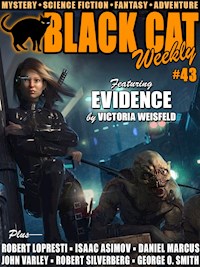
If you’ve been admiring our fabulous cover art, it deserves a second look, too. Here’s the full image:
It’s by a new artist who goes by the handle BlackDog1966. Great stuff.
Here’s the complete lineup:
Mysteries / Suspense / Adventure
“The Suicide Club,” by Robert Lopresti [Michael Bracken Presents short story]
A Wee Bit of Dough,” by Hal Charles [Solve-It-Yourself Mystery]
Evidence, by Victoria Weisfeld [Barb Goffman Presents short story]
Ruth of the U.S.A., by Edwin Balmer [novel]
An Uncanny Revenge, by Nicholas Carter [novel]
Non-Fiction
“Speaking with John Varley” [Interview with Darrell Schweitzer]
Science Fiction & Fantasy
“Jesus Christ Superstore,” by Daniel Marcus [Cynthia Ward Presents short story]
“Let’s Get Together,” by Isaac Asimov [short story]
“The Undamned, by George O. Smith [short story]
“Planet of Sand,” by Murray Leinster [short story]
“The Guest Rites,” by Robert Silverberg [short story]
Until next time, happy reading!
—John Betancourt
Editor, Black Cat Weekly”
TEAM BLACK CAT
EDITOR
John Betancourt
ASSOCIATE EDITORS
Barb Goffman
Michael Bracken
Darrell Schweitzer
Cynthia M. Ward
PRODUCTION
Sam Hogan
Karl Wurf
THE SUICIDE CLUB,by Robert Lopresti
“Why?”
“That’s what I want you to find out,” said Lieutenant Stone.
Laskin shook his head. “I get that. But why is it a police matter? Since when do we investigate suicides?”
Stone sat back, frowning. “Since your boss told you to?”
“A crime’s a crime,” said Oller. He was a decade older than Stone; a score older than Laskin. He had given up fighting with the scales three years ago when he quit smoking.
“You telling me,” said Laskin, “every time someone snuffs himself, we—” He paused, looking for words. “Delve into their psyche,trying to find their secret motivation? Are we cops or shrinks?”
“Some of us are cops,” said Stone. “Some of us are smart-asses.”
“I’m not missing something, am I? Was this possibly a murder?”
“Hell, no,” said Oller.
“Look,” said Stone. “The vic, Peter Augustyn, was a financier. Ran hedge funds. In today’s economy one of those guys killing themselves could knock the stock market for a loop. Let’s find out why he did it.”
“So now we’re economists.”
Oller covered a yawn. “This rich guy, he have a wife?”
“Sandra, yeah.”
“And being a rich wife, she probably worked with charities. Just like Chief Elmore’s wife.”
“Oh,” said Laskin. “Is that what this is about? The chief pulling strings?”
Stone threw his pen down on the desk. “I decide what cases you investigate, and I say you do this or go back on traffic patrol. Any questions?”
Oller stood up. “Nope. Let’s go.”
Laskin wheeled on him. “You’re okay with this?”
“Suicide’s a felony. Works for me. Let’s go get ’em.”
“Get who? The perp is dead.”
* * * *
“My husband had no reason to kill himself,” said Sandra Augustyn. She was in her thirties, probably fifteen years younger than the victim.
She was talking to the detectives in a room she called the library. It was almost as big as Laskin’s apartment, and certainly the contents were worth more.
“So, you think it wasn’t suicide?” he asked.
She glared at him. “He left me a note and hit a bridge abutment at sixty miles an hour. Of course, it was suicide. But it doesn’t make any sense.”
She was a beautiful woman but suddenly she looked like a child. She hugged herself. “I thought we were happy. I know I was. Then he does this, without a hint that something was wrong. Unless I missed it.”
“People don’t always give you any warning,” said Oller.
She shook her head. “It just—It twists my whole view of reality. Like maybe the furniture will start talking to me. If something I was so sure of was wrong, what can I believe?”
“You need closure,” said Laskin.
“Is that it?” She seemed to think about the word. “Maybe so. Please, detectives. Tell me why Peter did it.”
* * * *
“Guilt,” said Laskin, as he started the car. “She’s afraid it was her fault, somehow. She wants us to find a terminal disease, or a drug addiction. Something that takes her off the hook.”
“Or maybe some master criminal set it up to look like a suicide,” said Oller. “According to you. That was the second time you suggested it might be murder.”
“Give me a break. I wanted to know if she thought it was murder.”
Oller shook his head. “Trouble with you, sonny, is you’ve watched too many detective shows. Out in the real world there ain’t no mastermind criminals, no dogs in the night, no dying messages. Did I ever tell you about the time somebody left a dying message?”
“Don’t call me sonny.”
“This was back when I was partnering with Jimmy Patrice. A businessman was killed downtown. Broad daylight. He’d been walking past the Kugot Playfield, which was cocaine central back then, but nobody figured the businessman being a customer. Somebody shot him, though.”
Laskin glanced over. “Who heard the dying message?”
“Some tourists who rushed over. Didn’t see the shooter, but one of them knelt down. The vic looked up and said ‘Jay Miller.’ Clear as day.”
“So, you started looking for Jay Miller.”
“And there weren’t any in the phone book, but there was James, and Jane, and so on. A Richard Miller lived two blocks away, so we sent uniforms to check him out. That’s when the victim’s cell phone rang.”
“And it was Jay Miller?”
“Nope. The vic’s wife, wondering where he was. They’d gone downtown to go shopping. He’d dropped her off and went to park the car. We broke the news and interrogated her. She didn’t know any Jay Miller. Had no idea why anyone would want hubby dead.”
“Tell me there’s a point to this story.”
“We set a couple of prowl cars looking for the victim’s car. Finally found it at the corner of J Street and Miller Avenue. J Miller.”
“For God’s sake,” said Laskin. “He used his last words to tell you where he parked?”
“I guess it was on his mind.”
“You find the killer?”
“Yeah. It was a drug deal gone bad. Hubby had been shopping for crack.” Oller sighed. “Proving you can’t judge by appearances. And there ain’t no such thing as dying messages.”
* * * *
Tom Boley, the city’s questioned documents expert, had an office one flight up from the forensics laboratory. He was a skinny man with a buzz cut.
“Handwritten suicide note. Fingerprints team found the vic’s and his wife’s.”
“And you’re sure Augustyn wrote it?”
“To a moral certainty. No sign of copying, no forger’s tremor.”
“Can you tell what kind of mood he was in?”
Boley stared at Laskin. “Not too jolly, I guess, considering it’s a freaking suicide note.”
“I mean, can you tell us anything from the handwriting?”
“That’s not what I do. That’s graphology, and it’s voodoo science.” Boley shoved the document back across the table at them. “But you could show the note to a suicidologist.”
“You’re kidding,” said Oller.
“What?”
“Suicidologist. That ain’t a word.”
“Look it up. There’s a good one at the university, in the Sociology Department.”
“Okay. Sociology is a word.”
* * * *
“Now we’re doing sociology,” said Laskin. He threw the car into drive with a jerk. “When I made detective, I thought I would be solving crimes, for God’s sake.”
“Quit whining. I’ve had a gold shield for thirteen years, and I’ve investigated more kinds of crimes than you can imagine. Crimes that aren’t even illegal anymore. I’ve had three partners—”
“Four.”
“What?”
“You don’t think I remember all the partners you’ve talked about? Brownie, Patrice, Spender, and me. That’s four.”
Oller snorted. “You ain’t my partner, sonny. I’m just babysitting you while they decide whether you’ve got the stones for the job.”
“Don’t call me sonny.”
* * * *
Laskin figured a woman who studied suicide for a living would be a Goth type, all in black, with tattoos and piercings.
Dr. Gigi Spark was none of the above. In her mid-thirties, she wore a scarlet top and a white skirt. No visible markings.
“Suicide notes fall into four categories,” she lectured, “with surprisingly little overlap.”
She raised one finger. The nail was also scarlet. “First type: apologetic. I’m sorry to do this but I can’t stand it anymore.”
“That’s what we have here,” said Laskin, holding out the document.
“Wait,” said Oller. “I want to hear the other types.”
Spark nodded. “Two: angry. Look what you made me do, you son-of-a-bitch. Three: Informative. My will is in the desk, and by the way, I probably gave you the clap.”
“Maybe a little anger in that one,” noted Oller.
“Could be.”
“Type four?” asked Laskin.
She stretched across the desk to a pile of paper. “I was looking at one when you came in. It starts: The warriors have commanded it. The seven devils have justified it.”
“Whacko,” said Oller.
“We prefer the term altered. Now may I see the note?”
She pushed her reading glasses up her nose. She had a nice nose, Laskin noted.
Sandra,
This had nothing to do with you. I am so sorry, and I see no other way out but this. Please try to forgive me...
“Apologetic, right?” said Oller.
“Yes,” said Spark. “But do you notice the odd thing about it?”
The cops frowned and bent over the desk. “No.”
Spark sighed, like a teacher dealing with dull students. “The standard apology is I’m sorry that I have to kill myself. Your man says I’m killing myself because I’m sorry.”
“And that makes a difference?” asked Oller.
“It raises a question,” said Laskin. “What was he sorry about?”
“I don’t know,” said the professor, “but his wife does.”
“She says she doesn’t.”
“Then either she’s lying, or she doesn’t know she knew the reason, or maybe he was just wrong.”
* * * *
“Let’s talk to the widow again,” said Laskin, over lunch at Oller’s favorite diner.
“And ask her what exactly?” He took a bite of his cheeseburger. “She’s already said she doesn’t know why he’d kill himself. Let’s try the business partner.”
“You’ve got bacon hanging out of your mouth. How can you eat that stuff?”
“Salad,” said Oller, “is for rabbits.”
* * * *
“We’re still in shock from Peter’s death,” said Henry Wu. He was a trim man in his forties, wearing a long-sleeved white shirt and a bow tie. He had kept them waiting almost an hour while he talked to someone in Hong Kong.
“You two ran a hedge fund?” said Oller.
“Several, actually.”
“How did you survive the real estate debacle?” asked Laskin.
“Damned well, considering,” said Wu. “And that’s because of Peter. I was ready to jump into those crazy mortgage deals, because everyone else was. Just following the lemmings. He convinced me they didn’t make mathematical sense. We looked like cowards for a while, but now we look like geniuses.” He shook his head. “We.”
“So, your funds are worth as much now as, say, two years ago?”
“Of course not. We took on water like everyone else, but our ship isn’t sinking. I was just talking to Peter last week, saying that when the recovery comes, we’ll be in great shape, because our judgment was proven right.” Wu raised a hand. “His judgment. I still can’t believe he’s gone.”
“Can you think of any reason for him to kill himself?”
“None. Before you ask, as far as I know his marriage was fine.”
“No girlfriends?”
“Used to play the field. But a week after he met Sandra, he told his secretary not to forward personal calls from any women but her. As far as I know he was still nuts about her.”
“Can you think of anything he would need to apologize to her about?” asked Oller.
Wu frowned. “We all have regrets, Detective. I can’t imagine what he felt bad enough to end his life about.”
* * * *
“The whole thing is a fool’s errand,” said Laskin, as they drove away.
“The paycheck’s the same whatever they tell us to do.”
“Don’t you want to earn your pay?”
“There’s lots of ways to earn it, sonny.” Oller’s hand went to his jacket pocket, fumbling for cigarettes that he had thrown away three years before. “I ever tell you about the time Spender and I had to go through a dumpster looking for a gun? The killer was caught a block away from the vic’s store, and we knew he’d chucked the weapon somewhere. Spender was wearing a skirt, too, and she was terrified something would crawl up her legs. Fearless under gunfire, but rats gave her the heebie-jeebies. Christ, the stink. We had to throw out everything we were wearing.”
“So did you find the gun?”
“Yeah. No fingerprints on it, so it didn’t help with the case. Perp pled guilty anyway and Spender wanted to sue him in small claims court for the price of her suit.”
* * * *
“I’m too busy,” Sandra Augustyn told them over the phone the next morning. “The funeral is tomorrow. Contact me after that.” And she hung up.
“She’s got some nerve,” said Laskin. “She started this. Now she’s got us chasing our tails.”
“Mourners aren’t known for practicality,” said Oller. “When you get old enough to lose a few relatives you’ll find out.”
“How old do you think I am? I’ve been to funerals.”
“You’ve told me your grandfather’s still kicking. Both parents alive?”
Laskin shuffled papers on his desk. “What are we supposed to do until her grace consents to see us?”
“I’ll call Wu. See if he can name some friends for us to check with. You go through our open cases. Who knows, maybe you can catch a murderer.”
The business partner called back just as Oller was getting ready to go to lunch. “Detective, I just got a phone call from someone you need to want to talk to. He found Peter’s card in his partner’s papers. And his partner killed himself last week.”
* * * *
Kirk Worley lived in a condo on the riverside, a neighborhood and building that said money as clearly as Augustyn’s mansion.
Worley was a thin man with curly blond hair. “Business partner? No. Leonard was my lover. If we lived in Canada, he would have been my husband, but that’s not allowed down here, is it?”
“We’re sorry for your loss,” said Laskin. “We understand Mr. Federico died last week?”
“Six days ago.” Worley shook his head. “It feels like last night, or ten years ago. It doesn’t feel real, that’s for sure.”
“We hear he shot himself.”
“Yes. There’s a garden zone on the east side, where city-dwellers can grow vegetables. We have a little piece of land there. It was Leonard’s; digging in the dirt was never my idea of fun.”
Worley was standing by the fireplace, looking at a photo of two men on the mantle. “There’s a little shed there. Maybe he kept a gun in it; I had no idea he owned one.”
“Where were you when it happened, sir?”
“Visiting friends in the next state. They were having a housewarming party. Leonard had been in a bad mood for days, but he insisted I go. Said he wanted some time alone.”
Worley sat down. He was looking past the detectives, seeing something far away. “He called me, said it was to make sure I got there safely. He asked to speak to our friends; wished them well. Then he hung up and called nine-one-one. Told them where to find his corpse.”
He smiled. “Leonard loved this house. I guess he couldn’t bear to see it turned into a crime scene. But I have no idea why he called me. Didn’t even say goodbye.”
The cops looked at each other. “Were you his heir, sir?” asked Laskin.
“I’ll get most of his money. What’s your point?”
“Maybe he called to make sure you wouldn’t be a suspect. Your friends can prove you were nowhere near the scene when he died.”
The young man blinked. “I never thought of that.”
“He didn’t leave a note?” asked Oller.
“No. I have no idea what he was so upset about. He wouldn’t talk about it. Of course, I didn’t think he would do this. If I had—”
“Look at how he prepared this,” said Laskin. “He made sure you wouldn’t know. You can’t blame yourself.”
“Can’t I?”
“Look, Mr. Worley.” Oller turned a chair around and sat directly in front of the man, his face a foot away. “Suicide is stupid. Somebody called it a permanent solution to a temporary problem. If we live with someone for years, we see them fighting through plenty of bad times, so it’s the most natural thing in the world for us to think they’ll get through the next problem too. We don’t expect the people we love to suddenly turn stupid, do we?”
Worley stared at him. “Thanks, Detective. That helps, I think.”
Laskin cleared his throat. “Sorry to go over this again, but you aren’t aware of any money problems, personal problems, health worries, relationship troubles?”
“I wish I was. I called his doctor, thinking maybe Leonard had heard, you know, something bad. That’s when I started going through his address book, calling everyone to see if they knew something I didn’t.”
“And Peter Augustyn was in the book?”
“Yes. I had never heard the name, but that wasn’t unusual. Leonard knew a lot of people before I met him, of course. Do you know why that other man killed himself?”
“We’re trying to figure that out,” said Oller. “Can we borrow Mr. Federico’s address book?”
“And his calendar,” said Laskin.
* * * *
Oller spent the next day comparing the two victims’ address books and finding no other connections. Augustyn had not listed Federico.
Meanwhile, Laskin ran both men’s calendars through a computer.
“And did that get you anywhere?” asked Lieutenant Stone.
“Finally,” said Laskin.
“The kid’s a genius,” said Oller. “I would never have seen it.”
“The computer saw it. Turned out Augustyn had lunch the first Friday of every month at Maison Pierre.”
“Expensive place,” said Stone. “Did Federico eat there too?”
“He doesn’t mention it, but he had a meeting with M.C. at noon the first Friday of every month. The thing is, last year the Fourth of July fell on a Friday.”
“I love this part,” said Oller.
“Turned out both men moved their appointments to the last Friday of June. That struck me as a coincidence worth checking.”
“So, we asked Kirk Worley to check Federico’s credit card bills. Turns out he paid a big lunch bill at Maison Pierre twice last year.”
“And he ate there on first Friday’s,” guessed Stone. “With Augustyn and the mysterious M.C.?”
“Unless the price of frog legs is through the roof,” said Oller, “he was paying for more than three people.”
“I’ll bet somebody at the restaurant remembers them,” said Stone. “Bring photos. And, no, the Department won’t pay for lunch.”
* * * *
“Of course, I recognize them,” said the maître d’, whose name was René. “They are part of Monsieur Cutton’s party.”
“What’s Cutton’s first name?” asked Laskin.
“Matthew, I believe. He has dined here once a month for, I believe about two years.”
“And he always has the same guests?” asked Oller.
“I suppose the party has changed a bit over time. This gentleman—” He pointed to the photo of Peter Augustyn. “I believe he was the newest member.”
“Can you give us the names of the other members of the party?”
“I’m afraid not.”
“How long do you keep your credit card receipts?” asked Oller. “We need to see the ones for the first Fridays of each month.”
René shrugged. “As long as you are the ones to dig through them, I see no harm. You know, next Friday is the first. It’s a shame they won’t be coming.”
“How do you know that?” asked Laskin.
“Well, I just assumed, since Monsieur Cutton died, and he was the host.”
* * * *
The assistant coroner, Francis Reed, was a tall black man with an Afro haircut. He reminded Oller of Eldridge Cleaver. Laskin didn’t know who that was.
“Cutton died two weeks ago.”
“And why didn’t you include his name when he asked for a list of recent suicides?”
“Because he didn’t kill himself.”
“I’ll bet you he did,” said Oller.
“Deal,” said Reed. “How about a hundred?”
“You’re on. So how did this alleged non-suicide occur?”
“Two a.m. on a Sunday morning Cutton was on Grace Avenue. A truck driver went through a red light and hit him at double the speed limit. And speaking of double, that was the truck driver’s blood alcohol level.”
Reed grinned. “When you figure out how Cutton arranged to kill himself that way, let me know. Until then, you owe me a Franklin.”
Oller frowned. “That’s not fair. I didn’t know it was a real accident.”
“Pathetic. Pay up.”
He looked at Laskin. “How much have you got?”
Laskin sighed.
* * * *
“Show me the timeline,” said Lieutenant Stone. “This guy Cutton, who hosted the lunch parties—”
“But never paid, as near as we can tell,” said Laskin.
“He died on Sunday morning. His name wasn’t in the paper until Tuesday—”
“The department had to notify his family, who turned out to be a nephew.”
“Thursday Augustyn drove into a bridge abutment,” said Oller. “On Saturday Federico sent his boyfriend to a party and then blew his brains out.”
“That sure as hell is no coincidence. Why did one man’s accidental death cause two suicides?”
“The kid had a clever idea,” said Oller. “He thought maybe one or both of our suicides might have had something to do with the drunk driver. That could explain the guilt, especially since they knew the victim.”
“I thought maybe one of them owned the bar where the truckdriver drank,” said Laskin. “Something like that. But there’s no link.”
“It was a longshot,” said Stone. “Talk to the other members of the lunch bunch. How many were there?”
“The head waiter.”
“Maître d’,” said Laskin.
Oller sighed. “He says there were two other regulars. Both women.”
“Could that be it?” said Stone. “Something sexual?”
“Not likely in Federico’s case,” said Laskin. “And the maître d’ said they looked like businesswomen, not hookers.”
“Do we know how Cutton made his money?”
“Not yet.”
“Maybe there was a dodgy investment. Cutton dies and everybody loses his shirt. That could explain why Augustyn thought his wife would know the reason he was killing himself.”
“She says their finances are okay.”
“We’ll see the nephew first,” said Oller. “Maybe he knows what his uncle did for a living.”
* * * *
“Uncle Matt was a security consultant,” said Dan Bryce. “He told businessmen how to keep their offices and papers safe. Made quite a good living at it.”
He smiled. It wasn’t a very attractive sight. The nephew was in his thirties, overweight, and his curly hair was getting thin. His parents apparently couldn’t afford an orthodontist.
The detectives had come to his apartment, formerly Uncle Matt’s. It was a mess: all the DVDs near the giant TV had been removed from their cases and scattered around. The kitchen cupboards had received a similar treatment.
“Looking for something?” asked Oller.
“Just trying to know what’s here,” said the nephew. “I inherit everything so I’m taking stock, so to speak. I may move in.”
“Do you know any of these people?” asked Laskin, and he read off the list of the lunch crowd.
Bryce shook his head. “They don’t ring a bell. But I don’t understand exactly what you are investigating. There isn’t any doubt about the cause of Uncle Matt’s death, is there?”
“No. But there have been some mysterious deaths since then.”
“Really.” He looked thoughtful. “Maybe you could give me a copy of that list. In case I come across something in Uncle Matt’s papers.”
“We can do that.”
He brightened. “Excellent. What else can I do for you?”
* * * *
“He’s up to something,” said Oller.
“Why do you say that?”
“Nobody’s that eager to talk to a cop unless he’s up to something.”
Laskin sighed. “We have the names of the rest of the lunch bunch. Naomi Hecht lives in Copper Gardens. That’s not too far from here.”
There was no answer at Hecht’s door.
“You think she may be in there?” asked Laskin.
“You mean, that she joined the club?” Oller thought. “Maybe. You smell anything funny? Or hear anything?”
“Like what?”
“A bathtub overflowing.”
They paused and listened.
“No sign of anything,” said Laskin.
“Then we try the other luncher.”
* * * *
Alice Tinker was an elegant woman in her late thirties. She was the marketing director at Cobb, Bright, and Hanson, which took up a whole floor on a building downtown.
She led them into a meeting room. “Thank you for being discreet, detectives. I’m new at this firm and being interviewed by the police is not, well... ”
“Not how you want to market yourself?” said Laskin.
She smiled. “Exactly. What’s this about?”
“Are you familiar with Peter Augustyn?” asked Oller.
“Peter? I know him slightly. What about him?”
“Were you aware that he killed himself last week?”
And now she looked astonished, but that only lasted for a second. It was replaced by an understanding. “I’m so sorry. I hadn’t heard.”
“How did you know him, exactly?”
“Mutual friend, I think. I’m not sure who.”
“How often did you see him?”
“Every month or two. Like I said, we were just casual... ”
She’s thinking it through, Laskin noted. And what she concludes is...
“There’s a little group of us who get together for lunch,” she said. “I suppose that’s how you found out about me.”
“Can we have the names of the others?” asked Oller.
She gave them the names they already had.
“How did you start having these lunches?”
“I believe Matt Cutton started inviting us. He did some consulting at the last company I worked for.”
“Security consulting?”
“I think so.”
“What did you talk about at these meetings?”
“Oh, all kinds of things. Some work, some pleasure.” She smiled blandly.
“You know Mr. Cutton died two weeks ago?”
“I heard. A terrible thing.” Her face was blank.
“What was your relationship with Leonard Federico?”
“Leonard?” Her eyes went wide. “Oh. Now I understand why you’re here. He died, too, didn’t he?”
“Another suicide,” said Oller. “Can you explain why two men would kill themselves a few days after Mr. Cutton died in a car accident?”
“I have no idea.” She looked thoughtful. “How is Naomi Hecht? I haven’t heard from her lately.”
“We’re trying to find her. Where does she work?”
“She does something complicated in the art world. Databases for auctions or something like that. I believe she works from home.”
“And if she isn’t at home?”
“Then I’m afraid I can’t help you, Detective. Are we done here?”
* * * *
“She knows something,” said Laskin, back in the car.
“Damn right she does. She knows why those two men killed themselves. She’s worried that the Hecht woman might have done the same thing.”
“Yeah. But if it had to do with that lunch bunch, why is she immune?”
They drove in silence for a while.
Oller asked, “You got the credit card bills from those lunches?”
“I printed it out. It’s in the file on the back seat.”
Oller leaned through the seats with a lot of grunts. “Here we go. The last time the Tinker woman picked up the check was six months ago.”
“So?”
“So, there were five people at those lunches, and it looks like Cutton never paid. Wouldn’t you say she was overdue?”
“Can we tell how many people ate at these things?”
“The bills trend lower in the last few months. Maybe Tinker dropped out.”
“About the same time she changed jobs,” said Laskin. “She changed—damn! I’ve got it.”
He started signaling for a left.
“Where are you going?”
“Back to talk to Tinker.”
* * * *
This time they waited almost twenty minutes.
“Did you find Naomi?” she asked.
“Not yet,” said Laskin. “We wanted to ask you one more question about Matt Cutton. You said he was a friend, but that wasn’t true, was it?”
Her face was grim. “I don’t know what you mean.”
“Let’s spell it out,” said Laskin. “Cutton was a security consultant. That meant he had access to computers, cameras, God knows what else. He died in what looked like suspicious circumstances and two of his associates killed themselves before they could have found out that his death was an accident. You see it?”
She folded her arms. “You better spell it out, Detective. I can be a little dense.”
“Cutton was a blackmailer,” said Laskin. “He told his victims that if he got killed all their secrets would be revealed. That’s why Peter Augustyn wrote that his wife would know why he killed himself.”
“So where are all those secrets?”
“Beats us. We’re going to try to figure that out. But maybe you can tell us why a blackmailer would have regular lunches with his victims.”
“I haven’t said I was being blackmailed.”
“Look,” said Oller. “If you were, you’re a victim. We’re not interested in what secret he may have known. We just want to make sure nobody else dies.”
“Like Naomi Hecht,” added Laskin. “So why the lunches?”
“Because he was a sadistic bastard.” Tinker shrugged. “Why else? He liked to watch us squirm, and for all of us to know that we were his victims.”
“Were there others or just the four of you?”
“There were more, or so he said. What made us four unique was that he couldn’t hide his identity from us. If I had received an anonymous letter threatening to reveal my secret, I would have known that only the man in charge of my office security could have sent it. But he said there were others who never knew who was bleeding them.”
“You stopped attending his parties a few months ago.”
“They weren’t parties! They were torture!”
“You quit when you changed jobs.”
She nodded. “My secret had to do with the last place I worked. When I switched jobs, I told him we were even. I still wanted my privacy, but it wouldn’t kill my career if he told, and if he did, I’d reveal he was a blackmailer. So, we agreed to a truce.”
“Do you know what kind of hold he had over Ms. Hecht? I mean, do you believe she would kill herself if she thought her secret might be revealed?”
“I have no idea. I never heard the other people’s secrets. But I think Naomi is a stronger person than that.” Tinker rubbed her upper lip. “Detective, if it looks like those secrets are coming out, would you let me know?”
“We’ll give you all the warning we can,” said Laskin.
* * * *
“That was good thinking,” said Lieutenant Stone.
“It was the kid,” said Oller. “I’ve got too logical a mind to dream up a monthly blackmail party.”
“Good job. What’s your next step?”
“The nephew again,” said Laskin. “See if he’s got that stash of secrets.”
“No,” said Oller. “We go see the lawyer that filed his will. That’s where the list would be.”
“Do the lawyer,” said Stone. “But check on the Hecht woman first. I don’t want to find her dead if we can avoid it.”
* * * *
There was still no answer at Hecht’s apartment. They left a note under the door.
On the way down the stairs Laskin, peaked through the glass window of the mailbox door. “Only two envelopes and an ad. She can’t have been gone long.”
The manager of the condo had no forwarding address.
“Dead end,” said Laskin. “So, we try the lawyer. What are the odds he’ll tell us anything useful?”
“Slim, lawyers being lawyers. But let me tell you about a trick Brownie dreamed up once. It has to do with rich men and their hobbies.”
* * * *
“Mr. Cutton’s death was tragic,” said Benjamin Peer. Laskin thought he looked like something out of Dickens, with a balding head framed by white wisps and a narrow goatee. The wire spectacles he peeked over added to the image.
What didn’t fit were the framed photos of BMWs that hung on each wall of the office.
“Are you involved in prosecuting the truck driver who hit him?”
“We’re looking into another matter,” said Oller. “We heard Cutton left everything to his nephew. Is that correct?”
Peer nodded. “Wills are public record, of course. Yes, Bryce got everything.”
“And we know there was a house and some cash. Was there anything else?”
The lawyer frowned. “Like what?”
“A safe deposit box. Or maybe something he kept on file with you.”
The frown deepened. “I think you need to ask Mr. Bryce about that.”
“I was hoping—”
“I’m sorry, Detective. Lawyer-client privilege.”
“Could you get us a phone number for Mr. Bryce?” said Laskin. “That’s not privileged, is it?”
Peer smiled. “I don’t think so. I’ll have my secretary find it for you. Is there anything else?”
“Just one thing,” said Oller. “Is that your silver BMW in the parking lot?”
Peer’s wispy eyebrows rose. “Yes, indeed. Is there a problem?”
“Not at all. I just love those cars. Is it an M3?”
The lawyer smiled. “Not quite. It’s an M5. Very rare.”
Oller shook his head. “I envy you, Mr. Peer. That’s what I’ll buy when I win the lottery.”
The lawyer laughed. “Would you care to see it up close?”
The big man rose to his feet. “Could we? That would be great.”
When they reached the outer office Laskin lagged behind. “Mr. Peer, you said your secretary... ”
The lawyer hesitated, halfway out the door. “Oh, right. Katie, give the detective what he needs, please.” And then he led Oller out, chatting about transmissions.
The secretary was a woman in her forties. She looked up at Laskin with gray eyes that had seen it all before.
“BMW fans,” Laskin explained.
“I guessed that. He doesn’t move that fast for anything else.”
“Mr. Peer said you could find us Mr. Bryce’s cell phone number.”
“No problem.” She turned to the computer screen. In a minute she had printed out a page.
“Terrific,” said Laskin. “Oh, one more thing. Did Cutton store anything with Mr. Peer besides his will? Maybe a box or a safe deposit key?”
“Nothing like that,” said Katie. “Just the envelope.”
Score one for Brownie. “A big manila envelope?”
“No. Just letter sized. I remember it because he used to change it every few months.”
“Change it? What do you mean?”
“He’d come in with a new envelope and Mr. Peer would have me shred the old one. They all said the same thing on the front.”
“What was that?”
Katie looked at the ceiling. “It went like this, more or less. ‘In case of my death or disappearance, please give this letter to my nephew, Dan Bryce. If he dies first, destroy it.’”
“Well, that’s a strange one.”
Katie smiled. “I’ve seen worse.”
* * * *
“So, you think that envelope was the packet of evidence he was using to blackmail them?” asked Oller.
“Too thin. The secretary says we’re talking about one page.”
“Then it told the nephew where to find the stash.”
“Maybe. But why change it every few months? Did he move it so often?”
“Doesn’t sound right.” Oller bit a knuckle. “You know what could need updating every few months? The list of people he was blackmailing.”
“I like that. So, the page said, ‘Here are the suckers and here is where to find the dirt on them.’”
“Next stop, nephew land.”
* * * *
“An envelope?” Dan Bryce blinked at them. “Oh, yes. I remember it now. What do you want to know?”
“What was in the envelope, Mr. Bryce?”
The young man was pouring himself another gin and tonic. “Well, it was personal. Sentimental, you might say. Memories of my mother, who was his sister.”
“Do you still have it?” asked Laskin.
“No, I don’t think so. Why do you want it?”
“Just part of the investigation.”
“Why would you throw out a letter like that?” Oller asked. “I mean, family memories, I think that would mean a lot.”
“I guess you and I are different, detective.” Bryce sipped booze. “Anything else?”
* * * *
“Was he lying?” said Lieutenant Stone.
“Sure,” said Oller. “But can we prove it?”
“We think he’s planning to continue the blackmail,” said Laskin, “but the only live victim we know of is Naomi Hecht.”
“Back to her. You’ve checked her employers?”
“Yup. And neighbors. No one has seen or heard from her.”
“Maybe she fled the country. Call Homeland Security and see if she flew in the last week.”
* * * *
It took two days to hear back from Homeland Security.
“This is interesting,” said Laskin. “They say she hasn’t left the country, and there’s a good reason for that.”
“Yeah?” said Oller. “Why’s that?”
“Her passport expired. She ordered a new one months ago, but with the backlog they just mailed it out this week. Too bad she can’t pick it up.”
“Wait a minute,” said Oller. “When you peeked in her mailbox what did you see there?”
Laskin frowned. “Two envelopes and a flyer, I think. Why?”
“I get more mail than that every day and I’m not a wealthy executive.”
“You think she’s been coming back to check for the passport?”
“Crap,” said Oller. “I hate stakeouts.”
* * * *
This time there were half a dozen letters in the mailbox.
“Let’s switch places every hour,” said Oller. “Otherwise, I’ll get cramps.”
Laskin took out a coin. “Call it.”
“Heads.”
“You win. Where do you want to start?”
Oller picked the car, parked across the street from the building. Laskin took up a post on the landing above the mailboxes. He’d been there twenty minutes when his cell vibrated.
“Yeah?”
“Nothing. How’s it going, sonny?”
“Don’t call me sonny. I’m wearing my shield on my jacket pocket, so I don’t have to explain to people what I’m doing here. You would think having a cop in the hallway would make people feel safer.”
“You haven’t told anyone who we’re waiting for?”
“I said we’ve heard someone was tampering with the mailboxes. Whoops.”
“What’s going on?”
“There’s an apartment door on the landing above. A five-year-old keeps peeking out at me.”
“You’ll be the talk of kindergarten tomorrow.”
Hours passed slowly. Laskin was starting his third shift on the stairs when his phone buzzed again.
“Heads up. Someone’s coming in, and she looks nervous.”
Laskin peered down from the landing. A woman dressed in a dark gray overcoat had unlocked the front door and slipped inside. After a quick look around, she hurried to the mailboxes. She opened 313.
“It’s her,” he said into the phone, and hung up.
Laskin waited until she had pulled out her mail before stepping out onto the landing.
“Ms. Hecht? I’m a police officer.”
The woman turned and ran for the front door. Oller was just pulling it open.
She threw the mail at him and backed away. “We just want to talk to you,” said Oller.
“Stay the hell away from me,” said Naomi Hecht. “I didn’t kill him.”
“Nobody said you did,” said Laskin, coming down the stairs. “Cutton died in an accident.”
“If that’s who you meant,” said Oller.
Hecht’s eyes were wide and red. She hadn’t been sleeping much. She backed up to the wall, trying to look at both cops at once.
“I have a right to be here,” she said. “Let me show you my identification.” She opened her purse and dug in.
“It’s okay,” said Oller. “We know who you are. Listen—”
“Gun!” said Laskin.
Oller was caught flatfooted, both hands empty, ten feet away from the muzzle of a small pistol. “Christ, lady. There’s no need for this.”
Hecht raised the gun toward her own temple. “I am not going to prison.”
“For what? Nobody killed Cutton. And whatever dirt he had about you, he never sent to the police. The only charge against you is waving a gun around.”
“You’re lying.”
“Please,” said Oller. “Augustyn and Federico already killed themselves for nothing. Don’t let Cutton score a hat trick.”
For a moment Hecht hesitated. Then she pressed the barrel against her temple and closed her eyes.
So Laskin shot her.
* * * *
“They must have introduced that tactic after I left the academy,” said Oller.
“I was improvising,” said Laskin. The ambulance was pulling away.
“Well, you did a hell of a job. Shooting her in the foot from that angle was quite a stunt. And it sure took her mind off blowing her brains out.”
“She’ll live to sue the city over her limp, I’m sure.”
“Here comes Stone. Listen, you want me to say she had the gun aimed at me? Then it’s a straight-up shooting and they’ll only complain about your aim.”
Laskin thought about it. “No. Let’s play it as it lies. If they don’t like it, I’ll take my medicine.”
Lieutenant Stone walked up. “Anyone hurt except the suspect?”
“No, sir.”
“Good. Laskin, I’ll need your gun.”
“The evidence techs took it.”
“Okay. You know the post-shooting drill?”
“Oller’s told me about it, sir.”
Stone nodded. “You’ll be on restricted duty till the review board does its thing. Go home and get some rest.”
“Aren’t I supposed to make a statement?”
“We know where to find you.”
* * * *
When Oller arrived the next day, Laskin was already at his desk. “Just talked to the hospital. Ms. Hecht is on suicide watch.”
“I’ll mosey over and try to explain that her secret is still secret.”
“Assuming the nephew isn’t sitting on a stash of evidence.”
“Let’s hope not. Have they—” Oller yawned.
“Late night?”
“Stakeouts don’t agree with me. Have they scheduled your hearing?”
“Later in the week. I’ll see what I can do from my desk. I wonder if we could get a subpoena for Cutton’s business records? He was using his company for a criminal enterprise.”
Oller made a face. “Picture the headlines. Cops Seek Security Firms’ Secrets. I’m guessing the lieutenant won’t buy it.”
“Maybe not. But, hey, I can ask. What else have I got to do?”
“Detectives?”
It was Dan Bryce, but Laskin barely recognized him. The nephew looked five years older than two days ago. His hair was a mess, and his shirt was half tucked in.
Oller stood. “Mr. Cutton, what can we do for you?”
“Jesus, don’t you guys read your own reports?”
“I’m sorry, I don’t know—”
“Someone tried to kill me last night!”
Laskin was tapping his keyboard. “Here it is.”
“Have a seat,” said Oller. “Coffee?”
“No.” Bryce’s hands shook as he sat down. “I was at a bar until two a.m.. When I got home and stepped out of the car, I saw a shadow at the other end of the parking lot. Then bang! Someone fired two shots at me.”
“What did you do?”
“I crapped my pants. Then I jumped in my car, slammed the door on my foot, and backed into a Subaru. But I got away before he could fire again.”
“Good for you,” said Laskin. “Can you tell us who it was?”
“No. I didn’t get any kind of a look at them.” Bryce frowned. “Him. It was a man. Or a big woman, I guess.”
“Tall?” asked Oller.
“Tall and wide. But look, it was one of the people on this list.” He pulled a folded page out of his pocket.
“What’s this?”
“Read it for yourselves.”
It was a neatly printed page.
Dan—
If I am murdered or die in suspicious circumstances. The killer is probably one of these people. Please give this list to the police.
“How long have you had this?” asked Laskin.
“That doesn’t matter. One of these bastards tried to kill me.”
“And why would they do that?” asked Oller.
Bryce ran his hand through his hair. “How the hell do I know? Maybe they don’t like my family.”
“Here’s a theory,” said Laskin. “Your uncle was a blackmailer. You inherited his stash of dirty little secrets. You tried to go back to the trough, and somebody didn’t like it.”
“That’s crap.” He shook his head. “Look, I didn’t see any reason to give you the list because by the time I got it everyone knew he hadn’t been murdered. So, what was the point?”
“Which of these people did you put the squeeze on?”
“Nobody!” He hesitated. “Maybe I was thinking about it. But I didn’t have my uncle’s evidence. It’s not in his condo. Maybe it’s locked up in his computer. Maybe he didn’t keep the evidence at all.”
“So why did someone shoot at you?” asked Laskin.
“Somebody thought I knew something.” Bryce stood up. ‘Tell them I don’t,okay? I’m totally ignorant. And I’m getting out of town. Gonna take a long vacation.”
* * * *
“It can’t be a coincidence,” said Lieutenant Stone. “Do you think he’s lying? Maybe he did try blackmailing one of these jokers.”
“I don’t think so,” said Oller. “He was too scared to make up stories.”
“If he had a clue who had done it, he would have told us in a heartbeat,” said Laskin.
“So, who’s on the list?”
“Most of them we already know. The suicides, plus Hecht.”
“Not Tinker?”
“No. I suppose Cutton figured she didn’t hold a grudge. But there are four new names. From what Tinker said, these were the ones who didn’t know who the blackmailer was.”
“Go talk to them. Take a uniform. One of them might be violent.”
“If you’d let me go—” said Laskin.
“Give it up,” said Stone. “Until you’re cleared for shooting Hecht you play only indoor sports. At least we know she didn’t shoot at anyone last night.”
“Just relax,” Oller said. “I’ll try not to have any adventures.”
* * * *
Max Bennedict was the president of a construction company. “I never heard of anybody named Cutton. And I sure as hell have never been blackmailed.”
“I’m glad to hear it,” said Oller. “But Cutton put you on a list of people who might want him dead.”
“And he was murdered?”
“Definitely not. But last night someone tried to kill his nephew. We think it might be someone who thought he was going to start the blackmailing over.”
“It wasn’t me. I was at a baseball game last night. I’ll give you the names of three people who saw me.”
“Thanks, sir. We’ll get out of your hair.” Oller stood up. “By the way, I wonder if you ever did any business with Cutton’s security company.” He gave the name.
Bennedict froze. Then his face went so white Oller thought he was having an attack. “I’ll be a son of a bitch. So that’s how he found out about... ”
He trailed off. Whatever he was being squeezed about he wasn’t going to confess it now.
* * * *
Two of the other interviews went much like the one with Bennedict. Each of them denied being blackmailed until they heard the name of Cutton’s company. Oller didn’t think any of them had a clue that Cutton had been involved.
But the other interview was different. Ronald Vance was another wealthy man—a software millionaire, according to Laskin’s computer search.
The door of his house was opened by a maid. She invited Oller and the uniformed cop to wait in the drawing room.
“Why do they call it a drawing room?” asked the uniform, a skinny guy named Fogle.
“It’s where they play draw poker,” said Oller. “They have a stud room next door.”
“If you don’t know, just say so.”
Vance joined them ten minutes later. He was in his fifties, not fit, and had started drinking early.
Oller introduced them. “We’re investigating a violent incident—”
“I did it,” said Vance.
Oller froze. “Did what, exactly?”
“Killed that girl. But I swear it was an accident.” He frowned. “Aren’t you supposed to read me my rights?”
“Let me think about that. You aren’t in custody. Do you think you should be?”
“I told you, I killed that girl. Shouldn’t a murderer be under arrest?” He looked around as if the room was unfamiliar. “I want a drink. Do you want a drink?”
“Who did you murder?”
Vance sat down. “Aileen O’Cahn.” He spelled it. “I didn’t know that at the time, of course. She said her name was Emerald, but that was just a working name, of course. She was a working girl.” He laughed, hoarsely.
“And when did this happen?”
“June thirtieth, two years ago. The end of my life.”
“I thought it was the end of Ms. O’Cahn’s.”
“Hers too. My funeral has just taken longer to organize than hers. Maybe I could have gotten over what happened if it hadn’t been for the blackmail.”
“When did that start?”
“Almost a year ago. I received an email from somebody who said he knew I killed Aileen and I had to give him five grand a month.” He shook his head. “It isn’t the money. It’s the monthly reminders of what I did.”
“So, who was the blackmailer?”
He frowned. “How the hell would I know? I don’t even know how they found out.”
“How did you learn Emerald’s real name?”
“I used the Web to track news stories about her death.”
“And stored them on your computer?”
“Yes. Why do you ask?”
* * * *
“So, the suicide hunt wasn’t such a waste after all,” said Oller. They were at a table in the Blue Bag, having a beer. “We nabbed a murderer.”
“That’s great,” said Laskin. “I guess it was a lucky thing somebody took a potshot at Bryce and scared him into doing the right thing. We still have no idea who did that, right?”
“Well.” Oller put down his beer and looked around. “Unofficially, I might have an idea.”
“Yeah, who?”
He smiled.
“For God’s sake, no.” Laskin almost dropped his bottle. “Tell me you didn’t go out in the middle of the night and take a shot at the man.”
“Somebody had to convince him to stay out of the family business.”
“But, my god, you could have killed somebody.”
Oller shook his head. “You don’t think I’d use my service piece? That would be irresponsible. Criminal, in fact.”
“Well, I’m glad to hear it.”
Oller sipped beer. “On the other hand, a starter’s pistol makes all the noise and doesn’t fire a bullet. Plenty of scare, but no injuries.”
“I’ll be damned,” said Laskin. “You really did it.”
“I really did.”
“And I’m the one who’s suspended.”
“Nobody said the job was fair, partner.”
ABOUT THE AUTHOR
Robert Lopresti is a retired librarian who lives in the Pacific Northwest. He blogs at SleuthSayers and Little Big Crimes and is the current president of the Short Mystery Fiction Society.
A WEE BIT OF DOUGH,by Hal Charles
Amy Murphy always enjoyed visiting her Aunt Mary, especially at this time of year. Amy’s family had come to America from what they affectionately called the Old Country, and while they had adopted their new home with enthusiasm, a part of the Emerald Isle remained in their blood. And no time was this love more evident than around St. Patrick’s Day.
As Amy entered the kitchen, she was greeted by a smiling wisp of a woman standing by a huge stove that had prepared so many delicious meals for both family and friends. “Ah, Amy me girl,” Aunt Mary said with the accent that always seemed to grow more pronounced around this holiday, “the saints are smiling on your aunt today.”
Amy watched as her aunt practically danced over to the elaborately-decorated bread box that had been in the family as long as she could remember. “Your Aunt Mary has been visited by the wee people.”
“What?”
Mary opened the tin box and pulled out a large jar filled with bills and coins. “The wind has torn several shingles off the roof, and I’ve been saving to have it repaired.”
“What does that have to do with the wee people?”
“Since Mr. Hagan told me the cost of the repair, I’ve been sticking every spare cent in this jar,” said Mary.
“I’m still not following,” said Amy
“Truthfully, my savings haven’t amounted to much, and I was getting a little worried waiting for the roof to leak. Then I remembered the old stories about the wee people. Nana used to say that if you were a good person and truly believed, the wee people would help you out.”
“I don’t know,” said Amy, a hint of suspicion in her voice.
“Well, all I know is I invited some folks over today to join us for the St. Patrick’s Day parade on TV. Everybody was in the den when I decided to get a glass of water. Something told me to look in the bread box, and faith and begorra, there was a new $100 bill in the jar.”
“And you think it was put there by a leprechaun?”
“How else can you explain it?”
Amy didn’t want to spoil her aunt’s excitement, but her own curiosity wouldn’t let her leave this mystery unsolved. “Who are your guests in the den?”
Mary smiled. “Your cousin Kevin had the day off from the lumber yard and stopped by. And you know my friend and bridge partner Sadie Devlin. Then Virgil Stanton from down the street—”
“The Virgil Stanton,” said Amy teasingly.
“Oh, go on,” said Mary, a hint of red rising to her face.
As they entered the den, Amy ran some options through her mind. Not quite ready to accept the existence of leprechauns, she reasoned that one of the three guests must have slipped the bill into the jar.
Sadie Devlin had been Mary’s best friend for years. Amy had no doubt that Sadie would help her friend with the repair cost, but on a fixed income herself, could Sadie afford the generosity?
Money was certainly no problem for Virgil Stanton, who owned a thriving hardware store downtown. She had heard, however, that the businessman was extremely tight with his finances.
Amy’s cousin Kevin was a hardworking young man with a wife and two kids. With his job at the town’s only lumber yard, it was everything he could do to make ends meet.
Sitting down in a huge overstuffed chair, Amy studied the group. Kevin finished a glass of milk and set it down next to a sandwich plate filled with crumbs while Virgil Stanton fiddled with a cell phone as if expecting a call or text. Sadie Devlin seemed more interested in a bulky catalog than the television set.
“Faith and begorra, indeed,” Amy said under her breath as she realized wee people could come in unexpected sizes.
Solution
When Amy saw the crumbs on the plate in front of Kevin, she reasoned that he had made himself a sandwich and discovered the jar while looking for the bread. Working at the lumber yard, he had probably learned about the repair and its cost from Mr. Hagan, the roofer and decided to help out his aunt. As she watched the parade, Amy was content to let her aunt continue to believe in the generosity of the wee people.
EVIDENCE,by Victoria Weisfeld
The Barb Goffman Presents series showcasesthe best in modern mystery and crime stories,
personally selected by one of the most acclaimed
short stories authors and editors in the mystery
field, Barb Goffman, for Black Cat Weekly.




