



9,99 €
Mehr erfahren.
- Herausgeber: Atlantic Books
- Kategorie: Gesellschafts- und Liebesromane
- Sprache: Englisch
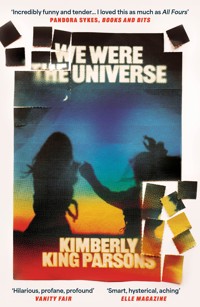
'The stories in Black Light are grimy and weird, surprising, utterly lush... I loved every moment of this book.' Carmen Maria Machado, author of Her Body and Other Parties _____________________ A black light illuminates that which the eye doesn't see, uncovering what is hidden in plain sight. In this raw, compassionate, debut collection Kimberly King Parsons casts light onto the weird, the intimate, the eerie and the sublimely beautiful with unflinching gaze and ferocious eloquence. Over twelve crackling stories, each a glorious escape hatch, she captures the bright ache of first love, the claustrophobic shadows of desire, the obsessive nature of friendship and the rapturous pull of taboo. Filled with a frenetic longing for connection, her reckless yet resilient heroines exhilarate and charm as they pursue the promise of elsewhere. With psychedelic energy and deep humanity, Black Light chews over the messiness of being alive, the unsteadiness of hope and the ecstasies of coming of age.
Das E-Book können Sie in Legimi-Apps oder einer beliebigen App lesen, die das folgende Format unterstützen:
Veröffentlichungsjahr: 2020
Ähnliche


















KIMBERLY KING PARSONS
BLACK LIGHT
Kimberly King Parsons was born in Lubbock, Texas. She earned an MFA in fiction from Columbia University. Her writing has been published in The Best Small Fictions 2017, New South, Black Warrior Review, No Tokens, Egress, Ninth Letter, Indiana Review, Kenyon Review, The Paris Review, Bookforum, and elsewhere. She has been awarded fellowships and residencies from Columbia University, Writing by Writers, Hypatia-in-the-Woods, PLAYA, and the Sustainable Arts Foundation.
First published in the United States in 2019 by Vintage Books, a division of Penguin Random House LLC, New York.
Published in Great Britain in 2020 by Atlantic Books, an imprint of Atlantic Books Ltd.
Copyright © Kimberly King Parsons, 2019
The moral right of Kimberly King Parsons to be identified as the author of this work has been asserted by her in accordance with the Copyright, Designs and Patents Act of 1988.
All rights reserved. No part of this publication may be reproduced, stored in a retrieval system, or transmitted in any form or by any means, electronic, mechanical, photocopying, recording, or otherwise, without the prior permission of both the copyright owner and the above publisher of this book.
This novel is entirely a work of fiction. The names, characters and incidents portrayed in it are the work of the author’s imagination. Any resemblance to actual persons, living or dead, events or localities, is entirely coincidental.
Several pieces originally published in the following publications: “Fellowship” in Black Warrior Review (2016); “Fiddlebacks” in New South (2016); “In Our Circle” in NANO Fiction, Vol. 10, Number 1 (Fall 2016); “Nothing Before Something” in Indiana Review (Winter 2017); “The Soft No” in Joyland (2017); “We Don’t Come Natural to It” in No Tokens, Issue No. 6 (Spring/Summer 2017); “Into the Fold” in The Fiddleback, Volume 2, Issue 4; and “The Light Will Pour In” in Ninth Letter (Fall/Winter 2017-2018).
10 9 8 7 6 5 4 3 2 1
A CIP catalogue record for this book is available from the British Library.
Paperback ISBN: 978 1 83895 129 0
E-book ISBN: 978 1 83895 130 6
Printed in Great Britain
Atlantic Books
An imprint of Atlantic Books Ltd
Ormond House
26–27 Boswell Street
London
WC1N 3JZ
www.atlantic-books.co.uk
For Ronnie
Cut me open and the light streams out.
—Richard Siken, Crush
CONTENTS
GUTS
IN OUR CIRCLE
GLOW HUNTER
THE ANIMAL PART
FOXES
THE SOFT NO
WE DON’T COME NATURAL TO IT
THE LIGHT WILL POUR IN
INTO THE FOLD
BLACK LIGHT
FIDDLEBACKS
STARLITE
Acknowledgments
GUTS
WHEN I START DATING TIM, an almost-doctor, all the sick, broken people in the world begin to glow. Light pours from careful limpers in the streets, from the wheezers and wet coughers who stop right in front of me to twist out their lungs. People I once found gross or contagious are radiant, gleaming with need. The newborn on my bus shines like swaddled halogen—harnessed to his tired mother’s chest, he turns his jaundiced little face toward me, no matter where I sit. I’ve always been a noticer, but this tug from the hearts and minds and ailing bodies of strangers—this is all Tim’s fault.
“How can you stand it?” I say to him.
We’re at the movies, in the very back row, the theater—I swear—full of hidden rashes and shriveled limbs. I tell Tim that even the Jesus screamer—the guy who paws through my garbage and sometimes shits on my front stoop—he is now incandescent, his eyes drippy with hope.
“It’s too much,” I say. “Beautiful, shattered people everywhere. Is this what it’s like to be you?”
We’re too early, as usual. Trivia and local business ads flash on the big screen. The movie Tim has chosen is a comedy, a mistaken-identity caper with a pug dog in a supporting role.
“Nah,” Tim says, and yawns. One of his eyes closes. “I turn it on and off.”
Tim is a week into his internal medicine rotation, and I have so many questions. I’d rather be sitting across from him at the Chinese place, dumplings on the way, listening to him talk about patient histories and lab data, about how best to deliver bad news. I want to absorb it all—the lining of every wrinkle in his brain. But Tim is too tired to eat, exhausted from being on call. He picks movie dates because when the house bulbs dim he can drift off. He thinks he’s got me fooled.
“They’re all so fragile,” I say. I mean the strange heads in front of us, other people waiting for the lights to go out.
“Well, yeah,” Tim says. His device vibrates in his pocket. He takes it out and taps on it. “But unless I’m looking at somebody’s chart I don’t really think of them that way.”
Tim’s device flashes. He taps and taps. “Goddamn it,” he says. “Give me a second.” He steps into the aisle to call somebody important.
I’m wearing control-top tights over control-top underwear. With Tim occupied, I breathe a little deeper, take a break from sucking in.
An old woman enters the theater, staggers up the steps. She’s a bright spot in a lank dress, one arm bandaged at the bend. Loud blood beats in my ears. She’s every frail grandma, every elderly aunt I never visit, every maternal figure who has loved me in spite of my selfishness. I use my mind to help her safely up the steps, all the way to Tim, who has finished his call. Authority teems from him, even without a stethoscope around his neck. The woman leans in close and asks him something, where is she, is this the right place? Tim gestures directions, waves her away. She starts down, afraid to push off from the handrail. She shimmers, the type of woman who makes you heart food from scratch, recites the recipe while you eat.
Tim comes back to his seat and sighs hard. “That lady’s dumb nose touched my glasses,” he says. He holds them out, shows me a smudge on the lens.
He’s tired, a little cranky, maybe. I get back to the heads. “Is it like being a hairdresser?” I say. “Like you have to separate yourself or you’d be tortured by people’s bad choices? Awful perms?”
“Maybe,” Tim says. He uses his device to search for reviews of the film we are about to see. He reads them aloud. Tim has a voice that sounds like everything will be okay. It’s a tone they must teach in med school.
“Rip-roaring,” he says. “Hysterical but with heart.”
Tim starts breathing slow during the previews. He’s snoring a little by the opening credits. I lean into him, pose his hot arm around my shoulder. I put my hand into our bucket of slippery popcorn. I don’t tell Tim that I find movies in the theater confusing. The giant stars and their giant mouths are unsettling—the background actors unconvincing, living life with too much zeal. But I like going to the movies. I like plush seats and frigid air, all the dark snacking.
When I lose track of the plot, I lean away from sleeping Tim and reach into my huge, floppy purse. I feel around for contraband, one of the secret tallboys I picked up at the gas station. Onscreen, a bank teller insults the leading man while the dog pisses on a potted plant. I look at the descending theater heads and some of them start to flicker. I see a tiny black tunnel spiraling through one guy, his brain tissue eaten away and peppery in places. I guzzle the tallboy through a car chase and a madcap karate fight. I watch the sick, sparkly heads and hope these people can make peace with what’s happening to them. I know there’s nothing to be afraid of—death is just a countdown to the calm—but I’m doing that thing where I can’t pull the oxygen from the air, where everything I look at gets smeary at the edges.
I drink and drink and focus on the threads coming together onscreen. The leading man is vindicated. The pug wears sunglasses and drives a car, its little paws on the steering wheel. I pop tallboy two. Tim’s mouth falls open.
TIM MOVES THROUGH HIS rotations and I move along behind him, picking up shards of knowledge, trying to make sense of them. When he isn’t exhausted, he entertains my questions.
“Pretend I’m a first-year,” I say. “Leave nothing out.”
I want to know about lumbar punctures, so Tim touches my spine while I brush my teeth. He uses his finger to dig into my lower back.
“This is the spot,” he says. “Between L4 and L5. You draw a line from the iliac crest.”
I’ve seen the crest he’s talking about, that scooped bowl of bone on the hips of supermodels and centerfolds, but I’ve never seen mine. Tim is already dressed, a silver pen clipped to the pocket of his lab coat. He talks to my lumpy, naked reflection, raps his hard knuckle between my vertebrae.
“I’m amazed you can find a bone anywhere on me,” I say.
I spit white foam into the sink. Tim says spinal taps are easier to perform on infants because their bones are still soft.
“Like a needle into butter,” he says.
I shudder and ask if he’s afraid of paralyzing a baby.
“Those itty-bitty bones!” I say. “Their wittle tiny backs! What if you mess it up?”
Tim tells me again he’s the best in his class—there were no white blood cells in his last spinal.
“They call it a champagne tap,” he says. “The chief resident buys you a bottle to celebrate.”
He looks at his hand on my back and frowns.
“May I?” he says.
He pushes until his knuckles find the buried grooves in my spine. He works his fist up the column of bone, straightening me out as he goes. He rests his palm on the back of my neck, then braces his other forearm across my chest.
“What’s this, the Heimlich?” I say. It’s a rough kindness, this unexpected attention, and it flusters me.
Tim concentrates on shifting everything about me inward and upward. Once he’s satisfied, he holds me in place, backs slowly away. My reflection looms in the foreground. He has made the difference in our heights obvious. I’m so much wider than Tim and now I’m taller, too. He assesses his work, finishes with an upward tilt of his head, which I mimic.
“Better,” he says. “So much.”
“I know, I know,” I say, holding the pose.
“Don’t shrink yourself,” he says, serious. “Take up your space.”
“Oh, that’s no problem,” I say. “That, I’m great at.”
“Stop it,” he scolds. “Don’t put yourself down.”
He steps in front of me and turns off the water, uses one of his monogrammed hand towels to dry the basin.
“Look at you!” he says. “I like it.” Then, quietly, he says, “I like your size.” And suddenly it’s there, my size, this third person in the room with us.
Tim looks at himself in the mirror and shows his teeth. The steam from the running shower fogs up his glasses. He takes them off and uses his lab coat to rub the lenses. I start to slouch.
“Quit holding your breath,” he says. “Don’t lock your knees.”
“There’s no way this is how real people stand,” I tell him. “It’s exhausting.”
“Good posture takes muscle memory and mental effort, both,” Tim says. “Use your brain until your body gets it.” Tim moves through the world like a human clipboard.
He goes to make the coffee, and I rush to take a shower. He says it’s better if we leave at the same time. “That way we can enjoy each other’s company in the car,” he says. I don’t have a key to his place.
In the car Tim plays the classic rock station. He slurps coffee from his thermos and steers with his knees. He floats through traffic, catching every green light. It’s still dark when he drops me at my office. He parks head out in a handicap space and leans over me to open my door.
“Have a productive day, babe,” he says, and taps my nose.
“You, too,” I say. “Good luck with all the guts.”
The car rises when I get out. Tim turns up the radio and powers down the windows. I use my big purse to hide my ass as I walk away.
I don’t have a key to the office, either, so I go across the street to sit on the benches in the park. I eat a few bites of the toast Tim packed for me. He uses a plant sterol called Take Control! instead of butter. He says it’s scientifically proven to lower cholesterol in rats. It tastes like ChapStick melted down. Eventually, I give up and throw hunks of bread at some birds. I peg one square in the chest, and it stands there, stunned.
Your size.
Tim is on a program of radical truth telling, and he says it’s setting him free.
Nobody else is around—no moms with babies, no joggers jogging—so I tie my hair back and take out my onehitter. It’s another secret from Tim.
“Drinking is one thing,” he tells me. “But pot keeps people from reaching their potential.”
I get a little bit high, watch the world wake up.
There’s a lit window at the Arby’s where a cute cashier once mocked me for my big lunch order, ruining the place forever. I wonder if it’s the same kid opening shop, if he’s the one up early, cleaning grease traps, pushing a mop around. So many places have been wrecked for me. One mortifying moment triggers all the rest. It starts with fast food and radiates outward, a map of shame. Usually these thoughts make me feel like I’m being pushed to the ground, somebody’s knee on my chest, but now I’m detached, each embarrassment an object resting in front of me, something to be picked up and weighed in my hand. That’s the weed working.
There’s the skating rink where a boy with fluorescent braces broke my teenage heart. There’s the jagged sidewalk where I rolled my ankle and some asshole called out, “Timber!” as I fell. There’s the public pool where I misinterpreted a friend’s intense stare, his fingers grazing my bare shoulder. “It was a mosquito!” he squawked, my hand already on his underwater dick.
I keep reloading the one-hitter. It’s still so early. The weed I have is threaded through with little hairs. Colors start, everything gets pretty and crisp, exaggerated. There’s something about how pot releases pressure in your eyeballs. Tim would know. Warm light slides around for a while. I blow smoke, and pink clouds stream across the sky.
After a while the birds get beady-eyed and silent, suddenly judgmental, cocking their heads to see me from different angles. The sunlit trees are too leafy, overwhelming. Crickets get rowdy in the bushes, and for a second I think the hood of my jacket is a person looming behind me.
“People respect the truth,” Tim always says. I contemplate taping a note to the office door that says: Got high. Got too high. Had to go home. The birds finish my toast and then fly up and swarm with their friends, all of them swirling and looping into one big-ass bird.
When the coffee shop opens, I take a table by the window, lick lavender glaze off a doughnut. It’s sublime. I flip through free circulars and wait for nine o’clock.
IRENE DRAGS ONE OF the lobby chairs up to my desk. I keep an eye out for Mr. Beezer, who doesn’t like chitchat.
“Are vitamins a waste of money?” Irene asks. She uses one of her business cards to pick her teeth. “Because I heard you just pee them out.”
She pulls a glob of plaque off the card, rolls it between her fingers.
“What about homeopathy?” she asks. “What does that even mean?”
I shouldn’t have bragged to Irene about Tim, how he’s a white-hot star being singled out for greatness in life.
“I don’t know,” I say. “I’ll ask him.”
Irene puts her business card back in the acrylic holder on my desk. Irene’s cards are displayed behind Mr. Beezer’s. Irene is Mr. Beezer’s assistant. When I’m not answering phones or greeting visitors or making coffee, I am Irene’s assistant.
The lobby is empty. A man’s overcoat is draped across one of the couches.
Mr. Beezer’s office door is closed and he’s turned his line to “unavailable.” Irene’s door is open. A steady stream of AM talk drifts from the plastic radio on her desk. I trace the outline of my hand on company stationery.
“Ear candling’s a joke, probably,” Irene says, and scrapes at her fingernail polish with my letter opener. She makes a pile of red flakes by my stapler.
Irene’s radio says, “Prices are slashed! Slashed! Slashed!”
She bites at a hangnail. “Ask him about gargling with salt water, too,” she says. “I heard that’s a scam. I heard the salt people made that up.”
My pen is out of ink. I trace manic invisible circles on the message pad, the top of my desk, the back of my hand.
The phone rings, and I recite the greeting script. Mr. Beezer says the person on the other end can hear a smile, so I smile. Irene keeps looking at her nails, but she mouths along and smiles, too, toothy and deranged.
“It’s for you,” I say, and transfer the call to her office. She stands up and breaks into an awkward gallop. It’s possible that Irene is slightly fatter than I am. She’s shorter, and though my thighs are definitely smaller, my waist is maybe bigger. Tim says the eye prefers a 0.7 waist-to-hip ratio—there have been studies.
“I could care less,” he’d said. “Or I couldn’t care less, whichever. I mean ratios don’t matter to me, obviously. It’s just a fun fact.”
Obviously.
It’s possible the eye prefers Irene, even if she’s bigger overall.
When Irene’s door closes I use one of Mr. Beezer’s cards to rake the red slivers of nail polish into the wastebasket. I move the chair back into place and make my pass through the lobby, situating a disrupted nesting table and hanging the overcoat on a brass hook. I pluck fuzz off an ottoman.
Mr. Beezer wants the lobby to feel like a living room, a place indicative of the homes he sells. Every morning, I float fresh rose petals in cut crystal bowls. I fluff throw pillows and spritz the room with cookie-scented air freshener. Unfortunately for Mr. Beezer, an office is still an office. The fluorescent light is harsh on the paisley wingbacks and brocade window treatments. The ceiling tiles are institutional. A copy machine dominates the north wall, its yellow extension cord trailing under the Oriental rug. My desk is the biggest giveaway, though I keep my wastebasket out of sight and hide my Kleenex box under a floral printed cover. It’s too bad the clients don’t see the room from behind my desk, where the perspective is slightly more convincing.
In the break room I rinse out coffee mugs in the sink. Irene comes in with one of Mr. Beezer’s files.
“This wasn’t in the right place,” she says. “Not even close.”
“Oh, no,” I say. I turn off the water and dry my hands on my skirt. “I’m so sorry.”
Tim keeps telling me to stop being so sorry for everything all the time.
“I don’t apologize for anything, ever,” he says. And it’s true, he doesn’t.




