


123,99 €
Mehr erfahren.
- Herausgeber: John Wiley & Sons
- Kategorie: Wissenschaft und neue Technologien
- Serie: Wiley - IEEE
- Sprache: Englisch
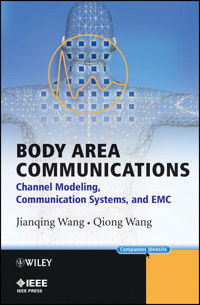
Providing an introduction to the fundamentals of body area communications, this book covers the key topics of channel modeling, modulation and demodulation, and performance evaluation
A systematic introduction to body area networks (BAN), this book focuses on three major parts: channel modeling, modulation/demodulation communications performance, and electromagnetic compatibility considerations. The content is logically structured to lead readers from an introductory level through to in-depth and more advanced topics.
- Provides a concise introduction to this emerging topic based on classroom-tested materials
- Details the latest IEEE 802.15.6 standard activities
- Moves from very basic physics, to useful mathematic models, and then to practical considerations
- Covers not only EM physics and communications, but also biological applications
- Topics approached include: link budget, bit error rate performance, RAKE and diversity reception; SAR analysis for human safety evaluation; and modeling of electromagnetic interference to implanted cardiac pacemakers
- Provides Matlab and Fortran programs for download from the Companion Website
Sie lesen das E-Book in den Legimi-Apps auf:
Seitenzahl: 366
Veröffentlichungsjahr: 2012
Ähnliche



















Contents
Cover
Title Page
Copyright
Preface
Chapter 1: Introduction to Body Area Communications
1.1 Definition
1.2 Promising Applications
1.3 Available Frequency Bands
1.4 Standardization (IEEE Std 802.15.6-2012)
References
Chapter 2: Electromagnetic Characteristics of the Human Body
2.1 Human Body Composition
2.2 Frequency-Dependent Dielectric Properties
2.3 Tissue Property Modeling
2.4 Aging Dependence of Tissue Properties
2.5 Penetration Depth versus Frequency
2.6 In-Body Absorption Characteristic
2.7 On-Body Propagation Mechanism
2.8 Diffraction Characteristic
References
Chapter 3: Electromagnetic Analysis Methods
3.1 Finite-Difference Time-Domain Method
3.2 MoM-FDTD Hybrid Method
3.3 Finite Element Method
3.4 Numerical Human Body Model
References
Chapter 4: Body Area Channel Modeling
4.1 Introduction
4.2 Path Loss Model
4.3 Multipath Channel Model
References
Chapter 5: Modulation/Demodulation
5.1 Introduction
5.2 Modulation Schemes
5.3 Demodulation and Error Probability
5.4 RAKE Reception
5.5 Diversity Reception
References
Chapter 6: Body Area Communication Performance
6.1 Introduction
6.2 On-Body UWB Communication
6.3 In-Body UWB Communication
6.4 In-Body MICS-Band Communication
6.5 Human Body Communication
6.6 Dual Mode Body Area Communication
References
Chapter 7: Electromagnetic Compatibility Considerations
7.1 Introduction
7.2 SAR Analysis
7.3 Electromagnetic Interference Analysis for the Cardiac Pacemaker
References
Chapter 8: Summary and Future Challenges
Index
This edition first published 2013
©2013 John Wiley & Sons Singapore Pte. Ltd.
Registered officeJohn Wiley & Sons Singapore Pte. Ltd., 1 Fusionopolis Walk, #07-01 Solaris South Tower, Singapore 138628
For details of our global editorial offices, for customer services and for information about how to apply for permission to reuse the copyright material in this book please see our website at www.wiley.com.
All Rights Reserved. No part of this publication may be reproduced, stored in a retrieval system or transmitted, in any form or by any means, electronic, mechanical, photocopying, recording, scanning, or otherwise, except as expressly permitted by law, without either the prior written permission of the Publisher, or authorization through payment of the appropriate photocopy fee to the Copyright Clearance Center. Requests for permission should be addressed to the Publisher, John Wiley & Sons Singapore Pte. Ltd., 1 Fusionopolis Walk, #07-01 Solaris South Tower, Singapore 138628, tel: 65-66438000, fax: 65-66438008, email: [email protected].
Wiley also publishes its books in a variety of electronic formats. Some content that appears in print may not be available in electronic books.
Designations used by companies to distinguish their products are often claimed as trademarks. All brand names and product names used in this book are trade names, service marks, trademarks or registered trademarks of their respective owners. The Publisher is not associated with any product or vendor mentioned in this book. This publication is designed to provide accurate and authoritative information in regard to the subject matter covered. It is sold on the understanding that the Publisher is not engaged in rendering professional services. If professional advice or other expert assistance is required, the services of a competent professional should be sought.
MATLAB® is a trademark of The MathWorks, Inc. and is used with permission. The MathWorks does not warrant the accuracy of the text or exercises in this book. This book's use or discussion of MATLAB® software or related products does not constitute endorsement or sponsorship by The MathWorks of a particular pedagogical approach or particular use of the MATLAB® software.
Library of Congress Cataloging-in-Publication Data
Wang, Jianqing.
Body area communications : channel modeling, communication systems, and EMC / Jianqing Wang, Qiong Wang.
pages cm
Includes bibliographical references and index.
ISBN 978-1-118-18848-4 (cloth)
1. Body area networks (Electronics) 2. Medical telematics. I.Wang, Qiong. II. Title.
TK5103.35.W36 2013
621.382–dc23
2012027876
Preface
The past decades have witnessed wide demand and applications for wireless communications in the human body area, that is, in the immediate environment around a human body. These demands and applications especially focus on wireless transmission and networking of personal information for user identification, healthcare and medical applications. Body area communication techniques make this more feasible. Compared with classical wireless communications, the human body acts as a communication medium either passively or favorably in body area communications. This is no doubt a kind of novelty in the context of classical wireless communications. As expected, the human body exhibits various different features from the typical wireless medium, that is, air, when it is used as a communication medium. Nowadays, more and more people are trying to uncover its intrinsic mystery so as to profit from the expected communication purposes.
As noticed by many researchers in this area, body area communications is an emerging technique which exhibits very good prospects not only in entertainment and user identification but also in healthcare and medical applications. The required knowledge ranges from wireless communications to bio-electromagnetics. In fact, we have been working in wireless communications for many years. The first author spent the first six years on completion of his doctoral work in developing wireless transceivers/systems for mobile communications and personal computer communications in both industry and research institutions, and then began bio-medical electromagnetic compatibility research after moving to a university. In 2005, when the first author became a full professor, it was felt that his background in both wireless communications and bio-electromagnetics would be very suitable to pursue this new research area. This triggered our full-scale research on body area communications.
Until now, however, there has been no textbook which systematically and completely covers this area and provides an introductory course for newcomers to this field. Two years ago, we started a course in this area for graduate students at the Nagoya Institute of Technology and for undergraduate diploma/master students at Dresden University of Technology, respectively. During the preparation of the lecture materials for these courses, we thought about how to gather our research to produce a systematic and introductory work. Fortunately, Mr James Murphy, a senior commissioning editor at John Wiley & Sons provided us with such a valuable opportunity. Following his kind invitation, we met him at an international conference in 2010 and discussed the contents of this book.
This book attempts to provide an introductory course for graduate students and newcomer engineers/researchers who need to know about or intend to be involved with body area communications. The book starts with an introduction to basic electromagnetic properties and modeling methods of the human body in various frequency bands that are available for body area communications. Next, the representative analysis techniques for body channel modeling are introduced. Based on the basic knowledge, the book focuses on three major areas: channel modeling, modulation/demodulation communications performance and electromagnetic compatibility considerations in body area communications. Most of the contents is based on the research in our laboratories.
The following topics will be described in detail from the viewpoint of an introductory course:
Available frequency bands and expected applications for body area communications.Electromagnetic properties of the human body in various frequency bands, and how to model them.Major propagation mechanisms in various frequency bands.Channel models for on-body communication and in-body communication.Modulation and demodulation schemes used in body area communications and their analytical error probabilities.Link budget, bit error rate performance, RAKE and diversity reception for various on-body and in-body modulation/demodulation schemes in the available frequency bands.Specific absorption rate analysis for human safety evaluation in the available frequency bands.Modeling of electromagnetic interference with implanted cardiac pacemakers, based on both electromagnetic field approach and electric circuit approach.Useful computer codes for channel model generation, bit error rate analysis and specific absorption rate evaluation.The completion of this book has been achieved by selfless contributions and help from many people. First, we would like to express our deep gratitude to the commissioning editor, Mr James Murphy, for providing us with this valuable writing opportunity, and to the project editor, Ms Shelley Chow, for her great assistance and patience in handling our manuscript. Without their support and effort it would have been impossible to publish this book. Secondly, we would like to take this opportunity to acknowledge the five anonymous referees who provided many constructive comments and suggestions, which helped us to finally form the framework of this book. Thirdly, we would like to thank our colleagues and students in our laboratory at the Nagoya Institute of Technology, especially Dr Daisuke Anzai and Dr Jingjing Shi for their contributions to the analytical and experimental data in this book. Finally, we also want to thank our families, Sufang, Moe and Mizuki in the first author's family, and Hui and Nina in the second author's family. We are sorry that we had to spend most of our spare time in writing this book rather than being able to spend our time with them. We are grateful to them for their support and understanding.
We sincerely hope that this book is both of interest and useful as an introduction for newcomers to this emerging and exciting research area.
Jianqing WangNagoya Institute of Technology
Qiong WangDresden University of Technology
Chapter 1
Introduction to Body Area Communications
The ever-advancing miniaturization and low-power consumption of electronic devices, combined with recent developments in wireless communication, is leading to a rapidly increasing demand for wireless communications in the human body area. In a scenario of human body area communications, various communication devices may locate on, in or near the human body to form a wireless link or a small-scaled network to share data, reduce functional redundancies, and allow for new services. As an emerging communication technique, it is especially expected to be useful in medical, healthcare and consumer electronics applications. It may provide new possibilities in high-quality medical and healthcare services by linking various on/in-body vital sensors to establish a body area network (BAN) of personal health information. It may also allow high convenience and security in consumer electronics and user identification systems.
1.1 Definition
Body area communications is a short range wireless communication technique in the vicinity of, or inside, a human body. Differing from other short range communication systems such as Bluetooth and Zigbee, it focuses on communications just in the human body area, that is, the immediate environment around the human body which only includes the nearest objects that may be one part of the body.
As a most promising scenario for body area communications, BAN is attracting much attention especially for medical and healthcare applications. The concept of BAN was first proposed by Zimmermann (1996), and the definition of BAN is given by the IEEE 802.15.6 task group (IEEE802.15.TG6). BAN operates in the body area with radio frequencies to provide a wireless network of wearable and implanted sensors and/or devices in the human body. It can take a continuous measure and transmit a vital sign or body physiological data to facilitate remote monitoring for the purposes of healthcare services, assistance for people with disabilities, and entertainment or user identification. Since it operates on or in the human body and focuses on personal information, requirements such as support for the quality of service to keep a highly reliable communication link, extremely low consumption power for long term use, and high data rate for real time transmission, should be considered. Moreover, body area communications uses the human body as a transmission medium. The transmitter and receiver are also in close vicinity in the body area. This means human body effects on the transmitting and receiving antennas have to be considered. As a transmission medium, the human body not only creates a completely different channel characteristic but also introduces a safety issue. The safety of the human body in body area communications has a higher priority than for other wireless communications.
In addition, BAN can be divided into wearable BAN and implant BAN according to its location on or in the human body where it operates. Wearable BAN includes all of the communication devices worn on the body, while implant BAN has some in-body devices which communicate with on- or off-body devices. The different operating environments lead to some differences between a wearable BAN and an implant BAN or on- and in-body communications. First, on-body communication may mainly suffer from a shadowing due to the body shape and structure or a multipath fading due to the body movement, while in-body communication mainly undergoes severe signal decay during the transmission through the lossy human tissue (Hall and Hao, 2006). These result in different requirements for the operating frequency bands. Secondly, in-body communication devices are generally more power limited and sometimes require smaller or specific shape due to their locations inside the body. Thirdly, both need to consider the bio-electromagnetic compatibility issue or transmitting power restriction to ensure human safety.
Lesen Sie weiter in der vollständigen Ausgabe!
Lesen Sie weiter in der vollständigen Ausgabe!
Lesen Sie weiter in der vollständigen Ausgabe!
Lesen Sie weiter in der vollständigen Ausgabe!
Lesen Sie weiter in der vollständigen Ausgabe!
Lesen Sie weiter in der vollständigen Ausgabe!
Lesen Sie weiter in der vollständigen Ausgabe!
Lesen Sie weiter in der vollständigen Ausgabe!




