


2,99 €
Mehr erfahren.
- Herausgeber: Überberg Media
- Kategorie: Ratgeber
- Sprache: Englisch
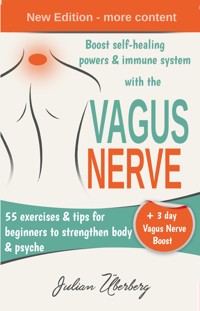
Balanced, stress- and pain-free, vital and joyful in everyday life! Does that sound far away? The solution is very close, it is even INSIDE YOU!
Vagus Nerve Training is the solution and has already improved the quality of life of many thousands of people without any side effects.
More content - more choice now:
⚞NEW⚟ 15 new vagus nerve exercises: NOW over 55 exercises and tips!
⚞NEW⚟ new, easier Vagus self-test for home use.
⚞NEW⚟ 3 Day Flash Vagus Cure for super fast results.
Why exactly buy this book on the Vagus Nerve?
Because everything is included so you can get started & get results right away - without having to buy anything extra :
★ Information section about the Vagus Nerve and its place in the human nervous system: Once you have an idea of how vagus training works, you will be even more motivated to practice regularly.
★ Practical section with exercises: over 55 proven methods and tips to help you make rapid progress towards better health.
★ 3-day Vagus Lightning Cure: Feel as good as your last 14-day holiday in 3 days. Take the practical test now! ★Vagus Home Test: Test the functionality of your Vagus at home right now!
★ Scientifically based: with detailed list of studies and sources.
★ Pictures: For a better, faster understanding of the vagus nerve and the practical exercise section, you will find numerous illustrations and pictures throughout the book.
When Vagus Training can help you:
- Do you suffer from pain, anxiety, stress or depression?
- Do you take a long time to recover after exercise?
- Do you want to manage your symptoms with less or no medication?
- Do you have symptoms, such as headaches, that suggest a physical problem, but your doctor can't find anything wrong?
- Do you have an illness and are looking for powerful ways to strengthen yourself without side effects?
- Have you ever experienced burnout?
- Do you want to boost your immune system to stay fit at any age?
If you can answer 1 or more of these questions with "yes", then you should start with Vagus Training!
Take advantage of the health and well-being potential of the vagus nerve now!
Das E-Book können Sie in Legimi-Apps oder einer beliebigen App lesen, die das folgende Format unterstützen:
Veröffentlichungsjahr: 2023
Ähnliche


















Foreword
Part 1 Info section: Exciting facts about the nervous system
1. The Miraculous Human Nervous System
1.1 The central nervous system
1.2 The peripheral nervous system
1.2.1 The somatic nervous system
1.2.2 The enteric nervous system
1.2.3 The autonomic nervous system
1.3 The Vagus Nerve
1.3.1 What is the vagus nerve?
1.3.2 Course of the Vagus in the Human Body
1.3.3 Functions of the vagus nerve (incl. polyvagal theory)
1.3.4 Strong Vagus & Vagotonus
1.3.5 Vagus, Social Environment & Meritocracy
1.3.6 Vagus blockages
Part 2 Practice Section: We take action!
2.1 Test your Vagus!
2.1.1 The Vagus Test
2.1.2 Instantaneous activation of the vagus nerve
2.2 Twelve ways to activate your vagus!
I. Nervus Vagus Master Meditation
II. slow touch- the healing self-touch
III. Breathing exercises for the vagus nerve
IV. 10 anti-stress (cooking) recipes
V. Intermittent fasting
VI. food & dietary supplements
VII. Endurance sports
VIII. The power of the voice!
IX. Eye Yoga
X. EFT - Emotional Freedom Technique
XI. Fantasy journey
XII. 10+1 Magic Short Tips
C. Bonus
3 days Vagus lightning cure
The 3 days vagus lightning cure
Studies and sources
Legal
Foreword
Dear Reader,
I am delighted that you have purchased this book and decided to invest time in your health and well-being.
More and more people are becoming interested in the vagus nerve and the potential that can be gained from activating it.
While the search term 'vagus nerve' was searched for around 200 times on Amazon.co.uk at the beginning of 2019, it has now peaked at over 2000 searches per month. Interest is growing!
The graph shows how often the term "Vagus nerve" has been searched for on Amazon.co.uk in the years
As a physiotherapist, I became aware of the potential of this self-healing nerve back in the 1990s.
Patients with a wide range of symptoms often showed great therapeutic success when the vagus nerve was stimulated - regardless of whether the patient's problems were physical, psychological or psychosomatic.
Nearly 30 years later, the autonomic nervous system, and the vagus nerve in particular, has come even more into the spotlight.
In the next 130 pages of this book, you will learn why this is so, and why, especially now, in our performance-driven society, knowing the potential of the "relaxation nerve" can be so rewarding and enriching for everyone.
And I hope that you will gain as much knowledge from it as possible, and that putting it into practice will bring you joy and well-being!
Enjoy reading, yours
Part 1 Info Section: Exciting Facts about the nervous system
Before the practical part, there is an information section. This is to give you the theoretical basis for why working with your own parasympathetic nervous system can be so beneficial to your health, wellbeing and daily life.
In treating patients, it has been shown time and time again that once the practitioner has internalised why an exercise should be done and how it works, it has a tremendously positive effect on exercise motivation.
So, while the whole relevant anatomy of the body is only partially explained to a medical layman in a few pages, you will see that it is possible to understand the basic principles without much effort.
Understanding how and why something works can greatly enhance long-term motivation, especially when it comes to training and exercise.
Often the successes achieved through Nervus Vagus training sound as if the Vagus is an all-in-one or universal solution. Many people doubt this when they first hear about the vagus nerve. However, Vagus training has a rock solid scientific foundation as you will see!
To better understand this foundation, let's first take a look at the fascinating human nervous system.
1. The Miraculous Human Nervous System
The human nervous system with its billions of nervecellsis divided into several levels. The subdivision is based on the respective function and/or the location of the respective nervous system area.
The human nervous system, with its billions of nerve cells, is divided into several levels. The subdivision is based on the function and/or location of the respective nervous system area.
What all parts of the nervous system have in common is that the transmission of stimuli - in the context of information transfer - takes place via the individual nerve cells.
If you were to line up all the nerve fibres of a human being, they would stretch for an unimaginable 450,000 miles - or even more! Researchers disagree about how many nerve cells a human being actually has. Figures vary from 100 billion to 1 trillion.
Even in 2023, there is still a long way to go before we know everything about the human body.
The connections between individual nerve cells are called synapses, and they enable a dense, large-scale network for the transmission of information and stimuli.
Other 'organs' - or components - of a nerve cell are the axon, the dendrites and the cell body.
Nerve cells have an ability called depolarisation. This is how the electrical impulses that transmit information work.
There are ascending and descending impulses because the flow of information goes in both directions.
At the level of the nerve cell, information is transmitted in two ways - chemically and electrically:
1.1 The Central Nervous System
Left: The central nervous system with the bony structures of the skull, the spine and the junctions with the peripheral nervous system.
Right: The central nervous system, isolated from the surrounding structures.
The central nervous system, commonly referred to as the CNS, is a subsystem of the entire nervous system. It interacts very closely with the other parts of the nervous system, and the demarcation is anatomical, i.e. based on location rather than different functional assignments.
The central nervous system consists of the brain and the spinal cord. Both are very well protected from external forces, the brain by the bones of the skull and the spinal cord by the bony vertebral column.
No matter what activity we do, the central nervous system always plays an important leading role: when we move, eat, observe a landscape, have sex, are happy, sad or depressed, the central nervous system is always the director.
It is through the central nervous system that we are able to perceive, feel and act.
The CNS is also responsible for controlling our motor skills, posture and all movements; it controls the correct and smooth functioning of the organs, our breathing, blood circulation, sensory organs and muscles. It also controls our hormonal balance and day/night cycles.
It is through the CNS that we experience emotions and instincts. Without the CNS, all stimuli from within and from the environment could neither be perceived nor (further) processed.
The central nervous system enables humans to consciously connect with their environment, i.e. the outside world, as well as with their inner world of perception.
1.2 The Peripheral Nervous System
Right: The central nervous system terminates at the lateral exit points of the spinal column and passes directly into the peripheral nervous system.
Left: The widely branched nerve tracts of the peripheral nervous system.
The term "peripheral nervous system" is used to describe the part of the human nervous system that lies outside the spinal cord and also outside the brain. Functionally, the peripheral and central nervous systems cannot be completely separated.
The peripheral nervous system in turn houses the somatic and autonomic nervous systems and also corresponds to the central nervous system.
1.2.1 The Somatic Nervous System
The somatic nervous system is one of the two main functional divisions of the nervous system. The other main division is the autonomic nervous system.
As a quick reminder, the division between the central and peripheral nervous systems is based on location, and the division between the somatic and autonomic nervous systems is also based on function.
Like the autonomic nervous system, the somatic nervous system has an extensive nerve fibre network of ascending and descending pathways.
The descending nerve fibres always run to the (striated) muscles and thus implement the voluntary desire to move; however, they are also responsible for the function of the supporting and holding muscles, which are predominantly not executed by the will but - at least to a large extent - automatically.
The ascending nerve fibers primarily serve to provide the so-called projection centers in the brain - including the olfactory, visual, auditory, vestibular, and gustatory pathways - with information for further processing.
1.2.2 The Enteric Nervous System
150 million nerve cells! That is the proud total number of nerve cells in the enteric nervous system.
It is also known as the "abdominal brain", "2nd brain" or "gut brain" because it runs through the entire digestive tract.
In the different layers of the abdominal brain are the 2 main components, the Auerbach's plexus and the Meissner's plexus.
Together they form the command bridge of the digestive system.
They provide the necessary increased or decreased blood flow in the digestive tract, and they initiate the intestinal motility that ensures chyme transport and mixing.
It is interesting to note that the parasympathetic nervous system (note: the vagus nerve is part of the parasympathetic nervous system) activates to promote digestive activity, while its counterpart, the sympathetic nervous system, inhibits digestive functions.
1.2.3 The Autonomic Nervous System
Right: Sympathetic Nervous System: course of nerve fibres to target organs and function.
Left: Parasympathetic nerve: nerve fibre trajectories to target organs and function. The vagus nerve is the largest nerve in the parasympathetic nervous system.
Also known as the visceral nervous system, autonomic nervous system or vegetative system, the autonomic nervous system, together with the somatic nervous system, forms the peripheral nervous system.
The term "autonomic" indicates the self-regulating nature of the autonomic nervous system. Many of the processes that the autonomic nervous system is responsible for cannot be directly influenced by humans, such as blood pressure and breathing rate.
The autonomic nervous system is made up of two parts: the sympathetic and parasympathetic nervous systems.
The sympathetic nervous system is the active part of the autonomic nervous system, while the parasympathetic nervous system is responsible for the body's activity at rest.
The sympathetic nervous system is also responsible for our 'fight or flight' behaviour, i.e. when we are in danger and need to act, the sympathetic nervous system becomes active. In such a situation, adrenaline is released from the adrenal cortex. This immediately triggers reactions throughout the body: hormone release, increase in heart rate, pulse and breathing rate, dilation of the pupils.
Ideally, there is a balance between the sympathetic and parasympathetic nervous systems in the body, so that the two states usually occur in succession, inhibiting or replacing each other.
A healthy vegetative balance is characterized by a very active sympathetic phase followed by a relaxing parasympathetic phase.
When this delicate balance is disturbed, it is called vegetative dystonia. The balance can be shifted towards the sympathetic nervous system or towards the parasympathetic nervous system.The following features characterize the respective states:
Overactivity sympathetic nervous system
Overactivity parasympathetic nervous system: "vagotonia".
Insomnia, muscle cramps
Low blood pressure
Headache, digestive discomfort
Slow pulse rate
Nervousness, stress
Pupils constricted, cold feet and hands
Difficult breathing, e.g. shortness of breath
Listlessness
For example, in the case of vegetative digestive complaints, an examination of the stomach or intestines will not reveal any disease, since the cause of the complaints is to be found in the nervous system.
The symptoms mentioned above, when the sympathetic nervous system is overactive: stress, nervousness, poor quality of sleep and also digestive problems, are all symptoms that are very common in our society. You could say that we are a society in which the sympathetic nervous system plays a dominant role.
A lot of work, a lot of "to do's" and often a lot of stress. In many people the body loses its ability to relax over time, i.e. it is almost constantly in a "sympathetic state".
One characteristic of a disordered autonomic nervous system is that you cannot switch off even when you are resting, for example in your spare time. You lie on the sofa and still can't relax. The body's own system cannot switch into rest mode because the vagus nerve's baseline voltage is too low. (More on this in the chapter "Strong vagus & vagotonus").
This is not only uncomfortable, but also unhealthy, as it interferes with the body's healing and repair processes.
One reason for this is that the immune system can only work when the vagus nerve is strong.
Another sign of an imbalanced autonomic nervous system could be when the body cannot cope with a minor illness or painful event and there is no improvement in sight. Other symptoms and conditions that may be caused by an imbalanced autonomic nervous system are listed in Chapter 2.1.
The list of possible symptoms of insufficient vagal activity is long, but as different as the symptoms and clinical pictures may be, the same actions will help!
And these measures are aimed at activating the vagus nerve.
1.3 The Vagus Nerve
A master of relaxation at work




