


9,55 €
Mehr erfahren.
- Herausgeber: Carcanet Poetry
- Kategorie: Poesie und Drama
- Sprache: Englisch
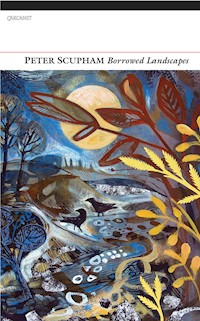
Borrowed Landscapes, Peter Scupham's first book since his acclaimed Collected Poems of 2002, explores a hinterland of enchantment and nightmare, a landscapre whose contours reach back to Shakespeare's England by way of two world wars and a coming of age shaped by the Suez crisis and the Cold War. The barbarities of the twentieth century haunt the shadows; there is comfort in the graces of domestic life, in friendships and long memories, in cats and gardens and eccentricities. A sequence of poems honours the life of a scholarly father-in-law who fought in the Great War. In a parallel autobiographical sequence, 'Playtime in a Cold City', three undergraduate years in the 1950s become a touchstone for a lost pastoral, before the 'fields of youth' fade to memory, 'the lit faces of dead friends, / laughing'. Generous, witty and shrewd, Borrowed Landscapes affirms Scupham's belief that when a 'murderous crew' of sorcerer's apprentices 'turn is to was', there is 'only a pen to turn was to is'.
Das E-Book können Sie in Legimi-Apps oder einer beliebigen App lesen, die das folgende Format unterstützen:
Veröffentlichungsjahr: 2011
Ähnliche

















PETER SCUPHAM
Borrowed Landscapes
Acknowledgements
Some of these poems have appeared in The Rialto, PN Review, OxfordPoets 2001, A Treasury of Love Poems (Book Blocks), Christmas Books (Mandeville Press), and the Emmanuel College Magazine. ‘Out of Season’ was published in a limited edition by the Chestnut Press. ‘Seventy Years a Showman’ was shortlisted for the Forward Prize for Best Single Poem, 2006, and appeared in The Forward Book of Poetry, 2006.
Contents
Title Page
Acknowledgements
The Old Type Tray
Figures in a Landscape, 1944
The Way
Estuary
Out of Season
The Singing Field
Out There
Three Evening Pastorals
Scarecrows
It
Set-aside
A Civil War
Wildstrubel, 1913
Christmas: Hanover, France, Cambridge, 1914
Adams Road, 1915
42nd Motorised Ambulance Company, 1916-1918
Obiter Scripta: France, August-November 1918
Anthropologies: London and Africa, 1920-1953
Torre House, Harpenden, 1963
Wetten, November 2006
The Hunt
Shredded with Rose
Generations
Spots
Goodman
Cat and Mouse
A Merry-go-round for Megan
May
Borrowed Landscapes
Seventy Years a Showman
At the Window
Flight into Egypt
Unusual Phenomena
September Song
Between the Lines
Lawnheads Avenue
Hurrel’s Walk
Green Boy
Reaches: 1946
Night Moles: Cambridge
Umbrella Man
‘Market Rasen Nostalgia’
Playtime in a Cold City
Prologue: Negative Space
Michaelmas Term, 1954
Playtime in a Cold City
Father
The English Faculty, or Sweetness and Light
Long Vacation, August 1955
‘God with us’
Mind Games
In the Dark
Considerations
Notes from Oxford
Basic Training for Fine Minds
‘They’re Off!’
Amours de Voyage
Long Vacation, August 1956
Get Well Soon
A Somewhere Hut
The Lady’s Not For Burning
Lost Hearts
Unfoldings
Epilogue: Whatever Happened?
Eskimo Toys
About the Author
Also by Peter Scupham from Carcanet Press
Copyright
The Old Type Tray
for Roger Burford Mason, 1943-1998
Here triune orchid, Caesar, swan,
find Auden’s common box, lie down
in beds of loose and lettered gravel;
patience now must undishevel
feathers, tongues and petals long dispelled –
the case is everything which is the world.
Collected Works, Principia,
primal scream and earliest ur,
tall talk, the latest from the street
where Caliban, Miranda meet
spill from this crazy leaden casket, still
packed to the brim with hope and syllable.
For words – which grew from thinginess –
have cast their spells in metal dress,
each petalled, feather-light impression
a stay against their distribution:
typographer and text, the clock defied,
put to their final proof and justified.
Figures in a Landscape, 1944
for John and Mary Mole
We could hear the oncoming doodle-bug behind us chugging like a motor bike, in front of us on a rise to the left we saw two semi-detached houses. A man was digging in a garden alongside, a little boy was running up the garden path towards the house… at the doorway was a woman beckoning him to hurry indoors… there was a loud explosion, a mushroom cloud of dust. Everything went up; no houses, no man, no mother and no boy. We picked up three dustbins full of pieces out of the rubble. The only way to identify where they were was the dampening dust and the cloud of flies.
Stanley Rothwell, Lambeth at War (SE1 People’s History Project, 1981), quoted by Jane Stevenson in Edward Burra:
A Twentieth Century Eye (Jonathan Cape, 2007)
I
How busy, busy, busy these ghosts are,
who pack away their bones and wrinkles,
roll ashen sleeves up for the duration.
She ties time back to its apron strings,
puts up her hair in a nest of curlers.
They cling tight for a safe rough-ride
when she pummels and scrubs life stupid,
sets the Vactric moaning like a siren,
pegs out her tempers to the washing-line.
He buffs up his blue, chalk-striped trousers,
snaps the jaws of his briefcase shut
on dull certificates of proficiency,
sets out in khaki on a croaking push-bike
for sticky-bombs, firecrackers, clay grenades,
the Captain’s chalk-and-talk in the Village Hall.
Their children’s job is just to shrink a little,
cut rinds of mud from square-toed shoes,
trundle dolly about in a deadbeat pram
while the wireless wraps house and garden
in creamy sheets of taratantara.
Housewives without choice, workers without playtime
work themselves back again to skim and bone.
The dustmen make schräge musik with the bins,
swinging us all to the grave on stooped shoulders.
II
Big flowers lean to the sun,
blonde village simpletons,
dirt faces picked to moons
like the one I watch climb,
pause out on a limb
of a tree I can’t name
in a place I called home.
Each dissolving room
rubs to the same
patch of distempered wall
made gestural
by Van Gogh’s chorale:
sunflowers with yellow heads
A Zouave’s brilliant red,
a blue cart in a field
their licks of paint all
primary, primal.
The world before this fall
into unlit green and brown
where the big flowers lean
and bombers groan.
III
In a flat-faced semi on the road out
shaky taps have left their misery running.
Garden-skins souse in slurps of cess
or loll and sunburn to a sour frizz.
Is it Charlie Holmes, digging in his patch,
in battledress, in summer, in silence?
At the window I watch our neighbour’s child
go riding down the gravel in his coffin,
watch Charlie, Father: patched and taciturn
as guys or scarecrows, whose hands
cradle potatoes like misshapen eggs
wring chickens’ necks, drown kittens.
Houses brim with slow, hoarded anger;
spill to outbursts of wild sobbing.
Mens’ work is burial, exhumation;
the clay weeps at their slicing spades.
IV
War, cat-like, hoards nine lives
in dust-scribbles, boxes of dull silence.
Here the boy cupboards his ruinous loves –




