


5,99 €
Mehr erfahren.
- Herausgeber: Steeger Books
- Kategorie: Gesellschafts- und Liebesromane
- Sprache: Englisch
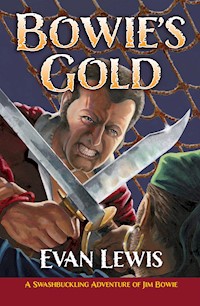
Jim Bowie is on a Quest for Vengeance—and the Lost Treasure of Jean Lafitte. Famous knife fighter James Bowie wants a seat in Congress. But to win it he needs money—and lots of it. When an old pirate friend—and his beautiful daughter—seek his help with a treasure map, he’s drawn into a wild race across the Gulf of Mexico, to Texas and beyond. Opposing them is Bowie’s most bitter enemy, a former captain of Lafitte’s calling himself The Last Great Terror of the Gulf. The two men’s fates have been long entwined, and their thirst for vengeance exceeds even their desire for the treasure. Who will feed the sharks? Find out in Bowie’s Gold.
Das E-Book können Sie in Legimi-Apps oder einer beliebigen App lesen, die das folgende Format unterstützen:
Veröffentlichungsjahr: 2023
Ähnliche




















Bowie’s Gold
by
Evan Lewis
cover by Gary Carbon
Steeger Books / 2022
Copyright Information
© 2022 Evan Lewis
Cover art © 2022 Gary Carbon. All rights reserved.
ALL RIGHTS RESERVED
No part of this book may be reproduced or utilized in any form or by any means, electronic or mechanical, without permission in writing from the publisher.
This edition has been marked via subtle changes, so anyone who reprints from this novel is committing a violation of copyright.
Dedication
Mr. Bowie and I wish to salute the following folks, heroes all, who helped out on this one. In pretty much alphabetical order, they are:
Drew Bentley, Jackie Blain, Gary Carbon, Jack Edmondson, Rob and June Edwards, Christine Finlayson, LaVonne Griffin-Valade, Ron Ianitello, Kassandra Kelly, Becky Kjelstrom, Nancy LaPaglia, Doug Levin, Ann Littlewood, Marilyn McFarlane, Matt Moring, Will Murray, Cap’n Bob Napier, Angela M. Sanders and Brian Trainer.
And, most of all, my lovely wife Irene, without whom this book would never have seen the light of day.
Part I: Vengeance
CHAPTER 1
“Little more than a savage.”
“Come, Mr. Bowie. Won’t you show us the knife?” The former governor of Louisiana slid a stack of gold coins toward the glittering pile at table’s center. “Raise five hundred.”
“Yes, James, please do.” The judge on Bowie’s left studied his cards a moment before dropping them in disgust. “Lord knows this game is not providing me much amusement.”
The tobacco baron on Bowie’s right made a sound that was half growl, half harrumph. “I’m out. But I, too, would like to see this fabled blade.”
James Bowie eyed his three jacks and two queens. He fingered five coins from his own dwindling stack and pushed them forward. “Call.”
When no one spoke, he glanced up to find them all looking at him.
He hesitated. The plush gaming salon of the Hotel Monock, favored haunt of the most distinguished men of New Orleans, was no place to be brandishing a knife. Particularly a knife with a ten-inch blade designed to open a man from gut to chin.
“Here.” The ex-governor plucked a gold piece from his stack. “I’ll even pay for the privilege.” He flicked his thumb, and the coin glittered as it spun through the air.
Bowie caught the coin and closed a fist around it. “A knife, gentlemen, is much like a sword. It should not be unsheathed unless one intends to use it. And I earnestly hope I shall never have to use it again.”
“By God,” the judge said, “I almost believe he means it.”
The former governor accepted the return of his coin. “You still intend, then, to seek Brent’s seat in Congress?”
“I intend,” Bowie said, “to win it. And I hope I may count you gentlemen among my supporters.”
Congressman William Brent was now in his third term, and voters had become increasingly dissatisfied with him. His latest opponent—a blowhard Democrat named Overton—had been favored to defeat him, a prospect that played no small part in Brent’s decision not to seek re-election.
After an uncomfortable pause, the tobacco grower said, “But what of your health? Have you truly recovered from that—that incident?”
“I’m strong as an ox,” Bowie lied, “and twice as handsome. The six months abed gave me time to reflect upon my sins, and I’ve come forth a new and better man.”
Bowie hoped at least part of that was true. The “incident” had been a huge setback in his quest for respectability, but had carried a hidden blessing.
Seven months earlier, on a humid afternoon in September 1827, his dreams had nearly gone to smash. On hand to witness a duel between a friend and another gentleman, he’d become embroiled with a personal enemy with friends of his own. As a result, he’d taken three pistol balls to the body and been run through four times with sword blades. One of those blades had pierced a lung, as he was still reminded with every breath.
That he lived was astonishing enough, but in the process he had buried his knife in the vitals of his chief opponent—killing him on the spot—and severely wounded another. The Sandbar Fight, as the newspapers called it, had tarnished his reputation as a gentleman. Over the past few months, Bowie’s name had become synonymous with dueling and sudden death.
But he had discovered, to his surprise, that while his newfound notoriety was off-putting to some high-minded voters, their less sophisticated neighbors heartily approved the notion of sending a knife fighter to Congress.
And that fact, he knew, was not lost on his present companions.
The ex-governor examined him with shrewd, probing eyes. “I find you a most formidable individual, Mr. Bowie, and believe you may be just the man to represent our interests. So yes, you shall have my support.”
The judge nodded. “And mine.”
The tobacco grower raised a glass. “Let’s make that unanimous.”
Aglow with success and fine bourbon, Bowie found the scene almost magical. Pipe and cigar smoke formed a hazy cloud above the players, muting the light of the great crystal chandelier. Waiters drifted like wraiths between the tables. To his ears came the murmur of a dozen conversations and the gentle clink of coins and chips, punctuated at intervals with cries of exultation or dismay.
As play progressed, Bowie lost steadily but with much grace. He was skillful enough to win when he wished, but today’s foray into the heart of New Orleans respectability was not about winning at cards. Having found favor with these three gentlemen, he peered through the haze of smoke in search of others to help advance his campaign.
Snatches of conversations in French and Spanish identified the Creoles, who still considered themselves the city’s aristocracy. The Creole families, having come to Louisiana during the time of French and Spanish rule, held less influence than they once had, but were still a contingent to be reckoned with.
These were outnumbered by the more boisterous Americans, who owed their social positions to wealth rather than breeding. They were sugar growers, shipping magnates, mill owners, manufacturers, physicians, barristers and landlords, and all, by their very presence here, proclaimed themselves to be among the city’s new elite.
“I hear Lafitte is dead again,” the ex-governor remarked.
The judge emitted a snort. “What is it this time? I suppose hanging is too much to hope for.”
“Sadly, yes.” The tobacco baron made a sour face. “Something about malaria, I believe.”
Bowie’s thoughts took him far from the gaming room and its distinguished company, back to the island stronghold Lafitte had called Campeachy. The sandy bank had teamed with jeering pirates, while Bowie himself sat nailed to a log in the lagoon, face to face with a man determined to take his life. Among the crowd he noted the saucy blonde cause of the duel, and the livid, snarling face of his opponent’s brother, Renato. And overseeing it all, amusement curling his lips, towered the figure of Jean Lafitte himself.
“What say you, Bowie? Did you ever encounter the blackguard?”
In his mind, Bowie ducked as his opponent’s blade flashed past his head, nicking his ear.
“Mr. Bowie, are you with us?”
Quick as lightning, he returned the thrust, grinning as blood spurted from the other man’s arm.
“James! James, for God’s sake!”
A hand gripped his wrist, and Bowie nearly lashed out, but some instinct warned him, and he blinked, shocked to behold his gaming companions regarding him with mouths agape.
“Good Lord, James.” The former governor fanned himself with his cards. “The way you were gripping that knife, we feared you were about to slaughter us all.”
Bowie glanced down, relieved to see the knife still sheathed at his hip. With effort, he loosened his grip on the smooth wooden handle and returned his hand to the table.
The scene at Lafitte’s base on Galveston Island had played out eight years earlier, but its aftermath, involving the saucy blonde wench and the pirate Renato, still haunted his dreams.
“Your pardon, gentlemen,” he said lightly, “I believe you were speaking of Lafitte. For my money, he was dead the last time we heard of him, and dead the time before that. These continuing rumors are the work of idle minds.”
“I must agree,” the former governor said. “Lafitte is indeed dead, and piracy died with him.”
Bowie lit a cigar to hide his smirk. The ex-governor was a fool, but there was no profit in saying so. Lafitte was dead, he had no doubt. But piracy, as he well knew, lived not upon the seas, but in the hearts of men.
It was mere minutes later—and Bowie’s equilibrium had not yet returned—when a new and entirely unwelcome voice came from the table behind.
“That bumpkin Bowie,” the voice said, “troubles me not at all. Lord knows, the man is little more than a savage, prancing about with that ridiculous toadsticker of his.”
Bowie turned to cast a hard eye upon the new arrival. It was General Walter Overton, one of the aging heroes of the Battle of New Orleans, and Bowie’s main rival in the coming election.
Dropping his bulk into a vacant chair, the man continued, “Thankfully, his bid for Congress has died a’borning, because that scoundrel Brent has reneged on his pledge to retire. ‘Duty to his constituents,’ he says. Balderdash! The man has been suckling at the public teat so long he cannot bear to be weaned.”
Bowie was out of his chair in an instant, already reaching for the man’s collar.
“What a state of things!” Overton droned on. “Men of character who will not stoop to low and dirty intrigue are shunned as being out of fashion, while the most blatantly corrupt are—”
The man gasped for air, his fat face purpling as Bowie yanked him out of his chair.
“This news of Brent,” Bowie gritted. “How did you come by it? Speak, damn you!”
“James.” The ex-governor was at his side. “A man can hardly speak while being strangled.”
Bowie’s red fury abated not at all, but he saw sense in the words, and loosened his grip.
“Now,” he said, “you will tell me more of Brent.”
Overton sucked in great draughts of air, his eyes bulging from their sockets. The only sounds escaping him were whimpers.
“It may also serve,” the ex-governor said, “to sheath your blade. Unless, of course, you feel compelled to use it.”
And Bowie realized, to his horror, that the knife was in his hand, quivering like a thing alive, its point an inch from Overton’s nose.
CHAPTER 2
“Your ears on a necklace.”
Renato gripped his brush with a firm but supple wrist, applying a deft stroke of glimmering gold. Leaning back in his chair, he examined the canvas with a critical eye. This was a fine day’s work. The Last Great Terror of the Gulf, it would be called, a bold and graceful prince of pirates, wide of shoulder, trim of waist, and up to his kneeboots in treasure.
The booty as yet had little definition, appearing almost a hillock of molten gold, but that would soon change. Renato hoped it would include a little of everything: goblets, vases, necklaces, crowns, statuary, and his personal favorite—chests spilling over with glittering coins.
“Er, ah, Cap’n…”
Renato scowled up at the burly buccaneer posing against the ship’s rail. The man’s attire was truly magnificent. A shining breastplate of hammered silver, a flowing red velvet cloak and a wide-brimmed hat adorned with a band of rubies. But the vision was marred by the man’s brutish features, dull and common as mud.
“Cap’n, sir, by yer leave, might I be returning to my station?”
Renato wrinkled his nose. The fellow’s fist-like face and harsh voice had driven his muse away. “Go, damn you. But see that you remove that clothing and stow it in my cabin. And take care, LaChaise. Should I find the slightest rip or stain, you’ll be wearing your ears on a necklace.”
As the oaf lumbered off, Renato laid his brush aside and examined the painting yet again. Fine as it was, it would be vastly improved once he filled in the face—a task that could only be performed in a mirror.
Renato slipped a hand into his coat pocket and extracted the smooth oilskin pouch holding the key to his future. The pouch contained a map, the object of a five-year search, that would make him the richest man in the western world—perhaps wealthier than all the kings of Europe.
The map held the secret to the treasure the vaunted Lafitte had sought—and failed—to find. Lafitte, who had deemed himself Prince of Pirates, had slunk off to die on a forlorn island, while most of his contemporaries had been driven to ground. The once great Dominique You now prowled the streets of the French Quarter, selling tired tales for the price of a drink, and Renato’s own stepfather, the famed Renato Beluche, had switched sides, helping Simón Bolívar rout the last privateers out of Cuba.
The true pirates of the modern day, Renato knew, were the rich merchants of New York and London. They had usurped the smuggling trade that once belonged to the buccaneers. That he himself still thrived was a credit to his cunning, and his nimble ship’s ability to navigate the shoals and coves lining the Gulf of Mexico. For the past few years he had plied his trade between the mouth of the Mississippi and the shores of Texas, always alert for word of the map that was his by right, the map that would lead him to his destiny.
The map had come to him only recently—and at great cost—and he had not yet had an opportunity to study it in detail. He was about to do just that when he heard the telltale clack of Faraday’s boots on the deck behind.
Returning the oilskin pouch to his pocket, Renato fixed the man with a glare. “Mr. Faraday. I gave orders we should make for Texas at all possible speed. Why are we still at anchor?”
“Your pardon, Captain.” In place of a bow, the man offered a barely perceptible nod. “We are taking on provisions, and it will be late afternoon before we’re fit to sail.”
Faraday wore ragged burlap trousers and a simple blouse of once-white cotton—hardly an outfit to rival Renato’s gold-trimmed frock coat, plumed tricorn hat, black silk breeches and silver-laced boots. His straw-blond hair, blowing free in the wind, paled beside Renato’s black-lacquered curls. Still, the man had a certain presence, and Renato had already begun to regret appointing him quartermaster.
Faraday was a shade too handsome, dimming Renato’s luster with the ladies—and a shade too tall, forcing Renato into heels higher than he liked. But the man’s ultimate offense lay in becoming too popular with the crew.
He recalled the first time he had seen Faraday, a gangly youth barely in his teens. He’d taken the boy under his wing, taught him the ways of pirating, even saw him as a substitute for his dead brother Rayón. But those hopes were long gone.
It was at times like this he missed Rayón most. True, he’d been only a half-brother, but twice the man of any now among his crew. And Rayón would still be with him if not for that backwoods braggart Bowie and the lordly ways of Lafitte. But Renato would soon have his vengeance on them both. The treasure would bring him power Lafitte had only dreamed of. And from the height of his glory, he would reach down and obliterate Bowie and all his kin.
But for now, he was stuck with Faraday.
“I am not well pleased,” he said. “I wish to lay hands upon my treasure without delay.”
“The men and I are equally eager, Captain.” And when Renato merely stared at him, Faraday added, “to claim our own allotted shares, of course.”
Renato recalled a favorite saying of his famous stepfather. Dead men require no shares.
“Oh, of course,” he agreed. “You and the men shall get all that you deserve.”
The schooner L’Intrepidelay at anchor in a secluded cove on Barataria Bay, fifty miles south of New Orleans. The place had been ideally suited for Lafitte’s headquarters, accessible to the city by small boat, but shielded from the Gulf by two barrier islands. By 1814 it had become an open marketplace for smuggled goods and slaves, popular with citizens eager to avoid the heavy duties imposed by the state. But in that year, a fleet of U.S. ships and gunboats had made a concerted attack on the bay. Jean Lafitte, along with his brother Pierre and most of their four hundred-odd men—Renato included—escaped on pirogues into the bayous, but a good number were captured, along with more than two dozen pirate vessels.
Renato’s mouth still watered at the thought of that lost booty. Thousands of dollars in silver bullion, gold coins and paper bank notes. Uncounted gallons of wine, brandy and other spirits. Warehouses full of silk, cigars, chocolate, coffee and other merchandise.
Following the raid, the Lafittes had moved their base of operations to Galveston Island and prospered anew. Illicit trade in Barataria Bay did not end, but was greatly diminished, and now, more than a dozen years later, it was one of many places Renato found refuge from his enemies.
At one end of the bay was a Cajun trading post, and Renato found it convenient to exchange stolen cargoes of tobacco, cotton and other items for necessities such as gunpowder and spirits.
While boats ferried such goods back and forth, shore parties filled casks of fresh water and baskets of fruit from the shore.
Renato found the process maddeningly slow. He paced the deck, finding fault at every turn, and damning men, beasts, fishes, the sun, the moon and all the gods in the heavens.
And he was in this frame of mind when an apparition climbed over the rail to deposit itself on deck.
The thing appeared to be a woman, but that could hardly be. The Cajun women on this stretch of the coast were tawny, rough-skinned creatures, and the plump and toothless slatterns found in nearby taverns were equally undesirable.
The vision before him, slim-waisted with delectable curves above and below, was coiffed, rouged and adorned in a hooped gown, looking for all the world like she’d stepped from a New Orleans bordello. Her features were delicate, her skin smoothly pink, her hair lustrous as black pearls, and her eyes startlingly green. When she smiled at him his heart forgot to beat.
“What?” he said haltingly. “Who? How?”
Then reality came crashing upon him as another apparition stepped over the rail, one he recognized and had hoped never to see again.
“Andre!” he snarled. “You dare show your face upon my ship?”
The man was altogether as hideous as the girl was fair. His coat was ragged, his trousers stained, and his hat appeared to have been regurgitated by an alligator. In face as well as form, he resembled nothing so much as a giant toad.
Andre had been a fixture among the pirates of the Gulf for decades, but always as a creature of Lafitte’s. After the great poseur died, the man had even sailed for a brief time with Renato himself. But he’d been unable to control his tongue, constantly veiling criticism as advice, as in That’s not how Lafitte woulda done it, or as Lafitte always said… Renato soon had his fill of the blatherskite, and had him cast ashore.
The thing called Andre performed a mock bow. “Beggin’ your pardon, Cap’n Renato, sir. On me own hook, I’d never have come, but when me dear daughter learned ye was anchored here, she was afire to meet thee. She’s heard much of your exploits, see, and when she wants a thing it’s beyond me to deny her.”
“Daughter?” Renato was dumbstruck. “This—this beauty is your daughter?”
“Mariette, dear,” Andre said, “the gentleman deserves a proper greetin’, does he not?”
And as Renato stood rooted to the spot, the vision floated toward him. Placing white-gloved hands upon his chest, she stretched to plant a wondrously soft kiss upon his cheek. The sweetness of her perfume made his head swim.
“I am so pleased to meet you, Monsieur. It has long been a girlish dream of mine.”
The next few minutes were a daze. Renato readily acquiesced to the lady’s request to see his cabin, where she greatly admired his paintings. Twitching in every nerve for want of her, he poured large goblets of wine.
“Oh, Monsieur Captain! That is far too much. I suspect you wish to make me tipsy.”
“Nonsense,” he said. “This is nothing.” And to demonstrate, he downed his own glass to the last drop.
“Well,” she said, ever the coquette, “only if you will join me.”
And he quickly refilled his goblet, while she sipped at her own.
Several glasses later, she removed her dress, while he doffed his coat and trousers.
Her elegantly soft arms were about his neck, her lips tantalizingly near, her heart beating in time with his own, when he felt himself slipping away, tumbling into the depths of her enormous sea green eyes. And then he knew no more.
CHAPTER 3
“You call me a liar?”
Bowie’s blood boiled as he made his way down Bourbon Street.
He had spent the past two years cultivating men of influence and ingratiating himself to voters throughout the southern parishes of the state, and he would not see his political hopes fall prey to the mercurial whims of Congressman William Brent.
Bowie had come from nothing, raised wild in the bayous where men were esteemed for their ability to wrestle bulls and alligators. After years of arduous work, he and his brothers had established a large cypress plantation near Opelousas, complete with a sawmill. After engaging in certain profitable activities with Jean Lafitte—an enterprise they would just as soon forget—they had devoted their efforts to land speculation and politics.
His brother Rezin had recently been elected to serve Avoyelles Parish in the state legislature, and John reelected from nearby Catahoula. James, ever eager to best them, had set his sights on Washington. Having gained the support of several wealthy landowners, he had convinced Brent to step aside.
His troubles began in late 1826, when the knife became fixed to his hip. After being shot in the breast in an encounter with a particular enemy named Major Norris Wright, Rezin convinced him he must thenceforth carry a formidable blade for his protection. While a pistol might misfire, Rezin pointed out, a knife would not.
The chosen weapon was a crude, single-edged hunting knife, with a blade nine inches long and an inch and a half wide. Bowie had fashioned a sheath that almost disguised it as the weapon of a gentleman. But it was not, as he well knew. Once the point pierced flesh, a twist of the wrist would cut the heart strings of an opponent, as it had done to that same Major Wright in the Sandbar Fight.
Reports of the fight had appeared in newspapers throughout the South—and beyond—making Bowie both famous and infamous. Everyone wanted to see and touch the knife, and it seemed prudent to show them something worthy of admiration. So, during the long months of recovery, he’d found a blacksmith worthy of the task.
The new knife was ten inches of shining steel, with a crossguard to catch an opponent’s blade, and a curving clip point near the tip. The curve was honed sharp as a shaving razor, and the mere sight of it had already made men think twice about challenging him.
Over the past few months he’d taken great pains to reassure supporters he was still fit to serve them in the nation’s capital. But his new reputation was proving both a blessing and a curse. He was no longer just a man—he was a manwith a knife, and he sometimes felt the blade was wielding him, rather than he the blade.
The fact that he had unsheathed it at the Monock Hotel still troubled him. He had not meant to draw it. He had not even known he had drawn it.
The thing seemed to have a mind of its own.
Hugo Tamarand’s outer door opened onto a small, dark-paneled room containing several cabinets and a single desk strewn with papers. Behind the desk, a florid-faced man with thick spectacles scribbled numbers into a ledger, his ferret-like eyes darting from papers to book and back again.
When the clerk failed to acknowledge him, Bowie cleared his throat.
Without looking up, the man said, “Your purpose?”
“I must see your employer,” Bowie said. “On a matter of great importance.”
“Out of the question. Mr. Tamarand sees no one without an appointment.”
“In that case, I require one. Immediately.”
The florid-faced man dipped his pen in an inkwell, blotted the tip, and proceeded to transfer more numbers into the ledger. “You misunderstand me, sirrah. Mr. Tamarand grants appointments only at his own pleasure. If he wished to see you, you would have been summoned.”
Bowie felt the knife calling to him. I am the answer, it said, to every question. He clenched his fists. He would not succumb to it again. He could not. Not with his entire future in the balance. Planting his knuckles on the desk, he leaned over the scribbling man.
“It occurs to me,” he said in a deathly quiet voice, “that I neglected to give you my name.”
Still the clerk did not look up. “You are welcome to keep it. And take it with you when you go.”
“The name is Bowie. James Bowie.”
For several seconds more, the man continued working. Then his hand began to shake, as if from palsy. Beads of sweat trickled down the slope of his skull. At last, he angled his gaze upward. “Ah.”
“I have just recalled,” Bowie said, “that I do have an appointment. Now. Do you wish to call me a liar?”
Color fled the man’s face. “I will inform him you have arrived.” He rose and turned toward a door on the rear wall.
“Let’s inform him together.”
Bowie followed him into a hallway lined with small offices containing other pinch-faced men hunched over ledgers.
Bowie felt a measure of shame at bullying this little man. It was an act unworthy of a gentleman. Still, it was good to know his reputation had practical application. And once ensconced in Congress, such threats would no longer be necessary.
The name of Hugo Tamarand was spoken in hushed tones within Louisiana political circles. Ostensibly, his business was shipping, but his true source of power was the behind-the-scenes manipulation of Louisiana politics. Anyone with aspirations in the state had to deal, soon or late, with Hugo Tamarand. Even Andrew Jackson, it was said, had recently come hat in hand, seeking Tamarand’s favor in his bid for the Presidency. And when Congressman William Brent promised to step aside, he had couched his words with the catchphrase, Should it please Mr. Tamarand.
Loath to prostrate himself before any man, Bowie had avoided seeing him. But he must know the truth of Brent’s intentions.
At the end of the hall, the clerk rapped knuckles delicately against an unmarked door.
“Go away,” issued a thin voice from within.
The clerk exhibited an elaborate shrug.
Bowie guided the sputtering fellow out of the way and strode inside.
The clerk shrilled, “Mr. Tamarand, sir! This ruffian forced his way in. I assure you I—”
“That will be all, Smythe,” the voice said. “I will see him.”
Bowie’s eyes swept the room in search of the speaker. The padded chair behind the massive, marble-topped desk was vacant. Behind it rose row upon row of leather-bound books. In one corner stood a shining globe of the earth, fully a yard in diameter, and next to it stood half a man. Half, because the great Hugo Tamarand, despite the giant shadow he cast over Louisiana, was hardly larger than a boy.
The fellow’s skull was bald, and gleamed pink in the lamplight. Indeed, his entire face was pink, and his side-whiskers, as long as Bowie’s own, had the look of peach fuzz. His formal dress, a florid scarlet cravat over a satin waistcoat, made him appear the mere parody of a man.
Bowie felt even more the bully. “Your pardon, sir. I fear I have behaved badly.”
“On the contrary, Mr. Bowie. Compared with your actions this afternoon at the Hotel Monock, it would seem you have shown uncharacteristic restraint. I must thank you for not slicing poor Mr. Smythe’s throat.”
Bowie swallowed. So the man knew him, and was remarkably well informed. “That was regrettable,” he said, “but I was provoked.”
“Yes. So I understand. And I expect you had a similar excuse for that celebrated killing on the sandbar.”
Bowie bit back his response. Any answer he gave would sound lame.
Tamarand threw open his coat. “I assure you I am not armed. I hope you feel no provocation from me.”
“It’s about Brent,” Bowie blurted. “He promised me his seat.”
“Did he now?” Tamarand’s eyes were gleaming steel balls. “And did you truly think it his to give?”
Bowie held his tongue, feeling foolish.
Tamarand climbed into the overstuffed chair behind his desk. Somehow it made him appear even smaller. “Please sit, Mr. Bowie. I dislike looking up at people.”
Bowie found a straight-backed chair across from the desk. His knees rose at an ungainly angle, and he realized Tamarand could now look down upon him.
“Brent gave me his word,” Bowie said.
Tamarand reached for a long-stemmed pipe, tapping its contents into a small silver bowl. “Yes. I persuaded him to reconsider.”
“May I ask why?”
Stuffing a pinch of tobacco into his pipe, the little man lit it from a candle and puffed it to life. For a long moment, he examined Bowie through the smoke. “Mr. Brent, I regret to say, has been unwise in his investments. Quite simply, he cannot afford to leave office.”
Bowie was stunned. Money flowed freely in Washington, and had a way of sticking to the hands of public officials. That was no small factor in his desire to join them.
“You persuaded him,” Bowie said. “May I assume his debt is to you?”
“I must say, sir, you are unusually direct. But it happens directness is a quality I admire. Your assumption is correct.”
“How much does he owe?”
“A great deal, I’m afraid.”
“How much?”
“There is such a thing, Mr. Bowie, as being too direct.”
“I wish to pay it,” Bowie said. “With his debt paid, he would be free to retire.”
Tamarand turned his pipe, using the stem as a pointer. “You have much to learn of politics, I fear. Whatever the amount of Mr. Brent’s actual debt, his presence in Congress is of far greater value. To put it bluntly, he is an asset I am not prepared to lose.”
So he’s in your pocket, Bowie thought. Things were much clearer now.
“How much will it take? How much to release him, and run me in his stead?”
Tamarand’s mouth hung open. “You are an unusual fellow, Mr. Bowie. I am not unaware, of course, of your current difficulties with the General Land Office. It seems they suspect you of forging a number of old Spanish grants.”
Bowie bristled. “Unproven charges. And in any case, such pursuits are behind me now.”
Tamarand eyed him keenly. “Do not misunderstand me. The fact that you have engaged in such activities and so far eluded prosecution is a point in your favor. I am also not unaware of certain dealings you had with the pirate Lafitte. With proper grooming, a man of your audacity and moral fluidity might do quite well in Washington.” He puffed on his pipe, eyeing Bowie keenly through the smoke.
Bowie waited. To this man, everything had a price.
At length, Tamarand said, “I am sorry to dampen your hopes, but I’m afraid you would find the amount quite beyond your reach.”
“How much?”
Tamarand twisted his pink lips. “I could not possibly consider less than a hundred and fifty thousand dollars.”
Had Bowie been standing, he would have staggered. Even if he and his brothers were to liquidate all their property and borrow against future prospects, they would be hard pressed to raise half that amount. “Not impossible,” he said, “given time. But the election will soon be upon us. The most I could offer on such short notice is seventy-five thousand.”
“I might look favorably on a hundred and twenty-five thousand.”
“Eighty-five,” Bowie said, “with one month to gather the funds.”
Tamarand’s eyes gleamed. The man was enjoying this. “A hundred and fifteen, with a good faith deposit of twenty thousand.”
Bowie drew a wallet from his jacket pocket, sliding a thick stack of bills into his hand—money entrusted him by his brothers for a land deal in Arkansas. “Ten thousand dollars,” he said, “toward a total of a hundred thousand, payable one month from today.”
Tamarand’s eyes fixed on the cash. “Mr. Bowie, we may make a congressman of you yet. Provided you raise the rest of the money.”
“Do you doubt I can?”
“I believe you can,” Tamarand said with obvious amusement. “It will be interesting to see if you will.”
CHAPTER 4
“Your head on a platter.”
Renato awoke to a scratchy tongue licking his cheek. He yawned, the yawn becoming a groan, and blinked into the piss-yellow eyes of a hairless cat.
“Ah, Princess,” he said, his voice thick and slurred, “can it be that you are jealous?”
The cat made the low gargling noise that passed for purring and strutted about the cabin, sniffing at this and that.
Renato massaged his temple. He felt as if he had been dragged to Davy Jones’s Locker and back. He must have given Andre’s daughter a magnificent ride.
“Mariette,” he said, “you must meet my other princess, the one you have now dethroned.”
But the girl was nowhere to be seen, and the only sign she had been there was her wine glass, still nearly full.
Renato ran his tongue about his mouth. It tasted peculiar, and as the fog lifted from his brain the realization struck him like a blow. He had been drugged!
At first in confusion, then with growing alarm, he stumbled to his frock coat and thrust fingers into the pocket, encountering only lint. In panic, he wrenched all the pockets inside-out, and clawed at the coat until it lay mangled at his feet.
Then he burst from the cabin, reached the deck in a single bound, and roared, “Where is she?”
The deckhands nearly jumped overboard in fright, while Mr. Faraday, cool-as-you-please, inquired, “Where is who, Captain?”
“That hell-bitch of Andre’s, you dolt! What has become of her?”
“Oh,” Faraday said. “Her. She and her father left hours ago, saying you gave orders not to be disturbed. So, ever acceding to Your Lordship’s wishes, we were careful to let you rest. Now that you are greatly refreshed, I’m sure you’ll be pleased to learn we have entered the Gulf, and are on our way to Texas.”
Renato felt his head was about to explode. He gripped Faraday by the neck and lifted him one-handed from the deck.
“You bungler! You fool! They stole my map. You shall turn the ship at once, returning to that cove, and set men after them. I’ll have their heads for this—or I shall surely have yours!”
Hours later, back in Barataria Bay, Renato was still in an ill humor, and his mood was reflected in the crew. Their movements were lethargic, and he sensed them furtively watching him.
As they left the Gulf, they’d sighted a tempting prize—a well-laden merchantman moving ponderously toward the mouth of the Mississippi. But the stolen map was worth a thousand such prizes, and Renato had been afire to send search gangs ashore. It had now been more than an hour with no word.
Renato sat tensely on the church pew he’d stolen from a Spanish freighter and had installed on his quarterdeck. Angels and cherubs adorned the arms and back of the bench, intermixed with images of crosses, flowers and bleeding hearts. While not in the least devout, he recognized the power in such icons, and it impressed the men to see him amid such heavenly company.
On his lap lay a yellow-backed book, one of many he’d appropriated from passing travelers. On the flyleaf he’d sketched the vague beginnings of a map—all that he could remember from his brief perusal of the original. In his mind’s eye, the image had been clear, but as he drew, the lines became blurred, and the features elusive.
That it represented a bay on the Texas coast, he knew, and it was hauntingly familiar. Renato had come to know the inlets and coves of the Gulf coast intimately—but from a ship’s deck, not looking down upon them like a god in the sky.
The map depicted a cove shaped rather like an old crone’s breast. At the tip of the cove, a sagging nipple pointed directly at a bold black X. There had also been drawings of animals, and a host of connecting lines, but he could no longer envision them.
Hearing the determined tread of Mr. Faraday, Renato turned the book to a random page and pretended to read.
Faraday stopped in front of him. “Captain.”
After half a minute of feigned interest, he looked up to find a smirk on the quartermaster’s face.
“A good book, Captain?”
Renato was about to deliver a suitable reply when he noted the title atop each page. The Faerie Queen.
Renato’s cheeks grew warm. He snapped the book shut. “I had no idea you could read.”
“Some,” Faraday said, not without pride. “Mr. Quayle’s been teaching me.”
“Quayle reads too? Then I fear civilization is doomed.”
“No word from the search parties, Captain. Shall I send more men?”
Renato shook his head. “I am going below. You will notify me the instant there is news.”
In his cabin, Renato hurled the book aside, cursing himself for not noticing the title. It would be the talk of the ship within the hour.
The book hit the bed, spilling a number of newspaper clippings onto the blanket. Renato bent to retrieve them. They were accounts of a battle involving James Bowie, the man he hated most in the world, and he had saved them for future perusal.
Eight years had passed since Bowie had murdered his brother Rayón, but Renato’s rage had dimmed not a whit. Even the spectacular vengeance he had visited upon the girl responsible had done nothing to sate him, and he’d followed Bowie’s activities, planning for the day they would meet again.
Bowie, the story went, had been one of a large party transported to an unnamed beach near Natchez, Mississippi to witness a duel. The duel itself came to nothing, but in the aftermath, Bowie, a supporter of one combatant, had an altercation with members of the opposite party—first with a man named Crane, then with two brothers and a particular enemy named Major Norris Wright.
Renato scanned the accounts, focusing on underlined passages from various articles to refresh his memory.
Crane observed Bowie with a drawn pistol. He thereby shot him first. Bowie exclaimed, “Crane, you have shot me, and I will kill you if I can.” He then drew a large butcher knife and endeavored to put his threat in execution, but was prevented by Crane by a blow from the butt of his pistol, which brought him to his knees.
Good!
Bowie then discovered Major Wright, who had arrived from the woods at the scene of action, in company with the two Blanchards. They both fired,Wright one or two seconds first, and both with effect. Mr. Bowie was shot through the breast.
Even better!
Wright then fled. Bowie drew a knife and pursued him, and when within about ten feet of him, he received a simultaneous fire from the two Blanchards; one of the balls took effect in his thigh and cut him down; observing which, Wright wheeled, when he and Alfred Blanchard drew their sword canes, rushed on and commenced stabbing Bowie who was prostrate.
Renato smiled, savoring the image.
But this, he knew, was where the reading became less pleasant.
Bowie scuffled for some seconds until he had gained his seat. He then reached up, caught Wright by the coat, drew him down on him, and plunged his knife in his bosom, a stab which went to his heart. He died instantly.
Renato tossed the clippings aside in disgust. Some of these accounts had appeared in The New Orleans Argus, which was prestigious enough, but others were from The Niles Register, a paper circulated throughout the entire plaguey United States.
That such a brief incident should earn Bowie fame was an insult he could not abide. Renato had been raiding ships and settlements on the Gulf for years. It was his name that should be on men’s lips in taverns and clubs. To see this upstart farmer so lionized was the height of injustice.
Soon, Renato vowed, once his treasure had been won, he would exact the terrible vengeance that was his due, and newspapers everywhere would trumpet his achievements.
Came a rap at the cabin door.
“What is it, damn you?”
“Quayle has been sighted, Captain.” Faraday’s voice. “He’s on his way from shore.”
“Have him await me on deck.”
Slipping a key from around his neck, Renato unlocked the iron strongbox he used as a night table. The box was the most secure spot on the ship, and it was here he kept his most choice possessions. Among them was a note written in his father’s own hand—and a delicate miniature of his mother, painted by that same gentleman.
Before inserting the book, he took a last look at the rough map, but had nothing to add. His memory of the rest was entirely gone.
Renato was back on deck to see the his rotund bosun clamber over the rail. The man was slack-jawed, slovenly, and dumb as a stump, but he was the one crew member Renato could trust. Quayle knew nothing of loyalty or honor. He knew only fear—and feared Renato far too much to betray him.
“Quayle, you piece of weasel shit, what kept you so long?”
Quayle touched his forelock. “Your everlastin’ pardon, Cap’n. Some of the local folk was hard to catch, and then couldn’t speak ’til they regained their senses.”
“Spit it out, then. What did you learn?”
“Andre was seen, Cap’n. Him and the girl. They wished to buy a pirogue, but no one would admit to selling them one.”
A pirogue. Such a small boat could only mean they hoped to slip into the bayous and wind their way to New Orleans.
“And that was all you learned?”
Quayle winced before answering. “No, Cap’n, no. Others allowed as how they might have taken passage on that merchantman we seen earlier.”
“Did anyone see them board?”
“Not for certain sure, Cap’n, but boats was seen to ply back and forth from shore.”
So Andre and the bitch had fled into the swamps, bound for New Orleans. Or they had gone aboard that slow-moving brig, with the same intent. That made sense. To seek the treasure, they would need a ship and crew, and those were easiest found in the city.
“Where are the rest of the men?”
“They took boats, if you please, sir, and headed into the bayous.”
That covered one possibility. The fat merchantman was one he must deal with himself.
“Mr. Faraday! What are you waiting for? If we don’t catch that brig by sunset, I’ll have your head on a platter.”
CHAPTER 5
“I shall call you ‘Jim.’ ”
Bowie’s boot heels rapped the wooden planks as he strode purposefully along the wharf. The dockyards followed the great bend in the Mississippi, and the masts of a hundred ships snaked off into the distance like a forest of barren trees. Officers and overseers barked orders in half a dozen languages. Stripe-shirted sailors strained on ropes, hoisting cargo from ships’ holds. Burly dockworkers trundled handcarts to and from waiting wagons.
Bowie hurried on. Each step brought a twinge in his lung, a parting gift from the sword of Major Norris Wright, but he could not be troubled by pain. He must raise ninety thousand dollars in thirty days or his congressional career would be over before it began. He and his brothers owned great tracts of land, but to see both men and overcome their reluctance to sell would consume most of the thirty days.
Collecting debts owed him was equally problematic. The odds of his debtors having funds at hand were slight, and there was every chance he would encounter gentlemen to whom he himself owed money.
At length he spied the red and yellow flag of Spain atop the mast of a brig. A group of gentlemen in tall beaver hats watched liveried grooms struggle to keep four spirited horses in check. Bowie admired their strong, clean lines. They were thoroughbreds all, and coming down the gangplank was the most impressive of the group, a great black stallion with a blaze of white across its face.
The well-dressed gentlemen crowded around, running hands over their flanks. One was arguably a thoroughbred himself, standing head and shoulders above the rest. He wore a camel hair coat of the latest cut and a broad brimmed white hat with an eagle feather.
Bowie hurried forward, executed a brief bow and extended a hand.
“Mr. Neville,” he said, mustering all his grace. “My compliments on an exemplary group of animals.”
Fletcher Neville chewed his cigar a moment before taking the hand. His grip was firm, but the shake tentative. “Do I know you, sir?”
“Indeed,” Bowie said. “My late friend Reuben Kemper introduced us at the track in Alexandria. My name is—”
“Bowie. Yes, I remember. You won a fair amount of my money that day, if I am not mistaken.”
“Luck,” Bowie said truthfully. The horse he had backed had bested Neville’s filly by little more than a nose. “I trust there are no hard feelings.”
“Not at all,” Neville said. “I admire a man canny enough to beat me at my own game.” He removed the cigar from his mouth and pointed it at Bowie. “Though it does make me wary of him in future.”
Neville commanded one of the richest cotton plantations in the state, and was known to be somewhat mercurial, prone to invest vast sums on the merest whim. If any man in Louisiana could be Bowie’s savior, Fletcher Neville was that man.
“I heard a story about you, Mr. Bowie.”
Bowie attempted a smile, dreading the sordid tale that was sure to come.
“I heard,” Neville said, “that you are running for Congress.”
Bowie’s smile became genuine. “I am indeed. And I intend to win.”
Neville studied him critically.
The man’s neatly coiffed black hair and strong, jutting jaw made Bowie uncomfortably aware of his own unruly red locks and dimpled chin.
“What sort of congressman would you make, Mr. Bowie?”
“A great one. And one who would not forget his friends.”
“Hm. If true, it would certainly distinguish you from that scoundrel Brent. I suppose you would not be averse to accepting a modest donation to your campaign.”
Bowie could not believe his luck. Neville was making his case for him. “You are more right than you know, sir. Truth to tell, it was for that reason I sought you out today.”
Neville turned to the tweedy, bespectacled man at his shoulder. “Levin, see that Mr. Bowie receives a check in the amount of…” he twirled his cigar in the air, “five thousand dollars.” Then, catching Bowie’s eye, he raised an eyebrow at what he found there, and said, “No, make it ten.”
“You are most generous, sir. So generous that it pains me to admit my need is considerably greater.” Seeing Neville’s eyes grow hard, he rushed ahead. “I ask no further donation, of course, but if you could see your way clear to a personal loan, I am confident that within a few months I would be able to—”
The sound of a whip crack brought both their heads around. Opposite the dock, before a tavern whose sign read Satan’s Crypt, stood a burly giant with a braided horsewhip in his hand. Facing him in the street, next to a wagon laden with kegs, was one of the tallest black men Bowie had ever seen. The fellow wore only white-duck trousers and a red rag about his neck, and his chest shone like a newly polished riding boot.
“How much?” Neville demanded.
Bowie found his mouth dry. Now that the moment had arrived, he could barely form the words.
“How much do you need? Clearly you came here with an amount in mind.”
The number was barely more than a whisper. “Ninety thousand.”
Neville raised an eyebrow. “You presume a great deal on so slight an acquaintance.”
“If I overreach,” Bowie said, “it is only due to zeal.”
The whip cracked again. No blow had yet been struck, but Bowie could see it coming. The slave betrayed not the slightest trace of fear. And with the girth of two men, the man with the whip was clearly one to be feared. A well-greased mustache flared out onto mottled cheeks, and thick brown stubble covered his fleshy jaw. Bowie knew him to be the tavern’s proprietor, a man he’d heard addressed as Heckmann.
“Move, you black jackanapes! That wine does me no good sitting on a wagon.”
Bowie turned away. He was no stranger to slavery, but he had never tolerated brutality. Still, this was no time to involve himself in the troubles of others.
He found Neville watching him.
“Well, Mr. Bowie, you do not lack brass, I’ll grant you that. And no one can accuse you of doing things in small measure. But not all I’ve heard is favorable. I believe you have earned quite a reputation as a brawler.”
“I’m a new man,” Bowie said. “I’ve put violence behind me now.”
“I see. And exactly when did this reformation begin? Yesterday, perhaps, right after you almost slit a man’s throat in a respectable hotel?”
Bowie could offer no defense.
“Is that how you intend to conduct yourself in the halls of Congress?”
“Certainly not,” Bowie said, hoping that was true.
“I must say I am not convinced. On the other hand, a knife at the throat may be exactly what some of our legislators need, if applied with moderation and restraint.”
“Those,” Bowie said solemnly, “are qualities I sincerely aspire to.”
Neville eyed him steadily. “For ninety thousand dollars, even in the form of a loan, I would expect a certain allegiance.”
Bowie pursed his lips. This felt like selling another piece of his soul. But a seat in Congress was practically a license to print money.
“As you may know,” Neville said, “I also have interests in Tennessee. I backed a fellow there in the last election—a backwoodsman named Crockett—because I thought he could be useful.” He gave Bowie a piercing look. “He has now decided he is his own man. I should hate for that to happen again.”
The whip cracked a third time. Not the sharp warnings he had heard earlier, but the thick, obscene slap of a quirt biting into human flesh. Bowie turned, wincing at the angry welt across the black man’s chest.
Heckmann’s whip shot forward again like a great snake.
Bowie flinched, hand straying without thought toward his hip.
But as the lash raked the slave’s shoulder, a black hand shot up. Like a trained serpent, the whip coiled around the slave’s arm, and Heckmann was caught like a fish on a hook.
Over Bowie’s shoulder, Neville said quietly, “The fool.”
Bowie wondered which man he meant.
The slave’s courage was impressive, if not mere stupidity. And no matter what Heckmann did next, he would lose. If he killed the man, he would be out a great deal of money. But if he did not, his power over this and any other slave would be forever forfeit.
Heckmann yanked a long-barreled pistol from his belt. “Release that whip, or I’ll splatter your brains on the street.”
“Shoot, then. I shall suffer no further indignities from you.” The slave’s voice was rich and weighty like an orator’s, and smacked of aristocracy.
“Shoot,” Neville said softly. “Shoot and be done with it.”
The wharf had grown still. Sailors, dockworkers and slaves alike stood frozen, waiting to see what Heckmann would do.
What he did was sputter. “Wh-Why you damned sassy ape!” His arm shook as he strove to level his pistol on the black man’s chest.
Bowie sprang forward, covering the yards between them at a gallop. Heckmann’s pistol exploded as Bowie slammed into him, and the ball crashed through the staves of a barrel. Wine gushed as Heckmann went sprawling to the cobblestone street.
The man was up in an instant, hand reaching for another pistol.
Bowie’s blade flashed from its sheath, catching the morning sun. Before Heckmann could bring the gun to bear, Bowie had him by the throat, the knife biting into his chest.
Heckmann glared into Bowie’s eyes. “Who the devil are you, to meddle in my affairs?”
“A man who hates bullies. But for the record, the name is Bowie. James Bowie.”
Heckmann’s face drained of color. “I don’t care who you are. No man stands between me and my property.”
Bowie smiled grimly. “I see two possible solutions. One, I stick you like a pig and foul the river with your corpse.” The blade dug deeper. “Or two, I relieve you of your problem.”
“So that’s the way of it.” Heckmann sneered. “You’ll either murder me or steal my slave.”
“Killing a snake is hardly murder. But it needn’t come to that. I’ll give you a fair price.”
When Heckmann ran out of curses, a crafty gleam came into his eyes. “He’s worth at least a thousand.”
“He may have been once,” Bowie said, “but he’s been ill-treated. You’ll take four hundred.”
“Four! That’s robbery!”
“If it’s more than your life is worth, so be it.”
The man’s eyes went dull as stones. “Six hundred cash, and not a penny less.”
“Five,” said Bowie, “and you’ll accept a note. I assure you I’m good for it.”
With a great scowl, Heckmann agreed, and Bowie lowered the knife. From the onlookers came a smattering of cheers, but an equal number of jeers. And as if a spell had been broken, the dock returned to life.
Bowie’s eyes sought Neville, but all he caught was the back of the man’s jacket disappearing into a carriage. An instant later the carriage and horse trailers went rumbling off down the wharf.
Bowie watched them go. The ninety thousand was now certainly lost to him, and likely the promised ten thousand as well.
He turned to face the slave.
The black man stood as if rooted to the street, the tail of the whip still coiled about his arm. “You will most assuredly regret that,” he said in his orator’s voice. There was no threat in the words. He was merely stating a fact, one he seemed to find amusing.
Bowie grinned tightly. “I already do. What’s your name, fellow?”
The man straightened, making himself even taller. “I am Mr. Samuel Frost Gideon.”
“An impressive name. And you’re an impressive man, Sam. But I’ve no use for a slave. I’m granting you your freedom.”
The man’s head drew back. “I prefer to be addressed as ‘Mr. Gideon’. And my freedom is far too valuable to be tendered upon a whim. Until I can earn it, I shall not accept it at all.”
Bowie felt his heat rising, but detected a faint smile on the black man’s lips. The rascal was baiting him. Shaking his head, Bowie emitted a gruff laugh. “I’ll play your game, for the moment. I shall call you Mr. Gideon, and you shall call me—”
“ ‘Jim,’ ” the black man said firmly. “I shall call you ‘Jim.’ ”
CHAPTER 6
“Can you not even die properly?”
The twelve-pound bow-chaser boomed a warning shot, sending a quiver through L’Intrepide’s deck. Renato smiled as the iron ball burst through the smoke, clearing the bow of the other ship by scant yards before geysering into the sea.
He stroked the neck of the hairless cat perched on his shoulder. “What say you, Princess? Will she fight or flee?”
The brig was a two-masted merchantman, her square white sails climbing high into the azure sky. She rode low in the water, signifying a heavy cargo, perhaps sugar or cacao.
“Your silence speaks wisdom, my dear,” he told the cat. “We shall have them either way.”
Raising his gold-mounted telescope—inscribed to its previous owner by the King of Spain—Renato brought the brig into focus. She bore only three small guns per side, no match for L’Intrepide’s six 9-pounders. And instead of preparing to fight for their lives, her slack-jawed crewmen stood idle, awaiting their captain’s decision.
The cat’s needle-sharp claws pierced the wool of Renato’s coat. “What is it now, Mr. Faraday?”
The voice behind him said, “Oh! Um. Your pardon, Captain. I—I mean the men—have concerns.”
“Which is it? You—or the men?”
Faraday looked pointedly at the other ship. “She’s American.”
Renato eyed the stars and stripes flying from the brig’s mainmast. “A wondrous deduction, Mr. Faraday. However did you accomplish it?”
“It troubles the men,” Faraday said. “The American navy has largely ignored us of late, but such an attack may force their hand.”
Renato bristled. “You think I fear the navy?”
“It’s not a matter of fear,” Faraday said. “They’re bad for business. Besides, we don’t know Andre and the girl are aboard.”
“And we don’t know they are not.” Renato snapped the telescope shut. “Mark me well, Mr. Faraday. I will do whatever it takes to recover that map, and no amount of carping from you or the men will dissuade me.”
It had been a full day since the theft, and the bitter tang of the drugged wine was with him still. His rage had grown stronger by the hour, to the point he now desired vengeance nearly as much as the treasure itself.
A flurry of activity erupted on the brig’s deck, as the Americans rushed for their guns. Their captain had chosen to fight. Renato’s lips curved into a grin. “We will put a full broadside into her rigging. But take care. I wish to capture, not sink her.”
At Faraday’s order, the pirates scurried to their stations. “A surly lot,” Renato whispered to the cat. “But we require their services, like Faraday’s, for a short while longer.”
The ship came about to the music of ports creaking open and guns rumbling out. The Americans had run out their own guns as well, but the brig’s movements were sluggish. A sleek schooner like L’Intrepide could dance rings around such a heavy-laden scow.
Renato could now read the faded letters on the merchantman’s hull. Old Hickory. Named for the so-called hero of the Battle of New Orleans. Renato snorted. He himself had been as much responsible for that victory as the horse-faced General Jackson, and what had it got him? A pardon for past crimes and not a penny more. Little wonder he and his mates had soon returned to piracy.
“Starboard guns,” Faraday bellowed, “fire!”




