


0,99 €
Mehr erfahren.
- Herausgeber: Wildside Press
- Kategorie: Fantasy und Science-Fiction
- Sprache: Englisch
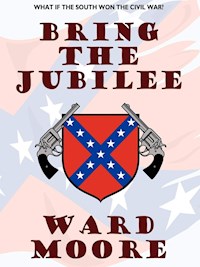
Bring the Jubilee, by Ward Moore, is a 1953 novel of alternate history. The point of divergence occurs when the Confederate States of America wins the Battle of Gettysburg and subsequently declares victory in the American Civil War. Includes an introduction by John Betancourt.
"An important original work... richly and realistically imagined." —Galaxy Science Fiction.
Das E-Book können Sie in Legimi-Apps oder einer beliebigen App lesen, die das folgende Format unterstützen:
Seitenzahl: 317
Veröffentlichungsjahr: 2022
Ähnliche




















Table of Contents
BRING THE JUBILEE, by Ward Moore
COPYRIGHT INFORMATION
INTRODUCTION
CHAPTER 1
CHAPTER 2
CHAPTER 3
CHAPTER 4
CHAPTER 5
CHAPTER 6
CHAPTER 7
CHAPTER 8
CHAPTER 9
CHAPTER 10
CHAPTER 11
CHAPTER 12
CHAPTER 13
CHAPTER 14
CHAPTER 15
CHAPTER 16
CHAPTER 17
CHAPTER 18
CHAPTER 19
CHAPTER 20
CHAPTER 21
BRING THE JUBILEE,by Ward Moore
What he will he does, and does so much
That proof is call’d impossibility
—Troilus and Cressida
COPYRIGHT INFORMATION
Copyright © 2022 by Wildside Press LLC.
Text copyright © 1952, 1953 by Ward Moore.
Published by Wildside Press, LLC.
wildsidepress.com | bcmystery.com
INTRODUCTION
Ward Moore’s alternate history tale Bring the Jubilee first appeared as a novella in 1952, then expanded it to novel length in 1953. It was hailed as a important work of science fiction as soon as it appeared. It was Moore’s second published novel.
Editor Anthony Boucher recognized its importance and published the short version of it in The Magazine of Fantasy & Science Fiction in the November, 1952 issue. The next year, it appeared in hardcover from the prestigious publishing company Farrar, Straus and Young. Ballantine Books published it in paperback that same year. (How things have changed—the hardcover cost $2.00, and the paperback cost only 35 cents!)
Within the science fiction field, critical reception was quite favorable. Groff Conklin characterized the novel as “an important original work... richly and realistically imagined” when he reviewed in in Galaxy. P. Schuyler Miller, when he reviewed it in Astounding Science Fiction, thought the novel’s appeal was “limited,” although he praised its mature, meticulously thought-out structure. I understand his reservation—a book about a turning point of a uniquely American war may not be of much interest to readers in other countries. Later, author and critic Richard A. Lupoff described it as “one of the most ingenious parallel world stories ever written” in the fanzine Algol.
In the decades since its first appearance, however, its reputation has spread beyond the limited science fiction community. The Jewish Daily Forward included Bring the Jubilee among “the best literary examples of alternate history.” Brian Aldiss and David Wingrove, in their survey of the science fiction field, Trillion Year Spree, called it as a “brilliant alternate history novel” and cited that its “wit and ingenuity” as influential in the genre. High praise, indeed!
I find it still holds up well today—much as H. Beam Piper’s 1948 story“He Walked Around the Horses” does—because it deals with time-travel largely in the past, where there are no futuristic elements that appear dated to modern readers.
Enjoy!
—John Betancourt
Cabin John, Maryland
CHAPTER 1
LIFE IN THE TWENTY-SIX STATES
Although I am writing this in the year 1877, I was not born until 1921. Neither the dates nor the tenses are error—let me explain:
I was born, as I say, in 1921, but it was not until the early 1930’s, when I was about ten, that I began to understand what a peculiarly frustrate and disinherited world was about me. Perhaps my approach to realization was through the crayon portrait of Granpa Hodgins which hung, very solemnly, over the mantel.
Granpa Hodgins after whom I was named, perhaps a little grandiloquently, Hodgins McCormick Backmaker, had been a veteran of the War of Southron Independence. Like so many young men he had put on a shapeless blue uniform in response to the call of the ill-advised and headstrong—or martyred—Mr Lincoln. Depending on which of my lives’ viewpoints you take.
Granpa lost an arm on the Great Retreat to Philadelphia after the fall of Washington to General Lee’s victorious Army of Northern Virginia, so his war ended some six months before the capitulation at Reading and the acknowledgment of the independence of the Confederate States on July 4, 1864. One-armed and embittered, Granpa came home to Wappinger Falls and, like his fellow veterans, tried to remake his life in a different and increasingly hopeless world.
On its face the Peace of Richmond was a just and even generous disposition of a defeated foe by the victor. (Both sides—for different reasons—remembered the mutiny of the Unreconstructed Federals in the Armies of the Cumberland and the Tennessee who, despite defeat at Chattanooga, could not forget Vicksburg or Port Hudson and fought bloodily against the order to surrender.) The South could easily have carved the country up to suit its most fiery patriots, even to the point of detaching the West and making a protectorate of it. Instead the chivalrous Southrons contented themselves with drawing the new boundary along traditional lines. The Mason-Dixon gave them Delaware and Maryland, but they generously returned the panhandle of western Virginia jutting above it. Missouri was naturally included in the Confederacy, but of the disputed territory Colorado and Deseret were conceded to the old Union; only Kansas and California as well as—for obvious defensive reasons—Nevada’s tip went to the South.
But the Peace of Richmond had also laid the cost of the war on the beaten North and this was what crippled Granpa Hodgins more than the loss of his arm. The postwar inflation entered the galloping stage during the Vallandigham Administration, became dizzying in the time of President Seymour and precipitated the food riots of 1873 and ’74. It was only after the election of President Butler by the Whigs in 1876 and the reorganization and drastic deflation following that money and property became stable, but by this time all normal values were destroyed. Meanwhile the indemnities had to be paid regularly in gold. Granpa and hundreds of thousands like him just never seemed to get back on their feet.
How well I remember, as a small boy in the 1920’s and ’30s, my mother and father talking bitterly of how the War had ruined everything. They were not speaking of the then fairly recent Emperors’ War of 1914-16, but of the War of Southron Independence which still, nearly seventy years later, blighted what was left of the United States.
Nor were they unique or peculiar in this. Men who slouched in the smithy while Father shod their horses, or gathered every month around the postoffice waiting for the notice of the winning lottery numbers to be put up, as often cursed the Confederates or discussed what might have been if Meade had been a better general or Lee a worse one, as they did the new-type bicycles with clockwork auxiliaries to make pedaling uphill easier, or the latest scandal about the French Emperor, Napoleon VI.
I tried to imagine what it must have been like in Granpa Hodgins’ day, to visualize the lost past—that strange bright era when, if it could be believed, folk like ourselves and our neighbors had owned their farms outright and didnt pay rent to the bank or give half the crop to a landlord. I searched the wiggling crayon lines that composed Granpa Hodgins’ face for some sign that set him apart from his descendants.
“But what did he do to lose the farm?” I used to ask my mother.
“Do? Didnt do anything. Couldnt help himself. Go along now and do your chores; Ive a terrible batch of work to get out.”
How could Granpa’s not doing anything result so disastrously? I could not understand this any more than I could the bygone time when a man could nearly always get a job for wages which would support himself and a family, before the system of indenture became so common that practically the only alternative to pauperism was to sell oneself to a company.
Indenting I understood all right, for there was a mill in Wappinger Falls which wove a shoddy cloth very different from the goods my mother produced on her handloom. Mother, even in her late forties, could have indented there for a good price, and she admitted that the work would be easier than weaving homespun to compete with their product. But, as she used to say with an obstinate shake of her head, “Free I was born and free I’ll die.”
In Granpa Hodgins’ day, if one could believe the folktales or family legends, men and women married young and had large families; there might have been five generations between him and me instead of two. And many uncles, aunts, cousins, brothers and sisters. Now late marriages and only children were the rule.
If it hadnt been for the War—This was the basic theme stated with variations suited to the particular circumstance. If it hadnt been for the War the most energetic young men and women would not turn to emigration; visiting foreigners would not come as to a slum; and the great powers would think twice before sending troops to restore order every time one of their citizens was molested. If it hadnt been for the War the detestable buyer from Boston—detestable to my mother, but rather fascinating to me with his brightly colored vest and smell of soap and hair tonic—would not have come regularly to offer her a miserable price for her weaving.
“Foreigner!” she would always exclaim after he left; “sending good cloth out of the country.”
Once my father ventured, “He’s only doing what he’s paid for.”
“Trust a Backmaker to stand up for foreigners. Like father, like son; suppose you’d let the whole thieving crew in if you had your way.”
So was first hinted the scandal of Grandfather Backmaker. No enlarged portrait of him hung anywhere, much less over the mantel. I got the impression my father’s father had been not only a foreigner by birth, but a shady character in his own right, a man who kept on believing in the things for which Granpa Hodgins fought after they were proved wrong. I don’t know how I learned that Grandfather Backmaker had made speeches advocating equal rights for Negroes or protesting the mass lynchings so popular in the North, in contrast to the humane treatment accorded these non-citizens in the Confederacy. Nor do I remember where I heard he had been run out of several places before finally settling in Wappinger Falls or that all his life people had muttered darkly at his back, “Dirty Abolitionist!”—a very deep imprecation indeed. I only know that as a consequence of this taint my father, a meek, hardworking, worried little man, was completely dominated by my mother who never let him forget that a Hodgins or a McCormick was worth dozens of Backmakers.
I must have been a sore trial to her for I showed no sign of proper Hodgins gumption, such as she displayed herself and which surely kept us all—though precariously—free. For one thing I was remarkably unhandy and awkward, of little use in the hundred necessary chores around our dilapidated house. I could not pick up a hammer at her command to do something about fixing the loose weatherboards on the east side without mashing my thumb or splitting the aged, unpainted wood. I could not hoe the kitchen garden without damaging precious vegetables and leaving weeds intact. I could shovel snow in the winter at a tremendous rate for I was strong and had endurance, but work requiring manual dexterity baffled me. I fumbled in harnessing Bessie, our mare, or hitching her to the cart for my father’s trips to Poughkeepsie, and as for helping him on the farm or in his smithy I’m afraid my efforts drove that mild man nearest to a temper he ever came. He would lay the reins on the plowhorse’s back or his hammer down on the anvil and say mournfully:
“Better see if you can help your mother, Hodge. Youre only in my way here.”
On only one score did I come near pleasing Mother: I learned to read and write early, and exhibited some proficiency. But even here there was a flaw; she looked upon literacy as something which distinguished Hodginses and McCormicks from the ruck who had to make their mark, as an accomplishment which might somehow and unspecifiedly lead away from poverty. I found reading an end in itself, which probably reminded her of my father’s laxity or Grandfather Backmaker’s subversion.
“Make something of yourself, Hodge,” she admonished me often. “You can’t change the world”—an obvious allusion to Grandfather Backmaker—“but you can do something with it as it is if you try hard enough. There’s always some way out.”
Yet she did not approve of the postoffice lottery, on which so many pinned their hopes of escape from poverty or indenture. In this she and my father were agreed; both believed in hard work rather than chance.
Still, chance could help even the steadiest toiler. I remember the time a minibile—one of the small, trackless locomotives—broke down not a quarter of a mile from Father’s smithy. This was a golden, unparalleled, unbelievable opportunity. Minibiles, like any other luxury, were rare in the United States though they were common enough in prosperous countries like the German Union or the Confederacy. We had to rely for our transportation on the never-failing horse or on the railroads, wornout and broken down as they were. For decades the great issue in Congress was the never completed Pacific transcontinental line, though British America had one and the Confederate States seven. (Sailing balloons, economical and fairly common, were still looked upon with some suspicion.) Only a rare millionaire with connections in Frankfurt, Washington-Baltimore or Leesburg could afford to indulge in a costly and complicated minibile requiring a trained driver to bounce it over the rutted and chuckholed roads. Only an extraordinarily adventurous spirit would leave the tar-surfaced streets of New York or its sister city of Brooklyn, where the minibiles’ solid rubber tires could at worst find traction on the horse or cable-car rails, for the morasses or washboard roads which were the only highways north of the Harlem River.
When one did, the jolting, jouncing and shaking inevitably broke or disconnected one of the delicate parts in its complex mechanism. Then the only recourse—apart from telegraphing back to the city if the traveler broke down near an instrument—was to the closest blacksmith. Smiths rarely knew much of the principles of the minibiles, but with the broken part before them they could fabricate a passable duplicate and, unless the machine had suffered severe damage, put it back in place. It was customary for such a craftsman to compensate himself for the time taken away from horseshoeing or spring-fitting—or just absently chewing on an oatstraw—by demanding exorbitant remuneration, amounting to perhaps twenty-five or thirty cents an hour, thus avenging his rural poverty and self-sufficiency upon the effete wealth and helplessness of the urban excursionist.
Such a golden opportunity befell my father, as I said, during the fall of 1933, when I was twelve. The driver had made his way to the smithy, leaving the owner of the minibile marooned and fuming in the enclosed passenger seat. A hasty visit convinced Father, who could repair a clock or broken rake with equal dexterity, that his only course was to bring the machine to the forge where he could heat and straighten a part not easy to disassemble. (The driver, the owner, and Father all repeated the name of the part often enough, but so inept have I been with “practical” things all my life that I couldnt recall it ten minutes, much less thirty years later.)
“Hodge, run and get the mare and ride over to Jones’s. Don’t try to saddle her—go bareback. Ask Mr Jones to kindly lend me his team.”
“I’ll give the boy a quarter dollar for himself if he’s back with the team in twenty minutes,” added the owner of the minibile, sticking his head out of the window.
I won’t say I was off like the wind, for my life’s work has given me a distaste for exaggeration or hyperbole, but I moved faster than I ever had before. A quarter, a whole shining silver quarter, a day’s full wage for the boy who could find odd jobs, half the day’s pay of a grown man who wasnt indented or worked extra hours—all for myself, to spend as I wished!
I ran all the way back to the barn, led Bessie out by her halter and jumped on her broad back, my enthralling daydream growing and deepening each moment. With my quarter safely got I could perhaps persuade my father to take me along on his next trip to Poughkeepsie; in the shops there I could find some yards of figured cotton for Mother, or a box of cigars to which Father was partial but rarely bought for himself, or an unimagined something for Mary McCutcheon, some three years older than I, with whom it had so recently become disturbing as well as imperative to wrestle—in secret of course so as not to show oneself unmanly in sporting with a weak girl instead of another boy.
It never even occurred to me, as it would have to most, to invest in an eighth of a lottery ticket. Not only were my parents sternly against this popular gamble, but I myself felt a strangely puritanical aversion to meddling with my fortune.
Or I could take the entire quarter into Newman’s Book and Clock Store. Here I could not afford one of the latest English or Confederate books—even the novels I disdained cost fifty cents in their original and thirty in the pirated United States’ edition—but what treasures there were in the twelve-and-a-half cent reprints and the dime classics!
With Bessie’s legs moving steadily beneath me I pored over in my imagination Mr Newman’s entire stock, which I knew by heart from examinations lulled by the steady ticking of his other, and no doubt more salable, merchandise. My quarter would buy two reprints, but I would read them in as many evenings and be no better off than before until their memory faded and I could read them again. Better to invest in paperbacked adventure stories giving sharp, breathless pictures of life in the West or rekindling the glories of the War. True, they were written almost entirely by Confederate authors and I was, perhaps thanks to Granpa Hodgins and my mother, a devout partisan of the lost cause of Sheridan and Sherman and Thomas. But patriotism couldnt steel me against the excitement of the Confederate paperbacks; literature simply ignored the boundary stretching to the Pacific.
I had finally determined to invest all my twenty-five cents, not in five paperbound volumes but in ten of the same in secondhand or shopworn condition, when I suddenly realized that I had been riding Bessie for some considerable time. I looked around, rather dazed by the abrupt translation from the dark and slightly musty interior of Newman’s store to the bright countryside, to find with dismay that Bessie hadnt taken me to the Jones farm after all but on some private tour of her own in the opposite direction.
I’m afraid this little anecdote is pointless—it was momentarily pointed enough for me that evening, for in addition to the loss of the promised quarter I received a thorough whacking with a willow switch from my mother after my father had, as usual, dolefully refused his parental duty—except perhaps that it shows how in pursuing the dream I could lose the reality.
My feeling that books were a part of life, and the most important part, was no passing phase. Other boys in their early teens dreamed of going to the wilds of Dakotah, Montana or Wyoming, indenting to a company run by a young and beautiful woman—this was also a favorite paperback theme—discovering the loot hidden by a gang, or emigrating to Australia or the South African Republic. Or else they faced the reality of indenture, carrying on the family farm, or petty trade. I only wanted to be allowed to read.
I knew this ambition, if that is the proper word, to be outrageous and unheard of. It was also practically impossible. The school at Wappinger Falls, a survival from the days of compulsory attendance and an object of doubt in the eyes of the taxpayers, taught as little as possible as quickly as possible. Parents needed the help of their children to survive or to build up a small reserve in the illusory hope of buying free of indenture. Both my mother and my teachers looked askance at my longing to persist past an age when my contemporaries were making themselves economically useful.
Nor, even supposing I had the fees, could the shabby, fusty Academy at Poughkeepsie—originally designed for the education of the well-to-do—provide what I wanted. Not that I was clear at all as to just what this was; I only knew that commercial arithmetic, surveying, or any of the other subjects taught there, were not the answer to my desires.
There was certainly no money for any college. Our position had grown slowly worse; my father talked of selling the smithy and indenting. My dreams of Harvard or Yale were as idle as Father’s of making a good crop and getting out of debt. Nor did I know then, as I was to find out later, that the colleges were increasingly provincialized and decayed, contrasting painfully with the flourishing universities of the Confederacy and Europe. The average man asked what the United States needed colleges for anyway; those who attended them only learned discontent and to question time-honored institutions. Constant scrutiny of the faculties, summary firing of all instructors suspected of abnormal ideas, did not seem to improve the situation or raise the standards of teaching.
My mother, now that I was getting beyond the switching age, lectured me firmly and at length on idleness and self-indulgence. “It’s a hard world, Hodge, and no one’s going to give you anything you don’t earn. Your father’s an easy-going man; too easy-going for his own good, but he always knows where his duty lies.”
“Yes, maam,” I responded politely, not quite seeing what she was driving at.
“Hard, honest work—that’s the only thing. Not hoping or wishing or thinking miracles will happen to you. Work hard and keep yourself free. Don’t depend on circumstances or other people, and don’t blame them for your own shortcomings. Be your own man. That’s the only way you’ll ever be where you want to.” She spoke of responsibility and duty as though they were measurable quantities, but the gentler parts of such equations, the factors of affection and pity, were never mentioned. I don’t want to give the impression that ours was a particularly puritanical family; I know our neighbors had of necessity much the same grim outlook. But I felt guiltily vulnerable, not merely on the score of wanting more schooling, but because of something else which would have shocked my mother beyond forgiveness.
My early tussles with Mary McCutcheon had the natural consequences, but she had found me a too-youthful partner and had taken her interests elsewhere. For my part I now turned to Agnes Jones, a suddenly alluring young woman grown from the skinny kid I’d always brushed away. Agnes sympathized with my aspirations and encouraged me most pleasantly. However her specific plans for my future were limited to marrying her and helping her father on his farm, which seemed no great advance over what I could look forward to at home.
And there I was certainly no asset; I ate three hearty meals a day and occupied a bed. I was conscious of the looks and smiles which followed me. A great lout of seventeen, too lazy to do a stroke of work, always wandering around with his head in the clouds or lying with his nose stuck in a book. Too bad; and the Backmakers such industrious folks too. I could feel what the shock of my behavior with Agnes added to my idleness would be to my mother.
Yet I was neither depraved nor very different from the other youths of Wappinger Falls, who not only took their pleasures where they found them, but often more forcibly than persuasively. I did not analyze it fully or clearly, but I was at least to some extent aware of the essentially loveless atmosphere around me. The rigid convention of late marriages bred an exaggerated respect for chastity which had two sides: sisters’ and daughters’ honor was sternly avenged with no protest from society, and undiscovered seduction produced that much more gratification. But both retribution and venery were somewhat mechanical; they were the expected rather than the inescapable passions. Revivalists—and we country people had a vast fondness for those itinerants who came periodically to castigate us for our sins—denounced our laxity and pointed to the virtues of our grandparents and greatgrandparents. We accepted their advice with such modifications as suited us, which was not at all what they intended.
And this was how I took my mother’s admonition to be my own man. What debts I owed her and my father seemed best discharged by relieving them of the burden of my keep, since I was clearly not fitting myself to reverse the balance. The notion that there was an emotional obligation on either side hardly occurred to me; I doubt if it did to them. Toward Agnes Jones I felt no debt at all.
A few months after my seventeenth birthday I packed my three most cherished books in my good white cotton shirt, and having bade a most romantic goodbye to Agnes, one which would certainly have consummated her hopes had her father come upon us, I left Wappinger Falls and set out for New York.
CHAPTER 2
OF DECISIONS, MINIBILES, AND TINUGRAPHS
I thought I could do the walk of some eighty miles in four days, allowing time to swap work for food, supposing I found farmers or housewives agreeable to the exchange. June made it no hardship to sleep outdoors, and the old post road ran close enough to the Hudson for any bathing I might want to do.
The dangers of the trip were part of the pattern of life in the United States in 1938. I didnt particularly fear being robbed by a roving gang for I was sure organized predators would disdain so obviously unprofitable a prey, and individual thieves I felt I could take care of, but I was not anxious to be picked up as a vagrant by any of the three police forces, national, state, or local. As a freeman I was more exposed to this chance than an indent would be, with a work-card on his person and a company behind him. A freeman was fair game for the constables, state troopers, or revenuers to recruit, after a perfunctory trial, into one of the chain gangs upon whom the roads, canals and other public works were dependent.
Some wondered why the roads were so bad in spite of all this apparent surplus of labor and were dubious of the explanation that surfacing was expensive and it was impossible to maintain unsurfaced highways in good condition. Only the hint that prisoners had been seen working around the estates of the great Whig families or had been lent to some enterprise operated by foreign capital brought knowing nods.
At seventeen possible disasters are not brooded over. I resolved to be wary, and then dismissed thoughts of police, gangs and all unpleasantness. The future was mine to make as my mother had insisted, and I was taking the first steps in shaping it.
I started off briskly, passing at first through villages long familiar; then, getting beyond the territory I had known all my life, I slowed down often enough to gaze at something new and strange, or to wander into wood or pasture for wild strawberries or early blueberries. I covered less ground than I had intended by the time I found a farmhouse, after inquiring at several others, where the woman was willing to give me supper and even let me sleep in the barn in return for splitting a sizable stack of logs into kindling and milking two cows.
Exercise and hot food must have counteracted the excitement of the day, for I fell asleep immediately and didnt waken till quite a while after sunup. It was another warm, fine morning; soon the post road led, not between shabby villages and towns or struggling farms, but past the stone or brick walls of opulent estates. Now and then I caught a glimpse between old, well-tended trees of magnificent houses either a century old or built to resemble those dating from that prosperous time. I could not but share the general dislike for the wealthy Whigs who owned these places, their riches contrasting with the common poverty and deriving from exploitation of the United States as a colony, but I could not help enjoying the beauty of their surroundings.
The highway was better traveled here also; I passed other walkers, quite a few wagons, a carriage or two, several peddlers and a number of ladies and gentlemen on horseback. This was the first time I’d seen women riding astride, a practice shocking to the sensitivities of Wappinger Falls which also condemned the fashion, imported from the Chinese Empire by way of England, of feminine trousers. Having learned that women were bipedal, both customs seemed sensible to me.
I had the post road to myself for some miles between turns when I heard a commotion beyond the stone wall to my left. This was followed by an angry shout and shrill words impossible to distinguish. My progress halted, I instinctively shifted my bundle to my left hand as though to leave my right free for defence, but against what I had no idea.
The shouts came closer; a boy of about my own age scrambled frantically over the wall, dislodging some of the smaller lichen-covered rocks on top and sending them rolling into the ditch. He looked at me, startled, then paused for a long instant at the road’s edge, undecided which way to run.
He was barefoot and wore a jute sack as a shirt, with holes cut for his arms, and ragged cotton pants. His face was little browner than my own had often been at the end of a summer’s work under a burning sun.
He came to the end of indecision and started across the highway, legs pumping high, head turned watchfully. A splendid tawny stallion cleared the wall in a soaring jump, his rider bellowing, “There you are, you damned black coon!”
He rode straight for the fugitive, quirt upraised, lips thickened and eyes rolling in rage. The victim dodged and turned; in no more doubt than I that the horseman meant to ride him down. He darted by me, so close I heard the labored rasp of breathing.
The rider swerved, and he too twisted around me as though I were the post at the far turn of a racecourse. Reflexively I put out my hand to grab at the reins and stop the assault. Indeed, my fingers actually touched the leather and grasped it for a fraction of a second before they fell away.
Then I was alone in the road again as both pursued and pursuer vaulted back over the fence. The whole scene of anger and terror could not have lasted two minutes; I strained my ears to hear the shouts coming from farther and farther away. Quiet fell again; a squirrel flirted his tail and sped down one tree trunk and up another. The episode might never have happened.
I shifted my bundle back and began walking again—less briskly now. My legs felt heavy and there was an involuntary twitch in the muscles of my arm.
Why hadnt I held on to the rein and delayed the hunter, at least long enough to give his quarry a fair start? What had made me draw back? It had not been fear, at least in the usual sense, for I knew I wasnt timorous of the horseman. I was sure I could have dragged him down if he had taken his quirt to me.
Yet I had been afraid. Afraid of interfering, of meddling in affairs which were no concern of mine, of risking action on quick judgment. I had been immobilized by the fear of asserting my sympathies, my presumptions, against events.
Walking slowly down the road I experienced deep shame. I might, I could have saved someone from hurt; I had perhaps had the power for a brief instant to change the course of a whole life. I had been guilty of a cowardice far worse than mere fear for my skin. I could have wept with mortification—done anything, in fact, but turn back and try to rectify my failure.
The rest of the day was gloomy as I alternately taunted and feebly excused myself. The fugitive might have been a trespasser or a servant; his fault might have been slowness, rudeness, theft or attempted murder. Whatever it was, any retaliation the white man chose could be inflicted with impunity. He would not be punished or even tried for it. Popular opinion was unanimous for Negro emigration to Africa, voluntary or forced; those who went westward to join the unconquered Sioux or Nez Perce were looked upon as depraved. Any Negro who didnt embark for Liberia or Sierra Leone, regardless of whether he had the fare or not, deserved anything that happened to him in the United States.
It was because I held, somewhat vaguely, a stubborn refusal to accept this conventional view, a refusal never precisely reasoned and little more, perhaps, than romantic rebellion against my mother in favor of my disreputable Grandfather Backmaker, that I suffered. I couldnt excuse my failure on the grounds that action would have been considered outrageous. It would not have been considered outrageous by me.
I pushed self-contempt at my passivity aside as best I could and strove to recapture the mood of yesterday, succeeding to some extent as the memory of the scene came back less insistently. I even tried pretending the episode had perhaps not been quite as serious as it seemed, or that the pursued had somehow in the end evaded the pursuer. I could not make what had happened not happen; the best I could do was minimize my culpability.
That night I slept a little way from the road and in the morning started off at dawn. Although I was now little more than twenty miles from the metropolis the character of the country had hardly changed. Perhaps the farms were smaller and closer together, their juxtaposition to the estates more incongruous. But traffic was continual now, with no empty stretches on the roads, and the small towns had horse-drawn cars running on iron tracks embedded in the cobbles.
It was late afternoon when I crossed Spuyten Duyvil Creek to Manhattan. Between me and the city now lay a wilderness of squatters’ shacks made of old boards, barrel-staves and other discarded rubbish. Lean goats and mangy cats nosed through rubble heaps of broken glass and earthenware demijohns. Mounds of garbage lay beside aimless creeks struggling blindly for the rivers. As clearly as though it had been proclaimed on signposts this was an area of outcasts and fugitives, of men and women ignored and tolerated by the law so long as they kept within the confines of their horrible slum.
Strange and repugnant as the place was, I hesitated to keep on going and arrive in the city at nightfall, but it seemed unlikely there was a place to sleep among the shacks. Once away from the order and sobriety of the post road one could be lost in the squalid maze; undefined threats of vaguely dreadful fates seemed to rise from it like vapors.
Then the fading light revealed the anomaly of a venerable mansion set far back from the highway, with grounds as yet unusurped by the encroaching stews. The house was in ruins; the surrounding gardens lost in brush and weeds. Evidently a watchman or caretaker guarded its forlorn dignity or had very recently abandoned it; I could not imagine its remaining long without being entirely overrun otherwise.
It was almost fully dark as I made my way cautiously toward the remains of an old summerhouse. Its roof was fallen in and it was densely enclosed by ancient rosebushes whose thorns, I thought, when they pricked my fingers as I struggled through them, ought to give warning of any intruder. For weatherworthiness this shelter had little advantage over the hovels, yet somehow the fact that it had survived seemed to make it a more secure retreat.
I stretched out on the dank boards and slept fitfully, disturbed by dreams that the old mansion was filled with people from a past time who begged me to save them from the slumdwellers and their house from being further ravaged. Brokenly I protested I was helpless—in true dream manner I then became helpless, unable to move—that I could not interfere with what had to happen; they moaned and wrung their hands and faded away. Still, I slept, and in the morning the cramps in my muscles and the aches in my bones disappeared in the excitement of the remaining miles to the city.
And how suddenly it grew up around me, not as though it was a fixed collection of buildings which I approached, but as if I stood still while the wood and stone, iron and brick, sprang into being all about.
New York, in 1938, had a population of nearly a million, having grown very slowly since the close of the War of Southron Independence. Together with the half million in the city of Brooklyn this represented by far the largest concentration of people in the United States, though of course it could not compare with the great Confederate centers of Washington, now including Baltimore and Alexandria, St Louis, or Leesburg (once Mexico City).
The change from the country and the dreadful slums through which I had passed was startling. Cable-cars whizzed northward as far as Fifty-ninth Street on the west side and all the way to Eighty-seventh on the east, while horse-cars furnished convenient crosstown transportation every few blocks. Express steam trains ran through bridged cuts on Madison Avenue, an engineering achievement of which New Yorkers were vastly proud.
Bicycles, rare around Wappinger Falls, were thick as flies, darting ahead and alongside drayhorses pulling wallowing vans, carts or wagons. Prancing trotters drew private carriages, buggies, broughams, victorias, hansoms, dogcarts or sulkies; neither the cyclists, coachmen nor horses seemed overawed or discommoded by occasional minibiles chuffing their way swiftly and implacably over cobblestones or asphalt.




