


2,99 €
Mehr erfahren.
- Herausgeber: myOstrich Press
- Kategorie: Gesellschafts- und Liebesromane
- Sprache: Englisch
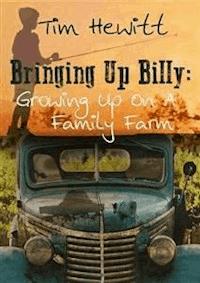
Bringing up Billy: Growing up on a Family Farm, is a delightful collection of stories from a simpler time. It was a time when neighbors all knew one another and took care of each other without question. A time when the stresses of the day were about making it home for dinner at six-thirty, when you were out playing in the woods a little too late. For Billy Blasedale, life is one adventure after another, as he learns all about life, friendship, and the responsibility of growing up on a small family farm. Join Billy on this adventure, and experience the simple life of rural America in the sixties and seventies in the eyes of a bright, energetic young boy.
Das E-Book können Sie in Legimi-Apps oder einer beliebigen App lesen, die das folgende Format unterstützen:
Veröffentlichungsjahr: 2018
Ähnliche



















Bringing Up Billy
Growing up on a Family Farm
Tim Hewitt
Edited byKelly Hartigan
Cover Design byJeanine Henning
Copyright © 2018 Tim Hewitt
All rights reserved
First Edition
October 2018
Bringing up Billy is a work of fiction. Names, characters, places, and incidents either are the product of the author’s imagination or are used fictitiously. Any resemblance to actual persons, living or dead, events or locales, is entirely coincidental (or not).
No part of this book may be reproduced in any form or by any electronic or mechanical means, including information storage and retrieval systems, without written permission from the author, except for the use of brief quotations in a book review.
Cover design by Jeanine Henning
http://jhillustration.wordpress.com
Editing by Kelly Hartigan of XterraWeb
http://editing.xterraweb.com
Created with Vellum
This book is dedicated to all those who seek a simpler time - a time when neighbors all knew one another, when no one needed to lock their doors, and community meant helping each other, friend or stranger, in good times and in bad.
Contents
Hi, I’m Billy
Rufus
Where’s the Farm Truck?
Vietnam
Llamas or Yamas?
Which Came First?
Puppies and the Pond
A Sheep in Wolf’s Clothing
Zero to Sixty
Sausage Making
Silver Ants
Let it Snow, Let it Snow, Let it Snow
Fire in the Hole!
The Fishing Holes
Anna
White Lightning
The End
About the Author
Hi, I’m Billy
I was nearly six years old when I discovered that not everyone lived on a farm. My world was filled with morning chores, chasing chickens, tormenting my brothers, great home-cooked food, praising the Lord at dinner, and early to bed.
Occasionally, I was able to ride a horse, play in the hay loft in the barn, or follow my brother Hank into the woods behind the house to burn ants with a propane torch. Hank was seven years older than me, but he was always doing something fun, and I loved to tag along. As long as his friends were not over, I could usually take part in the mini-adventure, and we almost never got caught doing something we were not supposed to be doing, so that was good.
I had regular chores, of course, even at age six. I fed the chickens and brought in the eggs. My brother Michael milked the cow twice a day, and that seemed to be all he did. He was eight years older than me, and he never picked on me at all. Most of the time he was studying books on being an aerospace engineer—those were the guys who would eventually put men on the moon, design space stations where people would live in space, and create giant spaceships that would take millions of people to live on other planets someday.
Michael and Hank shared a room that had a ceiling covered with charts of all the planets, the constellations, and every known star. There were so many stars that I would sometimes lay on my back on the floor and dream about going to those faraway stars. Michael could be an astronaut-engineer. That was just fine with me. I just wanted to go along for the adventure!
My brother Liam was the youngest of my older brothers, being just three years older than me. Liam and I shared a room until Michael left home, and then he moved in with Hank and left me alone. They all called me the baby of the family, and Liam spent most of his free time torturing me. Everyone had chores, but Liam seemed to get out of his more than anyone else. He would trade me chores for something and then not do mine or his. I would get in trouble for not doing my chores, because I always did the traded chores first. Liam just laughed at me and ran off to play with his friends. I trusted him every time, and eventually, I just did his chores and my chores every day since it was easier that way.
Remember I said I thought everyone lived on a farm? That’s because at six years old all my friends did. The farthest I ever went from a farm was to the big grocery store in town. In that store, you bought food and put it in boxes on a big flat trolley. They sold toilet paper in a package with sixty rolls that was nearly as tall as I was! It was a place to get all the things we did not grow ourselves or barter from our neighbors.
My dad wasn’t really a farmer. He left every morning to work at the bank. My mom was an elementary school secretary. Grandma and Grandpa Blasedale lived just down the street, and Grandma cooked for us nearly every day. Mom was not a very good cook. I loved to cook with Grandma, and I was pretty good at it as well. After Grandpa Blasedale died, Grandma moved in with us. She made sure that I did all my chores before I went off to play.
Every one of us was supposed to cook one meal a week, but my brothers did not spend much time in the kitchen. Grandma would take over and run them off most of the time. Since I loved to cook and learn all her recipes, I spent a great deal of time cooking and even cooked meals all by myself quite often.
By the way, my name is Billy, Billy Blasedale. My real name is William Lawrence Blasedale, but everyone just calls me Billy. This book is mostly the story of my growing up on a small family farm in Washington. The chapters are not really in order, so it's not like you can start when I'm six and read all about until I leave for college. Each chapter shares a special story from my life growing up on the farm. Skip around if you like, it's okay. You shouldn’t get too confused. Come on along with me, and let’s have some fun on the farm!
Rufus
I started driving the backhoe when I was around ten. I needed to attach wooden blocks to the pedals to reach them, but I had a delicate hand on the controls and could run the machine better than any of my brothers. My dad was an absolute disaster on any piece of farm equipment, but fortunately, he understood that, so he would delegate chores to one of us whenever some piece of farm equipment needed to be operated. On the day of this particular adventure, I was just twelve. I remember that because it happened right after my twelfth birthday.
“Billy, come over here and bring the backhoe!” Dad called out from the barn.
I was just finishing the evening feeding at the kennel, so I gladly jumped on the backhoe, strapped my blocks to the pedals with a bungee cord, and drove it over to the barn. “What’s up, Dad?”
“Doc Anderson just told me we need to bury Matilda, as he cannot figure out how she died,” Dad said. Matilda was one of our retired milk cows. I think she probably died of old age. “Chain her to the bucket and take her out to the far corner of the pasture.”
“What do I do with her there?” I asked.
“Bury her as deep as that machine will dig,” Doc Anderson advised as he walked out of the barn with his medical bag. “That way there won't be any smell, none of the other animals will be bothered, and you won’t attract any scavengers.”
“Okay,” I answered cheerfully. I loved to operate the backhoe.
“Finish up before dark,” Dad instructed. “I don’t want you out there just playing around.”
“Don’t worry, Dad,” I answered. “It won’t take that long.”
I chained Matilda to the bucket and dragged her out of the barn. Once clear of the building, I raised the bucket so she wouldn’t just drag on the ground, opened the gate to the big pasture, and began my mission.
Doc Anderson yelled and waved as he got into his station wagon and drove out the driveway. I couldn’t really hear him, but I waved back. Dad went into the house, and I proceeded across the fifteen-acre pasture.
I picked a spot roughly twenty feet from the corner fence on both sides, set Matilda down on the grass, and started to dig my hole. I first peeled back the sod and laid it on the side. That was delicate work with the bucket, but it was fun. The backhoe was able to reach nearly twelve feet directly in front of me, so I dug down as far as I could in one place, backed up, and extended the hole in this way. When I had a trench about eight feet long and nearly twelve feet deep, I chained Matilda to the bucket and gently lowered her into the hole.
I could have just pushed her in with the front loader, but I thought she deserved a little better than that. I pulled the chain out of the hole and started to fill it back up one bucket at a time. I suppose I could have pushed the dirt back in with the front loader as well, but it was a lot more fun using the bucket.
After a half a dozen scoops, I was surprised to see a sheriff’s car pull up outside the fence with his red roof light flashing. I wasn’t sure what to do, but it was going to be dark soon, so I kept filling in the hole.
“Rhoo rhere ron rah ractor, rut rit roff ran ret rown!” An incomprehensible voice said something to me over the loudspeaker from the car. A spotlight was shining right in my eyes from next to the driver’s side window, and the voice said something again that I could not understand.
“What?” I hollered, shielding my eyes. The voice again repeated his command, but I really couldn’t hear anything over the sound of the old diesel motor running right behind me.
I killed the motor and hollered again, “What?”
“Get down off the tractor, turn around, and put your hands on the side of the machine!” the voice commanded.
“Do what?” I asked. "It's a backhoe, not a tractor!" I was a little surprised and wanted to make sure I actually heard the sheriff correctly.
“I said get down off the tractor, turn around, and put your hands on the side of the machine!”
I could almost see around the spotlight now and could tell that the sheriff was standing behind the open door, pointing his gun at me! My heart started racing. I climbed down, turned around, and put my hands on the rear tire. I could not put them on the side of the backhoe, as that was the motor housing and it was very hot.
“Don’t move!” the sheriff yelled.
I turned to see him come around the car, holster his weapon, and climb over the split rail fence.
“What’s wrong?” I yelled as I started to turn around.
“I said don’t move,” the sheriff again commanded. He came up behind me, put me in handcuffs, and bodily turned me around to face him—keep in mind, I was twelve years old.
“What’s wrong?” I asked again. “What did I do?” I was so scared that I practically peed myself. I knew the local sheriff, and this wasn't him. This officer was younger and seemed more nervous. I had no idea what was happening.
“What are you doing?” he demanded.
“I’m burying a dead cow. My dad told me to do it. I’m doing exactly what he told me to do,” I quickly replied.
“Stay there and don’t move,” he instructed. The deputy walked over to the hole and looked down. It was starting to get dark, and the hole was deep and completely in shadow. Even if it were not so deep, Matilda was completely covered in dirt by this time anyway.
“I had a report that someone was burying a body,” the deputy stated as he started to walk around the hole.
“I am. It’s a dead cow. Her name was Matilda. The vet said to bury her deep.”
“I don’t see a cow,” the deputy said as he continued to walk around the hole.
“I wouldn’t stand right there if I were you,” I called out.
“Shut up, kid,” the deputy called back.
“It’s not a good idea to stand right there,” I yelled again.
“I said shut up, kid!” the angry deputy called back.
“I want you to dig up whatever it is you put in this hole, I—” Whack. Thud. Thud.
Rufus, the fifteen-hundred-pound Black Angus bull who lived in this pasture, had charged the deputy from behind and hit him like a freight train. He did not like trespassers in his pasture, and unless you were on the tractor or, like me, on the backhoe, he would chase anyone who entered. I scrambled back up on the backhoe, handcuffs and all, so I would not be his next victim.
Another sheriff’s car drove up alongside the first. This one also had his light on, and together, the two sets of flashing lights caused Rufus to back off about twenty yards though he kept his vigil.
“Hey, Billy, what’s going on?” the sheriff called out.
“Hi, Sheriff Martin, I’m burying a dead cow,” I called back.
“Where’s your dad?”
“He’s up at the house. I’m supposed to be back up there by dark, but I’m going to be late now.” My heart was still pounding in my ears, but I knew Sheriff Martin to be a nice man.
“Where’s my deputy?” he called out from the fence.
“He’s in the hole,” I called back.
“He's what?”
“Rufus knocked him in. I tried to warn him, but he handcuffed me and told me not to move. I climbed back up on the backhoe so Rufus wouldn’t come after me too.”
Sheriff Martin climbed the fence and walked up to the edge of the hole, keeping the hole between himself and the nervous bull.
“Do you think he’s dead?” he asked as he looked toward the hole.
“I don’t think so.” I peered over the front of the backhoe into the hole.
Sheriff Martin shined his flashlight in the hole, where the unconscious deputy was lying facedown in the dirt. I heard the tractor and saw my dad bearing down on the scene. I didn’t think I was in trouble, but sometimes, with Dad, you couldn’t be sure.
“Hello, Henry,” Sheriff Martin greeted my dad as he arrived and climbed off the seat.
“David,” he greeted the sheriff. “What’s going on here?” Dad walked up to the hole and looked down at the deputy and then looked over at me. “What did you do?” he asked me.
“I didn’t do anything,” I replied. “Rufus knocked him into the hole. I told him not to stand there, but he didn’t listen and just told me to shut up.”
Both dad and the sheriff stood looking in the hole for a few more minutes not saying a word. Finally, the sheriff turned to my dad and said, “He was just assigned here from the city, I’m afraid. He doesn’t know anything about country life. I’m tempted to just let Billy fill in the hole with him down there.”
Dad just nodded, and I didn’t know if they were serious or not. “I’ll need to have these handcuffs taken off if I’m going to fill in the hole,” I said.
“Handcuffs?” Dad asked. I twisted sideways so he could see I was cuffed behind my back.
Sheriff Martin sighed and came over to remove my shackles.
“You want me to fill in the hole?” I asked innocently.
“No, but I think we will just let him lie there until he comes to,” the sheriff replied.
We only had to wait a few minutes more before the deputy stirred in the bottom of the hole.
“Wha? What happened?” he asked as he looked up at his boss shining a flashlight down on him.
“What were you thinking, handcuffing a twelve-year-old boy?” the sheriff asked.
“I—”
“When he told you not to stand where the bull could ram you, did you think he might be at least a little bit correct?” the sheriff interrupted.
“Bull? What bull?” the deputy asked.
“Climb out of that hole, and get your butt back to the office. I’ll decide what to do with you later.” The sheriff turned to my dad next. “Sorry, Henry, I’ll have a word with him and see that this type of thing doesn’t happen again.” He turned to me next. “Billy, I’m sorry about this.”
"It's okay, Sheriff," I replied. "Can I finish filling in the hole now?"
“Get out of there, Larry,” the sheriff called down to his deputy.
“I, I can’t,” he stammered. “It’s too deep and the walls just cave in when I try to climb up.”
"We should probably fish my deputy out of there first, then you can take care of your cow, Billy," Sheriff Martin replied.
“I’ll lower the bucket, and you can hang on while I lift you out!” I called down to the deputy.
"I'll see you in the house later," Dad added. "David, would you like to come in for a cup of coffee?"
"Irish coffee perhaps?"
"Irish coffee for sure."
Where’s the Farm Truck?
We had an old yellow dual-axle dump truck. It was made by GMC, and I thought it had always been old. It wasn’t street legal, though we did take it to the Farm and Feed store in town once in a while. The old yellow truck didn’t have headlights, had a piece of plywood covering the springs in the seat, and started with the push of a button—no key required.
Our neighbors knew they could borrow the truck when they needed it. All my dad asked was that they replaced any diesel fuel they used and returned it with the bed cleaned out.
One afternoon as I was getting ready to enter the kitchen after school, Sheriff Martin drove in the driveway and honked the horn.
“Good afternoon, Billy,” the sheriff said through his open car window.
“Afternoon, Sheriff. Can I help you with something?”
“You know where your dump truck is?”
I looked over behind the barn, and sure enough, the big yellow farm truck was not there.
“I suppose one of the neighbors borrowed it,” I replied. “It happens all the time.”
“Your dad home?”
“Not till nearly six o’clock. Grandma is here though.”
“Can your grandmother drive that truck?”
“Grandma? No way.” I laughed. “She can’t even drive the station wagon. No way she could drive the farm truck.”
“Tell her you are going to take a little ride with me,” the sheriff instructed.
I bounded up the stairs, opened the kitchen door, and dropped my bag in the corner.
“Hi, Grandma. Do you know who borrowed the big yellow truck?” I asked.
She was stirring a pot of something on the big black kitchen stove. “No one asked me. No one told me,” she replied.
“Sheriff Martin asked me to take a ride with him, so I’m going to be gone a little while,” I informed her.
“Don’t be late for dinner,” she admonished.
“I won’t.” I spun around and took the kitchen stairs in one leap. “Let’s go!” I yelled to the sheriff.
“You sure you don’t know who borrowed your dump truck?”
“No idea. Sometimes, they leave a note. Sometimes, they will tell Grandma. I asked her, and she didn’t know either.”
“Do you remember if it was there when you left for school this morning?”
“I don’t know, maybe,” I said. “I went into the barn through the milking parlor this morning, so I don’t know for sure.”
“Okay, well, I know where your truck is but not exactly how it got there,” the sheriff stated.
“Where is it?”
“I’ll show you, just climb in.”
We drove down my street to the first intersection and then down toward Rural Route 7, but we turned onto Johnson Road before the highway.
“See those tracks along the edge of the road?” Sheriff Martin pointed out deep tracks in the soft shoulder. “I think those are from your truck.”
“Who would have brought it down here?” I asked.
“I was hoping maybe you knew,” he replied. “Keep watching that side of the road.”
As I watched the tracks swerve into the road and then back onto the shoulder, I noticed that all the mailboxes on that side of the road were smashed. The tracks led into the soft shoulder and right through where the mailbox posts once held their little metal cans at mailman height.
“All the mailboxes are knocked over!” I announced.
“For nearly three miles on this road, only a couple of boxes seemed to survive,” the sheriff said.
“You think someone drove over them in our farm truck?” I asked.
“I do and you will see why in just a minute.”
As we reached the end of Johnson Road where it met up with the Quarry Road and formed a T-shaped intersection, there was our old yellow farm truck, nose down in the ditch. Apparently, whoever was driving was not able to make the turn.




