


Erhalten Sie Zugang zu diesem und mehr als 300000 Büchern ab EUR 5,99 monatlich.
- Herausgeber: epubli
- Kategorie: Fachliteratur
- Sprache: Englisch
Browser Tasks Automation: Supercharge Your Web Productivity Unlock the full potential of your web browser with Browser Tasks Automation, the essential guide to mastering automated web interactions and transforming how you work online. This powerful resource reveals how everyday browser tasks—from logging into websites and extracting data to submitting forms and managing downloads—can be executed faster, more efficiently, and with minimal effort. Inside This Book, You'll Discover: Getting Started with Automation Tools — Learn about popular frameworks and extensions that kickstart your automation journey. Understanding the Browser DOM — Unlock the inner structure of websites to effectively interact with elements. Using JavaScript for Basic Automation — Write your first automation scripts using the language of the web. Web Scraping Essentials — Extract useful data from any webpage with precision and clarity. Automating Login and Session Handling — Maintain access to websites without manual logins. Handling Pop-Ups, Alerts, and Modals — Keep your automation scripts running smoothly through unexpected interruptions. Debugging and Error Handling — Build resilience into your automations with smart troubleshooting techniques. From foundational principles to advanced projects, each chapter is crafted to ensure you gain both the skills and confidence to build automation that truly works. You'll not only understand how to automate but why it matters—and how to do it responsibly, securely, and in ways that enhance productivity without crossing ethical lines. If you're ready to reclaim your time, streamline your digital workflows, and level up your efficiency in the browser, this is the book that will take you there. Scroll Up and Grab Your Copy Today!
Sie lesen das E-Book in den Legimi-Apps auf:
Seitenzahl: 104
Veröffentlichungsjahr: 2025
Das E-Book (TTS) können Sie hören im Abo „Legimi Premium” in Legimi-Apps auf:
Ähnliche


















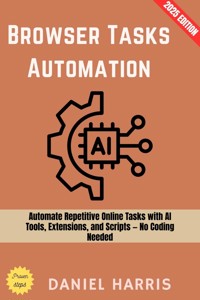
Browser Tasks Automation
Automate Repetitive Online Tasks with AI Tools, Extensions, and Scripts — No Coding Needed
Daniel Harris
Table of Content
Introduction to Browser Automation
Why Automate? Benefits and Use Cases
Getting Started with Automation Tools
Understanding the Browser DOM
Using JavaScript for Basic Automation
Web Scraping Essentials
Form Filling and Auto Submission
Automating Login and Session Handling
Automating File Uploads and Downloads
Handling Pop-Ups, Alerts, and Modals
Scheduling and Triggering Automated Tasks
Headless Browsers Explained
Debugging and Error Handling
Real-World Automation Projects
Security, Ethics, and Best Practices
Conclusion
© Copyright [2025] [Daniel Harris] All rights reserved.
- No part of this book may be reproduced, stored in a retrieval system, or transmitted in any form or by any means, electronic, mechanical, photocopying, recording, or otherwise, without prior written permission of the publisher, except for brief quotations in a review or scholarly article.
- This is an original work of fiction [or non-fiction] by [Daniel Harris]. Any resemblance to actual persons, living or dead, or actual events is purely coincidental.
Legal Notice:
The reader is solely responsible for any actions taken based on the information contained in this book. The author and publisher expressly disclaim any responsibility or liability for any damages or losses incurred by the reader as a result of such actions.
Disclaimer:
This book is intended for educational purposes only. The information contained within is not intended as, and should not be construed as medical, legal, or professional advice. The content is provided as general information and is not a substitute for professional advice or treatment.
This declaration is made for the purpose of asserting my legal ownership of the copyright in the Work and to serve as proof of ownership for any legal, publishing, or distribution purposes. I declare under penalty of perjury that the foregoing is true and correct.
In the age of information, where time is currency and efficiency defines success, automation has become not just an advantage—but a necessity. Every day, millions of repetitive, time-consuming tasks are performed in browsers: logging into accounts, scraping data, filling forms, checking updates, downloading files, and navigating complex websites. What if all those tasks could run on their own, triggered automatically, completed with precision, and free of human error? That’s exactly what Browser Tasks Automation sets out to explore.
This book is your comprehensive guide to understanding, building, and deploying browser-based automation—from the foundational concepts to advanced real-world applications. Whether you're a developer looking to streamline workflows, a data analyst hoping to speed up information retrieval, or a business owner interested in scaling routine web interactions, this book is designed to walk you through every step of the journey.
We begin with the introduction to browser automation, where you’ll understand what it is, why it matters, and how it’s transforming modern workflows across industries. The next chapters help you explore the benefits and use cases that go beyond theory, showing practical, powerful applications in marketing, e-commerce, customer service, research, and more. With these concepts in hand, we’ll move into the tools that make automation possible—from browser extensions and scripting languages to powerful frameworks like Puppeteer and Playwright—in Getting Started with Automation Tools.
Understanding the inner workings of the web is essential. The book leads you into the structure of websites via Understanding the Browser DOM, helping you see how elements, scripts, and interactions are wired together behind the scenes. With this knowledge, you’ll learn how to take control using JavaScript for Basic Automation, the scripting language of the web.
Next, we explore the art and science of Web Scraping Essentials, teaching you how to extract structured data from complex websites cleanly and efficiently. From there, we get practical with Form Filling and Auto Submission, showing how automated inputs can replace hours of manual typing. And since logging into services is a critical step in most workflows, Automating Login and Session Handling takes you deep into managing authentication, cookies, tokens, and secure access.
Real-world tasks often involve handling files, so we explore Automating File Uploads and Downloads, enabling your scripts to interact with file systems, upload forms, and download reports seamlessly. Web interactions aren't always smooth—unexpected pop-ups, alerts, and modals can break automation. That’s why Handling Pop-Ups, Alerts, and Modals is dedicated to making your bots more resilient and intelligent.
Timing and reliability are key to automation. You’ll learn how to set up Scheduling and Triggering Automated Tasks, ensuring your scripts run exactly when needed—daily, hourly, or in reaction to external events. For performance, stability, and silent execution, Headless Browsers Explained demystifies running browsers without a GUI, saving resources while scaling automation.
Automation isn’t just about running scripts—it’s about keeping them running. That’s where Debugging and Error Handling comes in, giving you the tools to identify and fix problems quickly, ensuring your automations are robust and error-resistant.
To bring everything together, Real-World Automation Projects shows case studies and examples of complete systems: from tracking prices on e-commerce platforms to monitoring social media activity or generating reports across dashboards. These projects illustrate the power of automation in action.
But with power comes responsibility. In the final chapter, Security, Ethics, and Best Practices, we examine the legal, ethical, and technical considerations that come with automation. Respecting user privacy, protecting data, staying compliant with terms of service, and ensuring the security of your systems isn’t optional—it’s vital.
This book is not just a manual of code or theory; it's a roadmap for empowering your work and ideas. It invites you to move beyond tedious manual web interaction and into a future where browsers work for you. Whether you're new to the field or already familiar with automation, each chapter is crafted to build your knowledge, confidence, and capability.
Welcome to the world of browser tasks automation—where your time is reclaimed, your systems are supercharged, and your ideas come to life faster than ever before.
Introduction to Browser Automation
In today's digital age, browsers are our gateways to the internet. From accessing social media to managing bank accounts, submitting job applications to monitoring market trends, browsers serve as our universal platform for interacting with a wide range of services. Yet, despite how central they are to our daily work and personal tasks, much of what we do in browsers is repetitive, time-consuming, and prone to human error. This is where browser automation steps in—a powerful solution that transforms how we interact with the web by allowing machines to take over these repetitive actions with precision and speed.
Browser automation is the process of programming a machine or script to perform actions in a web browser just like a human would. Imagine opening a webpage, clicking a button, filling out a form, downloading a report, or scraping a table of information—all without lifting a finger. What once took hours to complete manually can be automated to run in seconds or minutes, often without supervision. It's like hiring a virtual assistant that works tirelessly, never gets bored, and doesn't make mistakes due to fatigue or distraction.
The concept of automation is not new. In factories, machines have replaced manual labor for years. In software, we’ve automated everything from emails to data processing. Browser automation simply applies this same principle to web interfaces. What makes it particularly compelling is its accessibility and universality. Web pages follow a consistent set of rules based on HTML, CSS, and JavaScript. If you can understand the structure of a page and the behavior of its elements, you can teach a machine to interact with it.
This kind of automation isn't just for tech experts or large corporations. Thanks to the development of user-friendly tools and open-source libraries, almost anyone with basic programming knowledge can build powerful automation scripts. Python libraries like Selenium and Playwright, for example, provide an intuitive way to control browsers programmatically. Meanwhile, no-code platforms and browser extensions also exist for those who want to automate tasks without writing a single line of code.
The use cases are virtually endless. Consider the world of e-commerce. Online sellers can use automation to track competitor prices, monitor stock availability, and even adjust their own prices accordingly. Recruiters and job seekers might automate the process of browsing job listings or submitting resumes. Marketers can schedule and post content across multiple platforms, scrape contact details, and analyze engagement statistics—all in one go. Even students and researchers benefit from automated tools that collect data from academic databases or extract content from multiple sources for review.
Of course, with great power comes great responsibility. Automation must be used ethically and responsibly. Many websites have terms of service that limit or prohibit automated access, especially if it burdens their servers or compromises user data. Security is also a key concern—automating login processes, for instance, requires safely handling passwords and authentication tokens. That’s why it’s important to balance functionality with compliance and safety when developing automation scripts.
Still, the power of browser automation cannot be understated. As businesses and individuals increasingly rely on web platforms to operate, automation offers a massive efficiency boost. It can dramatically reduce the need for manual oversight, free up time for more strategic tasks, and minimize human error. Moreover, it enables a kind of scalability that would otherwise be impossible—scripts don’t get tired, and they can run 24/7 if needed.
One of the most exciting aspects of browser automation is its adaptability. The tools and scripts can be fine-tuned to perform very specific tasks. If you only want to collect data from a single website once a day, you can do that. If you need to simulate an entire user journey—clicking through menus, responding to prompts, even submitting payments—automation can handle that too. This makes it incredibly versatile for both small and complex workflows.
Moreover, automation plays a pivotal role in testing and quality assurance. Developers use browser automation to test how websites perform under various conditions, catch bugs, and ensure that user interactions work as intended. Without automation, testing every feature manually would be a labor-intensive and inconsistent process. With it, updates can be rolled out more confidently, knowing that automated scripts will catch most regressions before users do.
We’re also seeing automation become more intelligent. Integration with artificial intelligence and machine learning opens new doors. Scripts can now adjust based on patterns in user data, optimize for outcomes like higher engagement, and even mimic natural decision-making processes. While this is still an emerging field, it signals the future direction of automation—not just as a tool for executing commands but as a smart system capable of learning and evolving.
Despite its strengths, browser automation isn't a magic bullet. It has limitations. Websites that use dynamic content loading, heavy JavaScript frameworks, or security mechanisms like CAPTCHAs and two-factor authentication can present challenges for automation scripts. These barriers are designed to prevent non-human activity, and getting around them often requires advanced techniques or manual intervention. Nonetheless, even in these cases, partial automation is still achievable and often worthwhile.
Ultimately, browser automation is about empowerment. It allows individuals to take control of their digital workload, streamline repetitive tasks, and achieve more with less effort. For businesses, it represents a strategic advantage—an opportunity to reduce costs, improve consistency, and speed up operations. And for developers and hobbyists, it’s an exciting playground for creativity, exploration, and real-world problem solving.
As we explore this topic deeper throughout the book, we’ll uncover the tools, techniques, and real-life applications that make browser automation not only possible but practical. Whether you're a curious beginner, a tech-savvy entrepreneur, or a software developer looking to level up your skills, the world of browser automation has something valuable to offer. This chapter is just the first click into a larger journey—one where your browser becomes more than a tool; it becomes a tireless digital assistant ready to execute your every command.
Why Automate? Benefits and Use Cases
In a world increasingly reliant on digital platforms, time has become one of the most valuable commodities. People are constantly navigating the web—logging into portals, searching for information, copying data, updating records, and more. These actions, although necessary, are often repetitive and consume hours of productive time. It’s not uncommon for someone in a modern office to spend a third of their day doing routine browser tasks that require little creativity but cannot be avoided. That’s where browser automation becomes not just a convenience, but a game-changer. The idea of automating tasks within a browser isn’t just about saving time—it’s about amplifying efficiency, eliminating human error, and unlocking new possibilities across various industries.




