


115,99 €
Mehr erfahren.
- Herausgeber: John Wiley & Sons
- Kategorie: Wissenschaft und neue Technologien
- Sprache: Englisch
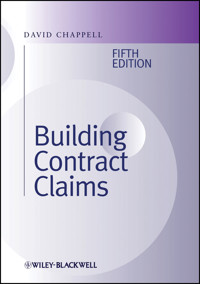
Many building projects are the subject of claims – the assertion of a right, usually by the contractor, to an extension of the contract period or an additional payment under the terms of the building contract. Many of these claims are unsound or ill-founded, often because the basic principles are misunderstood.
This highly regarded book examines the legal basis of claims for extensions of time and additional payment, and what can and cannot be claimed under the main forms of contract. It includes chapters dealing with direct loss and expense, liquidated damages, extension of time, concurrency problems, acceleration, time at large, common law and contractual claims, global claims, and heads of claim and their substantiation. With the publication of the fifth edition, Building Contract Claims has been thoroughly revised to ensure it is fully up to date with the latest contracts, court judgments and building practice. Changes include:
- Coverage of over 60 additional relevant court cases
- Coverage of the 2005 JCT contracts suite
- Coverage of changes to the NEC contract
- Coverage of additional contracts such as Constructing Excellence; Measured Term Contract and the ACA PPC2000 contract together with the 2005 relevant JCT sub-contracts
- Important changes to liquidated damages and to extensions of time, and the giving of notices
- Appendix 1 has been substantially revised
Like its predecessors, the fifth edition of Building Contract Claims will be essential reading for architects, contract administrators, project managers and quantity surveyors, as well as contractors, contracts consultants and construction lawyers.
Sie lesen das E-Book in den Legimi-Apps auf:
Seitenzahl: 1317
Veröffentlichungsjahr: 2011
Ähnliche















Table of Contents
Cover
Title page
Copyright page
Preface
Acknowledgements
Contract abbreviations
PART I
Chapter 1 Introduction
1.1 Structure of the book
1.2 Types of claims
1.3 The basis of claims
1.4 Architect’s and contract administrator’s powers and liability to contractor
1.5 Quantity surveyor’s powers
Chapter 2 Time
2.1 Time of the essence
2.2 Time at large
2.3 Extension of time clauses in contracts
2.4 Concurrency
2.5 Acceleration
2.6 Sectional completion
2.7 The SCL extension of time Protocol
Chapter 3 Liquidated damages
3.1 The meaning and purpose of liquidated damages
3.2 Liquidated damages or penalty
3.3 Liquidated damages as limitation of liability
3.4 Sums greater than a genuine pre-estimate
3.5 Liquidated damages as an exhaustive remedy
3.6 Injunction
3.7 Liquidated damages in relation to loss
3.8 Where there is no breach of contract
3.9 Calculation of liquidated damages
3.10 Where there is partial possession
3.11 Maximum recovery if sum is a penalty
3.12 Maximum recovery if liquidated damages do not apply
3.13 Defences to liquidated damages in building contracts
3.14 Bonus clauses
Chapter 4 Basis for common law claims
4.1 General
4.2 Implied terms
4.3 Variation of contract
4.4 Omission of work to give it to others
4.5 Extra work
4.6 Possession of site
4.7 Site conditions
Chapter 5 Direct loss and/or expense
5.1 Definition
5.2 Direct v indirect
5.3 Exclusion of consequential loss
Chapter 6 Points of principle
6.1 Measure of damages
6.2 Burden of proof
6.3 Res ipsa loquitur
6.4 Mitigation of loss
6.5 Betterment
6.6 Notices
6.7 Categories of claim
Chapter 7 Potential heads of claim
7.1 Foreshortened programme
7.2 The ‘knock-on’ effect
7.3 The more common heads of loss
7.4 Cost of a claim
Chapter 8 Causation
8.1 Theory
8.2 Use of networks
8.3 Float
Chapter 9 Global claims
9.1 Basic principles of global claims
9.2 Unacceptable global claims
9.3 The current position
Chapter 10 Preparation and substantiation of claims
10.1 Preparing a claim
10.2 Types of evidence required to support a claim
10.3 ‘Scott schedules’
PART II
Chapter 11 Extension of time under JCT standard form contracts
11.1 Standard Building Contract (SBC)
11.2 Intermediate Building Contract (IC and ICD)
11.3 Minor Works Building Contract (MW and MWD)
11.4 Design and Build Contract (DB)
11.5 Prime Cost Building Contract (PCC)
11.6 Management Building Contract (MC)
11.7 Construction Management Trade Contract (CM/TC)
11.8 Major Project Construction Contract (MP)
11.9 Measured Term Contract (MTC)
11.10 Constructing Excellence Contract (CE)
Chapter 12 Liquidated damages under JCT standard form contracts
12.1 Standard Building Contract (SBC)
12.2 Intermediate Building Contract (IC and ICD)
12.3 Minor Works Building Contract (MW and MWD)
12.4 Design and Build Contract (DB)
12.5 Prime Cost Building Contract (PCC)
12.6 Management Building Contract (MC)
12.7 Construction Management Trade Contract (CM/TC)
12.8 Major Project Construction Contract (MP)
12.9 Measured Term Contract (MTC)
12.10 Constructing Excellence Contract (CE)
Chapter 13 Loss and/or expense under JCT standard form contracts
13.1 Standard Building Contract (SBC)
13.2 Intermediate Building Contract (IC and ICD)
13.3 Minor Works Building Contract (MW and MWD)
13.4 Design and Build Contract (DB)
13.5 Prime Cost Building Contract (PCC)
13.6 Management Building Contract (MC)
13.7 Construction Management Trade Contract (CM/TC)
13.8 Major Project Construction Contract (MP)
13.9 Measured Term Contract (MTC)
13.10 Constructing Excellence Contract (CE)
Chapter 14 Variations
14.1 Introduction
14.2 The baseline
14.3 Bills of quantities
14.4 Functions of the architect and the quantity surveyor
14.5 JCT Standard Building Contract (SBC)
14.6 JCT Intermediate Building Contract (IC and ICD)
14.7 JCT Minor Works Building Contract (MW and MWD)
14.8 JCT Design and Build Contract (DB)
14.9 JCT Prime Cost Building Contract (PCC)
14.10 JCT Management Building Contract (MC)
14.11 JCT Construction Management Trade Contract (CM/TC)
14.12 JCT Major Project Construction Contract (MP)
14.13 JCT Measured Term Contract (MTC)
14.14 JCT Constructing Excellence Contract (CE)
PART III
Chapter 15 Claims under the General Conditions of Government Contracts for Building and Civil Engineering Works (GC/Works/1(1998))
15.1 Introduction
15.2 Extension of time and liquidated damages
15.3 Prolongation and disruption
15.4 Valuation of instructions
Chapter 16 Claims under the ACA Form of Building Agreement (ACA 3)
16.1 Introduction
16.2 Extension of time and liquidated damages
16.3 Prolongation and disruption
16.4 Valuation of instructions
Chapter 17 Claims under the ACA Standard Form of Contract for Project Partnering (PPC2000)
17.1 Introduction
17.2 Extension of time and damages
17.3 Loss and/or expense
17.4 Changes
Chapter 18 Claims under NEC 3 Engineering and Construction Contract (NEC 3)
18.1 Introduction
18.2 Compensation events
18.3 Delay damages
Chapter 19 Sub-contract claims
19.1 Introduction
19.2 JCT Standard Building Sub-Contract Conditions (SBCSub/C)
19.3 JCT Standard Building Sub-Contract with Sub-Contractor’s Design Conditions (SBCSub/D/C)
19.4 JCT Intermediate Named Sub-Contract Conditions (ICSubNAM/SC)
19.5 JCT Intermediate Sub-Contract Conditions (ICSub/C)
19.6 JCT Intermediate Sub-Contract with Sub-Contractor’s Design Conditions (ICSub/D/C)
19.7 JCT Design and Build Sub-Contract Conditions (DBSub/C)
19.8 JCT Management Works Contract Conditions (MCWC/C)
19.9 ACA Form of Sub-Contract (ACA/SC)
APPENDIX
Example of contractor’s claim for reimbursement of direct loss and/or expense under SBC with quantities clauses 4.23–4.26 – architect’s and quantity surveyor’s assessment with commentary
A.1 Introduction
A.2 Contract Particulars
A.3 The ascertainment
A.4 Generally
Table of cases
Table of standard form contract clauses
Index
© 1983, 1988 The Estate of Vincent Powell-Smith & John Sims
© 1998 David Chappell, The Estate of Vincent Powell-Smith & John Sims
© 2005 David Chappell, The Estate of Vincent Powell-Smith & John Sims
© 2011 David Chappell
Wiley-Blackwell is an imprint of John Wiley & Sons, formed by the merger of Wiley’s global Scientific, Technical and Medical business with Blackwell Publishing.
Registered office:
John Wiley & Sons, Ltd, The Atrium, Southern Gate, Chichester, West Sussex, PO19 8SQ, UK
Editorial offices:
9600 Garsington Road, Oxford, OX4 2DQ, UK
The Atrium, Southern Gate, Chichester, West Sussex, PO19 8SQ, UK
2121 State Avenue, Ames, Iowa 50014-8300, USA
For details of our global editorial offices, for customer services and for information about how to apply for permission to reuse the copyright material in this book please see our website at www.wiley.com/wiley-blackwell.
The right of the author to be identified as the author of this work has been asserted in accordance with the UK Copyright, Designs and Patents Act 1988.
All rights reserved. No part of this publication may be reproduced, stored in a retrieval system, or transmitted, in any form or by any means, electronic, mechanical, photocopying, recording or otherwise, except as permitted by the UK Copyright, Designs and Patents Act 1988, without the prior permission of the publisher.
Designations used by companies to distinguish their products are often claimed as trademarks. All brand names and product names used in this book are trade names, service marks, trademarks or registered trademarks of their respective owners. The publisher is not associated with any product or vendor mentioned in this book. This publication is designed to provide accurate and authoritative information in regard to the subject matter covered. It is sold on the understanding that the publisher is not engaged in rendering professional services. If professional advice or other expert assistance is required, the services of a competent professional should be sought.
First edition published by Granada Publishing 1983
Second edition published by BSP Professional Books 1988
Third edition published by Blackwell Science Ltd 1998
Fourth edition published by Blackwell Publishing 2005
Library of Congress Cataloging-in-Publication Data
Chappell, David (David M.)
Building contract claims / David Chappell. – 5th ed.
p. cm.
Includes bibliographical references and index.
ISBN-13: 978-0-470-65738-6 (hard cover : alk. paper)
ISBN-10: 0-470-65738-3
1. Construction contracts–England. 2. Breach of contract–England. 3. Actions and defenses–England. 4. Damages–England. I. Title.
KD1641.P67 2011
343.41'078624–dc22
2011013763
A catalogue record for this book is available from the British Library.
This book is published in the following electronic formats: ePDF [9781119951940]; Wiley Online Library [9781119951971]; ePub [9781119951957]; Mobi [9781119951964]
Preface
It was with pleasure, flecked with trepidation, that, in 1997, I accepted the invitation to enlarge the scope and update the third edition of this popular book.
Much of the original text was retained, but updated in the light of case law; the number of case references was almost doubled and, at the wish of the late Professor Powell-Smith, footnotes were included; a change which has proved very popular. Some restructuring took place within chapters to establish a comprehensible system of sub-headings and a few topics, such as liquidated damages (the subject of many disputes), global claims, causation and concurrency, were given greater importance. The scope of the book was extended to include more contracts.
In the fourth edition, the opportunity was taken to carry out further fundamental changes to the structure of the book, bringing general principles to the beginning of the book and dealing with their application to specific contracts later. The text also was substantially revised and almost a hundred additional cases added. New contracts were added including: the JCT Construction Management and Major Projects contracts, the JCT Standard Form of Domestic Sub-Contract and the Engineering and Construction Contract.
In this fifth edition the structure of the book has been slightly amended to give greater prominence to important topics such as notices, mitigation and the measure of damages and more has been said about the way in which a contractor should put together a claim. Account has been taken of the JCT 2005 suite of building contracts and sub-contracts. The Constructing Excellence, Measured Term and the ACA Project Partnering contracts have been included for the first time and the latest NEC contract has been considered. As before, when dealing with JCT contracts the style has been to use the JCT Standard Building Contract 2005 (SBC) as the basis and highlight important differences in the other forms. In some instances there are few similarities. Reference has been made to more than a hundred additional legal cases. In previous editions, the text of relevant contract clauses was reproduced. In this edition, the decision has been taken to remove them. The reason is two-fold: it removes from the book many pages of clauses which many readers will not require and it is assumed that readers have a copy of the relevant contract beside them. At the time of writing, the latest official amendments have been taken into account as follows:
Main contract forms:
SBCRevision 2IC and ICDRevision 2MW and MWDRevision 2DBRevision 2PCCRevision 2MCRevision 2MPRevision 2CM/TCRevision 2CERevision 1MTCRevision 2GC/Works/1 (1998) ACA 32003 RevisionPPC20002008 AmendmentNEC 3June 2005 (with 2006 amendments)Sub-contract forms:
SBCSub/CRevision 2SBCSub/D/CRevision 2ICSub/NAM/CRevision 2ICSub/CRevision 2ICSub/D/CRevision 2DBSub/CRevision 2MCWC/C ACA/SC2003 RevisionReference has also been made to the Housing Grants, Construction and Regeneration Act 1996 as recently amended by Part 8 of the Local Democracy, Economic Development and Construction Act 2009 and the Arbitration Act 1996 where appropriate. It should be noted that, at the time of writing, the 2009 Act is not yet in force.
It should also be noted that in the reproduction and commentary on the JCT standard forms, for brevity ‘Architect’ is used to stand for ‘Architect/ Contract Administrator’. Throughout the book, contractors and sub-contractors have been assumed to be corporate bodies and they have been referred to as ‘it’.
Building contract claims combine a good understanding of the law and of building practice. Certain principles can be discerned and this book is an attempt to explain the principles and to show how those principles should be applied to the popular standard contracts. Standard contracts not only set out the powers and duties of the parties and of various consultants, they also often give procedures which must be followed to enable the participants to carry out the duties and exercise the powers. However, it must not be thought that standard building contracts are excused from the operation of the general law of contract. They are contracts, like any others and subject to the same rules. Thereby hangs the solution to many perceived problems.
In my experience, many claims fail because the basic principles are misunderstood and contractors and sub-contractors do not appreciate the amount of effort required to properly substantiate a claim. A loss of money or lack of profit alone cannot substantiate a claim, although it is usually the trigger. The book is addressed to all parties involved in construction. It is not always possible to give a definitive answer to every question, either because the courts have not considered the matter or because there have been apparently conflicting judgments. Where there is doubt, the doubt is expressed and, if practicable, I have taken a view of the situation.
This book was the idea of the late Professor Vincent Powell-Smith LLB(Hons) LLM DLitt FCIArb DSLP MCL FSIArb and John Sims FRSA FRICS FCIArb MAE. These two eminent practitioners in this field were responsible for the first and second editions and their names were kept on the cover in recognition of this in the third and fourth editions although Vincent had died when I came to write the third edition and John took no part in the writing thereafter. It is a pleasure to formally acknowledge their inspiration and work without which, of course, there would be nothing of which to write a fifth edition. However, nothing of the original text now remains and it has been thought appropriate for their names to be taken off the cover for this edition.
One of the great perks of writing a preface is that it provides the opportunity to thank the people who have assisted me. I am extremely grateful for the help given to me by Michael Cowlin LLB(Hons) DipOSH Dip Arb FCIArb Barrister (not practising) who has assisted me by locating cases and quotations, commenting on various portions of the text and making many helpful suggestions. Michael Dunn BSc(Hons) LLB LLM FRICS FCIArb provided relevant citations and contracts and many useful comments. He went far and beyond what I could expect by giving me the benefit of a very detailed criticism of the material included in the Appendix and suggestions for its improvement. I am grateful for their expertise, but the responsibility for using or not using their suggestions is mine. I am grateful also to Caroline Dalziel LLB(Hons) Solicitor who was meticulous in preparing the Table of cases. My wife, Margaret, has shown her usual patience throughout the long writing process.
I have endeavoured to state the law from available sources at the end of February 2011.
David Chappell
Wakefield
February 2011
Acknowledgements
Permission to reproduce extracts from the following contracts is gratefully acknowledged:
Extracts from the ACA Form of Building Agreement 2003 and the Sub-Contract Form 2003 are reproduced with the kind permission of the Association of Consultant Architects Ltd the copyright holders.
Extracts from the ACA Standard Form of Contract for Project Partnering PPC2000 are reproduced with the kind permission of the Association of Consultant Architects Ltd and Trowers & Hamlins LLP the copyright holders.
Crown Copyright material is reproduced under the terms of the Open Government Licence.
Contract abbreviations
PART I
Chapter 1
Introduction
1.1 Structure of the Book
The book has been arranged in three parts:
Part 1 deals with general principles relating to time, liquidated damages and financial claims of various kinds.
Part 2 looks at the relevant clauses in JCT contracts.
Part 3 looks at the equivalent clauses in other standard contracts and in some standard sub-contracts.
1.2 Types of Claims
The dictionary defines ‘claim’ as ‘a demand for something as due’.1 Standard form contracts do not use the word ‘claim’. In this book the word is taken to mean the assertion of an alleged right, usually by the contractor, to an extension of the contract period and/or to payment arising under the express or implied terms of a building contract. In the construction industry a ‘claim’ is usually used to describe any application by the contractor for payment which is additional to the payment to which it would be entitled under the general interim payment provisions in the building contract. Although commonly associated with money (i.e. a claim for direct loss and/or expense) ‘claim’ is also used to describe a contractor’s application for extension of time. If it was not for ‘claims clauses’ in building contracts, the contractor would be obliged to fall back on a common law claim for damages (usually for breach of contract). In that sense, claims clauses may be considered, albeit not entirely correctly, as a contractual procedure for dealing with damages. More will be said about this later in the book.
It is useful to classify claims by contractors against employers into four categories. They are: contractual claims, common law claims, quantum meruit claims and ex gratia claims. It should not be forgotten that an employer may make claims against a contractor for liquidated damages or for payment of a balance owing on the final certificate or after termination of the contractor’s employment by the employer.
1.2.1 Contractual Claims
These are claims which are based on a clause or clauses in the contract which expressly provide for the contractor to make a claim in certain prescribed situations. A prime example is the direct loss and/or expense clause 4.23 in the Joint Contracts Tribunal Limited (JCT) Standard Building Contract 2005 (SBC). Such claims make use of the machinery in the contract to process the claim and produce a result. The principal reason for having such provisions in the contract is to avoid the necessity for the contractor to have to seek redress at common law and the inevitable expense involved for both parties in doing so. Most standard form contracts in any event preserve the contractor’s right to seek damages at common law if it is not satisfied with its reimbursement under the contract.
1.2.2 Common Law Claims
Common law claims are claims for damages, usually but not exclusively, for breach of contract under common law. They may also embrace claims for breach of some other aspect of the law such as tortious claims or claims for breach of statutory duty. Most standard forms expressly reserve the contractor’s right to make such claims, for example SBC clause 4.26. A common law claim may be made when it is impossible or difficult to make the claim under the contractual machinery, perhaps because the contractor has failed to comply with the criteria set out in the contract within the appropriate timescale. The making of an application within a reasonable time is an example of such a criterion. However, a common law claim may be more restricted in scope than the matters for which a contractual claim can be made, some of which (for example, architects’ instructions) are not breaches of contract. Common law claims are sometimes referred to as ‘ex-contractual’ or ‘extra-contractual’ claims. These terms are sometimes confused with the term . That term is, rarely, found in certain legal textbooks when referring to claims which arise from the contract.
Lesen Sie weiter in der vollständigen Ausgabe!
Lesen Sie weiter in der vollständigen Ausgabe!
Lesen Sie weiter in der vollständigen Ausgabe!
Lesen Sie weiter in der vollständigen Ausgabe!
Lesen Sie weiter in der vollständigen Ausgabe!
Lesen Sie weiter in der vollständigen Ausgabe!
Lesen Sie weiter in der vollständigen Ausgabe!
Lesen Sie weiter in der vollständigen Ausgabe!
Lesen Sie weiter in der vollständigen Ausgabe!
Lesen Sie weiter in der vollständigen Ausgabe!
Lesen Sie weiter in der vollständigen Ausgabe!
Lesen Sie weiter in der vollständigen Ausgabe!
Lesen Sie weiter in der vollständigen Ausgabe!
Lesen Sie weiter in der vollständigen Ausgabe!
Lesen Sie weiter in der vollständigen Ausgabe!
Lesen Sie weiter in der vollständigen Ausgabe!
Lesen Sie weiter in der vollständigen Ausgabe!
Lesen Sie weiter in der vollständigen Ausgabe!
Lesen Sie weiter in der vollständigen Ausgabe!
Lesen Sie weiter in der vollständigen Ausgabe!
Lesen Sie weiter in der vollständigen Ausgabe!
Lesen Sie weiter in der vollständigen Ausgabe!




