


Erhalten Sie Zugang zu diesem und mehr als 300000 Büchern ab EUR 5,99 monatlich.
- Herausgeber: The History Press
- Kategorie: Geisteswissenschaft
- Sprache: Englisch
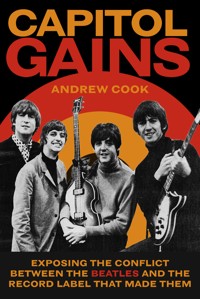
A chance remark on the stairs at Peter Morris Music in London's Denmark Street, in October 1963, set off a chain reaction that helped Brian Epstein apply some much-needed leverage on America's Hollywood-based Capitol label. Although February 1963 marked the Beatles' breakthrough in Britain, by the closing months of that year they still had not conquered the United States. Their manager Brian Epstein had been fighting what seemed like a losing battle to persuade Capitol to release the band's records in America. Indeed, when the Beatles eventually hit the big time in the United States in February 1964, both Epstein and Capitol executives obscured the truth behind it. What is the story behind this essential step in the Beatles' meteoric rise to worldwide fame? In Capitol Gains, historian Andrew Cook uses corporate and personal archives to reveal the reality behind this and much more, lifting the lid on Capitol's unfavourable view of the British record industry and how they set out to remix UK master tapes and create distinct US albums. It shows how, while Capitol's strategy made the Beatles rich beyond their wildest dreams, Epstein often struggled to balance Capitol's commercial decisions against the Beatles' own demands, and explores the efforts made to protect the Beatles' image as they were caught up in the whirlwind of global success.
Sie lesen das E-Book in den Legimi-Apps auf:
Seitenzahl: 363
Veröffentlichungsjahr: 2025
Das E-Book (TTS) können Sie hören im Abo „Legimi Premium” in Legimi-Apps auf:
Ähnliche














To Josephine(who’s only 9 months old – maybe she’ll read this book one day)
First published 2025
The History Press
97 St George’s Place, Cheltenham,
Gloucestershire, GL50 3QB
www.thehistorypress.co.uk
© Andrew Cook, 2025
The right of Andrew Cook to be identified as the Author of this work has been asserted in accordance with the Copyright, Designs and Patents Act 1988.
All rights reserved. No part of this book may be reprinted or reproduced or utilised in any form or by any electronic, mechanical or other means, now known or hereafter invented, including photocopying and recording, or in any information storage or retrieval system, without the permission in writing from the Publishers.
British Library Cataloguing in Publication Data.
A catalogue record for this book is available from the British Library.
ISBN 978 1 80399 729 2
Typesetting and origination by The History Press
Printed and bound in Great Britain by TJ Books, Padstow, Cornwall.
eBook converted by Geethik Technologies
The History Press proudly supports
www.treesforlife.org.uk
EU Authorised Representative: Easy Access System Europe
Mustamäe tee 50, 10621 Tallinn, Estonia
Contents
Acknowledgements
Preface
1 The Way It Wasn’t
2 The Way It Was
3 That No Good SOB
4 No Stone Left Unturned
5 A Change of Mind
6 The Beatles Are Coming!
7 A Legal Matter
8 Parallel Universe
9 The Not So Special Relationship
10 The Loophole
11 Man in the Middle
12 The Last Supper
13 A Miller’s Tale
14 The Old Treasure Story
Appendix 1 Singles on Albums
Appendix 2 US Record Charts
Appendix 3 For Export Only
Source Notes
Bibliography
Acknowledgements
I am greatly indebted to all those, in the UK and US, who have kindly shared material and recollections in connection with the researching of this project.
My sincere thanks also go to Margot Antignac for assisting with the editing of the book, and the following individuals who greatly assisted me with various aspects of its research, preparation and production: Jill Adams, Jordan Auslander, Jim Ayo, Abraham Bahmer, Michael Barlow, Paul Bearman, Lou Carrico, Joe Cavagnaro, Jade Christie, Alia Cook, David Day (Capitol Records Archive), Vince Giesecke, Mary Juraszek, Colin Kendall, Jody Klein (CEO, ABKCO Music & Records Inc.), Dr Anthony LaBat (University of Missouri-Kansas City Special Collections), Suhalia Liaquat, Michelle McConnell, Shirley Mazzei, Nancy Molina, Sarah Mullane, Maria Papazahariou (ABKCO Music & Records), Bob Salva, Greg Schmidt, Simon Sellars, Dan Shaneyfelt, Benjamin Shepard (Billboard), Chris Sillars, Harvey Stringer, Phil Tomaselli and Kevin Welch.
Last but certainly not least, my thanks go to Mark Beynon, Amy Rigg and Graham Robson at The History Press for all their support, advice and hard work.
Preface
To be rich and famousJohn Lennon, New Musical Express, 1963
In one of their first in-depth interviews with the New Musical Express, the Beatles were asked about their personal ambitions in life. While Ringo’s was ‘to be happy’, John’s was ‘to be rich and famous’. Never a truer word said in jest, as the old saying goes. John, typically, was being bluntly honest and was not only speaking for the Beatles as a whole, but for literally every ‘wannabe’ pop star before and since. The Beatles, of course, not only achieved their ambition, but achieved it well beyond their wildest dreams.
Whoever made the Beatles rich, it most certainly was not EMI Records in the UK, who, as we shall see, very reluctantly signed the band in June 1962, on a contract which paid them one old penny per record sold (or one quarter of a penny each). Of course, back in 1963 this, and plenty more, was not public knowledge – in fact, the goings on within the ‘old boy’ network of the British recording industry was more of a closely guarded secret than the world of MI6.
If any one company made the Beatles rich, it was without doubt the American record label Capitol, who signed the band in late 1963, having already rejected them on three separate occasions previously. The American market was the largest and most gargantuan in the world and filled the Beatles’ coffers many times over. The band would eventually cut a separate deal with the American company that boosted their earnings even further in comparison with their miserly EMI deal. Of course, one might more accurately argue that it was the Beatles who made EMI and Capitol rich, not the other way round, but that’s further on in our story.
Back in 2008 when I was coming to the end of two television documentaries I had been working on as a consultant, an old friend contacted me out of the blue. He’d helped me research my first book back in 2002, by accessing American archives, court records and personal documents, which proved to be a godsend in terms of the book.
Based in America, he emailed me about some documents he’d come across while following up a genealogy assignment in California. Being a big music fan, his attention was immediately drawn by the fact that the recently deceased had, for most of his working life, been employed in the west coast record business, and in the early days, by one particularly exceptional label that was literally at the heart of a musical phenomenon that soundtracked the 1960s.
A little more digging lifted the lid on a series of anecdotes and tales of intrigue that gave a unique, behind the scenes insight into the corporate shenanigans of a closed world. It also gave a whole new meaning to the old saying ‘the truth is stranger than fiction’ – in other words, sometimes what actually happens is more bizarre than anything that could have been imagined. However, while there was the making of a great story back in 2008, there was not really enough to stretch to a whole book. The half-started project therefore sat in a cupboard for the best part of ten years, along with several other mothballed projects. However, as the result of a lengthy period of contemplation at home, brought about by the Covid lockdowns, two of these projects were taken out of cold storage with a view to resuming the research and hopefully finishing them. Thankfully, the Beatles book was not only finished but had unearthed further files of archive material that had not been available a decade earlier.
This newly finished reveal therefore presents a picture of the events, many of which turn out to be somewhat different from and indeed contrary to those projected at the time, and subsequently handed down over the past six decades as accepted fact. This book is not only about the Beatles, but also about a groundbreaking record company that, like themselves, started from nothing and climbed to the top in next to no time. It began operating out of two small rooms in 1942. A decade later the founders were living next door to movie stars in Hollywood mansions. Almost in spite of themselves, they ended up signing the Beatles and soon found out that in many ways they’d bitten off more than they could chew. That again, however, is jumping ahead in our story.
My own introduction to the music of the Beatles was inheriting a number of well-played Parlophone singles my older cousins had bought when they were first released in the early/mid-1960s. That gave me the bug to go out and buy a couple more that I’d either heard on the radio or read about in Hunter Davies’s biography of the Beatles that I’d recently borrowed from the local library.
In the early 1970s, most local record stores still stocked the original Parlophone singles, which cost 50 pence, or 10 shillings in old money. You could also order them if they’d sold out of one particular title or another. Not long afterwards, a new, amazing record shop by the name of F.L. Moore’s opened up in the town where we lived. It was massive compared with the small High Street record shops we were used to – in fact, it was more like a record supermarket than a corner shop.
F.L. Moore’s had an incredible stock of records way beyond what was contemporary or in the charts at the time. One day, not long after it opened, I decided to go in and look around. It took me a whole afternoon! What caught my attention more than anything else were the racks containing Beatles albums. I’d seen most of the Parlophone albums before – you could find them in literally every record store. However, what stopped me dead in my tracks were a number of Beatles albums I didn’t even know existed before. On closer inspection, these were albums issued by an American company called Capitol in Hollywood, California. The album covers seemed a lot more colourful and appealing than the UK ones, and had names like Yesterday and Today, Beatles VI and Something New. What’s more, they cost a small fortune, over twice the price of the UK albums. F.L. Moore’s was also unique in that it sold second-hand records that customers had part-exchanged for new ones. These were on sale for 20 pence each, less than half the price of brand-new singles, and enabled me to buy a few more on my ‘wanted’ list. However, you had to search through literally hundreds of records before finding something that was actually worth buying.
Not long after, I got talking to the staff behind the counter who, unlike those at Woolworths and the like, actually seemed interested and knowledgeable about the music they were selling. From them I gathered that the floor-to-ceiling shelves of singles they had behind the counter, which you couldn’t sort through yourself, included American Beatles singles on the Capitol label, which like the albums, they’d imported – singles on a swirling red and yellow label that had never been released in the UK, like All My Loving, Twist and Shout, Please Mr Postman, Boys, Eight Days A Week, Nowhere Man and Slow Down.
To my father, F.L. Moore’s and indeed record shops generally were not only dens of iniquity, populated by hippies and layabouts, but sink holes where hard-earned money from paper rounds, Saturday jobs and pocket money was needlessly squandered. A while later he told me that if I wanted the new bike I was saving up for, I needed to stay well away from F.L. Moore’s. Ultimately, I came to the conclusion that I’d have to carry on using the bus for a while longer, to get into town. In fact, I eventually ended up ditching the bus altogether and walked there and back, in order to save on the bus fare and spend even more money on Beatles records. There was definitely something different about the Capitol albums and singles – they seemed to have a distinctly different, more exciting sound than my second-hand Parlophone collection. Of course, that’s only a personal opinion, long before I had a clue what reverb and echo chambers were.
It was only in the 1980s, once I’d left university and was working in London, that I was able to afford to complete my collection of the Capitol albums by making regular pilgrimages to the HMV shop in Oxford Street. Apart from being even bigger than F.L. Moore’s, it also had the attraction of being the very place where Brian Epstein had first managed to make personal contact with someone of influence at EMI, who owned the store at the time. The rest, as they say, is history.
However, just like the history we learn about at school, things are not always what they seem, so it’s always best, before finding out what really happened, to start off our story by briefly acquainting ourselves with what didn’t happen back in the day – in other words, the way it wasn’t.
1
The Way It Wasn’t
When the Beatles touched down at New York’s Kennedy Airport on 7 February 1964, the world of popular music would never be quite the same again. Met by an estimated 10,000 screaming fans who had come to watch them step off the plane, any doubts that they or Brian Epstein had about the reception that awaited them immediately vanished.
Their arrival in America not only triggered a tidal wave of ‘Beatlemania’ from coast to coast, it continued to roll on to envelop the entire ‘known world’. Seven hours before, when they boarded Pan Am flight 101 from London Airport to New York, they couldn’t quite believe that they were on the verge of conquering ‘the New World’. Neither could they help wondering what lay ahead – America, they told themselves, had everything; what could they possibly want with the Beatles? But their journey to New York hadn’t really begun in London at all; it began a month earlier in Paris.
It’s very rare indeed that a camera captures the precise moment history is made. In the case of the Beatles, the moment that catapulted them from being a British to a world-wide phenomenon was arguably on Friday, 17 January 1964. Following that evening’s performance at the Olympia Theatre in Paris, they arrived back at the Hotel George V, just after 11 p.m., and retreated to their rooms on the fourth floor. Within minutes, Brian Epstein came running into John’s room where the band had congregated, in a state of some excitement. In 1994, Paul described the watershed moment:
A telegram came through to Brian from Capitol Records in America. He came running in to the room saying, ‘Hey, look. You’re number one in America!’ I Want to Hold Your Hand had gone to number one.
Well, I can’t describe our response. We all tried to climb onto Big Mal’s back to go around the hotel suite: ‘Wey-hey!’ And that was it – we didn’t come down for a week!
The song was number one in the Cashbox Chart, which had been compiled on the previous day. It showed that the Beatles had, in fact, leapt from number forty-three to the top spot. George recalled that:
It was such a buzz to find that it had gone to number one. We went out to dinner that evening with Brian and George Martin. George took us to a place which was a vault, with huge barrels of wine around. It was a restaurant and its theme was, well, the bread rolls were shaped like penises, the soup was served out of chamber pots and the chocolate ice cream was like a big turd. And the waiter came around and tied garters on all the girls’ legs. I’ve seen some pictures of us.
When Brian Epstein signed a contract with writer Hunter Davies in January 1967, commissioning him to write the Beatles’ official biography, he gave Davies access to a host of documents and photos, including the ones referred to by Ringo.
Taken by an unknown waiter, the photos show Judy Lockhart-Smith, soon to be Mrs George Martin, Ringo, George, Paul, John, George Martin and Brian Epstein, chamber pot on head, sitting around the restaurant table eating their uniquely themed celebration meal.
As Derek Taylor, then a reporter for the Daily Express, accompanying the Beatles on their French trip, and present at the George V that evening, recalled:
I remember the Great Happening in the George V, when The Beatles learned that they were Number One in Cashbox magazine with I Want to Hold Your Hand. In response to a message from George, I hurried to their suite and found them all there, happier than I had ever seen them, Brian clutching his telegram containing the good news. The euphoria was infectious … somehow everything now seemed possible, for all of us. The column would write itself – and who cared about a boring column anyway? The Beatles were Number One in America.
The telegram of 17 January 1964 was groundbreaking. It led almost immediately to the Beatles’ history-making conquest of America and the ‘British Invasion’, and from there the ‘domino effect’ – virtually every continent and nation around the globe quickly succumbed and surrendered to the ‘Fab Four’ in the remaining months of 1964! The Beatles were, without doubt, the first globally successful pop group ever, and then again, they so nearly weren’t.
The initial obstacle that confronted them was that having, against all the odds, finally managed to get a UK recording contract in June 1962 after virtually every UK label, apart from Parlophone, had turned them down, history was now cruelly repeating itself in that no major US record label seemed willing to sign them. Cliff Richard and Adam Faith had at least managed to get signed up in the States, with major labels. How then did Brian Epstein manage to pull off a second Houdini-like miracle and get the group signed up in the US against all the odds?
All summer, Epstein had been trying to get an American record company to back the Beatles. Executives at Decca, Columbia, RCA Victor and others blanked them time and again. Even Capitol, the Los Angeles-based label, which was actually owned by the EMI group, had turned them down. Capitol had tried before to market British EMI acts like Cliff Richard and the Shadows with zero success. The response from US labels was generally that the name ‘the Beatles’ sounded funny; they looked peculiar and the market for this kind of thing in the United States just did not exist.
By this time, two Beatles singles, Please Please Me and From Me to You had already been released in America, on Vee-Jay, and got nowhere. After trying Capitol once more, and being rejected again, EMI finally persuaded the small Philadelphia-based Swan label to take She Loves You, which they released with no great enthusiasm on 16 September 1963. Again, the record sold sparingly. With a new single, I Want to Hold Your Hand, recently recorded and scheduled for release in the UK on 23 November, Epstein made one more attempt to persuade Capitol to release a Beatles single – yet again the answer was a curt ‘no’.
After this, the fourth rejection from Capitol, Epstein apparently decided to speak to Capitol’s president, Alan Livingston, personally by long-distance phone call and talk him into signing the band – or so the accepted story goes.
The 1960s have, to a very large degree, become eulogised to such an extent that myth and reality have become almost totally intertwined. Nothing better exemplifies this than the rise of the Beatles. The ground rules for the study of popular music history are, in fact, no different from those required for the study of any genre or era of history. Original primary sources should be the first port of call, as opposed to ‘time-travelled’ second- or third-hand accounts that, like a rolling snowball, gather pace and momentum over the years. Unintentional errors made in early reports and press releases are also woven into the fabric. Such accounts are then taken at face value, embellished over time by those with vested interests or mistaken memories, and later accepted almost without question as historical fact.
For sixty years the ‘creation myth’, as peddled by Brian Epstein and Alan Livingston, has not only been taken at face value and without question, but been repeated so many times in books and documentaries that it has literally become unquestioned fact. Here is an extract from Alan Livingston’s 2002 recollection of the Epstein phone call:
I’m sitting in my office one day and I got a call from London from a man named Brian Epstein, who I didn’t know. I took the call. Epstein said, ‘I’m the personal manager of the Beatles and I don’t understand why you won’t release them.’ I said, ‘Frankly Mr Epstein, I haven’t heard them’. He said, ‘Would you please listen and call me back.’ So, I said ‘OK’ and I called Dexter and said, ‘Let me have some Beatles records.’
He sent up a few and I listened. I liked them. I thought they were something different. I can’t tell you in all honesty I knew how big they’d be, but I thought this is worth a shot. I called Epstein back and said, ‘OK, I’ll put them out’. Smart man Epstein, he said, ‘Just a minute, I’m not going to let you have them unless you spend $40,000 to promote their first single’. You didn’t spend $40,000 to promote a single in those days. For whatever reason, I said ‘OK, we’ll do it’, and the deal was made.
So, to sum up Livingston’s story, he takes a long-distance call from a man he ‘didn’t know’. How Epstein’s cold call managed to get as far as the company president’s secretary is never explained. Within two minutes Livingston has agreed to look into the matter and then call Epstein back. Within another twenty minutes he’s not only phoned back but agreed to sign a group Capitol have four times rejected in the past twelve months.
Epstein, who was, by late 1963, a desperate man who would give his right arm to get his band signed to a major US label, then apparently risks everything by making $40,000 a condition for signing. Livingston, with no questions asked or conditions made, instantly agrees to spend $40,000 (£408,550 in today’s money) promoting a record he later admitted he hated – a sum which no US record company had ever spent promoting one record for any artist.
Does this story sound a little thin in terms of credibility? Unbelievable even? Yes, hardly a single word of the story is true! How do we know? The answer lies in Capitol’s own written records, some in company files long since forgotten, others retained by senior Capitol personnel.
Apart from revealing clues to the real story behind the Beatles’ US breakthrough, Capitol sources lift the lid on a host of other Beatles myths that arose during the height of their fame, along with the internal politics, business decisions and squabbles at Capitol’s Los Angeles headquarters. From the very beginning Capitol believed, with good reason, that the UK approach to the record industry was as antiquated and fatally flawed as other declining spheres of British business, such as manufacturing and consumer goods. Capitol believed, again with some justification, that EMI in London had no experience of the US market and little idea how to effectively sell records anywhere other than the UK and British Commonwealth.
As Capitol president Alan Livingston bluntly put it:
Capitol has taken much criticism, for changing British Beatles albums for release in America, but we knew what we were doing. We knew how to sell records in America, and it paid off for us and the Beatles.
From the very start, Capitol decided that, in order to sell the Beatles in the US, they would need to remix many of the master tapes they received from EMI in London, and create new albums of their own that were distinctly different in terms of song content, sleeve design and often title.
Capitol president Alan Livingston, and other Capitol executives, would also point to the fact that when, as a consequence of their success in America, the Beatles finally broke into other world markets, record labels in those countries, more often than not, chose Capitol’s format, rather than the British, for the albums they issued.
That’s why when you listen today to most live Beatles concerts recorded overseas, the Beatles announce their songs as being from albums such as Beatles 65, Yesterday and Today and Beatles VI. If they had mentioned With the Beatles or Beatles for Sale, for example, no one would have known what they were talking about.
Capitol not only provided the Beatles with the vast majority of their accumulated earnings from record sales, but also helped bring about the new phenomenon of stadium tours. This innovation of playing baseball and football stadiums instead of theatres enabled the group to attract an audience of several hundred thousand fans per US tour. This in turn resulted in them earning world record sums of money for live appearances. Many written accounts of the Beatles’ recordings today focus primarily on their UK EMI output, and producer George Martin. The reality is, however, that the UK record market was a small drop in the ocean compared with the US and the rest of the world. If the group had never broken through in America, and by consequence the rest of the world, their record sales would have been 80 per cent smaller.
Throughout the Beatles’ relationship with Capitol, Brian Epstein and Alan Livingston exemplified the love–hate relationship that developed between Capitol and the Beatles. Despite these tensions, they not only managed to keep the relationship on the rails, but also ensured that their version of the relationship was the one that would endure over time.
What though was the reality behind the myths they spun – in particular, the circumstances that led to Capitol’s surprise signing of the band, after four rejections, in November 1963?
2
The Way It Was
1963 had been a great year for Brian Epstein, at least in the UK. His stable of artists held the number one spot for thirty-two out of fifty-two weeks, and broke the grip that American music had held on the British music industry and music-buying public.
Brian Epstein was 29 and had been born in Liverpool. At 16 he’d begun work at the family’s furniture store, I. Epstein & Son, in Walton. At 18 came conscription to National Service. He was discharged within a year because the army said he was emotionally and mentally unfit to serve, which was code for an incident in which he had ‘impersonated an officer’.
In 1954, 20-year-old Brian began to manage Clarendon Furnishing in Hoylake, another Epstein family business, but his family seem to have understood that life in retail was never going to be enough. In 1956 he enrolled at the Royal Academy of Dramatic Art (RADA) in London to train as an actor. It wasn’t for him. A year later he was back in Liverpool, managing a new branch of his father’s thriving business, the North End Music Store (NEMS), in Great Charlotte Street in Liverpool city centre.
This was a bit more like it; NEMS had musical instruments, television sets and radios for sale on the ground floor, but the young Epstein saw the potential of a gramophone department selling records and record players. Rock ’n’ roll was blooming in the late 1950s, with a lot of American artists like Chuck Berry, Buddy Holly and the Crickets and, of course, Elvis all having huge success with teenagers.
Record sales were pretty soon driving profits at the store and Epstein opened another branch at 12–14 Whitechapel, a short distance from the Cavern Club in Matthew Street. He also promoted NEMS by writing a weekly column ‘Stop the World – And Listen to Everything in It’, in the local music paper Mersey Beat, which had begun publishing in July 1961.
When Epstein saw the Beatles perform at the Cavern Club for the first time on 9 November 1961, along with his NEMS PA Alastair Taylor, he found them ‘tremendous’. Despite Taylor’s view that they were ‘absolutely awful’, he decided that he wanted to manage them. His intuition told him that he’d just witnessed something unique, possibly something he couldn’t quite put his finger on. As he was often a man of few words, no one really knows for sure what was really going through his mind as he watched the Beatles and their audience that Friday lunchtime. As an artistic man who had a unique gift for retail and for presenting concepts and products in the best possible way, it may well have been the Cavern audience and their reaction to the Beatles that he found ‘tremendous’. If this was the response of an audience to what he saw as an unpolished act, functioning at somewhat less than their full potential, the prospects were almost limitless if he could remould their image and put them on the right road.
From the very word go, Epstein knew all about leverage. He became the Beatles’ manager within weeks of first meeting them, on the sales pitch that he, and only he, could get them the one thing they had always dreamt of – a record contract with a big-time London label. In fact, prior to signing them, he had visited each of the Beatles’ parents – or in John’s case, his aunt, Mrs Best, who was arguably the nearest thing they had to a manager at that point. She typically asked him a straight and to the point question: what could he do for them that she couldn’t? Epstein immediately shot back that he not only could, but would, get them a record deal. Was this just ‘closing the deal’ sales talk from a man who had made his bread and butter from shop-floor retail, or did he really think it was going to be that easy? At this point, Epstein was confident that as one of the largest record retailers in the north-west of England, he shouldn’t have too much difficulty in attracting the attention of the big London record labels. By this time, with two highly successful stores on the go, he was already selling over £20,000 worth of EMI discs alone in 1961, around £580,000 in today’s money, with Decca sales more than outstripping that figure.
Unlike most aspiring managers, he didn’t begin his quest for a record deal by making a bee-line for the Artistes and Repertoire (A&R) managers (today known as producers), whose job it was to sign up new talent. Instead, he made a deliberate play to the sales departments of the two biggest record companies, EMI and Decca, in the hope that they would apply some door-opening influence on the A&R managers. He also sent EMI and Decca copies of the German Polydor single My Bonnie/The Saints, recorded earlier that year, on which the band had backed singer Tony Sheridan.
From the chronology of surviving records, it seems clear that contrary to many previous accounts of this episode, while EMI had been his number one choice of label for the Beatles, Decca were not approached after EMI. Correspondence indicates that Decca were most likely introduced into the equation more or less at the same time as he approached EMI, in order to apply a little leverage. This strategy seems clear from a letter Brian Epstein wrote to Ron White, EMI’s general marketing manager, on 8 December 1961:
Next week the Group will be seen by A&R men from Decca. I mention this because (as you may appreciate), if we could choose it would certainly be EMI. These four boys who are superb instrumentalists, also produce some exciting and pulsating vocals. They play mostly their own compositions and one of the boys has written a song which I really believe to be the hottest material since ‘Living Doll’. This is a group of exceptional talents and appealing personalities.
On 18 December, however, Epstein finally received a reply from Ron White:
Dear Mr Epstein
Thank you for your letter of 8 December in connection with ‘The Beatles’.
I am sorry that I have been so long in giving you a decision but I have now had an opportunity of playing the record to each of our Artistes Managers. Whilst we appreciate the talents of this group, we feel that we have sufficient groups of this type at the present time under contract, and that it would not be advisable to for us to sign further contracts of this nature at present.
Please accept my sincere apologies and also thanks for letting us have the opportunity of first refusal. I return the original of the German contract herewith. With best wishes for Christmas and the New Year.
Yours sincerely
R.N. White
It was clearly not the response he had been expecting or had hoped for. He now threw himself into the pursuit of Decca. Unlike EMI, Decca at least offered the Beatles an audition at their West Hampstead Studios in London, which took place on 1 January 1962. Decca’s verdict took even longer than Ron White’s. However, unlike EMI’s short and curt letter, Decca had the good grace to break the bad news to Epstein’s face over lunch in the executive dining room at their headquarters on London’s Albert Embankment.
The Decca rejection hit Epstein’s confidence hard; he had been so sure that a combination of his retail clout and the Beatles’ magic, which he so passionately believed in, would come up trumps with at least one of the two biggest labels. His gamble on pulling off an almost instant deal was now beginning to come unstuck. With rejections from the two biggest labels, he now needed to quickly regroup and take his wares to the third- and fourth-biggest labels, Pye and Phillips, and indeed to anyone else who might agree to speak to him.
As a parting shot at Decca, he had asked for a copy of the fifteen-song audition tape. Decca were happy to give him a copy of the tape and he used this when approaching Pye, Phillips, Ember and Oriole, who were therefore simply turning down the same sub-standard performance that Decca had rejected back in January. In a sense, then, the Beatles not only failed the Decca audition once, but on at least four subsequent occasions between February and May 1962.
One of the main reasons for the failure of Epstein’s overture to EMI in December 1961 was down to the use of the My Bonnie disc as a calling card. In retrospect, and with the benefit of hindsight, My Bonnie was an uninspired track, which was totally unrepresentative of the Beatles and their repertoire at the time. Their contribution to the recording was effectively buried beneath the lead guitar and vocals of Tony Sheridan, for whom they were simply a backing band at the recording session. It was hardly surprising, then, that the disc failed to prick up the ears of the A&R men Ron White sent the disc to. It was, however, the only thing Brian Epstein had, apart from a very amateurish self-recorded tape made at the Cavern around that time, which Tony Barrow later described as ‘a great deal of wild screaming and a backbeat; I couldn’t even identify the tune’.
Whatever else might be said about My Bonnie and the sense in using it to try to secure a record contract with EMI, it was, for all its faults, two minutes and eight seconds of music with everyone in the studio in tune, and not a bum note to be heard. Equally, producer Bert Kaempfert, as we now know six decades later, had also taken the precaution of removing Pete Best’s drum kit with the exception of a ride cymbal and the snare drum, after he noticed, during the first few takes, that Best was struggling to keep time and seemed unable to co-ordinate his bass and snare drum.
Sadly, the Decca audition tape was not, from a production point of view, comparable to the Sheridan disc, nor did it present the Beatles in the best possible light musically. The tracks, chosen exclusively by Epstein, were, on the whole, ‘standards’ that were neither representative of the Beatles’ stage act that Mike Smith had been so impressed by when he saw them in front of an audience at the Cavern Club, nor performed with the same polish displayed by Brian Poole and the Tremeloes, the other band auditioning for Smith at the time.
While it could be argued that it was the Sheridan track, albeit one with John, Paul, George and Pete providing the backing, that had been rejected by EMI, no such excuses could be made about the Decca audition tape.
The later myth that every record company in the business had turned down the Beatles was only really half true. Firstly, there were, in practice, not that many labels in the UK in 1962. Secondly, Pye, Phillips and Ember never actually met the Beatles, let alone auditioned them. They based their rejection purely on the less-than-polished Decca audition tape.
While he initially saw no risk or detriment in playing record company executives songs from the ill-fated Decca session, as time passed, Epstein was shrewd enough to focus on two of the three self-penned songs by Lennon and McCartney – Hello Little Girl and Like Dreamers Do. He also realised that he stood more chance of getting his songs listened to if he was able to produce a vinyl disc as opposed to a reel of tape. Most label executives had a record player to hand in their offices. It was for this very reason that on 12 February 1962, he headed to Britain’s largest record store, the EMI-owned HMV record shop at 363 Oxford Street, in London. It was here on the first floor that a Personal Recording Department was to be found, something virtually unique in 1962. Customers could record a song or a spoken message which would be presented to them on a one-sided 78rpm disc. Apart from making recordings, the department also offered a service whereby a song on tape could be transferred to a vinyl record.
This was far from being an impulsive cold call – Epstein knew the store manager, Bob Boast, whom he’d met on several occasions at record retail conventions he’d attended over the past few years. Boast had arranged an appointment for him to meet Jim Foy who managed the department. The personal recording service was a very popular feature at the HMV shop and Boast periodically advertised it in the music press, drawing attention to the fact that it was as a result of recording the Elvis song Lawdy Miss Clawdy there in June 1958 that Cliff Richard was ultimately signed up by EMI’s Columbia label. Many an aspiring performer had, as a result, beaten a track to 363 Oxford Street over the past four years.
Foy later recalled talking with Epstein while he was waiting for the lathe to cut the three discs he wanted, and telling him he thought the tape sounded good. Epstein apparently responded by proudly telling him that some of the songs were written by two members of the group. Foy asked whether he had a publishing deal for the group-composed songs, to which Epstein replied no. Foy then suggested that he introduce Epstein to Sid Colman, the general manager of Ardmore and Beechwood, one of EMI’s music publishing firms, who had an office on the top floor of the record store.
As a result, Colman came down, introduced himself and listened to the tape. He too was impressed and expressed an interest in offering a publishing deal on the three Lennon–McCartney songs. Epstein, while being highly delighted at the first sign of a positive response to the Beatles’ music since he had begun his quest, politely stressed to Colman that his number one goal was securing a recording contract for the group. He promised Colman that if he could assist him in achieving this, he would be delighted to do a deal with Ardmore and Beechwood for the publishing rights to these and future Lennon–McCartney songs.
It is at this point in the story that a host of divergent myths come into play to muddy the waters somewhat. Just over a year later, Brian Epstein told a slightly different story, claiming that Colman’s liking for the three songs had led him to immediately pick up the phone and arrange for him to meet Parlophone A&R man George Martin at EMI’s Manchester Square HQ the next day. According to Epstein’s 1964 autobiography A Cellarful of Noise, Martin was most complimentary about the songs and the musicianship on the Decca tape and apparently said, ‘I like your discs and I would like to see your artistes.’ Epstein goes on to add, ‘we fixed a provisional date there and then’ for a recording test.
EMI’s archive, however, tells a somewhat different story, which at best questions the chronology of Epstein’s account, and at worst casts aspersions on the accuracy and truth of the story he tells. On top of this, George Martin himself gave a very different account of his 13 February 1962 meeting with Epstein in an interview with the Melody Maker, some four years after Epstein’s death. According to Martin’s recollection:
I wasn’t knocked out at all – it was a pretty lousy tape, recorded in a backroom, very badly balanced, not very good songs and a rather raw group.
In a further contradiction of Epstein’s account, it would seem that Martin politely said that he would get back to Epstein if he needed to hear more. All the documentation points to the fact that he did not, and that there was to be no more contact between the two men for another three months. A further piece of testimony that contradicts Epstein’s account is that of Kim Bennett, Colman’s assistant. He had been out at the time of Epstein’s visit to 363 Oxford Street, but on his return had listened to the Beatles’ tape, which he was taken with, even more so than Colman. Bennett apparently voiced the view that it was different from anything else he’d heard and that it had the potential to break into the charts. His reaction to the group’s name, however, was not so positive: ‘Bloody hell – what a name to use!’
Bennett is also forthright in his belief that Colman did not phone George Martin. According to Bennett, Colman had a profound dislike of Martin, which went back to the very day they first met in July 1958.
A much more likely scenario is that Colman phoned EMI’s HQ in nearby Manchester Square and arranged for Epstein to go over there the following day to meet the A&R department. However, as EMI records show, on 13 February, three of the four A&R managers were out of the office; George Martin was the only one who was in and available. Colman told him that if they could get a record deal for the group, their manager had promised Ardmore and Beechwood the publishing rights for these and all future compositions. Colman apparently followed up by visiting EMI HQ after Epstein’s 13 February meeting with Martin, only to return to 363 Oxford Street with the news that ‘no one over there is interested’.
Eventually, it would seem that as the result of Sid Colman’s gentle but continued pressure on managing director L.G. Wood, probably aided and abetted by Epstein, Wood acquiesced and decided to give the Beatles a contract. Ardmore and Beechwood could at last get their hands on the first two Lennon–McCartney songs to be released – Love Me Do and PS I Love You. However, as we shall see later, it all proved to be in vain when, at George Martin’s behest, Epstein broke his promise of future publishing rights for Ardmore and Beechwood, and made a deal with Martin’s friend, Dick James, instead.
Although Epstein’s assistant, Alastair Taylor, said many years later that Epstein had contemplated refusing to stock EMI records in his NEMS stores if EMI did not change their minds, this would seem to have been either a threat that proved unnecessary, or something said privately in Taylor’s presence, during an outburst of emotion and frustration, which according to many who worked with or for Epstein occurred quite often.
Ron Richards, George Martin’s number two at Parlophone, who had actually conducted the Beatles’ recording test on 6 June, was well aware of the fact that Len Wood had put George Martin on the spot when the other A&R managers had effectively refused to take the Beatles under their wing. Martin, it would seem, was virtually ordered by Wood to sign the band. From Wood’s point of view, a contract to make three singles only that would never sell, thus justifying EMI not renewing the contract, was a small price to pay to get Sid Colman off his back.




