


45,50 €
Mehr erfahren.
- Herausgeber: John Wiley & Sons
- Kategorie: Wissenschaft und neue Technologien
- Sprache: Englisch
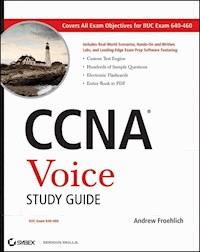
The ultimate guide to the new CCNA voice network administrator certification examThe new CCNA Voice exam tests candidates on their ability to implement a Cisco VoIP solution. Network administrators of voice systems will appreciate that the CCNA Voice Study Guide focuses completely on the information required by the exam.Along with hands-on labs and an objective map showing where each objective is covered, this guide includes a CD with the Sybex Test Engine, flashcards, and entire book in PDF format.* The new CCNA Voice certification will be valuable for administrators of voice network systems using Cisco VoIP solutions* From Sybex, the leading CCNA publisher, this guide offers in-depth coverage of every exam objective and the technology developed by Cisco for VoIP systems* Covers the components of the Cisco Unified Communications Architecture as well as PSTN and VoIP components and technologies* Shows how to configure gateways, voice ports, and dial peers* Demonstrates how to configure a Cisco network to support VoIP and implement voicemail* CD-ROM includes the Sybex Test Engine, flashcards, and entire book in PDF formatCCNA Voice Study Guide will thoroughly prepare candidates for the new CCNA Voice certification.Note: CD-ROM/DVD and other supplementary materials are not included as part of eBook file.
Sie lesen das E-Book in den Legimi-Apps auf:
Seitenzahl: 824
Veröffentlichungsjahr: 2010
Ähnliche



















Contents
Introduction
Assessment Test
Chapter 1 Cisco Unified Communication Solutions
Why Should We Bother Integrating Voice and Data Services?
Introducing the Cisco Unified Communications Manager Lineup
Introducing the Cisco Unity Lineup
Introducing Cisco IP Phones and User Applications
Using Voice Gateways
Introducing the Cisco Unified Communications 500 Series
Choosing an IP Telephony Deployment Option
Summary
Exam Essentials
Written Lab 1.1
Review Questions
Answers to Review Questions
Answers to Written Lab 1.1
Chapter 2 Traditional Telephony
Understanding Analog Network Signaling
Comparing Analog and Digital Circuits
Multiplexing
Private Phone Switching
PSTN Numbering Plans
Summary
Exam Essentials
Written Lab 2.1
Review Questions
Answers to Review Questions
Answers to Written Lab 2.1
Chapter 3 Voice over IP (VoIP)
Understanding the Unified Communications Model
A Closer Look at Voice Gateways
An Overview of Voice and Video Transport Protocols
Comparing VoIP Endpoint Signaling Protocols
Comparing the Common Voice Codecs
Calculating IP Voice Packet Sizes
Summary
Exam Essentials
Written Lab 3.1
Review Questions
Answers to Review Questions
Answers to Written Lab 3.1
Chapter 4 Configuring the Network Infrastructure for Voice
Power Options for IP Phones
Understanding and Configuring VLANs and Voice VLANs
Introduction to Quality of Service (QoS)
Configuring Other Link Efficiency Techniques
Network Infrastructure Services for VoIP support
Summary
Exam Essentials
Written Lab 4.1
Hands-on Labs
Review Questions
Answers to Review Questions
Answers to Written Lab 4.1
Chapter 5 CUCM Express Installation and Basic Configuration
Understanding CUCM Express Licensing
Cisco Voice IOS and CUCM Express Software Installation
Initial CUCM Express Configuration
Basic Configuration Using the Telephony Service Setup Script
Basic Configuration Using the GUI
Using CUCM Express Verification and Troubleshooting Commands
Summary
Exam Essentials
Written Lab 5.1
Hands-on Labs
Review Questions
Answers to Review Questions
Answers to Written Lab 5.1
Chapter 6 CUCM Express Advanced Configuration
Configuring Key System and PBX DNs and Ephones
Configuring Telephony Service Features
Configuring Voice Productivity Features
Configuring Voice Access and Accounting Features on the CUCM Express
Configuring Music on Hold (MoH)
Summary
Exam Essentials
Written Lab 6.1
Hands-on Labs
Review Questions
Answers to Review Questions
Answers to Written Lab 6.1
Chapter 7 Configuring Voice Gateways for POTS and VoIP
Configuring Analog FXS and FXO Ports with Basic Dial Peers
Configuring Digital T1 Ports
Configuring VoIP Dial Peers over WAN Connections
Dial-Plan Strategy
Understanding the Dial-Peer Decision-Making Process
Dial-Peer Digit Manipulation
Configuring a Trunk between Voice Gateways using H.323 and SIP Trunks
Summary
Exam Essentials
Written Lab 7.1
Hands-on Labs
Review Questions
Answers to Review Questions
Answers to Written Lab 7.1
Chapter 8 Unity Express Overview and Installation
Understanding Unity Express Voice Mail Features
Unity Express Advanced User Functionality
Understanding Unity Express Auto Attendant Scripting Methods
Understanding Unity Express Interactive Voice Response
Understanding CUCM Express Licensing
Installation and Initial Configuration of Unity Express on CUCM Express Routers
Restoring Unity Express to Factory Default Settings
Summary
Exam Essentials
Written Lab 8.1
Hands-on Labs
Review Questions
Answers to Review Questions
Answers to Written Lab 8.1
Chapter 9 Unity Express Configuration
Configuring Unity Express System Settings and Voice Mail Defaults
Creating Users, Groups, and Mailboxes
Configuring Auto Attendant
Configuring Message Notification
Administrating and Troubleshooting Unity Express
Summary
Exam Essentials
Written Lab 9.1
Hands-on Labs
Review Questions
Answers to Review Questions
Answers to Written Lab 9.1
Chapter 10 Introducing the SBCS Platform and Cisco Configuration Assistant
The Smart Business Communications System
Using the UC500 Series Platform out of the Box
Introducing the Cisco Configuration Assistant
Setting Up CCA for Supporting the UC500 Series Platform
Summary
Exam Essentials
Written Lab 10.1
Review Questions
Answers to Review Questions
Answers to Written Lab 10.1
Chapter 11 Configuring Telephony Functions Using the Cisco Configuration Assistant
Telephony Initialization
Configuring the Telephony Region Using CCA
Configuring Telephony Voice Features Using CCA
Configuring Telephony Voice Mail Features Using CCA
Configuring Telephony Phone Groups Features Using CCA
Configuring Telephony Schedules Using CCA
Configuring Telephony Auto Attendant Features Using CCA
Configuring Telephony Dial Plans Using CCA
Summary
Exam Essentials
Written Lab 11.1
Review Questions
Answers to Review Questions
Answers to Written Lab 11.1
Appendix A Design and Configuration Using the CCA Telephony Setup Wizard
CCA Telephony Setup Wizard Overview and Requirements
The Information-Gathering Meeting for CC-NAV Inc.
Configuring Networking Parameters Using the TSW
Configuring User and Extension Parameters Using the TSW
Configuring Auto Attendant Parameters Using the TSW
Configuring Analog PSTN Trunk Parameters Using the TSW
Configuring Call Routing Parameters Using the TSW
Final Review and Applying the Configuration Using the TSW
Summary
Appendix B About the Companion CD
What You’ll Find on the CD
System Requirements
Using the CD
Troubleshooting
Glossary
Index
Acquisitions Editor: Jeff Kellum Development Editor: Jim Compton Technical Editor: Scott Morris Production Editor: Dassi Zeidel Copy Editor: Linda Recktenwald Editorial Manager: Pete Gaughan Production Manager: Tim Tate Vice President and Executive Group Publisher: Richard Swadley Vice President and Publisher: Neil Edde Media Project Manager 1: Laura Moss-Hollister Media Associate Producer: Shawn Patrick Media Quality Assurance: Josh Frank Book Designers: Judy Fung and Bill Gibson Proofreader: Publication Services, Inc. Indexer: Ted Laux Project Coordinator, Cover: Lynsey Stanford Cover Designer: Ryan Sneed
Copyright © 2010 by Wiley Publishing, Inc., Indianapolis, Indiana
Published simultaneously in Canada
ISBN: 978-0-470-52766-5
No part of this publication may be reproduced, stored in a retrieval system or transmitted in any form or by any means, electronic, mechanical, photocopying, recording, scanning or otherwise, except as permitted under Sections 107 or 108 of the 1976 United States Copyright Act, without either the prior written permission of the Publisher, or authorization through payment of the appropriate per-copy fee to the Copyright Clearance Center, 222 Rosewood Drive, Danvers, MA 01923, (978) 750-8400, fax (978) 646-8600. Requests to the Publisher for permission should be addressed to the Permissions Department, John Wiley & Sons, Inc., 111 River Street, Hoboken, NJ 07030, (201) 748-6011, fax (201) 748-6008, or online at http://www.wiley.com/go/permissions.
Limit of Liability/Disclaimer of Warranty: The publisher and the author make no representations or warranties with respect to the accuracy or completeness of the contents of this work and specifically disclaim all warranties, including without limitation warranties of fitness for a particular purpose. No warranty may be created or extended by sales or promotional materials. The advice and strategies contained herein may not be suitable for every situation. This work is sold with the understanding that the publisher is not engaged in rendering legal, accounting, or other professional services. If professional assistance is required, the services of a competent professional person should be sought. Neither the publisher nor the author shall be liable for damages arising herefrom. The fact that an organization or Web site is referred to in this work as a citation and/or a potential source of further information does not mean that the author or the publisher endorses the information the organization or Web site may provide or recommendations it may make. Further, readers should be aware that Internet Web sites listed in this work may have changed or disappeared between when this work was written and when it is read.
For general information on our other products and services or to obtain technical support, please contact our Customer Care Department within the U.S. at (800) 762-2974, outside the U.S. at (317) 572-3993 or fax (317) 572-4002.
Wiley also publishes its books in a variety of electronic formats. Some content that appears in print may not be available in electronic books.
Library of Congress Cataloging-in-Publication Data
Froehlich, Andrew, 1977-
CCNA voice study guide (640-460) / Andrew Froehlich. — 1st ed.
p. cm.
ISBN-13: 978-0-470-52766-5
ISBN-10: 0-470-52766-8
1. Internet telephony—Examinations—Study guides. I. Title.
TK5105.8865.F76 2010
004.69'5—dc22
2009047259
TRADEMARKS: Wiley, the Wiley logo, and the Sybex logo are trademarks or registered trademarks of John Wiley & Sons, Inc. and/or its affiliates, in the United States and other countries, and may not be used without written permission. CCNA is a registered trademark of Cisco Technology, Inc. All other trademarks are the property of their respective owners. Wiley Publishing, Inc. is not associated with any product or vendor mentioned in this book.
10 9 8 7 6 5 4 3 2 1
Dear Reader,
Thank you for choosing CCNA Voice Study Guide. This book is part of a family of premium-quality Sybex books, all of which are written by outstanding authors who combine practical experience with a gift for teaching.
Sybex was founded in 1976. More than 30 years later, we’re still committed to producing consistently exceptional books. With each of our titles, we’re working hard to set a new standard for the industry. From the paper we print on, to the authors we work with, our goal is to bring you the best books available.
I hope you see all that reflected in these pages. I’d be very interested to hear your comments and get your feedback on how we’re doing. Feel free to let me know what you think about this or any other Sybex book by sending me an email at [email protected]. If you think you’ve found a technical error in this book, please visit http://sybex.custhelp.com. Customer feedback is critical to our efforts at Sybex.
Best regards,
Neil EddeVice President and PublisherSybex, an Imprint of Wiley
Acknowledgments
I’d like to thank the entire team Sybex assembled for their hard work and dedication in putting this book together. I wish to acknowledge Jeff Kellum, my acquisitions editor, for giving me the opportunity to write my first book for Sybex. A big thanks to my development editor, Jim Compton. Jim’s tireless effort helped to shape the book into a much more readable format. I’d also like to thank my technical editor, Scott Morris. Having a multi-CCIE like Scott edit the book gave me a big reassurance that it was accurately written. Also, thanks to Dassi Zeidel, my production editor, and copy editor Linda Recktenwald. As is common with many books, the copy editor’s timeline is always shrinking because of slowdowns in authoring and other edits. Dassi and Linda were able to crank out the copy editing in record time so it could be placed into the readers’ hands on schedule.
Finally, I’d like to thank my family and friends for all of their support and encouragement. The writing and editing of this book over the past year for me took place in multiple locations around the world including the United States, Colombia, and Thailand. In each of these countries, I had support of family and/or friends to keep me motivated and inspired. Starting with those in the United States, I’d specifically like to thank my mother and father, Ron and Elaine Froehlich, as well my Chicago friends, including Angie Barbini, Matt and Fabiana Liska, Kevin and Ruth Ann McQuire, and Sean and Heather Uhles. Also in Chicago, my friends and co-workers at the University of Chicago Medical Center. In Colombia, I want to thank my dear friend Adriana Castro. Finally, in Thailand, I want to thank Manta Jambanja and the School of Information Technology staff at Mae Fah Luang University.
About the Author
Andrew Froehlich, CCNA, CCDA, CCNA-Voice, CCNP, CCSP, CCDP, F5 systems engineer, is the president of West Gate Networks, a network and IT consulting firm based in Chicago. Andrew also holds the position of network architect at the University of Chicago Medical Center. In the past, Andrew has performed network design and support for large companies, including State Farm Insurance and United Airlines. In addition to having more than 12 years of network experience, he holds a degree in Management Information Systems from Northern Iowa University and a master of business administration degree from Northern Illinois University. He is also a freelance writer for IT publications, including Network World magazine. Andrew’s most recent work is as a professor of Network Architecture at Mae Fah Luang University in Chiang Rai, Thailand.
Introduction
Welcome to CCNA Voice Study Guide, a comprehensive guide that covers everything you need for Cisco’s new exam 640-460. For readers who are new to Cisco certifications, there is a well-defined structure to the different levels that network administrators can achieve. Cisco’s current certification structure has the following five levels of certification:
Entry level
Associate
Professional
Expert
Architect
This book is written for the associate level of certification. Cisco considers this level to be the “apprentice or foundation level” for network administrators.
Cisco has recently broadened its associate-level certifications to include not only a certification for routing and switching (CCNA) and design (CCDA) but also more targeted associate-level certifications for security (CCNA Security), wireless (CCNA Wireless), and voice (CCNA Voice). These new certifications target specific areas of Cisco technology and are to be used as stepping-stones for the professional and expert levels of certification that Cisco offers.
Cisco’s Voice Certifications
Cisco offers three distinct levels of voice certifications. The following diagram shows that the CCNA Voice certification is a building block to the professional- and expert-level voice certifications:
This book covers the CCNA Voice certification exam 640-460. As of the writing of this book, the exam costs $250 USD. The exam tests your knowledge a great deal in areas both theoretical and technically specific to Cisco hardware and software.
Once you achieve your CCNA Voice certification, you can choose to continue on the voice path and achieve higher certifications, such as the CCNP Voice or the ultimate CCIE Voice Expert. But even if you stop after achieving your CCNA Voice certification, you will have demonstrated to your current or prospective employers that you have a sound knowledge of the interoperations of voice and Cisco voice technologies. This assurance to employers will make it easier for you to land that dream job you’ve always wanted!
What Skills Do You Need to Become CCNA Voice Certified?
To meet the CCNA Voice certification skill level, you must possess the following skills:
A thorough knowledge of analog and voice technologies, including but not limited to FXS, FXO, T1/E1, voice trunks, voice packetization, codecs, transcoding, PBX, key systems, and multiplexing
The ability to install, configure, and operate Cisco Unified Communications Manager Express hardware and software. In addition, you must be able to install, configure, and manage Unity Express hardware and software to work in coordination with the CUCM Express.
How Do You Become CCNA Voice Certified?
There are two ways to become CCNA Voice certified. This book provides one method, which is to pass the 640-460 exam. This is considered the CCNA Voice Commercial track, which covers the CUCM Express hardware and software that are commonly found in small and medium-size organizations.
The other way to obtain a CCNA Voice Certification is to study for and pass the 642-436 exam. This exam is known as the CCNA Voice Enterprise track, which covers the CUCM hardware and software used in large organizations. This exam is also a requirement for those pursuing their CCVP certification.
It is critical that you get some hands-on experience with a router installed with the CUCM Express software. It would be even more valuable to acquire an SBCS UC500 device that contains both CUCM Express functionality and Unity Express. In addition, you can practice working with the Cisco Configuration Assistant software to set up the UC500, which is a critical skill to have before attempting to pass the exam.
Finding UC500 hardware at a low cost can be very difficult. If you cannot afford to purchase a system, you’ll be happy to know that I’ve worked hard to provide configuration examples and screenshots throughout this book to help test takers learn what they need to pass the 640-460 exam.
What Does This Book Cover?
This book covers everything you need to know in order to pass the CCNA 640-460 exam. In addition to this book, having the ability to study and practice with CUCM Express/Unity Express hardware and software will provide you the confidence to complete the simulation questions found in the exam.
You will learn the following information in this book:
Chapter 1
introduces you to the Cisco hardware and software lineup for small to medium-size businesses as well as large enterprise organizations. In addition, you will learn about the different deployment options you can use to design your voice network.
Chapter 2
provides you with the background covering traditional telephony. Topics such as analog network signaling, analog interface types, the analog-to-digital conversion process, multiplexing, and numbering plans are detailed to give you a firm foundation in traditional voice terminology and processes.
Chapter 3
introduces you to Voice over Internet Protocol in a Cisco network environment. This chapter covers topics such as the Cisco Unified Communications Model, voice gateway purpose and components, dial peers and call legs, and voice gateway and endpoint communication protocols. You will also read about the protocol that is responsible for transporting voice over an IP network—RTP. Finally, you will be introduced to some of the more popular voice codecs used with Cisco voice equipment and shown how to calculate voice packet sizes.
Chapter 4
provides you with the core networking skills required to design, configure, and operate IPT equipment on a Cisco IP network. Cisco endpoint power options are covered so you can appropriately plan for powering your IP phones in office deployments. The chapter then goes on to discuss the importance of segmenting voice traffic from data using voice VLANs and trunks. The chapter then describes some QoS techniques that can be implemented on a Cisco IP network for more reliable delivery of time-sensitive traffic such as voice.
Chapter 5
exposes readers to CUCM Express licensing options required to operate a Cisco voice system. The chapter then moves on to describe how to install and set up CUCM Express software on compatible Cisco hardware. At the end of this chapter, readers will know how to configure ephones and ephone-DNs to the point where a phone call can be successfully made from one Cisco IP phone to another.
Chapter 6
dives into more complex CUCM Express techniques that show readers how to set up voice features such as ephone button options, user and network locales, and user directories. This chapter also covers configuration of voice-productivity features including call forwarding, call parking, hunt groups, and paging. Then you will learn about voice accessibility and accounting settings such as call blocking and call detail records. Lastly, you will learn how to configure Music on Hold settings for both unicast and multicast MoH.
Chapter 7
covers the design and configuration of voice gateways, including how to configure analog and digital interfaces as well as POTs and VoIP dial peers. In addition, the chapter covers how to develop a dial-plan strategy to provide a simple and expandable dial plan for current and future growth. Finally, the chapter covers the dial-peer decision-making process of a voice gateway and how to manipulate dial strings for proper call routing.
Chapter 8
introduces you to the various features found in the Unity Express voice mail system. Those features include users/groups, message waiting indicators, message notification, Auto Attendant (AA), and Interactive Voice Response (IVR). You will then learn how to install and configure the Unity Express software to work with the CUCM Express. Once Unity Express can interoperate with the CUCM Express, you will learn how to set up Unity Express using the Unity Express Initialization Wizard.
Chapter 9
covers how to configure Unity Express using the web GUI. Specifically, you will learn how to configure system settings such as NTP, time zone, and DNS. You will also learn how to create and modify user and group mailbox settings. You will also learn how to set up and modify the Auto Attendant feature as well as learn different tools used to create AA scripts. You will see how to configure message notification configuration to allow users to be remotely notified and listen to voice messages when the user is away from their desk. Finally, you will learn techniques an administrator can use to maintain and troubleshoot Unity Express.
Chapter 10
is an introduction to the Cisco Smart Business Communications System (SBCS) lineup, including the UC500 Series hardware, which is an ideal voice/data platform for small to medium-size businesses. This chapter also introduces the Cisco Configuration Assistant (CCA), which is an innovative GUI tool used to configure and maintain SBCS devices.
Chapter 11
goes into how to configure a SBCS UC500 device using the CCA. Specifically, the chapter shows readers how to configure telephony regions, network options, SIP trunking, voice features, voice mail features, Auto Attendant options, and dial plans.
Appendix A
provides a real-world scenario designing and implementing a small office with a Cisco SBCS UC500 using the Cisco Configuration Assistant Telephony Setup Wizard.
How to Use This Book
The CCNA Voice Study Guide is designed to prepare a reader to pass the 640-460 exam to achieve the associate-level certification in Cisco voice technologies. To get the most out of this book, I recommend you use the following study method:
Take the assessment test provided to you prior to Chapter 1 of this book. Try to answer each question without looking at the answers and explanations found in the back of the book. This should give you an indication of your skill level prior to reading the book. Once you have completed the assessment test and graded yourself, take time to carefully read over the explanations for any question you get wrong and note the chapters in which the material is covered. This information should help you identify sections of the book that you need to spend additional time on. Keep in mind, however, that the book was designed for you to read each chapter in order. Much of the material found in the chapters builds on knowledge learned from previous chapters.
Prior to reading each chapter, make sure to review the test objectives listed at the beginning. These objectives are what the exam taker must ultimately know in order to pass the CCNA Voice 640-460 exam.
Complete each written lab at the end of each chapter. These labs are created to make sure the reader fully understands key topics that are contained within that chapter. Using a written format instead of multiple-choice format forces the reader to know the answers off the top of their head instead of just eliminating options, as we often do with multiple-choice questions.
Work through and fully understand the commands found in the hands-on labs in the chapter. Not all chapters have hands-on labs, but the book focuses on the important tasks necessary for aspiring CCNA Voice–certified network engineers. See the accompanying sidebar for a recommended lab setup.
Answer all of the review questions related to each chapter. Once you have finished answering the questions, review the answers and explanations to not only understand the correct answers but also understand why the incorrect answers are actually incorrect! Keep in mind that these review questions will not be the exact questions you will find on the exam, but they will help you to understand the material that Cisco creates the actual exam questions from.
Take time to review the bonus exams that are included on the companion CD. Questions in these exams appear only on the CD.
Test yourself using all the flashcards on the included CD. These flashcards can be viewed on both PCs and mobile devices, so now you can take your study material with you wherever you go!
Recommended Home Lab Setup
As stated earlier, it is critical to get some hands-on experience with both CUCM Express and Unity Express hardware and software. Following is a list of equipment I recommend you try to acquire for your home lab studies. If you are concerned about the high cost of purchasing the equipment, keep in mind that Cisco hardware can be easily resold on used markets such as Craigslist or eBay. Combine that fact with adding an extremely hot certification to your resume, and it’s an investment well worth the initial cost.
Qty
Item
1
Cisco SBCS UC520
1
Cisco 7940 IP phone
1
Cisco 7965 IP phone
1
Windows PC loaded with the Cisco IP Communicator and Cisco Configuration Assistant software
2
Analog telephones
This equipment should give you the ability to practice configuring CUCM Express and Unity Express using the command line, web GUI, and CCA methods detailed in this book. The two different IP phones I recommend allow you to understand the differences between two- and six-line phones as well as the fact that different Cisco IP phones require different firmware files. A Windows PC will be needed to install both the Cisco IP Communicator softphone and the Cisco Configuration Assistant software used to configure SBCS devices such as the UC520. Finally, the analog phones in your lab are useful for testing FXS configurations.
What’s on the CD?
The CD included with this book includes many supplemental tools that you can use to further your studies and achieve your goal of becoming a CCNA Voice–certified administrator. The following content is provided for you to use to further your study.
The Sybex Test Engine
The Sybex test engine software lets readers practice all of the review and assessment questions found in the book as well as two additional bonus exams that are found only on the CD. The exams let potential test takers practice in an electronic test-taking environment that is similar to the actual Cisco exam.
Electronic Flashcards for PCs and Handheld Devices
In addition to the Sybex test engine software, Sybex has included over 200 electronic flashcards for you to test yourself with on PCs and compatible handheld devices. These flashcards are designed to get the reader to quickly recognize and recall important CCNA Voice information that will be useful for them when taking the 640-460 exam.
CCNA Voice: Cisco Certified Network Associate Voice Study Guide in PDF
Finally, this book contains the entire CCNA Voice Study Guide in PDF format on the included CD so you can read the book on your PC or laptop or any handheld devices that reads PDF files such as a Blackberry or iPhone.
Tips for Taking Your CCNA Voice Exam
According to Cisco’s website at https://learningnetwork.cisco.com/community/ certifications/voice_ccna/iiuc?view=overview, the CCNA Voice exam contains anywhere from 60 to 70 questions and must be completed in 90 minutes or less. The languages this exam is offered in include English, Japanese, Chinese, Russian, Portuguese, Korean, French, and Spanish. This information can change per exam. A passing score varies according to the types of questions found in the exam, but it is probably best to assume you need to get approximately 85 percent of the questions correct to pass the exam.
When taking the exam, thoroughly read each question to make sure you know what answer it is looking for. Cisco exam questions tend to have answers that look identical. You will find, however, that there are small differences in the answer that can determine a correct or incorrect answer.
Also, keep in mind that you should choose the answer that Cisco believes is the correct as opposed to what you or other vendors believe. This is a Cisco exam, after all, so the right answer is the one that Cisco recommends!
The format of the 640-460 exam questions might include any of the following:
Multiple-choice single-answer
Multiple-choice multiple-answer—Cisco will always tell you to choose two or three, depending on the proper number of multiple correct responses.
Drag-and-drop
Fill-in-the-blank
CUCM Express and Unity Express simulations
Test-Day Tips for Certification Success
Arrive at least 30 minutes early to the exam center. That way you can check in and mentally prepare for the exam without having to rush.
Take the Cisco exam tutorial. This tutorial is offered prior to the official start of each exam before the test timer starts. In this tutorial you will be given an interactive lesson as to the format of the exam and how to navigate through the different question types, including multiple-choice, drag-and-drop, fill-in-the-blank, and simulation questions. Even if you have taken many Cisco exams, I highly recommend going through the tutorial in case there is something new to the exam format since the last time you took an exam.
Read both the questions and answers very carefully. Cisco often will intentionally lead the hasty test taker, who simply glosses over a question, to quickly choose the incorrect answer. Patience and careful thinking pay off greatly when taking Cisco exams!
Be aware that you cannot go back to change an answer once you have moved on to the next question. Make sure that the answer you choose is the one you want to stick with, because there is no way to change it later on.
Assessment Test
1. What two configuration steps are required for proper communication between the CUCM Express and Unity Express?
A. A loopback interface needs to be configured.
B. A default gateway needs to be configured on the service module pointing to the IP of the service engine (or integrated service engine).
C. The service engine (or integrated service engine) must be on the same IP subnet as the service module.
D. A default gateway needs to be configured on the service engine (or integrated service engine) pointing to the IP of the service module.
2. Which IP Telephony deployment model places independent call-processing and voice mail devices at each remote site?
A. Multisite with distributed call processing
B. Single site
C. Multisite with centralized call processing
D. Single site with SRST
E. Clustering over the WAN
3. What type of license might you need if you want to add a new Cisco IP phone to your existing CUCM Express system? Choose all that apply.
A. Cisco softphone license
B. CCME Express feature license
C. Cisco IOS license for voice capabilities
D. Individual user license
4. When you order a T1 circuit from a PSTN, you request that only 12 channels be available. What term is used for this scenario?
A. Timeslots
B. Fractional
C. LoopStart
D. Ds0-group
5. What is the 3.5 mm port used for on the UC500 system?
A. Wireless expandability
B. ESW 500 series uplink
C. Fax/modem connectivity
D. External music source for MoH
6. What Windows application can be used to configure a UC500 system?
A. CUCM Express GUI
B. CCA
C. SIP
D. SRST
7. Which two are peer-to-peer signaling protocols?
A. SCCP and H.323
B. SIP and MGCP
C. SIP and H.323
D. SCCP and MGCP
E. H.323 and MGCP
8. What queuing technique is considered the best option for voice traffic?
A. FIFO
B. LIFO
C. LLQ
D. PQ
E. CQ
9. What CUCM Express config-telephony command modifies tone and cadence differences between geographic regions?
A. user-locale
B. network-locale
C. language-locale
D. telephony-service-locale
10. What type of hunt group algorithm rings the hunt group members in the order in which they were entered into the CUCM, always starting from the first number?
A. Longest idle
B. Peer
C. Round robin
D. Sequential
E. FIFO
11. Using the Unity Express CLI, what show command lets you view the maximum number of configurable personal and GDM mailboxes?
A. router#show license
B. router(config)#show license
C. router#show software license
D. router#show software mailbox
12. When configuring voice features by using CCA, what tab would you use to exclude an IP address from the DHCP scope on a UC500?
A. System
B. SIP Trunk
C. Voice Features
D. Network
E. User Extensions
13. When SCCP is used between two endpoints that call each other, how is RTP data transported when a connection is established?
A. It must be proxied throughout the CUCM.
B. It must be sent through a voice gateway.
C. It is sent directly from one endpoint to another.
D. Each RTP stream terminates at the CUCM.
14. When a telephone handset is in its cradle, what state is it in?
A. Multiplex
B. Dual-line
C. Single-line
D. Off-hook
E. On-hook
15. What are the three different inter-VLAN routing methods that you can configure on your network?
A. Layer 3 switching
B. Layer 2 switching
C. Individual router links
D. Trunked router link
E. Individual trunk link for each VLAN
16. By default, what type of signaling are FSX ports configured for?
A. SIP
B. GroundStart
C. LoopStart
D. SCCP
17. How are Unity Express backups run using the web GUI?
A. Backups can be set to run automatically each day.
B. Backups can be run only during evening hours or holidays.
C. Backups can be run using the TUI interface as long as the user is an AvT administrator.
D. Backups are run by navigating to Administration ⇒ Backup/Restore ⇒ Start Backup.
18. Which of the following is not a Trunk Priority dial-plan rule for outgoing calls?
A. PSTN Only
B. SIP Only
C. FXO Only
D. None
19. What does 2 represent in the command button 1:2?
A. Extension #2 on the phone
B. A dual-line ephone
C. Ephone-DN #2
D. Ephone #2
20. Which voice signaling protocol is proprietary?
A. H.323
B. SIP
C. SCCP
D. MGCP
E. G.711
F. G.729
21. What PBX service redirects a call to a different extension?
A. Extension dialing
B. Call forwarding
C. Hunt group
D. Paging group
E. Call park
22. What step in the analog-to-digital conversion converts the data into binary?
A. Encode
B. Quantize
C. Compress
D. Sample
23. What percentage of dropped packets can be allowed on a network and still have quality voice calls according to Cisco?
A. Less than 1 percent
B. Less than 4 percent
C. Less than 8 percent
D. Less than 2 percent
24. Given the following dir flash: output, what command would you use to view Cisco IP phone firmware files?
Router#dir flash: Directory of flash:/ 1 drw- 0 Apr 7 2009 18:17:56 +00:00 bacdprompts 13 -rw- 22224 Apr 7 2009 18:25:56 +00:00 CME43-full- readme-v.2.0.txt 14 drw- 0 Apr 7 2009 18:18:06 +00:00 Desktops 27 drw- 0 Apr 7 2009 18:18:14 +00:00 gui 45 -rw- 496521 Apr 7 2009 18:26:22 +00:00 music-on- hold.au 46 drw- 0 Apr 7 2009 18:18:28 +00:00 phone 127 drw- 0 Apr 7 2009 18:31:02 +00:00 ringtones 161 -rw- 47576204 Apr 7 2009 18:37:22 +00:00 c3825- ipvoicek9-mz.124-15.XZ2.bin
A. dir flash:/Desktops
B. dir tftp:/Desktops
C. dir tftp:/phone
D. dir flash:/phone
25. What are three situations where a voice gateway is required?
A. Connecting a CUCM Express to the local IP network
B. Connecting a CUCM Express to the PSTN
C. Connecting a CUCM Express to an SIP phone
D. Connecting a CUCM Express to a legacy PBX
E. Connecting a CUCM Express to a second CUCM Express over an IP WAN
26. What is the absolute maximum number of devices supported by CCA within a single site?
A. 20
B. 15
C. 25
D. 50
27. When running through the Unity Express Initialization Wizard, when are changes actually made to the configuration?
A. After pressing the Next button to move on to the next configuration screen.
B. Changes are saved every 60 seconds.
C. When the administrator selects the Save To Startup Configuration check box and clicks the Finish button.
D. When the administrator presses the Finish button at the Initialization Wizard Commit page.
28. What are the two voice mail configuration tabs within the CCA?
A. Network
B. Pilot
C. Mailboxes
D. Setup
E. Users
29. Out of the box, if a Cisco IP phone is plugged into an Ethernet interface on a UC500 system, what extension is automatically assigned to it?
A. 2001
B. 3001
C. 201
D. 301
E. 101
30. What is the default call-transfer method on the CUCM Express for dual-line DN phones?
A. local-consult
B. full-consult
C. blind
D. full-blind
31. Which protocol is used to synchronize clocks on all voice and data network equipment?
A. VTP
B. NTP
C. CDP
D. Timezone
E. DST
32. What portion of the E.164 International code is actually assigned by the ITU board?
A. Country code
B. National destination code
C. Area code
D. Station code
E. Office code
33. Which Cisco Communications Manager runs on a router platform?
A. CUCM
B. CUCMBE
C. CUCM Express
D. All of the above
34. At what layer of the UC model is the Cisco Unity voice mail solution found?
A. Infrastructure layer
B. Data Link layer
C. Call Control layer
D. Applications layer
E. Session layer
35. Which protocol is used to monitor and provide detailed information about the quality of an RTP stream?
A. cRTP
B. RTCP
C. UDP
D. TCP
E. H.323
36. When issuing a show ephone command on a CUCM Express system, you see that one of your ephones is in a DECEASED state. What does this mean?
A. The phone unregistered abnormally because of a keepalive timeout.
B. A hardware malfunction occurred at the phone endpoint.
C. The phone unregistered normally and is not currently active.
D. The phone unregistered abnormally because of a reverse proxy lookup.
E. The phone unregistered normally because of a keepalive timeout.
37. Which of the following is not a required configuration setting when setting up a T1 CAS?
A. Pri-group options
B. Framing type
C. Clock source
D. Ds0-group options
E. Linecode type
38. What methods are available to administrators when they want to run a trace on Unity Express?
A. Using the Unity Express command line
B. Using the Unity Express web GUI
C. Using the CUCM Express command line
D. Using the CUCM Express web GUI
39. What type of analog interface connects to standard analog telephones?
A. CO
B. DID
C. FXS
D. FXO
40. Given the following configuration output, what type of phone system does this represent?
Router(config)#ephone-dn 1 Router(config-dn)#number 5555558888 Router(config-dn)#ephone-dn 2 Router(config-dn)#number 5555559999 Router(config-dn)#exit Router(config)#ephone 1 Router(config-ephone)#button 1:1 2:2 Router(config)#ephone 2 Router(config-ephone)#button 1:1 2:2
A. PBX system
B. Key system
C. Hybrid system
D. Publisher system
41. If you try to use the web GUI for Unity Express Configuration but you are unable to connect to the Unity Express web service, what must you do?
A. You must enable HTTP server on the CUCM Express.
B. You must enable SSH on the CUCM Express.
C. You must enable HTTP server on Unity Express.
D. You must enable SSH on Unity Express.
E. You must configure a username/password on Unity Express.
42. What is a function of a voice gateway?
A. Provides user authentication
B. Provides call processing
C. Translates between analog-to-digital and digital-to-analog connections
D. Connects IP networks over a WAN
E. Stores voice mail information
43. What limits the types of numbers that can be used by the message-notification feature?
A. Extension blocking
B. Message expiry
C. Number profile
D. Restriction tables
Answers to Assessment Test
B, C. The two interfaces must be located on the same IP subnet either by creating a brand-new subnet or by using a preexisting subnet and
ip unnumbered
. Also, the service module on the CUCM Express side of the network must point to the IP address of Unity Express. See Chapter 8 for more information.
A. The multisite with distributed call processing model places all voice functions out to the remote site edge. See Chapter 1 for more information.
B, D. You will need individual user licenses for each phone, and you might need to purchase additional feature licenses depending on how many feature licenses you have available. See Chapter 5 for more information.
B. When you order any capacity of lines on a T1 or E1 circuit that is less than the maximum, the term used to describe this circuit is “fractional.” See Chapter 7 for more information.
D. The 3.5 mm jack is used to connect an external audio source for MoH. See Chapter 10 for more information.
B. The Cisco Configuration Assistant is a Windows application used for configuration of small-business hardware such as the UC500. See Chapter 1 for more information.
C. Both SIP and H.323 are considered peer-to-peer protocols. See Chapter 3 for more information.
C. Low Latency Queuing creates a priority queue for voice and sets aside a guaranteed rate for this traffic. See Chapter 4 for more information.
B. The
network-locale
command changes tone and tone cadences to match what users at a given geographic location are accustomed to. See Chapter 6 for more information.
D. The sequential algorithm always rings the first configured member first, then the second entered number, and so on. See Chapter 6 for more information.
C. The
show software license
command lets you view the maximum number of configurable personal and GDM mailboxes the license allows. See Chapter 8 for more information.
D. The Network tab includes DHCP configuration options. See Chapter 11 for more information.
C. SCCP information is passed from the endpoint to the CUCM, and RTP data is sent from one endpoint to another. See Chapter 3 for more information.
E. A phone is considered on-hook when the phone handset is in its cradle. See Chapter 2 for more information.
A, C, D. You can configure inter-VLAN routing using Layer 3 switches, individual links per VLAN, or a trunked link in router-on-a-stick mode. See Chapter 4 for more information.
C. The most common signaling for FXS ports is LoopStart, which is enabled by default. See Chapter 7 for more information.
D. Backing up Unity Express using the web GUI requires that the administrator navigate to Administration ⇒ Backup/Restore ⇒ Start Backup. See Chapter 9 for more information.
C. The Trunk Priority dial-plan rules can be set for PSTN Only, SIP Only, PSTN Then SIP, SIP Then PSTN, or None. See Chapter 11 for more information.
C. This command tells the CUCM Express system that button 1 is to be set with Ephone-DN 2. See Chapter 5 for more information.
C. The Skinny Call Control Protocol is proprietary to Cisco equipment. See Chapter 3 for more information.
B. Call forwarding allows a user to redirect calls from one extension to another automatically. See Chapter 2 for more information.
A. Encoding takes the quantized sample and converts it into binary code of 1s and 0s. See Chapter 2 for more information.
A. You can have approximately 1 percent or less of dropped IP packets on a network and still maintain a quality voice network. See Chapter 4 for more information.
D. This CUCME system used the
archive tar
/xtract
command to uncompress files and place them into a directory structure. All of the phone firmware files will be located in the
flash:/phone
directory. See Chapter 5 for more information.
B, D, E. Voice gateways are required to connect to PSTNs, legacy PBX systems, or other voice gateways/call managers across an IP network. See Chapter 7 for more information.
C. CCA supports a maximum of 25 devices in a single site. See Chapter 10 for more information.
C. The Save To Startup Configuration check box must be checked on the Commit page for the changes to be saved on Unity Express. See Chapter 8 for more information.
C, D. The two CCA voice mail configuration tabs are Mailboxes and Setup. See Chapter 11 for more information.
C. Auto-registration of Cisco IP phones is used to set up the phone, and it is assigned a single extension beginning with 201. See Chapter 10 for more information.
B.
Full-consult
allows you to speak to the transfer number party prior to transferring the call. See Chapter 6 for more information.
B. The Network Time Protocol is used to synchronize network equipment to extremely accurate time sources on a network. See Chapter 4 for more information.
A. The ITU distributes the country code each country uses. See Chapter 2 for more information.
C. CUCM Express runs on Cisco router hardware. See Chapter 1 for more information.
D. CUCM Express runs on Cisco router hardware. See Chapter 3 for more information.
B. RTCP provides information regarding the quality of the RTP stream it is responsible for. See Chapter 3 for more information.
A. When a phone is in a DECEASED state, this means that the phone was on the network but failed to return keepalives. This is common when a phone loses power. See Chapter 5 for more information.
A. The
pri-group
command is used on T1 PRI interfaces and not on T1 CAS interfaces. See Chapter 7 for more information.
A. The only way to run a trace is to use the Unity Express command-line interface. See Chapter 9 for more information.
C. FXS interfaces connect analog devices to the PSTN. See Chapter 2 for more information.
B. Key systems typically share lines, and each ephone is identically configured. See Chapter 6 for more information.
A. Your CUCM Express must have HTTP server enabled by issuing the
ip http server
global configuration command. See Chapter 8 for more information.
C. A primary function of a voice gateway is to translate voice streams between analog and digital. See Chapter 3 for more information.
D. Restriction tables protect the organization from users employing message notification to forward calls to long-distance numbers. See Chapter 9 for more information.
Chapter 1
Cisco Unified Communication Solutions
THE FOLLOWING CCNA VOICE EXAM OBJECTIVES ARE COVERED IN THIS CHAPTER:
Describe the components of the Cisco Unified Communications Architecture.
Describe the function of the infrastructure in a UC environment.
Describe the function of endpoints in a UC environment.
Describe the function of the call processing agent in a UC environment.
Describe the function of messaging in a UC environment.
Describe the applications available in the UC environment, including Mobility, Presence, and TelePresence.
Describe and configure gateways, voice ports, and dial peers to connect to the PSTN and service provider networks.
Describe the differences between PSTN and Internet Telephony Service Provider circuits.
Cisco Systems seems to have the market cornered when it comes to product placement of telephones in television shows and movies. If you look closely at shows such as The Office and 24, Cisco is cleverly placing their phones in the camera shots. While that placement is a good way to show off the sleekness of the phones, network engineers want to know what’s powering the phones behind the scenes. This first chapter begins CCNA: Voice Study Guide with an overview of the Cisco Unified Communications (UC) hardware and software currently available. Knowing all the equipment that is in Cisco’s IP telephony (IPT) arsenal will enable you not only to prepare for the CCNA Voice exam but ultimately to make intelligent engineering decisions for your company and clients.
Lesen Sie weiter in der vollständigen Ausgabe!
Lesen Sie weiter in der vollständigen Ausgabe!
Lesen Sie weiter in der vollständigen Ausgabe!
Lesen Sie weiter in der vollständigen Ausgabe!
Lesen Sie weiter in der vollständigen Ausgabe!
Lesen Sie weiter in der vollständigen Ausgabe!
Lesen Sie weiter in der vollständigen Ausgabe!
Lesen Sie weiter in der vollständigen Ausgabe!
Lesen Sie weiter in der vollständigen Ausgabe!
Lesen Sie weiter in der vollständigen Ausgabe!
Lesen Sie weiter in der vollständigen Ausgabe!
Lesen Sie weiter in der vollständigen Ausgabe!
Lesen Sie weiter in der vollständigen Ausgabe!
Lesen Sie weiter in der vollständigen Ausgabe!
Lesen Sie weiter in der vollständigen Ausgabe!
Lesen Sie weiter in der vollständigen Ausgabe!
Lesen Sie weiter in der vollständigen Ausgabe!
Lesen Sie weiter in der vollständigen Ausgabe!




