


91,99 €
Mehr erfahren.
- Herausgeber: John Wiley & Sons
- Kategorie: Wissenschaft und neue Technologien
- Sprache: Englisch
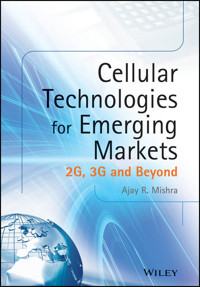
In this book, the author addresses technologies that are being used in emerging cellular markets. These include GSM/EGPRS and CDMA which are being deployed at a rapid pace, while technologies such as UMTS (3G)/ HSPA (3.5G) which have started to find a place in these high growth markets, are also considered. The book examines other technologies including LTE (3.9G) which have already moved out of research labs into the commercial world. 2G-CDMA is widely used, while further developments, e.g. CDMA2000 are also finding acceptance in the commercial arena. IMS/Convergence is increasingly popular all over the world; UMA, which is deployed mostly in North America; and DVB which is gaining worldwide popularity, especially in South Asia, are all reviewed.
Each chapter discusses a different technology and is structured into three parts. The technology is examined at an overview level, first explaining what the technology is and then considering the technical features of the technology. The chapter concludes by looking at the planning/implementation aspects of the technology.
Key Features:
- Useful for all cellular industry professionals as provides an overview of the currently deployed technologies in mass scale, and the forthcoming technologies that are expected to make an impact in the future, such as 4th Generation Cellular Networks.
- One of the first books on the market to encompass all the major cellular technologies, as well as considering the design and implementation perspective.
Wireless Technology will play a key role in uplifting the economies of the Emerging countries globally. Ashok Chandra, Wireless Advisor to Govt. of India
Sie lesen das E-Book in den Legimi-Apps auf:
Seitenzahl: 538
Veröffentlichungsjahr: 2010
Ähnliche


















Contents
Cover
Half Title Page
Title Page
Copyright
Dedication
Foreword 1: Role of Technology in Emerging Markets
Foreword 2: Connecting the Unconnected
Preface
Acknowledgements
1: Cellular Technology in Emerging Markets
1.1 Introduction
1.2 ICT in Emerging Markets
1.3 Cellular Technologies
1.4 Overview of Some Key Technologies
1.5 Future Direction
2: GSM and EGPRS
2.1 Introduction
2.2 GSM Technology
2.3 Network Planning in the GSM Network
2.4 EGPRS Technology
2.5 EGPRS Network Design and Optimization
3: UMTS
3.1 The 3G Evolution – UMTS
3.2 UMTS Services and Applications
3.3 UMTS Bearer Service QoS Parameters
3.4 QoS Classes
3.5 WCDMA Concepts
3.6 ATM
3.7 Protocol Stack
3.8 WCDMA Network Architecture – Radio and Core
3.9 Network Planning in 3G
3.10 Network Optimization
4: CDMA
4.1 Introduction to CDMA
4.2 CDMA: Code Division Multiple Access
4.3 Spread Spectrum Technique
4.4 Codes in CDMA System
4.5 Link Structure
4.6 Radio Resource Management
4.7 Planning a CDMA Network
4.8 CDMA2000
4.9 TD-SCDMA
5: HSPA and LTE
5.1 HSPA (High Speed Packet Access)
5.2 HSDPA Technology
5.3 HSDPA Channels
5.4 Dimensioning in HSDPA
5.5 Radio Resource Management in HSDPA
5.6 High Speed Uplink Packet Access (HSUPA)
5.7 HSUPA Channels
5.8 HSUPA Radio Resource Management
5.9 HSPA Network Dimensioning
5.10 LTE (Long Term Evolution)
5.11 LTE Technology
5.12 Radio Resource Management
5.13 Security in LTE
6: OFDM and All-IP
6.1 Introduction to OFDM
6.2 OFDM Principles
6.3 MIMO Technology
6.4 OFDM System
6.5 Design of OFDM Channel
6.6 Multi-User OFDM Environment
6.7 All-IP Networks
6.8 Architecture of All-IP Networks
7: Broadband Wireless Access: WLAN, Wi-Fi and WiMAX
7.1 Wireless Technology Differentiation
7.2 Wireless LAN
7.3 Wi-Fi Networks
7.4 WiMAX Networks
8: Convergence and IP Multimedia Sub-System
8.1 Introduction to Convergence
8.2 Key Aspects of Convergent Systems
8.3 Architecture in Convergent Networks
8.4 IMS
8.5 IMS Architecture
8.6 IMS Security System
8.7 IMS Charging
8.8 Service Provisioning in IMS
9: Unlicensed Mobile Access
9.1 Introduction to UMA
9.2 Working on UMA Network
9.3 Architecture of UMA
9.4 Up Interface in UMA
9.5 Protocols in UMA
9.6 Security Mechanism of UMA
9.7 Identifiers and Cell Identifiers in UMA
9.8 Mode and PLMN Selection
9.9 UMAN Discovery and Registration Procedures
9.10 UNC Blocks
9.11 Comparison between Femtocells and UMA
9.12 Conclusion
10: DVB-H
10.1 Mobile Television
10.2 Introduction to DVB
10.3 DVB-H Ecosystem
10.4 DVB-H System Technology
10.5 DVB-H Network Architecture
10.6 DVB-H Network Topologies
10.7 Network Design in the DVB-H Network
Appendix A: VAS Applications
A.1 Multimedia Messaging Service
A.2 Push-to-Talk over Cellular
A.3 Streaming Service
A.4 Short Message Service
A.5 Wireless Application Protocol
Appendix B: Energy in Telecommunications
B.1 The Solution Exists – but It's not Very Good
B.2 Renewable Energy – a Better Solution
B.3 The Optimal Design for a Base Station Site
B.4 Business Case for Renewable Energy in Mobile Base Station Sites
B.5 Effects of Climate Change on Mobile Networks
Bibliography
Index
Cellular Technologies for Emerging Markets
This edition first published 2010 © John Wiley & Sons Ltd.
Registered office John Wiley & Sons Ltd, The Atrium, Southern Gate, Chichester, West Sussex, PO19 8SQ, United Kingdom
For details of our global editorial offices, for customer services and for information about how to apply for permission to reuse the copyright material in this book please see our website at www.wiley.com.
The right of the author to be identified as the author of this work has been asserted in accordance with the Copyright, Designs and Patents Act 1988.
All rights reserved. No part of this publication may be reproduced, stored in a retrieval system, or transmitted, in any form or by any means, electronic, mechanical, photocopying, recording or otherwise, except as permitted by the UK Copyright, Designs and Patents Act 1988, without the prior permission of the publisher.
Wiley also publishes its books in a variety of electronic formats. Some content that appears in print may not be available in electronic books.
Designations used by companies to distinguish their products are often claimed as trademarks. All brand names and product names used in this book are trade names, service marks, trademarks or registered trademarks of their respective owners. The publisher is not associated with any product or vendor mentioned in this book. This publication is designed to provide accurate and authoritative information in regard to the subject matter covered. It is sold on the understanding that the publisher is not engaged in rendering professional services. If professional advice or other expert assistance is required, the services of a competent professional should be sought.
Library of Congress Cataloging-in-Publication Data
Mishra, Ajay R. Cellular technologies for emerging markets : 2G, 3G, and beyond / Ajay R Mishra. p. cm. Includes bibliographical references and index. ISBN 978-0-470-77947-7 (cloth) 1. Cellular telephone systems. I. Title. TK5103.2.M567 2010 384.5′35–dc22
2010005780
A catalogue record for this book is available from the British Library.
ISBN 9780470779477 (HB)
Dedicated to
The Lotus Feet of my Guru
Foreword 1
Role of Technology in Emerging Markets
Telecom wireless technology has been progressing rapidly over the last two decades. Initial introduction of the GSM platform created global standards in the 1980s and provided opportunities to innovate new business models to reduce costs and increase affordability, leading to substantial growth and expansion in the emerging countries. In the process, GSM technology was enhanced through several new features and functionalities to add data capabilities. In the 1990s, third generation wireless technology was introduced in advanced countries of the western world and Japan. At the same time China and India witnessed an unpredicted growth with over 700 million subscribers in China and over 500 million subscribers in India. Similar growth in many other emerging markets of Latin America, Africa and Asia pushed the number of global mobile phone users to over 4 billion worldwide.
The expansion of mobile phones in the emerging markets has been critical in the overall development of the rural areas and the people at the bottom of the pyramid. This has provided a unique access to basic telephone services and a variety of new SMS based applications related to entertainment, news, agriculture, payments, etc. It has been shown by the OECD and other studies that a 10 % increase in the mobile phone coverage increases the GDP of the country by 0.6 %. This offers hope for new features and functionalities with more data capabilities and applications related to education, health, governance, etc. to benefit the poor in the emerging markets.
All of this was possible because we were able to make a business case for affordable technology and bring down the total cost of ownership for the people. This is where Ajay Mishra’s book steps in. It provides a comprehensive coverage of many technologies that will give the readers a quick understanding of the upcoming new opportunities. A basic understanding of the evolution of technologies will help make the right choices for future network capabilities.
Once we are able to bring down the total costs of ownership by placing the right technology, we can provide an opportunity for real economic development and growth to the community. The key is to continue to focus on lowering the cost of mobile services where basic voice services will become a commodity and the future revenue for the operators will come from novel and useful applications and transaction services. Only then the real potential of the mobile revolution will be realized.
Sam Pitroda Advisor to the Prime Minister of India Former/First Chairman Telecom Commission of India
Foreword 2
Connecting the Unconnected
The world now has more than 4B telephone lines – thanks to wireless connectivity as more than 65 % are mobile connections. The increase has been tremendous in emerging markets such as India where mobile connections are now happening in double digit millions every month. It has been a phenomenal journey of perhaps one technology (i.e. wireless/mobile) that has not only outgrown the vision of the founding fathers but has been quite successful in touching the lives of people living in the remotest of locations. We have many studies that have very strongly pointed to the fact that an increase mobile penetration would impact the lives of people and this is absolutely amazing.
As we talk about ‘connecting the un-connected’ and reducing the digital divide, it is absolutely necessary that the benefits of technology reach to people living in the remotest places on this planet. Many of the emerging markets, although immensely successful for highest connectivity growths, have not achieved similar success in making its people reap the benefits of being connected to the world.
Technology will play an important role in bringing down the total costs of ownership. With a host of technologies at the disposal of emerging markets, it would be even easier for operators and industry in general to bring connectivity to the door steps of people in the farthest of locations. I think that by giving the right overview of the technologies that will play a role in emerging markets, under one cover, this book will prove to be extremely useful to decision-makers in the cellular industry. The book brings technology and design aspects that one would need for day-to-day decision making in a simple and lucid way. Only when both connectivity and its benefits will reach every one single person would we say that we are living in a truly connected world.
Adel Hattab Vice-President Nokia Oy
Preface
Emerging markets have seen an unprecedented growth in the last few years. The operator focus has been on giving complete coverage to all regions (urban to rural) and to subscription to all – people from the highest to the lowest income groups. When the idea is taking coverage for the remotest of the regions and getting the ‘unconnected–connected’, technology and business modelling are two important focus areas. This book covers one of them – technology. Many of the mobile technologies find importance in one network. No more do we see networks that are working on just one or two technologies but we are seeing networks that are an amalgamation of technologies. Engineers and executives working in the field sometimes find it challenging to get hold of a single manual that gives them an overview of technologies that are existing in the mobile field. This book tries to address that challenge – providing an overview of technology, designing and applications of the few important technologies under one cover.
There are many books that are available dealing with individual technologies and so this book is not for in-depth reading of one technology but rather a quick overview of some key technologies. Experts of one technology can quickly understand what they can expect in other technologies. So, this book will be beneficial to beginners, experts, managers and technocrats at the same time.
Chapter 1 discusses the scenario in emerging markets and technologies that are making their mark. Chapter 2 focuses on GSM and EGPRS and includes a technology overview, details on network architecture and network planning/optimization.
Chapters 3 and 4 are concerned with UMTS and CDMA, covering technology, network architectures and designing issues.
In Chapter 5 we go beyond the third-generation technology. Technologies that are sometimes called 3.5G (HSPA) and 3.9G (LTE) are discussed. These are of immense interest in current scenarios – both in the developed and emerging markets.
Going further, we look into OFDM and All-IP technologies in Chapter 6. Both of these have started to make an impact and are being studied with much greater interest by the technocrats of emerging markets.
We look into the world of Wi-Fi, WLAN and WiMAX in Chapter 7. Although Wi-Fi and WLAN have established places in the technology world, they are finding more importance as we move towards fourth-generation networks.
WiMAX and LTE are still being debated but leaving that for cellular operators to decide, we focus on looking into the technical aspects of WiMAX in this chapter.
Convergence is again a fascinating world and is covered along with the underlying technology of IMS in Chapter 8.
Although UMA has been more common in North America, it is briefly covered in Chapter 9 to give the reader an overview of the concept that is implemented in one of the biggest cellular markets in the world.
Chapter 10 deals with DVB-H, the underlying technology for mobile TV. This technology is now making inroads into emerging markets and has an impact on the life of ‘common man’ – taking TV to his/her handheld devices.
There are two appendices as well – one which covers VAS applications while the other one concentrates on highly important areas for anyone and everyone in the telecom industry – ‘energy’.
Finally, at the end of this text, there is a Bibliography with a carefully chosen list of books and papers for further reading which I hope the interested reader will find useful. In conclusion, I would appreciate it if readers can give me feedback with respect to comments concerning this text and suggestions for improvement, via [email protected].
Ajay R. Mishra
Acknowledgements
Writing this book has been nothing short of an exciting journey – and no words are sufficient to thank those people who have helped in various ways during the course of this project.
My big thanks go to Mark Hammond and Sarah Tilley from John Wiley & Sons, Ltd, Chichester, UK, who believed that this project would finally be completed in spite of numerous delays.
Special thanks are due to my following colleagues and friends for taking out the time to read the manuscript and give their valuable comments: Johanna Kahkonen, Mika Sarkioja, Sushant Bhargava, Shweta Jain, Pauli Aikio, Munir Sayyad (Reliance Communications) and Cameron Gillis.
Many thanks go to Sam Pitroda, Advisor to The Prime Minister of India and First Chairman of the Telecom Commission of India, and Adel Hataab Vice President, Nokia Oy for donating their precious time in writing the Forewords and sharing their vision with us.
Many thanks are due to Rauno Granath and Amit Sehgal for their contributions to Chapter 1 and to Sameer Mathur and Anne Larilahti for their contributions in writing the Appendices.
Thanks also to KanakShree Vats, Kanchan Agarwal, Shankar Shivram, C. Ravindranath Bharathy, Das Bhumesh Kailash, Dandavate Pushpak Ravindra, Abhishek Kumar and Kriti Vats for helping me during the last phases of the writing of this book.
My all-time thanks must go to my Professors/Mentors, G. P. Srivastava, K. K. Sood and J. M. Benedict, and to my colleagues, Antti Rahikainen, Reema Malhotra and Prashant Sharma, for their moral support during the course of my career.
Finally I would like to thank my parents, Mrs Sarojini Devi Mishra and Mr Bhumitra Mishra, who gave me the inspiration to undertake this project and deliver it to the best of my capability.
1
Cellular Technology in Emerging Markets
Rauno Granath
Nokia Siemens Networks
Amit Sehgal
Nokia Siemens Networks
Ajay R. Mishra
Nokia Siemens Networks
1.1 Introduction
From the remotest areas of the developing world to the most advanced areas of the developed world, connectivity has become a key issue. How to connect the ‘unconnected’ is an issue that is facing the governments of most of the developing countries, while mobile operators in advanced countries are looking towards connecting their consumers to enhanced services. While the developing world is trying various advanced technologies, it is not necessarily following the path taken by the developed world. They are trying out various permutations and combinations of technologies to reach their goal to connectivity and profits. In this context, it becomes important to understand the various technologies that would help technologists in the developing world realize their ultimate goal – getting the ‘unconnected’ connected in the shortest duration of time.
1.2 ICT in Emerging Markets
During year 2009 the global cellular industry was able to celebrate its 4th billionth subscription to its services. By any means this is a staggering figure. It is even more staggering to realize how short a time it has taken to achieve this. It is hard to come up with any other example where a new technology has proliferated and diffused throughout the world, to all continents, countries and markets and among all consumer groups, cultures and socio-economic strata. How did this happen? Was it planned and designed into the specifications and implementations of early cellular technologies? It is quite safe to say that the huge success of the most common and used cellular technologies has taken the industry itself by a little bit of surprise. However the global ecosystems around the cellular technologies have not been ‘stunned’ by the success, rather the growth momentum and positive response have been used as strong levers to develop the next steps in the evolution towards even richer and more penetrated services.
Looking back 20 years, the first cellular or mobile services were clearly created for and targeted to the business segment. The clear value addition was the mobility itself. People who carry out businesses which are not tied to a fixed office desk and location obtained a great productivity boost by being connected all the time. One can think of some other examples where ‘freeing people from a fixed place’ will bring obvious economic benefits – at the macro level as well as at the individual level. One of these could be by comparing people having watches instead of a ‘grandfather's clock’ inside a house. Having a ‘time with you’ greatly enhanced the way one can plan and synchronize interactions with other people.
‘Mobility’ was the first phase of cellular penetration and while the actual number of users in the first phase was relatively low, it was as important because it demonstrated business viability as well as showing some of the main requirements. As the users were mainly from the business segment their requirements became very apparent in 2nd generation technology specifications and functionalit of the systems. Some of the seeds for future global success can be traced here: international roaming, globally harmonized frequencies allowing use of the same device – or a simpler device, certified interoperability between network and user devices, etc. All of this started to push the industry towards a truly global scale, enabling the immense cost benefits later.
Lesen Sie weiter in der vollständigen Ausgabe!
Lesen Sie weiter in der vollständigen Ausgabe!
Lesen Sie weiter in der vollständigen Ausgabe!
Lesen Sie weiter in der vollständigen Ausgabe!
Lesen Sie weiter in der vollständigen Ausgabe!
Lesen Sie weiter in der vollständigen Ausgabe!
Lesen Sie weiter in der vollständigen Ausgabe!
Lesen Sie weiter in der vollständigen Ausgabe!
Lesen Sie weiter in der vollständigen Ausgabe!
Lesen Sie weiter in der vollständigen Ausgabe!
Lesen Sie weiter in der vollständigen Ausgabe!
Lesen Sie weiter in der vollständigen Ausgabe!
Lesen Sie weiter in der vollständigen Ausgabe!




