


123,99 €
Mehr erfahren.
- Herausgeber: John Wiley & Sons
- Kategorie: Wissenschaft und neue Technologien
- Serie: Wiley - IEEE
- Sprache: Englisch
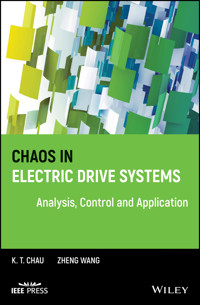
In Chaos in Electric Drive Systems: Analysis, Control and Application authors Chau and Wang systematically introduce an emerging technology of electrical engineering that bridges abstract chaos theory and practical electric drives. The authors consolidate all important information in this interdisciplinary technology, including the fundamental concepts, mathematical modeling, theoretical analysis, computer simulation, and hardware implementation. The book provides comprehensive coverage of chaos in electric drive systems with three main parts: analysis, control and application. Corresponding drive systems range from the simplest to the latest types: DC, induction, synchronous reluctance, switched reluctance, and permanent magnet brushless drives. * The first book to comprehensively treat chaos in electric drive systems * Reviews chaos in various electrical engineering technologies and drive systems * Presents innovative approaches to stabilize and stimulate chaos in typical drives * Discusses practical application of chaos stabilization, chaotic modulation and chaotic motion * Authored by well-known scientists in the field * Lecture materials available from the book's companion website This book is ideal for researchers and graduate students who specialize in electric drives, mechatronics, and electric machinery, as well as those enrolled in classes covering advanced topics in electric drives and control. Engineers and product designers in industrial electronics, consumer electronics, electric appliances and electric vehicles will also find this book helpful in applying these emerging techniques. Lecture materials for instructors available at href="http://www.wiley.com/go/chau_chaos">www.wiley.com/go/chau_chaos
Sie lesen das E-Book in den Legimi-Apps auf:
Seitenzahl: 405
Veröffentlichungsjahr: 2011
Ähnliche


















Contents
Cover
Title Page
Copyright
Dedication
Preface
Organization of this Book
Acknowledgments
About the Authors
Part I: Introduction
Chapter 1: Overview of Chaos
1.1 What is Chaos?
1.2 Development of Chaology
1.3 Chaos in Electrical Engineering
References
Chapter 2: Introduction to Chaos Theory and Electric Drive Systems
2.1 Basic Chaos Theory
2.2 Fundamentals of Electric Drive Systems
References
Part II: Analysis of Chaos in Electric Drive Systems
Chapter 3: Chaos in DC Drive Systems
3.1 Voltage-Controlled DC Drive System
3.2 Current-Controlled DC Drive System
References
Chapter 4: Chaos in AC Drive Systems
4.1 Induction Drive Systems
4.2 Permanent Magnet Synchronous Drive Systems
4.3 Synchronous Reluctance Drive Systems
References
Chapter 5: Chaos in Switched Reluctance Drive Systems
5.1 Voltage-Controlled Switched Reluctance Drive System
5.2 Current-Controlled Switched Reluctance Drive System
References
Part III: Control of Chaos in Electric Drive Systems
Chapter 6: Stabilization of Chaos in Electric Drive Systems
6.1 Stabilization of Chaos in DC Drive System
6.2 Stabilization of Chaos in AC Drive System
References
Chapter 7: Stimulation of Chaos in Electric Drive Systems
7.1 Control-Oriented Chaoization
7.2 Design-Oriented Chaoization
References
Part IV: Application of Chaos in Electric Drive Systems
Chapter 8: Application of Chaos Stabilization
8.1 Chaos Stabilization in Automotive Wiper Systems
8.2 Chaos Stabilization in Centrifugal Governor Systems
8.3 Chaos Stabilization in Rate Gyro Systems
References
Chapter 9: Application of Chaotic Modulation
9.1 Overview of PWM Schemes
9.2 Noise and Vibration
9.3 Chaotic PWM
9.4 Chaotic PWM Inverter Drive Systems
References
Chapter 10: Application of Chaotic Motion
10.1 Chaotic Compaction
10.2 Chaotic Mixing
10.3 Chaotic Washing
10.4 Chaotic HVAC
10.5 Chaotic Grinding
References
Index
This edition first published 2011
© 2011 John Wiley & Sons (Asia) Pte Ltd
Registered office
John Wiley & Sons (Asia) Pte Ltd, 2 Clementi Loop, # 02-01, Singapore 129809
For details of our global editorial offices, for customer services and for information about how to apply for permission to reuse the copyright material in this book please see our website at www.wiley.com.
All Rights Reserved. No part of this publication may be reproduced, stored in a retrieval system or transmitted, in any form or by any means, electronic, mechanical, photocopying, recording, scanning, or otherwise, except as expressly permitted by law, without either the prior written permission of the Publisher, or authorization through payment of the appropriate photocopy fee to the Copyright Clearance Center. Requests for permission should be addressed to the Publisher, JohnWiley & Sons (Asia) Pte Ltd, 2 Clementi Loop, #02-01, Singapore 129809, tel: 65-64632400, fax: 65-64646912, email: [email protected].
Wiley also publishes its books in a variety of electronic formats. Some content that appears in print may not be available in electronic books.
Designations used by companies to distinguish their products are often claimed as trademarks. All brand names and product names used in this book are trade names, service marks, trademarks or registered trademarks of their respective owners. The Publisher is not associated with any product or vendor mentioned in this book. This publication is designed to provide accurate and authoritative information in regard to the subject matter covered. It is sold on the understanding that the Publisher is not engaged in rendering professional services. If professional advice or other expert assistance is required, the services of a competent professional should be sought.
Library of Congress Cataloging-in-Publication Data
Chau, K. T.
Chaos in electric drive systems : analysis, control and application / K.T. Chau, Zheng Wang.
p. cm.
Includes bibliographical references and index.
ISBN 978-0-470-82633-1 (cloth)
1. Electric driving–Automatic control. 2. Chaotic behavior in systems. I. Wang, Zheng, 1979- II. Title.
TK4058.C37 2011
621.46–dc22
2010051061
Print ISBN: 978-0-470-82633-1
E-PDF ISBN: 978-0-470-82634-8
O-book ISBN: 978-0-470-82635-5
E-Pub ISBN: 978-0-470-82836-6
To our parents, families, colleagues and friends worldwide
Preface
Chaos is a phenomenon that occurs in nature, from as large as the universe to as tiny as a particle. The concepts of chaology have penetrated into virtually all branches of science and engineering. In the field of electrical and electronic engineering, recent research has covered a wide spectrum, including the analysis of chaos, the stabilization of chaos, the stimulation of chaos, and the application of chaos.
There are many books that deal with the field of chaology, focusing on the theoretical analysis of chaotic systems and the mathematical formulation of chaotic behaviors. In recent years, some books have begun to deal with chaos in electronic engineering, especially in the areas of electronic circuits and telecommunications. Although chaos and its practical application in electric drive systems have been widely published as papers in learned journals, a book that comprehensively discusses chaos in electric drive systems is highly desirable.
The purpose of this book is to provide a comprehensive discussion on chaos in electric drive systems, including the analysis of their chaotic behaviors, the control of their chaotic characteristics, and the application of their chaotic features. Contrary to other books which usually involve intensive mathematics or idealized experiments, this book aims to use a minimum of mathematical treatments, extensive computer simulations, and realistic experimentations to discuss chaos in various electric drive systems, including DC drive systems, AC drive systems, and switched reluctance drive systems. Also, while other books consider that the relevant application of chaos or chaos theory is to model or simply explain some strange behaviors, this book aims to discuss and explore the realistic application of chaos in electric drive systems, especially the utilization of chaotic motion for compactors, mixers, washers, HVAC devices, and grinders.
While an electric drive can be chaoized by a simple parameter and stabilized by a feedback controller, my life is also chaoized by a naughty boy and stabilized by a wonder woman. I would therefore like to take this opportunity to express my heartfelt gratitude to my son, Aten Man-ho, and my wife, Joan Wai-yi, for their existence in my life.
K.T. ChauThe University of Hong Kong, Hong Kong, China
Since its first introduction by Poincaré in the 1890s, chaos has been discovered in many disciplines. Although it was previously identified as a scientific problem, chaos is being paid more and more attention by engineers today. As a person engaged in electrical engineering, I got to know chaos when I read a book about nonlinearity in power systems. My first impression was that chaos was interesting, but so complicated, and with increasing knowledge I began to realize that chaos was actually a “conservative” guy with a messy outlook but a beautiful intrinsic property.
I became familiar with chaos when I started my PhD study at The University of Hong Kong (HKU) in 2004. Encouraged by my supervisor, Professor K.T. Chau, I was connected closely with the area of chaos in electric drives. By that time, Professor Chau had already developed a lot of pioneering work on the identification, analysis, and stabilization of chaos in electric drives. As in other disciplines, the innovative idea of the positive utilization of chaos in electric drives had just started in Professor Chau's group. My work then focused on chaotic drives, in particular on their industrial applications. When Professor Chau told me about his book proposal, I felt very happy as some of the creative work by our group on this topic could be introduced systematically worldwide. Most importantly, we hope that more people might pay attention to this multidisciplinary area, not only scientifically, but also in an engineering capacity. We also hope that more colleagues join us in this area!
Finally, I would like to take this opportunity to express my appreciation to Professor Chau for his guidance and for allowing me to participate in the writing of this book; to Professors Jie Wu and Ming Cheng for their support during my master's degree and work at the Southeast University of China (SEU); and to my group fellows in HKU and SEU, whose work has greatly excited me. I also wish to acknowledge the genuine support and unselfish care I have received from my parents at all times.
Zheng WangSoutheast University, China
Organization of this Book
This book is a happy marriage of two fields of research – chaology and electrical engineering. Chaology has always been tagged as an abstract field that involves intensive mathematics but lacks practical application. On the other hand, electrical engineering has been well recognized as a practical field that usually transforms innovative technology into commercial products, thus improving our living standards. Chaos in electric drive systems is a representative of this marriage, enabling chaos to exhibit realistic behavior and provide a practical application. It also fuels electrical engineering with a new breed of technology.
The book covers the multidisciplinary aspects of chaos and electric drive systems, and is written for a wide range of readers, including students, researchers, and engineers. It is organized into four parts:
Part I presents an introduction to the book. It contains Chapters 1 and 2, which will provide an overview of chaos with an emphasis on electric drive systems. These chapters will also introduce the basic theory of chaos and a fundamental knowledge of electric drive systems.Part II is a core section of the book – namely, how to analyze chaos in various electric drive systems. It consists of Chapters 3, 4, and 5, which will discuss the analysis of chaos in DC drive systems, AC drive systems, and switched reluctance drive systems.Part III is another core section which explains how chaos in various electric drive systems can be controlled. It comprises two chapters, Chapters and 7, which will discuss various methods of controlling chaos, including the stabilization and stimulation of chaos. It should be noted that this book adopts the general perception of the meaning of control, rather than use the jargon of chaos theory where ‘control’ and ‘anticontrol’ represent ‘stabilize’ and ‘destabilize’, respectively.Part IV – which is probably the most influential part of the book – unveils and proposes some promising applications of chaos for electric drive systems. It contains three chapters (Chapters 8, 9, 10) that will be devoted to describing various applications of chaos, including the application of chaos stabilization, the application of chaotic modulation, and the application of chaotic motion.Since these four parts have their individual themes, readers have the flexibility to select and read those parts that they find most interesting. The suggestions for reading are as follows:
Undergraduate students taking a course dedicated to electric drive systems may be particularly interested in Parts I, II, and IV.Postgraduate students taking a course dedicated to advanced electric drive systems may find all parts interesting.Researchers in the areas of chaos and/or electric drive systems may also be interested in all parts. In particular, they may have special interest in Parts III and IV, which involve newly explored research topics.Practicing engineers for product design and development may be more interested in Parts I and IV, in which new ideas can be triggered by the overview, and commercial products can be derived from the proposed applications.General readers may be interested in all parts. They are advised to read the book from beginning to end, page by page, and will find the book to be most enjoyable.The book contains 10 chapters, each of which has various sections and subsections. In order to facilitate a reading selection, an outline of each chapter is given below:
Chapter 1 gives an overview of chaos, including the definition of chaos, the development of chaology, and the research of chaos in the field of electrical engineering, with an emphasis on electric drive systems.Chapter 2 introduces the necessary background knowledge for this book – namely, a description of the basic theory of chaos and the fundamentals of electric drive systems.Chapter 3 is devoted to analyzing chaos in DC drive systems, including both of the voltage-controlled mode and the current-controlled mode. The corresponding modeling, analysis, simulation, and experimentation will be discussed.Chapter 4 is devoted to analyzing chaos in AC drive systems, including the induction drive system, the permanent magnet synchronous drive system, and the synchronous reluctance drive system. The corresponding modeling, analysis, simulation, and experimentation will be discussed.Chapter 5 is devoted to analyzing chaos in switched reluctance drive systems, including the voltage-controlled mode and the current-controlled mode. Relevant discussion with verification will be given.Chapter describes various control approaches to stabilize the chaos that occurs in both DC and AC drive systems. A relevant discussion with verification will be given.Chapter 7 describes various control approaches to stimulate chaos operating at various electric drive systems. Both of the control-oriented chaoization and the design-oriented chaoization will be discussed.Chapter 8 presents the stabilization of chaos in various applications, including automotive wiper systems, centrifugal governor systems, and rate gyro systems. The corresponding modeling, analysis, and stabilization will be elaborated.Chapter 9 presents how to apply chaotic modulation to PWM inverter drive systems, hence reducing the corresponding audible noise and mechanical vibration. Open-loop and closed-loop control will both be discussed.Chapter 10 presents a new breed of chaos application, namely the electrically-chaoized motion – simply known as chaotic motion. Various promising applications of chaotic motion, including compaction, mixing, washing, HVAC, and grinding, will be unveiled and elaborated.Acknowledgments
The material presented in this book is a collection of many years of research and development by the authors in the Department of Electrical and Electronic Engineering, The University of Hong Kong.
We are grateful to all members of our research group, especially Mr Wenlong Li, Miss Jiangui Li, Miss Shuang Gao, and Miss Diyun Wu, for their help in the preparation of this work. We must express our sincere gratitude to our PhD graduates, namely Dr Jihe Chen, Dr Yuan Gao, and Dr Shuang Ye, who have made enormous contributions to the area of chaos in electric drive systems.
We are deeply indebted to our colleagues and friends worldwide for their continuous support and encouragement over the years. We appreciate the reviewers of this book for their thoughtful and constructive comments, and thank the editors at John Wiley & Sons for their patience and effective support.
Last but not least, we thank our families for their unconditional support and absolute understanding during the writing of this book.
About the Authors
K. T. Chau received his BSc (Eng) degree with First Class Honors, MPhil degree, and PhD degree all in Electrical and Electronic Engineering from The University of Hong Kong. He joined his alma mater in 1995, and currently serves as Professor in the Department of Electrical and Electronic Engineering. He is a Chartered Engineer and Fellow of the Institution of Engineering and Technology. He has served as editor and editorial board member of various international journals as well as chair and organizing committee member of many international conferences. His teaching and research interests are electric drives, electric vehicles, and renewable energy. In these areas, he has published over 300 refereed technical papers. Professor Chau has received many awards, including the Chang Jiang Chair Professorship; the Environmental Excellence in Transportation Award for Education, Training and Public Awareness; the Award for Innovative Excellence in Teaching, Learning, and Technology; and the University Teaching Fellow Award.
Zheng Wang received his BSc (Eng) degree and Master (Eng) degree in Electrical Engineering from the Southeast University of China, and his PhD degree in Electrical and Electronic Engineering from The University of Hong Kong. After working as a postdoctoral fellow in Ryerson University of Canada, he joined the School of Electrical Engineering of the Southeast University in 2009, and currently serves as an associate professor. He is a member of the Institute of Electrical and Electronics Engineers. His teaching and research interests are power electronics, electric drives, and renewable energy techniques. He has published several technical papers and industrial reports in these areas. Dr Wang has received some awards including the postdoctoral fellowship financially supported by the Canadian NSERC/Rockwell, the Hong Kong Electric Co. Ltd Electrical Energy Postgraduate Scholarship, and the Outstanding Young Teacher Award of Southeast University.
Part One
Introduction
Chapter 1
Overview of Chaos
This chapter gives an overview of chaos, including the definition of chaos, the development of chaology, and the research of chaos. In particular, the research and development of chaos in the field of electrical engineering – with an emphasis on electric drive systems – are discussed in detail.
1.1 What is Chaos?
The etymology of the word “chaos” is a Greek word “χα′ς” (Nagashima and Baba, 1999) which means “the nether abyss, or infinite darkness,” and was personified as “the most ancient of the gods.” Namely, the god Chaos was the foundation of all creation. From this god arose Gaea (god of the earth), Tartarus (god of the underworld) and Eros (the god of love). Eros drew Chaos and Gaea together so that they could produce descendants, the first born of whom was Uranus (the god of the sky). This also resulted in the creation of the elder gods known as Titans. The interaction of these gods resulted in the creation of other gods, including such well-known figures as Aphrodite, Hades, Poseidon, and Zeus.
There is a Chinese myth of chaos (Liu, 1998), taken from one of the ancient Chinese classics Chuang-Tzu: “The god of the Southern Sea was called Shu (Change), the god of the Northern Sea was called Hu (Suddenness), and the god of the Central was called Hun-tun (Chaos). Shu and Hu often came together for a meeting in the Central, and Hun-tun treated them generously. Shu and Hu determined to repay his kindness, and said, ‘Mankind has seven holes for seeing, hearing, eating and breathing; but Hun-tun has none of them; let us bore the holes for him!’ So, every day they bored one hole in his head. On the seventh day, Hun-tun died.” This myth not only indicates the disorder-like or random-like behavior of chaos, but also implies that chaos is the natural state of the world and should not be disrupted by a sudden change.
There are many myths relating to the god of chaos in different cradles of civilization, such as Greece, China, Egypt, and India, but in the modern world chaos is no longer a god. In 1997, its meaning in the Oxford English Dictionary Online was updated as “Behavior of a system which is governed by deterministic laws but is so unpredictable as to appear random, owing to its extreme sensitivity to changes in parameters or its dependence on a large number of independent variables; a state characterized by such behavior” (Simpson, 2004).
The general perception on chaos is equivalent to disorder or even random. It should be noted that chaos is not exactly disordered, and its random-like behavior is governed by a rule – mathematically, a deterministic model or equation that contains no element of chance. Actually, the disorder-like or random-like behavior of chaos is due to its high sensitivity on initial conditions.
Similar to many terms in science, there is no standard definition of chaos. Nevertheless chaos has some typical features:
Nonlinearity: Chaos cannot occur in a linear system. Nonlinearity is a necessary, but not sufficient condition for the occurrence of chaos. Essentially, all realistic systems exhibit certain degree of nonlinearity.Determinism: Chaos must follow one or more deterministic equations that do not contain any random factors. The system states of past, present and future are controlled by deterministic, rather than probabilistic, underlying rules. Practically, the boundary between deterministic and probabilistic systems may not be so clear since a seemingly random process might involve deterministic underlying rules yet to be found.Sensitive dependence on initial conditions: A small change in the initial state of the system can lead to extremely different behavior in its final state. Thus, the long-term prediction of system behavior is impossible, even though it is governed by deterministic underlying rules.Lesen Sie weiter in der vollständigen Ausgabe!
Lesen Sie weiter in der vollständigen Ausgabe!
Lesen Sie weiter in der vollständigen Ausgabe!
Lesen Sie weiter in der vollständigen Ausgabe!
Lesen Sie weiter in der vollständigen Ausgabe!
Lesen Sie weiter in der vollständigen Ausgabe!
Lesen Sie weiter in der vollständigen Ausgabe!
Lesen Sie weiter in der vollständigen Ausgabe!
Lesen Sie weiter in der vollständigen Ausgabe!
Lesen Sie weiter in der vollständigen Ausgabe!
Lesen Sie weiter in der vollständigen Ausgabe!
Lesen Sie weiter in der vollständigen Ausgabe!
Lesen Sie weiter in der vollständigen Ausgabe!




