


9,99 €
Mehr erfahren.
- Herausgeber: Titan Books
- Kategorie: Fantasy und Science-Fiction
- Sprache: Englisch
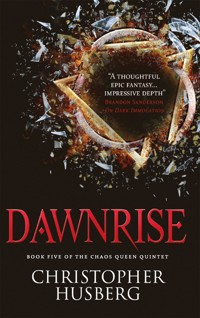
The fifth and final book in the epic Chaos Queen series. "Perfect for fans of Daniel Abraham and Brandon Sanderson." (Library Journal on Duskfall) Nothing is as it seems. Sfaera-shattering revelations reveal there is more to the Nine Daemons--and Canta--than anyone could have imagined, and deep in the heart of Triah, a threat that has lurked below the surface for years finally rises, gathering unimaginable power. Knot, still reeling from a shocking death, tries to put himself back together in time to fight. Two ex-Nazaniin assassins, Code and Kali, form an unlikely alliance. Cinzia, more suspicious than ever of her sister Jane Oden--Canta's prophetess--rallies as many people as she can to save the Sfaera from imminent destruction. And Winter, the Chaos Queen herself, realizes she must finally choose sides and face the greatest test of her life: finding the humility to seek help. Deep in the heart of Triah, a threat that has lurked below the surface for years finally rises, gathering unimaginable power. Only the unlikely alliance formed between the two former Nazaniin assassins, Code and Kali, stands in its way. Characters old and new join forces to preserve life as they know it. The darkest night the Sfaera has ever known is about to end, but whether it ends in daylight or destruction remains to be seen...
Das E-Book können Sie in Legimi-Apps oder einer beliebigen App lesen, die das folgende Format unterstützen:
Veröffentlichungsjahr: 2021
Ähnliche













Contents
Cover
Also by Christopher Husberg
Title Page
Leave us a review
Copyright
Dedication
Map
Prologue
Part I: Daemon’s Bane
Chapter 1
Chapter 2
Chapter 3
Chapter 4
Chapter 5
Chapter 6
Chapter 7
Chapter 8
Chapter 9
Chapter 10
Chapter 11
Chapter 12
Chapter 13
Chapter 14
Chapter 15
Part II: Live to Love
Chapter 16
Chapter 17
Chapter 18
Chapter 19
Chapter 20
Chapter 21
Chapter 22
Chapter 23
Chapter 24
Chapter 25
Chapter 26
Chapter 27
Chapter 28
Part III: Convergence
Chapter 29
Chapter 30
Chapter 31
Chapter 32
Chapter 33
Part IV: Ripples of Light
Chapter 34
Chapter 35
Chapter 36
Chapter 37
Chapter 38
Chapter 39
Chapter 40
Epilogue
Acknowledgments
About the Author
Also by Christopher Husberg
The Chaos Queen Quintet
Duskfall
Dark Immolation
Blood Requiem
Fear the Stars
LEAVE US A REVIEW
We hope you enjoy this book – if you did we would really appreciate it if you can write a short review. Your ratings really make a difference for the authors, helping the books you love reach more people.
You can rate this book, or leave a short review here:
Amazon.com,
Amazon.co.uk,
Goodreads,
Barnes & Noble,
Waterstones,
or your preferred retailer.
Dawnrise
Print edition ISBN: 9781783299232
E-book edition ISBN: 9781783299249
Published by Titan Books
A division of Titan Publishing Group Ltd
144 Southwark Street, London SE1 0UP
www.titanbooks.com
First edition: May 2021
10 9 8 7 6 5 4 3 2 1
This is a work of fiction. All of the characters, organizations, and events portrayed in this novel are either products of the author’s imagination or are used fictitiously. Any resemblance to actual persons, living or dead (except for satirical purposes), is entirely coincidental.
© Christopher Husberg. 2021. All Rights Reserved.
Christopher Husberg asserts the moral right to be identified as the author of this work.
No part of this publication may be reproduced, stored in a retrieval system, or transmitted, in any form or by any means without the prior written permission of the publisher, nor be otherwise circulated in any form of binding or cover other than that in which it is published and without a similar condition being imposed on the subsequent purchaser.
A CIP catalogue record for this title is available from the British Library.
For dad
PROLOGUE
173rd Year of the People’s Age, beneath the citadel of Triah
KOSARIN LOTHGARDE HATED IT when they asked questions.
The man tied to the wooden table before him squirmed and wiggled against the ropes, pleading hoarsely in a heavy Alizian accent.
“Who are you? Why are you doing this? Please, answer!”
Discomfort had long been a stranger to Kosarin, and these pitiful questions were not about to reacquaint him with the feeling.
Not that the man’s questions weren’t justified. If Kosarin had spent a year in isolated imprisonment only to be knocked unconscious and then suddenly and unceremoniously tied to a table by a mysterious man deep underground, he might have a few panicked questions as well. In any case, the man’s grasping desperation would not last much longer. His life was an unprotected candle; Kosarin was a hurricane.
Kosarin cleared his throat, and cracked his neck from side to side with two solid pops. The psimancer Wyle stood across the table, face pale, eyes wide as he stared at the man screaming between them.
Kosarin extended a single tendron outward and into the Alizian’s mind, and the man fell immediately, blessedly, silent. As he made contact, his vision erupted in a burst of light. He could still see the Sfaera, but everything around him dimmed just slightly as the remnants of the light explosion settled all around him.
He was in his body, here in the Sfaera, but somehow he also saw the Void.
It was a strange phenomenon, which had only begun occurring in the past eighteen months. He liked to think it was due to his own increasing power; he could access two more tendra than he could eighteen months ago. Not a huge increase for him, relatively speaking, but he was always pleased to see his powers augmented. But the realist in him assumed it had something to do with Winter, the Nine Daemons, and the other extraordinary events happening on the Sfaera.
“You’ve located Code?” Kosarin said, speaking to Wyle. His single tendron wrapped around the Alizian’s mind. He could not see it in the Sfaera, but in the Void his tendron took the form of a delicate, hazy tendril of violet smoke, extending from Kosarin to envelop the pinpoint of light—a strong yellow color—that represented the man’s sift.
Wyle nodded. “We have, Triadin.”
Kosarin, as the Venerato of the Citadel and the Triadin of the Nazaniin—and, he could admit with simplicity, one of the most powerful people on the Sfaera—always had more business that needed attending, and Code was the latest hiccup in his plans. Kosarin had known Code would attempt to take the sunstone—Rune had told him as much, as had his own insights into Code’s sift. That was why he’d sent Anthris, Tarbin, and Methasticah—one of his most trusted cotirs—to deal with his wayward agent. But then Anthris, Tarbin, and Methasticah had all been found dead. Kosarin would have suspected Code, but the three had clearly been killed by an acumen, not a telenic. Either Code had help from some unknown psimancer (Kosarin sincerely doubted he’d befriended the Chaos Queen, but who bloody knew at this point), or there was another party at play. Rune, strangely, seemed unsure in the matter.
Either way, finding Code was key to finding the sunstone—either he had it, or he would have some clue as to who did—and Kosarin needed that particular rihnemin for his plans to continue forward.
“Good,” Kosarin grunted. “Get a team in position. I want him alive—and his friends from Maven Kol as well, if possible.”
“The team is already prepared, and awaits your orders, Triadin.”
Kosarin’s tendra paused as he looked up at Wyle, allowing a brief smile to cross his face. “Thank you. You have proved a valuable instrument. I could not have done this without you.” That wasn’t exactly true, but Wyle had at least expedited the process.
“I live to serve you, Triadin.” Wyle stood still, but Kosarin could sense the young man watching from the Void. After months of practicing, Kosarin was finally ready to make a real attempt, and he figured he owed it to the young man to at least let him watch. Wyle had procured the information that made this process possible in the first place. By delving Knot—the strange conglomerate sift that occupied Lathe Tallon’s body—Wyle had gleaned what the Ceno order and Rodenese psimancers had done to the man to make him exactly what he was. While the idea was innovative, the Rodenese had done a hack job of it, a brand-new sift the inexplicable byproduct of that botched experiment.
But after studying the information Wyle had given him, Kosarin knew exactly how to put such procedures to use. The Rodenese had been attempting to create some sort of super soldier, with the abilities of a Nazaniin psimancer, the expertise and fighting prowess of a great general, and various other qualities from other sifts. But their mistake had been in smashing each sift inits entirety into Lathe’s body. A maladroit approach. The Rodenese had used their power like a hammer, cramming their pale excuse for an experiment together, patches and leaks everywhere.
Of course, one could not expect too much from them. They were novices, hardly aware of their own capabilities. Kosarin was the Triadin of the Nazaniin, and he used his power like a surgeon’s blade.
He’d separated the experiment’s sift from the body, now, and the body before him was nothing more than an empty shell: a lacuna. Kosarin concentrated on the sift he held in his tendron, the tiny yellow light in the Void, and went to work.
In his younger years, Kosarin had taken up the hobby of whittling chunks of wood. He’d crafted the figures of a king and queen, crowned and square-shouldered, for his parents. Kittens and bunnies and dolls for his sisters. Dolls for himself, too, until he had an entire army of them. An army he could control and manipulate, every soldier bending to his will. He’d always preferred blackbark—a material even his own wealthy family came across sparingly—but would work with whatever wood was available to him, using a variety of blades of different sizes and edges. He’d become quite good at it, the minuscule details and features of each model becoming more lifelike with every attempt. The materials’ essence and potential cried out to him, and he began to discern what any block of wood might become before even taking a knife to it. He embraced what others would discard, shaping the scars and knots in the wood into the strongest aspects of the figure it would become.
Eventually the cultivation of more important duties and talents had eclipsed his carving, but Kosarin felt a great deal of nostalgia—and pleasure—as he worked with his tendron now, whittling away at this man’s sift. He could see the essence of exactly what he wanted, the barest sliver of magic embedded in this man’s being. He’d practiced this exact procedure on dozens of test subjects over the past few months, the process both tedious and full of errors at first. Eventually, he’d rediscovered his ability to see a material’s worth, the flaws and flourishes that made it special, and exploit them. A street urchin’s perspicacity here; an old man’s stone will there; a young woman, with no family, whose crocheting ability surpassed all others. While the initial products were too rough and uneven to prove serviceable—they’d just been practice, after all—eventually Kosarin got to a point where he’d begun inserting these shards into other minds, other sifts. He’d placed a few in other experiments, just to make sure it wouldn’t kill them. Then he’d inserted a few into Wyle, as a reward for his service. Nothing spectacular, of course, but a greater capacity to problem-solve, and by Wyle’s specific and profoundly uncreative request, an increased ability to entice and woo the opposite sex.
Finally, Kosarin had begun placing the shards—crafted sculptures, now—into himself. And, unlike what the Rodenese had done to Lathe by cramming sifts together without purpose, without intent, Kosarin had refined his work until he could place these sculptures with such precision and gentleness that only the most trained acumen could tell where the old sift ended and the new, inserted fragment began.
It was a short skip from there to this moment, what this process had all been for, as he shaped the sift before him.
It had been Code Fehrway himself who had brought the man on the table to Kosarin, shortly after the former Nazaniin had returned from Arro Isle. According to Code’s report the dead had begun to rise on Arro, resurrected by the power of the Daemon Hade, and while Kosarin had been skeptical at first, recent events had forced him to reevaluate what he considered within the realm of possibility. This man allegedly had been one of those endowed with Hade’s power, and as Kosarin had studied the man’s sift over the past year, he thought he’d discerned the exact section that housed that power.
The section he’d now shaped into a fragment in the Void before him.
Deftly, he inserted the shard into his own sift. The process was simple, with far less pomp than it deserved, and then it was done.
Kosarin felt Wyle’s wide eyes on him.
“Did it—”
Kosarin drew the long dagger at his belt and slid it across the neck of the lacuna on the table. Arterial blood jutted into the air between Wyle and Kosarin. Kosarin took a step back, avoiding most of the gore, but Wyle spluttered as he stumbled away, his face spattered with crimson.
The body convulsed once, but the face registered no pain, no shock or surprise. Kosarin had taken his sift; there was nothing left inside the lacuna to process feeling or emotion. But the body had still been alive, at least until Kosarin had cut the thing’s throat. As the last vestiges of life seeped out of the lacuna, Kosarin stood his ground, and waited.
He did not have to wait long.
Before the blood stopped leaking from the corpse’s throat, Kosarin felt a connection develop between them. Something linked him to the body, something reminiscent of an acumenic tendron but at the same time altogether different. Invisible, intangible, but Kosarin felt it there nonetheless. A tether, running from his mind, his sift, to the corpse before him.
Gently, Kosarin strummed the link. The moment he did so, he felt something move, very far away. He felt it in the back of his mind, and he felt it deep in his bowels. He felt a gray skull turning slowly to lock onto him with great, gaping black eyes.
Kosarin ignored the sensation—he had an idea what that was about, but he had time to deal with that yet. At the moment, he was far more concerned with the corpse on the table.
The corpse that now swiveled its head to look at Kosarin.
The corpse’s eyes were still open—neither Kosarin nor Wyle had bothered to close them—but the moment Kosarin strummed the tether, the moment he felt the gray skull fixate on him, the corpse’s once blue eyes had shifted to a dull, dark gray, as if great rolling storm clouds had thundered across a clear blue sky with unprecedented speed.
The corpse’s head turned again, this time toward Wyle. A low, empty groan emanated from the body’s throat. It strained against its bonds, snapping its jaws at Wyle, who shrank back, yelping softly as he backed into the far wall.
“I’ll be damned,” Kosarin whispered. His own surprise surprised him; what outcome other than success could he reasonably have expected?
Wyle asked him a question, but Kosarin dismissed it out of hand. Plans tumbled rapidly through his mind, plans he’d been unsure whether he could put into motion. Unsure, until now.
“We have more work to do,” Kosarin snapped. He looked at Wyle, then nodded to the corpse. “Put a sword through the corpse’s brain. Code said the only way to kill these abominations was to go for the head. This one we can disregard; I don’t imagine we’ll have any shortage of them in the days to come.”
Wyle, having more or less recovered from his previous scare, stepped forward, sword held high.
PART I
DAEMON’S BANE
1
Odenite camp, outside of Triah
CINZIA SQUINTED IN THE lantern light, unsure of how long she had been reading the Veria. Quite some time, given the strain she could feel behind in her eyes, strain that had been easy to ignore as she delved deep into the Veria’s words. She clutched a dark red gemstone in one hand as she read. She had found the jewel in the Denomination’s Vault, atop Canta’s Fane, and used its power to kill four of the Nine Daemons.
She was no longer sure that had been the right choice.
Called Canta’s Heart, the gemstone was far from typical; its multifaceted surface shifted and twisted, and even its size seemed to change, sometimes shrinking as small as a chicken’s egg, other times growing larger than Cinzia’s fist. Cinzia kept the strange artifact close at all times. Four Daemons still roamed free, but Cinzia had begun to fear Canta and the Goddess’s Prophetess, Jane, even more.
“The Nine really were tiellans, then,” she said, finally looking up from the manuscript.
When Nayome did not answer, Cinzia turned to see the Holy Crucible curled up and asleep in the large chair in the tent. Cinzia herself sat cross-legged on her cot, pages of the Veria scattered around her.
“Nayome,” Cinzia whispered harshly. When the woman still did not respond, Cinzia hefted one of the cushions from her cot and threw it, smacking the Crucible in the head.
Nayome sat up sharply, a scowl creasing her brow.
“What in Oblivion—”
“How can you possibly be sleeping?” Cinzia kept her voice to a whisper, partly because it was the dead of night—she did not wish to disturb anyone—but also because of the nature of what she and Nayome had been discussing.
A tumult of emotions raged and spiraled within Cinzia. Shock, first and foremost. She could hardly believe the concepts the Veria presented. The Nine Daemons, not daemons after all, but betrayed tiellan monarchs? And Canta herself, the Goddess Cinzia had worshipped her entire life, was the one who had betrayed them.
Beyond that, she felt confusion. Was any of this true at all? If so, how could it be possible?
Deeper still simmered a rage she had never felt before. Could everything she had known, everything she had believed and followed her entire life, be a lie?
And, beneath it all, underlying everything, an ache so intense that if it ruptured, Cinzia was sure it would overwhelm every other emotion and take over completely.
So, instead, she focused on what she had just read.
A distraction.
“Remember, sister,” Nayome said, yawning, seemingly oblivious to Cinzia’s turmoil, “I have been privy to this information longer than you have. I’ve already lost my sleep over it; it’s time we both caught up.”
Sister. Cinzia blinked at that word. Nayome had once called her sister, when Cinzia was a priestess in the Denomination, a companion to Nayome’s office of Crucible. But Cinzia had been excommunicated from the Denomination for her involvement with the budding Church of Canta. She was Nayome’s sister no longer; the reference had been nothing but a slip, an error made in coming out of sleep so suddenly.
But the word had another connotation for Cinzia. She had spent many hours staying up late into the night, poring over a far different set of pages, with another woman who called her “sister.”
A woman who, as Cinzia read more of the Veria, she began to wonder whether she truly knew at all.
Cinzia ignored Nayome’s comment about sleep and returned to her point. “The Nine. They were tiellans.”
Which means the Beldam has been right all along. To some extent, at least.
The Beldam had preached the tiellans had descended from the Nine, hadn’t she? Everything in Cinzia’s mind muddled together, like every color she could imagine splashed onto a canvas at once.
“That surprised me as well,” Nayome said. “Although I can’t see why you care about that particular detail, amidst everything else.”
When Nayome first presented Cinzia with the Veria earlier that evening, she had summarized more or less what Cinzia would discover in its pages: the Nine Daemons were far from the worst threat to the Sfaera. While they threatened to recreate the Sfaera as they saw fit, another force—Canta, the Goddess who claimed to have created and shaped the Sfaera in the first place—would soon destroy it completely.
At first Cinzia had been unable to believe such a thing was possible. The Canta she had known, grown up with, learned about at the seminary, was a being who cared for her children on the Sfaera. When Cinzia had attached herself to Jane’s movement, what would become the Church of Canta, those feelings had been all but confirmed.
A snowy, cold night in Izet had taught her that she was loved, loved by a force beyond and greater than herself.
She’d learned at Harmoth how to trust, giving up what little control she had to that same force.
Cinzia had valued those moments; they had changed her, made her into something better. Watching Jane, interacting with Luceraf, Cinzia had already begun to doubt some of her beliefs, but this, what she read now, shattered everything.
“The Beldam… the Beldam taught this,” Cinzia said. “Or something like it, anyway.”
“The Beldam betrayed the—” Nayome stopped, catching Cinzia’s eye. She scowled, but did not continue.
“Betrayed the Denomination? Just as I have?” Cinzia continued for her.
“What does it matter,” Nayome said sharply, “when the Denomination is not what either of us thought it was?”
They sat in silence.
“You are convinced of the truth of all of this, then?” Cinzia said after a while.
Nayome did not meet Cinzia’s eyes.
“No. I… remain unconvinced.”
A beacon of hope split the clouds that had eclipsed Cinzia’s soul. If there was the slightest chance that her entire life was not about to crumble all around her, she would cling to it like a drowning woman to a lifeline.
“I cannot un-know what I know,” Nayome continued. “Doubt has sprung up where I’d previously only cultivated faith, and no matter how much I reap, prune, and pluck, I cannot seem to rid myself of it.” Their eyes met, and Cinzia perceived the broken fragments of belief within Nayome that she had long recognized so well within herself.
As quickly as it had appeared, that beacon of hope snuffed out inside of her, and she was left in the dark.
“If none of what we have believed our entire lives is true,” Cinzia said slowly, “then… how…”
She could not finish the question. She did not know the question to ask.
“Then what matters?” Nayome said.
Cinzia nodded, though it was not exactly what she had been trying to say. Nayome’s words, however, brought to mind another question, posed to her in Canta’s Fane, by the Essera herself.
“The question used to be ‘Does Canta exist?’—at least that is what those who doubted asked,” Cinzia said. “But, now, I think we can state definitively that Canta exists. Perhaps the better question is, what do we owe her, if anything? And, if she is not the goddess we supposed, is there a god or goddess out there beyond her?”
Nayome had no response.
The two sat in silence for a while longer, Cinzia’s eyes blurring as she looked at the pages spread around her. A part of her wanted to stop reading; another part of her dreaded what might happen if she did. Stronger than either of those parts, however, was the desire simply to know everything the Veria said, to understand it all, her feelings and everything she had considered to be true for her entire life be damned.
She had taken the plunge, now. She had to follow it through, all the way down.
A hand rested on Cinzia’s shoulder. Nayome stood above her, a dark cloak once again wrapped around her, hood shadowing her face.
“It is time for me to leave, sister,” Nayome said.
This time, Cinzia knew the word was not a mistake. Whatever had happened between them, whatever they had done to one another, in and outside of the Denomination, had faded, transcended into a different sisterhood: stronger in bond, far more harrowing in nature.
Cinzia placed her hand on Nayome’s. She meant the gesture to be calming, but her hand clamped down on the Crucible’s in desperation she could not mask. “Please,” she said. “Stay.”
“We will talk more of this, but now is not the time. Or the place, really. I know I don’t belong where I am anymore. It pains me to say you’ll soon feel the same.”
“I’ve felt that way already,” Cinzia said quietly, “for some time.” With effort disproportionate to the task, she pried her hand away from Nayome’s.
Nayome’s eyes remained on Cinzia, and she hesitated as if she might respond, but then shook her head.
“We will find the truth,” Nayome said. “Goodbye, Cinzia.”
Nayome walked out of the tent, the first rays of dawn streaming through the tent flap as it wavered in her absence.
Cinzia picked up the next page of the Veria, ready to read more, dreading what the morning would bring. Dreading who would come through that tent flap next, what they might require of her.
Nayome’s last words echoed in Cinzia’s mind. Truth. The Beldam had said something to her once, about truth. Just after the Beldam’s thugs had beaten Cinzia, leaving her bruised and bloody, the old woman had stood over her with a sad smile on her face.
There is no fairness, no freedom, nothing of the sort. Cinzia could hear her words echoing, as if the Beldam stood next to her at that very moment. There is only truth, and the inevitable pain that follows.
And now, Cinzia knew, the pain would follow.
But not the pain of the Veria, not the pain of having her beliefs, her life, shattered into irreconcilable pieces. That pain faded rapidly into the distance, behind the rage, behind the confusion, behind the shock.
Now, instead, the insidious ache that lurked deep beneath the surface, kept at bay only by
a distraction,
suddenly and overwhelmingly ruptured upward in great, splintering spasms.
Her distraction was gone.
Astrid was gone.
And Cinzia wept.
2
WINTER AWOKE TO A bright morning, augmented by the sun reflecting from gentle drifts of snow on tents, trees, covering grass, and all around the Odenite camp. She squinted, shading her eyes with one hand, while she threw her meager blanket off her with the other. Someone had handed it to her late in the night—someone who likely hadn’t recognized her. If they had, she doubted they would have shown her even that much hospitality.
She hoped her anonymity would continue. Among the tiellans, her wild black hair, tightly braided along the sides of her head while rising in much thicker, looser braids along the top and down her back, had become something of an icon. Her black leather armor, expertly tailored, form-fitting but still allowing her a full range of motion, had attracted attention, too. But that was among her own people; the Odenites had their own armed force that included tiellans, and she hoped her appearance would not be too out of place here.
At least no one had called her “Your Majesty” yet.
She struggled to her feet, her limbs aching and sore from the chill and the battles and the hollow exhaustion that never quite seemed to fade.
She needed warmth after such a night, first and foremost, and so found her way to the nearest blazing bonfire. One of dozens in the camp, it was already surrounded by Odenite soldiers. Some held their hands towards the flames, others clutched steaming mugs or bowls. Of what, Winter did not know, but she wouldn’t mind a share if there was any left.
A part of her didn’t want to take anything from these people; she was not one of them, and they owed her nothing. On the contrary, if they knew who she truly was, she was sure they’d send her packing, if not kill her on the spot.
Or attempt to kill her, anyway. At this point, Winter was of half a mind to let them try.
The fire was large enough for her to warm herself by it, while still keeping her distance from the others. Once she got her blood flowing, she’d get out of this camp. Where she would go after that, she did not know. She had psimantically checked in with her people numerous times, sensing the cluster of their sifts in the Void, but had not yet been able to communicate with them. They seemed to be on the Wyndric Ocean with a large Rodenese force. Winter did not like the sound of that, given Roden’s past treatment of tiellans, but Urstadt was with them, and Winter trusted the woman. Either way, she needed to get back to them. They were her people; these were not. Cinzia and Jane could not possibly have a use for her, and Knot…
Winter did not want to see Knot. He had cared for the girl Astrid even more than Winter had realized; he had not left his tent since they’d returned with Astrid’s body. A burial service would be held later that afternoon, and Winter did not intend to be around for it. She was responsible for Astrid’s death as much as anyone else. She had facilitated the Nine’s rising. She had summoned them, made a deal with them, only to break that deal and try to kill them. A task at which she had failed spectacularly. It was a good thing that Goddess-damned ex-priestess had been doing whatever she was doing, otherwise the Nine Daemons might actually have triumphed.
But then the remaining Nine—they were the Four, now, Winter supposed—had left, leaving hundreds of Outsiders. Outsiders that Winter could not face, a mess she could not clean up.
So Astrid had done it for her, saving them all, and the vampire girl had burned as the sun rose.
No, Winter would not stay. Her next order of business was to find her people. Then, she could figure out what in Oblivion she was going to do next.
“Hello there.”
Winter looked sideways at the two people who’d sidled up next to her. She’d sensed them walking behind her, had hoped they would continue on whatever business they had. But when Winter saw who they were, she cringed.
It was the damn couple with the strange accents who had approached her the previous evening.
Bloody bones, this was the last thing she needed.
Without responding, Winter stood and walked away. She didn’t need this. She didn’t need that fire, either, not badly enough to suffer through those two talking her pointed ears off. There were dozens of other fires in the camp. She could make her way to one of those and then be on her way.
Footsteps kept pace behind her, and a spike of anger flashed through her with such intensity that she almost drew her sword and whirled on them both.
Fortunately, she was of sound enough mind that she rejected that impulse, instead turning on them with the most withering look she could manage.
Goddess, I could use some faltira right now.
“What do you want?” she demanded.
To Winter’s credit, the two actually did seem taken aback, freezing in their tracks and staring at her with wide eyes. Winter found it odd she was surprised; she thought she’d gotten used to her own people flinching at her every beck and call, whether she liked it or not.
Then again, these weren’t tiellans. The man and woman standing before her were both human, and Winter certainly wasn’t their queen.
When the two got a hold of themselves, they both bowed. Winter motioned them up as surreptitiously as she could. Glancing around, it did not appear anyone had noticed the act, and she prayed it stayed that way.
“As I said before,” the man said, inclining his head, “I only want to help you.” He popped his knuckles, and the woman gave him a sidelong glance.
Winter scoffed. “What makes you think I need help?” she asked. “And even if I did, what makes you think you could give it?”
Winter tensed as the man stepped closer to her—his companion, the woman, stayed at a distance, and now that Winter observed her more closely, she seemed far less enthusiastic about talking to her than the man. Winter wished she could remember their names; she’d dismissed them out of hand the other night, assuming she would never see them again.
“We know who you are,” the man said quietly, leaning towards her.
Winter rolled her yes. “I know you know who I am,” she said, attempting to keep her voice to a whisper, though the harshness of it made her speech significantly louder than that. “Your friend already pointed that out. Where is he, by the way?”
The other one, the Nazaniin warrior, at least had something of an attitude. These two were so bloody polite it made Winter want to vomit.
Goddess, I really need that frost.
She had very few crystals left, after using some yesterday just to come off the jitters of what had happened with the Nine and their Outsiders. She had more in her pack, but she’d left her pack with Urstadt, and Urstadt…
Winter frowned. She needed to find Urstadt, and these two were in her way.
The man and woman looked at one another, then back to Winter. “Code is… looking for someone,” the man said, shrugging faintly. “But please, although I do not want to impose, I truly believe—”
“Whatever this is,” Winter said, pouring all of her desire for faltira into the frostiness of her voice, “let it go. You cannot help me.”
“If you would let me explain, just for a moment, I might be able to help you understand.”
Winter wanted to turn and leave them, but something she had thought the other day echoed faintly in her mind.
After what had happened with the Nine—after they had found the girl’s body—Winter had felt something different. A desire far deeper than any she could remember in recent years. Certainly since she left Pranna, since the night of her wedding.
She had wanted to change.
That desire had faded even in the few days since the thought entered her mind. Practicality took precedence; she had her people, her friends that she needed to find, to help if necessary. She did not have time for changing, whatever in Oblivion that meant, anyway.
And yet, as the man looked down at her earnestly—he was tall, taller than Winter had realized the previous night—and his companion looked down at her with what Winter was quite sure was a disapproving stare, she felt the slightest hint of that yearning again.
“Who are you two, again? What are your names?”
“Alain Destrinar-Kol,” the man said, inclining his head.
“I am Morayne Wastrider,” the woman said. She turned to Alain. “We are from Maven Kol. Alain was the crown prince there.” She said that last bit with some discernible pride.
Winter blinked. The crown prince? Was she standing in the presence of royalty?
It took her a moment to remember that she was royalty herself.
Alain looked at Morayne, his lips pursed together. “That does not matter,” he said. “I no longer lay claim to the throne.”
“She is a queen,” Morayne said, her voice not quite low enough for Winter not to hear, “she will respect your former position.”
“I am a simple traveler, now.”
“A simple traveler, who just… helps people?” Winter said skeptically.
A part of her doubted whether anything they said was true. When she had first met them, they’d been in the company of a Nazaniin, and that did not exactly help their case.
Alain closed his eyes. Winter heard more pops, and looked down to see him cracking his knuckles again. Morayne put a hand on his shoulder, her eyes laced with concern, but he whispered something to her that seemed to calm her.
When he opened his eyes again, they met Winter’s.
“You are out of control, are you not?”
This time, Winter didn’t even dignify the comment with a scoff. “I beg your pardon?”
“You are out of control. What you did to the Eye… and whatever you had to do with the Daemons… that cannot have been what you truly wanted.”
Winter felt a coolness settle on her that had very little to do with the chill of the air. “You know nothing about me.”
“I know more than you might think. If you would just sit and talk with me, I could—”
“No,” Winter said. She met each of their gazes in turn, making sure they completely understood. “We’re done here. If you follow me again…” she looked around, to make sure no one else was close enough to hear. A shiver began, the tremor unstoppable as it coursed through her body. She clenched her teeth before continuing. “If you follow me again,” she whispered, “I will kill you both. I have far more important things to worry about than two humans who think they can… Goddess, save me? Is that it?” She shook her head. “Don’t bother answering. I don’t care. If you know who I am, you’ve seen what I can do. Believe me when I say you could not handle my wrath.”
Winter turned on her heel and stalked off to the next closest fire where she could finally warm herself.
3
THEY BURIED HER AS the sun set, on a hill overlooking the Sinefin River. From the vantage point, Knot could see the Wyndric Ocean beyond Triah’s skyline, which seemed somehow appropriate. He was not sure why; he was not sure Astrid had ever spoken of the sea to him, but he had a feeling she would appreciate it.
Knot had insisted on carrying her himself. Jane and the disciples had planned the funeral. There was a possibility Cinzia might have been involved, but Knot had not seen her since they had retrieved Astrid’s body together, carrying her back through the snow. Truth was, he didn’t much care who had planned it. While a part of him knew that this was what must happen, that her body would only decay and deform the longer it remained out in the open, there was another part of him that reacted violently against the idea. Putting her in the ground seemed wrong. To think about it, putting anyone in the ground seemed wrong. What bloody good did it do, tossing a pile of dirt on a corpse?
Yet he carried her to the crest of the hill anyway, his footsteps crunching in the snow. The entire time, he could not tear his eyes away from her face. He wanted to memorize every detail, remember just how she looked. And yet, how she looked now was not how he remembered her. He loved this version of her, eyes barely closed, as if at any moment she would wake from a dreamful sleep. But just as much, he realized, he loved the version of her with glowing green eyes, fangs, and claws. He could feel her fierceness and her courage, radiating from within her even now.
When he finally reached the top of the hill, he looked up, and sucked in a breath.
Hundreds of people surrounded the burial site, spilling down snow-covered hillsides and into the Odenite camp below. Hundreds of people, standing together, staring directly at them.
At her.
Knot opened his mouth, unsure of what to say, even more unsure what he felt. A part of him was proud of her for drawing such a crowd. Goddess knew she deserved it; Goddess knew she’d saved every damned life in the Odenite camp, and likely in the entire city of Triah to boot. And yet, he hated the fact that there were so many people here. He did not want them here.
He wanted this moment to himself, and he knew he would not have it.
“Thank you, Knot,” someone said, and he had the feeling it was not the first time the person had said the words. Jane approached him, wearing a dress and overcoat of deep blue, her long blonde hair loose and flowing behind her. She had a wide smile on her face, and Knot wanted to hate her for it.
Astrid had been fond of Jane from the beginning, although it seemed they had had something of a falling out in recent months. About what, Knot could not guess, although perhaps it had been nothing more than Jane’s increasing commitment to the Church of Canta. Either way, he chose to settle on feeling grateful she was here, rather than angry. Gratitude seemed, for now, a much better emotion than the alternative.
Jane indicated a box next to a hole in the ground. The box was of plain, unpolished wood but well-made, and carved intricately with designs Knot could not quite make out. He felt immediately grateful for whoever had done it. The box, as constrained and limiting as it appeared, was infinitely better than the hole, the gaping wound in the ground, snow giving way to frosted grass and dirt giving way to richer soil and clay, down and down into Oblivion.
A low growl began in Knot’s chest as he faced Jane, Astrid still hanging limply in his arms. Then, a hand on his shoulder. A hand that immediately calmed him, quelling the anger and fear, though the sorrow still burned deep in his guts.
Knot turned to see Cinzia at his side, tears streaming down her face. He blinked, at first unable to meet her eyes, but then she came in close to him, her hand on Astrid’s head, and when they separated, though she said nothing, what he felt from her gave him the strength to place Astrid, gently, in the intricately carved casket.
After he had said what he could manage of his goodbyes, he stood, and turned away. He was aware of Jane speaking, but her words blurred together before they reached his ears, and he could only stare at the box in which he’d placed the girl.
After Jane had finished, others approached. Knot did not want to be around for what they might say, but he could not bear to leave Astrid’s side, either. So he remained where he was, to the side and slightly back, as each of the hundreds of people made their way up the hill to pay their respects.
Cinzia’s family came, and when her father, Ehram, approached, Knot knew immediately it was he who had carved Astrid’s casket. Ehram had been a woodcarver by trade, and while Knot had not seen the man do much of his life’s work since leaving Navone, he would have bet everything he owned that the carvings were Ehram’s. Knot gave the man a single nod as he approached, and Ehram nodded in return.
The rest of Cinzia’s family passed, Ader—Cinzia’s youngest brother—and Cinzia herself trailing at the end of the group. Ader laid something gently on the casket: a small winter’s rose, tiny blue petals stark against the unstained wood. The lad said something Knot could not quite hear, and then ran into the arms of his mother.
Cinzia knelt by the side of the coffin, one hand on the wood.
When she stood, she came to Knot.
“Would you like me to stand with you?” she whispered, her voice hoarse.
Knot gave the slightest of nods, not trusting his words, and she came to his side, gripping his arm in hers.
The rest of them came, in a long line.
Odenites—tiellans, humans, people Knot recognized and knew, and people he didn’t. Jane and the rest of her disciples, including Elessa and Ocrestia among the six others that had been called. Arven, the Church’s cleric, and Cavil—the tiellan disciple Ocrestia’s husband. Cinzia’s Uncle Ronn and his servant Gorman from the Harmoth estate, and Lord Derard from Kirlan. Dozens of Prelates, the fighting force of the Church of Canta, each of them kneeling, presenting Astrid with some token or other: a small dagger, an arrowhead, a coin, a cut of chain mail. Olan, the former servant of the Odens, whose wife had been killed by the Crucible in Navone. And many, many more, each paying their respects. Knot found himself torn between resentment at them all for hardly having known the girl in the first place and daring to pretend they did, and anger at the fact that there weren’t more people here to thank the child for what she had done for them. He took deep breaths, searching for the gratitude that swam beneath the murky mess of emotion. He still felt that, too, grateful for the gestures and tokens, but it was more and more difficult to find.
The sky grew dark as the sun fully submerged beneath the horizon, and Knot realized for the first time that each of the people passing carried candles. Where they were getting them from, and how Jane and the disciples had obtained so many, he could not say, but every single person that passed cradled their small flame with care, and when Knot looked up, he saw the entire hillside and a great swathe of the field below covered in tiny, flickering orange lights, curving along with the Sinefin.
He stayed in his own head most of the time, blocking out the words spoken to Astrid, but a few came through. One old man broke down in tears, blubbering at the casket’s side, and Knot purposefully looked away. Later, toward the end of the line, he heard another family speaking, their words standing out to him.
“That’s her, Father. The girl we saw at the fireside.”
“Aye, Jonef. That’s her.”
“She saved us?”
“Aye. Every one of us.”
And then the family moved on, and eventually the people all trickled away, surrounding the hillside once more with hundreds of flickering candles.
When the time came, Knot stepped forward, and looked up to see Eward across from him. Slowly, Cinzia and her father lifted the lid onto the casket, and Ehram secured it deftly with hammer and nail.
Knot and Eward knelt together, lifting the box with the girl inside—far lighter than it had any right to be, even with all of the keepsakes that had been tossed inside—and lowered it together into the gash in the ground.
Knot stepped back as others stepped forward to replace the mound of dirt that had come from the hole, and soon all that remained was a brown patch amidst trampled, dirty snow.
The candle lights around the hill began to disperse, fading into the distance, some snuffed quietly, gently out in the night.
A few lights caught his eye, however. Lights that did not belong. Near the banks of the Sinefin, lights of varying colors—blue, violet, yellow, and orange, but mostly red—stared up at him.
A dozen pairs of eyes, looking up the hill toward them.
A wave of rage swept up through Knot’s chest, crushing the sorrow and horror and guilt and fear and gratitude, burning it all away until only wrath remained.
The vampires did not move as he approached. Knot counted eight pairs of red eyes, and one each of blue, violet, yellow, and orange. Knot could guess to whom those eyes belonged; he had encountered the vampires of the Coven underground when rescuing Astrid from the clutches of Olin Cabral.
Or attempting to rescue her, anyway. Turns out she had rescued herself, in the end.
Knot was vaguely aware of the foolishness of stomping down, full of wrath, towards a dozen vampires, any single one of whom could easily best him in a fight in the daytime, let alone with their enhanced abilities at night. But he did not stop himself, could not stop, as he trudged down the hill. He wondered, deeply, whether he had something of a mind to get himself killed. He decided if that were the case, it might not be the worst thing.
Knot’s suspicions were confirmed as he reached them. Eight red-eyed vampires, apparently members of the Coven’s inner circle that had not yet developed their powers. An absolutely massive, orange-eyed vampire named Igar, standing head and shoulders above all the others and twice as broad, hulking to one side of the group. In front stood the three ancient vampires of the Coven: Equity, a male with gray speckled hair and violet eyes; Elegance, a dark-skinned woman with yellow eyes; and Eldritch, their leader, a pale tiellan woman with short silver hair and burning blue eyes. Eldritch, unlike the other vampires, levitated a half-rod above the ground, one leg bent gracefully beneath her, both feet bare in the cold night.
Astrid had told Knot the dynamic of the Coven, at least as far as she had understood it. Technically vampires weren’t even told of the Coven’s existence until their five-hundredth year, when they would make the pilgrimage to Triah to meet some of the most powerful creatures in the Sfaera. Astrid, at only a few hundred years old, had been an exception, as her former master and rival Olin Cabral had taken her to the Coven to be judged for her crimes, or what he had deemed as such. Vampires usually manifested red glowing eyes when the sun set, but as they aged and became stronger, they began to manifest various powers—powers accompanied by a change in their glowing eye color. Astrid had once again been an exception to this rule; she’d had glowing green eyes for as long as she could remember, and she manifested her power—a massive, flaming sword—for the first time while fighting Cabral in a trial by combat orchestrated by the Coven.
She’d manifested her power for the second and final time while protecting the Odenites and citizens of Triah from an innumerable army of Outsiders. She had fought, and died, and saved the Odenites and Triahns—alone.
“You should have been there,” Knot said, walking straight up to Eldritch. None of the vampires moved, their glowing eyes staring at him impenetrably.
We are here to express our condolences, Eldritch’s voice echoed in Knot’s mind. And our sorrow.
Apparently this was the only way Eldritch communicated; Astrid had said something along the lines of Eldritch’s power being that of perception, but Knot hadn’t understood what she meant. She’d simplified it by telling him she had powers similar to that of an acumen and a voyant combined, but vastly more powerful.
Knot had thought that sounded more than a bit unfair, at the time. Why did vampires gain powers the older they got? Weren’t they already powerful enough?
But now, all he could think was what these monsters could have done with their powers to save Astrid.
“Bullshit,” Knot said. “If you had deigned to come out of that sewer you call a home, you could have defeated those monsters before Astrid had to lift a finger. Goddess, you could have at least come to help before she… she…”
Astrid did what she was meant to do. There is nothing any of us could have done to stop what happened.
“No,” Knot growled. The anger, the helplessness, the fire within him boiled over, and before he knew what he was doing, he lunged at Eldritch, grasping for her neck.
An orange blur flashed before him, accompanied by a massive dark shadow, and suddenly Knot found himself hanging from Igar’s grasp, the vampire holding Knot with one huge hand around his neck, like a child holding a rag doll. Knot’s feet dangled a full rod above the ground, and Igar wasn’t even holding him at eye level.
Knot struggled against Igar’s grip, pulling against the vampire’s thick fingers with both arms, but the hand made steel seem flimsy and brittle. Knot kicked his legs, not caring how pathetic he looked, and struggled to get at Igar, or Eldritch, or anyone he could hurt just to distract himself from the horrible, aching hollow that gaped within him.
There is nothing you could have done to stop what happened, Knot. I know you do not understand this now, but one day I believe you will.
Knot continued to struggle against Igar, but the fight was already draining out of him.
Set him down, Igar. He will not harm us.
Silently, Igar placed Knot back on the ground. Knot felt like a child being dismissed by a distracted parent. Igar walked back to his place at the other end of the vampires’ line, as if nothing had happened.
“You could have saved her,” Knot said again, and while he did believe it, he knew it didn’t matter now. She was gone. She was gone and there was nothing he, or even the Coven, could do about it.
“Did you see what happened?” Knot asked, locking eyes with Eldritch.
Only at the very end. Even we came too late, you see. There was nothing we could have done, and we came too late to do anything.
Knot let the anger at the ridiculousness behind that statement simmer, while he got to the point. “Then you saw what happened to her, when the sun rose.”
We saw what happened to her, when the sun rose.
To Eldritch’s left, Equity nodded solemnly. To her right, Elegance spoke.
“We saw what she became. It was…”
Eldritch held up a hand, and Elegance stopped speaking.
She became a pillar of light, Eldritch said.
“What did… what did that mean?” Knot asked. “I thought vampires were supposed to burn to ash in the sunlight, but she didn’t, she…”
He could not finish. Just the thought of it made it difficult to speak. He did not know what had happened to her, but she had not burned. They had just buried her body, perfectly intact. Beneath it all, he still harbored a hope that what had happened to her was different, that she hadn’t died, that…
Astrid is gone, Knot.
As Eldritch said the words, Knot’s last hope evaporated in a dark flame.
Even we are not entirely sure what happened to her, but… her essence is gone. I suspect she reached the full extent of her powers; summoning her sword, Radiance, was just the beginning of what might have been a long life of discovering the complexities and intricacies and overwhelming power of what she carried inside of her. But during her fight with the Outsiders, I believe she burned through what should have taken millennia in a matter of moments. That overcharge of power, combined with the rising sun, killed her.
Knot blinked, still hardly able to process what Eldritch was saying.
She was powerful, Eldritch said, her voice quiet even within the walls of Knot’s mind. But, more importantly, she was quite simply astonishing. She did what no one else could, precisely when no one else could do it. For that, we owe her our lives. Eldritch looked around her, indicating the other vampires. We all owe her our lives. And for that, we are grateful.
As one, the other vampires walked away. Only Eldritch lingered. Slowly, she reached her hand out to touch Knot on the arm. For the briefest moment, Knot saw the light dim in Eldritch’s eyes, and instead of two great burning slits in the night, he saw two regular eyes, both a deep blue, staring back at him, full of pity, and sorrow, and loss.
Then she too turned, and left Knot standing in the snow next to the Sinefin River. He wanted to call after them, to ask them more questions. Most importantly, and most immediately, if they didn’t help against the Outsiders, would they be able to help in the further fight against the Nine?
But the truth was, he didn’t care in that moment whether they did or not. He didn’t care whether the Nine were triumphant or not. In that moment, Knot cared about very little indeed.
With a shaky breath, he turned to make his way back up the hill.
4
Triah
OF ALL THE TOOLS an acumen had at her disposal, obliteration was one of the simplest. For new or weaker acumens, the process often took some time—something akin to scrubbing a massive wall, covered with layers of paint, dirt, grime, and anything else that would stick, scouring it completely pure and clean. For an acumen like Kali, however, it was a much faster affair. Kali had obliterated well over a hundred people—she’d lost track long ago—and for her the act was as simple as wiping a smudge from a pane of glass.
Which was just what Kali did now as she obliterated the sift of the woman before her.
It was nighttime in Triah, and Kali and the woman stood close in a dark alley near the harbor. The smell of the sea, and day-old fish left over from the previous day’s market, wafted toward her in waves. Luring the woman here, where no one would see nor care, had not been difficult. “Luring” was perhaps too delicate a term. Kali had planted the idea in the woman’s head to trust and follow, and the woman had done it.
Now, the obliteration process finished, the woman was nothing more than an empty vessel, incapable of thought or feeling.
It would not be the first time Kali’s sift occupied a body that was not her own. The body she inhabited now was the sixth she’d taken since the death of her original, more than eight years ago. Kali was older than she had any right to be, and she had no plans on dying anytime soon. There was no shortage of lacunas on the Sfaera, after all.
And now, it was time to take another.
She’d scouted the city for the past few days for a candidate, finally settling on this one. The woman was not perfect—Kali preferred to groom and condition a lacuna for at least several months before taking over—but she would do. She was human, for one, which was Kali’s central requirement at this point in time. Living the life of a tiellan for the past few months had been absolute torture. There was a reason she hated the tiellans, and having to pretend she was one not only insulted her but everything she stood for.
And, worse, since the Fall of the Eye, tiellans in Triah were not treated kindly. They hadn’t really been treated kindly before, but human anger against them had increased dramatically since the incident, and understandably so. The Chaos Queen—the tiellan monarch, Winter Cordier—had assaulted God’s Eye, toppling the massive tower and destroying many buildings around it, taking thousands of lives in the process. It was an unprecedented attack against the citizens of Triah, against Triah herself, bypassing the Khalic Legion that protected the city and going straight for the heart. Many tiellans had since fled the city, and Kali’s presence inside risked compromise at every turn.
In addition to not being tiellan, the woman was a woman, which Kali appreciated almost as much. Her current body was the first—and, if she had any say in it, only—man she would ever occupy. This lacuna had gotten her out of the Void, something for which Kali was particularly grateful, but a man’s body was an incredibly awkward tool, and Kali looked forward to shedding this one.
With shoulder-length light brown hair, eyes the color of dark wine, and a slender figure, the woman was also attractive. Kali wouldn’t pass up the addition of such tools to her kit. And, while the woman seemed relatively athletic—she had been the daughter of a farming family on the outskirts of the city, which meant she was no stranger to manual labor, at least—Kali was sure it would take some training to gain the strength and stamina Kali was used to in a body. That was exactly the sort of thing Kali would have conditioned into the lacuna as she groomed it for habitation, had she the time, but she was particularly short on that commodity at the moment.
Kali took a breath, but before she reached out a tendron to complete the transfer, she hesitated.
Winter had expressly forbidden her finding another body. Kali did not know exactly why; forcing Kali to remain in a tiellan body seemed more of a punishment than anything else, given that Winter at least had an idea of Kali’s prejudices. And, the truth was, if the Chaos Queen had a mind to, Kali was sure Winter could find her sift in the Void very quickly, no matter what body she’d assumed in the Sfaera.




