


Erhalten Sie Zugang zu diesem und mehr als 300000 Büchern ab EUR 5,99 monatlich.
- Herausgeber: Bookmundo.pt
- Kategorie: Wissenschaft und neue Technologien
- Sprache: Englisch
This book follows a series of "conversations" with these tools, mainly with "chatGPT 4.0" but also with "Bard". It's well known that chatGPT is hampered in its research up to a certain point in time and, because they are language modeling tools, they end up inventing... a lot, especially in bibliographic references. However, accessory tools are emerging that make it possible to improve and even correct this situation, tools that will certainly become much more powerful in the future, but which are already a reality. So, using all these AI tools, a book has been created that aims to be a pedagogical tool that answers a series of questions that can be asked by secondary and higher education students, or even people who are just interested in these issues, but who don't have the access or predisposition to use these types of AI tools.
Sie lesen das E-Book in den Legimi-Apps auf:
Seitenzahl: 49
Veröffentlichungsjahr: 2023
Das E-Book (TTS) können Sie hören im Abo „Legimi Premium” in Legimi-Apps auf:
Ähnliche


















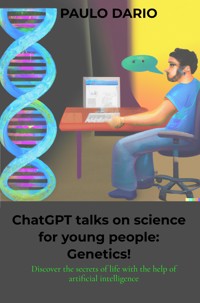
ChatGPT talks on science for young people: Genetics! Discover the secrets of life with the help of artificial intelligence
ChatGPT talks on science for young people: Genetics! Discover the secrets of life with the help of artificial intelligence
Paulo Dario
Author: Paulo Dario
Cover design: Paulo Dario
ISBN: 9789403712758
© Paulo Dario
Preamble
At a time when so much is being said about Artificial Intelligence (AI) chatbots and when they are increasingly being used to write texts in many areas of human activity, particularly for websites and online marketing tools, the question arose as to whether it would be possible to use these tools to create a science book... yes, a Genetics book! So this book follows a series of "conversations" with these tools, mainly with "chatGPT 4.0" but also with "Bard". It's well known that chatGPT is hampered in its research up to a certain point in time and, because they are language model tools, they end up inventing... a lot, especially in bibliographic references. However, accessory tools are emerging that make it possible to improve and even correct this situation, tools that will certainly become much more powerful in the future, but which are already a reality. So, using all these AI tools, a book has been created that aims to be a pedagogical tool that answers a series of questions that can be asked by secondary and higher education students, or even people who are just interested in these issues, but who don't have the access or predisposition to use these types of AI tools. The "human" author checked that the answers obtained were correct and that the works cited were true and appropriate to the problem in question. However, although this text can provide the reader with initial information and suggest other sources of reading, we suggest reading the textbooks used in the scientific disciplines under study or reading the books in the specialty. As a final note, it's important to point out that the book's cover was created by the AI software DALL-E, of course.
1. Introduction to Genetics
1.1. What is genetics and why is it important?
Genetics, in essence, is the study of genes, which are the hereditary units responsible for coding the physical and functional characteristics of organisms1. These genes are specific DNA sequences that provide the necessary instructions for the construction and maintenance of organisms. The science of genetics arose to study the transmission of physical characteristics from parents to their offspring1.
The importance of genetics is vast and multifaceted. Firstly, genetics has the power to provide insights into human biology, opening up new possibilities for therapies and disease prevention2. In addition, genetics is crucial to understanding how individual characteristics, such as athletic ability or predispositions to certain health conditions, are inherited. This information can be used to make more accurate diagnoses, offer genetic counseling and develop more effective treatments2.
However, genetics is not just limited to biology and medicine. It also has profound implications for society. For example, personal genetics serves as a site for public engagement with science, where communities of biological citizens interpret, debate and act on the basis of professional research3. In addition, the introduction of genes into new environments, the understanding of genetic disorder in inherited diseases and attempts at gene transplantation have made a limited contribution to human benefit, and these activities have profound ethical and social implications4.
Genetics education is essential to prepare society for the benefits and challenges of modern genetics5. Genetics has the potential to influence how we define family, how we make informed decisions about our health and how we interact with the world around us. It is therefore crucial that citizens and health professionals are properly educated in genetics in order to make the most of advances in this area and address the associated ethical and social implications6.
1.2. A brief history of genetics.
Genetics, as a formal science, has its roots in the pioneering work of Gregor Mendel, an Austrian monk who, in the 19th century, conducted experiments with peas and laid the foundations for genetic inheritance. However, the understanding of inheritance and genetic variability dates back to ancient times, with archaeological and genetic evidence suggesting that the first farmers in the Levant region played a crucial role in Europe's population history7.
With the advance of techniques and technologies, the 20th century saw an explosion of discoveries in genetics. The structure of DNA was elucidated by James Watson and Francis Crick in 1953, marking a milestone in the understanding of molecular genetics. Subsequent studies have revealed the complexity and diversity of the human genome and that of other species. For example, recent research has explored the genetic history of populations in regions such as Siberia and north-eastern Europe, revealing insights into ancient migrations and interactions between groups8.
Genetics has also played a crucial role in understanding the population history of various regions of the world. Genomic studies have provided insights into the demographic and migration history of populations, such as the Bene Israel of India, who have shown a substantial mix of Jewish and Indian ancestry9. In addition, genetics has helped to clarify the history of specific populations, such as the analysis of mitochondrial DNA in North Atlantic eels, highlighting the importance of life history in the genetic structuring of populations10.
In short, genetics has provided powerful tools to unravel the complex tapestry of human history and evolution. As technology advances, genetics will continue to play a crucial role in understanding our shared heritage and predicting our collective future.




