


47,99 €
Mehr erfahren.
- Herausgeber: John Wiley & Sons
- Kategorie: Wissenschaft und neue Technologien
- Sprache: Englisch
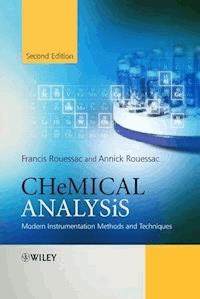
Completely revised and updated, Chemical Analysis: Second Edition is an essential introduction to a wide range of analytical techniques and instruments. Assuming little in the way of prior knowledge, this text carefully guides the reader through the more widely used and important techniques, whilst avoiding excessive technical detail.
- Provides a thorough introduction to a wide range of the most important and widely used instrumental techniques
- Maintains a careful balance between depth and breadth of coverage
- Includes examples, problems and their solutions
- Includes coverage of latest developments including supercritical fluid chromatography and capillary electrophoresis
Sie lesen das E-Book in den Legimi-Apps auf:
Seitenzahl: 830
Veröffentlichungsjahr: 2013
Ähnliche



















Contents
Foreword to the first English edition
Preface to the first English edition
Preface to second edition
Acknowledgments
Introduction
PART 1 SEPARATION METHODS
1 General aspects of chromatography
1.1 General concepts of analytical chromatography
1.2 The chromatogram
1.3 Gaussian-shaped elution peaks
1.4 The plate theory
1.5 Nernst partition coefficient (K)
1.6 Column efficiency
1.7 Retention parameters
1.8 Separation (or selectivity) factor between two solutes
1.9 Resolution factor between two peaks
1.10 The rate theory of chromatography
1.11 Optimization of a chromatographic analysis
1.12 Classification of chromatographic techniques
Problems
2 Gas chromatography
2.1 Components of a GC installation
2.2 Carrier gas and flow regulation
2.3 Sample introduction and the injection chamber
2.4 Thermostatically controlled oven
2.5 Columns
2.6 Stationary phases
2.7 Principal gas chromatographic detectors
2.8 Detectors providing structural data
2.9 Fast chromatography
2.10 Multi-dimensional chromatography
2.11 Retention indexes and stationary phase constants
Problems
3 High-performance liquid chromatography
3.1 The beginnings of HPLC
3.2 General concept of an HPLC system
3.3 Pumps and gradient elution
3.4 Injectors
3.5 Columns
3.6 Stationary phases
3.7 Chiral chromatography
3.8 Mobile phases
3.9 Paired-ion chromatography
3.10 Hydrophobic interaction chromatography
3.11 Principal detectors
3.12 Evolution and applications of HPLC
Problems
4 Ion chromatography
4.1 Basics of ion chromatography
4.2 Stationary phases
4.3 Mobile phases
4.4 Conductivity detectors
4.5 Ion suppressors
4.6 Principle and basic relationship
4.7 Areas of the peaks and data treatment software
4.8 External standard method
4.9 Internal standard method
4.10 Internal normalization method
Problems
5 Thin layer chromatography
5.1 Principle of TLC
5.2 Characteristics of TLC
5.3 Stationary phases
5.4 Separation and retention parameters
5.5 Quantitative TLC
Problems
6 Supercritical fluid chromatography
6.1 Supercritical fluids: a reminder
6.2 Supercritical fluids as mobile phases
6.3 Instrumentation in SFC
6.4 Comparison of SFC with HPLC and GC
6.5 SFC in chromatographic techniques
7 Size exclusion chromatography
7.1 Principle of SEC
7.2 Stationary and mobile phases
7.3 Calibration curves
7.4 Instrumentation
7.5 Applications of SEC
Problems
8 Capillary electrophoresis and electrochromatography
8.1 From zone electrophoresis to capillary electrophoresis
8.2 Electrophoretic mobility and electro-osmotic flow
8.3 Instrumentation
8.4 Electrophoretic techniques
8.5 Performance of CE
8.6 Capillary electrochromatography
Problems
PART 2 SPECTROSCOPIC METHODS
9 Ultraviolet and visible absorption spectroscopy
9.1 The UV/Vis spectral region and the origin of the absorptions
9.2 The UV/Vis spectrum
9.3 Electronic transitions of organic compounds
9.4 Chromophore groups
9.5 Solvent effects: solvatochromism
9.6 Fieser–Woodward rules
9.7 Instrumentation in the UV/Visible
9.8 UV/Vis spectrophotometers
9.9 Quantitative analysis: laws of molecular absorption
9.10 Methods in quantitative analysis
9.11 Analysis of a single analyte and purity control
9.12 Multicomponent analysis (MCA)
9.13 Methods of baseline correction
9.14 Relative error distribution due to instruments
9.15 Derivative spectrometry
9.16 Visual colorimetry by transmission or reflection
Problems
10 Infrared spectroscopy
10.1 The origin of light absorption in the infrared
10.2 Absorptions in the infrared
10.3 Rotational–vibrational bands in the mid-IR
10.4 Simplified model for vibrational interactions
10.5 Real compounds
10.6 Characteristic bands for organic compounds
10.7 Infrared spectrometers and analysers
10.8 Sources and detectors used in the mid-IR
10.9 Sample analysis techniques
10.10 Chemical imaging spectroscopy in the infrared
10.11 Archiving spectra
10.12 Comparison of spectra
10.13 Quantitative analysis
Problems
11 Fluorimetry and chemiluminescence
11.1 Fluorescence and phosphorescence
11.2 The origin of fluorescence
11.3 Relationship between fluorescence and concentration
11.4 Rayleigh scattering and Raman bands
11.5 Instrumentation
11.6 Applications
11.7 Time-resolved fluorimetry
11.8 Chemiluminescence
Problems
12 X-ray fluorescence spectrometry
12.1 Basic principles
12.2 The X-ray fluorescence spectrum
12.3 Excitation modes of elements in X-ray fluorescence
12.4 Detection of X-rays
12.5 Different types of instruments
12.6 Sample preparation
12.7 X-ray absorption – X-ray densimetry
12.8 Quantitative analysis by X-ray fluorescence
12.9 Applications of X-ray fluorescence
Problems
13 Atomic absorption and flame emission spectroscopy
13.1 The effect of temperature upon an element
13.2 Applications to modern instruments
13.3 Atomic absorption versus flame emission
13.4 Measurements by AAS or by FES
13.5 Basic instrumentation for AAS
13.6 Flame photometers
13.7 Correction of interfering absorptions
13.8 Physical and chemical interferences
13.9 Sensitivity and detection limits in AAS
Problems
14 Atomic emission spectroscopy
14.1 Optical emission spectroscopy (OES)
14.2 Principle of atomic emission analysis
14.3 Dissociation of the sample into atoms or ions
14.4 Dispersive systems and spectral lines
14.5 Simultaneous and sequential instruments
14.6 Performances
14.7 Applications of OES
Problems
15 Nuclear magnetic resonance spectroscopy
15.1 General introduction
15.2 Spin/magnetic field interaction for a nucleus
15.3 Nuclei that can be studied by NMR
15.5 Larmor frequency
15.6 Pulsed NMR
15.7 The processes of nuclear relaxation
15.8 Chemical shift
15.9 Measuring the chemical shift
15.10 Shielding and deshielding of the nuclei
15.11 Factors influencing chemical shifts
15.12 Hyperfine structure – spin–spin coupling
15.13 Heteronuclear coupling
15.14 Homonuclear coupling
15.15 Spin decoupling and particular pulse sequences
15.16 HPLC-NMR coupling
15.17 Fluorine and phosphorus NMR
15.18 Quantitative NMR
15.19 Analysers using pulsed NMR
Problems
PART 3 OTHER METHODS
16 Mass spectrometry
16.1 Basic principles
16.2 The magnetic-sector design
16.3 ‘EB’ or ‘BE’ geometry mass analysers
16.4 Time of flight analysers (TOF)
16.5 Quadrupole analysers
16.6 Quadrupole ion trap analysers
16.7 Ion cyclotron resonance analysers (ICRMS)
16.8 Mass spectrometer performances
16.9 Sample introduction
16.10 Major vacuum ionization techniques
16.11 Atmospheric pressure ionization (API)
16.12 Tandem mass spectrometry (MS/MS)
16.13 Ion detection
16.14 Identification by means of a spectral library
16.15 Analysis of the elementary composition of ions
16.16 Determination of molecular masses from multicharged ions
16.17 Determination of isotope ratios for an element
16.18 Fragmentation of organic ions
Problems
17 Labelling methods
17.1 The principle of labelling methodologies
17.2 Direct isotope dilution analysis with a radioactive label
17.3 Substoichiometric isotope dilution analysis
17.4 Radio immuno-assays (RIA)
17.5 Measuring radioisotope activity
17.6 Antigens and antibodies
17.7 Enzymatic-immunoassay (EIA)
17.8 Other immunoenzymatic techniques
17.9 Advantages and limitations of the ELISA test in chemistry
17.10 Immunofluorescence analysis (IFA)
17.11 Stable isotope labelling
17.12 Neutron activation analysis (NAA)
Problems
18 Elemental analysis
18.1 Particular analyses
18.2 Elemental organic microanalysis
18.3 Total nitrogen analysers (TN)
18.4 Total sulfur analysers
18.5 Total carbon analysers (TC, TIC and TOC)
18.6 Mercury analysers
Problems
19 Potentiometric methods
19.1 General principles
19.2 A particular ISE: the pH electrode
19.3 Other ion selective electrodes
19.4 Slope and calculations
19.5 Applications
Problems
20 Voltammetric and coulometric methods
20.1 General principles
20.2 The dropping-mercury electrode
20.3 Direct current polarography (DCP)
20.4 Diffusion current
20.5 Pulsed polarography
20.6 Amperometric detection in HPLC and HPCE
20.7 Amperometric sensors
20.8 Stripping voltammetry (SV)
20.9 Potentiostatic coulometry and amperometric coulometry
20.10 Coulometric titration of water by the Karl Fischer reaction
Problems
21 Sample preparation
21.1 The need for sample pretreatment
21.2 Solid phase extraction (SPE)
21.3 Immunoaffinity extraction
21.4 Microextraction procedures
21.5 Gas extraction on a cartridge or a disc
21.6 Headspace
21.7 Supercritical phase extraction (SPE)
21.8 Microwave reactors
21.9 On-line analysers
22 Basic statistical parameters
22.1 Mean value, accuracy of a collection of measurements
22.2 Variance and standard deviation
22.3 Random or indeterminate errors
22.4 Confidence interval of the mean
22.5 Comparison of results – parametric tests
22.6 Rejection criteria Q-test (or Dixon test)
22.7 Calibration curve and regression analysis
22.8 Robust methods or non-parametric tests
22.9 Optimization through the one-factor-at-a-time (OFAT) experimentation
Problems
Solutions
Appendix – List of acronyms
Bibliography
Table of some useful constants
Index
English language translation copyright © 2007 by John Wiley & Sons Ltd,
The Atrium, Southern Gate, Chichester, West Sussex PO19 8SQ, England
Telephone (+44) 1243 779777
Email (for orders and customer service enquiries): [email protected]
Visit our Home Page on www.wiley.com
Translated into English by Francis and Annick Rouessac and Steve Brooks
First Published in French © 1992 Masson
2nd Edition © 1994 Masson
3rd Edition © 1997 Masson
4th Edition © 1998 Dunod
5th Edition © 2000 Dunod
6th Edition © 2004 Dunod
This work has been published with the help of the French Ministère de la Culture-Centre National du Livre
All Rights Reserved. No part of this publication may be reproduced, stored in a retrieval system or transmitted in any form or by any means, electronic, mechanical, photocopying, recording, scanning or otherwise, except under the terms of the Copyright, Designs and Patents Act 1988 or under the terms of a licence issued by the Copyright Licensing Agency Ltd, 90 Tottenham Court Road, London W1T 4LP, UK, without the permission in writing of the Publisher. Requests to the Publisher should be addressed to the Permissions Department, John Wiley & Sons Ltd, The Atrium, Southern Gate, Chichester, West Sussex PO19 8SQ, England, or emailed to [email protected], or faxed to (+44) 1243 770571.
This publication is designed to provide accurate and authoritative information in regard to the subject matter covered. It is sold on the understanding that the Publisher is not engaged in rendering professional services. If professional advice or other expert assistance is required, the services of a competent professional should be sought.
Other Wiley Editorial Offices
John Wiley & Sons Inc., 111 River Street, Hoboken, NJ 07030, USA
Jossey-Bass, 989 Market Street, San Francisco, CA 94103-1741, USA
Wiley-VCH Verlag GmbH, Boschstr. 12, D-69469 Weinheim, Germany
John Wiley & Sons Australia Ltd, 33 Park Road, Milton, Queensland 4064, Australia
John Wiley & Sons (Asia) Pte Ltd, 2 Clementi Loop #02-01, Jin Xing Distripark, Singapore 129809
John Wiley & Sons Canada Ltd, 6045 Freemont Blvd, Mississauga, Ontario, L5R 4JE Canada
Wiley also publishes its books in a variety of electronic formats. Some content that appears in print may not be available in electronic books.
Anniversary Logo Design: Richard J. Pacifico
Library of Congress Cataloging in Publication Data
Rouessac, Francis.
[Analyse chimique. English]
Chemical analysis : modern instrumentation and methods and techniques / Francis Rouessac and Annick
Rouessac ; translated by Steve Brooks and Francis and Annick Rouessac. — 2nd ed.
p. cm.
Includes bibliographical references and index.
ISBN 978-0-470-85902-5 (cloth: alk. paper) — ISBN 978-0-470-85903-2 (pbk.: alk. paper)
1. Instrumental analysis. I. Rouessac, Annick. II. Title.
QD79.I5R6813 2007
543—dc22 2006036196
British Library Cataloguing in Publication Data
A catalogue record for this book is available from the British Library
ISBN 978-0-470-85902-5 (HB)
ISBN 978-0-470-85903-2 (PB)
Foreword to the first English edition
Instrumentation was, for a long time, rather crude by today’s standards: the furnace, the alembic, the separatory funnel, the filter, the balance … Crude, and cheap. Today, no modern analytical laboratory is without M$ investments in optical, mass and NMR spectrometers, in high performance chromatographs, in electro-analytical equipment.
But also, how heavy the responsibility resting on the shoulders of the analytical chemist! He is the one who in the first place is responsible for the forced closing of a dioxin-delinquent waste incineration plant, for the approval of a new non-persistent pesticide, for the demotion of an athlete from his Olympic title for having used illegal drugs, for the identification of a criminal by the traces of gunpowder on his hands, for the quantification of environmental contaminants, for the detection of diabetes or of poisoning, for the establishment and the enforcement of standards used in World trade … The analyst, with his power to say ‘yes’ or ‘no’, is one of the most influential of our contemporaries!
There are many books on analytical chemistry, but there were very few, and rather old ones, in French, until F. and A. Rouessac published the first French edition of the present book, eight years ago: they had a niche to fill. Four successive editions have confirmed that they had filled it well: their book was simple, highly informative, and it was kept up-to-date. Through its successive improvements, it has become mature for translation. I am sure the present English version, for which I see no equivalent, will now be useful world-wide to students, as well as to professionals. Fare well, Rouessac & Rouessac!
14 February 2000Guy OurissonPresident of the French Academy of Sciences
Preface to the first English edition
The book entitled Analyse Chimique. Methodes et techniques instrumentals modernes, written originally in French by Professor F. Rouessac and his wife A. Rouessac, has been revised several times and is now in its 4th edition. It is an ongoing project that provides updated versions and increases the usefulness of the manuscript.
The purpose of the work has been to provide basic information on methods of chemical analysis and new instrumentation techniques that have been developed and improved in recent years. Its objective is to provide the analyst with a reference manual while providing students with a teaching tool that covers the basics of most instrumental techniques presently used in chemical analysis. It incorporates basic principles, describes commonly used instruments and discusses the main application for most of the analytical techniques.
The book classifies methods of analysis according to three categories: separation techniques, spectroscopy techniques and other methods. It was written for undergraduate students in chemistry but with the view that it may be of interest for students in other disciplines (physics, biology, etc.) where chemical methods of analysis and instrumental techniques are used. Thus, it provides sufficient information to understand the techniques and their application and allows students to find additional information in more advanced works that discuss specialised instrumental techniques in more detail.
Professor Rouessac gathered the material presented in this book during his teaching career at the University of Le Mans and he has made an effort to integrate theory and practice in a remarkable way. The chapters contain detailed descriptions of instruments and techniques with a few applied examples that are useful to appreciate the scope of the techniques as well as their strengths and limitations in the applied world. The philosophy behind the manuscript is to show that although analytical chemistry and chemical analysis are sometimes considered as different topics, they are inherently intertwined.
Over the years, we have seen a tremendous evolution in chemical analysis. Because of developments in electronics and computer sciences, many new approaches have been developed based on physical measurements and these approaches are now widely used. Nowadays, there is a legion of instrumentation techniques that are more sensitive, more selective and can be applied to analytical problems in many areas of science where the structure determination and quantisation of chemical species is needed. For example, physical methods of chemical analysis are being used overwhelmingly in the biological sciences. Moreover, the combination of two or more instrumentation analysis techniques had led to the introduction of hyphenated methods that are extremely powerful and require the basic knowledge of the underlying principles. This manuscript provides the essential knowledge for the understanding of these techniques and opens the door to their areas of applications. It also treats some older techniques that maintain their important place in industrial processes. It has been a pleasure for us to translate Professor Rouessac’s work. Although we have been able to translate the technical material relatively precisely, there is a flavour of expression used by the authors in their native language that cannot be transposed, as is usually the case with translations. In spite of this limitation, we believe that the content of this book will be extremely useful to readers that are seeking knowledge and information on chemical analysis and analytical instrumentation.
Michel J. Bertrand, ProfessorKaren C. Waldron, Assistant ProfessorDepartment of ChemistryUniversité de MontréalSeptember 1999
Preface to second edition
This textbook presents an explanatory and exploratory review of the basic concepts behind the methodologies most frequently encountered in the qualitative, quantitative and structural chemical analysis employed in sectors as diverse as the chemical, pharmaceutical, food and agricultural industries as well as those areas of the environment subjected to stringent controls.
The techniques under review have been classed into one of the following three categories: Separative Methods, Spectral Methods and Other Methods, each of which is the object of an investigative study of the fundamental ideas, their extension, development and application to the corresponding principal, instrumental techniques. Each chapter is illustrated by photographs, numerous diagrams and schemes of chemical reactions or technical principles many of which have been inspired by real instruments and documents obtained from the constructors. However, in order that the book be contained within a reasonable volume, those methods rarely used, or currently in regression are not discussed.
Written and presented as comprehensively as possible, the text addresses a broad spectrum of techniques relevant to a wide range of subjects in chemistry, physics and applied biology and will prove appropriate for students of pre-university, undergraduate and postgraduate levels. Specialist technicians in university support, research and industrial training services will equally find this book useful. The current needs of certain professional sectors in chemical analysis, some of which may appear to have been neglected, linked with the increasing choice of techniques and instruments available, equally justify this compendium of information which updates and unifies several previously available texts.
Though aimed at an otherwise broad readership, this book has been principally designed to engage the interest of students of chemical analysis and to harness their appreciation of the subject as a particular tool employed in a great many experimental sciences and a variety of associated domains.
The authors have included reminders of fundamental principles and have taken account of the evolution of knowledge and the developments in approaches to physical and mathematical phenomena. The text contains only a minimum of theory in order not to lose the attention of the broader readership whose interest is preferential for the technical content. Those readers so wishing may undertake the reading of the more specialised œuvres without major difficulty, having acquired from this book a suitable introduction to both the current methods and practical aspects.
The content also reflects the profound changes in analytical techniques currently employed in laboratories. The inherent changes resulting from the growth in demand, the now quite necessary volume of data to be treated, from computerisation and the new requirements most notably in trace analysis.
Comprising a discussion of more than twenty methods, which bearing in mind the large number of applications for each capable of being the subject of a lengthy review, along with the addition of individual exercises, (problems and solutions) and the whole delivered in less than 580 pages, the authors have responded to a considerable challenge. They have preferred a format limited to the presentation of the tools themselves rather than to descriptions of all that their use permits them to do. The choice of applications has therefore been simplified to those which express an illustrative value.
The origin of this book has been the coursework, accumulated over a number of years, which has been presented to the students of the Institute of Technology at the University of Le Mans, France. Colleagues and friends have given graciously of their time for both the re-reading of the text and for critical suggestions. This version of Chemical Analysis is the 2nd International Edition and has been updated and completed with respect to its predecessor. The fifth edition of this book has equally been translated into Spanish. The title is Anàlisis Quimico. Methodos y Técnicas Instrumentales Modernas, McGraw-Hill Interamerica de Espana, S.A.U.
F. & A. RouessacLe Mans, December 2005
Acknowledgments
We are very pleased that the 2nd English edition of Analyse Chimique has been published. The authors wish to thank professors Karen Waldron and Michel Bertrand of the University of Montreal for the very hard work they did in translating the manuscript that was used for the first English edition (John Wiley, 2000). The present text leans on this translation, a large part of it being kept.
We also acknowledge Dr Steve Brooks of the Institut de Génétique et de Biologie Moléculaire et Cellulaire in Strasbourg, who translated the text of the French 5th edition. Finally, we have reworked all the chapters and included improved drawings into the text.
The authors also wish to express their gratitude to Professor Guy Ourisson, former President of the French Académie des Sciences, who in agreeing to write a forward for previous editions of this book, bestowed upon it a great honour. Sadly Professor Ourission passed away in November 2006.
Our special thanks also to the staff of John Wiley & Sons, Ltd (Chichester). We are especially indebted to the following for their kind assistance: Andy Slade, Robert Hambrook, Elizabeth Kingston, Alison Woodhouse (freelance copy-editor) and also Sunita Jayachandran of Integra Ltd (India) for producing a book of pleasing appearance. Those we have inadvertently missed have our sincere apologies.
Below is a list of the companies that have graciously agreed to provide us with both information and documents, certain of which have been reproduced within the text. Their assistance has been particularly precious in view of the speed of technological progress in the sector of analytical instrumentation.
Agilent Technologies, Alltech Associates Inc, American gas & Chemical Co., American Stress Technologies, Amptek Inc, Analytical Instruments, Anotec, Antek, Arelco, ARL, Asoma, ATI Unicam, ATMI Sensoric Div., ATS, Aurora, Beckman Coulter Inc, Berger Mettler Toledo, Bio-Rad, Bosch, Bruker, BW Technologies, Camag, Carbone-Lorraine, Chrompack, Ciba, CTTM, Daiiso Company, Desaga, Dionex, DuPont, Edinburgh sensors, EG&G-ORTEC, ETP Scientific, Eurolabo, Finnigan, Fisons-Instruments, Foxboro, Galileo, Genesis Lab Syst. Inc., Gilson, Grasby-Electronics, Hamamatsu, Hamilton, Imaging Sensing Technology, Jeol, Jenway, Jobin-Yvon, Jordan Valley, Labsystems, LaMotte Co., Leeman Labs., Leybolds, Merck, Mercury Instr. USA, Metorex, Metrohm, Mettler-Toledo, Microsaic System, Microsensor Technology, Nicolet, Niton, Ocean-optics, Oriel, Ortec, Oxford Instruments, Perkin-Elmer, PESciex, Pharmacia-Biotech, Philips, Photovac, Polymer Lab., PS Analytical, PSS, Rheodyne, RTI, Scientec, Scientific Glass Company, SensIR, Servomex, SGE Europe Ltd, Shimadzu, Siemens, Skalar, SMIS, Spectra Tech, Supelco, Tekmar, Teledyne, Thermo Electron Corp., Thermo-Optek, Thermo-Quest, Thermo Jarrell Ash, Tosohaas, Varian Inc, VG Instruments, Vydac, Waters Corp, Wilmad, Wyatt Technology.
Annick and Francis Rouessac
Introduction
Analytical chemistry is a science close to physical chemistry, which is a branch of pure chemistry. The objective of analytical chemistry is essentially to develop and apply new methodology and instrumentation with the goal of providing information on the nature and composition of matter. Analytical chemistry also allows the determination of a compound’s structure, either partially or totally, in samples of differing complexity. Finally, part of the role of analytical chemistry is to provide an interpretation of the results obtained.
From a more applied point of view, analytical chemistry is the basis of chemical analysis, which corresponds to the study of the methods and their diverse techniques designed to solve the concrete problems of analysis. The term chemistry is a reminder that analytical chemistry involves the analysis of chemical elements and the defined compounds derived from these.
The vast discipline of analytical chemistry has implications in all experimental sciences. Its study requires knowledge of many different areas. As a multidisciplinary science, also sometimes referred to as transferable, analytical chemistry calls upon many phenomena, certain of which quite distant from chemistry in the usual sense of the term, in order to provide results. Thus, modern chemical analysis is based on physico-chemical measurements obtained through the use of a variety of instruments, which have greatly benefited from the appearance of microcomputers.
Gradually a tremendous arsenal of processes has been developed, allowing the analyst to respond to an increasing number of various demands. Furthermore, the study of modern chemical analysis techniques is far removed from traditional descriptive chemistry. Many analyses are conducted in non-specialized environments, either on site or at simple workbenches. The determination of compounds is currently quite remote from the use of chemical reactions, which are often avoided for many reasons.
Former wet chemistry methods, at the origin of the term analytical chemistry, have become less important because they are labour intensive, require large samples due to their lack of sensitivity, are lengthy and their precision can too easily be altered by the use of insufficiently pure reagents. Nonetheless, wet chemistry methods are still interesting to study.
Analytical chemistry has become indispensable in a number of areas beyond those considered traditional such as chemistry or parachemistry, being increasingly present in activities closely associated with mankind such as applications in medical sciences (diagnostics), biochemistry, food sciences, environmental sciences (pollution), security in a world often dangerous and in numerous industrial sectors. Analytical chemistry is no longer confined to chemistry. For example, development of regulations in countries regarding the free circulation of products and the agency in charge of environmental protection both require a great number of analyses; evidence that analytical chemistry will assuredly have a privileged position in the future.
More than ever, analytical chemistry is a lively discipline with applied research, specialized journals and many international events (Pittsburgh Conference, Salon du Laboratoire, Analytica, etc.) attended by internationally recognized manufacturers.
One way of determining the importance of a technique is to examine the economic statistics related to the sale of corresponding instruments. The diffusion of a technique increases the probability that an analyst will encounter it during his professional career. For example, chromatographic techniques alone represent more than half of the sales of instruments for molecular analysis, as opposed to elemental analysis which is half of this. However, the latter domain is far from static, other emerging sectors of analysis or novel, alternative methods are being developed and will no doubt come to the prominence. Elsewhere, economic indicators are not the only factor taken into account when assigning the importance of a method. For certain analyses, even a rarely used method can be the most important if it represents the only available means of solving a problem.
Chemical analysis is the proof of many innovations: the evolution of technologies has led to the development of high-performance instruments bringing newer and broader possibilities, notably hyphenated methods and non-destructive methods. Non-destructive tests can be conducted on very small samples that do not necessitate extensive sample preparation prior to the measurement. Users can finally acquire instruments that meet the quality and precision requirements necessary for attaining certification. This latter requirement an important step in the official recognition of the quality of the laboratory. Certification procedures are enforced by a number of test compounds all over the world.
Being an analyst requires scientific competence, austerity and honesty. To undertake these kinds of study the analyst must be well trained in different techniques. She/He must be expert and aware of the basic concepts of chemistry realising that a compound might be analysed by alternate methods. Selecting the appropriate method and if possible the best requires knowledge of many parameters. A whole range of questions come up, not necessarily in the following order:
The sample is of what kind (steel, soil, water…)?
Does it require a partial or complete analysis of the sample?
Is the analyte a major component (1 to 100 per cent), minor component (0.01 to 1 per cent) or trace level component (less than 0.01 per cent) of the sample?
Are qualified personnel available to conduct the analysis?
Must the analysis be repetitive?
What is the precision needed?
What is the cost of analysis?
Must the sample be recovered after measurement?
What are the consequences of a possible error in measurement?
How long will the analysis take?
What will the reliability of the results be for the method chosen?
As demonstrated by the questions above, when a new analytical objective has been defined, the problem must be approached methodically. The science called chemometrics is aimed at helping to find the best method required for solving an analytical problem as a function of imposed constraints and according to three different directions: methodology, data treatment and interpretation of results.
Taking into account the nature of the analyte to be determined, the starting point consists of choosing a method of analysis: the spectroscopic method, electrochemical method, separation method, etc.
The second step concerns that of choosing a technique. For example, if chromatography has been chosen as the method, will gas-phase or liquid-phase chromatography be better?
The third decision to make concerns the choice of sample procedure and the sample preparation method that will be required to obtain a good result.
As far as experimental protocol is concerned, this will correspond to the mode of operation chosen. This is effectively the ‘recipe of the measurement’, generally a procedure working within existing norms (AFNOR). This normalization is based upon the standardization of the steps at each stage of analysis from sample preparation to experimental measurement.
Finally, the results are presented and the raw data from analysis is archived, if possible, as non-rewritable computer files. All of these important aspects of an analysis can be found in official texts under the heading Good Laboratory Practice or GLP.
In order that the most appropriate method is selected for an analysis there exists a science called chemiometrics which has the aim of assisting and advising the analyst, as a function of the imperatives required and according to several orientations: appropriate methodology, minimum sampling plan, treatment of the data and interpretation of the results. By use of computerized instruments a correct response can be proposed through exploitation of the results by means of statistical methods in order to reduce the number of lengthy or costly analytical trials.
In conclusion, analytical chemistry includes both chemical analysis and chemiometry. Chemical analysis has the aim of producing results, generally quantitative (concentrations) while chemiometrics applies mathematical methods based on formal logic to extract chemically information from chemical data.
PART 1
Separation methods
The invention of chromatography
Who invented chromatography, one of the most widely used laboratory techniques? This question leads to controversies. In the 1850s, Schönbein used filter paper to partially separate substances in solution. He found that not all solutions reach the same height when set to rise in filter paper. Goppelsröder (in Switzerland) found relations between the height to which a solution climbs in paper and its chemical composition. In 1861 he wrote ‘I am convinced that this method will prove to be very practical for the rapid determination of the nature of a mixture of dyes, especially if appropriately chosen and characterised reagents are used’.
Even if both of them did valuable work towards the progress of paper chromatography, it is traditional to assign the invention of modern chromatography to Michael S. Tswett, shortly after 1900. Through his successive publications, one can indeed reconstitute his thought processes, which makes of him a pioneer, even if not the inventor, of this significant separative method. His field of research was involved with the biochemistry of plants. At that time one could extract chlorophyll and other pigments from house plants, usually from the leaves, easily with ethanol. By evaporating this solvent, there remained a blackish extract which could be redissolved in many other solvents and in particular in petroleum ether (now one would say polar or non-polar solvents). However, it was not well understood why this last solvent was unable to directly extract chlorophyll from the leaves. Tswett put forth the assumption that in plants chlorophyll was retained by some molecular forces binding on the leaf substrate, thus preventing extraction by petroleum ether. He foresaw the principle of adsorption here. After drawing this conclusion, and to test this assumption he had the idea to dissolve the pigment extract in petroleum ether and to add filter paper (cellulose), as a substitute for leaf tissue. He realized that paper collected the colour and that by adding ethanol to the mixture one could re-extract these same pigments.
As a continuation of his work, he decided to carry out systematic tests with all kinds of powders (organic or inorganic), which he could spread out. To save time he had carried out an assembly which enabled him to do several assays simultaneously. He placed the packed powders to be tested in the narrow tubes and he added to each one of them a solution of the pigments in petroleum ether. That enabled him to observe that in certain tubes the powders produced superimposed rings of different colours, which testified that the force of retention varied with the nature of the pigments present. By rinsing the columns with a selection of suitable solvents he could collect some of these components separately. Modern chromatography had been born. A little later, in 1906, then he wrote the publication (appeared in Berichte des Deutschen Botanische Gesellshaft,24, 384), in which he wrote the paragraph generally quoted: ‘Like light rays in the spectrum, the different components of a pigment mixture, obeying a law, are resolved on the calcium carbonate column and then can be measured qualitatively and quantitatively. I call such a preparation a chromatogram and the corresponding method the chromatographic method.’
1
General aspects of chromatography
Chromatography, the process by which the components of a mixture can be separated, has become one of the primary analytical methods for the identification and quantification of compounds in the gaseous or liquid state. The basic principle is based on the concentration equilibrium of the components of interest, between two immiscible phases. One is called the stationary phase, because it is immobilized within a column or fixed upon a support, while the second, called the mobile phase, is forced through the first. The phases are chosen such that components of the sample have differing solubilities in each phase. The differential migration of compounds lead to their separation. Of all the instrumental analytical techniques this hydrodynamic procedure is the one with the broadest application. Chromatography occupies a dominant position that all laboratories involved in molecular analysis can confirm.
1.1 General concepts of analytical chromatography
Chromatography is a physico-chemical method of separation of components within mixtures, liquid or gaseous, in the same vein as distillation, crystallization, or the fractionated extraction. The applications of this procedure are therefore numerous since many of heterogeneous mixtures, or those in solid form, can be dissolved by a suitable solvent (which becomes, of course, a supplementary component of the mixture).
A basic chromatographic process may be described as follows (Figure 1.1):
Figure 1.1A basic experiment in chromatography. (a) The necessary ingredients (C, column; SP, stationary phase; MP, mobile phase; and S, sample); (b) introduction of the sample; (c) start of elution; (d) recovery of the products following separation.
This basic procedure, carried out in a column, has been used since its discovery on a large scale for the separation or purification of numerous compounds (), but it has also progressed into a stand-alone , particularly once the idea of measuring the migration times of the different compounds as a mean to identify them had been conceived, without the need for their collection. To do that, an optical device was placed at the column exit, which indicated the variation of the composition of the eluting phase with time. This form of chromatography, whose goal is not simply to recover the components but to control their migration, first appeared around 1940 though its development since has been relatively slow.
Lesen Sie weiter in der vollständigen Ausgabe!
Lesen Sie weiter in der vollständigen Ausgabe!
Lesen Sie weiter in der vollständigen Ausgabe!
Lesen Sie weiter in der vollständigen Ausgabe!
Lesen Sie weiter in der vollständigen Ausgabe!
Lesen Sie weiter in der vollständigen Ausgabe!
Lesen Sie weiter in der vollständigen Ausgabe!
Lesen Sie weiter in der vollständigen Ausgabe!
Lesen Sie weiter in der vollständigen Ausgabe!
Lesen Sie weiter in der vollständigen Ausgabe!
Lesen Sie weiter in der vollständigen Ausgabe!
Lesen Sie weiter in der vollständigen Ausgabe!
Lesen Sie weiter in der vollständigen Ausgabe!
Lesen Sie weiter in der vollständigen Ausgabe!
Lesen Sie weiter in der vollständigen Ausgabe!
Lesen Sie weiter in der vollständigen Ausgabe!
Lesen Sie weiter in der vollständigen Ausgabe!
Lesen Sie weiter in der vollständigen Ausgabe!
Lesen Sie weiter in der vollständigen Ausgabe!
Lesen Sie weiter in der vollständigen Ausgabe!
Lesen Sie weiter in der vollständigen Ausgabe!
Lesen Sie weiter in der vollständigen Ausgabe!
Lesen Sie weiter in der vollständigen Ausgabe!
Lesen Sie weiter in der vollständigen Ausgabe!
Lesen Sie weiter in der vollständigen Ausgabe!
Lesen Sie weiter in der vollständigen Ausgabe!
Lesen Sie weiter in der vollständigen Ausgabe!
Lesen Sie weiter in der vollständigen Ausgabe!




