


6,99 €
Mehr erfahren.
- Herausgeber: Darf Publishers
- Kategorie: Gesellschafts- und Liebesromane
- Sprache: Englisch
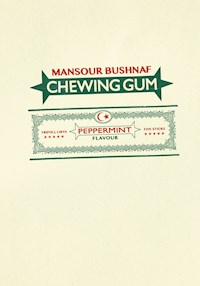
With its satirical and semi-journalistic style, Chewing Gum is an existential quest to understand how a society exists beneath a repressive dictatorship. The rhythmic act of chewing relentlessly continues as individuals, time and land turn to waste. In this debut novel, no one escapes the critical gaze of a writer who witnessed first-hand the brutality of Gaddafi's regime. At times downright funny and at times poignantly sad, Chewing Gum depicts the academics, politicians and businessmen of Libya who all claim a monopoly on the truth of the country.
Das E-Book können Sie in Legimi-Apps oder einer beliebigen App lesen, die das folgende Format unterstützen:
Seitenzahl: 113
Veröffentlichungsjahr: 2014
Ähnliche




















CHEWING GUM
Mansour Bushnaf is a playwright, novelist and essayist, born in Libya, 1954. He was imprisoned for ten years in the early 1970s because of his political activism and critical writings and is renowned for his award-winning satirical plays. Chewing Gum is his first novel. He lives and works in Tripoli.
Published by DARF Publishers 2014
Copyright © Mansour Bushnaf
Mansour Bushnaf has asserted his right under the Copyright,Designs and Patents Act 1988 to be identified asthe author of this work
This book is sold subject to the condition that it shall not, byway of trade or otherwise, be lent, resold, hired out, or otherwisecirculated without the publisher’s prior consent in any form ofbinding or cover other than that in which it is published andwithout a similar condition, including this condition,being imposed on the subsequent purchaser.
Translated by Mona Zaki
Cover Design by Luke Pajak
First published in Great Britain in 2014by DARF Publishers LTD277 West End Lane, London, NW6 1QS
www.darfpublishers.co.uk
eBook ISBN 9781850772767
Printed and bound in Turkey
Typeset by Corporate Translations Limited - UKwww.corporatetranslations.co.uk
CHEWING GUM
by
Mansour Bushnaf
DARF PUBLISHERSLONDON
Table of Contents
The Beginning to Our Story
‘I Chew Her and She Chews Me’
The Story
The Statue 2
The Park 2
The Father 2
Rahma
The Hero 2
Another Beginning to Our Story
The Statue
The Park
The Father
The Story of Our Heroine
Our Hero
The Night Mirage
The Gum
The Beginning to Our Story
Our hero looked on as our heroine walked away in the rain, wrapped in her black coat and red shawl. Ten years went by before he was able to whisper into her ear again, ten years during which he remained standing in the exact spot where she had left him in the park, enduring his terrible suffering. Days went by, then months, and years. He waited in the rain while she walked on, hoping she would stop, turn and run back. Her red shawl fluttered gently as she headed towards the sunset, revealing her black shoulder-length hair.
At first, passersby gazed at him with consternation and lovers were startled to discover him rooted a few feet away from them. However, in time he became part of the park, indistinguishable from the tree that shaded him all those years. Children played, lovers whispered, drug dealers shook hands, prostitutes made their rounds, conspiracies were hatched, assassinations, kidnappings and rapes were carried out not far from where he stood. Yet he was conscious of nothing except her retreating, shrouded in a black coat and red shawl. His hair grew, as did his beard. His clothes became tattered, his family and friends abandoned him and the city lost track of him. He became a forgotten feature of a neglected park.
Meanwhile, Libya fell into the grip of chewing gum mania. In pursuit of this latest craze, citizens applied for passports, purchased dollars on the black market and queued up in front of airline offices, desperate to travel overseas so as to bring back the precious commodity. Gum became the rage almost overnight. Mothers listed it in their daughters’ dowries and a class of smugglers mushroomed to meet the increasing demand. Such illicit activity was necessary, for commerce was deemed an illegal act, akin to smuggling, and punishable by law. In the local market, currencies rose and fell against the stable value of the gum, whose traders elevated its worth to the status of a bond. Secret study groups conducted passionate debates on the craze, its profitability, and its physical benefits. To counter this, television programmes, newspapers and even government loudspeakers tirelessly proclaimed that gum, like shampoo, was an imperialist ploy designed to destabilize the national economy, all of which fell on deaf ears.
Chewing gum acquired a philosophical dimension with the return of a professor from France, who had obtained a PhD there with a thesis on Sartre. While in France, this man had discovered a startling similarity he shared with the Gallic philosopher: they both had chameleon-like eyes. In what his followers dubbed ‘incendiary articles’, the Professor of Philosophy called the chewing gum craze ‘a mania for the existential gum’. In debates, leftists and rightists argued the finer points of the issue. The former were of the opinion that teeth were a metaphor for the human race while gum represented time, whereas the pessimistic rightists, or ‘nihilists’ as the leftists called them, upheld the view that the gum stood for human existence, while the teeth were eternity and the act of mastication a motion that would continue ad infinitum.
Our hero had nothing to do with philosophy or gum. He was an abandoned lover, standing beside a tree in a neglected park, unable to see anything but his beloved as she walked away in the rain, her black hair and red shawl fluttering gently in the wind. If it had not been for a pair of lovers from the Philosophy Department, then his presence would have remained undiscovered. They had come upon him by chance. The boy had chucked his copy of Being and Nothingness at him, causing hundreds of flies to swarm up, their buzzing increasing as the girl threw her copy of The Flies into the fray. Eventually the flies settled back onto the face of our abandoned hero. Thus, he was discovered by the brooding world of philosophy. If not for those two lovers, he would have remained a necessary philosophical ideal, for no one could grasp his existence or meaning and, naturally, his own existence couldn’t grasp that of chewing gum.
At the time he wrote his articles, the Professor of Philosophy was, to our hero’s good fortune, endorsing the rightist side of the debate. He rushed to the scene to examine this philosophical specimen and concluded that our hero supported his premise with regard to the tumultuousness of the human condition. The Professor of Philosophy delivered his truth as though he were a Buddha among his disciples. He circled his specimen seven times in a state of disgust and ecstasy, myopically observing the rubbish strewn all over the ground and the clear sky above. Pointing to his specimen, he exclaimed, ‘Students! Write this down in your notebooks! Chewing is infinite!’ The girl wept and the boy experienced an overwhelming desire to kill himself. The Professor of Philosophy left the scene with his head bowed in thought, contemplating the sky with one eye and willfully ignoring the rubbish with the other.
Not long after she disappeared into the rain, abandoning our hero beneath the tree, our heroine succumbed to the gum-chewing fad. She returned home every day with a fresh stash of gum. After locking the door, taking a bath and rubbing fragrant oils into her body, she would lie down on her bed to savour the gum. It became her most pleasurable pastime. She would slowly remove its enticing wrapper and, with a delicious shiver of anticipation, slide it through her lips as her tongue slowly licked its sweet sugary coating. She would carefully bite into it before chewing slowly and luxuriously. This private ritual allowed her to experience the mimesis of eternal repetition. She alternated libidinously between lemon, mint, apple and any of the new flavours that came onto the market. The act of mastication affirmed her femininity and offered her an intense sense of fulfillment.
Acquiring the gum was undoubtedly a challenge. She found herself in contact with people she would never otherwise have known. The scarcity of gum drove her into the arms of fixers, flight attendants, pilots, businessmen, security personnel, officers in the National Guard and numerous others. All for the sake of gum.
Another Beginning to Our Story
If my memory doesn’t fail me, it started in the park. Our heroine, Fatma, stares into space. She comes from a middle class family and is studying sociology at the university. Our hero, Mukhtar, is from an established upper-class family, that enjoyed all the ease and prestige brought by power and wealth. His father is a high-ranking officer in the Royal Police Force. They sit in silence. He stretches his long legs as she hunches further into the red bench. He doesn’t say a word and she doesn’t leave. He can tell she belongs to a common family, an easy catch. His proximity causes her great anguish, as the attentions of affluent young men often do.
She gets up. He stands and gazes into her eyes in search of that glimmer of interest that girls often try to hide by averting their eyes. As he continues to stare into her eyes, Fatma doesn’t fully turn her gaze away. Despite the absence of obvious interest, her deep black eyes and her un-coquettish behaviour captivate him. She takes a step back and he takes one forward. The dance fascinates him. She is short. In fact, everything about her is small. In some ways, she appears no older than a school girl. He longs to bury his face in her neck and hair. But her steady gaze causes him to hesitate. Unyieldingly, she continues to follow his eyes as they attempt to decipher any sign of secret longings.
He realizes that although she comes from one of those middle-class families that have, as his father would say, roamed the earth since the beginning of time, she was not an easy catch. Boys from his background assumed that sexual success was a God-given privilege. Her reticence makes her unattainable and therefore desirable. He fantasizes about her rushing towards him, her rich black hair flying around her smiling face while he, on his knees, extends his arms to hold her small body and bury his face in her neck and hair.
But, in the coming days, as they get to know one other, all these fantasies come to a stop. She keeps him at arm’s length, shaking his hand as she would a stranger’s. If only her small palm would indicate her formidable resilience was nearing collapse!
She stands her ground. The image of her hair billowing as she runs forever towards him, plays again and again in his mind. He waits to meet her every day under the shade of the Dakheliyyah Arches. In summer, the genius of its Italian architect shields him from the powerful desert sun, while in winter it protects him from Tripoli’s erratic downpours. His fascination with her leads to an interest in the architecture around him. She would take him to the park. He would take her to the museum where they could enjoy some privacy behind its large Roman statues. He would try in vain to embrace her, but she would push him away and move nimbly amongst the figures of stone, away from his futile attempts to snatch a kiss, chattering on about social mobility and demonstrating her capacity for regurgitating university lectures.
At this point, Mukhtar found himself face to face with the statue that would mark a turning point in his life. Carved in the nineteenth century, it lay neglected against a wall in the Red Palace Museum. The statue is of a woman, her head thrown back, her eyes closed and her lips pursed as if waiting for a kiss. In our hero’s eyes, this stone woman is the most lifelike sculpture in the museum, the entire city even. It was only a matter of time before his feet found their way to that statue. In its presence, he experienced an epiphany, which affected him more deeply than he could ever have imagined.
The Statue
The statue’s story is one of pain and longing. It was carved by an Italian prisoner, whom the Pasha of Tripoli had kept in his dungeons for many years. The Italians ignored his work, as did the British, the Royalists and the Revolutionaries. The Italians were in search of military glory in Libya, and the British were uninterested in the historical legacy of a burdensome country they were only too happy to hand over to the Senussis, who, in turn, proclaimed all statues and statue makers as fodder for Gehenna. Had it not been for an agreement they’d reached with the Italians, they would have demolished every statue in the city immediately after Independence. Meanwhile, the Revolutionaries were torn between a hatred of imperialist Rome and its idols and an understanding of the importance of statues as representations of the glorious achievements of the Arab nation. They were both for and against statues. Roman sculptures were idolatrous, but Phoenician and modern Arab sculptures were high art.




