


0,49 €
Mehr erfahren.
- Herausgeber: e-artnow
- Kategorie: Religion und Spiritualität
- Sprache: Englisch
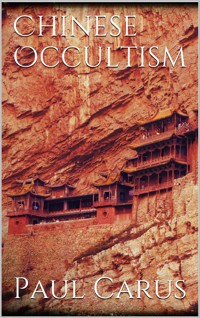
"Chinese Occultism" by Paul Carus explores various aspects of occult practices and beliefs in China, shedding light on the mystical and esoteric traditions within Chinese culture. Carus delves into a wide range of topics related to Chinese occultism, including divination, magic, spiritualism, talismans, astrology, alchemy, and the exploration of supernatural realms. He draws from a combination of historical accounts, traditional Chinese texts, and personal observations to provide insights into the fascinating world of Chinese occult practices. The book examines the philosophical and religious foundations that underpin Chinese occultism, discussing the influence of Taoism, Confucianism, Buddhism, and folk beliefs.
Das E-Book können Sie in Legimi-Apps oder einer beliebigen App lesen, die das folgende Format unterstützen:
Veröffentlichungsjahr: 2023
Ähnliche

Chinese Occultism
Table of Contents
CHINESE OCCULTISM.
Belief in mysterious agencies characterises a certain period in the religious development of every nation. Even the Jews, distinguished among the Semites by their soberness, consulted Yahveh through the Urim and Thummim, an oracle the nature of which is no longer definitely known. Kindred institutions among most nations are based upon primitive animism, or a belief in spirits, but in China we have a very peculiar mixture of logical clearness with fanciful superstitions. Chinese occultism is based upon a rational, nay a philosophical, or even mathematical, conception of existence. An original rationalism has here engendered a most luxurious growth of mysticism, and so the influence of occultism upon the people of the Middle Kingdom has been prolonged beyond measure.
THE YIH SYSTEM.
Among the ancient traditions of China there is a unique system of symbols called the yih (), i.e., "permutations" or "changes,"
THE TWO PRIMARY FORMS * (LIANG I).
* It is difficult to translate the term Liang I. One might call the two I "elements," if that word were not used in another sense. The two I are commonly referred to as "Elementary Forms" or "Primary Forms." De Groot speaks of them as "Regulators."
which consists of all possible combinations of two elements, called liang i (), i.e., the two elementary forms, which are the negative principle, yin (), and the positive principle, yang (). The four possible configurations of yang and yin in groups of two are called ssu shiang (), i.e., "the four [secondary] figures"; all further combinations of the elementary forms into groups of three or more are called kwa (). In English, groups of three elementary forms are commonly called trigrams, and groups of six, hexagrams.
The book in which the permutations of yang and yin are recorded, was raised in ancient times to the dignity of a canonical writing, a class of literature briefly called king in Chinese. Hence the book is known under the title of Yih King.
The Yih King is one of the most ancient, most curious, and most mysterious documents in the world. It is more mysterious than the pyramids of Egypt, more ancient than the Vedas of India, more curious than the cuneiform inscriptions of Babylon.
In the earliest writings, the yang is generally represented as a white disk and the yin as a black one; but later on the former is replaced by one long dash denoting strength, the latter by two short dashes considered as a broken line to represent weakness. Disks are still used for diagrams, as in the Map of Ho and the Table of Loh, but the later method was usually employed, even before Confucius, for picturing kwa combinations.
The trigrams are endowed with symbolical meaning according to the way in which yin and yang lines are combined. They apply to all possible relations of life and so their significance varies.
Since olden times, the yih system has been considered a philosophical and religious panacea; it is believed to solve all problems, to answer all questions, to heal all ills. He who understands the yih is supposed to possess the key to the riddle of the universe.
The yih is capable of representing all combinations of existence. The elements of the yih, yang the positive principle and yin the negative principle, stand for the elements of being. Yang means "bright," and yin, "dark." Yang is the principle of heaven; yin, the principle of the earth. Yang is the sun, yin is the moon. Yang is masculine and active; yin is feminine and passive. The former is motion; the latter is rest. Yang is strong, rigid, lordlike; yin is mild, pliable, submissive, wifelike. The struggle between, and the different mixture of, these two elementary contrasts, condition all the differences that prevail, the state of the elements, the nature of things, and also the character of the various personalities as well as the destinies of human beings.
1 Unity in multiplicity, i.e., the Yang dominating over the Yin.
2 Multiplicity in unity, i.e., the Yin dominating over the Yang.
3 While the Yin major denotes dominion in the concrete world of material existence, the Yang major symbolises the superhuman and supernatural, the divine, the extraordinary, such as would be a genius on a throne, a great man in the highest sense of the word.
The Yih King () is very old, for we find it mentioned as early as the year 1122 B.C., in the official records of the Chou dynasty, where we read that three different recensions of the work were extant, the Lien Shan, the Kwei Ts‘ang and the Yih of Chou, 1 of which, however, the last one alone has been preserved.
* A native student of the Yih system does not connect the usual meaning of the word with the names of the eight Kwas, and we insert here a translation of the character only for the sake of completeness.
This Yih of Chou, our present Yih King, exhibits two arrangements of the kwa figures, of which one is attributed to their originator, the legendary Fuh-Hi, 2 the other to Wen Wang. 3 Fuh-Hi is also called Feng, 4 "wind," and Tai Ho, 5 "the great celestial," and he lived, according to Chinese records, from 2852 to 2738 B.C. It speaks well for the mathematical genius of the ancient founders of Chinese civilisation that the original order of the yih, attributed to Fuh-Hi, corresponds closely to Leibnitz’ Binary System of arithmetic. If we let the yin represent 0 and the yang, 1, it appears that the eight trigrams signify the first eight figures from 0–7, arranged in their proper arithmetical order, and read from below upward. Leibnitz knew the yih and speaks of it in terms of high appreciation. Indeed it is not impossible that it suggested to him his idea of a binary system.




