


94,99 €
Mehr erfahren.
- Herausgeber: John Wiley & Sons
- Kategorie: Wissenschaft und neue Technologien
- Sprache: Englisch
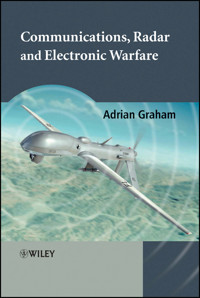
A practical guide to the principles of radio communications for both civilian and military applications
In this book, the author covers both the civilian and military uses of technology, focusing particularly on the applications of radio propagation and prediction. Divided into two parts, the author introduces the basic theory of radio prediction before providing a step-by-step explanation of how this theory can be translated into real-life applications. In addition, the book presents up-to-date systems and methods to illustrate how these applications work in practice. This includes systems working in the HF bands and SHF. Furthermore, the author examines the performance of these systems, and also the effects of noise, interference and deliberate jamming, as well as the performance of jamming, detection and intercept systems. Particular attention is paid to the problems caused by Radio Controlled Improvised Explosive Devices (RCIEDs).
Key Features:
- A practical handbook on the topic of radio communications and propagation
- Written by an expert in both the civilian and military applications of the technology
- Focuses on methods such as radio and radar jamming, and radio-controlled improvised explosive devices (IEDs)
- Contains problems and solutions to clarify key topics
Sie lesen das E-Book in den Legimi-Apps auf:
Seitenzahl: 484
Veröffentlichungsjahr: 2011
Ähnliche



















Contents
Cover
Title Page
Copyright
Preface
Glossary
Part One: Basic Theory
Chapter 1: Introduction
1.1 The Aim of this Book
1.2 Current Radio Technology
1.3 Factors Constraining Radio Communications
References and Further Reading
Chapter 2: Management of the Radio Spectrum
2.1 Spectrum Management Fundamentals
2.2 Civil Spectrum Management
2.3 Military Spectrum Management
2.4 Management of EW Activities
References and Further Reading
Chapter 3: The Radio Channel
3.1 Frequency Aspects of the Radio Channel
3.2 Narrowband Signals
3.3 Frequency Hopping Signals
3.4 Wideband Signals
3.5 The Effect of Movement on the Radio Channel
References and Further Reading
Chapter 4: Radio Links in the Presence of Noise
4.1 Sources of Radio Noise
4.2 Effects of Noise
4.3 The Radio Receiver
4.4 Radio Link Budgets in the Presence of Noise
References and Further Reading
Chapter 5: Radio Links in the Presence of Interference
5.1 Sources of Radio Interference
5.2 Interference in the Spectral Domain
5.3 Interference in the Time Domain
5.4 Interference Mitigation Techniques
References and Further Reading
Chapter 6: Radio Links and Deliberate Jamming
6.1 The Purpose of Jamming
6.2 How Jamming Works
6.3 Types of Communications Jammers
6.4 Jamming Mitigation Techniques
References and Further Reading
Chapter 7: Radar and Radar Jamming
7.1 Introduction to Radars
7.2 The Radar Equation
7.3 Types of Radar
7.4 Radar Jamming Techniques
7.5 Radar Jamming Mitigation Techniques
References and Further Reading
Chapter 8: Radio-Controlled Improvised Explosive Devices
8.1 The Poor Man's Weapon of Choice: IEDs
8.2 Radio Control for IEDs
8.3 Detection of IED Radio Control Systems
References and Further Reading
Part Two: Practical
Chapter 9: Predicting HF Radio
9.1 Propagation at HF
9.2 HF Skywave Link Budgets
9.3 Groundwave
References and Further Reading
Chapter 10: VHF to SHF Radio Prediction
10.1 Propagation above HF
10.2 Modelling Methods
10.3 Deterministic Models
10.4 Empirical Models
10.5 Combined Models
10.6 Link Budgets
References and Further Reading
Chapter 11: Data Requirements for Radio Prediction
11.1 Why Consider Modelling Requirements?
11.2 Communications System Parameters
11.3 ES Specific Parameters
11.4 EA Specific Parameters
11.5 Radar Specific Parameters
11.6 Third-Party Characteristics
11.7 General Antenna Characteristics
11.8 Antenna Environment Considerations
11.9 Terrain Data
11.10 Ground and Radio Clutter Data
11.11 Sunspots, Ionospheric and Atmospheric Data
References and Further Reading
Chapter 12: Planning and Optimising Radio Links
12.1 Path Profile Prediction
12.2 Optimising a Link
12.3 Re-Broadcast Links
12.4 Linked Networks
References and Further Reading
Chapter 13: Planning Radio Networks for Coverage
13.1 Coverage Predictions
13.2 Optimisation of Radio Networks
13.3 Limiting Coverage
References and Further Reading
Chapter 14: Interference Analysis
14.1 Introduction to Radio Interference Analysis
14.2 Fading Considerations
14.3 Interference from Other Channels
14.4 Different Ways of Representing Co-existing Signals
References and Further Reading
Chapter 15: Management Techniques for Interference
15.1 Preventing Interference
15.2 Managing Interference
15.3 Interference Reports
References and Further Reading
Chapter 16: Management of Interference at a Radio Site
16.1 Special Features of Radio Sites with Multiple Systems
16.2 Sources of Interference at a Radio Site
16.3 Methods of Managing Interference at Radio Sites
References and Further Reading
Chapter 17: Communications Electronic Warfare
17.1 Introduction
17.2 Detection and Intercept Networks
17.3 Direction Finding Networks
17.4 Communications Jammers
17.5 The Role of Unmanned Airborne Vehicles
17.6 Countering Enemy Communications Electronic Warfare
References and Further Reading
Chapter 18: Non-Communications Electronic Warfare
18.1 Non-Communications EW
18.2 Radar Jamming Techniques
18.3 Platform Self Protection Methods
18.4 Parametric Information Collection Methods
References and Further Reading
Chapter 19: Countering Radio-Controlled IEDs
19.1 Introduction to IEDs
19.2 Radio Controlled IED
19.3 Basic IED Counter Methods
Chapter 20: Summary and Conclusions
Appendix A: Working with Decibels
Appendix B: Common Conversion Formulae and Reference Tables
Free Space Loss
Reflection Coefficient for a Two-Ray Model
Index
This edition first published 2011
© 2011 John Wiley & Sons Ltd.
Registered office
John Wiley & Sons Ltd, The Atrium, Southern Gate, Chichester, West Sussex, PO19 8SQ, United Kingdom
For details of our global editorial offices, for customer services and for information about how to apply for permission to reuse the copyright material in this book please see our website at www.wiley.com.
The right of the author to be identified as the author of this work has been asserted in accordance with the Copyright, Designs and Patents Act 1988.
All rights reserved. No part of this publication may be reproduced, stored in a retrieval system, or transmitted, in any form or by any means, electronic, mechanical, photocopying, recording or otherwise, except as permitted by the UK
Copyright, Designs and Patents Act 1988, without the prior permission of the publisher.
Wiley also publishes its books in a variety of electronic formats. Some content that appears in print may not be available in electronic books.
Designations used by companies to distinguish their products are often claimed as trademarks. All brand names and product names used in this book are trade names, service marks, trademarks or registered trademarks of their respective owners. The publisher is not associated with any product or vendor mentioned in this book. This publication is designed to provide accurate and authoritative information in regard to the subject matter covered. It is sold on the understanding that the publisher is not engaged in rendering professional services. If professional advice or other expert assistance is required, the services of a competent professional should be sought.
Library of Congress Cataloging-in-Publication Data
Graham, Adrian W.
Communications, radar, and electronic warfare / Adrian William Graham.
p. cm.
Includes bibliographical references and index.
ISBN 978-0-470-68871-7 (hardback)
1. Radio wave propagation. 2. Radio frequency. 3. Wireless communication systems. I. Title.
TK6553.G697 2011
621.384–dc22
2010035687
A catalogue record for this book is available from the British Library.
Print ISBN: 9780470688717 (H/B)
ePDF ISBN: 9780470977163
oBook ISBN: 9780470977170
ePub ISBN: 9780470977149
Preface
I have been fortunate during my career to work with a wide range of designers, managers and operators in the communications, radars and electronic warfare fields. During that time, I have had the opportunity to provide a technical input into their activities via providing consultancy, design of new systems and techniques and training courses at a range of levels. One of my main tasks has been to develop methods suitable for operators based on highly technical materials. This is not always an easy task; it can be difficult to present complex material in a form that does not require the operators to be experts themselves. This is not to denigrate in any way the abilities of operators. They have to perform excellently in their roles, often in very difficult circumstances, and they simply do not have the time to commit to working out how to convert theory into practice in the field. Thus, much of my time has been spent working out ways to simplify practical methods of applying theory for the widest possible range of circumstances. I have tried to adopt the same approach in the preparation of this book. It is also my own personal opinion that there are two types of information available about these subjects. One is highly theoretical and beyond the needs of most workers in the field. The other is slightly too simplified, omitting vital information without which it is impossible to really understand the subject. In this book, I have tried to bridge the gap between these two opposing approaches. I hope I have succeeded.
During my time working with operators, engineers and managers, I have identified a number of specific areas where I believe understanding is limited throughout the industry. These are the areas I have tried to emphasise in this book, and the ones I spend most time on when I design and run training courses. I have also tried to bridge the terminology gap between workers in the three areas covered by this book. Often, there is misunderstanding between these people when they meet, simply based on terminological and learned approaches when they are in fact talking about the same things. I have deliberately used a mix of terminology to blur these lines. I have in some cases also opted not to use terminology used by one group that may not be understood by others. This is often service or allegiance based, and again they can act to cause confusion where the terminology is not shared by others; this book is, after all, aimed at a worldwide market.
I have provided some references and further reading after most of the chapters. I have tried to choose reading material that is not too theoretical such as academic papers where possible. Where no references are provided, the material is based on my own experience.
As the reader can imagine, I could not have created this book without the input of a vast array of input from other people over the years. There are a few in particular I would like to thank. Since they are still working in the field, particularly in EW, most would rather not be identified. However, both they and I know who they are.
I would also like to thank my long-suffering project editor at John Wiley & Sons, who has had to wait far too long for this manuscript. The support given to me by my equally long-suffering special friend Leanne, my brother Jim and my mother Brenda has also been invaluable. Finally, I would like to thank Alan Smith, the best friend anyone could hope for, who has supported me in many ways during the writing of this book and who, when times have been tough, has comforted me with cider.
Adrian Graham
Glossary
AAM
Air to Air Missile
AGA
Air-Ground-Air, usually relating to communications
AGC
Automatic Gain Control
ARM
Anti-Radiation Missile
AM
Amplitude Modulation
ASM
Air to Surface Missile
AOR
Area of Responsibility; area within which a military force element works
APOD
Air Point of Departure
AWGN
Average White Gaussian Noise (a flat response over the band of interest)
Antenna
Device to convert electrical energy to RF energy and the converse
Backhaul
Network used to trunk traffic from a mobile system
Battlespace
Term used to define the battle area, which extends beyond physical bounds (the battlefield)
BER
Bit Error Rate
BSM
Battlespace Spectrum Management (plan); military spectrum plan
Burn-through
Overcoming jamming by the robustness of the target link
CDMA
Code Division Multiple Access
CEW
Communications Electronic Warfare
C/I
Carrier-to-Interference ratio (dB)
CIWS
Close In Weapons System
CME
Coronal Mass Ejection; an eruption on the surface of the sun
COMINT
COMmunications INTelligence
CONUS
Continental United States (of America)
CNR
Combat Net Radio
Combiner
Device to combine more than one radio signal into a single antenna
Connector
Physical electrical connector for RF cables and systems
COTS
Commercial Off The Shelf; standard systems available to buy
CW
Continuous wave; as opposed to periodic pulsed transmissions
Diplexer
Passive device to combine radio signals into a single antenna without loss
dBd
Loss or gain reference an ideal dipole antenna
dBi
Loss or gain reference an ideal isotropic antenna
DEM
Digital Elevation Model
DF
Direction Finder/Finding
DME
Distance Measuring Equipment (aeronautical)
Downlink
(1) Link from a terrestrial fixed radio station to an associated mobile station(2) In satellite systems, from satellite to Earth station
DRDF
Digitally Resolved Direction Finding
DTM
Digital Terrain Model
DVOR
Digital VHF Omni-directional Radio ranging (aeronautical)
EA
Electronic Attack (EW)
ECCM
Electronic Counter-Counter Measures
EIRP
Effective Isotropic Radiated Power, versus a perfect isotropic antenna
EHF
Extra High Frequency (30–300 GHz)
ELF
Extra Low Frequency (0.3–30 kHz)
EMCON
EMission CONtrol; controlling RF emissions to avoid exploitation by the enemy
EM
Electro-Magnetic
EMC
Electro-Magnetic Compatibility
EMI
Electro-Magnetic Interference
EMP
Electro-Magnetic Pulse; damaging RF energy from a nuclear weapon or EMP weapon
EOD
Explosive Ordnance Demolition
EORBAT
Electronic Order of BATtle
EP
Electronic Protection (EW)
ERP
Effective Radiated Power, normally versus a dipole antenna
ES
Electronic support (EW)
EW
Electronic Warfare (EW)
EW
Early Warning (alternative meaning, depending on context)
FAA
Federal Aviation Authority
FDD
Frequency Division Duplex
FDMA
Frequency Division Multiple Access
FEBA
Forward Edge of Battle Area
Feeder
RF cable used to connect RF components together
FFZ
First Fresnel Zone
FH
Frequency Hopping
Filter
Device to condition an electrical signal in the spectral domain
FM
Frequency Modulation
Force Element
Military assets assigned to a specific task
FSL
Free Space Loss; spreading loss only (dB)
GCHQ
Government Communications HeadQuarters (UK)
GCI
Ground Controlled Intercept
GIS
Geographic Information System
GPS
Global Positioning System
GSM
Global System for Mobile Communications
Hardkill
Physical destruction of assets
HF
High Frequency (3–30 MHz)
HME
Home Made Explosive
HND
Host Nation Declaration; response to an SSR
HUMINT
HUMan INTelligence; informants
ICAO
International Civil Aviation Organisation
ICD
Improvised Chemical Device
IED
Improvised explosive device
IF
Intermediate Frequency
IFF
Identification Friend or Foe
IID
Improvised Incendiary Device
ILS
Instrumented Landing Systems
IMINT
Image INTelligence
IND
Improvised Nuclear Device
IMP
Inter-Modulation Product
IRD
Improvised Radiological Device
IRF
Interference Rejection Factor
ITU
International Telecommunications Union
JRFL
Joint Restricted Frequency List
J/S
Jamming to Signal ratio
JSIR
Joint Spectrum Interference Resolution (process) – US interference resolution method
JSR
Alternative form of Jammer to Signal Ratio
LIDAR
LIght Detection And Ranging; high resolution terrain data capture method
LF
Low Frequency (30–300 kHz)
MASINT
Measurement And Signature INTelligence
MBITR
Multi-Band Inter/Intra Team Radio
MCFA
Most Constrained First Assigned; frequency assignment approach
MF
Medium Frequency (300 kHz–3 MHz)
MGRS
Military Grid Reference System
MLS
Microwave Landing System (aeronautical)
MOTS
Mostly Off The Shelf; standard systems that are partially modified
MSR
Main Supply Routes
NDB
Non-Directional Beacon (aeronautical)
NFD
Net Filter Discrimination
NSA
National Security Agency (USA)
OP
Observation Post
OPTEMPO
Level of operational intensity; OPerational TEMPO
ORBAT
ORder of BATtle
OTHT
Over The Horizon Targeting
PIRA
Provisional Irish Republican Army
PM
Pulse Modulation
POD(1)
Probability of Detection
POD(2)
Point of Departure; air (also known as APOD) or port used in military operation
POI
Probability of Intercept
POJ
Probability of Jamming
PRF
Pulse Repetition Frequency
PRI
Pulse Repetition Interval
PSK
Phase Shift Keying
PSO
Probability of Successful Operation; the likelihood that a given link will work
QAM
Quadrature Amplitude Modulation
QPSK
Quadrature Phase Shift Keying
Radio System
Any system that uses RF channels in order to function, including communications, navigation, radars, jammers etc
RCIED
Radio Controlled Improvised Explosive Device
RF
Radio Frequency, as in radio frequency device
SAG
Surface Action Group; naval force element
SAM
Surface to Air Missile
SAR
Synthetic Aperture Radar
SHF
Super High Frequency (3000–30 000 MHz)
SHORAD
Short Range Air Defence system
Short sector
A region where the nominal signal level will not change, but within which the instantaneous level changes due to fast fading
SINAD
Signal In Noise and Distortion
SMM
Simplified Multiplication Method; method of assessing interference from multiple interferers
SNR
Signal to Noise Ratio
Softkill
Disruption or destruction by non-lethal means
SOP
Standard Operating Procedure
Spoofing
A radiating system pretending to be a different system to fool enemies
SSM
Surface to Surface Missile
SSN (1)
Sun-Spot Number (HF)
SSN (2)
Nuclear Submarine (force element)
SSR
Spectrum Supportability Request; request to a host nation for spectrum
TAPS
TETRA Advanced Packet Service
TEL
Transporter, Erector, Launcher – a missile launch platform, usually a large vehicle holding a tactical land or coastal surface-attack missile
TETRA
TErrestrial Trunked RAdio
UGS
Unattended Ground Sensor
UHF
Ultra High Frequency (300–3000 MHz)
UN
United Nations
Uplink
(1) Link from a mobile station to a fixed terrestrial radio station
(2) In satellite, from Earth station to satellite
UTM
Universal Transverse Mercator; a data projection
VHF
Very High Frequency (30–300 MHz)
VLF
Very Low Frequency (3–30 kHz)
VOIED
Victim Operated Improved Explosive Device
WGS84
World Geodetic System 1984; geographic datum used by GPS
Part One
Basic Theory
Chapter 1
Introduction
1.1 The Aim of this Book
This book looks at the subjects of radio communications, radar and electronic warfare. The aim is to provide the reader with a mixture of theory and practical illustrations to explain the way in which these systems are used in practice. The book is aimed at operators, designers and managers operating in these areas. It is designed to provide a detailed overview at a level suitable for this audience. This means that the intention has been to provide explanation of complex theory in as simple manner as possible, and to link the theory to real life as far as possible. One of the main reasons for writing the book is that there is a large body of very in-depth, complex works that are beyond the grasp of the average reader. There are also works that provide simple overviews but without introducing the necessary background theory. Hopefully, this book provides a middle way between these two extremes.
The book has been split into two main sections; theory and practice. The idea is to lay the necessary theoretical groundwork, and then to spend more time in the main, practical part of the book identifying the operational effects of the theory when applied. In this way, the book is designed to bridge the gap of theory to application in a way that makes sense to communications and electronics operators, system designers and managers.
One aim in writing the book has been to provide as compact knowledge as possible in each section. Thus rather than having to find an earlier reference, in some cases the theory has been re-introduced, and some diagrams replicated, in some of the practical sections where they are explicitly required. The reader can therefore easily dip into to individual sections and get most of the information without having to go back to the theoretical sections. Thus, those whose interest is primarily for radar for example, the book has been split up in such a ways as to collate the relevant information into readily located sections. , , .
Lesen Sie weiter in der vollständigen Ausgabe!
Lesen Sie weiter in der vollständigen Ausgabe!
Lesen Sie weiter in der vollständigen Ausgabe!
Lesen Sie weiter in der vollständigen Ausgabe!
Lesen Sie weiter in der vollständigen Ausgabe!
Lesen Sie weiter in der vollständigen Ausgabe!
Lesen Sie weiter in der vollständigen Ausgabe!
Lesen Sie weiter in der vollständigen Ausgabe!
Lesen Sie weiter in der vollständigen Ausgabe!
Lesen Sie weiter in der vollständigen Ausgabe!
Lesen Sie weiter in der vollständigen Ausgabe!
Lesen Sie weiter in der vollständigen Ausgabe!
Lesen Sie weiter in der vollständigen Ausgabe!
Lesen Sie weiter in der vollständigen Ausgabe!
Lesen Sie weiter in der vollständigen Ausgabe!
Lesen Sie weiter in der vollständigen Ausgabe!
Lesen Sie weiter in der vollständigen Ausgabe!
Lesen Sie weiter in der vollständigen Ausgabe!
Lesen Sie weiter in der vollständigen Ausgabe!
Lesen Sie weiter in der vollständigen Ausgabe!
Lesen Sie weiter in der vollständigen Ausgabe!
Lesen Sie weiter in der vollständigen Ausgabe!
Lesen Sie weiter in der vollständigen Ausgabe!




