


46,99 €
Mehr erfahren.
- Herausgeber: John Wiley & Sons
- Kategorie: Wissenschaft und neue Technologien
- Sprache: Englisch
Construction projects are beset with disputes. In 1960 around 250 writs were issued relating to construction disputes. Within 30 years this number increased five-fold, and in the 20 years since then the number of disputes has not fallen. Some disputes are significant, others are quite minor, but most could probably be avoided. Disputes originate in disagreements or conflict between individuals, which if addressed early, can prevent escalation into situations that are difficult, expensive and time consuming to resolve.
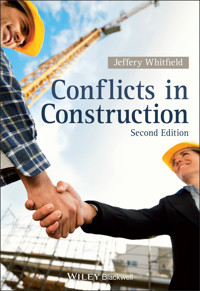
Conflicts in Construction deals with all types of conflict but concentrates on the conflicts that lead to disputes in construction projects. The book shows the reader how to avoid, manage and resolve conflicts before they become serious disputes.
The first edition of Conflicts in Construction was read widely and saved many individuals and companies from falling into intractable disputes. The second edition, fully updated, forms the base content for the Hill/ Knowles seminar series on conflicts, delivered around the globe by the author, and will be an important read for everyone employed in the construction industry.
Sie lesen das E-Book in den Legimi-Apps auf:
Seitenzahl: 306
Veröffentlichungsjahr: 2012
Ähnliche



















Contents
Preface: A Time of Change
1 Conflicts in Construction
1.1 Recent history
1.2 Understanding conflict
1.3 Addressing conflict
1.4 Positive aspects of a conflict
1.5 The real causes of conflict
2 Why Do We Need to Manage Conflict?
2.1 Functional conflict
2.2 Dysfunctional conflict
3 Causes of Conflict
3.1 A conflict of ideas
3.2 A conflict of beliefs
3.3 A conflict of interests
3.4 The Fertile Ground Theory
3.5 Internal conflict
3.6 Internal conflict in construction
3.7 Other factors
4 Dishonesty and Self Deception
4.1 Plain dishonesty
4.2 Self delusion
4.3 Cognitive Dissonance
4.4 Confirmative Bias
5 Interpersonal Relationships
5.1 Anthropological factors
5.2 Sociological factors
5.3 Physiological factors
5.4 Psychological factors
5.5 Prejudice
5.6 Personality types
5.7 The urge to conflict
6 Anatomy of a Construction Project
6.1 Overview of the project and the parties
6.2 The pre-contract period
6.3 The contract period
6.4 The dispute period
6.5 Summary and analysis of the dispute
7 Twelve Steps for Reducing Conflict
7.1 Step 1: Communicate with precision
7.2 Step 2: Listen and consider attentively
7.3 Step 3: Think before speaking
7.4 Step 4: Take time to build relationships
7.5 Step 5: Be honest in your dealings with others
7.6 Step 6: Do not dispute trivial matters
7.7 Step 7: Look for common ground
7.8 Step 8: Recognise and avoid prejudice
7.9 Step 9: Express your understanding
7.10 Step 10: Control your emotions
7.11 Step 11: Apologise gracefully if you are wrong
7.12 Step 12: Accept apologies gracefully if others are in the wrong
8 Reducing Conflict
8.1 People, people, people
8.2 Interpersonal techniques
8.3 Perceptions and personalities
8.4 Tactical behaviour
8.5 Summary
9 Managing Conflict
9.1 Simple resolution techniques
9.2 Control of conflict
9.3 Conflict prevention
9.4 Prevent conflict from spreading
9.5 Call the professionals
9.6 Summary
10 Informal Dispute Resolution
10.1 Negotiation
10.2 Alternative Dispute Resolution (ADR)
11 Formal Dispute Resolution
11.1 General principles of dispute management
11.2 Arbitration and Litigation
11.3 Arbitration explained
11.4 Litigation explained
12 Conflict in Changing and Challenging Markets
12.1 Will people change?
12.2 Will contracts change?
12.3 Does Europe have anything better to offer?
12.4 Conflict in changing market conditions
12.5 More conflict or less conflict – you decide!
Index
This edition first published 2012© 2012 John Wiley & Sons, Ltd.First edition published in 1994 by Macmillan Press Ltd
Wiley-Blackwell is an imprint of John Wiley & Sons, formed by the merger of Wiley’s global Scientific, Technical and Medical business with Blackwell Publishing.
Registered OfficeJohn Wiley & Sons, Ltd, The Atrium, Southern Gate, Chichester, West Sussex, PO19 8SQ, UK
Editorial Offices9600 Garsington Road, Oxford, OX4 2DQ, UKThe Atrium, Southern Gate, Chichester, West Sussex, PO19 8SQ, UK2121 State Avenue, Ames, Iowa 50014-8300, USA
For details of our global editorial offices, for customer services and for information about how to apply for permission to reuse the copyright material in this book please see our website at www.wiley.com/wiley-blackwell.
The right of the author to be identified as the author of this work has been asserted in accordance with the UK Copyright, Designs and Patents Act 1988.
All rights reserved. No part of this publication may be reproduced, stored in a retrieval system, or transmitted, in any form or by any means, electronic, mechanical, photocopying, recording or otherwise, except as permitted by the UK Copyright, Designs and Patents Act 1988, without the prior permission of the publisher.
Designations used by companies to distinguish their products are often claimed as trademarks. All brand names and product names used in this book are trade names, service marks, trademarks or registered trademarks of their respective owners. The publisher is not associated with any product or vendor mentioned in this book. This publication is designed to provide accurate and authoritative information in regard to the subject matter covered. It is sold on the understanding that the publisher is not engaged in rendering professional services. If professional advice or other expert assistance is required, the services of a competent professional should be sought.
Library of Congress Cataloging-in-Publication Data
Whitfield, Jeffery, author.Conflicts in construction / Jeffery Whitfield, Director, Hill International (UK).pages cmIncludes index.
ISBN 978-1-118-29870-1 (pbk.)1. Construction industry–Management. 2. Conflict management. I. Title. HD9715.A2W46 2012624.068′4–dc23
2012015857
A catalogue record for this book is available from the British Library.
ISBN: 978-1-118-29870-1 (pbk.)
Wiley also publishes its books in a variety of electronic formats. Some content that appears in print may not be available in electronic books.
Cover design by Sandra HeathCover photo courtesy of Shutterstock
Preface: A Time of Change
I have been writing this book in the run up to 2012, an exciting and a challenging time for the country and the construction industry. Whilst there is a strong demand, and need, for new construction of all types, there is also a strong yet unfulfilled demand for the funding of that construction growth.
In the UK, the last government did not meet its promises on affordable and decent housing. New school and college buildings, along with large capital projects in the health sector, were promised but unfunded. Under the austerity measures introduced by the new government, even infrastructure spending has suffered, and all of this is happening as governments around the world are looking to reduce their spending too.
We can read in the printed media and watch on TV as it becomes clear that the UK is not alone in reducing government spending. I travel widely to assist in international construction disputes and have seen tower cranes standing idle across China, Southeast Asia and in India, the very countries that are said to be booming. The Middle East is continuing to spend on infrastructure and industrial projects, but my recent visits have coincided with major commercial and residential project suspensions, deferments and cancellations. There is considerable doubt about whether many of the United Arab Emirates’ ambitious plans for new ‘cities’ will come to fruition soon, or ever. Their plans for spectacular theme parks, projected to dwarf even Disney World in Florida, are slowing dramatically, and lenders are questioning the wisdom of placing enormous city-sized theme parks in both Dubai and in Abu Dhabi, when they are only an hour apart by road.
The good news is that some sectors are holding up very well. New retail capital spending, mainly large supermarket chains, is on the rise. Power companies are building on a scale not seen for many years, to try to make up for a lack of investment over the past three decades, in an effort to reduce carbon emissions. Oil, gas and chemical investment has slowed a little but they too are looking to the future, 2015 to 2020, when demand will again outstrip supply.
The challenges are great, the opportunities greater, but what will these straitened circumstances mean for conflict in the construction related industries? Read on and together you and I will try to forecast what shape conflicts will take, but I suspect that many of the historic causes of conflict will continue to repeat themselves for the foreseeable future.
1Conflicts in Construction
The term ‘Built Environment’ describes the product of what is probably the most diverse industry in the world, ‘the Construction Industry’. Not only does the built environment cover a wide variety of end products from apartment blocks to oil refineries, but the people working within the construction and engineering industries are drawn from a broad range of trades and professions. With architecture and almost every branch of finance, engineering and surveying represented, there can be 20 or more professional disciplines involved in a moderately complex construction project.
The projects tackled by the industry are not only wide ranging and varied in their end use, but they also have significant variety within their types, for example; a power station can be fuelled by oil, gas, coal, bio fuel or nuclear products and each type of power station is very different in design, size, output and cost. The proposition that construction produces more variety than any other industry is supported by the premise that almost every major building project is unique, a prototype, a one-off.
So it is that for every complex project that stands to be constructed, a learning curve is inevitable. It is a rare industry indeed that produces so many varied prototypes without significant repetition.
The construction industry is further complicated by the presence of numerous parties with an interest in the completed structure. These include the end user, the funding parties, the developer, the planning authority, the construction regulators, the Health and Safety Executive and the public at large, whose built environment is important to them economically, environmentally and aesthetically. Add to these divergent interests the expectations of the Contractor who builds the asset, his sub-contractors and suppliers who contribute specialist plant, skills and materials, and there are relatively few people in our society without at least a small investment in the construction process.
Lesen Sie weiter in der vollständigen Ausgabe!
Lesen Sie weiter in der vollständigen Ausgabe!
Lesen Sie weiter in der vollständigen Ausgabe!
Lesen Sie weiter in der vollständigen Ausgabe!
Lesen Sie weiter in der vollständigen Ausgabe!
Lesen Sie weiter in der vollständigen Ausgabe!
Lesen Sie weiter in der vollständigen Ausgabe!
Lesen Sie weiter in der vollständigen Ausgabe!
Lesen Sie weiter in der vollständigen Ausgabe!
Lesen Sie weiter in der vollständigen Ausgabe!
Lesen Sie weiter in der vollständigen Ausgabe!
Lesen Sie weiter in der vollständigen Ausgabe!




