


48,99 €
Mehr erfahren.
- Herausgeber: John Wiley & Sons
- Kategorie: Wissenschaft und neue Technologien
- Sprache: Englisch
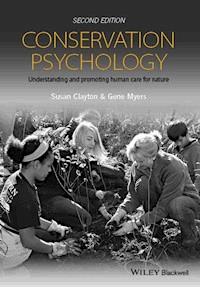
People are inseparable from natural ecosystems, and understanding how people think about, experience, and interact with nature is crucial for promoting environmental sustainability as well as human well-being.
This is the new edition of what is now the leading textbook in conservation psychology, the field that explores connections between the study of human behavior and the achievement of conservation goals. Completely
updated, this book summarizes theory and research on ways in which humans experience nature; it explores people’s conceptions of nature and environmental problems, their relationship with nature, and their moral lenses on nature; and examines ways to encourage conservation-oriented behavior at both individual and societal levels. Throughout, the authors integrate a wide body of research demonstrating the role of psychology in promoting a more sustainable relationship between humans and nature.
New sections cover human perceptions of environmental problems, new examples of community-based conservation, and a “positive psychology” perspective that emphasizes the relevance of nature to human resilience. Additional references are to be found throughout this edition along with some new examples and a reorganisation of chapters in response to reader feedback.
This fascinating volume is used for teaching classes to senior undergraduate and graduate students of Conservation Psychology, Environmental Psychology and Conservation Science in departments of Psychology, Geography, Environmental Science, and Ecology and Evolution. It is equally suitable as a starting point for other researchers and practitioners - psychologists, conservation biologists, environmental scientists, and policy-makers - needing to know more about how psychological research can inform their conservation work.
Sie lesen das E-Book in den Legimi-Apps auf:
Seitenzahl: 848
Veröffentlichungsjahr: 2015
Ähnliche



















Table of Contents
Cover
Title Page
Copyright
Preface to the Second Edition
About the Companion Website
Chapter 1: Introducing the Field of Conservation Psychology
Conservation
Psychology
Human care for nature
The roots of conservation psychology
The utility of conservation psychology
The practice of conservation psychology
The organization of the book
Conclusion
For further information, visit these websites
References
Part I: Human Experiences of Nature
Chapter 2: Domestic Nature: Cohabiting with Animals and Plants
Animals in the home
Plants in the domestic sphere
Conclusion
References
Chapter 3: Managed Nature: Zoos, Aquariums, and Public Parks
Zoos and aquariums
Urban parks and green spaces
Conclusion
References
Chapter 4: Wild Nature: Encounters with Wilderness
Defining wild nature and wilderness
Wilderness use and wilderness values
Wilderness solitude
Natural forces and features
The edge of control: wilderness remoteness and challenge
Activity in wild nature, connection, and caring
Wild nature and spiritual experience
Wilderness-based growth and therapeutic programs
Conclusion
References
Part II: Thinking About Nature
Chapter 5: Attitudes, Values, and Perceptions
Core understandings of nature
Values
Attitudes
Perceptions
Evolutionary perspectives
Conclusion
References
Chapter 6: Perceptions of Environmental Problems
Risk perception
Biases in information processing
Language and discourse
Understanding environmental problems
Attributions of responsibility
Linking perceptions to behavior
Conclusion
References
Chapter 7: Moral Psychology and the Environment
Background on ethical concepts
Social intuitionism and moral foundations theory
A virtue ethics of the environment
The deontic tradition and psychological research
Consequentialism, emotion, and socialization
Psychological dynamics of moral functioning
Pragmatist ethics
Conclusion
References
Chapter 8: Environment and Identity
The concept of identity
Identity development
Developing an affiliation with nature
Environmental identity
Ecopsychology and depth psychology perspectives
Measuring environmental identity
Place identity
Animals and identity
Environmental social identity
Identity and behavior
Putting identity to work
Conclusion
References
Part III: Encouraging a Sustainable Relationship Between Humans and Nature
Chapter 9: Promoting Sustainable Behavior
Identifying target behaviors
Influences on behavior
Models for changing behavior
Collective behavior
Conclusion
References
Chapter 10: Community Psychology and International Biodiversity Conservation
International biodiversity conservation
Common pool resources and models of governance
Psychology, culture, and local knowledge
Creating ecological knowledge old and new: Traditional and modern citizen science
Accounting for the costs and benefits of conservation
Conservation and all-too-human psychology
Conclusion
References
Chapter 11: Environmental Education
Environmental education
Examples of contemporary environmental education
Psychological foundations of environmental education
Lessons for effective practice
Conclusion
References
Chapter 12: The Positive Psychology of Conservation
Nature as a positive environment
Negative emotions in response to environmental challenges
Positive emotions in relation to environmental behaviors
Eudaimonism and meaning
Materialistic values versus self-determination theory
Optimism and pessimism
Toward strengths-based approaches
References
Glossary
Index
End User License Agreement
Pages
xi
xiii
1
2
3
4
5
6
7
8
9
10
11
12
13
14
17
18
19
20
21
22
23
24
25
26
27
28
29
30
31
32
33
34
35
36
37
38
39
40
41
42
43
44
45
46
47
48
49
50
51
52
53
54
55
56
57
58
59
60
61
62
63
64
65
66
67
68
69
70
71
72
73
74
75
76
77
78
79
80
81
82
83
84
85
86
87
88
89
93
94
95
96
97
98
99
100
101
102
103
104
105
106
107
108
109
110
111
112
113
114
115
116
117
118
119
120
121
122
123
124
125
126
127
128
129
130
131
132
133
134
135
136
137
138
139
140
141
142
143
144
145
146
147
148
149
150
151
152
153
154
155
156
157
158
159
160
161
162
163
164
165
166
167
168
169
170
171
172
173
174
175
176
177
178
179
180
181
182
183
184
185
186
187
191
192
193
194
195
196
197
198
199
200
201
202
203
204
205
206
207
208
209
210
211
212
213
214
215
216
217
218
219
220
221
222
223
224
225
226
227
228
229
230
231
232
233
234
235
236
237
238
239
240
241
242
243
244
245
246
247
248
249
250
251
252
253
254
255
256
257
258
259
260
261
262
263
264
265
266
267
268
269
270
271
272
273
274
275
276
277
278
279
280
281
282
283
284
285
286
287
288
289
290
291
292
293
294
295
296
297
298
299
300
301
302
303
304
15
91
189
305
306
307
308
309
310
311
312
313
314
315
316
317
318
319
320
321
322
323
324
325
Guide
Cover
Table of Contents
Preface
Begin Reading
List of Illustrations
Chapter 1: Introducing the Field of Conservation Psychology
Figure 1.1 Shared environmental values among the American public. (Ecoamerica (2011). The American Climate and Environmental Values Survey. Available at http://www.climateaccess.org/sites/default/files/ecoamerica_ACEVS%20report.pdf).
Figure 1.2 A reciprocal relationship with nature. Photo credit Susan Clayton.
Figure 1.3 A simplified model of the human-nature relationship.
Chapter 2: Domestic Nature: Cohabiting with Animals and Plants
Figure 2.1 (a, b) Myers in primary research about child–dog relationship. Photos courtesy of Olin Myers Sr.
Figure 2.2 Gardening is a common leisure pursuit. Photo by Susan Clayton.
Figure 2.3 Benefits of gardening. Based on data in Clayton, 2007.
Chapter 3: Managed Nature: Zoos, Aquariums, and Public Parks
Figure 3.1 Reasons for visiting the zoo (based on data in Moss et al., 2014).
Figure 3.2 Hamill Family Play Zoo: Play partners share enthusiasm and facilitate development of caring attitudes (photo courtesy of Jim Schultz/Chicago Zoological Society).
Figure 3.3 Hamill Family Play Zoo: Pretend is a powerful form of caring (photo courtesy of Mardi Solomon).
Figure 3.4 Children and community members benefit from school ground greening projects (photo courtesy of Chuck Holtorf).
Chapter 4: Wild Nature: Encounters with Wilderness
Figure 4.1 Four-channel model of psychological flow. (Adapted from Jackson & Csikszentmihalyi, 1999.)
Figure 4.2 The experiential fluctuation model. (Adapted from Massimini & Carli, 1988, Figure 16.1, p. 270. Used with permission of Cambridge University Press.)
Figure 4.3 Adventure experience paradigm. (Adapted from Martin & Priest, 1986.)
Chapter 5: Attitudes, Values, and Perceptions
Figure 5.1 Demonstrating the value of trees. (Photo by Susan Clayton.)
Figure 5.2 A landscape without preferred features. (Photo by Susan Clayton.)
Figure 5.3 A landscape with preferred features. (Photo by Susan Clayton.)
Chapter 6: Perceptions of Environmental Problems
Figure 6.1 Answers to the question, “Is global warming a problem?” (Based on data from the Pew Global Attitudes Project, 2013.)
Figure 6.2 From Stern et al. (1999).
Chapter 7: Moral Psychology and the Environment
Figure 7.1 Mean pro-environmental attitude as a function of moral-messaging condition and political ideology. Asterisks indicate between group significant differences (
p
< 0.001). From Feinberg & Willer, 2013, p. 60, copyright © 2013 by Association for Psychological Science. Reprinted by Permission of SAGE Publications.
Figure 7.2 American adults' responses to “Which is the most important reason for you personally to care about protecting the environment?” Based on data from the Biodiversity Project, 2002b, p. 17.
Figure 7.3 Ethical prescriptions regarding the environment. Photo: Susan Clayton.
Figure 7.4 Taking a future environmental-change victim's perspective while viewing a slide show significantly increased three behavior indicators (intentions, time spent, and brochures collected) over asking subjects to remain objective, which was higher than a no instruction condition. Effects were the same across indicators. From Pahl and Bauer (2013), p. 164, copyright © 2013 by Environmental Design Research Association. Reprinted by Permission of SAGE Publications.
Figure 7.5 Empathy grounds moral responsiveness: Wildlife conservation education camp, Chengdu, China. Photo courtesy of Sarah Bexell.
Figure 7.6 As the number of pandas in need of aid increased, nonenvironmentalists provided significantly smaller donations, whereas environmentalists' donation did not differ significantly as a function of number of animals in need. Error bars show ±1 standard deviation. From Markowitz et al. (2013), Figure 5, p. 403.
Figure 7.7 Social and cognitive disequilibrium in moral conflict. The late Joan Norman Protesting logging of Old-Growth Reserves and Inventoried Roadless Areas in the Siskiyou National Forest, Oregon, 2005. Photo: Rolf Skar.
Chapter 8: Environment and Identity
Figure 8.1 Sources of developing place attachments in early and middle childhood and adolescence. (From Chawla, 1992, by permission of Springer Science and Business Media.)
Figure 8.2 Student ratings of the importance of the college landscape. (Unpublished data from Susan Clayton.)
Figure 8.3 Cultures may encourage defining oneself through consumption rather than environmentalism. (Photo by Susan Clayton.)
Figure 8.4 A zoo volunteer with visitors at the Bronx Zoo. (Photo by Larsen Maher. Copyright WCS, reprinted by permission.)
Chapter 9: Promoting Sustainable Behavior
Figure 9.1 Factors affecting behavior.
Figure 9.2 Prompts on light switches are common. (Photo courtesy of Susan Clayton).
Figure 9.3 Encouraging a perception of self-efficacy. (Photo courtesy of Susan Clayton).
Chapter 10: Community Psychology and International Biodiversity Conservation
Figure 10.1 Multilevel governance configuration composed of institutions (“I”), rules (“R”), and productive roles (gray) in tourism in Aqua Blanca, Ecuador. Arrows indicate influence; see source for content of rules (from Ruiz-Ballesteros and Gual (2012). Figure 6, p. 858, copyright © 2012. With kind permission from Springer Science and Business Media).
Figure 10.2 Network analyses of the Solomon Islands Locally Managed Marine Area Network (SILMMA), showing links among national agencies and sites they comanage (a); cross-scale networking between governmental levels (b); and SILMMA members and nonmember agencies linkages to international agencies (c) (from Cohen et al. (2012), Figure 3, p. 382).
Figure 10.3 Social networks in different cultural groups, represented schematically (top) and literally (from Atran et al., 2005. Reprinted with permission from APA Publications).
Figure 10.4 The proportion of published environmental monitoring schemes within each type of monitoring scheme that have a biodiversity (a) or livelihoods (b) objective; and the types of governance regime (c) they operate within, including areas without protection status (white), government-managed protected areas (black), and community-managed protected areas (shaded). The relative role of local stakeholders in the monitoring schemes increases from left to right (from Danielsen et al. (2014), Figure 2, p. 19).
Figure 10.5 Paraecologists setting up a field experiment in South Africa (photograph courtesy of Ute Schmiedel).
Chapter 11: Environmental Education
Figure 11.1 Sorting organisms from a beach seine net, students learn about intertidal natural history (photo courtesy of Courtney Blodgett).
Figure 11.2 Ladder of children's participation (from Roger Hart (1992),
Children's Participation: from Tokenism to Citizenship
. Florence: UNICEF Innocenti Research Centre).
Chapter 12: The Positive Psychology of Conservation
Figure 12.1 Sustainable behaviors predict subjective well-being. (From Corral-Verdugo et al., 2011, Figure 1, p. 101.)
Figure 12.2 Grouzet's circumplex of values. (From Grouzet et al., 2005, Figure 1, p. 808.)
Figure 12.3 Spatial optimism and temporal pessimism: Mean ratings of current environmental conditions (all above 0) and expected future change (mostly negative) at the local, national, and global spatial levels for 18 countries. (Reprinted from Gifford et al. 2009, p. 7, Figure 2. Copyright 2009, with permission from Elsevier.)
Figure 12.4 The structure of character. (From Peterson & Park, 2009, Figure 4.1, p. 32. By permission of Oxford University Press, USA.)
List of Tables
Chapter 2: Domestic Nature: Cohabiting with Animals and Plants
Table 2.1 U.S. Pet ownership statistics
Chapter 4: Wild Nature: Encounters with Wilderness
Table 4.1 Wilderness values: percent of US residents age 16 and older who said given values are extremely or very important. 1999–2000
n
= 5058; 2006–2007
n
= 2187
Table 4.2 Reported dimensions and feelings related to spirituality
Table 4.3 Factors in the concurrent model of wilderness experience
Chapter 5: Attitudes, Values, and Perceptions
Table 5.1 Kellert value types in order of prevalence in American society
Table 5.2 Some items from the new ecological paradigm scale
Table 5.3 Characteristics of folk biological systems that interact with experience and culture
Chapter 6: Perceptions of Environmental Problems
Table 6.1 A sample of information processing biases
Table 6.2 Environmental discourses
Chapter 7: Moral Psychology and the Environment
Table 7.1 Possible environmental virtues
Table 7.2 The virtue of simplicity as a mean between two sets of extreme vices
Table 7.3 Attitudes and beliefs associated with moral exclusion
Chapter 8: Environment and Identity
Table 8.1 Items from the environmental identity scale
Chapter 12: The Positive Psychology of Conservation
Table 12.1 Values in action classification of strengths
Table 12.2 Character strengths and their likely links to sustainable behavior
Table 12.3 Mindfulness in contrast and comparison to related forms of consciousness
Conservation Psychology
Understanding and promoting human care for nature
Second Edition
Susan Clayton and Gene Myers
This edition first published 2015 © 2015 by John Wiley & Sons Ltd
First edition published by John Wiley & Sons Ltd 2009
Registered office: John Wiley & Sons, Ltd, The Atrium, Southern Gate, Chichester, West Sussex,
PO19 8SQ, UK
Editorial offices: 9600 Garsington Road, Oxford, OX4 2DQ, UK
The Atrium, Southern Gate, Chichester, West Sussex, PO19 8SQ, UK
111 River Street, Hoboken, NJ 07030-5774, USA
For details of our global editorial offices, for customer services and for information about how to apply for permission to reuse the copyright material in this book please see our website at www.wiley.com/wiley-blackwell.
The right of the author to be identified as the author of this work has been asserted in accordance with the UK Copyright, Designs and Patents Act 1988.
All rights reserved. No part of this publication may be reproduced, stored in a retrieval system, or transmitted, in any form or by any means, electronic, mechanical, photocopying, recording or otherwise, except as permitted by the UK Copyright, Designs and Patents Act 1988, without the prior permission of the publisher.
Designations used by companies to distinguish their products are often claimed as trademarks. All brand names and product names used in this book are trade names, service marks, trademarks or registered trademarks of their respective owners. The publisher is not associated with any product or vendor mentioned in this book.
Limit of Liability/Disclaimer of Warranty: While the publisher and author(s) have used their best efforts in preparing this book, they make no representations or warranties with respect to the accuracy or completeness of the contents of this book and specifically disclaim any implied warranties of merchantability or fitness for a particular purpose. It is sold on the understanding that the publisher is not engaged in rendering professional services and neither the publisher nor the author shall be liable for damages arising herefrom. If professional advice or other expert assistance is required, the services of a competent professional should be sought.
Library of Congress Data applied for.
A catalogue record for this book is available from the British Library.
Wiley also publishes its books in a variety of electronic formats. Some content that appears in print may not be available in electronic books.
Cover image: Volunteers restoring streamside habitat. Photo courtesy of Nooksack Salmon Enhancement Association & Phil Humphries
Preface to the Second Edition
The role of psychology in conservation has grown dramatically since the first edition of Conservation Psychology. We are delighted by this development, although it has made our attempt to cover the field even more difficult. With this edition of the book, we have accepted the impossibility of including everything in this field. Instead, guided by the interests of our likely readers, we have reordered some of the material in a way that we hope will be more accessible and highlighted new developments in applied conservation. We have also described the promising intersection between conservation psychology and positive psychology. As originally, we are grateful to all the people working on this enterprise as well as to the students and practitioners whose interest is driving new research. This edition is dedicated to those who are doing their best to apply psychological insights to conservation practice.
About the Companion Website
This book is accompanied by a companion website:
www.wiley.com/go/clayton/conservation
The website includes:
Pdfs of all figures from the book for downloading
Powerpoints of all tables from the book for downloading
Chapter 1Introducing the Field of Conservation Psychology
Conservation
Psychology
Human care for nature
The roots of conservation psychology
The utility of conservation psychology
The practice of conservation psychology
The organization of the book
Conclusion
For further information, visit these websites
References
Humanity faces environmental challenges on every level from local to global. Human population growth and human activities are negatively affecting the ecological processes that support life as we know it, and the effect of these changes on human well-being will be profound. Recent quantitative assessments of the human impact on nature give a sobering picture; the Millennium Ecosystem Assessment found that that about 60% of the earth's ecosystem services are being used unsustainably. Using ecological footprint methodology, the Global Footprint Network (Global Footprint Network, 2013; http://www.footprintnetwork.org) has calculated that humanity's load on the biosphere is about 150% of earth's capacity, up from 70% in 1961. These trends result from individual behavior patterns as well as from the societal infrastructure constituted by our institutions, governance systems, and ways of interacting. At stake are two inextricably linked sets of values: concern for the present and future quality of human lives and care about the vitality of the biosphere and its other inhabitants.
We were drawn to write about conservation psychology not only by these uncompromising facts and future possibilities but also by a perception that our primary discipline, psychology, could do more to address these realities. This is clear across areas of conservation and natural resource research. We want to urgently ask: Are psychologists on those research teams? Are they prepared to intelligently deploy their skills in these new contexts (do they know their ecology and economics)? Are other social or natural science specialists ready to seek those skills (do they understand human motivations and biases)? A growing body of psychological research is relevant to conservation. Collectively, however, psychology is at best midway into effectively putting its resources at the disposal of individuals and groups working for a more healthy relation to our planet. We have yet to see a sea-change in the work of psychologists toward addressing sustainability. This book is for the reader with some interest in psychology, whether as a psychologist or just that of a normally curious and reflective human being, and concern about contemporary threats to environmental and social well-being posed by the way humans relate to ecological systems. Our goal is to describe the many ways in which psychology is relevant to environmental sustainability and vice-versa.
Conservation
We define conservation psychology as the use of psychological techniques and research to understand and promote a healthy relationship between humans and the natural environment. Let us unpack the book's title. “Conservation” should not be identified with turn-of-the-twentieth century resource conservation, with its strictly utilitarian focus. Instead, we associate “Conservation” with its rebirth in the 1980s, in which it was applied to a whole new set of ideas, including landscape and continent-wide ecosystem planning, and especially to Conservation Biology. That field was born of a sense of crisis and some within it openly avowed value-laden positions (Soulé, 1985). The same goes for conservation psychology: the goal is not only to understand the interdependence between humans and nature but also to promote a healthy and sustainable relationship.
Lesen Sie weiter in der vollständigen Ausgabe!
Lesen Sie weiter in der vollständigen Ausgabe!
Lesen Sie weiter in der vollständigen Ausgabe!
Lesen Sie weiter in der vollständigen Ausgabe!
Lesen Sie weiter in der vollständigen Ausgabe!
Lesen Sie weiter in der vollständigen Ausgabe!
Lesen Sie weiter in der vollständigen Ausgabe!
Lesen Sie weiter in der vollständigen Ausgabe!
Lesen Sie weiter in der vollständigen Ausgabe!
Lesen Sie weiter in der vollständigen Ausgabe!
Lesen Sie weiter in der vollständigen Ausgabe!
Lesen Sie weiter in der vollständigen Ausgabe!
Lesen Sie weiter in der vollständigen Ausgabe!
Lesen Sie weiter in der vollständigen Ausgabe!
Lesen Sie weiter in der vollständigen Ausgabe!
Lesen Sie weiter in der vollständigen Ausgabe!
Lesen Sie weiter in der vollständigen Ausgabe!




