


17,99 €
Mehr erfahren.
- Herausgeber: John Wiley & Sons
- Kategorie: Bildung
- Sprache: Englisch
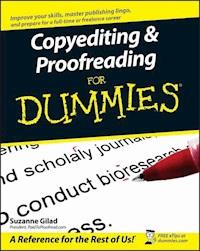
Turn your knack for language into a lucrative career Must-know techniques and resources for maximizing your accuracy and speed Interested in becoming a copyeditor or proofreader? Want to know more about what each job entails? This friendly guide helps you position yourself for success. Polish your skills, build a winning résumé and land the job you've always wanted. Books, magazines, Web sites, corporate documents - find out how to improve any type of publication and make yourself indispensable to writers, editors, and your boss. * Balance between style and rules * Master the art of the query * Use proofreader symbols * Edit and proof electronic documents * Build a solid freelancing career
Sie lesen das E-Book in den Legimi-Apps auf:
Seitenzahl: 517
Veröffentlichungsjahr: 2011
Ähnliche
















Copyediting & Proofreading For Dummies®
by Suzanne Gilad
Copyediting & Proofreading For Dummies®
Published byWiley Publishing, Inc.111 River St.Hoboken, NJ 07030-5774www.wiley.com
Copyright © 2007 by Wiley Publishing, Inc., Indianapolis, Indiana
Published by Wiley Publishing, Inc., Indianapolis, Indiana
Published simultaneously in Canada
No part of this publication may be reproduced, stored in a retrieval system, or transmitted in any form or by any means, electronic, mechanical, photocopying, recording, scanning, or otherwise, except as permitted under Sections 107 or 108 of the 1976 United States Copyright Act, without either the prior written permission of the Publisher, or authorization through payment of the appropriate per-copy fee to the Copyright Clearance Center, 222 Rosewood Drive, Danvers, MA 01923, 978-750-8400, fax 978-646-8600. Requests to the Publisher for permission should be addressed to the Permissions Department, John Wiley & Sons, Inc., 111 River Street, Hoboken, NJ 07030, 201-748-6011, fax 201-748-6008, or online at http://www.wiley.com/go/permissions.
Trademarks: Wiley, the Wiley Publishing logo, For Dummies, the Dummies Man logo, A Reference for the Rest of Us!, The Dummies Way, Dummies Daily, The Fun and Easy Way, Dummies.com, and related trade dress are trademarks or registered trademarks of John Wiley & Sons, Inc., and/or its affiliates in the United States and other countries, and may not be used without written permission. All other trademarks are the property of their respective owners. Wiley Publishing, Inc., is not associated with any product or vendor mentioned in this book.
LIMIT OF LIABILITY/DISCLAIMER OF WARRANTY: The publisher and the author make no representations or warranties with respect to the accuracy or completeness of the contents of this work and specifically disclaim all warranties, including without limitation warranties of fitness for a particular purpose. No warranty may be created or extended by sales or promotional materials. The advice and strategies contained herein may not be suitable for every situation. This work is sold with the understanding that the publisher is not engaged in rendering legal, accounting, or other professional services. If professional assistance is required, the services of a competent professional person should be sought. Neither the publisher nor the author shall be liable for damages arising herefrom. The fact that an organization or Website is referred to in this work as a citation and/or a potential source of further information does not mean that the author or the publisher endorses the information the organization or Website may provide or recommendations it may make. Further, readers should be aware that Internet Websites listed in this work may have changed or disappeared between when this work was written and when it is read.
For general information on our other products and services, please contact our Customer Care Department within the U.S. at 877-762-2974, outside the U.S. at 317-572-3993, or fax 317-572-4002.
For technical support, please visit www.wiley.com/techsupport.
Wiley also publishes its books in a variety of electronic formats. Some content that appears in print may not be available in electronic books.
Library of Congress Control Number: 2007924228
ISBN: 978-0-470-12171-9
Manufactured in the United States of America
10 9 8 7 6 5 4
About the Author
Suzanne Gilad is the founder of PaidToProofread.com. Over the course of ten years, Sue proofread or copyedited over 1,200 books for Random House, Simon & Schuster, John Wiley & Sons, St. Martin’s Press, Oxford University Press, and Workman Publishing, among others.
Illustrating firsthand that proofreading and copyediting can be profitable and fun while allowing additional pursuits, Sue is also a successful voice-over artist based in New York. You can hear her voice happily hawking products and playing characters on national and regional radio and television.
Thanks to some unexpected proofreading projects on personal finance a few years ago, a whole world of education in residual income opened for Sue. She wrote The Real Estate Millionaire (McGraw-Hill, 2005) with her husband, Boaz Gilad.
Sue currently leads seminars on multiple streams of income, and her latest passion is to teach financial freedom. Sue’s next book is the story of the creation of 15 millionaires in five years. Visit www.SueGilad.com to learn more.
Author’s Acknowledgments
This book is the culmination of thirteen years’ experience, and many people encouraged me during the entire process. I would like to acknowledge the generous individuals who helped bring it to fruition.
To my students at PaidToProofread.com, who gave such valuable feedback on creating proofreading and copyediting careers across the country and the world. Your success stories are thrilling.
Thank you to Mike Lewis and Joyce Pepple at Wiley, and to Wendalyn Nichols who gave the manuscript such a detailed technical review. Special kudos to editor Joan Friedman.
To Michael Larsen and Elizabeth Pomada, magnificent agents of change!
To my remarkable team of business partners for their daily inspiration: Christine and Joe Abraham, Barbie Andrews, Corey Anker, Alicia Armistead, Lisa Boggs, Tracey Bonner, Tony Colombo, Bobby Creighton, Ash Curtis, Matt Daugherty, Dionne Dilks, James Donegan, Donna Drake, Kelly Drury, Sean Dugan, Jay Falzone, Niceto Festin, Kenneth Gartman, Meta Goforth, Lisa Gold, Myles Goldin, Eric Briarley Grundy, Christopher Hadlock, Matt Hagmeier, Chris Hall, Marnee Hollis, Jessica Horstman, Kristin Huffman, Matty LaBanca, Geri and Zoe Lance, Renee Lawless, Mike Lesser, Shana Levy, Kevin Loreque, Josh Marmer, Sherry Mills, Heather Morgan, Cynthia Murray, Tony Nation, Tootsie and Jesse Olan, Gregg and Jeff Pasternack, Dara Praisler, Shira Price, Andy Reimann, Larry Rogowsky, Joe Rojas, Max Ryan, Mark Sanders, Amy Silverman, Karen Slavick, Rebecca Soler, James Stirling, Joy Styles, Jen Swiderski, Eric Thomann, Yanick Thomassaint, Veronica Vera, Heather Wahl, Jason Weston, Amanda Whitford, Elaine Williams, Tashana Williams-Moye, Lizette Yeakley, Kenneth Yim, and Stephanie Zinn.
A special thank you to Anthony Tedesco for his brilliant contributions and for keeping me on track.
Jeff Riebe, who was in my thoughts during every moment of writing. Riebe, you are a true champion.
Judy Cohen and Colette Russen, thanks to both of you for guiding me through the freelance path and for believing in me when I truly stunk at this.
To the amazing Andrew Gitzy, who spearheaded it all as my co-writer for Paid to Proofread.
Dad, you’re the best for whisking the girls away to the playground every time I had a deadline to meet.
Tami Gaines is a wonderful gift. Thank you for your wisdom and guidance over the past two years. You have changed my life.
Words cannot express my gratitude to Christopher Braund Simpson and Kelly Suzan Waggoner, without whom this book could not have been completed — but if there were such words, Chris and Kelly would have written them.
Most of all, I am grateful to Boaz for being an extraordinary force in my life — best friend, cheerleader, husband. With Boaz, all things are possible. In all the romance novels I’ve edited, I have never found a hero who comes close to mine.
Thank you, readers, students, and colleagues, for reading, absorbing, and utilizing the principles in this book. May your wallet and intellect grow!
Dedication
For Mom, who taught me to love literature and the magic of words.
And for my greatest muses, Noa and Ella — the next generation of wordsmiths.
Publisher’s Acknowledgments
We’re proud of this book; please send us your comments through our Dummies online registration form located at www.dummies.com/register/.
Some of the people who helped bring this book to market include the following:
Acquisitions, Editorial, and Media Development
Project Editor: Joan Friedman
Acquisitions Editor: Michael Lewis
Technical Editor: Wendalyn Nichols
Editorial Manager: Michelle Hacker
Editorial Supervisor: Carmen Krikorian
Editorial Assistants: Erin Calligan Mooney, Joe Niesen, Leeann Harney
Cover Photos: © iStock.com/Ifness
Cartoons: Rich Tennant (www.the5thwave.com)
Composition Services
Project Coordinator: Jennifer Theriot
Layout and Graphics: Shawn Frazier, Brooke Graczyk, Denny Hager, Joyce Haughey, Barbara Moore
Anniversary Logo Design: Richard Pacifico
Proofreaders: Aptara, Dwight Ramsey
Indexer: Aptara
Special HelpRenata Butera
Contents
Title
Introduction
About This Book
Conventions Used in This Book
What You’re Not to Read
Foolish Assumptions
How This Book Is Organized
Icons Used in This Book
Where to Go from Here
Part I : Welcome to the Word World
Chapter 1: Reading as a Job? Oh, Yes
Debunking Some Myths
Getting a True Picture of the Professions
So . . . Are You a Copyeditor or Proofreader?
Preparing to Invest Yourself
Chapter 2: Jobs for Bookworms
Becoming a Professional Bookworm
Making a Book
Talking the Talk
Chapter 3: Other Publishing Opportunities
Majoring in Magazines
Trying on the Corporate Style
Searching for Even More Opportunities
Part II : Conquering Copyediting
Chapter 4: So, What Does a Copyeditor Do?
A Day in the Life of a Copyeditor
The Marriage of Proofreading and Copyediting: Identifying the Overlap
A Copyeditor Apart: Editing Content
Chapter 5: What Makes a Good Copyeditor Great
Checking (and Checking and Checking) Facts
Spying Potential Offenses: Three Ways to Save an Author’s Backside
Becoming a Sourcing Expert: Footnotes, Endnotes, and Bibliographies
Chapter 6: A Handful of Copyediting Specialties
Editing Fiction
Translating British Materials for a U.S. Audience
Heading into the Kitchen
Chapter 7: The Copyediting Process in Action
Example One: Dabbling in Fiction
Example Two: Touching on Technical Writing
Part III : Picking Up a Proofreading Career
Chapter 8: So, What Does a Proofreader Do?
Separating the Proofreader from the Copyeditor
What Does a Proofreader Look For?
Testing Various Ways to Read
Honing Your Skills
Chapter 9: Mastering the Proofreading Symbols
Covering Some Basics
The Core Symbols
Punctuation Symbols
Formatting Symbols
Layout Symbols
Chapter 10: Dipping Your Pencil in the Proofreading Waters
The Core Symbols in Action
Practical Punctuation
Fun Times with Formatting
Looking Out for Layout
My Hidden Agenda: Proofreading as Art and Science
Chapter 11: Watching a Proofreader in Action
Example One: Playing with Fiction
Example Two: A Recipe for Disaster
Example Three: Wonder of the Word
How’d You Do?
Part IV : Adding to Your Repertoire
Chapter 12: Boning Up on Punctuation and Usage
A Punctuation Primer
Your Hit Parade: Spelling and Word Usage Errors
A Grab Bag of Other Common Errors
Chapter 13: Dissecting Books and Magazines
Unwrapping a Book’s Front Matter
Baring a Book’s Back Story
Examining Everything in Between
Piecing Together a Magazine
Chapter 14: Balancing Between Style and Rules
Arming Yourself with Resources
The Unbreakable Rule: Rules Can Be Broken
Realizing When House Style Reigns Supreme
Committing a Few Rules to Memory
Chapter 15: Creating and Using the All-Important Style Sheet
What’s the Big Deal about the Style Sheet?
Copyeditors, Know Your Audience
Deciding What to Put on Your Style Sheet
Proofreading Your Baby
Sampling Style Sheets
Putting the Style Sheet into Action
Chapter 16: Formatting a Manuscript
Knowing Just Enough about Design and Composition
Meeting the Basic Codes
Placing Codes or Tags
Taking Special Care with Extracts
Highlighting Text in Boxes, Sidebars, and Other Cheaters
Creating Lists
Hard-Copy Typecoding Sample
Electronic Tagging Sample
Chapter 17: Editing and Proofreading Electronically
Choosing Your Computer Wisely
Keeping Your Body Happy
Reading the Electronic Page
Mastering the Electronic Process
Electronic Pros(e) and Cons
Part V : Turning Your Skills into Paychecks
Chapter 18: Hunting for Work
Getting Some Practice
Generating Documents That Get You Noticed
Breaking into Books or Magazines
Selling Your Services to Web Sites
Organizing Your Efforts
Chapter 19: Preparing for a Freelance Career
Succeeding As You Go: Reasons to Consider Freelancing
Considering the Cash: How Much to Charge
Beating a Path to Clients
Chapter 20: Keeping the Freelance Jobs Coming
Handling Your First Project
Caring for Your Connections
Taking Your Business to the Next Level
Benevolent Dictatorship: How to Be Your Own Boss
Part VI : The Part of Tens
Chapter 21: Ten Keys to Success as a Copyeditor
Figure Out Your Employer or Client
Meet the Deadline Every Time
Review the Manuscript Before You Start Editing
Respect the Author (Even When You Don’t)
Look It Up
Google It
Write It Down, Write It All Down
Proofread Your Own Work
Read (and Then Read Some More)
Stay on Top of Changes in Your Profession
Chapter 22: Ten Keys to Success as a Proofreader
Know That Once Is Not Enough
Give the ToC Some TLC
Don’t Forget the Headings
Don’t Forget the Running Heads and Feet, Either
Look Out for Graphics
Keep It Neat
Mind Your PEs (and AAs)
Never Reedit
Read (And Then, Read Some More)
Dig the Deadline
Part VII : Appendixes
Appendix A: Commonly Misspelled Words
Appendix B: Glossary
Appendix C: Online Resources
Reference
Fact-Checking
Usage and Style
Other Stuff
Further Reading
End User License Agreement
Introduction
You read, right? Magazines, books, the back of your toothpaste tube. (Hey, we all get desperate.) How did that stuff get written? Well, people tend to think of writers, but few think about the unsung heroes who make those words look good: copyeditors and proofreaders.
Most words go through an entire process before they get printed on your toothpaste tube. Or in your magazine. Or in the juicy thriller in your backpack. In this book, I demystify the smoke and mirrors behind making writing good writing.
Let me be clear from the start: The grammar check function on your word-processing software does not create the kind of good writing I’m talking about. Don’t get me wrong: Technology is good. But all the electronic organizers, GPS devices, and robot vacuum cleaners in the world can’t do what people have been doing for thousands of years: communicate clearly and effectively through writing. That task is left to the writers, who are very much still in vogue. It can only follow that we copyeditors and proofreaders — who clean up after writers — are very much in our heyday as well.
I wrote this book for word lovers: people with an interest in becoming copyeditors or proofreaders, improving their language skills, and increasing their knowledge of the world of editing. I’m not talking about snobby word freaks here. (You know who you are, Edmund, from Freshman Composition.) I’m talking about people who love language, have a pretty solid understanding of how a sentence and a paragraph are put together, and truly enjoy the hunt for errors. If I just described you, welcome to your book! You and I are going to have a good time — promise.
About This Book
This book is meant to be used as a resource. Pick the parts that interest you most, and get what you need from them. If you want to delve in further at a later date, more will be waiting for you. You don’t need to read everything in order; this is no murder mystery where each section leads to the next.
I wrote this book knowing that you may be just starting out in the career world or you may be looking to change careers. Either way, I show you how to prepare yourself to be a good copyeditor or proofreader (or both), build your résumé, hunt for paying work, and excel on the job.
Conventions Used in This Book
Because almost no book can be the only resource you need on a particular topic, I include references to lots of other helpful books and Web sites. When you come across a Web address (which appears in monofont), be aware that the page layout may have required it to break across two lines of text. If that happened, trust me that I didn’t insert any extra characters (such as hyphens) to indicate the break. So just type the address into your browser like the break doesn’t exist. Then cross your fingers and hope that your Internet connection is better than mine.
What You’re Not to Read
I wrote every word of this book with the hope that you’d read it. But if you’re strapped for time, here’s a hint: Text that appears in sidebars is not critical to your understanding of copyediting and proofreading. I include that material for people who want a little more information or require a deeper explanation. If you’re in a hurry, just ignore that stuff. I’ll never know.
Foolish Assumptions
I’m guessing you’re reading this book for one of two reasons:
You want to become a copyeditor or proofreader. Perfect. This book contains lots of information you need to know to become a skilled copyeditor or proofreader — or both. Each section is designed to give you the tools and information necessary to get hired in an increasingly competitive field.
I confess that I can’t cover every topic in-depth. Most of my work experience is with book and magazine publishing, so those fields naturally get a lot of attention in the text. And much of the information applies no matter what type of publication you want to work with. However, working on a newspaper staff is very different from working with a book or magazine publisher. Most people interested in newspaper work spend at least four years and lots of dough to get a journalism degree. I simply can’t give newspapers the coverage they deserve, but I can (and do) suggest resources to supplement this book if newspapers are your destination.
You want to brush up your editing skills. Perfect. This book offers lots of juicy info that can help you improve your editing skills (and your writing skills as well). This isn’t a grammar guide, but you get solid tips about how punctuation should be used, and I point out the most commonly misspelled and misused words. I discuss various methods of reading documents so you can train your eyes and your brain to catch errors and question inconsistencies. I also list lots of other references so you know where to look if you’re craving more details about grammar or usage.
How This Book Is Organized
This book is divided into seven parts:
Part I: Welcome to the Word World
Want to explore the world of publishing without having to break the door down? Here’s where you get to know the major, minor, and little leagues in the prettily packaged planet of publishing. You also get the lowdown on the processes of bookmaking — the editing, production, and manufacturing steps that bump the book from conception to completion. But what if books aren’t your professional destination? No problem. I also discuss other ways to turn your passion for words into a full-time or freelance salary, from working on magazines to creating corporate documents to cleaning up the information superhighway.
Part II: Conquering Copyediting
In this part, I escort you through the gates of copyediting. I explain what copyeditors do all day and how they get it done, and I discuss the nuances of perfecting copy. You also find valuable sample sections to review so you can see copyediting techniques in action.
Part III: Picking Up a Proofreading Career
This part offers the 4-1-1 on proofreading. I know you’re already a great reader, but here I ask you to reconsider your approach so you can pick out all the things a proofreader looks for. You get a crash course in the hieroglyphics better known as proofreaders’ marks and two chapters’ worth of opportunities to see proofreading in action.
Part IV: Adding to Your Repertoire
Whether you want to copyedit or proofread, you need to be able to quickly identify punctuation and usage errors. I begin this part by reviewing punctuation use and highlighting some of the most commonly misspelled and misused words. Next, I offer a chapter on the anatomy of a book and magazine so you speak with authority about front matter, back matter, and all the matters in between.
I also show you how to balance rules against style and make informed judgment calls, and I explain what a style sheet is and how to use it. One of the most important chapters in the book appears here as well: one that explains how to copyedit and proofread electronic documents. (Even if your computer skills won’t earn you bragging rights, you want to add this knowledge to your repository so you don’t miss out on valuable job opportunities.)
Part V: Turning Your Skills into Paychecks
Here’s where you get the scoop on how to hunt for full-time or freelance work. If freelancing is your goal, you can read success stories from the people who are at the top of this profession, find out how to land your first paying gig, and discover how to make that first opportunity translate into a steady stream of work.
Part VI: The Part of Tens
If you’re looking for quick advice on how to make yourself stand out as a copyeditor or proofreader, this is the part for you. I offer ten tips for succeeding in each field.
Part VII: Appendixes
This part may make your life a bit easier: It contains three handy guides that you can use as references. First, I present a list of the most commonly misspelled words you’ll see while reading. Next, you find a glossary of terms you can use while navigating the book or magazine publishing world. Finally, I offer a list of online resources to use for checking facts, improving your skills, or chatting with people who share your love for words.
Icons Used in This Book
To keep things around here neat and tidy, I’ve marked some paragraphs of this book with the following icons:
This icon indicates something that you want to keep in mind for a later time. The information may be something you’re already aware of, but even so, tuck it away for future use because it’s something that I think could make the difference between doing okay at copyediting and proofreading and doing some serious cranking.
This icon indicates something that I’ve found to be particularly useful in my career as a copyeditor and proofreader. Think of these little nuggets as tricks of the trade.
I don’t use this one often — try to accentuate the positive whenever possible, right? But if I want you to avoid making a mistake that could cause some serious friction with your boss, client, or author, I highlight the suggestion with this explosive icon.
Where to Go from Here
Figuring out copyediting and proofreading is all about taking the leap and giving it the old college try (no matter how poor your skills may be at first).
If you find that you are more interested in one part of this book than another, and you want to start there, go for it. There’s no reason to read each page in succession from cover to cover. By all means skip around and find the sections that are most useful to you. When you hit the ones that are closest to your heart, I have every confidence that you’ll laugh, you’ll cry, you’ll wax grammatical.
Part I
Welcome to the Word World
In this part . . .
I help you get a general sense of what these folks called copyeditors and proofreaders do and where they do it. That way, as you prepare to join their ranks, you can develop a pretty clear picture of what your work life may look like.
You may know a lot more about copyediting and proofreading than you think. Don’t agree? Flip to Chapter 1. I bet you’ll be totally impresed with yourself. Er, make that impressed. In Chapter 2, I explore the world of book publishing, in case that’s the type of job you’re aiming to get. If it isn’t, you may want to jump right to Chapter 3, where I touch on some of the other job opportunities available.
Chapter 1
Reading as a Job? Oh, Yes
In This Chapter
Recognizing your qualifications to proofread and copyedit
Setting aside some outdated images
Discovering some truths about copyediting and proofreading
Considering which career path to pursue
So you picked up this book to discover how to become a copyeditor or proofreader? I’ve got some news: You’re probably already pretty good at it. You’ve been training for this career path since you first picked up A B C blocks in nursery school. Let me guess: You’re the person everyone begs to review their résumés . . . college applications . . . term papers . . . doctoral theses.
Any time you improve upon someone else’s writing, you take on the tasks of a copyeditor or proofreader. If you share your skills, helping people by wordsmithing for them and providing them with a better finished product, you’re already working in this field. The question is, are you getting paid for it? If not, I offer lots of advice in this book for turning your skills into paychecks. But let’s not put the cart before the horse. Here’s a little (true) tale for you.
I was bursting with pride when my friend Kevin called me on my lunch break many years ago. I had just landed my first freelance proofreading job through a temp agency, and my head was awash with the possibilities that lay ahead of me: an extra paycheck, potentially interesting material I could read in my spare time, and a flexible schedule that would allow me to have a social life. I told Kevin all about the job, adding that I had just proofread a piece for a major advertising firm.
“That’s scary,” he said.
I tried to reassure Kevin. “It’s not scary at all. You just have to read a little more slowly than normal and keep in mind . . .”
“Actually,” he interrupted, “I don’t mean scary that way. I mean that, here’s this big agency that feels it’s so important that whatever-it-is-they-sent-you is correct, they don’t trust their own people with it. So they decide it’s worth it to pay an ‘expert’ to proof it for them . . . and then it goes to you, who always misspells my last name. That’s scary.”
Hm. For a moment, I agreed with him.
But what I didn’t know then was that almost all proofreaders start out as I did — with little more than an interest in reading, access to a dictionary, and a few short lessons on style, grammar, and how to make proofer’s marks. See, I didn’t have to be a phenomenal speller; I just had to be able to look up words I was unfamiliar with. If I was unsure about grammar, I just had to know which reference guide to check. (And in all fairness, that guy’s last name was really hard to spell. It had, like, four consonants in a row.)
It soon became clear to me that I was doing just fine. And looking back, I realize that I did so without the kind of guidance I include in this book. So if you take nothing else away from reading this text (which I sincerely hope isn’t the case), know that you are indeed qualified to review the writing of others. And believe me, the more you do it, the better (and faster) you will be.
As for me, knowing that I can impart information to you that will put you way ahead of where I was when I began my proofreading career makes me so proud I could pretty much, well, burst.
Debunking Some Myths
Maybe you’re carrying around some archaic images in your skull about what copyediting and proofreading entail. If you assume that taking this career path means you’ll be wearing nerdy glasses while forever flipping through dusty grammar tomes and making nice white sheets of paper bleed with the markings from your red or blue pencil, think again. The resources you turn to for advice on grammar, spelling, and usage are just as likely to be Web sites as reference books. (See the resource listings in Chapter 14 and Appendix C if you want proof.) And depending on your employer, you may make all your contributions via keyboard instead of red or blue pencil (as I discuss in detail in Chapter 17).
So put your nerdy glasses away (unless you really like them, in which case, who am I to judge?). The world of professional words is full of infectiously cool creative types — writers, editors, designers, and artists. We’re movers and shakers with creative ideas and (almost always) a true love of reading, which means we’re pretty fascinating to talk to at parties.
Here are some other myths to strike:
Copyeditors and proofreaders have to be students of literature and English, classically trained by Ivy League professors. Even if there were a million bucks in it for me, I don’t think I could diagram a sentence. And reciting Shakespeare? Let’s just say my exposure to good ol’ William has more to do with Kenneth Branagh than I care to admit. Really. Or, um, verily.
You don’t need to know every nuance of the English language to be a copyeditor or proofreader. It helps to be an avid reader, but it doesn’t matter if you fall asleep at night reading Norton anthologies or copies of Sports Illustrated.
If you read for money, you’ll never enjoy reading again. The running joke among copyeditors is that if anyone ever buys us a book, there better be some cash tucked into the table of contents or we’re not going to bother reading it.
For me, it’s definitely a bonus that nowadays most of what I read is on someone else’s dime. Still, there’s no better thrill than putting my feet up and settling into a suspense thriller — without having to scour for errors. Chefs still enjoy tasty meals. Lifeguards still enjoy swimming. I still enjoy reading.
If reading is pleasurable to you now, it always will be. And I encourage you to pursue jobs that allow you to read the types of materials you find most interesting; don’t assume that in order to preserve your love for romance novels you’d better focus your professional efforts on scientific journals, for example. Stick with your passions, and chances are that you’ll be inspired to do great work (which will lead to you getting even more jobs). See Chapters 2 and 3 for some ideas of how to fine-tune your career goals.
All that reading will destroy your eyes and your back. If you choose to copyedit or proofread, you won’t be reading in the dim confines of a monastic cave. You’ll be reading the way you normally do — as if you’re perusing the morning newspaper or your favorite Web site. The difference is that you’ll be a bit more focused on the content.
In Chapter 17, I offer lots of tips for keeping your eyes, back, and other parts healthy while doing these jobs. The harder part is keeping your brain from experiencing overload while you process hundreds of bits of information on each page!
Getting a True Picture of the Professions
So copyediting and proofreading don’t require an Ivy League degree, won’t destroy your love of reading, and shouldn’t cause your body to deteriorate. In place of these myths, allow me to offer some truths that may help you develop a better idea of what to expect from either profession:
You can’t pick copyeditors or proofreaders out of a crowd. They’re people just like you and me. Some are full-time wordsmiths, and some are stay-at-home moms and dads fitting jobs in between the kids’ naps. (If you’re the stay-at-home type, be sure to check out Chapters 19 and 20 for tips on constructing a freelance career.) Some make copyediting or proofreading their sole profession, and some use their language skills to supplement an unsteady (or steadily low) income.
If there’s one thing that is true about copyeditors and proofreaders across the board, it’s that they are all fantastically beautiful and charming. And funny.
Opportunities abound. As literacy rates and the global population grow, so grow the markets for proofreaders and copyeditors. If the job opportunities available in the United States aren’t quite vast enough, you can always market yourself to firms in countries with significant English-speaking populations. A lot of people across the globe speak English as their first language. (I could tell you how many today, but that population explosion would keep proving me wrong.)
Here’s another reason you should have no trouble finding work as a copyeditor or proofreader: the World Wide Web. Before the Web came along, there were already lots of words being printed every day that needed to be copyedited and proofread. But with Web content thrown into that mix of (constantly changing) written communication, the possibilities for someone with your skills are limitless. Who knows? You could become the official copyeditor or proofreader of a Web site just by spotting an error and sending a friendly e-mail with your résumé attached (see Chapter 3 for ideas).
You get a paid education from either profession. Tell me if this advice sounds familiar: “Get a good education so you can get a good job!” That was my dad, the proponent of higher education. Well, we editorial types have good jobs that give us great educations.
My job as a copyeditor and proofreader is to get educated — oftentimes, with information I never would have happened upon in a library or bookstore. Whether you want to work with books, newspapers, Web sites, magazines, corporate reports, advertising copy, or bubblegum wrappers, I can pretty much promise that you’ll be introduced to information you never knew existed.
Your career can be as mobile as you need it to be. If you’re looking for full-time employment that comes with an office (or at least a cubby), mobility may not matter much to you. But if you’re given to roam, you’re considering the right professions.
Copyediting and proofreading can be done from anywhere in the world. If you freelance, or if you work for a company that allows telecommuting, you can work from your bedroom, on an airplane, or at the beach — no one will care as long as the job gets done well and on time. To make this happen, you may need to invest in a quality laptop computer; see Chapter 17 for my thoughts about what to look for in that piece of essential equipment.
Even if mobility isn’t your key concern right now, the skills you develop as a copyeditor or proofreader can help you get work wherever you may wander during your lifetime. These days, few of us stay put for decades on end, so investing the effort in a career with this kind of portability makes a whole lot of sense.
Your hours can be as flexible as you need them to be. Again, you may prefer (or need) a full-time schedule that comes equipped with health benefits and the other perks of a salaried position. But if you prefer (or need) a flexible work schedule, you definitely want to check out Chapters 19 and 20 where I discuss how to build a freelance career.
How flexible is flexible? Well, it’s 1:22 a.m. right now, and my home office (which happens to be a few steps from my bed) is open. As a freelancer, you can copyedit or proofread at 9 a.m. or 3 a.m. — the person giving you the assignment doesn’t care as long as you meet the deadline.
And another key perk of this flexibility is that you can say yes to as many or as few jobs as you can handle at any one time. If you’ve got other obligations that will demand a great deal of time in certain weeks or months, you have complete freedom to keep your copyediting or proofreading schedule clear during that time period. As long as you deliver quality work (on time), your contacts should be happy to hear from you when your schedule lightens and you’re available to accept assignments again.
If writing is your ultimate goal, copyediting and proofreading can carry you closer to it. Reading published work — or about-to-be-published work — can help you develop your own writing skills. Obviously, you could just read these pieces on your own and gain the same benefits. But why not get paid to do so? Besides, as I explain in Chapters 4 and 8, the process of copyediting or proofreading requires digesting text in ways that are atypical of a pleasure read. When you’re hired to help make a publication as perfect as it can be, you pay some serious attention to every word on the page.
And if the on-the-job writing education isn’t enough of a perk, the networking opportunities are another selling point. I wouldn’t encourage you to try to sell yourself as a writer as soon as you finish the first proofreading job for a new employer, but over time, as you prove how adept you are at wielding a pronoun, you may be able to identify writing opportunities that fit your skills.
You’ll have lots of fun stuff to talk about at your next class reunion. When you bump into an old acquaintance and he asks what you’ve been up to, won’t it be fun to rattle off the latest books, magazines, or Web sites you’ve worked on? This line of work makes for good conversation. Don’t be surprised if people ask you how they can get into it too.
So . . . Are You a Copyeditor or Proofreader?
Even a trained eye can mistake a copyeditor for a proofreader or a proofreader for a copyeditor — they know the same marks, they carry the same tools, and they even kinda look the same. What’s the difference, then?
Distinguishing between the two
The skills that a proofreader needs are probably the same ones that led you to pick up this book. You’re the person who can’t keep from crying out at errant apostrophes, right? And I think I heard your scream in the Italian restaurant a few weeks back — something along the lines of “How could they forget the h in spaghetti, for heaven’s sake!” And then there’s that pesky issue of which witch is which. Nobody gets that right but you. A proofreader examines text, discovers what’s wrong, and fixes it.
A copyeditor is like a proofreader who has gone to grad school. Well, metaphorical grad school.
Here’s the simplest difference between the two positions: The copyeditor gets his mitts on the text first. That’s because he has responsibilities that go beyond the proofreader’s. He pays close attention to grammar, punctuation, usage, and spelling, of course, but he also is charged with ensuring the consistency of voice, chronology, and fact. Plus, he checks every fact, every name, every Web site referenced to make sure the reader is getting accurate information. And he keeps meticulous notes the whole time (in a document called the style sheet, which I discuss in detail in Chapter 15) so he can make sure that the writing on page 203 reflects the same decisions as the writing on page 14.
Yup, good writing requires making a lot of decisions. Writers make them, publishers make them, production editors (whom I introduce in Chapter 2) make them, and copyeditors usually get to make them too. (At the very least, copyeditors can query authors and editors — ask questions and make suggestions — to highlight potential problems and suggest solutions. I spend some quality time discussing the fine art of the query in Chapter 4.) Proofreaders generally don’t make a lot of decisions; their job is to make sure that every decision documented on a style sheet (or in a publisher’s house style documentation — see Chapter 14) is implemented on every page of the document.
Choosing where to focus your energies
I began as a proofreader, so it’s my humble opinion that the best path is the one that starts at proofreading. If you’re getting into these fields because you adore reading, proofreading gives you exactly what you want: the chance to cozy up with (you hope) good writing and help to make it even better. Plus, you get to examine exactly what the copyeditor did before you got the text. If you’re observant (and I know you are), you can pick up a lot of new skills that way and prepare for a future career in copyediting, if that’s your goal.
But hey, if copyediting is where you want to begin, don’t let me stop you. Maybe you’d go mad if you couldn’t influence the bigger picture of how a book or article or annual report is put together. Maybe you’ve already had enough proofreading experience (paid or unpaid) to know that you’re ready to dig deeper into how writing is crafted.
Want some really great news? If you want to do both jobs, you can. You may have a slightly harder time doing so in a full-time position than in a freelance capacity, but the possibility exists either way. For full-time work, you may want to focus your search on smaller organizations whose staff members may be expected to fill multiple functions during the publishing process. If freelancing is your aim, the only person who decides whether you accept a proofreading job or a copyediting job is you.
Whichever path you choose to start down, I offer lots of info in Parts II and III of this book to get you going. And I strongly encourage you to read chapters in both parts even if you’re confident that you’re going to search for only one type of job. If copyediting is your thing, you definitely need to know proofreading marks and the types of errors you’ll be correcting — information I detail in Part III. And if proofreading is your destination, you can certainly benefit from understanding what a copyeditor does. (The more you understand about that job, the better the chance that you’ll avoid overstepping your bounds by questioning decisions made before you got the text.)
Preparing to Invest Yourself
This is a reference book. I don’t expect that you’ll read every word (I know, you’re not proofreading it); I do expect that you’ll turn back to certain chapters and the appendixes as you begin to establish yourself in the publishing world.
Here’s something else I expect: When you get a copyediting or proofreading job (or multiple jobs, if you’re freelancing), you’ll discover that your employer does things just a bit differently than what I describe here. Maybe even a lot differently. The challenge of writing a book like this is that I can’t possibly prepare you for every scenario; you have to do the work of adapting the information I offer to your specific work situation.
If you’re looking for a hard-and-fast truth about copyediting and proofreading that won’t change from job to job, here it is: To succeed in these professions, you must be persistent and patient. When you’re searching for work, persistence and patience definitely pay off; you can’t let rejections deter you from your goal. And when you’re on the job, those attributes are crucial as well.
I’d like to promise that when you start getting paid to copyedit or proofread you’ll never again have to work on documents as horrid as your college roommate’s term papers. But I can’t make that promise. Once in a while (I hope not too often), you’re bound to find yourself staring at a manuscript or computer screen filled with text that makes absolutely no sense — and not because it’s tackling a subject like quantum physics. The good news is that, as a copyeditor or proofreader, your job isn’t to rewrite that gobbledygook. Your job is to politely point out its deficiencies (see Chapter 4 for wording suggestions) and nudge it as far toward publishable status as you can.
In this scenario, persistence and patience will see you through. Your best option is to try to wow the person who hired you by identifying (and, if possible, correcting) as many errors and sources of confusion as possible. If you can accomplish that while working on a truly problematic piece, I can say with confidence that you’ll be rewarded with much more fun assignments as time goes by.
Chapter 2
Jobs for Bookworms
In This Chapter
Identifying your true loves
Meeting the publishers, big and small
Making a book happen
I’m betting you wouldn’t drive from Rochester to San Diego without checking your map (assuming, of course, that you are not my father). For such a trip, you’d probably note your overall direction, choose the highways to take (or let an online mapping program do it for you), get a sense of what cities you’ll pass through, and maybe even scope out a few possible places to sightsee or find lodging for the night. You want to know more than your destination; you want to know what’s just beyond the next bend as well.
Likewise, if you’re a person who’s loaded up, strapped in, revving the engine, and destined to work in the publishing industry, you’re probably curious about what comes next. The road ahead is dotted with publishing prospects. In this chapter and the next, I help you map them out.
I have a hunch that you may be most interested in copyediting or proofreading books. (If I’m wrong, feel free to go directly to Chapter 3, where I talk about lots of other opportunities available to you.) In this chapter, I give you ideas for getting starting on that path. For copyeditors and proofreaders, book publishing is a great industry to focus on. It can provide not only steady work but also defined standards to follow as you go about your business. Most book publishers have style guides chock-full of details you need to apply to the copy you’re reading — things like whether the house uses serial commas or how to hyphenate compound modifiers and other stuff to satisfy your word-nerd heart.
In some ways, the explosion of technology and mega-media ownership has made the publishing industry easier to navigate than before. But it’s still a place of bewildering stages of approvals and rejections, agents and editors, and politics and polishings to get from the writer’s brain to the book’s binding. If you’ll allow me room to wave my wand, I’ll do my best to break down the bewilderment.
Becoming a Professional Bookworm
If books are your destination, one of the best first steps you can take is to get familiar with various publishing houses and their specialties. Your goal is to find out who publishes what and then zero in on the type of stuff you’re interested in reading.
Browsing the shelves
Field trip time!
Here’s a field trip you can go on without even putting on your shoes: Go to the bookshelves of your personal library, and take a look-see at the spines of what’s there. See a Penguin or an Oxford? How about a Vintage or a Faber & Faber? You’ll probably pick up on a theme — you’ll see that the same publishers keep popping up. Well, that’s a pretty good indication of the publishers you want to focus on working with in the future.
Okay, now pull on a backpack (and some shoes) and walk to your local bookstore. Spend some time wandering through the aisles, maybe even traipsing to those far-reaching sections you never darken with your presence. Like children’s books? Pick up your favorite, flip to the copyright page, and take note of the publisher’s contact info. Enjoy New Age novels? Get a feel for who the major publishers are, and move in that direction when making your contacts.
As soon as you start identifying publishers of material you enjoy, jot down their contact information. That way, when you begin job hunting (see Chapter 18), you already have company names and addresses on hand.
Eyeing imprints
Book publishing is an industry that offers plenty of in-house copyediting and proofreading jobs — and it’s prolific in offering those of the freelance variety. Like any other industry, it has gone through a number of consolidations in recent years, resulting in but a handful of conglomerate houses publishing the bulk of the novels and nonfiction marvels read each day. I can’t tell you if that’s great for the publishing industry, but it’s great for you. Here’s why: You could conceivably work within one publishing house and hit every fiction genre and nonfiction subject area through its imprints.
What are imprints? Imprints are ways for publishing houses to market specific groups (or, in the biz, lines) of books to specific segments of the population. For example, Random House’s Knopf imprint is known for high-end writers with a literary bent. Vintage, part of the Knopf division, is the paperback imprint. Another Random House imprint, Doubleday, does more commercial work, and one of its paperback imprints is Bantam. Imprints are like neighborhoods that have their own character; the publishing house is the city that comprises all the neighborhoods.
Usually, imprints have their own look and feel (the biz lingo is branding). For instance, the Rough Guide imprint owned by Pearson publishes travel guides for lower-budget travelers, and the logo appears on everything from books to maps to phrase books and more. This branding lets a reader know the type of information, language, and style that can be expected, even before picking up a particular book.
The great thing about imprints is that many are housed within the same building of a particular publisher. After you’ve got a foot into one imprint, you’ve got at least a toe or two in the door of a sister imprint as well.
Getting to know the major publishers
So who are these publishing conglomerates? There are really only six major publishers these days, each housing the many divisions and imprints that make up the book industry. Gather ’round for the breakdown:
Bertelsmann AG: Anchor, Ballantine, Bantam, Broadway Books, Crown, Dell, Dial, Doubleday, Fodor’s, Golden Books, Knopf, Modern Library, Pantheon, Random House, Vintage, and others
Hachette Book Group USA (until recently Time Warner Book Group): Bulfinch Press; FaithWords; Little, Brown and Company; Springboard Press; Warner Books; and others
Holtzbrinck: Faber & Faber; Farrar, Straus & Giroux; Henry Holt; Let’s Go; Macmillan; Metropolitan; North Point Press; Owl; St. Martin’s Press; Times Books; and others
News Corp.: Access Travel, Amistad, Avon, Ecco, Cliff Street, HarperCollins, HarperCollins Children’s Books, Harper Perennial, William Morrow, and more
Pearson: Addison-Wesley; Berkley; DK Publishing; Dutton, Grosset & Dunlap; Ladybird; Longman; Peachpit; Penguin; Penguin Putnam Young Readers; Plume; Prentice Hall; Puffin; Rough Guides; Viking; and others
Viacom: Archway, Free Press, Kaplan, Pocket, Scribner, Simon & Schuster, Touchstone, and others
These are the mainstream mainstays who publish more than 100 titles per year. And this is all-important to you because this key piece of information — how many titles are published each year — helps you determine the heavy hitters who will need you (and many others like you) to copyedit and proofread everything that’s produced. The production editors at these publishers are your no-brainer starting points.
Just because a certain publisher doesn’t appear on this list doesn’t mean you can’t find work there. For example, I haven’t included John Wiley & Sons in the list, and that’s the company responsible for the words you’re reading right now. Consider all the publishers who interest you, and check how many books they publish a year. If your chances of finding work look good, go for it.
Writer’s Market (F&W Publications, Inc.) is the industry bible containing names, addresses, phone and fax numbers, and Web sites for every book, magazine, and trade journal publisher you could possibly want to know more about. (To find out how many books a publisher produces each year, this is your go-to resource.) In Chapter 18, I show you how to use Writer’s Market as a job-hunting tool. For now, know this: If you want to work in book publishing, you need to have access to this book. Buy it, borrow it, or pay a subscription fee to access it online at www.writersmarket.com.
Another goldmine of a resource is the Literary Market Place (Information Today). This tome, produced for domestic as well as overseas publishers, covers books, magazines, and newspapers. It is a yearly publication about the size of a phone book. You can find it in the reference section of your local bookstore or library.
Working with the specialists
No, I’m not talking about specialists who don lab coats and sprinkle fingerprint powder. Specialists are niche-market houses, academic publishers, and others. They also represent another career path for copyeditors and proofreaders.
Working at a university press is an interesting way to gain access to what’s being discussed at the academic level. New poets and literary trends, recent research in the arts and sciences, studies in the geographical areas of the universities themselves — the books produced by university presses are often fascinating scholarly works written by experts in the field. If you love Wallace Stevens, you just may be able to edit somebody’s academic thesis on his works!
Some of the bigger university presses include Cambridge University Press, Columbia University Press, MIT Press, New York University Press, University of California Press, University of Chicago Press, and Oxford University Press. Your handy Writer’s Market includes these presses and more. Take a gander at the number of titles they publish annually so you have a clue as to the size and viability of each university press.
For each publisher listing in Writer’s Market, there’s a rundown of the subject areas in which the publisher specializes. Take a look at them, and contact publishers that match your own areas of interest. All that time you spent in school may give you an advantage within a specific field (unless you focused a bit too much on the underwater basket-weaving).
There are enough niches in book publishing for just about anybody to get published. Religion can include reads for Christians, Jews, Wiccans, and follows of Zoroaster. Romance encompasses books for the gay and lesbian communities, the religious communities, and the . . . ahem, slightly naughtier communities. Whatever you’re interested in, you’ll find something to explore in the recesses of any topic.
Some publishers produce few enough materials each year to actually count on your digits — maybe on one hand. What’s great about them? Nobody’s calling every minute of the day for a job. And if they’re located in your hometown, you can slip in for a day or a week, maybe even take a project home, getting a good foot in the door and a few lines on your résumé. Hometown beginnings need not be so humble!
Vanity, thy name is . . .
Everybody has a book she wants to get into the grubbies of publishers, and a venue exists to meet that demand: subsidy presses. Through the average publishing process, an author submits a proposal or sample chapters to a literary agent or acquisitions editor, crossing her fingers that it will be chosen for publication. If the manuscript is chosen, the publisher pays an advance to the author and negotiates a contract that includes (one hopes) paying out royalties on the work.
In contrast, any Tom, Dick, or Mary can publish a work with a subsidy press. In fact, subsidy presses pretty much rely on authors for business, charging a writer a fee in return for publishing his books. (By the way, subsidy presses are also known as vanity presses.)
You will not find subsidy presses in your handy-dandy Writer’s Market. A better place to look is in the back of publishing magazines, where subsidy presses often advertise. What are these publishing magazines? There’s Publishers Weekly, Writer’s Digest, Writers’ Journal, and Poets & Writers, for starters.
Some of the better-known subsidy presses include the following:
AuthorHouse: www.authorhouse.com
BookSurge: www.booksurge.com
Dorrance Publishing Company, Inc.: www.dorrancepublishing.com
Infinity Publishing: www.infinitypublishing.com
iUniverse: www.iuniverse.com
Ivy House: www.ivyhousebooks.com
Melrose Press: www.melrosepress.co.uk
Vantage Press: www.vantagepress.com
Watermark Press: www.watermarkpress.com
Xlibris: www.xlibris.com
Subsidy presses can be a great place to begin your copyediting or proofreading career, what with the amount of published material that goes through them. Plus, their quality control is not as stringent as it is at a major press, so they’re more likely to forgive your fledgling errors. (I know you never make them, but . . .) However, subsidy-press budgets tend to be pretty tight, so don’t expect bells-and-whistles treatment. And I’ll whisper this: Some of the books can be downright dreadful. Just a word of warning.
Making a Book
In recent years, some publishing houses have grown so vast that they now house specialized honeycombs of busily buzzing bees. In addition to the dizzying publishing divisions for fiction, nonfiction, music, academic, ad nauseam, the hive of a publishing house also contains distinct editorial, publishing, sales, and marketing departments.
If you become a copyeditor or proofreader for one of these publishers, you will be one bee — albeit a very important one — in a honeycomb of a very large hive. You don’t need to be familiar with every stage in the book- publishing process, but it doesn’t hurt to know how that industry functions.
The movers, shakers, and machines that move a typewritten manuscript to a beautifully bound book (or a fully accessible Web site) are part of something known as the production process. Production can be further broken down into the editorial stages, the production stages, and the manufacturing stages, each with their own actors. In the sections that follow, I walk you through a typical process at one of the big publishing houses. There are always exceptions, however, so don’t be surprised if things work differently at some companies.
The editorial stages: Acquiring a book
Think of the editorial stages as everything that takes place before a book can be considered ready for polishing and publication.
Meeting the people
I’ll start by introducing who’s who on the editorial side of the business:
Editor-in-chief: Oversees the editorial direction and related policies of the imprint or publishing house, including content, style, budgets, and the editorial staff.
Acquisitions editor: Works with the editor-in-chief to acquire content and make decisions about upcoming title lists. The role varies from publisher to publisher: This person can have the actual title acquisitionseditor or can be called an editor, senior editor, or executive editor depending on seniority and on how much staff and list management responsibility the position carries. Some acquisitions editors are heavily involved in editing, and others do the acquiring and then assign the actual editing to a more junior editor.
Associate editor (or editorial project manager): Works with the acquisitions editor in preparing manuscripts for production. This person works directly with the author and is the acquisitions editor’s right-hand guy or gal. An associate editor will begin to acquire books as well.
Assistant editor: Handles some of the more mundane (but absolutely crucial) editorial and administrative tasks, such as researching competing titles, logging and doing reader’s reports on submissions, logging contracts and royalty statements, and writing copy for sales sheets.
Developmental editor: Sometimes works with the acquisitions editor and author to help the author further develop a manuscript. This person may actually play the role of the author if the author cannot do the recommended or necessary rewrites.
Not every editorial department has each of these editors on staff, and not all positions are needed for each book. A developmental editor, for example, is only called upon for certain situations. Position titles can also vary between publishing houses.
Why isn’t the copyeditor on this list? The copyeditor is part of the team of people who polish a manuscript, as I discuss in the upcoming sections on the production process.
Proposing a project
Usually, everything starts with the author — or, more accurately, the author’s agent. Sometimes a publishing house contacts an author to write a book, but that’s not the norm; it happens most often with people who have name recognition. The majority of manuscripts come to a publisher unsolicited, and these can be divided into ones that are submitted through a literary agent (which gives them a better chance of being noticed) and ones that come in directly from an author over the transom (which gives them a slim chance of being noticed).
An agent submits a manuscript on behalf of an author to several publishing houses. A good agent plays matchmaker, pitching a manuscript to editors and publishers that he thinks make the best potential mates. If the author has a strong hook — for example, she’s well known and brings a built-in audience with her — the agent may be able to submit only a query letter or book proposal containing a book outline or table of contents; an introduction; and a completed sample chapter, often the opening chapter of the book.




