


17,99 €
Mehr erfahren.
- Herausgeber: John Wiley & Sons
- Kategorie: Wissenschaft und neue Technologien
- Sprache: Englisch
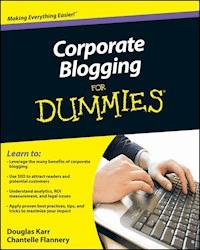
Establish a successful corporate blog to reach yourcustomers Corporate blogs require careful planning and attention to legaland corporate policies in order for them to be productive andeffective. This fun, friendly, and practical guide walks youthrough using blogging as a first line of communication tocustomers and explains how to protect your company and employeesthrough privacy, disclosure, and moderation policies. Blogging guru Douglas Karr demonstrates how blogs are an idealway to offer a conversational and approachable relationship withcustomers. You'll discover how to prepare, execute,establish, and promote a corporate blogging strategy so that youcan reap the rewards that corporate blogging offers. * Shares best practices of corporate blogging, including tricksof the trade, what works, and traps to avoid * Walks you through preparing a corporate blog, establishing astrategy, promoting that blog, and measuring its success * Reviews the legalities involved with a corporate blog, such asdisclaimers, terms of service, comment policies, libel anddefamation, and more * Features examples of successful blogging programs throughoutthe book Corporate Blogging For Dummies shows you how to establisha corporate blog in a safe, friendly, and successful manner.
Sie lesen das E-Book in den Legimi-Apps auf:
Seitenzahl: 544
Veröffentlichungsjahr: 2010
Ähnliche



















Corporate Blogging For Dummies®
Table of Contents
Introduction
About This Book
Conventions Used in This Book
What You Don’t Have to Read
Foolish Assumptions
How the Book is Organized
Part I: Getting Started with Corporate Blogging
Part II: Mapping Out and Implementing Your Corporate Blog
Part III: Engaging Your Search Engine Optimization Strategy
Part IV: Expanding Blog Posts and Promoting Content
Part V: Measuring Success
Part VI: The Part of Tens
Icons Used in This Book
Where to Go from Here
Part I: Getting Started with Corporate Blogging
Chapter 1: Corporate Blogging from Soup to Nuts
Why Blogging Is Different than Your Web Site
Understanding blogging as a communication tool
Using blogging as a search engine marketing platform
Recognizing blogging as an inbound lead strategy
Differentiating Corporate Blogging from Personal Blogging
Putting a human voice on your marketing communications
Speaking to your audiences
Writing with a purpose to a blog that sells
Defining Key Features of a Blog
Basic user interface features of a blog
Basic back-end features of a blog
Expanding your blog’s functionality
Recognizing the Benefits of Corporate Blogging
Booking public speaking engagements
Publishing opportunities online and offline
Attracting leads through your blog
Driving conversions online through blogging
Blogging: From Concept to Content to Conversion
Establishing your strategy and goals
Picking and training the blogging team
Identifying platforms and resources
Compiling search-engine-optimized content
Monitoring, measuring, and analyzing
Adjusting strategy or messaging
Chapter 2: Laying the Foundation for Blogging
Understanding What a Blog Can Do for Your Company
Defining a Blogging Strategy
Assemble your blogging team (and have backups)
Create a publication schedule
Determining Your Blog’s Content
Putting your customers and employees first
Understanding industry expectations of corporate bloggers
Writing your company’s blogging manifesto
Determining Who Owns Blogging
Letting leadership define the voice of your blog
Letting marketing define the voice of your blog
Understanding What to Publish on Your Corporate Blog
Chapter 3: Deciding On Your Blogging Goals
Setting Goals for Your Blogging Strategy
Defining the target audience for your blog
Estimating Your Return on Blogging Investment
Measuring conversions to improve your content
Reviewing objectives and measuring results
Identifying Marketing and Promotion Goals
Building authority in your industry
Search engine goals for keyword ranking
Setting Goals for Customer Relationship Management (CRM)
Using blogs to communicate with customers
Leveraging blogs for your organization’s knowledge base
Sharing customer testimonials
Part II: Mapping Out and Implementing Your Corporate Blog
Chapter 4: Using a Domain That Matters for Your Corporate Blog
Integrating Your Corporate Identity into Your Blog
Bringing your brand and corporate identity to your blog theme
Ensuring that your customers recognize your blog as authentic
Personalizing your corporate blog with portraits and biographies
Using Your Existing Search Engine Authority with Your Company Domain
Controlling how a domain affects search engine authority
Using your existing authority to your advantage
Working to establish authority as fast as possible
Moving your blog and retaining authority
Selecting the Best Domain Structure for Your Organization
Understanding the pros and cons of subdomains
Understanding the pros and cons of putting your blog in a subfolder
Chapter 5: Choosing a Blogging Platform
Determining Your Blogging Platform
Budget Considerations When Selecting Your Platform
Building your blog on a solid infrastructure
Hiring a blog consultant to assist with your strategy
Choosing a Hosted, Self-Hosted, or SaaS Solution
Advantages and disadvantages of hosted solutions
Advantages and disadvantages of self-hosted solutions
Advantages and disadvantages of SaaS solutions
Flexibility in Blog Templating Engines
Balancing SEO and optimal design
Developing an attractive and readable blog theme
Enhancing Your Platform with Plug-Ins, Widgets, and Gadgets
Installing WordPress plug-ins and widgets on your Hosted WordPress Blog
Selecting components that drive traffic to you, not away from you
Testing components to measure performance
Expanding Blogging Platforms Capabilities through Integration
Using a blogging platform’s API
Automating and routing content through integration
Differentiating your feed from your blog with integration tools
Chapter 6: Regarding Time, Resources, and Content
Using External Content Resources
Winning back time with ghostbloggers and professional content writers
Purchasing topical content to enhance your blog content
Hiring industry bloggers to write for your blog
Owning Your Content
Exporting Content to Import It to Your Next Platform
Protecting Your Content
Securing your corporate blog from hackers
Backing up your content regularly
Monitoring your blog to ensure it’s up and running
Providing Legal Protection for Your Blog
What to do when your content is stolen
Including all the required legal components
Chapter 7: Working with Your Blogging Team
Deciding Who Should Blog in Your Organization
Choosing the best bloggers
Recruiting bloggers: You’ll be surprised at who gets the results
Marketing with your bloggers
Setting expectations with your blogging team
Planning Your Content Strategy
Planning topics, owners, and timelines
Developing backup content strategies
Planning content for weekends and vacations
Developing an Education Program for Your Bloggers
Informing your bloggers of their responsibilities
Setting the vision for your bloggers
Balancing autonomy, individualism, and expectations
Monitoring Your Bloggers’ Performance
Balancing content versus traffic and conversions
Using analytics to monitor specific bloggers
Dealing with poor blogging performance
Motivating and Rewarding Your Bloggers
Moving a blogger from behind the keyboard to in front of the podium
Developing a performance-based rewards program for your blog
Recognizing bloggers without breaking the bank
Part III: Engaging Your Search Engine Optimization Strategy
Chapter 8: Making the Most of Search Engines
Understanding How Search Engines Find Your Content
Building your robots file to allow search engines permission
Publishing a sitemap that directs search engines properly
Setting content priorities in your sitemap
Implementing canonical URLs in your post pages
Using Keywords Correctly
Using page components to emphasize important keywords
Evaluating keyword competitiveness
Finding long-tail keywords that drive relevant traffic
Researching keywords
Improving Your Blog’s Keyword Content
Adding keywords to meta descriptions
Modifying existing posts to increase their search engine ranking
Optimizing your content for local searches
Registering Your Blog with Search Engines
Verifying your blog is located and indexed by search engines
Identifying problems in Webmasters and how to correct them
Monitoring your ranking and how you are being found
Putting Your Business on Map Results for Regional Searches
Registering your business with local search on Google, Bing, and Yahoo!
Adjusting your location on the map to ensure customers can find you
Promoting your entry with customer reviews
Using your entry to publish and offers
Chapter 9: Writing Content That Drives Search Engine Traffic
Writing Post Titles That Make Searchers Click
Avoiding link baiting
Getting traffic from the search engine results page
Formatting page titles with post titles
Using keywords effectively in page and post titles
Repeating yourself and reusing material
Using Keywords in Content to Get Indexed Properly in Search Results
Using the correct balance of keywords and content
Finding synonymous keywords and phrases
Driving Home the Message with Images and Diagrams
Using alt tags effectively for image searches and keyword placement
Using representative images for improved comprehension
Effectively sizing and formatting images for your page
Formatting Your Posts for Better Comprehension
Considering the importance of whitespace
Using bulleted and ordered lists
Sizing paragraphs for easy scanning
Writing High Converting Content
Part IV: Expanding Blog Posts and Promoting Content
Chapter 10: How to Blog without Writing
Spotlighting Other Experts with a Guest Blogging Program
Finding industry bloggers to guest write on your blog
Trading posts with other blogs and requesting permission to guest blog
Soliciting industry experts to reach their audience
Promoting Your Customer’s Voice for Maximum Impact
Writing effective customer testimonial blog posts
Automating customer testimonials directly into blog posts
Promoting vendors and partners to build your authority
Keeping Your Content Alive with Comments
Using comments as a measure of engagement
Moderating comments to add value and avoid spam
Deciding whether a third-party comment service is right for your blog
Encouraging employees to comment
Incorporating a Multimedia Strategy to Add Personality
Leveraging audio technologies for audible learners
Incorporating video for increased engagement
Hosting options for audio and video
Chapter 11: Marketing and Promoting Your Blog
Using RSS to Syndicate Content
Syndicating content to your corporate home page
Keeping static pages fresh with syndicated excerpts
Aggregating RSS into server-side pages
Getting Engaged in the Blogosphere to Attract Attention
Using a feed reader to organize and follow industry blogs
Interacting with other blogs through guest posting and comments
Respectful dissent to attract and build readership
Responding effectively to negative criticism
Integrating Your Blog into Other Social Media to Expand Your Readership
Using URL shorteners
Syndicating your blog in Twitter
Syndicating your blog in LinkedIn and Plaxo
Integrating your blog into Facebook profiles and Fan Pages
Promoting Your Posts through Social Bookmarking
Understanding social bookmarking and its impact on search and traffic
Automated posting to social bookmarking
Guerilla marketing and social bookmarking
Combining E-Mail and Blogging for Better Marketing
Using advanced e-mail service features to automate content to e-mail
How to automate RSS to e-mail with MailChimp
How to automate RSS to e-mail with ExactTarget
Driving e-mail readers to your blog
Promoting e-mail subscriptions on your blog
How to automate RSS to e-mail with FeedBurner
Part V: Measuring Success
Chapter 12: Imagining Your Blog as a Sales Funnel
Using Your Blog as a Sales Funnel
Optimizing conversions from the search engine results page
Understanding rank and its effect on traffic
Using Google Webmasters to identify search engine placement for keywords
Measuring Engagement and Conversions on Your Blog
Understanding bounce rate and its effect on your blog
Measuring trends versus instances
Comparing your analytics to industry results
Differentiating traffic sources and business benefits
Chapter 13: Directing Your Readers through Calls-to-Action
Understanding Why You Need Calls-to-Action
Designing Calls-to-Action That Readers Will Click
Finding images that draw attention to your call-to-action
Keeping it simple; writing call-to-action content
Measuring Click-Through Rates on Calls-to-Action
Implementing onclick events and campaign codes for tracking
Building goals in analytics
Tracking and reporting calls-to-actions
Testing and Improving Your Calls-to-Action Click-Through Rate
Understanding A/B testing versus multivariate testing
Implementing simple A/B tests with your calls-to-action
Analyzing results and optimizing calls-to-action
Targeting calls-to-action
Dynamically Displaying Calls-to-Action to Increase Click-Through Rates
Increasing click-through rates with relevant calls-to-action
Integrating third-party ad serving systems for your e-commerce blog
Understanding Where Readers Click on a Web Page
Laying out your blog’s content to impact retention and conversion
Implementing heat-maps to monitor where readers click
Figuring out what elements are important
Chapter 14: Leading Your Readers through Landing Pages
Designing a Landing Page That Closes the Conversion
Designing the path from a call-to-action to a landing page
Checking out the elements of an effective landing page strategy
Knowing your landing page goals and tactics
Laying out your landing page
Narrowing the Focus with Your Landing Page’s Content
Understanding how much information is enough
Trading information for benefits to capture inbound marketing leads
Capturing the Right Amount of Info on Your Landing Page
Requesting the right amount of information
Integrating your landing pages with your CRM
Using third-party form solutions to capture information
Chapter 15: Measuring Success with Analytics
Implementing an Analytics Solution That Works
Translating Statistics to Improve Your Strategy
Tracking visits and visitors
Tracing site references and visitor traffic
Measuring pageviews and bounce rates
Evaluating overall performance
Assessing visitors’ language and platform needs
Translating Traffic Sources to Opportunities
Viewing traffic sources
Calculating social media as a referral source
Observing Trends and Opportunities in Reporting Data
Setting Goals in Analytics to Measure Conversions
Capturing click events in Google Analytics
Developing custom reports for conversion tracking
Determining the Value of a Blog Post for Your Company
Measuring lead-to-close ratios with sales
Measuring leads coming from your blog
Measuring conversions from blog to landing pages
Tying it all together — estimating the sales value of your blog and each post
Monitoring Shortened Links with Third-Party Applications
Setting up backtweets to alert your company of mentions
Monitoring shortened links more effectively with bit.ly
Measuring Your Feed’s Consumption and Number of RSS Subscribers
Setting up your blog and its feeds on FeedBurner
Modifying your blog’s theme to integrate FeedBurner
Part VI: The Part of Tens
Chapter 16: Ten Ways to Promote Your Blog
Publishing Posts on Your Home Page
Publishing Your Blog’s Link in E-Mail Signatures
Promoting Your Blog in Business Cards
Publishing Posts to Twitter
Publishing Your Blog in Facebook
Publishing Your Blog in LinkedIn
Publishing Posts in Company Publications
Promoting Your Blog in Other Blogs’ Comments
Publishing and Distributing Your Corporate Blog in Print
Submitting Your Blog for Awards and Recognition
Chapter 17: Ten Ways to Grow Your Audience
Buying Visitors with Pay-Per-Click
Paying for Blog Reviews
Commenting on Other Industry Blogs
Trading Posts and Guest-Blogging
Promoting Other Blogs
Driving Traffic from Social Media
Link Baiting Traffic to Your Blog
Holding Promotions and Giveaways
Offering E-books, Whitepapers, and Case Studies
Syndicating Your Blog Everywhere
Integrating Word-of-Mouth Widgets in Your Blog
Chapter 18: Ten Ways to Reignite Old Content
Promoting Old Content in New Blog Posts
Promoting Old Content in Other Blogs’ Comments
Reviving Old Content with New Comments
Modifying Post Titles
Modifying Meta Descriptions
Modifying Content with Keyword Enhancements
Removing Dates from Blog Posts
Submitting Excerpts to Social Networks
Tagging Content and Building Tag Clouds
Promoting Internal Search on Your Blog
Corporate Blogging For Dummies®
by Douglas Karr and Chantelle Flannery
Corporate Blogging For Dummies®
Published byWiley Publishing, Inc.111 River St.Hoboken, NJ 07030-5774www.wiley.com
Copyright © 2010 by Wiley Publishing, Inc., Indianapolis, Indiana
Published simultaneously in Canada
No part of this publication may be reproduced, stored in a retrieval system or transmitted in any form or by any means, electronic, mechanical, photocopying, recording, scanning or otherwise, except as permitted under Sections 107 or 108 of the 1976 United States Copyright Act, without either the prior written permission of the Publisher, or authorization through payment of the appropriate per-copy fee to the Copyright Clearance Center, 222 Rosewood Drive, Danvers, MA 01923, (978) 750-8400, fax (978) 646-8600. Requests to the Publisher for permission should be addressed to the Permissions Department, John Wiley & Sons, Inc., 111 River Street, Hoboken, NJ 07030, (201) 748-6011, fax (201) 748-6008, or online at http://www.wiley.com/go/permissions.
Trademarks: Wiley, the Wiley Publishing logo, For Dummies, the Dummies Man logo, A Reference for the Rest of Us!, The Dummies Way, Dummies Daily, The Fun and Easy Way, Dummies.com, Making Everything Easier, and related trade dress are trademarks or registered trademarks of John Wiley & Sons, Inc. and/or its affiliates in the United States and other countries, and may not be used without written permission. All other trademarks are the property of their respective owners. Wiley Publishing, Inc., is not associated with any product or vendor mentioned in this book.
Limit of Liability/Disclaimer of Warranty: The publisher and the author make no representations or warranties with respect to the accuracy or completeness of the contents of this work and specifically disclaim all warranties, including without limitation warranties of fitness for a particular purpose. No warranty may be created or extended by sales or promotional materials. The advice and strategies contained herein may not be suitable for every situation. This work is sold with the understanding that the publisher is not engaged in rendering legal, accounting, or other professional services. If professional assistance is required, the services of a competent professional person should be sought. Neither the publisher nor the author shall be liable for damages arising herefrom. The fact that an organization or Website is referred to in this work as a citation and/or a potential source of further information does not mean that the author or the publisher endorses the information the organization or Website may provide or recommendations it may make. Further, readers should be aware that Internet Websites listed in this work may have changed or disappeared between when this work was written and when it is read.
For general information on our other products and services, please contact our Customer Care Department within the U.S. at 877-762-2974, outside the U.S. at 317-572-3993, or fax 317-572-4002.
For technical support, please visit www.wiley.com/techsupport.
Wiley also publishes its books in a variety of electronic formats. Some content that appears in print may not be available in electronic books.
Library of Congress Control Number: 2010930964
ISBN: 978-0-470-60457-1
Manufactured in the United States of America
10 9 8 7 6 5 4 3 2 1
About the Author
Douglas Karr has been working in the online industry for over 20 years. Douglas started in the newspaper industry, converting systems for use online, designing, and developing data warehouses, and automating marketing systems. He’s worked with some of the largest media corporations in the world including Gannett, the Toronto Globe and Mail, and the New York Times.
Douglas relocated to Indianapolis seven years ago and has made a name for himself regionally with businesses looking to adopt technology and leverage it for marketing. Douglas worked with the Indianapolis Colts on the launch of Colts.net, the city of Indianapolis for their 2012 Super Bowl bid, and launched Smaller Indiana with co-founder Pat Coyle, the most successful socio-economic network in the state.
Douglas worked for ExactTarget for several years, growing their integration capabilities with clients and developing future visions of the application. ExactTarget has been named one of the top e-mail service providers on the planet. Douglas also developed the original concept for Compendium Blogware and as a shareholder remains active in the company’s growth, support of its clients, and its ongoing vision.
In late 2009, Douglas launched DK New Media to assist Compendium and its clients with social media consulting and marketing automation. With Webtrends, ChaCha, and Walker Information as key clients, the company has grown. Douglas is now one of the most in-demand speakers on corporate blogging, social media, and search engine optimization in the country.
DK New Media assists large companies in the development and execution of online, search and social media marketing strategies to acquire measurable business results.
Douglas blogs daily at The Marketing Technology Blog (www.marketingtechblog.com) that’s continuously recognized as one of the top 100 blogs on the Internet.
Douglas is a single father of two — his son, William, a math and physics honors major at Indiana University Purdue University Indianapolis (IUPUI), and his talented and beautiful daughter, Katherine, who is still in high school. Douglas is also a United States Navy veteran of Desert Shield and Desert Storm.
For the past eight years, Chantelle Flannery has immersed herself in online marketing, working for small businesses, not-for-profits, and Fortune 500 companies. She currently works at a social media agency focusing on strategy, client relationships, and production management. Chantelle spent several years working at a SaaS organization managing blogging education, as well as gaining experience at a new media advertising agency developing and maintaining marketing plans.
Chantelle has focused on creating unique metrics for clients to measure and monitor ROI as it relates to corporate blogging. Her experience ranges from Web site creation to producing and directing short films. Chantelle has a passion for helping clients successfully execute their marketing initiatives and reach their target audience. To learn more about what Chantelle has to say, check out her blog at www.hertakeonmarketing.com.
Chantelle also helps to keep Douglas on track and out of trouble — for which he is eternally grateful.
The legal portions of Corporate Blogging For Dummies were written with the generous assistance of David Castor, partner and founder of Alerding Castor Hewitt. David provides counsel to entrepreneurs, venture capital firms, large businesses, and technology companies on licensing and computer law.
Authors’ Acknowledgments
To properly acknowledge everyone on one page is nearly impossible but we’re going to try.
For personal support, Douglas wishes to thank: William and Katherine Karr.
As a single father, finding quality time with my kids is already a challenge. During the duration of writing this book, family time was rare. Bill and Katie were not only forgiving, but cheered me on. I am truly blessed to have such incredible children. My parents, William and Carol Karr, and their parents, who inspired me to be an entrepreneur and find my own way in life. Brother (from another mother) Jason Carr and his wife, Chris, who would always take time to call or stop by to make sure I had my priorities in order. My best friend, Mike Moroz, and his wife, Wendy Russell, who called regularly from Vancouver and continued to cheer me on. My friends continue to amaze me with their selflessness and generosity.
Chantelle wishes to thank her husband, Nate Flannery.
For advice and friendship: Chris Baggott, Kyle Lacy, Lorraine Ball, Pat Coyle, David Castor, James Paden, Adam Small, Bill Dawson, Carla Ybarra-Dawson, Erik Deckers, Michael Reynolds, Jason Falls, Robby Slaughter, Jenni Edwards, Jeremy Dearringer, Kevin Bailey, Jascha Kaykas-Wolff, Justin Kristner, Matt Nettleton, Kristian Andersen, and Mark Ballard.
For the case studies, thanks to Webtrends, ChaCha, ExactTarget, Compendium, Tampa Bay and Company, Formstack, Roundpeg, Carhartt, Walker Information, Lifeline Data Centers, Alerding Castor Hewitt, Fairytale Brownies, Brandswag, Problogservice, Raidious Digital Content, MediaTile, Flexware Innovation, Tuitive, The Bean Cup Slingshot SEO, Lydia’s Uniforms, Good Grape Blog, HH Gregg, Kristian Andersen and Associates, Bitwise Solutions, Paper-Lite, The Trustpointe, and Social Media Explorer.
Thanks to our clients (both DK New Media and Firebelly Marketing) and to our friends at Wiley for their patience while we worked through this book project.
Publisher’s Acknowledgments
We’re proud of this book; please send us your comments through our online registration form located at www.dummies.com/register/.
Some of the people who helped bring this book to market include the following:
Acquisitions, Editorial, and Media Development
Senior Project Editor: Christopher Morris (Previous Edition: Jean Rogers)
Executive Editor: Amy Fandrei
Copy Editor: Brian Walls
Technical Editor: Bruce Castleman (www.blogbloke.com)
Editorial Manager: Kevin Kirschner
Editorial Assistant: Amanda Graham
Sr. Editorial Assistant: Cherie Case
Cartoons: Rich Tennant (www.the5thwave.com)
Composition Services
Project Coordinator: Sheree Montgomery
Layout and Graphics: Kelly Kijovsky
Proofreader: Jessica Kramer, Nancy L. Reinhardt
Indexer: Sherry Massey
Publishing and Editorial for Technology Dummies
Richard Swadley, Vice President and Executive Group Publisher
Andy Cummings, Vice President and Publisher
Mary Bednarek, Executive Acquisitions Director
Mary C. Corder, Editorial Director
Publishing for Consumer Dummies
Diane Graves Steele, Vice President and Publisher
Composition Services
Debbie Stailey, Director of Composition Services
Introduction
Once a hobby for writers on the Internet, blogging has evolved over the years into a mature strategy with incredible platforms that now support enterprise corporations. Blogging has every element needed to develop a great online presence. Blogging is an exceptional strategy for search engine optimization as well as a solid social media strategy for businesses to safely engage in.
Corporate blogging, however, requires a much different strategy than personal blogs or publication blogs. The objective for a corporate blog is to build a company’s online authority by using search engines and by acquiring a positive reputation. Ultimately, this will lead to customer acquisition and improved retention.
Most corporate blogs fail. As Seth Godin states in his book, Linchpin: Are You Indispensable? (Portfolio, 2010), “most corporate blogs suck.” If you don’t want your corporate blog to fail, you’ll need to develop a strategy before you ever publish your first blog post. You’ll also need to stick by that strategy and build momentum over time. Your journey won’t be easy, but it will be fruitful in the end.
Corporate blogging not only transforms your company’s online presence, but it can also transform your company’s culture and vision by providing your employees with the spotlight they deserve.
About This Book
Douglas Karr and Chantelle Flannery have developed strategies for, educated, and consulted with more than 200 companies throughout the country on their corporate blogging programs. They’ve worked with companies with a single employee to companies with thousands of employees throughout North America.
This book lays the foundation for a great corporate blogging strategy by ensuring that your company invests in the right platform, optimizes your blog to ensure it’s found by search engines, educates you on keyword research, provides you with content strategies, and helps you to develop your sales funnel to turn visitors into customers.
In short, this book shows you how to leverage blogging in order to grow your business online and off.
In its entirety, this book can take you from the selection of a platform all the way to optimizing landing pages to increase conversions. You need not read every section. If you’re an experienced blogger and already have a corporate blogging strategy underway, you can skip directly to the topics that are important to you.
Conventions Used in This Book
If the value of an attribute is in normal type, you enter it exactly as shown. If it’s in italic, it’s only a placeholder value, and you need to replace it with a real value. In the following example, you replace myownimage with the name of the image file you intend to use:
<IMG src=”myownimage”>
Whenever you see the URL for one of the top sites we’ve tracked down, it appears in a special typeface within the paragraph, like this: www.dummies.com. Or it may appear on a separate line, like this:
www.dummies.com
What You Don’t Have to Read
The content of this book is written so that any section can be read without having to read the book all the way through. While we believe every ounce of this book will add value to your corporate blogging strategy, we recognize that you probably already have a pile of work to do and need to jump directly to the areas you need assistance with first.
Foolish Assumptions
You speak English; otherwise, you’ll need to talk to the Dummies folks about translated versions of the book.
You’re not a tech genius but you have basic computer skills, and you’ve operated a browser and experienced the Web before. You have a basic understanding of Web sites, marketing, and analytics, and an interest in blogging to drive leads from the Web into your company’s sales funnel.
If you’re the Chief Operating Officer of a large organization, this book helps you understand what an effective blogging strategy can provide your company. If you’re an entrepreneur and a “do-it-yourselfer,” this book gets down enough details enough for you to plan, select, deploy, measure, and improve your company blog all by yourself.
If you’ve already got a blog and are getting some lackluster results, this book will help you to optimize your blogging platform and develop a plan for improvement.
Other great Dummies books make great companions to Corporate Blogging For Dummies, including TypePad For Dummies, WordPress For Dummies, Search Engine Optimization All-in-One For Dummies, Twitter Marketing For Dummies, Facebook Marketing For Dummies, Web Marketing For Dummies, Blogging For Dummies, and Social Media Marketing For Dummies.
How the Book is Organized
Corporate Blogging For Dummies is organized so that you can quickly find, read, and understand the information you want. The book is also organized so that if you have some experience with blogging, or want to deepen your knowledge of a particular topic, you can skip around and focus on the chapters that interest you.
The chapters in this book are divided into parts to help you zero in, quickly and easily, on the information you’re looking for.
Part I: Getting Started with Corporate Blogging
Blogging has evolved from a hobby into a critical component that’s being leveraged by the best and brightest companies in the world. From the largest companies to one person shops, blogging has become the centerpiece of building and leveraging online marketing to improve communications and drive business. Part I of the book describes all of the advantages of blogging, from search engines to social media, and helps you visualize how an effective corporate blogging strategy can be leveraged to improve your business.
Part II: Mapping Out and Implementing Your Corporate Blog
Most corporate blogs fail and are abandoned because companies didn’t have the right platform, the appropriate resources, or set the right expectations on how their program would work. This part helps you to develop your strategy and implement a solid plan of attack to fully leverage blogging for business results.
Part III: Engaging Your Search Engine Optimization Strategy
As more and more businesses and consumers research online, the search engine has become the gateway to seeking information, finding solutions, and engaging with the businesses that are present. Blogging has all the elements of an effective search engine strategy — the ability to easily produce content.
An effective corporate blogging strategy produces recent, frequent, and rich content that can be easily found by search engines and presented to businesses and consumers when they are looking. In marketing, that’s the right message at the right time. If your business isn’t competing in search, you’re losing a huge acquisition opportunity. This part helps you understand how search engines work, why blogging helps, how to optimize your blog, and how to target the right keywords to capture the attention of the right audience.
Part IV: Expanding Blog Posts and Promoting Content
LinkedIn, Twitter, Facebook, e-mail marketing, online video, word-of-mouth marketing . . . the job of the online marketer has become extremely demanding and complex. This part of the book shows you how to deploy a blog and fully leverage syndication to expand the footprint of your blog beyond your own domain. Automation, integration, and providing a path of engagement back on your blog is the most effective means of maximizing results while reducing your workload.
Part V: Measuring Success
Too often, companies don’t have an effective strategy for measuring success. This part of the book provides you with all the information you need to fully leverage analytics as part of your corporate blogging strategy. Analytics not only provides you with the reporting necessary to measure an effective corporate blogging strategy, it also provides you all the behavioral data you need to improve your blogging and increase the return on investment over time. This part shows you how to measure and improve your strategy.
Part VI: The Part of Tens
A requirement for the For Dummies series is the Part of Tens — reference guides for you that break down some pretty complex stuff about corporate blogging in easy-to-digest sections.
This part of the book should be earmarked, written on, highlighted, and checked every week as you launch your corporate blogging strategy. These are simple and effective lists of ideas and techniques that will promote your blog, acquire new readers, and continue to improve overall business results. Your corporate blogging strategy doesn’t stop at publishing content, this part helps you take it up a few notches!
Icons Used in This Book
The icons in the margins of this book point out items of special interest. Keep an eye out for them — they’re important.
Psst! Listen, pal, we wouldn’t tell just anybody about this, but here’s a way to make things a bit easier or get a little bit more from the material.
Time to tiptoe on eggshells. Make one false step, and things can get pretty messy.
You don’t really need to know this stuff, but we just like to show off sometimes. Humor us.
Well, of course, it’s all memorable material. But these bits are ones you’ll especially want to keep in mind.
Where to Go from Here
Do you remember the first time you picked up the phone at work or the first message you sent out with your company e-mail? Publishing your first blog post will be just as exciting. Over time, just as sending e-mail or answering the phone became natural and second nature, so will managing and writing for your blog.
Remember that you’re not alone and that the online marketing landscape continues to change. During the writing of this book, the search engines continue to change their algorithms to find and present the best content on the Web, Twitter continues to enhance its offerings, Facebook has build out new widgets and integrations, and mobile devices continue to skyrocket in popularity.
This book helps you deploy and leverage a world-class blogging strategy. Your business will prosper, your clients will appreciate your transparency, and your employees will enjoy getting their voice and expertise out to the masses. Don’t stop there, though. Follow industry blogs, attend conferences, and continue to educate yourself on what’s coming next.
Douglas and Chantelle have set up a site, Corporate Blogging Tips (www.corporatebloggingtips.com), an e-mail newsletter, Twitter (@corpblogging), and Facebook pages to keep you up-to-date and answer any questions you might have.
Get started or improve your corporate blog. We expect big things from you and so does your organization — growing your business online and obtaining great search engine ranking is very important.
Let’s blog!
Please note that some special symbols used in this ePub may not display properly on all eReader devices. If you have trouble determining any symbol, please call Wiley Product Technical Support at 800-762-2974. Outside of the United States, please call 317-572-3993. You can also contact Wiley Product Technical Support at www.wiley.com/techsupport.
Part I
Getting Started with Corporate Blogging
In this part . . .
This part introduces corporate blogging and the value it provides your organization — from customer service to customer acquisition and sales to an overall Web presence.
Chapter 1 discusses corporate blogging in general terms, laying the foundation for the rest of the book and your team’s blogging efforts. You discover the key factors that set corporate blogging apart from everyday corporate Web sites.
Chapter 2 shows you how to make sense of blogging for your organization — everything from who owns the program to what content to publish on your corporate blog. Most importantly, you find out about setting expectations with the blogging participants from the start to create accountability from the beginning.
Deciding your blogging goals is the focus of Chapter 3. All good marketing efforts start with goals for short and long term business results. After reading this chapter, you’ll be able to successfully set measureable goals for marketing and promotions, public relations, and customer relationship management.
Chapter 1
Corporate Blogging from Soup to Nuts
In This Chapter
Defining corporate blogging
Delineating a corporate blog from a Web site or a personal blog
Lesen Sie weiter in der vollständigen Ausgabe!
Lesen Sie weiter in der vollständigen Ausgabe!
Lesen Sie weiter in der vollständigen Ausgabe!
Lesen Sie weiter in der vollständigen Ausgabe!
Lesen Sie weiter in der vollständigen Ausgabe!
Lesen Sie weiter in der vollständigen Ausgabe!
Lesen Sie weiter in der vollständigen Ausgabe!
Lesen Sie weiter in der vollständigen Ausgabe!
Lesen Sie weiter in der vollständigen Ausgabe!
Lesen Sie weiter in der vollständigen Ausgabe!
Lesen Sie weiter in der vollständigen Ausgabe!
Lesen Sie weiter in der vollständigen Ausgabe!
Lesen Sie weiter in der vollständigen Ausgabe!
Lesen Sie weiter in der vollständigen Ausgabe!
Lesen Sie weiter in der vollständigen Ausgabe!
Lesen Sie weiter in der vollständigen Ausgabe!
Lesen Sie weiter in der vollständigen Ausgabe!
Lesen Sie weiter in der vollständigen Ausgabe!
Lesen Sie weiter in der vollständigen Ausgabe!
Lesen Sie weiter in der vollständigen Ausgabe!
Lesen Sie weiter in der vollständigen Ausgabe!
Lesen Sie weiter in der vollständigen Ausgabe!




