


Erhalten Sie Zugang zu diesem und mehr als 300000 Büchern ab EUR 5,99 monatlich.
- Herausgeber: CompanionHouse Books
- Kategorie: Lebensstil
- Sprache: Englisch
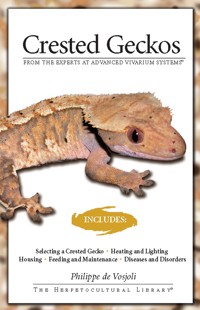
Illustrated with over 150 color photographs, Crested Geckos is an authoritative, visual guide to this very popular lizard species. For their amazing colors and patterns, low maintenance requirements, longevity, and attractive appearance, crested geckos have captured the fancy of hobbyists. Crested Geckos provides guidelines for keepers who wish to select a crested gecko to add to their vivarium and to maintain their pet in excellent health and condition. Author Philippe de Vosjoli provides an introduction to crested gecko, including information about purchasing a healthy pet, handling, heating and housing, water and feeding, life cycle and sexing, and breeding. A separate chapter on diseases and disorders provides solid info on the health needs of these rewarding reptiles, including recognizing signs of disease, tail loss and pelvic deformities. The author has also written two chapters devoted to the color of crested geckos, their most alluring feature for many herpetoculturists. The chapters include discussions of color changes (as the gecko matures) and morphs, heavily illustrated with photographs of unusually colored crested geckos. For crested gecko keepers looking to expand their home populations, a chapter on the Rhacodactylus species describes five species with similar requirements despite their significantly different appearances, from the medium-sized knobby-headed gargoyle gecko to the giant Rhacodactylus leachianus.
Sie lesen das E-Book in den Legimi-Apps auf:
Seitenzahl: 65
Veröffentlichungsjahr: 2012
Das E-Book (TTS) können Sie hören im Abo „Legimi Premium” in Legimi-Apps auf:
Ähnliche














Vice President, Chief Content Officer: June KikuchiVice President, Kennel Club Books: Andrew DePriscoProduction Supervisor: Jessica JaenschAssistant Production Manager: Tracy VogtmanI-5 Press: Jennifer Calvert, Amy Deputato, Lindsay Hanks, Karen Julian, Jarelle S. Stein Design by Michael Vincent Capozzi Indexed by Rachel Rice
Cover photography by Philippe de Vosjoli.
All photos by Philippe de Vosjoli except where otherwise indicated.
The additional photographs in this book are courtesy of Anthony Caponetto pp. 7 (top), 8 (top), 27–28, 34 (top and middle), 36 (middle), 37 (middle), 40 (bottom), 42 (top), 70 (bottom), 71 (top); Bill Love pp. 7 (middle); David Northcott pp. 11 (bottom), 13 (middle)
Copyright ©2005 by Advanced Vivarium Systems, Inc.®
All rights reserved. No part of this publication may be reproduced or transmitted in any form or by any means, electronic or mechanical including photocopy, recording or any information and retrieval system, without permission in writing from the publisher, except by reviewer, who may quote brief passages in a review.
LCCN: 96-183295ISBN-10: 1-882770-80-3ISBN-13: 978-1-882770-80-9eISBN-13:978-1-937049-71-3
An Imprint of I-5 Press™ A Division of I-5 Publishing, LLC™ 3 Burroughs Irvine, CA 92618
We want to hear from you. What books would you like to see in the future? Please feel free to write us with any comments on our AVS books.
Printed in China
14 13 12 11 4 5 6 7 8 9 10
CONTENTS
Acknowledgments
1: General Information
2: Life Cycle and Sexing
3: Color Change
4: Morphs
5: Housing Crested Geckos
6: Feeding and Watering
7: Diseases and Disorders
8: Breeding
9: Other Rhacodactylus Species
Conclusion: The Future
Works Cited and Recommended Reading
ACKNOWLEDGMENTS
As a former biology teacher and an author of more than 25 books on keeping reptiles, I wanted to experiment with a new format that would educate through photographs rather than extensive amounts of text. I am grateful to I-5 Press for allowing me the opportunity to assemble this type of book and for their continuing support of my herp-related writing projects. A tip of the herper hat goes to my good friends Frank Fast, who was my research partner on several field trips to New Caledonia; and Allen Repashy and Bob Mailloux, of Sandfire Dragon Ranch, for their generous help with this endeavor. Frank, Allen, and I were also the coauthors of Rhacodactylus: The Complete Guide, a larger work with more than 350 photos, which reflects our common obsession with this genus of geckos. As always, special thanks are owed to “Wild Bill” Love and David Northcott for coming through with outstanding photographs, as well as to Anthony Caponetto of ACJ Reptiles for his contribution of hard-to-find shots, such as examples of ontogenetic color change in crested geckos.
CHAPTER 1
GENERAL INFORMATION
Before the early 1990s, no one could have imagined that the crested gecko (Rhacodactylus ciliatus, a medium-sized gecko in the family Diplodactylidae), then a rare species known from only a few museum specimens, would become one of the most popular and readily available reptiles. Several earlier expeditions to New Caledonia to find this obscure lizard (which was first described in 1866) had proven fruitless, and there were growing rumors that the crested gecko could possibly be extinct. This all changed in 1994 when, following a tropical storm, specimens were sighted on the Isle of Pines (a small island south of Grande Terre, the main island of New Caledonia). Shortly after, field trips by Wilhelm Henkel and his colleagues, and by Frank Fast and the author yielded specimens that were brought into captivity. Surprisingly, these geckos readily bred in vivaria, allowing their offspring to subsequently be distributed to herpetoculturists. Some additional crested geckos were rumored to be smuggled by unscrupulous collectors wanting to capitalize on their “rediscovery.” The great majority of crested geckos in captivity originated from the Isle of Pines. Crested geckos are also found on Kutomo, next to the Isle of Pines; in several locations on southern Grande Terre; and on the Isle of Belep, north of Grande Terre. In any case, from a relatively small number of animals collected between 1994 and 1996, captive populations of this species have been growing exponentially.
Thousands of crested geckos are now captive-produced annually in the United States to meet the growing demand for this species. Besides being easy to breed, crested geckos have also turned out to be ideal pets. They are relatively small animals that have all of the features that make reptiles such fascinating creatures, including complex scalation and an unusual appearance that makes them seem like they crawled out of a fantasy story. Crested geckos are easy to house, have lower temperature requirements than many other reptiles, and for the most part are naturally tame and harmless. When kept in attractive planted vivaria, they make outstanding display animals. People who work all week and like to take weekend vacations can safely leave crested geckos for two to three days without having to resort to a pet-sitter. Based on records of animals currently in captivity, it appears that the potential longevity of crested geckos is at least 12 years, possibly much longer.
From a specialist standpoint, probably the most interesting feature of crested geckos is that they are polychromatic, naturally producing a wide range of colors and patterns. Combined with a short generation time, this has allowed hobbyists to selectively breed bright red, orange, and yellow morphs that now rank among the most beautiful of all reptiles. As attractive as these morphs may be, we have seen only the tip of the iceberg in terms of the potential this species offers for creating living works of art. In the reptile hobby, the crested gecko is destined to achieve great popularity and become the analog of the koi carp. The establishment of crested geckos in captivity ranks as one of the great accomplishments of herpetoculture.
Crested geckos reach a snout-to-vent length (SVL), the body length excluding the tail, of 4-4.7 inches (10-11.9 cm) and a total length of about 8 inches (20 cm). Adults typically weigh between 1.2 and 2.1 ounces (35 and 60 grams).
The crested gecko is found only in a primary forest, which is a type of old forest unlogged and undisturbed by human activities. The dense canopy makes it such that there is relatively little vegetation at ground level. The floor of the forest is covered with a layer of leaf litter.
The most obvious distinguishing features of crested geckos are the lateral crests that line the eyes, run along the sides of the back of the head and neck, and run partway down the back.
The crests are variable both in size and the degree to which they extend down the back. This specimen shows average-sized crests.
The width of the head and the length of the snout show a range of variation in this species. The snout is relatively long in this individual.
This individual has a broad head and relatively short snout.
This is an overhead view of the long-snouted individual shown previously. Compare it with the next picture.
In this overhead view, the relatively short snout and wide head of this individual are obvious. The broad head trait with well-developed crests is desirable in crested geckos.
This individual shows a long snout and poorly developed crests.
Crested geckos have well-developed toe pads combined with fine claws.
The undersides of the toes are lined with lamellae, pads of ultrafine setae that allow the gecko to cling to rough surfaces and climb on smooth ones such as glass.
A crested gecko has a relatively long, prehensile tail. The tail tip is slightly flattened and paddle shaped.
All members of the genus Rhacodactylus have prehensile tails capable of wrapping around tree branches or, in this case, fingers.
The underside of the tail tip also has lamellae.
Crested geckos are good jumpers. Extending the hind legs combined with straightening the body propels the gecko outward.




