


0,49 €
Niedrigster Preis in 30 Tagen: 1,99 €
Niedrigster Preis in 30 Tagen: 1,99 €
Mehr erfahren.
- Herausgeber: Booksell-Verlag
- Kategorie: Geisteswissenschaft
- Sprache: Englisch
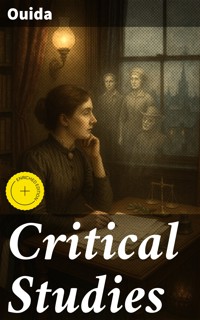
In "Critical Studies," Ouida presents a compelling collection of essays that explore the complexities of 19th-century literature, emphasizing the intricacies of character and the moral underpinnings of contemporary narratives. With her distinctive prose, rich in description and insightful analysis, Ouida examines the works of her contemporaries while delving into themes of social justice, gender, and the artistic predicament of her time. This collection not only elucidates literary paradigms but also reflects the shifting cultural landscape of Victorian England, making it a vital text in understanding the literary context of the era. Ouida, the pen name of Maria Louise Ramé, was a prominent writer and critic known for her vivid storytelling and strong characterization. Born in France and raised in England, her unique cultural perspective influenced her literary voice. An advocate for women's rights and social reform, Ouida's experiences shaped her critical outlook, prompting her to engage deeply with the moral implications of literature, thus enriching the discourse of her time through her critical assessments in this collection. "Critical Studies" is a must-read for scholars, students, and enthusiasts of 19th-century literature. Its blend of sharp critique and literary appreciation not only enhances one's understanding of Ouida's contemporaries but also invites readers to reflect on the enduring relevance of these themes in today's literary landscape. In this enriched edition, we have carefully created added value for your reading experience: - A succinct Introduction situates the work's timeless appeal and themes. - The Synopsis outlines the central plot, highlighting key developments without spoiling critical twists. - A detailed Historical Context immerses you in the era's events and influences that shaped the writing. - A thorough Analysis dissects symbols, motifs, and character arcs to unearth underlying meanings. - Reflection questions prompt you to engage personally with the work's messages, connecting them to modern life. - Hand‐picked Memorable Quotes shine a spotlight on moments of literary brilliance. - Interactive footnotes clarify unusual references, historical allusions, and archaic phrases for an effortless, more informed read.
Das E-Book können Sie in Legimi-Apps oder einer beliebigen App lesen, die das folgende Format unterstützen:
Veröffentlichungsjahr: 2021
Ähnliche









Critical Studies
Table of Contents
Introduction
A novelist’s sharp intelligence turned upon the culture that sustained her, Critical Studies examines how art, taste, and morality contend with fashion and commercial pressure, proposing that criticism itself is a principled act of citizenship as well as a test of nerve.
Critical Studies is a volume of literary and cultural criticism by Ouida, the widely read Victorian novelist best known for her popular fiction, issued around the fin-de-siècle in the British literary world (late nineteenth to early twentieth century). Rather than a narrative work, it gathers reflective pieces in which an established author addresses the ideas, artworks, and public tendencies of her moment. The book sits within a period when British and European debates about aesthetic value, social purpose, and the role of the critic were especially intense, and it participates in that conversation with a distinctly personal, writerly authority.
Readers encounter a collection that prizes clarity of judgment and stylistic flourish, moving between literary appraisal, cultural observation, and considered argument. The voice is confident, sometimes combative, and consistently lucid, balancing rhetorical sweep with pointed examples to illuminate broader claims. Ouida writes as a practitioner who understands how works are made and received, and that dual vantage shapes an experience that is both analytical and performative. The mood ranges from urgent to reflective, with essays that invite dialogue rather than dictation, offering the satisfaction of following a mind that tests its own convictions against the prevailing currents of its age.
Among its abiding concerns are the responsibilities of artists and audiences, the distinction between enduring merit and momentary vogue, and the tension between aesthetic refinement and social utility. The collection probes how taste is formed and deformed—by institutions, publishers, salons, and newspapers—and what critics owe to truth, to kindness, and to courage. It treats criticism not merely as judgment but as stewardship: a way of protecting the conditions in which serious art can be made and understood. In doing so, it raises questions about standards, sincerity, and the ethics of influence that remain vital across changing media and markets.
The book also considers the dynamics of celebrity and the economies that amplify or distort reputations, asking how the machinery of attention can eclipse substance. Ouida’s emphasis on care—care for language, for evidence, for proportion—feels bracing where speed often substitutes for thought. Readers today will recognize the dilemmas: whom to trust, how to weigh enthusiasm against expertise, and when dissent is a service rather than a slight. By modeling scrutiny without cynicism, the essays argue implicitly for a culture in which admiration and disagreement can coexist, and in which the love of art entails obligations beyond personal taste.
As a successful novelist turning to criticism, Ouida writes with the authority of craft, attentive to technique, tone, and the ways style carries conviction. That perspective makes the volume especially revealing about the porous boundary between making and judging: she sees how structural choices shape meaning and how public conversation shapes reception. Her prose—formal yet animated—demonstrates that criticism can be an art of its own, with cadence and color enlisted in the service of clarity. The result is a book that teaches, by example, how to read attentively, argue precisely, and keep one’s sense of proportion amid the excitements of novelty.
Approached as a companion to both classic and contemporary debates, Critical Studies offers a historically grounded yet enduringly pertinent guide to thinking with, and sometimes against, the crowd. It invites readers to slow down, to test their preferences against articulated principles, and to measure reputations by resilience rather than noise. Whether one comes for literary history, for reflections on the public life of art, or simply for the pleasure of a keen mind at work, the volume rewards with intellectual poise and moral seriousness, making a case for criticism as a generous, demanding, and necessary practice.
Synopsis (Selection)
Critical Studies gathers Ouida’s essays on literature and the arts into a single, cohesive survey of late nineteenth-century culture. Written for a general readership, the collection establishes clear standards for judgment—craftsmanship, sincerity, and beauty—while situating individual works within their historical and social contexts. Ouida outlines her aims at the outset: to examine how artistic forms shape public taste and civic life, and to distinguish enduring achievement from transient fashion. The opening pieces define the responsibilities of artists and critics alike, emphasizing the need for informed, disinterested evaluation. Throughout, the tone remains analytical and descriptive, presenting arguments, examples, and comparisons without resorting to anecdotal excess.
The first group of essays addresses modern literature, especially the novel and lyric poetry, charting the transition from romantic idealism to realist and naturalist modes. Ouida contrasts narrative methods, considering plot construction, character psychology, and stylistic texture, and weighs the literary value of meticulous observation against the risks of sensational detail. She discusses the influence of serial publication and the marketplace on length, pacing, and subject choice, and notes how readership expectations can shape authors’ themes. The section’s central conclusion is that durable fiction balances invention with ethical and aesthetic coherence, using precision of language and disciplined structure to transform experience into form rather than merely reproducing it.
Turning to the stage, the book surveys contemporary drama and performance practices in Britain and France. Essays describe the interplay between playwright, actor, and manager; the effect of censorship; and the practical constraints of production. Ouida examines dialogue, construction of scenes, and the integration of spectacle, arguing that theatrical power depends on unity of purpose rather than on mechanical devices. Attention is given to translation and adaptation, with examples of how works shift across languages and audiences. The section emphasizes ensemble work, diction, and tempo, concluding that theatre fulfills its public role when it refines emotion and thought without sacrificing clarity, proportion, or intelligibility.
Essays on the visual arts consider painting, sculpture, and the decorative disciplines, placing contemporary practice against the standards of earlier schools. Ouida discusses line, color, composition, and the relation of technique to idea, comparing academic training with newer approaches. Salons, juries, and exhibitions are treated as forces that can stabilize or distort judgment. The analysis addresses portraiture, landscape, historical subjects, and public monuments, noting how patronage and setting affect meaning. The section’s guiding point is that style must remain subordinate to conception; when surface effects eclipse structure, the work’s expressive force declines, whereas disciplined design enables content to emerge with firmness and purity.
A complementary portion treats music, with attention to opera, song, and orchestral forms. Ouida outlines principles of musical architecture—melodic line, harmonic balance, and thematic development—and discusses how virtuosity should serve rather than dominate composition. The essays examine the collaboration of composer, librettist, conductor, and singer, indicating how staging and acoustics influence interpretation. National schools are compared for their treatment of rhythm and color, and conservatory systems are noted for shaping standards. The argument closes by affirming that musical greatness rests on unity of form and feeling: technical fluency gains lasting value only when bound to intelligible structure and expressive restraint.
The collection then widens to the conditions under which art circulates: journalism, publishing, collecting, and public education. Ouida describes how the periodical press mediates taste, shaping reputations through quick judgments that may outlast their evidence. She considers copyright, reproduction technologies, and international exhibitions, showing how commerce can simultaneously expand access and flatten standards. Patronage—private and state—is analyzed for its benefits and pressures, alongside the role of schools and museums in forming habits of attention. The section concludes that cultural health depends on informed intermediaries and institutions that reward patience, learning, and integrity over novelty driven by competitive display.
Interleaved with these programmatic chapters are biographical and situational studies of artists and writers at work. Ouida sketches studios, rehearsal rooms, and editorial offices, using concrete instances to illustrate broader principles about discipline, environment, and collaboration. She notes how climate, city life, and national temperament condition method and theme, while cautioning against generalizations that ignore individual temperament. These portraits neither canonize nor disparage; they situate achievement within materials, training, and public contact. By bringing method and milieu into view, the essays clarify how exceptional works arise from habits of attention and craft, rather than from accident or mere impulse.
A concluding theoretical section makes explicit the criteria that have guided the inquiries: clarity of thought, economy of means, consonance between medium and idea, and a humane intention extending beyond fashion. Ouida articulates a comparative method that privileges internal coherence over personal preference, while acknowledging historical change in forms and audiences. Language itself is treated as an ethical instrument; criticism must be precise, free of cant, and attentive to proportion. The volume insists that reverence for tradition and openness to innovation are not opposites when both are governed by the same requirements of structure, purpose, and truthful representation.
The book ends by summarizing the responsibilities shared by creators, patrons, institutions, and the public. Ouida’s final emphasis falls on cultivation: the steady education of taste through exposure to well-made work, careful judgment, and resistance to mercenary pressures. Rather than prescribing dogma, Critical Studies offers working principles for recognizing quality across genres and schools. Its overarching message is that art’s social value arises from disciplined imagination aligned with intelligibility and moral poise. By tracing standards through literature, theatre, visual art, and music, the volume proposes a coherent framework for reading, viewing, and listening with fairness and discernment.
Historical Context
Ouida’s Critical Studies belongs to the late Victorian and fin-de-siècle world, written from the vantage of a British author long resident in Italy, especially in Florence and Tuscany. Composed in the 1880s and 1890s and published toward century’s end, the work reacts to a Europe transformed by rapid industrialization, mass politics, and high imperialism. Italy’s recent national unification, Britain’s urban expansion, and France and Germany’s geopolitical rivalry formed the living backdrop. Florence itself was altered by modernization after serving briefly as Italy’s capital (1865–1871), creating a friction between historic art centers and commercial redevelopment. The essays reflect a cosmopolitan observer comparing British, Italian, and French public life and morals.
The single most formative context is post‑Unification Italy and Florence’s modernization. After the Kingdom of Italy proclaimed 1861 (Rome added 1870), the new state imposed conscription, centralized administration, and heavy taxation to service debt and build infrastructure. The notorious grist tax (tassa sul macinato, 1868–1880) burdened bread prices and symbolized the social costs of nation‑building. Florence underwent risanamento projects—demolition and redesign of central quarters culminating in the destruction of the Mercato Vecchio area (largely 1885–1895)—that displaced residents and sparked debates on heritage versus progress. Fiscal crises culminated in the Banca Romana scandal (1892–1893), exposing political corruption. Under Prime Minister Francesco Crispi (terms 1887–1891, 1893–1896), aggressive policies, colonial ventures, and repression combined with rural poverty, pellagra, and land hunger to fuel discontent. Emigration surged—millions left Italy between the 1880s and 1914 for the Americas and elsewhere. The catastrophic defeat at Adwa (1 March 1896), where Ethiopian forces routed Italy, punctured nationalist bravado; bread riots in Milan in 1898 were met by General Bava Beccaris’s deadly artillery, deepening mistrust of the state. Living in Tuscany, Ouida could closely watch these upheavals and municipal transformations; in Critical Studies she repeatedly interrogates public probity, civic beauty, taxation, militarism, and the moral responsibilities of wealth, holding up Italy’s uneasy modernization as a mirror for broader European choices.
The Second Industrial Revolution reshaped Britain through steel, chemicals, electricity, and railways, yet also produced stark inequalities. The “Long Depression” (circa 1873–1896) depressed prices and sharpened labor conflict. Public responses included the Public Health Act (1875) to address sanitation, and the rise of organized labor—the Social Democratic Federation (1884), the London Dock Strike (1889), and the Independent Labour Party (1893). Slum clearances and municipal reforms tried to mitigate overcrowding. Critical Studies echoes these realities by condemning ostentatious plutocracy, examining urban squalor’s moral toll, and pressing for civic duty over speculative capital, often contrasting British industrial wealth with ethical shortcomings.
High imperialism framed public debate. Britain’s occupation of Egypt (1882), the Sudan campaigns (Gordon’s fall at Khartoum, 1885; Omdurman, 1898), the Berlin Conference (1884–1885) and Scramble for Africa, the Fashoda crisis (1898), and the South African War (1899–1902) exemplified expansion and its costs. Italy pursued Eritrea and Somaliland, meeting disaster at Adwa (1896). These events fostered jingoism, war journalism, and debates over empire’s economics and ethics. Ouida’s essays repeatedly censure militarism, question the civilizing claims of conquest, and, from an Italian base, juxtapose British and Italian ambitions to expose the human and fiscal burdens borne by ordinary people.
The Franco‑Prussian War (1870–1871) and the Paris Commune (March–May 1871) reorganized Europe. Prussia’s victory led to the German Empire’s proclamation at Versailles on 18 January 1871, the annexation of Alsace‑Lorraine, and a five‑billion‑franc indemnity that shaped French politics under the Third Republic. The Commune’s suppression intensified fears of mass revolution, while peacetime conscription and standing armies became continental norms. Critical Studies reflects the lingering anxiety and competitive nationalism that followed, warning against martial prestige, chauvinism, and the cultural narrowing that accompanies militarized patriotism in both France and Germany, with lessons the author applies to British and Italian publics.
The “woman question” matured into concrete reforms. In Britain, the Married Women’s Property Acts (1870, 1882) expanded wives’ legal control of earnings and assets; repeal of the Contagious Diseases Acts came in 1886 after sustained activism. Access to education widened with colleges such as Girton (1869) and Newnham (1871), while suffrage organizations coalesced, culminating in the National Union of Women’s Suffrage Societies (1897). These changes reconfigured household economies and public morality debates. Ouida engages these issues by scrutinizing the marketization of marriage, the costs of economic dependence, and the hypocrisies of respectability politics, often critiquing fashionable slogans while insisting on substantive social fairness.
Humanitarian reform broadened to include animals and scientific ethics. The Cruelty to Animals Act (1876) regulated experiments, and antivivisection societies flourished, notably the British Union for the Abolition of Vivisection (1898). These movements intersected with philanthropy, policing laboratory practices, and asserting that civilization is measured by treatment of the vulnerable. Ouida, famed for moral indictments of cruelty, aligns with this milieu: in Critical Studies she treats cruelty—toward animals or the poor—as a sign of societal degeneracy, arguing that a culture exalting profit and force will rationalize violence in laboratories, factories, and colonies alike.
As a social and political critique, the book attacks the late‑century worship of wealth, power, and militarized nationalism. It exposes how state priorities—colonial adventures, armaments, speculative finance, and disruptive urban projects—shift burdens onto workers, peasants, and small traders. By setting British industrial opulence against Italian post‑unification hardship and French‑German militarism, Ouida diagnoses a common European malady: public ethics subordinated to expediency. Her analyses press for civic responsibility, humane governance, and protection of the weak, indicting class arrogance, political corruption, and performative patriotism. The result is a cosmopolitan, historically grounded rebuke to the injustices of the fin‑de‑siècle order.




