


Erhalten Sie Zugang zu diesem und mehr als 300000 Büchern ab EUR 5,99 monatlich.
- Herausgeber: IVP Academic
- Kategorie: Religion und Spiritualität
- Serie: Strategic Initiatives in Evangelical Theology
- Sprache: Englisch
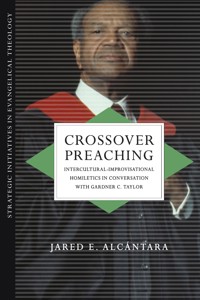
As society becomes more culturally diverse and globally connected, churches and seminaries are rapidly changing. And as the church changes, preaching must change too.Crossover Preaching proposes a way forward through conversation with the "dean of the nation?s black preachers," Gardner C. Taylor, senior pastor emeritus of Concord Baptist Church in Brooklyn, New York. In this richly interdisciplinary study, Jared E. Alcántara argues that an analysis of Taylor?s preaching reveals an improvisational-intercultural approach that recovers his contemporary significance and equips U. S. churches and seminary classrooms for the future.Alcántara argues that preachers and homileticians need to develop intercultural and improvisational proficiencies to reach an increasingly intercultural church. Crossover Preaching equips them with concrete practices designed to help them cultivate these competencies and thus communicate effectively in a changing world.
Sie lesen das E-Book in den Legimi-Apps auf:
Seitenzahl: 673
Veröffentlichungsjahr: 2015
Das E-Book (TTS) können Sie hören im Abo „Legimi Premium” in Legimi-Apps auf:
Ähnliche



















STRATEGIC INITIATIVES IN EVANGELICAL THEOLOGY
JARED E. ALCÁNTARA
To Jen,
My Anchor and Sail
CONTENTS
Acknowledgments
Abbreviations
Introduction: “Time Is Filled with Swift Transition”
1 Gardner C. Taylor: Case Study in Crossover Preaching
2 Turning Ink to Blood: Performative Improvisation
3 Rooted, but Not Restricted: Metaphorical Improvisation
4 Transgressing the Divides: Intercultural Competence
5 Putting Flesh to Bones: Homiletical Strategies
Conclusion: Crossing la Frontera (the Border)
Notes
Bibliography
Author and Subject Index
Praise for Crossover Preaching
About the Author
Strategic Initiatives in Evangelical Theology (SIET)
More Titles from InterVarsity Press
Copyright
ACKNOWLEDGMENTS
Only one name appears on the title page of this book, but the one who has written it knows that more than one name should appear. Numerous people shaped and guided its completion: teachers, friends, mentors, clergy, colleagues, and family members. Throughout this whole process, countless people have advised me, come alongside me, opened doors for me, supported me, challenged me, and encouraged me. For that, I am humbled and most grateful.
At the outset, I should note that some of what is written in these pages has already appeared at annual homiletics conferences as a way of testing the value of some ideas over against others. For instance, selected portions of chapter two appear in a paper titled “Improvisational Preaching” that I delivered at the 2013 meeting of the Academy of Homiletics in Louisville, Kentucky. Selected portions of chapter four appear in a paper titled “Toward an Intercultural Homiletic” that I delivered at the 2012 meeting for the Evangelical Homiletics Society in New Orleans. The feedback and pushback from people in these venues and others shaped my thinking indelibly. Thank you!
Special thanks are due to Rev. Dr. Gardner C. Taylor, the inspiration for this book. Dr. Taylor’s preaching continues to bless people from many different walks of life and church traditions, and it continues to bless me. I will remember the precious moments I spent with him in informal interactions and formal interviews for the rest of my life. Dr. Taylor passed away on Easter Sunday, April 5, 2015. Thank you to the Taylor family, especially his wife, Phillis Taylor, and his daughter, Martha Taylor LaCroix, for allowing me to spend time with him in his final years of life. Thank you for sharing him with so many of us.
I would like to thank the members of my dissertation committee for their wise counsel, commitment to academic rigor, and generous support. Drs. Michael A. Brothers and Cleophus J. LaRue pointed me to helpful resources that supported my work, and they directed me to key people to interview. They also provided me with valuable feedback on my writing. A special word of thanks is due to the chairperson of my committee, James F. Kay, who was generous with his time and thoughtful with his feedback. His wise counsel, constant encouragement, and editorial skill were all sources of help and inspiration. Without a doubt, he pushed me to do my best work.
Also, to some of my current colleagues and mentors at Trinity Evangelical Divinity School—Elizabeth Sung, Greg Scharf, Peter Cha, Steve Roy, Craig Ott, Tite Tiénou, and Donald Guthrie—thank you for reading draft revisions and providing feedback and support. Thanks also to Jimmy Roh, my graduate assistant.
I am also indebted to two organizations in particular that have invested their time, energy, and resources toward this book’s completion. The Hispanic Theological Initiative has been invaluable as a source of theological deepening, academic training, Latin@ solidarity, and professional networking. Thank you to the whole staff at the HTI, especially the director, Joanne Rodriguez, along with two of my HTI mentors: Dr. Elizabeth Conde-Frazier and Ulrike Guthrie. Also, the Louisville Institute provided me with financial funding, emotional support, and academic training in the final year of my studies through their dissertation fellowship program. Their support has also been invaluable.
I would be remiss if I did not also thank the congregation at Central Baptist Church in Ewing, New Jersey, and its pastor, Richard Gay. Their love, care, and support were steadfast and life giving during our days at Princeton Theological Seminary.
Thanks as well to David Congdon at IVP Academic for his editorial support and guidance.
Finally, I want to thank my family. Thank you to my parents, José and Susan, who have supported me in too many ways to count and have made innumerable sacrifices toward my education; my sisters and brothers; my children, who are a constant source of joy; and my extended family, whose presence in my life blesses and enriches me in more ways than they know. Most of all, thank you to my wife, Jennifer. She is a loving companion, a constant friend, a tireless encourager, a spiritual bulwark, and a beautiful sign of God’s grace in my life.
Reflecting on God’s faithfulness through such a lengthy, challenging, and rewarding process, I resonate with these ancient words attributed to King David: “Who am I, O Lord GOD, and what is my house, that you have brought me thus far?” (2 Sam 7:18).
ABBREVIATIONS
NYAN
New York Amsterdam News
NYT
New York Times
WGT
Gardner C. Taylor. The Words of Gardner Taylor. Edited by Edward L. Taylor. 6 vols. Vol. 1,
NBC Radio Sermons, 1959–1970
. Vol. 2,
Sermons from the Middle Years, 1970–1980
. Vol. 3,
Quintessential Classics, 1980–Present
. Vol. 4,
Special Occasion and Expository Sermons
. Vol. 5,
Lectures, Essays, and Interviews
. Vol. 6,
50 Years of Timeless Treasures
. Valley Forge, PA: Judson Press, 2004.
INTRODUCTION
“TIME IS FILLED WITH SWIFT TRANSITION”
In 1900, fully 90 percent of Christians lived in Europe or the United States. Today 60 percent live in Asia, Africa, and Latin America, and that figure will probably rise to 67 percent by 2025. About 1975, Christianity ceased to be a “Western” religion.
Harvey Cox, The Future of Faith
It was a spring day in Princeton, New Jersey, in April 2001. The speaker was noted missiologist Andrew F. Walls, who was there to deliver the Stone Lectures on Missions at Princeton Theological Seminary. Walls chose as his theme the recent history of Western mission and its connection to world Christianity in the twenty-first century, and he emphasized two phenomena in particular: the exponential rise of Western Protestant missionary expansion in non-Western nations, especially in the late nineteenth and early twentieth centuries, and the demographic transformation of the church to the southern and eastern hemispheres over that same time span. In just over one century, Walls argued, Christianity had undergone a tectonic shift from being a predominantly Western religion to being a predominantly non-Western religion.1
It was not that Christianity was never Eastern. Walls reminds us: “There was nearly a millennium and a half of active and expansive Christianity in Asia . . . [and] Christian communities in Africa that could claim a continuous history from sub-apostolic and early patristic times.”2 Rather, Christianity was statistically Western when the twentieth century began. In the centuries leading up to the twentieth, Christianity’s numerical representation had receded in the southern and eastern hemispheres and expanded in the northern and western hemispheres.3 For example, in 1893, 80 percent of the world’s Christians lived either in North America or Europe.4 It appeared that Christianity had become Western by the end of the nineteenth century, at least statistically speaking. Walls explains:
Circumstances dictated that Christianity became more European than it had ever been before, and did so just at the point when Europe became more Christian than it had ever been before. Events so welded Christianity and the West together, and the domestication of Christianity in the West was so complete, the process of acculturation there so successful, that the faith seemed inseparable from the categories of European life and thought.5
Christianity and the West were so intertwined that it was difficult for Western Christians to imagine one without the other. The two “seemed inseparable.”
Many of the late nineteenth and early twentieth-century reactions to the marriage between Christianity and Western civilization were bold and declarative. Some concluded that the economic rise of the European continent was part of God’s providential plan. As European life, thought, and economic power ascended, so also Christianity would ascend, at least so it was thought. Strong ties between Christianity and the West led the French writer Hilaire Belloc to declare in 1920: “The Faith is Europe, and Europe is the Faith.”6 In the world that Belloc inhabited, the church’s destiny was bound together with the destiny of Europe. Without the church there was no Europe, and without Europe there could be no church. Others reacted with excitement over the impact Western Christianity could have on the entire world. Many Western missionaries responded with eagerness and exhilaration about the future, especially in regard to the church’s potential expansion into the non-Western regions of the world.
Several leaders of the modern (Western) missions movement responded with a mood of optimism, triumphalism, and even martialism. “God has chosen American Christians to be the saviors of Christianity in the East,” exclaimed the Rev. Dr. James S. Dennis, a Presbyterian missionary to Beirut, Lebanon, when he presented the first Students’ Lectures on Missions at Princeton Theological Seminary in 1893.7 Eight years earlier, in 1885, the American reformer and clergyman Josiah Strong declared, “It is fully in the hands of the Christians of the United States, during the next fifteen or twenty years, to hasten or retard the coming of Christ’s kingdom in the world by hundreds, and perhaps thousands, of years.” In his book Our Country, Strong referred to the United States as “the Gibraltar of the ages which commands the world’s future” and described the generation in which he lived as having “the power to mold the destinies of unborn millions.”8 Then, in 1910, during the closing address of the Edinburgh Missionary Conference, an event dedicated to the evangelization of the non-Western world within the century, John R. Mott, the chairman of the convention, proclaimed: “The end of the Conference is the beginning of the conquest. . . . The end of the planning is the beginning of the doing.”9 A prevailing sense of excitement was in the air.
Not even the most perceptive or prescient missiologist could have predicted the unforeseen outcomes and seismic shifts that were set to take place in Christianity, and in the world, for that matter, over the course of the next century. The world that most Christians occupy today is markedly different from the one Western Christians occupied in the early twentieth century. One decade into the twenty-first century, the shortsightedness of Belloc’s assertion, Dennis’s prediction, Strong’s declaration, and Mott’s proclamation, is in plain view—the West is no longer Christian, and Christianity is no longer Western. The Christian faith is withering in its former centers and growing in its previous peripheries. As Walls notes, “Christianity began the twentieth century as a Western religion, and indeed, the Western religion; it ended the century as a non-Western religion, on track to become progressively more so.”10
Around 1910, approximately eleven million Christians lived in Africa. Around 2010, the number of African Christians exceeded 490 million.11 When Walls lectured at Princeton in 2001, more than 60 percent of the world’s Christians lived in Africa, Asia, Latin America, and the Pacific—it stood at 20 percent in 1900.12 As a consequence of these trends and others like them, more and more Western systems and structures linked to Christendom are moving to the periphery as new ways of being the church emerge. Alister McGrath suggests that “the Protestant denomination is essentially a European phenomenon” that will probably meet its demise by the end of the twenty-first century.13 Philip Jenkins observes: “The era of Western Christianity has passed within our lifetimes, and the day of Southern Christianity is dawning. The fact of change itself is undeniable: it has happened, and will continue to happen.”14
It would be unrealistic and counterproductive to expect that this shift will somehow reverse its course. Likewise, it would be premature and even unhelpful for Western Christians to abandon ship out of fear that they have nothing worthwhile left to offer. Neither willful ignorance nor nihilistic escapism is a realistic option. What is required is reorientation and recalibration. At such a time, theological reflection on a course of action is not only warranted but urgent. The church may have shifted, but it is also growing in surprising and exciting ways and expanding to unexpected places. To quote again from Walls, “At the end of the story and the beginning of our century, Christendom is dead or almost so, but Christianity is alive and well without it.”15
Not everyone shares Walls’s sense of optimism concerning the prospects for Western Christianity moving forward. In significant ways, the West is post-Christian and Christianity is post-Western. Statistically, and even symbolically, Europe is no longer the Christian heartland. The faith is not Europe and Europe is not the faith. In some corners of Europe, for example, church attendance is at record lows. In the United Kingdom, where weekly church attendance stood at around 50 percent in the mid-nineteenth century, church attendance in 2005 hovered at around 6.5 percent. Walls also notes: “There are now far more Muslims in England than there are Presbyterians in Scotland.”16 Even in Edinburgh, within a one-mile radius of the site of the great missions conference of 1910, there are at least four churches that have been converted into coffee shops or tourism bureaus. Travel a bit farther out, and you find churches converted into homes, pubs, performance venues, and climbing walls.
Some argue that the prospects for Christianity in the United States are equally perilous, the recession of Christian faith from society a foregone conclusion. In Christianity After Religion (2012), Diana Butler Bass suggests that “the first decade of the twenty-first century in the United States could rightly be called the Great Religious Recession.”17 “Christian belief and practice,” she claims, are experiencing a precipitous decline, and “general belief in God has eroded in the last thirty years.”18 Not only does Bass cite recent polls in USA Today and statistics that highlight the rapid numerical decline in traditional mainline denominations, but she also notes the sizable increase among those who self-identify as “religiously unaffiliated,” “atheist,” or “agnostic” compared to a generation ago. The writing is on the wall for American Christianity, she suggests. Even Walls acknowledges that statistics like these coupled with other trends in society at large should at least cause American Christians to pause before making optimistic generalizations about Christianity in their own nation. Add to these trends the complexities of secularization,19 globalization,20 and polarized perspectives on immigration,21 and pessimism seems like a more tenable option than optimism. Walls writes: “Many signs are visible in the United States now that marked Europe when its own rapid retreat from Christianity began.”22
But what if the task of reorientation and recalibration required a more nuanced and textured approach, one that complicated and problematized the data? What if traditional binaries such as Western Christianity/world Christianity, Christian West/post-Christian West, were too simplistic and reductive? How might the narrative change concerning these statistics if there were also countervailing data supporting an alternate conclusion, data, say, that highlighted a significant connection between Christianity’s move south and east and the demographic transformation of the population in the United States?
Almost everyone acknowledges that Christianity is growing at an exponential rate in the Global South. The data is irrefutable and probably conservative in its estimates. Statistically speaking, Africa and Latin America are now the Christian heartlands. Instead of Wittenberg and Geneva, think São Paulo and Jakarta. The majority of the world’s Christians live in the eastern and southern hemispheres. However, here is what is so surprising: few people have observed the significant connection between Christianity’s shifts southward and eastward and the demographic shifts taking place among the general population of the United States. If Christianity is moving south and east, then what do we make of the fact that the majority of immigrants who come to the United States, as well as the subpopulations within the United States that are growing the fastest, happen to come from these regions?
Take the matter of immigration and the trends today versus the trends fifty years ago. In the 1960s, persons from Europe, Canada, and Oceania (Australia, New Zealand, etc.) accounted for 49 percent of US immigrants “obtaining lawful permanent residence,” and those coming from Latin America, Asia, and Africa accounted for 49 percent, with the other 2 percent referred to as “unspecified” or “Other America.” By contrast, in 2013, the latest year these statistics were available, percentages were markedly different. European, Canadian, and Oceanic immigrants accounted for just under 12 percent of the nation’s immigrant population, and Latin America, Asia, and Africa accounted for just over 86 percent of the nation’s immigrants (Asia: 40 percent, Latin America: 38 percent, Africa: 10 percent), with just under 2 percent reporting as “unspecified.”23 These demographic shifts are not just remarkable; when examined more closely, they constitute a counternarrative to challenge Bass’s thesis and that of others. Moreover, they provide American Christians with a unique opportunity to rethink their theological and homiletical agendas as they discover new ways of being the church.
Put differently, Christianity’s geographical shift positively affects the church in the United States. Three demographic trends in particular are significant. First, over the next forty years, there will be a steady increase in the overall population of the United States. As some European nations are confronted with the problem of indigenous depopulation, the overall population in the United States is set to grow larger each year. In 1950, European nations accounted for eight of the twenty most populous nations. In 2000, the number was three out of twenty. By 2050, only one nation—the Russian Federation, projected to rank eighteenth—will remain. According to projections, dwindling populations and low birth rates will hit European countries like Italy and Spain especially hard. By contrast, the United States is projected to grow by approximately two million people per year between now and 2050. In the United States, ranked the third most populous nation after China and India in 2000, the trends will be opposite to trends in Europe. The United States will have 408.7 million people in 2050 (in 2000: 285 million) and retain its status as the third most populous nation, with India projected to be first ahead of China on account of China’s former one-child policy.24 Barring a major economic meltdown or an isolationist renaissance, it is probable that the US church will also grow in line with these projections. Yet, how the church will grow and the demographic the church will represent is what is of vital importance, which leads to the next significant demographic shift.
Second, there will be a significant rise in the nonwhite population within the United States over the next forty years, partly due to non-Western immigration and partly on account of high birth rates among nonwhite ethnic groups. On the matter of immigration, Christians from the eastern and southern hemispheres will immigrate to the United States at much higher rates and in larger numbers than non-Christians. In fact, this has already happened. In his 2013 book, From Times Square to Timbuktu, Wesley Granberg-Michaelson observes:
An estimated 214 million people in the world today are migrants, living in a country different from where they were born. Nearly half of these migrants are Christians—about 105 million, far more than the proportion of Christians in the world, which is about 33 percent. And for these Christians who are on the move, the United States is their chief destination; they presently account for about 32 million, or 13 percent of the Christian community in the United States. That percentage will continue to rise. These new immigrant Christians are changing America’s religious landscape.25
Granberg-Michaelson’s claim can be statistically substantiated by at least one other reputable source. According to the Pew Forum on Religion and Public Life, in the year 2010, there were forty-three million foreign-born residents living in the United States, approximately one in eight people. About 74 percent of these forty-three million were Christian, 5 percent Muslim, 4 percent Buddhist, and 3 percent Hindu.26 In other words, three of every four foreign-born residents living in the United States self-identified as Christian. By 2050, the number of foreign-born residents will increase to one in five people. As it pertains to population projections, both the Asian and Latin@ populations will triple in size between now and 2050. By contrast, the number of those who self-identify as white will drop from 67 percent to 47 percent. In 1960, whites accounted for 85 percent of the population.27
Third, in 2050, the white population in the United States will be older than the nonwhite population, and it will also be smaller. The year 2010 was the first year that more nonwhite babies were born in the United States than white babies. In 2012, four states and one municipality—California, New Mexico, Hawaii, Texas, and Washington, D.C.—already had populations in which minorities were the majority. In that same year, statisticians also observed the significant differences between the median age of whites and that of nonwhites. In 2012, the median age for whites was about forty-two, for African Americans and Asians about thirty-two, and for Latin@s about twenty-eight. Differences in median age also account for the rapid shift in the ethnic makeup of children enrolled in public schools in the United States. The academic year 2014–2015 was the first that public schools had a nonwhite majority of children enrolled. Only twenty years ago, in the mid-1990s, white children accounted for 65 percent of public school students. Today, that number is less than 50 percent and is set to drop to 45 percent by the mid-2020s.28 The year 2042 is now the latest projected year in which nonwhites will become the overall, general-population majority in the United States and whites the minority.29
These three demographic shifts also mean that seminary classrooms in general and homiletics classrooms in particular will change. In fact, the ethnic and cultural makeup of the seminary classroom has already changed dramatically since 2001. Barbara G. Wheeler, an independent researcher who works in consultation with Auburn Seminary’s Center for the Study of Theological Education, spoke in depth about these trends and their impact on seminaries between now and 2040 in an April 2013 consultation address for the Forum for Theological Exploration. She explains:
The enrollment of groups other than whites has been growing fast and will continue to increase at high rates, because those are the groups that are growing in the population as a whole. The religious segment of the population is changing even faster in its make-up. Whites are disaffiliating from organized religion, but other groups are doing so much more slowly, so the part of the population that is religiously observant and adherent is diversifying faster. In religious America, 2040—the year that there is predicted to be no racial or ethnic majority in the United States—will occur well before 2040.30
Wheeler’s claims are grounded in the Association of Theological Schools’ (ATS) recent statistics on enrollment in North American seminaries over the last decade. Since the year 2005, white student enrollment has dropped by 17 percent from its peak; African American student enrollment has increased by 7 percent; and Latin@ student enrollment has grown by 26 percent since 2005 and a remarkable 100 percent (i.e., doubled in size) since 1996. Asian American student enrollment has dropped by 7 percent since 2005, but when the focus shifts from microtrends to macrotrends, the data show us that Asian American student enrollment has increased by 3 percent since 2002 and 13 percent since 1996. It is also significant that these figures do not include enrollment by international students from Asian countries, a demographic that has grown significantly in the last two decades. At least one more statistic on trends is worth mentioning. In 2008, the first year ATS gathered data on students who self-identified as multiracial (people like myself), they counted 123 students in this category. In 2011, the last year these projections were made available, that number had risen to 448, an increase of 364 percent.31
Based on these data (national and educational), we can posit that over the next one to two generations Christians born in the Global South or with ethnic and cultural ties to the Global South will be a major force in the preservation, reshaping, and renewal of the US church and its mission. The nonwhite, non-Western population will do more than join the church’s ranks; it will lead the church into an “intercultural” future.32 Herein lies the significance of the connection between global Christianity’s shift and the projections for the overall population in the United States: If the church in the United States bears even a remote resemblance to the overall population, it will be an intercultural church with an intercultural witness to an intercultural society. An ancillary claim can also be made about the homiletics classroom: If the homiletics classroom in the United States bears even a remote resemblance to the overall population, those who teach them will need to develop pedagogies that account for and engage with an intercultural church with an intercultural witness to an intercultural society.
An intercultural future is knocking on the church’s door, and the preachers and homileticians of today and tomorrow must answer it. The danger of doing nothing is too great. If we cannot or, worse yet, will not rethink our theological and homiletical agendas in light of these projections, we will soon discover that no one is listening or paying attention. Our so-called audience will be disinterested and dissuaded by us, and our homiletical strategies will be better suited to a museum than a classroom.
Introduction to the Primary Claim
In this book, I argue that the way to bring homiletics into congruence with demographic shifts in the church is to develop a crossover homiletic that engages with and accounts for difference. By crossover homiletic I mean a homiletic that effectively deploys performative and metaphorical improvisation-as-intercultural-negotiation. This approach constitutes an alternative way of thinking about preaching practice and homiletical strategy with a specific aim in mind: to foster dispositional commitment to improvisational-intercultural proficiency as a way of being and acting. To construct this approach, we will engage in a case study of one of America’s premier twentieth-century preachers: Gardner C. Taylor, pastor emeritus of Concord Baptist Church of Christ in Brooklyn, New York. Taylor’s preaching functions as a way by which the improvisational-intercultural homiletic that I propose becomes visible and viable. The reason I chose Taylor as opposed to other preachers of the past or present becomes clear in chapter one.
Moving toward the advent of an improvisational-intercultural homiletic does not have to mean starting from scratch. It assumes that we can learn lessons from the past and, in particular, from past preachers who embodied and actualized improvisational and intercultural proficiency. Taylor displayed these two proficiencies in his preaching, and it is my contention in this book that these are the same two proficiencies homileticians need in the future to meet the demands of an intercultural church. The thesis I propose is as follows: An analysis of Gardner C. Taylor’s preaching reveals an improvisational-intercultural approach that, in light of recent developments in improvisational and intercultural theory, illumines his contemporary significance to preaching and homiletics in the United States now and in the future.
It should be stated at the outset that this book is not a biblical or systematic theology of preaching. It is a case study on a particular individual’s contemporary significance at a particular point in time and the bearing his improvisational-intercultural approach might have on today’s context. It assumes that preachers and homileticians already strive to be gospel centered, biblically tethered, exegetically proficient, theologically competent, and spiritually mature, and that they are also committed to other significant aspects of Christian proclamation. The focus here is much more specific and narrow. It studies an individual preacher from whom we can learn, and it is a proposal as to what we can learn from him. Most everyone who preaches understands the importance of these other commitments, and they have studied and gained competency in them. As a result, they recognize the importance of attending to the timeless dimensions of preaching and the character of Christian faithfulness. Although these are important and even crucial to a robust understanding of proclamation, this book is designed to provoke thought and initiate dialogue around issues of contextual timeliness and homiletical fittingness in twenty-first-century churches and seminaries on account of rapid demographic changes in both of these spaces.
In the first part, we will provide a rationale for why we can refer to Taylor as a “crossover preacher,” and we will discuss performative and metaphorical improvisation. Performance theory and race theory are emerging fields that provide us with tools for describing how improvisation functions in Taylor’s preaching. I argue that improvisation is both a practice in which one riffs on one’s tradition (performative) and an ability to negotiate across racial, ethnic, and ecclesial difference with protean reflexivity (metaphorical). First, I point to performative instances, that is, occasions on which improvisation appears in Taylor’s sermons, and I discuss his own acknowledgment that his preaching has improvisational dimensions. While Taylor does not use the word improvisation to describe some of his preaching practices, it will become evident that these practices are improvisational, at least in the way I define the term.33 Then, I make the bolder claim that Taylor’s social location is both a condition of and catalyst for improvisation at a metaphorical level. Put differently, I argue for a connection between Taylor’s social location and his adeptness at improvising in the broader sense of communicating across cultural difference.34
Then, in the second part, we will examine intercultural competence and pedagogy. Here I enlist intercultural and education theory as interlocutors. Like performance theory and race theory, these theories are descriptive tools that situate Taylor’s practices and effectuate strategies for the future. In this section, I will not leave the language of improvisation entirely behind; rather, I foreground the language of intercultural competence (IC), by which is meant the cultivation of knowledge, skills, and habits for effectively negotiating cultural, racial, and ecclesial difference. I survey intercultural competence theorists, suggest ways these theorists can deepen our understanding of Taylor’s approach, and provide a threefold model for attaining IC proficiency. The educational theory I appeal to is more specific rather than general. It is educational theory in conversation with performance and intercultural theories.
Although we will foreground improvisation in chapters one through three and intercultural theory in chapter four, neither has logical priority; they are symbiotically related. The two categories—intercultural and improvisational—are two sides of the same coin. Taylor’s homiletical approach is both improvisational and intercultural. To be intercultural in preaching is to be improvisational and to be improvisational is to be intercultural.
Throughout this book, we will use the metaphor of crossing over in order to describe an improvisational-intercultural approach to preaching. We will also use phrases such as “crossover preacher” and “crossover preaching” to visually depict the dispositional dimensions to this approach.35 The point in doing so is neither to lift up a reductive binary nor to imply a facile or sterile action. The aim is to provoke thought, initiate dialogue, and recommend action.
Crossing over is a salient and fecund metaphor for a number of reasons. First, it conceptualizes Taylor’s ability to negotiate racial, ethnic, and ecclesial difference effectively, a phenomenon we will discuss in greater depth in chapter one. Taylor was a crossover preacher in the sense that he engaged with and negotiated across difference so as to be well received in diverse contexts. Second, crossing over reflects an important reality, namely, that both improvisational performers and interculturally proficient persons are known for their commitment to crossing borders and transgressing boundaries. For the former, these are usually boundaries of convention and tradition in theater and music and, for the latter, these are boundaries of otherness and normativity in intercultural dialogue. Third, crossing over is action oriented. Twenty-first-century preachers must be willing to act improvisationally and interculturally, not just think about or talk about improvisation or discuss interculturality. In addition to thinking and speaking, crossover preachers have a bias toward action; they transgress boundaries and cross borders inside and outside the pulpit. Fourth, in the Latin@ theological circles in which I participate, the imagery of crossing over resonates on account of its migratory, diasporic connotations.36 Finally, the imagery implies both risk and possibility. Those who cross borders, whether literal, performative, metaphorical, or intercultural, are willing to risk much, sometimes even their lives, to discover the promise of something better and to experience what is new. Borders are the places where danger and possibility meet, where risk and reward come together, where the threat of transgression converges with the promise of new life.37 In this book, preachers and homileticians are invited to be border crossers, to become crossover preachers, who are willing to risk much in order to discover the promise of something better, in order to experience what is new.
The Structure of the Book
Chapter one addresses three questions that pertain to the case study for the primary claim: (1) Who is Gardner C. Taylor? (2) Why choose Taylor as a case study in crossover preaching? and (3) What is a crossover homiletic, or, what characterizes a homiletic that is improvisational and intercultural? To answer the first two questions, I will look at a biographical sketch of Taylor, and I demonstrate the ways Taylor was a crossover preacher in different phases of his life and ministry. To answer the third question, I delimit my terminology (i.e., what I mean by improvisational and intercultural) by surveying recent developments in improvisational and intercultural theory, and I provide a rationale as to why current homiletical literature requires revision in light of demographic shifts in the United States in general and homiletics in particular.
Chapters two through four analyze Taylor’s preaching in conversation with three academic disciplines: performance theory (chap. two), race theory (chap. three), and intercultural theory (chap. four). Chapter two sets forth improvisation as a performative phenomenon in Taylor’s preaching. It bears witness to actual instances where improvisational moves can be seen and heard. Not only does Taylor’s preaching sound differently depending on context and occasion in much the same way that performances sound differently when a jazz musician plays or an improvisateur acts in the theater, likewise his approach to preaching also parallels the approaches of improvisational performers. Taylor’s practice of performative improvisation is demonstrable in at least three ways: (1) observable differences between the sermon-as-prepared and the sermon-as-preached, (2) a commitment to attuning to the space where he preaches, and (3) the use of oral formulas or “tropes” in sermons much like improvisational performers draw from templates, familiar melodies, or formulas in practice and performance. Chapter two also draws on performance theory in order to place Taylor’s practice of performative improvisation in conversation with current discussions in performance studies. In addition to surveying the literature in the field, I set forth my own definition of performative improvisation. Then, I highlight the connections or family resemblances between performative improvisation and Christian preaching. Last, I describe the practices mentioned previously—differences between the sermon prepared and the sermon preached, attunement to the space, and the use of tropes.
Chapter three explores the larger metaphorical extensions of improvisation vis-à-vis Taylor. I argue for a connection between Taylor’s social location and his adeptness at operating in an improvisational mode. Improvisation as a metaphor for one’s stance in the world is not new to critical race theory, nor is it unfamiliar to African American studies. In Race Matters, Cornel West argues that improvisation is integral to the black experience in America. It is a “mode of [black] being in the world . . . of protean, fluid and flexible dispositions.”38 In Open Mike: Reflections on Philosophy, Race, Sex, Culture and Religion, sociologist Michael Eric Dyson claims that improvisation is the “great next” for African American discourse in the twenty-first century. Throughout their history, he argues, African Americans have improvised with “leftovers” and “fragments” from the dominant culture. Dyson invokes the image of the “bricolage” (a metaphor borrowed from Claude Lévi-Strauss) in claiming that African Americans have historically used the disparate cultural materials at hand to recreate and reinvent themselves through improvisation.39
Instead of making the bolder claim of West or Dyson that improvisation is characteristic of the African American experience, I appropriate their arguments to make a narrower claim: Gardner C. Taylor’s experience of being black in the United States was a central but not sole factor in accounting for his protean reflexivity. Taylor’s social location is not a single-strand but a multistrand phenomenon. His race constitutes a necessary but not sufficient cause in understanding his improvisational-intercultural approach. To make this claim and, thus, problematize potentially reductive categories such as “authentic blackness” and “authentic black preaching,” I criticize the views of James H. Cone and Henry H. Mitchell, and I engage critically with the works of J. Kameron Carter, Brian Bantum, and Victor Anderson. Carter critiques “hermetically sealed” essentialist definitions of blackness that remain “beholden to the [oppressive] logics of modern racial reasoning.”40 According to Bantum, Cone’s famous dictum that “Jesus is black” promotes an unnecessary and limiting “enclosure of Christ’s redemptive moment” that may actually harm rather than help the cause of black theology.41 Anderson warns of the dangers of “metaphysical” or “ontological blackness.” Narrow understandings of blackness, he claims, lead to a dangerous and counterproductive reification of race as the exhaustive category for identity.42 Through enlisting Carter, Bantum, and Anderson as conversation partners, I challenge reified definitions of “authentic blackness” and “authentic black preaching.” My aims are to complexify Taylor’s social location, add requisite layers to improvisation as a metaphor of identity, and contribute to ongoing debates concerning what makes black preaching distinctive.
Chapter four claims that Taylor’s adeptness at metaphorical improvisation is another way of describing what communication theorists refer to as intercultural competence (IC).43 Once again, by intercultural competence I mean the cultivation of knowledge, skills, and habits for effectively negotiating cultural, racial, ethnic, and ecclesial difference. It would not be at all presumptuous to say that Taylor—like Martin Luther King Jr.—was highly proficient at acquiring and wielding the skill of intercultural competence. The ease with which Taylor preached across racial, ethnic, and ecumenical difference uniquely positions him as a pioneer in the sort of intercultural proficiency required for the twenty-first-century church of the present and the future. After defining intercultural competence in conversation with intercultural theory, I recommend a threefold framework for intercultural competence attainment that consists of acquisition, aptitude, and action, or a “3A Model of Intercultural Competence Proficiency.” In this chapter, Taylor’s preaching serves as an “interpretive guide” for intercultural competence proficiency.44 At present, the stakes for homileticians to prepare seminarians to preach in ways that are demonstrably effective, theologically astute, and interculturally faithful are higher than ever. As the church becomes more intercultural, preachers and those who teach them must develop intercultural competence proficiency; they must learn to cultivate knowledge, habits, and skills that account for and engage with difference.
Chapter five concludes the argument by “climbing down the ladder of abstraction,” to borrow a phrase from the semantic theorist S. I. Hayakawa.45 This chapter will provide readers with concrete strategies for the pulpit and for the homiletical classroom. While we have already established that both the church and the homiletical classroom in the United States are undergoing a seismic demographic shift—this fact is undeniable—the onus remains on homileticians to develop concrete preaching and homiletical-pedagogical strategies that account for and engage these changes. The strategies I recommend are drawn from three sources: insights from Gardner C. Taylor’s homiletical approach, homiletical literature in which improvisation and intercultural competence are discussed, and developments from improvisational and intercultural theory.
In my conclusion, we will examine why an improvisational-intercultural homiletic such as the one I have proposed will become more rather than less important to the US church context in the future, I suggest possibilities for further research, and I describe the dispositional commitments of crossover preachers.
Before arriving at this destination, however, at least two questions must be asked: Why Taylor? and Why crossover preaching? These are the questions we answer in the first chapter and to which we now turn.
1
GARDNER C. TAYLOR
Case Study in Crossover Preaching
The believer standing where Jesus stands is not someone who can only be “at home” in a specific bit of this worldly territory. He or she has become a person at home everywhere and nowhere.
Rowan Williams, Christ on Trial
The venue was Abyssinian Baptist Church in New York in 1960; the gathering was a regional Baptist Ministers Conference; and the occasion was a fundraiser for the Martin Luther King Defense Fund. White and nonwhite clergy and laypeople gathered there because they wanted to raise $10,000 to cover expenses for King’s legal defense in Alabama. Dr. Taylor, knowing that some in the audience had pockets deep enough to cover King’s legal fees, aware that King’s name was well known and widely regarded, took the podium and said the following to those gathered for the fundraiser, “I feel like a mosquito in a nudist colony. I know what I’m here for, but I don’t know where to start.” The place erupted in laughter, and the financial goal was met.
This story provides a brief snapshot into what makes Taylor a unique case study in crossover preaching: his attunement to space, attentiveness to listeners, capacity for humor, and rhetorical timing. But the actual claim of this book is that Taylor was more than just a good joke teller or public speaker. His contemporary significance to homiletics centers on two proficiencies in particular that mark him out as a forerunner, a harbinger of preaching’s future: improvisational proficiency and intercultural proficiency. These proficiencies are not only neglected in historical-homiletical assessments of Taylor but, of greater import to homiletics, they are the same proficiencies that preachers and homileticians need now more than ever to serve a church with an intercultural future here in the United States.
At least two questions are worth considering at the outset of this chapter: Why choose Gardner C. Taylor? and Was Gardner C. Taylor really a crossover preacher?
As to the first: Is studying a preacher from a bygone era worth so much time and energy, especially if the aim is to chart a course for the future? Perhaps an analysis of Taylor’s preaching is better suited to an honorific entry in an encyclopedia of preaching or a journal entry in a church history periodical. Moreover, is not the setting for his preaching ministry anachronistic? A number of signs point to this conclusion. Gone is the age of building neo-Gothic church cathedrals. Generally speaking, congregations in the United States no longer build cathedral-like structures as Harry Emerson Fosdick did when he built the Riverside Church with John D. Rockefeller’s money, or Taylor did when his congregation rebuilt the Concord Baptist Church of Christ in Brooklyn. While congregations still build large structures today, these buildings look nothing like the neo-Gothic architecture that once exemplified Western-establishment Christendom. Likewise, gone is the heyday of the nationally and internationally prominent radio preacher. Although some preachers today have successful radio ministries, their listening audiences do not rival the national and international audiences who listened to Taylor and other preachers on the NBC National Radio Pulpit or The Art of Living in the mid-twentieth century.1 Gone also is the golden age of preaching in New York City—the 1940s and 1950s—when preachers such as Harry Emerson Fosdick, Adam Clayton Powell Jr., Sandy F. Ray, George Buttrick, Ralph W. Sockman, and Paul Scherer were household names in the city and, in some cases, prominent at the national level.2
To be sure, the pulpit prince, the neo-Gothic church cathedral, the nationally and internationally prominent radio preacher, and the national preaching circuit that Taylor traveled are long gone. So too are the days of Jim Crow–era segregation, white numerical hegemony, and mainline liberal Protestantism at the controlling centers of US society.3 So then what does a preacher who belongs to a bygone era contribute to an intercultural church with an intercultural future? The answer lies not in what marks out Taylor’s time period as a product of the past; rather, it lies in what distinguishes Taylor in the present from the other pulpit princes of his day. Taylor was an improvisational-intercultural preacher who lived ahead of his time, a harbinger of crossover preaching proficiency.
This leads to the second question—Was Gardner C. Taylor really a “crossover preacher”? Did he engage with and account for difference? Do not the data suggest otherwise? How can one claim that Taylor was an improvisational-intercultural preacher who crossed borders of racial and ecumenical difference when Concord Baptist, the church he served for forty-two years, was more than 98 percent African American during his tenure there? If Taylor was both improvisational and intercultural, then why wasn’t Concord more racially and ethnically diverse when he was pastor? Wouldn’t a preacher with a racially and ethnically diverse congregation be a more suitable alternative? If we confined the list of candidates to New York City, more recent names would come to mind, such as James Forbes during his tenure at the Riverside Church, or Jim Cymbala at the Brooklyn Tabernacle Church. These two churches are more diverse than Concord was, and these two pastors were and are committed to diversity and inclusion. Is Taylor the best person on whom to confer the crossover preacher designation?
Another problem arises when we use crossover language and decouple it from the contexts in which Taylor crossed over. When one considers examples of crossing over such as Taylor’s broadcasts on the NBC National Radio Pulpit, his involvement on the board of education in New York City, his presidency of the local chapter of the National Council of Churches, and his delivery of the Beecher Lectures at Yale in 1976, all of which were predominantly white organizations at the time, Would these data support my claim that Taylor crossed over boundaries of difference, or would they support a counterclaim that predominantly white organizations crossed over boundaries of difference in reaching out to Taylor? Who is doing the crossing over, and why are they doing it? Is it predominantly white organizations, Taylor, or both? Who was being improvisationally and interculturally proficient: an African American preacher deciding to participate in predominantly white organizations, or white organizations asking an African American preacher to work alongside them?
The question as to whether whites embodied improvisational-intercultural proficiency is indeed a fascinating one. Perhaps the answer is yes. Perhaps no. How can we know for sure? Do we know the motivations among whites at NBC, the NCC, the New York City School Board, or at Yale? Can we know? Were their motivations guided by a desire for friendship, veiled forms of racism and tokenism, or a combination of both? Are there data that support or refute a conclusion in one of these directions? Other questions arise concerning majority/minority power differentials, giving and receiving hospitality, and structural and systemic change. Although an investigation into these questions and others would no doubt be beneficial, it is also beyond the scope of this project. The question under consideration for this book is not whether white organizations were embodying improvisational-intercultural proficiency, but whether Taylor was. Likewise, the question is not whether the crossover preacher designation can be applied to other preachers besides Taylor, preachers like Forbes, Cymbala, or others; it is whether the designation can be applied to him. The answer to both of these questions is yes. To answer the latter question, the data will be our guide.
As this chapter unfolds, it will become clear why crossover preacher is a more-than-apt description for Taylor. This designation will reveal new dimensions to understanding Taylor’s preaching, dimensions that have not been previously considered, and it will also frame his contemporary significance to homiletics. If Taylor was an improvisational-intercultural preacher who lived ahead of his time, then an analysis of his preaching not only sheds new light on past understandings of Taylor’s contribution to preaching; it also illumines a path for the future of preaching.
To support my argument and authorize the crossover designation, we will answer three questions in particular: Who is Gardner C. Taylor? Why choose Taylor as a case study in crossover preaching? What is an intercultural-improvisational homiletic? First, I provide a brief biographical sketch of Taylor designed to introduce the reader to his life and ministry. Second, I provide data to support my thesis that Taylor was a crossover preacher. Third, I delimit the key terms in the model I propose (e.g., What do I mean by improvisational? What do I mean by intercultural?) so as to provide parameters for the crossover designation, and I interface these key terms with current homiletical literature. Our answer to the third question will demonstrate that, although some important homiletical literature has already been written, much work remains.
Question 1: Who Is Gardner C. Taylor?
Gardner Calvin Taylor was born on June 18, 1918, in Baton Rouge, Louisiana. He was the only child of a well-known Baptist preacher, the Reverend Washington (“Wash”) Monroe Taylor, and his well-educated wife, Selina Gesell Taylor. Washington Taylor served as pastor at one of the largest churches in Louisiana, the Mt. Zion Baptist Church in Baton Rouge, and he was the vice president-at-large of the National Baptist Convention, U.S.A., Inc. (NBC).4 Despite not having finished high school, Taylor’s father was well read and widely respected, and his preaching ministry extended “far beyond the bounds of his local church.”5 Moreover, he had a gift for pulpit eloquence. “I do not know where my father got it,” Taylor recounts, “but there was a peculiar construction of language with which I think he was born.”6 In African American Preaching: The Contribution of Dr. Gardner C. Taylor, Gerald Lamont Thomas notes, “This father-son relationship became a cornerstone in the personal development and faith of Gardner Taylor.”7 Years of listening to Sunday morning sermons from a highly skilled preacher—even if he happens to be your father—do not hurt one’s chances for becoming a skilled preacher. When Taylor’s father died in 1931, he was only thirteen.
His mother Selina was a bright woman whom he described as having “an almost intimate feeling for the transactions of Scripture.”8 She was also well read and passed on to her son an abiding love for the English language.9 During Taylor’s early years, his mother did not work outside the home. However, this arrangement changed after her husband died. For financial reasons, she took a job as a public schoolteacher in order to produce income for the family. In an era of segregated schools, she worked at the all-black Perkins Road School and, with her gone all day, Dr. Taylor’s great-aunt Gerty moved in to help raise him.10 Those days were challenging, as he recounted: “We were land poor; we had some land but no money and the land was not worth anything back then. She [his mother] had to go to work and she did, supporting the two of us [Taylor and Aunt Gerty].”11
Dr. Taylor’s formative years might be described as a juxtaposition of constraints and contingencies, restrictions and open doors. He grew up during Jim Crow segregation in the South. His mother received a lower salary than white schoolteachers. They were poor, and throughout his childhood he attended underresourced, nonaccredited, all-black schools. Even so, despite segregationist laws at the local, state, and national levels, the street where he grew up was integrated. People of Italian, German, Cajun, and African descent lived alongside one another and, for the most part, got along well. To use Taylor’s words, in this neighborhood he received “early training in race relations.”12 His father’s church attracted upwardly mobile African American educators and community leaders, and it attracted old, poor people, some of whom had been former slaves.13 At one point, Taylor’s grades were so low that one of his teachers described him as a “good mind going to waste.”14 At another point, in fourth grade, he took a statewide IQ test and received “the top IQ rating of any elementary child, black or white, in Louisiana during the mid-1920s.”15 By the time he graduated, he had turned his grades around. He was valedictorian of his class and captain of the football team.
After high school, he received a football scholarship to attend Leland College, an all-black, unaccredited school twelve miles outside Baton Rouge. While at Leland, his vocational plan was to become a lawyer. But all of that changed suddenly. His life was radically altered on one day in particular when, during his senior year, he was in a near-fatal car accident. He writes: “My quick brush with death that afternoon . . . turned me imperiously toward consideration of the meaning of my life and the ultimate purpose of human existence.”16 It was then that he answered the call to pastoral ministry just as his father had done before him. At the recommendation of Dr. J. A. Bacoats, the president of Leland College, he enrolled at the Oberlin (Ohio) Graduate School of Theology in 1937.
At Oberlin, Taylor spent countless late nights in the library reading homiletics periodicals; these journals contained sermons by nationally known preachers such as Frederick Norwood, Paul Scherer, George Buttrick, and Harry Emerson Fosdick.17 Long before Taylor was regarded as a “great preacher,” he read the sermons of great preachers. At Oberlin, he also met his future wife, Laura Scott, to whom he was married for fifty-four years before she died in a bus accident in 1995. When he completed his degree in May 1940, Taylor became only the third African American to graduate from the School of Theology at Oberlin.18
Before becoming the senior pastor at Concord, Taylor served at three different churches: part time at Bethany Baptist in Oberlin, during seminary (1938–1941), full time at Beulah Baptist in New Orleans (1941–1943), and full time at Mt. Zion Baptist in Baton Rouge (1943–1947), the same church his father had served years earlier. In each place, he preached as much as possible. Especially at Mt. Zion, he built a solid reputation as a pastor and preacher. He gained a large following among students and professors at Southern University (an all-black school in Baton Rouge), he began a radio ministry, and he either preached or delivered addresses at a variety of church services, school chapels, and graduations. Commenting on the Baton Rouge years, Gerald Lamont Thomas observes: “The preaching success of Taylor along with his instant popularity took the Mt. Zion congregation to higher heights, as the largest church in the city.”19
Taylor also received more regional and national exposure. He was considered a rising star in the NBC.20 In September 1946, while Taylor was attending an NBC meeting in Atlanta, Rev. Dr. James B. Adams, the pastor of the prestigious Concord Baptist Church of Christ, one of the oldest and largest black Baptist churches in Brooklyn, approached him and said, “I want you to preach the centennial celebration of our church.”21 Shortly after this invitation, just a few weeks later, Dr. Adams died tragically and unexpectedly. Still reeling from this loss but wanting to celebrate Adams’s memory, Concord’s leaders wanted to honor their pastor’s last wishes by inviting Taylor to preach at their centennial celebration in 1947. When Taylor came to Concord, his sermon was so well received that he was invited back twice more that year and, in 1948, they called him to be their next pastor. At the state convention of the NBC in Louisiana that same year, Taylor announced to the delegates, “God has called me to preach at the crossroads of the world. I must go.”22 His church in Baton Rouge was devastated by the decision, as was his mother. During his farewell sermon, the church had standing room only, and radios throughout the black community were tuned to his weekly radio program. One of the black community’s favorite sons in Baton Rouge was heading north.
When he and Mrs. Taylor arrived in New York in 1948, Concord already had five thousand members. It had a large facility, a proud history, several ministry programs, a solid record on civil rights, and a long tradition of preaching pastors. As Timothy George puts it, Taylor stepped into “one of the most prestigious pulpits in the country.”23 Although this might intimidate most thirty-year-old ministers, Taylor recounts: “The more I preached the more they began to trust me and realize my talents not only as a preacher but also as a pastor.”24 One church congregant named Anna Belle recalled his first sermon at Concord: “When he came that first Sunday morning, he electrified the congregation with his mastery of the English language. . . . He had us on our feet.”25
Also, early in his tenure, Taylor became politically active. As church historian Clarence Taylor observes, “Taylor became the most noted black minister in the Democratic Party [in New York].”26 Most African American ministers in the city were still Republican when Taylor arrived. In addition, eleven months into his pastorate, he was nominated to serve on the local school board in Brooklyn.27 Then he became the second African American ever to serve on the citywide board of education, and for at least part of his tenure, he was the only African American on the board of education.28 Later, he served as a member of the Commission for Integrated Schools. For a time, he also chaired the Democratic Party in King’s County, one of the most powerful county organizations in the United States after Cook County in Chicago.29 At the same time in Harlem, Adam Clayton Powell Jr. was building a political machine for the Democrats.30 Taylor and Powell became political allies and good friends. Taylor would attend civil rights functions at Abyssinian Baptist (where Powell was pastor), and he lent him his public support, even when the two disagreed over Powell’s support of Dwight D. Eisenhower’s reelection bid.31
Taylor’s church was growing larger and his influence expanding. Many of Taylor’s constituents in Brooklyn saw promise in him and encouraged him to run for higher political office. However, according to Taylor, when his wife informed him one day that his preaching was “getting very thin,” he decided against running for political office.32
In point of fact, there were likely various reasons why Taylor chose not to seek public office. One possible reason was that his mother chided him for becoming too entangled politically. “I told you never to get involved in politics,” she exclaimed.33 That his close friend Sandy F. Ray, an African American pastor at Cornerstone Baptist Church, five miles down the road from Concord, had decided to opt out of seeking public office after experiencing the double-edged sword of political involvement on several occasions may also have influenced Taylor. Timothy George suggests that Taylor decided early on in his pastorate that he could “make a greater difference in the lives of his people through his ministry of influence as their pastor” than he could as a politician.34
In a 1995 interview with Michael Eric Dyson, Taylor acknowledged that his decision not to seek political office meant that he would have to make peace with his ministry not being as visible to the general public. “I recognized early that the [kind of] work I do is not attention-grabbing,” he said.35 In the same article, James Earl Massey suggests a possible explanation why Taylor’s ministry was neither politically impressive nor “attention-grabbing.” He writes: “Taylor has been stuck with the church. He has been busy handling the themes of the gospel and seeking to affect society in ways that are consonant with the gospel purpose. This is not newsworthy like leading a sit in.”36




