


11,99 €
Mehr erfahren.
- Herausgeber: Longstone
- Kategorie: Fantasy und Science-Fiction
- Serie: CúChulainn of Eirú
- Sprache: Englisch
His name was Setanta.
Born into the most brutal era of mythical Eirú, the young warrior will strive to fulfil his destiny as champion of his people, fending off the threat of a foul invading race, and confronting the sinister agents of the dark powers that pit their will against him.
The romance, drama and tragedy of his tale would ensure his place as the greatest hero of Celtic folklore, though all would come to know him by another name...
Now, his story will be told as never before.
Das E-Book können Sie in Legimi-Apps oder einer beliebigen App lesen, die das folgende Format unterstützen:
Seitenzahl: 595
Veröffentlichungsjahr: 2021
Ähnliche











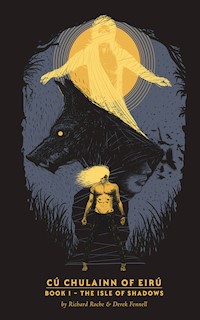
CúChulainn of Eirú
Book I
The Isle of Shadows
By
Richard Roche & Derek Fennell
CúChulainn of Eirú - Book I: The Isle of Shadows
by Richard Roche and Derek Fennellhttps://www.longstonebooksireland.com/Copyright © 2021 Richard Roche and Derek Fennell
All rights reserved.
No portion of this book may be reproduced in any form without permission from the publisher, except as permitted by U.S. copyright law.
For permissions contact: [email protected] or [email protected]
Cover by Mark Hill.Hardcover ISBN: 978-1-3999-1105-4
Paperback ISBN: 978-1-3999-1106-1
Printed in the United States of America
First Edition
Dedication
For our parents,
Dick & Mary Roche
and
Mick & Mary Fennell.
Acknowledgements
The authors extend their deepest gratitude to the many friends and supporters for their feedback on drafts, inspiration and encouragement on this (almost) twenty-year journey to publication; we are in your debt. Thanks also to Mark Hill for his beautiful artwork, and to Donal O’Connor for early visualisations. We also thank Colmán Ó Raghallaigh of Cló Mhaigh Eo, Lissa Oliver of the Irish Writers’ Union and Brian Langan for their insight and sage advice. Finally, our sincere thanks to Sophia Hadef for her belief in the power of myth and dark adventure.
Foreword
The following is a modern reimagining of the ancient Celtic myths that comprise the Ulster Cycle of Irish Mythology. Whenever possible, this telling of the myth has remained as close as possible to the original stories and tales as they are reported in such sources as the Yellow Book of Lecan, the Táin Bó Cuailgne and others of the manuscripts written and illuminated by early Irish monks, as well as modern translations such as that of The Táin by Thomas Kinsella. However, there are a number of problems associated with a heavy reliance on these texts which have played a major part in the form of the current text. Primary among the problems with the original texts is the fact that they themselves are retellings of stories which had existed for generations in the form of an oral tradition and as such, they are subject to contamination for two reasons; firstly, due to the nature of the oral tradition of storytelling in the seanchaí style, certain elements of the stories will have been exaggerated to almost absurd proportions, while other aspects of the stories will be nonsensical, as in the example of the warrior who is slain in one part of the tale of the First Battle of Moytura only to be revived and slain again in a later part of the tale. Through such ‘Chinese Whispers’ have many elements of the original stories been rendered baffling to the reader, which in many cases is to the detriment of the storyline (although it should be noted that the preservation of the storyline was not always the primary purpose of the storytelling process for the seanchaí).
The second problem with the early manuscripts is that they were written and illuminated by Christian monks who replaced many pagan elements and parts of the tales with biblical references, as can be seen in the sheer number of references to the Deluge of Noah and other biblical characters and locations in the early cycles of stories; the monks sought to make the Christian God more accessible and appealing by intermingling these stories with biblical themes and figures. For both of these reasons, we have felt justified in making whatever changes and alterations were necessary in the interests of telling the story. It is hoped - and perhaps it is not entirely implausible - that the stories as they are now told here come closer to the original storyline.
The dramatic potential of the Ulster (Uladh) Cycle has never been in any doubt; such tales as the boyhood deeds of CúChulainn, the Combat of Ferdia and CúChulainn, the Exile of the Sons of Uisliú, the Cattle Raid of Cooley (Táin Bó Cuailgne) and the Death of CúChulainn contain many moments of high dramatic content and stirring battles which are the fodder of the epic saga. The problem has always been that the stories have never been anything more than a collection of disjointed vignettes linked only by the characters involved in them. This fact is probably due to the reasons stated above, as well as the poor quality of many of the original manuscripts resulting in many sections and passages being lost forever. What we have done here is attempt to link these vignettes by means of a coherent plotline that simultaneously links the characters and events of the classical stories, and also tells the story in a manner that would be entertaining to a contemporary audience, while still doing justice to the themes of the original stories; themes of Magic (Draíocht), Trickery, Romance and Conflict. We have therefore written a story with a coherent framework which explains the motives of the various characters and links the vignettes. This proved to be no easy feat. We believe that in so doing, we have remained true to these themes and the traditions of the stories while also presenting the characters and situations in a less cartoonish manner than the treatment usually given them in the texts.
Here, we tell the stories of the Ulster Cycle (an Sraith Ultach), in three books. Book I, The Isle of Shadows, tells of the conception and boyhood deeds of CúChulainn, as well as the resistance of the men of Uladh to the second invasion of the Fomorians. Book II, Seeds of Ruin, will tell of the subsequent events including the combat of CúChulainn and his son. Finally, Book III, Gods’ End, will tell of the Táin Bó Cuailgne, the Cattle Raid of Cooley, which is the most famous story in the entire Irish mythology.
When asked about the relationship of Middle Earth to our world, JRR Tolkien famously described his Middle Earth as the world we live in, but at “a different stage of imagination”. Similarly, we present Eirú as a version of early Ireland at such a different stage of imagination; one in which magic and sorcery rub shoulders with feudal rivalries, where the veil between the worlds of the living and of the Sídhe is thin in places, and absent in others. This difference is reflected in our maps of Eirú – this is Ireland, but not as we know it. It is rather a version of ancient Ireland, one that has been nudged two or three degrees off the axis of reality.
We have written this story with one intention – that it would become the story of CúChulainn as we would like to see it told. For those purists who would claim that to deviate from, or change aspects of, the original stories is to somehow corrupt or diminish them, we can merely state that what we are doing here is no different to what each and every seanchaí of the ancient oral tradition has done for generations: to make the story more accessible and entertaining for the audience who hears it.
We hope we have succeeded.
Richard Roche & Derek Fennell,
October 2021
About the Authors
Richard Roche is an Associate Professor at the Department of Psychology, Maynooth University, where he lectures in neuroscience and neuropsychology. His areas of research include memory, dementia, synaesthesia and neuroaesthetics. To date he has published three academic books and 36 research papers, as well as several short stories, but this will be his first novel. His other interests include mythology, art and science communication, and has taken part in many outreach and engagement events.
Derek Fennell once put porridge on his table working as a sports writer in his native Co. Kildare and later Dublin. Chronically vulnerable to romance, adventure and literature, he threw caution to the wind and moved to Paris in 2006 where he constantly gets up to no good, keeping cheese in his larder as a language trainer, translator and interpreter. A deep fascination for Irish mythology has burned within him all his life, colouring and inspiring the fantastical short stories he amuses himself by writing. He describes working on this book as a labour of shared love - with his co-author - for the unique folklore of his home country and a monument to a friendship.
Prologue
I can only relate the tales as they were given to me to tell.
And if they seem more fantastic, or incredible, or somehow different to the ones you have heard yourself, then I say to you that this is just the way of tales.
They are alive, and never twice the same, nor should they be.
Every age brings freshness only to those legends that have strength enough to endure.
They change, and stay powerful.
What remains of truth, you might wonder? That thing we call truth concerns me little. There are certain truths which can cripple and harm and make weakness in men, and certain lies which can lend force and justice to actions.
In any case, I seek not to recount you histories, but stories; tales of renown as they have been passed down to me. They are the purest truth, because they have survived in our hearts.
So harken, if you will, to the deeds of a hero you thought you knew, but forgot.
But I have not forgotten, for I am Amergin, the Binder of Fates, and through me all is soon told….
*****
It began in the Ancient Times.
The days of the Tuatha Dé Dannan, the ancient race of powerful beings who dwelt in the raths and the secret places, were finished.
For millennia they had lived and reigned, weaving their magick, shaping what now remains.
But at length those Mighty Ones had chosen to slip out of our world and dwell elsewhere. Men, the newcomers, had emerged to forge their own destiny and inherit the earth.
But just as the Sun casts a shadow, there were those of the old race who resisted relinquishing their grasp on this earthly domain.
Some who found great nourishment from the souls of men.
And so these wicked powers had to be dragged by force into the nether realms, or imprisoned in the Sídhe, when the wise Dananns judged their fate.
But one lingered.
She was too wily, hiding herself from their thoughts, lying dormant and still as an ancient grave, so that in their final reckoning, the Dananns overlooked her.
And so it came to pass that The Morrigan, who whispered in men’s ears, inciting them to combat so she might feast on their battle-slain souls, was left free reign on this earth.
Unchecked. Unopposed.
Or so she thought. For there was one of the Tuatha Dé Danann whose mind shone as brightly as the Sun itself. Long had he hunted The Morrigan and thwarted her evil designs. He alone was not deceived by her cunning.
Lugh of the Long Arms, SunGod of the Eternal Light, bent his great will to her undoing. Never would he ascend to the distant stars to dwell with his kindred gods while the people he had grown to love – the Gaels – were in danger from her.
His task was not easy, but he did all that he could. Finally he came to realise the shocking error of his strategy at the great conflict known as the Second Battle of Moytura.
Balor of the Evil Eye, that loathsome and deranged Fomorian king, had led his twisted people from the cold deeps of the sea on a campaign of slaughter against the land dwellers.
Balor’s orgy of havoc threatened to consume the land until it was finally opposed by the League of Lugh – men of valour who chose to fight alongside the SunGod himself. The battle was long and brutal – the Fomorian horde vastly outnumbered the brave few who stood against them, yet resist them they did, and with much honour. But the sheer weight of numbers could not be overcome, and steadily they fell.
The songs tell of Balor’s great rage that day as he cut down wave after wave of noble warriors until he stood untouched and triumphant upon a hill of bloodied corpses. The flower of Lugh’s army lay shattered.
Hope had faded, and all seemed lost, until a shaft of light penetrated the looming clouds, reflecting on the golden armour worn by Lugh as he advanced on his bedazzled foe.
Balor howled in rage and beckoned the SunGod to a duel.
With unerring thrusts of his spear, Lugh quickly crippled his opponent. Then in a flash of light, he unsheathed his great sword Freagartach, The Answerer, and sundered Balor’s monstrous head from his body.
Thus ended the fighting on Moytura Plain that day, but the battle would become known for what immediately followed.
For as Lugh stood over Balor’s fallen corpse, his heart broken at the sight of the dead and dying strewn all around him, the dreaded Crow of Battle, The Morrigan, swooped down from the stormy clouds and began to mock him.
‘Do you feel victorious, then?’ she croaked maliciously.
‘The Fomors are broken. They won’t return to foul this land again,’ Lugh proclaimed, but already he was wary of the other’s triumphant tone.
Many times he had tried to capture The Morrigan, and yet here she was openly displaying herself to him. He sensed trickery, but advanced on the crow nonetheless.
From her perch on an upright sword-hilt, the goddess of death continued.
‘The bodies of the greatest of your League lie dead beneath me, Lugh of the Many Deeds. The mighty souls of all who have met eternity in this carnage are my prize. I grow fat from your tribute!’
And it was then that Lugh realised that the Morrigan drew her power from the souls of those slain in battle. There was no way to overcome her now; her strength was too great after so many deaths.
In frustration he cursed her.
‘The day will dawn, Fell Spirit, when there will no longer be a Morrigan to feast on the spoils of death. I will find a way to vanquish you. You will wither to nothing. This I vow.’
But the Morrigan merely laughed her coarse crow-laugh and took off into the heavens.
‘Even the God of the Sun will have burned cold before such a day! Death is the one constant. Wars will be waged. Men will perish in wickedness; my table will never be bare!’
Then the legends tell how the Morrigan drew around her dark clouds that churned and span with lightning. Those who were left living that day told of the souls rising like a mist from those slain upon the field of battle; Man and Fomor alike were dragged in terror into that obscene vortex.
And the sound. Some say those departing souls screamed. Others swear they heard them weeping, for the eternity of torment that now lay ahead of them.
Lugh knew then he could never defeat her. How could he, in battle, vanquish that which was death itself?
This was a fight he could never win.
No, Lugh would not be the one….
Part I
The Naming of CúChulainn
The Lay of the Land
The story that I tell unfolds in the last Age of Heroes.
After the disappearance of the Tuatha Dé Danann, power over the land was disputed by those mighty men of valour whose deeds live on in tales that blend and change, but never fade as long as hearts can soar and lips can speak.
At this time there were ranged against one another two principal forces. Firstly, that of King Conchobar MacNeasa, who ruled from the great hill fort of Eamhain Mhacha in the northern lands of Uladh, and to whom I was counsellor, and friend.
Strong and stubborn, his victories in battle were numerous and decisive. But his ways were harsh; opposing chieftains would be killed and replaced by one of his own trusted men, but it cannot be said that people did not live well under his rule. I saw his growing power and chose to stay beside him to temper the fury that would crush his enemies into extinction, and to guide his burning ambitions. This, I knew, was the duty the fates had planned for me.
Among the fearsome and cunning warriors who swore fealty to Conchobar was Fergus MacRoth. Fergus of the Flinted Fist, Wielder of Heaven’s Call, the Axe of Singing Sorrow, Fergus the Hundred-Slayer, commander of one half of Conchobar’s army, the Ruddy Boars. Many were the names they had for him, and his very presence on the battlefield caused enemies to suddenly lose grip upon their weapons and weep like infants.
And there was Forgall Manach, the general of the Second Sword, who led the other half of Conchobar’s army, the Wolf Horde. When it was required, the two forces would merge into one mighty battle host. It was thus that Conchobar kept his enemies off-balance. A wily and unpredictable tactician was Manach; he could see into a man’s heart and know his ways.
The only other power in the land that could truly oppose the primacy of Eamhain lay in the West, in Connacht, where dwelled the armies of Queen Medb, the untamable BattleDame of Cruachán Ai.
The province of Connacht was wild and proud, just like its people, and the Queen was no ordinary woman, for she was of the Tuatha Dé Danann. How this came to be is a tale I may tell another time...
The powers of the Danann kind confounded even the best-conceived plans of Forgall Manach and the valour of Fergus MacRoth, so that no invasion of Connacht ever came to fruition. For their part, Medb’s forces laboured in vain to find a way to counter the expansion of Conchobar’s dominion.
Our story unfolds at a time when Queen Medb had allied her forces with those of King Ailill of the Steady Hand, whose forts controlled the great lakes and rivers at the heart of the land, thus putting further forces between Conchobar and her territory. And not long after this pact was consecrated in Medb’s bedchamber at the great castle of Cruachán.
And so this was how the land lay before these events of great renown took place.
And they are soon told.
1.
The Red Branch
Sunlight bathed the Great Plain of Muirtheimne in the province of Uladh, though there was no heat in it. This place had seen much death in the past, but with the coming of the season of Imbolc came new life – the first delicate shoots and buds hinted at the rebirth to come. Before the Ogham Stone knelt Fergus MacRoth, the great champion of Eamhain Mhacha. As he meditated, head bowed, his hand travelled slowly down the edge of the rough-hewn surface, his lips moving in silent incantation as he deciphered each word with his fingers.
The silence was broken by a voice from behind him, but Fergus felt no shame at being found deep in prayer, even if such practices were largely mocked these days; rather it was his failure to detect the approach of the stranger that disturbed him. It was no easy thing to creep up on Fergus MacRoth by foot, and this intruder was on horseback. The voice that greeted him was little more than a whisper, and sounded out of breath. Fergus attributed this to the portly stature of its owner.
‘Begging your pardon, my lord, I did not mean to interrupt you,’ it wheezed.
‘Begging your own, but you have,’ retorted Fergus gruffly, getting to his feet and regarding the newcomer suspiciously. ‘Draw back your hood, stranger. I can see much of you, for there is much to you, but I would look upon your face if I am to speak with you.’
The face the rider revealed was not a fair one; his cheeks were as fat as his belly was large, and an array of sores were dotted across his unhandsome features. Fergus relaxed slightly. In his experience, assassins tended to be leaner, and kept in better health by their retainers.
‘Well? What business have you with me? It does not please me to be disturbed while at prayer on such a day as this. Particularly here, at the site of the Second Battle of Moytura where Lugh slew Balor of the Evil Eye.
‘Aye, ‘tis true, the SunGod blesses us today. Though I fear the days of His influence are drawing to their end.’ He shook his head slowly, though his eyes never left Fergus.
‘Another one who dishonours the Gods!’ muttered Fergus, his hostility toward the stranger rising again. ‘I ask you again, what is your business here? Your face, foul though it is, is not known to me and your accent is hard to place. How came you so quietly along the road that I heard no approach?’
By this point, he had moved his hand onto the handle of the great axe tucked between his tunic and belt, as if ready to draw the weapon.
‘Peace, my friend, I mean no disrespect. I would be in your debt if you would but lead me to Eamhain Mhacha and its King Conchobar. It’s a perilous road these days, I hear, and I’d feel much the safer if I were accompanied by one of renown such as you.’
Fergus stared at him for a moment. ‘Eamhain Mhacha is wary of strangers at this time. What business have you there?’
‘I am just a wandering bard,’ continued the stranger, ‘hoping to seek the protection of the king’s walls in return for my services. There are not many other places in this land safe for the likes of me now… But I’m told that Conchobar is just.’
Fergus found it difficult to imagine much musical talent emanating from such stubby fingers or breathless lungs. Yet he felt a sort of pity for the stranger, a pity that was beginning to replace his initial mistrust.
‘You have heard true enough, Conchobar MacNeasa is a fair King. Very well, fat bard, you don’t seem a likely brigand or warrior. Come with Fergus now and you will see how unhindered an Uladh champion moves in his own country. What is your name, traveller?’ he asked as he mounted his own horse and made to lead the bard along the road to the great citadel of Eamhain Mhacha.
The newcomer paused for a moment, staring at the Ogham Stone as if lost in thought. Then he turned to Fergus. ‘Ah, I have many names, though the one that seems to attach itself to me most often is Ramhar…’
Fergus laughed aloud at this. ‘And little wonder, fat bard, I can see that you are well rewarded for your craft, though it seems to me that such payment comes mostly in cooked form! Come then, Ramhar, Eamhain lies yonder.’
As the pair trotted away across the plain, it seemed to Fergus that the sun’s light gradually grew a little warmer on his neck.
*****
The two men journeyed side by side following an unmarked trail through the woodlands that Fergus seemed to know by heart, and as they rode, the bard asked many questions of the champion: of the kingdom, its people, and their customs. All of these things seemed to interest the newcomer greatly, though Fergus saw no reason to keep information from him; he was growing increasingly fond of this ‘Ramhar’ as they made their way across the countryside.
‘I know too little of Conchobar,’ said the bard. ‘How came he to his throne – has his line ruled here for generations as in other lands?’
Fergus looked askance at him as they rode.
‘How can you expect to earn your keep at Eamhain Mhacha if you do not know the story of its king?’
They rode on in silence for a few moments. An almost imperceptible smile formed on Ramhar’s lips.
‘Would you tell it to me, champion? I have travelled far, and am always in search of tales to tell, and stories to sing.’
‘Very well, bard, the tale will pass the hours. He is the son of a king, though his ascent to the throne was far from bloodless.
‘It was twenty-four summers past, and the kingdom of Eamhain Mhacha faced a grave threat. The sons of the dying king Fachtna Fatachwere squabbling amongst one another for the right to proclaim themselves the new ruler.
‘The eldest, Eochu, would have been the uncontested choice to take his father’s place, but he was opposed by the second son, Feidlech, who could never bear his brother’s greater prominence.
‘Wise Amergin, the renowned sage, was summoned by the king. Naturally he pronounced in favour of the eldest son Eochu, who seemed a just and promising leader, whilst Feidlech’s manner caused grave concern.
‘It had seemed that Amergin’s judgement had been accepted by all: the two brothers embraced before the court and, the problem of his succession solved, old Fachtna died peacefully that night.
‘The funeral feast lasted a week and as it came to an end Feidlech invited Eochu to hunt with him on the day before his coronation so that, through the ritual of the chase, they could seal the covenant of their loyalty to one another.
‘Alone the brothers set off into the forest to find a stag worthy of their father’s memory. It wasn’t long before Eochu spotted a fine beast and took chase. Feidlech followed him, but just as Eochu pulled back his arm to hurl his spear his horse reared and crumpled beneath him - struck in the flank by Feidlech’s lance. Eochu fell hard to the ground, his horse falling upon him, crushing his right arm and leg. Feidlech could see his brother lived yet, and raised his sword high to deliver the killing blow.
‘But he noticed a woodsman appear from the trees and, not wanting to be seen committing murder, shouted to the newcomer “Ho, come quick, the new King of Uladh has fallen from his horse. Help me bring him back to Eamhain Mhacha, for his wounds look grave!”
‘The woodsman nodded and together they gently lay the groaning Eochu upon his brother’s horse and brought him back to Eamhain.
‘There at the court Amergin examined Eochu’s wounds, and sadly announced that nevermore would he walk with two firm legs and that his arm had thrown its last lance. At the news Feidlech pronounced that according to the law, it was impossible for a king to be blemished in this way, so it now fell to him to rule Eamhain Mhacha.
‘It was then that the woodsman who had helped bring the wounded Eochu to the court pushed his way forward and declared:
‘“No! Feidlech should not become king! He is a rogue and full of deceit. I saw him in the woods strike down the horse of Eochu, causing these wounds. I saw him raise his sword to kill his brother, and he would have done so if he had not realised I was there to witness the villainy!”
‘“Who are you, peasant, to make such vicious claims?” shrieked Feidlech.
‘“I am Conchobar MacNeasa, the son of Ness Fian who laid down with King Fachtna Fatach during the summer when the great king defeated the army of Eochaind Salbruide!”
‘Feidlech knew then that this man, a direct son of Fachtna and thus eligible to the throne, could ruin all his schemes. He roared that he was born to rule and that the newcomer should be put to death immediately for such an affront.
‘But Conchobar challenged: “I swear that what I say is true, and I will prove its truth by putting a geis upon you! If I can defeat you unarmed whilst you yourself can use any weapon you wish, then my words cannot be unheeded.”
‘“Very well!” cried Feidlech, seeing that the advantage was so heavily stacked in his favour.
‘He seized his father’s sword from where it lay upon the throne and swung it with all his treacherous rage.
‘But Conchobar ducked beneath the blow and quickly came up behind Feidlech; before anyone could draw another breath, he seized the young pretender’s neck and snapped it like a dry twig.
‘“The truth of my words is before you,” cried the victor.
‘“I tell you again, I am Conchobar MacNeasa, son also of Fachtna Fatach, and I’ve lived long enough in hiding with my sister in the woods. Am I fit to be king?”
‘Those in attendance roared their fierce agreement, for along with the geis-bound deed which had taken place in front of their eyes, the warrior before them bore a strong resemblance to his father.’
*****
When Fergus had finished his fine tale the bard cheered heartily and, the mood becoming more confortable, they began to speak more freely as they rode. Ramhar enquired much about the current state of the province of Uladh: and was told how it was at war with the western land of Connacht and that her borders were constantly under threat; how danger came from the seas, whence the hideous Fomorian creatures were occasionally known to attack the outlying lands in small raiding parties.
‘Do not expect the air to be light in Eamhain Mhacha at present. Though the Fomor remnant has been fought back for now and the wars in the West are going well, the king is still laid low over the loss of his sister, the lady Dechtire.’
Fergus’s face grew dark as he broached this subject.
‘Whatever became of her?’
‘Taken in some dark manner from the very banquet table of Conchobar’s Great Hall.’ It still troubled him that all of the great warriors, himself included, should have been so powerless to prevent the abduction.
‘Some fools think it was the strong sun and the ferocity with which the champions took to the mead that day that laid us low. But I tell you, there was some magick surely at play that made us as drowsy as milked cows. When we came to our senses again, Dechtíre was gone. No one knows whither.’
‘Tell me more of these Fomorians. You say they are enemies of old?’
‘At one bleak time,’ Fergus began, ‘the Fomorians almost had this country under their sway. Some say that they were men once, cruel, wicked men who dishonoured the Gods with their vile, blasphemous acts, so the Dananns banished them to the seas for all time, their bodies ruined and misshapen that they might suffer life in the abyss. But even the Gods, it seems, cannot foresee all. The sea could not contain such evil; they learned to control the creatures of the deep, even bred with some of them, it is said. They formed crude craft that allowed them return to these lands and their rampages began afresh. Initially they merely controlled the coasts. But eventually they grew more aggressive and pillaged inwards. They sought to destroy our way of life, to enslave us.’
Fergus’s disgust was evident as he recounted these events, but his voice grew proud yet reverential when he began to speak of the Danann folk.
‘But they could not stand against the mighty charge of Lugh of the Long Arms! No warrior was ever better equipped than he. He rode the steed of Mannán Mac Lir, Enbarr of the Flowing Mane, which ran so swiftly no adversary could catch it. He wore Mannán’s armour and breastplate, which no weapon could pierce, and he wielded a great sword, Freagartach the Answerer, which cut through flesh like butter, creating wounds that no physician could ever hope to heal. Lugh came against the Fomorian horde in all his might and scattered them like frightened cattle. Nine alone survived, to bear the story of his deeds back to the Fomor people.’
His words had a strange effect on Ramhar. Unseen by Fergus, a pure golden light flickered in the eyes of the bard at the mention of the Sun God’s great deeds. It burned for a moment, then faded and was gone. When he spoke next, his voice was weary.
‘But now you tell me the Fomorians are gathering strength again. Lugh did not complete his task…’
‘The men of Uladh are stronger now. We could repel them. But even if we could not, Lugh would return. The Sun God always rises to banish the dark of night.’
Ramhar looked at Fergus for a moment. ‘Your faith impresses me, my friend. I only hope that the Gods are deserving of your devotion.’
Fergus was about to say something in response to this when the pair crested a hill and found themselves looking down at the great fortress of Eamhain Mhacha. Even after many years, the sight of the capital was still enough to steal the breath from him. To call Eamhain a fort seemed somehow inadequate, for it was in truth much more than that – part ring-fortress, part crannóg, with high walls of piled stone supported by massive oak logs upon which forbidding wooden battlements were perched. The stronghold was host to countless huts, bowers, workshops, stables and other dwellings of man and beast. Within these great defences, aside from the buildings, lay green fields of produce, grazing land for herds of livestock, a small wooded grove through which ran a narrow river that widened into two small lakes at points, and even playing fields. Towards the rear rose a great hill, shielded behind further defensive walls, at whose crest shone the magnificent Great Hall, golden against the dark foothills of the Twelve Peaks beyond. This was Eamhain Mhacha, the heart of Uladh, the centre of civilisation in this dangerous land.
As they entered through the defences and into the main expanse of the fortress, signs of everyday life unfurled all around them. People came and went with cattle or pigs, leading them to and from pens and enclosures for milking or butchering. Growers toiled in the earth and gathered vegetables. Craftsmen and women wove, stitched, hammered and forged in their huts. Children ran amuck with wooden swords and shields; others batted a sliotar to and fro with crude camáns. Inside the safety of these great walls, thought the bard, life can go about its business in peace. He turned to look at the fortified hilltop, which was crowned by the Great Hall, seat of King Conchobar MacNeasa’s court.
‘There’s an inn over yonder which may have use for a bard such as yourself,’ said Fergus, gesturing toward a long, dimly lit hut across the courtyard. Ramhar seemed puzzled by this, and his response came in a voice that was firm and steady.
‘I am here to see Conchobar.’
Fergus shook his head. ‘I told you, the king is not in the mood for merriment, so you’ll have more luck over…’
Ramhar transfixed him with a stare. ‘Bring me to Conchobar, man. He will see me.’
Fergus blinked, wavered, then regained himself. For a moment he sought to bring words of dismissal to his lips, but was suddenly soothed as he regarded the inoffensive, flabby face of the other man.
‘Come then!’ he grunted finally. ‘I will enjoy watching the sport he makes of you.’
Fergus rode off up the heavily guarded hillside, his fat companion trotting behind on his straining mount. The gates swung open unbidden at Fergus’s approach.
*****
Conchobar shifted uneasily in his throne while Forgall Manach, his most senior general, made his report. The king’s displeasure was obvious to most of the assembled warriors, courtiers and wise men; it seemed to Conchobar that even the servants were uneasy around him. And with good cause, he thought sourly to himself. He watched as Forgall moved around the great wooden map of the land that took up a sizeable area before the throne, driving flag-bearing spears into key locations to indicate success on the battlefield and ground gained from defeated enemies. Such news should lift a king’s heart, as well he knew, but matters were grave in the court of MacNeasa.
‘Coupled with your own victories on the eastern coast, my King, our claiming of the land around these ancient sídhe will ensure the neighbouring chieftains see the sense in your becoming High King of All Eirú.’
Forgall paused and glanced around at the other Uladh warriors attending this council.
‘Few could argue against a king who is uniting the old lands of the Dé Danann for the first time since the struggles in the Age of Plagues? Their druids will see the wisdom of it. You are High King, in all but name now. Even Ailill of Connacht is said to whisper this in his own court.’
Silence lingered in the high-vaulted hall for some moments as all eyes turned to Conchobar. At length, he spoke with a weary tone.
‘All this I know, Forgall, for I myself have planned these events with you. And ‘tis true that such proclamations hearten the men, most of all when so little Uladh blood has been spilled. But I am more eager for you to tell me of other pressing matters.
‘The fact that you have not already delivered good news of her bodes surely that my heart is soon to grow heavier yet.’
The general looked to the floor.
‘The lady Dechtíre is… not in Connacht, my King.’
He steeled himself for the response. Conchobar had risen to his feet, drawing himself up to his full, impressive, height. His booming voice shook the Great Hall, causing the golden apples on the ornate silver bough that adorned the wall behind his throne to chime with the vibration.
‘By the tears of Danú! Who else but Ailill could have taken her? He seeks to destroy this fledgling unity before it can threaten him, so he takes my sister from under my very roof to attribute weakness to me in the eyes of the petty kings!’
His face flushed crimson; his fists clenched. None dared move until a gnarled, ancient hand reached gently for the king’s arm. Amergin, the wise sage of the court, brought his bald, dark-skinned head close to the king’s ear.
‘We do not know this, O King. Be not so quick with your accusations. We are far from the young king Ailill’s influence here at Eamhain.’
Conchobar seemed lost in thought for a moment, but then he shook his head and sat back down heavily.
‘The Fomors could not have done it, for they always leave their trace on the land. Perhaps she simply…’
His musing was suddenly cut short by a great clamour as the huge doors of the hall were swung open. Fergus strode in, followed close behind by the shuffling figure of Ramhar. The king’s spirits rose visibly.
‘Fergus! What news? Come, my brother, and bring cheer to your sullen friend. Tell me, you have some news of Dechtire. And who is your fat companion? You know that strangers may not enter here…’
Fergus came to a stop and stood silent in the middle of the Great Hall, swaying slightly. When he finally spoke his words came slowly, as those of a man waking from a dream.
‘Who? He is… the one… who must speak with you… I…’
Forgall was the first to react. ‘He has been tricked! ‘Tis an assassin!’ he roared. Drawing his blade, he leapt between his king and the uninvited guest who Fergus had brought before them. But before his stroke could fall, he found himself frozen by a strange sight unfolding before him. Unnatural light appeared to be shining out from the hood and the cuffs of Ramhar’s cloak, and as the gathering looked on stupefied, it appeared to them that the figure grew larger and larger. The glow grew more intense, like sunlight breaking through mottled clouds, casting beams of gold around the hall.
The cloak rose higher into the air, appearing to hover unsupported while the now blinding light continued to escape from beneath its folds. Finally, the garment was shaken off, fluttering softly to the floor. Now in the centre of the hall stood a great pillar of light, almost twice the height of a man, dazzling to look upon. All stood aghast but Conchobar was the only one to summon a response to these strange events.
‘By Danú,’ he breathed.
‘By that name indeed!’ uttered a booming, resonant voice from the midst of the nimbus, and as the intensity of the light faded, a form became discernible. Feet clad in golden boots, a shimmering ochre breastplate upon which were engraved three swans in flight, a helm the colour of the rising sun, a flowing crimson cape. The giant figure took a step forward and all could now see, and knew in their hearts without any words needing to be uttered, that Lugh Samildánach, Lugh of the Long Arms, the SunGod himself, had returned to Uladh.
And not alone.
As he advanced, Lugh drew back his great cape to reveal a woman, dazed and heavily pregnant, his arm held protectively around her shoulder. Conchobar was so moved by the sight of his sister that he momentarily abandoned his reverence at the reappearance of Lugh and rushed across the floor to catch her as she wavered.
‘Dechtíre! What has become of you?’ he gasped.
‘It was no enemy, Conchobar MacNeasa, that took your sister. She came to dance with Lugh, and did so willingly.’ A broad smile creased the great bearded face of the giant, and it was as if the sun had broken out inside the walls of the great hall. All who were present later recounted a slightly different description of the apparition, no doubt some magick of the Faerie Folk; but each to a man would agree about the compassion and warmth which they found in his lined face, the great troughs of wrinkle etched across his brow, and the reassuring light that shone from those golden eyes. It was a moment that none present would ever forget. The Sun God continued:
‘Pay heed now, doughty Uladhmen. Though now triumphant in your victories, I tell you there is much darkness ahead. In less than a score of years, the greatest test of your people will be upon you. It will overcome you and sweep you aside, of that there is no doubt. The waning spirit of your kind has weakened the strength of mine. But fear not! To counter this we shall be linked again as we were linked in the past.’
Confused looks were exchanged around the hall. Murmurs of concern were quickly silenced by Amergin, the ancient sage commanding silence with a sweeping gesture of his hand.
‘Your king’s sister will soon be breached… by my son. He alone will have the strength to leap into the maw of the beast. As Lugh was before him, he will be a warrior without equal. You will name him Setanta. He will be the last slender hope for men in the face of the coming storm. The task of his teaching, however, falls to you.’
He looked around the court and each one present felt the sudden weight of responsibility carried with those words. Conchobar, having seen to his sister and seated her on his throne, stepped forward, bowing low before Lugh.
‘You honour us, Lugh of the Great Deeds. But who among us men could teach a God the divine knowledge as befitting your son. We are not prepared for this.’ Shaking his head slowly, he looked to his sage for support. Amergin, his brow furrowed deep in thought, raised his knotted hands in supplication.
‘My knowledge is as nought before that of the gods.’
‘He will not be fully divine; he’ll also be a flesh and blood man,’ Lugh went on. ‘His mind and body will be as a rough rock that you shall hew to perfection. It is for you, Conchobar, to raise the child, for he is next of kin to you. Let Sencha the Poet instruct him in speech and oratory; let Fergus the Warrior hold him on his knees; let Forgall the Tactician instruct him in strategy; and let Amergin the Sage be his tutor.
‘The child will be praised by all, by chariot drivers and soldiers; by kings and seers. He will avenge your wrongs; he will defend your fords; he will fight your battles. Here in this hall, where flourishes the bloodlines of those who fought alongside the Tuatha Dé Danann when we were at our greatest need at the Second Battle of Moytura, here will I leave my legacy.’
From the folds of his crimson cape, Lugh then produced a golden staff. As he held it aloft, it began to glimmer with a ruby glow, as if veins of scarlet were spreading along the length of the shaft. Twirling it deftly in the air, he suddenly and effortlessly planted the end of it into the floor of the hall, smashing through the flagstones and into the earth beneath.
‘Behold! You are forever under the protection of Lugh Samildánach and to this branch, pruned by my own hand from the last Quicken Tree, will your destiny ever be tied.’
With this, he released his grip on the staff, which then began to take root in the floor, metamorphosing from a smooth length of pared wood into a shape more akin to a burgeoning sapling. The young tree, still red and gold, began to grow and reach toward the rafters of the great hall.
‘This branch will be your symbol and your namesake. You must protect it always. For when the darkest hour is upon you, then will it be your final salvation. I charge you now with these two tasks, Knights of the Red Branch. The success of the one depends upon the survival of the other. They are as powerfully linked as Lugh is to his People. One day, all this will be made manifest and on that day will my debt to your kind be repaid.’
Raising his arms aloft, he spoke one final time.
‘Raise him well, Uladhmen.’
With that, he bowed low to Conchobar, then to the Branch, and at last he turned slowly and strode towards the great oak doors of the hall. Pushing them back as though they were no heavier than calfskin curtains, he disappeared into a sudden surge of afternoon sunlight that momentarily dazzled all those inside, and was seen no more.
A heavy silence deadened the air in the chamber. Some were still gaping in awe at the strange red-golden branch that still showed tiny signs of growth and movement. Others looked to Dechtíre; Conchobar had returned to her side and was hovering anxiously as Amergin tended to her. She was returning to her senses, and showed no signs of distress or ill-treatment. The sage turned to his king with a wan smile.
‘I do not know what is most fitting at this hour, to rejoice or to despair.
‘It is a murky sentence the Sun God has passed on us.’
Conchobar nodded. ‘He has brought life - that cannot be ill.’
‘Time will tell, my King,’ said Amergin, and despite the strange events there was a warmth and humour to his voice. ‘One way or another, we’ll be kept busy for the next twenty years or so it seems!’
The Great Hall of Eamhain Mhacha, which from that day forward was to be known as An Craobh Ruadh, the Hall of the Red Branch, then rang with a sound it had not heard for many months – the laughter of the king. Such was his relief and joy at his sister’s return that the golden apples above the throne chimed with his delight. The sound shook the other warriors from their trance before the Branch and slowly they made their way back towards the throne. Rising, Conchobar addressed them.
‘Then let us fill those years with worthy deeds, and make fertile soil in which this great lad may flourish. For if he is to be our final defence against what is to come, then we had best make sure he is well-constructed.’
So it was that while the Hall of the Red Branch rumbled with sounds of preparation and bustle, the people of Eamhain assembled outside the inner gates as word of the divine visitation began to spread. No-one noticed the small, squat, hooded figure that slipped silently through the crowded citadel, weaving his way towards the exterior defences. No-one except Fergus, who, staring from the door of the Great Hall, followed the fat man’s movements as he slipped past the guards who appeared not to even see him. Then, the portly bard looked back for a moment and caught his eye, before moving off past the gates and into the countryside beyond.
Fergus could see that the sun’s rays followed him as he went.
*****
And so it came to pass that, three days after the visitation of Lugh, Dechtíre delivered the promised child into this age of strife.
And she named him Setanta.
Bringing to bear all the knowledge of divination handed down to him by his order, Amergin the sage foresaw that the boy would become the champion of champions, and that his life would be the torch of hope in a time of darkness.
But his vision was also clear on one thing.
Though all the skills of the greatest Uladh heroes were his to learn, together with the abilities natural to his Danann blood, they would not be enough to secure him a great age.
His life-path was short. Like many legendary warriors, Setanta would die mighty and die young. But he would live beyond most men’s capabilities.
As Setanta grew out of childhood, his skills in the art of war became a source of wonder at Eamhain Mhacha.
All of the women of Uladh loved him for his strength, his handsome features and his fine way of speaking. They also admired his wisdom, his prudence in battle and his gifts of prophecy and judgement.
Indeed they could only find three faults in him: that he was too young, too brave and too beautiful.
And while none doubted that he would grow into the warrior upon whom all hope would one day rest, few imagined that day would arrive so soon. But such is prophecy – it has a way of making fools of those who purport to understand it.
And so it was that, before the end of his nineteenth year of life, Setanta would face the first of his many great challenges.
The Red Branch Knights
Everything changed at Eamhain Mhacha from the day of Lugh’s appearance and the return of the king’s sister Dechtíre.
The great branch the Sun God struck into the ground grew thick and tall, until it finally reached out from the roof. Its topmost parts, spreading towards the heavens, could be seen proudly from anywhere in Eamhain.
And the chamber of the King came to be known as An Craobh Ruadh, in honour of the red branch.
Those soldiers who that day bore witness to the event took the russet-skinned tree as their emblem. Conchobar was in agreement that from then on it would adorn his standard alongside his own sigil – a bloody spearhead – for Conchobar was fiercely devoted to Lugh, the Celestial Warrior.
Then some days later, the king visited me and told me of the dreams that had come to him since that auspicious day.
He dreamt, said he, that the Red Branch spoke to him and the voice said that its will was one and the same as the will of Lugh in what it had to reveal.
It told of terrible trials ahead and the need for great valour in the future. The son of Dechtíre would do a thousand great deeds, but in the convulsions to come he would have equal need of the best soldiers of Eamhain Mhacha.
The Red Branch told that it would know which among Conchobar’s warriors were fit to face the ultimate challenges and sacrifices that lay ahead.
Visions of heroic tasks came to Conchobar, and he put it to his soldiers to accomplish these feats if they desired to join his new order of elite fighting men - the Red Branch Knights.
Those that proved their mettle in this series of trials were allowed to carve away a sliver of the red-golden bark from the mighty branch and attach it to their gauntlet as a sign of their undying fealty and readiness to defend Eamhain Mhacha to the last drop of their blood.
It was well that they were so-willing, for soon there would be grave need of them, these stout battle-brothers of Uladh…
2.
The Garden of Lugh
It had rained heavily enough that morning.
And from the look of the eastern clouds, Emer felt sure it would rain again before the evening drew in. But at this moment Luglochta Lóga, the Garden of Lugh, was filled with sun. The pine-ringed gardens behind the south wall of Eamhain Mhacha had a curious way of capturing and channelling the light so that any who reflected on time spent there would be filled with memories of sunshine and warmth.
The Garden of Lugh was Emer Manach’s favourite place in the world, as much as she knew of it, which was considerable enough, given that she was the daughter of Forgall Manach, the far-riding war-planner of Eamhain Mhacha.
But war was a long way from her mind now as she sat on one of the wooden benches that formed a ring in the garden, encircled by five other well-born girls of Eamhain. For it was here that poets and storytellers came to weave tales when the days were suited.
Today was a day for needle-work instruction. It was one of her duties to ensure that young Mhachan girls could seam and repair both finery and leather armour alike. Grace and battle went hand in hand at Eamhain Mhacha.
Pausing from her demonstration and regarding the skies, she began to think it strange, even in this garden, that the light would shine so intensely today.
‘That’s a faerie sky if ever I saw it,’ she declared.
‘Why do you say that, Emer?’ asked one of her companions, Saidbh, the spear-maker’s daughter.
‘Look at the sky above us. A hole in the clouds, it seems, where the sun comes in to bathe us here in the garden. See the clouds move around it? They don’t dare cover the hole, they go around. The master of Luglochta Lóga has play in his heart today.’
‘He doesn’t seem to be the only one,’ whispered Saidbh and Emer saw her eyes fix on a point behind where she was sitting, her face a little flushed.
Then a voice from behind her spoke her name - a voice Emer Manach had spent her whole life trying to resist. But for how much longer, she often wondered.
It was a voice full of honey and danger; to Emer it was the very sound of love in all its frightfulness.
‘If the men of Uladh could wield a blade half as skilfully as Emer does her needle, then there would be no need for war, for all our enemies would cower from us!’
Emer turned to face the speaker, but for a moment could not reply as the sun’s rays shone onto the figure, surrounding him in a dazzling glow playing on his wild mane of hair, the colour of ripe barley. When she she put a hand to her brow there he was in full, an off-kilter grin adorning that otherwise perfect face, impertinence incarnate flashing from his sky-blue eyes.
That damned Setanta!
She ignored the shameful giggling of the other maidens, turning to face the young man she had known all her life yet felt she could never know, and met his grin with a sharp smile of her own.
And in that moment Emer began to realize something of the power that she alone held over the great hope of her land.
She stepped close to him and wielded that power with exquisite deftness.
‘And if the celebrated Setanta could only handle his sword as well as some people say, then we’d all have nothing to fear,’ she breathed into his face before turning quickly away, her blossom-laced hair casting a fragrance as it spun, causing Setanta to blink despite himself.
‘Swordsmanship, is it?’ he began, feeling a curious mixture of humiliation and burning desire.
‘Well, let me…’ he stopped short, his hand confusedly patting his empty scabbard.
The young girls around him laughed when Emer turned back, revealing his sword, newly adorned with daisy chains around the hilt.
Then, her voice thick with gentle mockery, she goaded the blushing Setanta further.
‘Come, mighty warrior, and relieve the poor maiden of this heavy thing before her dainty arms break off!’
But, somewhat to her irritation, the lopsided grin wasn’t long absent from Setanta’s face. He accepted the sword from her gracefully then twirled it impressively around in dizzying circles before placing it back in his scabbard, keeping the daisy chains in place.
Typical! Trying to win back the crowd! Emer thought.
‘See what happens, children, when you try to pay a compliment to a champion’s daughter?’ Setanta asked the handmaidens, theatrically. ‘She has fighting blood, so it will make a fine battle of wooing her!’
There was no way Emer was going to let him get away with that one.
‘There are other daughters of other champions in this fair country who would fall easily to your ‘attacks’, Setanta. But not I,’ she snapped, yet her retort didn’t come out strong enough for her liking. Damn it. What was wrong with her?
Setanta had stepped closer now, and his eyes moved slowly from her face, down her neckline and below...
‘That is a fair country,’ he said quietly. ‘And how I might wish to wander there.’
Shocked at this temerity, Emer was at a loss for words until Setanta touched her cheek with two fingers and began tracing a line downward. She snatched those fingers and grasped them tightly before they could even travel past her jaw.
‘No man may travel there unless he can prove that he actually is a man. And there are few enough around here; only boys who think their big mouths and fists make up for their hollow heads and…’ - Emer wrinkled her nose in feigned disgust – ‘…lack of charm.’
To her delight, his grin had disappeared and showed no sign of returning. The proud Setanta was enraged; he stood speechless, staring at her with his hard eyes. She was so close to him close to him, she could actually feel the heat of his fury radiating from his body!
‘Setanta!’ a voice called from beyond the conifer trees. Emer recognised it as Conall Cearnach, one of Setanta’s vagabond friends.
‘Tear yourself from your needlework practice! The hunt awaits and I wish to revenge myself on you, you dog!’
Somewhat relieved by this interruption, Emer turned sharply and walked back to her maidens, offering a final few words to Setanta without turning her head.
‘Away with you now, Setanta. I hope you can pursue an animal with more guile than you do a woman, or the king won’t dine well tonight.’
As hard as she tired, she could not keep the smirk from her face, and the giggling reaction of her maidens on seeing it was enough to tell Setanta of its presence. Although she would scold herself for it later, she was relieved that he would know her harsh tone was in jest.
‘Come on then, Conall! How eager you are to be shamed!’ he called. Then Emer heard him charging back through the trees.
And she heard also that the anger had passed from his voice.
The voice she already missed.




