


47,99 €
Mehr erfahren.
- Herausgeber: John Wiley & Sons
- Kategorie: Wissenschaft und neue Technologien
- Sprache: Englisch
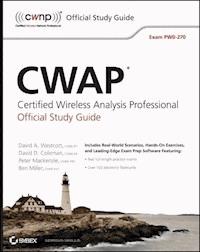
The official study guide for the Certified Wireless Analysis Professional certification from CWNP Four leading wireless experts thoroughly prepare you for the vendor-neutral CWAP exam administered by CWNP, the industry leader for enterprise Wi-Fi training and certification. This official study guide not only covers all exam objectives for the CWAP exam, it also prepares you to administer and troubleshoot complex enterprise WLAN environments. * Covers all exam objectives for the Certified Wireless Analysis Professional (CWAP) exam * Covers 802.11 physical (PHY) and 802.11 MAC layer frame formats and technologies * Also covers 802.11 operation and frame exchanges, spectrum analysis and troubleshooting, and protocol analysis and troubleshooting * Includes hands-on exercises using the Wireshark protocol analyzer and Fluke Network's Spectrum analyzer software * Companion CD includes two practice exams and over 150 electronic flashcards Advancing your skills as a wireless administrator professional? Start by passing the CWAP exam with the complete test prep you'll find in this practical study guide and CD. Note: CD-ROM materials for eBook purchases can be downloaded from http://booksupport.wiley.com .
Sie lesen das E-Book in den Legimi-Apps auf:
Seitenzahl: 998
Veröffentlichungsjahr: 2011
Ähnliche



















Table of Contents
Cover
Title Page
Credits
Copyright
Publisher's Note
Dedication
Acknowledgments
About the Authors
Foreword
Introduction
Assessment Test
Answers to Assessment Test
Chapter 1: 802.11 Overview
OSI Model
Packets, Frames, and Bits
Data-Link Layer
Physical Layer
802.11 Services
802.11 Frames
IEEE 802.11-2007 Standard and Amendments
Wi-Fi Alliance
Summary
Exam Essentials
Key Terms
Review Questions
Answers to Review Questions
Chapter 2: 802.11 Physical (PHY) Layer Frame Format
Physical Layer Operations
Physical Layer
PLCP Protocol Data Unit
2.4 GHz Communications
5 GHz Communications
Adjacent, Nonadjacent, and Overlapping Channels
Clause 14 FHSS PHY
Clause 15 DSSS PHY
Clause 17 OFDM PHY
Clause 18 HR-DSSS PHY
Clause 19 ERP PHY
Clause 20 HT PHY
Summary
Exam Essentials
Key Terms
Review Questions
Answers to Review Questions
Chapter 3: 802.11 MAC Sublayer Frame Format
General 802.11 MPDU Format
MAC Header
Frame Control Field
Duration/ID Field
MAC Layer Addressing
Sequence Control Field
QoS Control Field
Frame Body
FCS Field
Summary
Exam Essentials
Key Terms
Review Questions
Answers to Review Questions
Chapter 4: 802.11 Management Frames
Management Frame Types
Information Elements and Fields
Action Frames
Summary
Exam Essentials
Key Terms
Review Questions
Answers to Review Questions
Chapter 5: 802.11 Control Frames
Understanding Control Frames
Carrier Sense
RTS/CTS Frames
CTS-to-Self
Protection Mechanism
Acknowledgement Frame
Block Acknowledgement Request
Block Acknowledgement
PS-Poll
Control Wrapper
Contention Free
Summary
Exam Essentials
Key Terms
Review Questions
Answers to Review Questions
Chapter 6: Data Frames
Data Subtypes
Data Frame Address Fields
Fragmentation
Data Frame Aggregation
Rate Selection
Summary
Exam Essentials
Key Terms
Review Questions
Answers to Review Questions
Chapter 7: 802.11 Medium Contention
CSMA/CA
Interframe Spaces
Random Backoff
Frame Transmission
Quality of Service
802.11n
Exam Essentials
Key Terms
Summary
Review Questions
Answers to Review Questions
Chapter 8: Power Management
Wireless Radios and Battery Life
Power Management Structure
802.11 Power Management
802.11e Unscheduled Automatic Power Save Delivery
802.11n Power Management
IBSS Power Management
Exam Essentials
Key Terms
Review Questions
Answers to Review Questions
Chapter 9: 802.11 Security
Authentication
WLAN Encryption Methods
WPA/WPA2
Robust Security Network (RSN)
802.1X
EAP
4-Way Handshake
Group Key Handshake
Fast BSS Transition (FT)
802.11w Protected Management Frames
Summary
Exam Essentials
Key Terms
Review Questions
Answers to Review Questions
Chapter 10: 802.11n HT Analysis
Introduction to 802.11n
HT Control Field
HT Action Frames and Information Elements
HT Capabilities Element
HT Operation Element
Summary
Exam Essentials
Key Terms
Review Questions
Answers to Review Questions
Chapter 11: Spectrum Analysis
Spectrum Analyzer Options
Review of RF Fundamentals
How Network Interface Cards (NICs) Work
How Spectrum Analysis Works
Displaying Spectrum Analysis Data
Locating and Identifying RF Interfering Devices
RF Signature Characteristics
Example RF Signatures
Summary
Exam Essentials
Key Terms
Review Questions
Answers to Review Questions
Chapter 12: Protocol Analyzer Operation and Troubleshooting
Understanding Protocol Analyzers
Protocol Analyzer Features
Protocol Analysis Operation
Summary
Exam Essentials
Key Terms
Review Questions
Answers to Review Questions
Appendix: About the Companion CD
What You’ll Find on the CD
System Requirements
Using the CD
Troubleshooting
Glossary
Index
End-User License Agreement
Back Insert
Advertisement
Perf Card / Objectives Map
Acquisitions Editor: Jeff Kellum
Development Editor: Thomas Cirtin
Technical Editor: Jerome Henry
Production Editor: Eric Charbonneau
Copy Editor: Kim Wimpsett
Editorial Manager: Pete Gaughan
Production Manager: Tim Tate
Vice President and Executive Group Publisher: Richard Swadley
Vice President and Publisher: Neil Edde
Media Project Manager 1: Laura Moss-Hollister
Media Associate Producer: Josh Frank
Media Quality Assurance: Doug Kuhn
Book Designer: Judy Fung
Compositor: Craig Johnson, Happenstance Type-O-Rama
Proofreaders: Marcus Burton; Jen Larsen, Word One
Indexer: Ted Laux
Project Coordinator, Cover: Katie Crocker
Cover Designer: Ryan Sneed
Copyright © 2011 by Wiley Publishing, Inc., Indianapolis, Indiana
Published simultaneously in Canada
ISBN: 978-0-470-76903-4
No part of this publication may be reproduced, stored in a retrieval system or transmitted in any form or by any means, electronic, mechanical, photocopying, recording, scanning or otherwise, except as permitted under Sections 107 or 108 of the 1976 United States Copyright Act, without either the prior written permission of the Publisher, or authorization through payment of the appropriate per-copy fee to the Copyright Clearance Center, 222 Rosewood Drive, Danvers, MA 01923, (978) 750-8400, fax (978) 646-8600. Requests to the Publisher for permission should be addressed to the Permissions Department, John Wiley & Sons, Inc., 111 River Street, Hoboken, NJ 07030, (201) 748-6011, fax (201) 748-6008, or online at http://www.wiley.com/go/permissions.
Limit of Liability/Disclaimer of Warranty: The publisher and the author make no representations or warranties with respect to the accuracy or completeness of the contents of this work and specifically disclaim all warranties, including without limitation warranties of fitness for a particular purpose. No warranty may be created or extended by sales or promotional materials. The advice and strategies contained herein may not be suitable for every situation. This work is sold with the understanding that the publisher is not engaged in rendering legal, accounting, or other professional services. If professional assistance is required, the services of a competent professional person should be sought. Neither the publisher nor the author shall be liable for damages arising herefrom. The fact that an organization or Web site is referred to in this work as a citation and/or a potential source of further information does not mean that the author or the publisher endorses the information the organization or Web site may provide or recommendations it may make. Further, readers should be aware that Internet Web sites listed in this work may have changed or disappeared between when this work was written and when it is read.
For general information on our other products and services or to obtain technical support, please contact our Customer Care Department within the U.S. at (877) 762-2974, outside the U.S. at (317) 572-3993 or fax (317) 572-4002.
Wiley also publishes its books in a variety of electronic formats. Some content that appears in print may not be available in electronic books.
Library of Congress Cataloging-in-Publication Data
CWAP : certified wireless analysis professional official study guide : exam PW0-270 / David Westcott ... [et al.]. — 1st ed. p. cm. ISBN-13: 978-0-470-76903-4 (pbk.) ISBN-10: 0-470-76903-3 (pbk.) ISBN: 978-1-118-07521-0 (ebk) ISBN: 978-1-118-07523-4 (ebk) ISBN: 978-1-118-07522-7 (ebk)
1. Wireless LANs—Examinations—Study guides. I. Westcott, David, 1962- II. Title: Certified wireless analysis professional official study guide. TK5105.78.C929 2011 621.384076—dc22 2010053542
TRADEMARKS: Wiley, the Wiley logo, and the Sybex logo are trademarks or registered trademarks of John Wiley & Sons, Inc. and/or its affiliates, in the United States and other countries, and may not be used without written permission. CWAP is a registered trademark of CWNP, Inc. All other trademarks are the property of their respective owners. Wiley Publishing, Inc., is not associated with any product or vendor mentioned in this book.
10 9 8 7 6 5 4 3 2 1
Dear Reader,
Thank you for choosing CWAP: Certified Wireless Analysis Professional Official Study Guide (PW0-270). This book is part of a family of premium-quality Sybex books, all of which are written by outstanding authors who combine practical experience with a gift for teaching.
Sybex was founded in 1976. More than 30 years later, we’re still committed to producing consistently exceptional books. With each of our titles, we’re working hard to set a new standard for the industry. From the paper we print on, to the authors we work with, our goal is to bring you the best books available.
I hope you see all that reflected in these pages. I’d be very interested to hear your comments and get your feedback on how we’re doing. Feel free to let me know what you think about this or any other Sybex book by sending me an email at [email protected]. If you think you’ve found a technical error in this book, please visit http://sybex.custhelp.com. Customer feedback is critical to our efforts at Sybex.
Best regards,
Neil Edde Vice President and Publisher Sybex, an Imprint of Wiley
To Janie, Jennifer, and Samantha. Thank you for being part of my journey through life.—David A. Westcott
To my kids, Brantley and Carolina, you have made your father proud.—David D. Coleman
To my granddad, the late Jim Mackenzie, for the influence he had in my life.—Peter Mackenzie
To my patient, witty, and wise mother, Ellen, who instilled in me a love for storytelling and all things creative. To my father, Doug, who has been a role model and calming influence when I have needed it most. And to Chioma, my sweet Lovie and the sine qua non of my life.—Ben Miller
Acknowledgments
I would like to thank my in-laws Ann and John Barrett for providing us with a wonderful home this past year while ours was being built. Thank you, Janie, Jennifer, and Samantha, for your patience and understanding of my life on the road. To my parents, Kathy and George, thank you for almost always being willing to hop in the car and drive four hours to give a helping hand or to attend one of our many parties. I also want to say thank you to Devin Akin for introducing me to wireless in one of the first CWNA classes ten years ago, to Chris Leach for hiring me as a wireless networking trainer seven years ago, and to Carolyn Cutler for keeping me busy for the past three years.
—David A. Westcott
I would once again like to thank my children, Brantley and Carolina, for their patience and understanding of their father throughout the writing of yet another book. I love you kids very much. I would also like to thank my mother, Marjorie Barnes, and my stepfather, William Barnes, for many years of support and encouragement. I would also like to thank my brother, Rob Coleman, for all his help and support over the years.
—David D. Coleman
First and foremost, I would like to thank the God who created and sustains me and whose love and grace brings meaning and purpose to my life. I would like to thank my wife, Sarah, for the unconditional love and support she has shown me throughout the writing of this book. I would like to thank my children, Luke and Joshua, for bringing a smile to my face when I needed it the most, and I would like to thank my parents, Richard and Heather, for always believing in me.
I would like to thank my colleagues Alistair Meakin and Peter Quinn for their support during my professional career at MarQuest. I would also like to thank Riaz Khan at WildPackets and Janice Spampinato at Case Technologies for their support and contribution to this book.
—Peter Mackenzie
To begin, it is best to start at the beginning. Thank you, Ignacio De La Torre, for starting me on the path toward a career in wireless networking. You sure pick wireless professionals better than you pick fantasy football quarterbacks. Thank you, Devin Akin, whose great gift is to inspire the ordinary into the extraordinary. I was there when you taught the world’s first CWAP course, and I’m still trying to recover. Mike Walsh, thank you for taking a chance on a 28-year-old to write a seven-figure-a-year wireless training curriculum. Also, thank you for leveling with me when I was full of it. I must thank Tori Easterly for fighting for me in spite of my orneriness and against me when that orneriness needed reins. And thank you for reminding me that hockey is great. Great thanks must be given to Jeff Kellum and Tom Cirtin for guiding me through this project. They helped me turn scattered thoughts into something legible. And finally, a hearty shout-out to a man full of good ideas and good humor, GT Hill. If I had to pick one man as my partner in a wireless venture or to ride shotgun as I plunder the local Chick-Fil-A, GT would be that man.
—Ben Miller
Writing CWAP: Certified Wireless Analysis Professional Official Study Guide has been an adventure from the start. We would like to thank all of the following individuals for their support and contributions during the entire process.
We must first thank our acquisitions editor at Sybex, Jeff Kellum, for initially finding us and bringing us onto this project five years ago. Jeff is an extremely patient and understanding editor who occasionally sends a nasty email message. We would also like to thank our development editor, Thomas Cirtin.
Although he was not available to be one of the official authors of this book, we must thank Keith Parsons for the work he did on the spectrum analysis chapter. His knowledge and insight was instrumental in helping to understand and bring together a complicated topic.
We would also like to thank everyone from the CWNP program (www.cwnp.com). You should be proud of the internationally renowned wireless certification program that you have developed. It has been a pleasure working with all of you the past decade. A special thanks goes to Marcus Burton for his feedback and content review.
We would also like to thank the following individuals and companies for their support and contributions to the book:
Aerohive Networks (www.aerohive.com)—Devin Akin and Paul Levasseur
AirMagnet (www.airmagnet.com)—Dilip Advani, Chia Chee Kuan, and Joey Kuo
Aruba Networks (www.arubanetworks.com)—Chris Leach, Kevin Hamilton, Carolyn Cutler, and Susan Wells
CACE Technologies (www.cacetech.com)—Janice Spampinato
Fluke Networks (www.flukenetworks.com)—Carolyn Carter, Dan Klimke, and Lori Whitmer
Meru Networks (www.merunetworks.com)—Kamal Anand
Motorola (www.motorola.com)—Ralf Deltrap, Bryan Harkins, and David Thomas
NetStumbler (www.netstumbler.com)—Marius Milner
Wi-Fi Alliance (www.wifi.org)—Kelly Davis-Felner and Krista Ford
WildPackets (www.wildpackets.com)—Stephanie Temples
—The Authors
About the Authors
David A. Westcott is an independent consultant and technical trainer with more than 25 years of experience in information technology, specializing in wireless networking and security. In addition to providing advice and direction to corporate clients, David has been a certified trainer for more than 17 years, providing training to government agencies, corporations, and universities around the world. David was an adjunct faculty member for Boston University’s Corporate Education Center for more than 10 years and has developed and delivered courses on wireless networking, wireless mesh networking, wired networking, and security.
Since installing his first wireless network in 1999, David has become a Certified Wireless Network Trainer, Administrator, Security Professional, and Analysis Professional. David is also a member of the CWNE Roundtable, a selected group of individuals who work with the CWNP Program to provide direction for the CWNE exam and certification. David has earned certifications from Cisco, Aruba Networks, Microsoft, EC-Council, CompTIA, and Novell. David lives in Concord, Massachusetts. A licensed pilot, he enjoys flying his Piper Cherokee 180 around New England when he is not flying around the world commercially. David is CWNE #7 and can be reached via email at [email protected].
David D. Coleman is the global training manager for Aerohive Networks, www.aerohive.com, creators of the award-winning cooperative control wireless LAN (WLAN) architecture. David is in charge of Aerohive training programs for all partners and customers throughout the globe. David has instructed IT professionals from around the globe in wireless networking administration, wireless security, and wireless frame analysis. The company he founded 10 years ago, AirSpy Training (www.airspy.com), specialized in corporate Wi-Fi training, and he has worked with Aruba Networks, Avaya, Cisco Networks, Motorola AirDefense, and Polycom. He has trained numerous computer security employees from various law enforcement agencies, the U.S. Marines, the U.S. Army, the U.S. Navy, the U.S. Air Force, and other federal and state government agencies. David has written multiple books and white papers about wireless networking, and he is considered an authority on 802.11 technology. When he is not traveling, David resides in Atlanta, Georgia. David is CWNE #4, and he can be reached via email at [email protected]. You can also follow David online via Twitter at www.twitter.com/mistermultipath.
Peter Mackenzie is currently the head of technical operations for U.K. company MarQuest, where he is the principle instructor for both the CWNP and WildPackets Academy courses. Peter is also a certified Motorola instructor. Peter has taught courses in various countries around the globe. When not instructing courses, Peter provides consultancy services specializing in wireless networking and network analysis to many industries including local government, education, and retail. Peter also heads up the wireless installation team at MarQuest working with many different wireless vendors and holding many of their certifications, along with the vendor-neutral CWNE and CWNT certifications. Peter is CWNE #33 and is a member of the CWNE Roundtable. Peter can be reached at [email protected].
Ben Miller is a wireless services professional based in Los Angeles, California. Ben is an active trainer and writer covering a variety of topics pertinent to wireless LANs. He authors Sniff WiFi (www.sniffwifi.com), a blog about practical wireless protocol analysis and security. Ben is the course director for the Global Knowledge Wireless Curriculum, overseeing course development, instructor readiness, and equipment testing for Wireless LAN Foundations and Wireless LAN Security and Analysis. He was a guest speaker for the Information Systems Security Association (ISSA) – New England chapter event on wireless local area network security. In addition, he has been an advisor to the CWNP Program and a contributor to the CWNP Forum for vendor-neutral wireless certifications. In his spare time, Ben is a feature writer covering mixed martial arts and professional wrestling for the Wrestling Observer and a story editor for No Trace Camping, a production company based in Los Angeles. He graduated from the University of Southern California in 1999 with a bachelor’s of science degree in chemical engineering with an emphasis in polymer science. He is also CWNE #12.
Foreword
The finalization of the 802.11n standards in September 2009 appears to have been the starting point for tremendous technology evolution in the Wi-Fi industry all through 2010. Today we see coverage and capacity capabilities at lowered price points that were unheard of just a few years ago. Wireless equipment manufacturers are no longer concerned with simply providing automatic control of channel and power settings. Today’s centralized wireless network controllers provide quality of service (QoS) management, load balancing between adjacent access points, band steering (where an 802.11n client device is moved from a 2.4 GHz channel to a more optimal 5 GHz channel), and more. Real-time location services, sophisticated rogue device detection and blocking, geo-fencing, packet analysis, and other overlay technologies are riding on top of the Wi-Fi network infrastructure.
The Wi-Fi engineer in today’s marketplace is challenged to be better educated than may have been necessary a few years ago. I’ve often said that manufacturers’ data sheets can look like the result of collaboration between three marketing people and one engineer. Separating hype from reality can only be accomplished when you can hold a manufacturer’s claim or performance implication up to the measuring rod of core operational characteristics and the laws of physics. It’s that level of engineering detail that you’ll find in the pages of this Study Guide.
There are two categories of things to learn. First, you have to understand what the IEEE came up with when it specified 802.11 operational behavior in the various standards. You’re learning the logic and rules that were developed by a bunch of smart engineers. Second, you have to understand some aspects of electromagnetic wave propagation and the associated laws of physics. You’re learning the logic and rules that are part of nature. It’s this combination of rules and laws that provides the basis for fully understanding the way Wi-Fi works, how it interoperates, why it fails, and how to isolate, describe, mitigate, and repair problems. You’ll also be equipped to separate the hype from the reality when you’re assessing any of the numerous vendor claims in the marketplace.
Connect802 has had the opportunity to work with customers across the United States during on-site RF surveys, equipment installation, and postinstallation support and troubleshooting. We’ve seen the proverbial “good, bad, and ugly.” As a Certified Wireless Network Professional Premier Certified Solutions Provider and with multiple CWNP-certified engineers on staff, our company has seen the differentiation that CWNP certification makes in the field and in competitive sales situations. When we work with someone who has demonstrated their knowledge and experience through the CWNP certification program, we know we’re going to be working with someone who has technical competence. That person should be you.
The scope and depth of content in the CWAP exam are considered the basis for your continued engineering growth in the Wi-Fi space. The goal is not to simply “pass the test” but, rather, to learn and internalize what’s being presented. We all agree that what you have in your hands is a fundamental starting point and a core “springboard” for everything else you’ll be learning about RF engineering and wireless data communication in the future. Enjoy, learn, and have fun!
Joe Bardwell
President/Chief Scientist
Connect802 Corporation
Introduction
If you have purchased this book or if you are thinking about purchasing this book, you probably have some interest in taking the Certified Wireless Analysis Professional (CWAP) certification exam or in learning more about what the CWAP certification exam is about. We would like to congratulate you on this next step in the wireless certification process, and we hope that this book can help you on your journey. Wireless networking is one of the hottest technologies on the market. As with many fast-growing technologies, the demand for knowledgeable people is often greater than the supply. The CWAP certification is one way to prove that you have the knowledge and skills to support this growing industry. This Study Guide was written with that goal in mind.
This book was written to help teach you about analyzing wireless networking so that you have the knowledge needed not only to pass the CWAP certification test but also to support and troubleshoot wireless networks. We have included review questions at the end of each chapter to help you test your knowledge and prepare for the test. We have also included labs, white papers, videos, and presentations on the CD to further facilitate your learning.
Before we tell you about the certification process and requirements, we must mention that this information may have changed by the time you are taking your test. We recommend you visit www.cwnp.com as you prepare to study for your test to determine what the current objectives and requirements are.
Do not just study the questions and answers! The practice questions in this book are designed to test your knowledge of a concept or objective that is likely to be on the CWAP exam. The practice questions will be different from the actual certification questions. If you learn and understand the topics and objectives, you will be better prepared for the test.
About CWAP and CWNP
If you have ever prepared to take a certification test for a technology that you are unfamiliar with, you know that you are not only studying to learn a different technology but probably also learning about an industry that you are unfamiliar with. Read on, and we will tell you about CWNP.
CWNP is an abbreviation for Certified Wireless Network Professional. There is no CWNP test. The CWNP program develops courseware and certification exams for wireless LAN technologies in the computer networking industry. The CWNP certification program is a vendor-neutral program.
The objective of CWNP is to certify people on wireless networking, not on a specific vendor’s product. Yes, at times the authors of this book and the creators of the certification will talk about, demonstrate, or even teach how to use a specific product; however, the goal is the overall understanding of wireless, not the product itself. If you learned to drive a car, you had to physically sit and practice in one. When you think back and reminisce, you probably do not tell someone you learned to drive a Ford; you probably say you learned to drive using a Ford.
There are seven wireless certifications offered by the CWNP program:
CWTS: Certified Wireless Technology Specialist The CWTS certification is an entry-level enterprise WLAN certification and a recommended prerequisite for the CWNA certification. This certification is geared specifically toward WLAN sales professionals, project managers, networkers, and support staff who are new to enterprise Wi-Fi.
CWNA: Certified Wireless Network Administrator The CWNA certification is a foundation-level Wi-Fi certification; however, it is not considered an entry-level technology certification. Individuals taking this exam (exam PW0-104) typically have a solid grasp on network basics such as the OSI model, IP addressing, PC hardware, and network operating systems. Many candidates already hold other industry-recognized certifications, such as the CompTIA Network+ or Cisco CCNA, and are looking for the CWNA certification to enhance or complement existing skills.
CWSP: Certified Wireless Security Professional The CWSP certification exam (PW0-200) is focused on standards-based wireless security protocols, security policy, and secure wireless network design. This certification introduces candidates to many of the technologies and techniques that intruders use to compromise wireless networks and that administrators use to protect wireless networks. With recent advances in wireless security, WLANs can be secured beyond their wired counterparts.
Lesen Sie weiter in der vollständigen Ausgabe!
Lesen Sie weiter in der vollständigen Ausgabe!
Lesen Sie weiter in der vollständigen Ausgabe!
Lesen Sie weiter in der vollständigen Ausgabe!
Lesen Sie weiter in der vollständigen Ausgabe!
Lesen Sie weiter in der vollständigen Ausgabe!
Lesen Sie weiter in der vollständigen Ausgabe!
Lesen Sie weiter in der vollständigen Ausgabe!
Lesen Sie weiter in der vollständigen Ausgabe!
Lesen Sie weiter in der vollständigen Ausgabe!
Lesen Sie weiter in der vollständigen Ausgabe!
Lesen Sie weiter in der vollständigen Ausgabe!
Lesen Sie weiter in der vollständigen Ausgabe!
Lesen Sie weiter in der vollständigen Ausgabe!
Lesen Sie weiter in der vollständigen Ausgabe!
Lesen Sie weiter in der vollständigen Ausgabe!
Lesen Sie weiter in der vollständigen Ausgabe!
Lesen Sie weiter in der vollständigen Ausgabe!
Lesen Sie weiter in der vollständigen Ausgabe!




