


Erhalten Sie Zugang zu diesem und mehr als 300000 Büchern ab EUR 5,99 monatlich.
- Herausgeber: Angels Fortune Editions
- Kategorie: Fantasy und Science-Fiction
- Sprache: Englisch
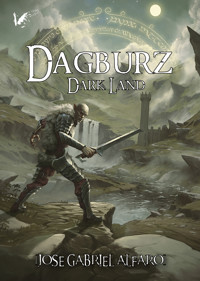
I am an old sorcerer who has lived too long and was seduced by darkness for a long time. I discovered the light in the words. Some time ago, I found a text that made me reflect and has inspired this manuscript. It started like this: My name is Leirbag. I have fought alongside great wizards, warriors and elves, but no one tells a story about me. I suppose it's because my race is considered savages, murderers, deformed and a long list of unpleasant adjectives. But I am also part of the great stories that became legendary. If you haven't already guessed who I am, I'll tell you that I'm a despicable orc with a desire for revenge. Dagburz, dark land is an epic fantasy novel that tells the battles from the perspective of the most dastardly being of all. Using a direct narrative with a unique style, the author aims to give the story a different approach to the adventure classics, but respecting its essence.
Sie lesen das E-Book in den Legimi-Apps auf:
Seitenzahl: 143
Veröffentlichungsjahr: 2024
Das E-Book (TTS) können Sie hören im Abo „Legimi Premium” in Legimi-Apps auf:
Ähnliche












Dagburz
Dark land
J. Gabriel Alfaro
Translated by Carol Vila Micó
First Edition: July 2024© Copyright of the work: José Gabriel Alfaro
© Copyright of the edition: Angels Fortune Editions
© Copyright of the translation: Carol Vila Micó
Digital ISBN: 978-84-128873-9-6
Literary Correction: Blanca De La RosaCover Design: Celia ValeroEditing by Ma Isabel Montes Ramírez© Angels Fortune Editions www.angelsfortuneditions.com
All rights reserved for all countries The total or partial reproduction of this book, or the compilation in a computer system, or the transmission in any form by any means, whether electronic, mechanical or by photocopy, by registry or by other means, neither the loan, rent or any other form of a cession of the use of the copy without prior written permission of the copyright owners. “Any form of reproduction, distribution, public communication or trans- formation of this work can only be carried out.
To my children for their inspiring yells in orc battles.
And specially to Pili for being my guide in this adventure of being a novel writer.
This book is my humble tribute to J. R. R. Tolkien for his extraordinary literary work.
"Fantasy is, like many other things, a legitimate right of every human being, for through it is found complete freedom and satisfaction.”
J.R.R Tolkien
Prologue
Life is full of ‘characters’ who reluctantly accept and follow all the established standards and rules without questioning anything, while others come across as ‘misfits’ to most people.
The author of this book, a teacher specialised in therapeutic pedagogy -a profession that we share, which made us cross paths over a decade ago, shows a special interest in this second group. -
This story, set in the same universe as Tolkien’s The Lord of the Rings, of which Gabriel is an unconditional follower, tells the adventures of Leirbag, a special orc. In a world where only hatred, struggle for survival, blind obedience and lack of reasoning can be found, the author creates a revolting main character from whom one can extract totally opposite values.
The surprising thing about this book full of battles is that, amidst all the maelstrom of violent and rough actions which are common in fantasy settings, one can glimpse salvation after falling into the darkness by relying on the most primal survival instincts. This is made clear in the following paragraph:
With the passage of the lunar cycles, I have learnt that awful beings, no matter the race, can argue, shout for no reason, and think that they hold the absolute truth. The opposite of that would be a creature that thinks before talking and reflects on it before saying anything.
[…]
Withdrawing in time will allow you to fight again. Being brave and stupid will kill you sooner than later.
The story keeps you on the edge of your seat, as if you were experiencing each combat and running the risk of feeling the blows, axes, and arrow wounds in your own flesh. But at the same time, you also run the risk, or are lucky enough, to get to know and love the characters for their loyalty, their faithfulness to their nature and, in Leirbag’s case, for their ability to question the fine line between good and evil.
Finally, I would like to thank Gabriel for giving me the chance to write these lines about a brave and sincere story about those who seem invisible in the eyes of society yet have a lot to offer.
Ariadna Aurell
PART ONE
Leirbag’s gaze
I am an old sorcerer who has lived for too long and has been seduced by the darkness for a long time. I found the light in the words. Now I hide like a rat.
During the ancient ages, I lived to see the time when philosophy and art were the cornerstone of the world.
The high elves wanted to understand nature, and they held councils with the rest of the races in order to have an earthly view of Dagburz. But someone subtly sowed the seed of ambition, a delicate germ, creating schemes in the shadows such as not trading with the dwarves or not stopping some rebellion to overthrow a certain reign and put a despot on the throne.
Meanwhile, the elves ignored what was happening around them, and they started getting away from the world of the mortals, taking refuge in oases which were transformed into munificent metropolises, where imperfections were not allowed.
In the golden ages, the dwarves carved into the stone and turned it into art. They created magnificent buildings such as the now disappeared Millennium City , an architectural jewel which could be entered through a narrow gorge. Chiselled into the stone, its façade recreated a forge, right above a hammer and a battle axe, all surrounded by the crests of the different houses and topped with an inscription carved into the frieze which proclaimed: ‘The language of the mountain is imperishable, yet we are but mere guests’
This settlement was deleted from the face of the Earth, and, with the passing of the ages, the dwarves ended up being controlled by their greed for precious metals, and thus stopped being the mountains’ mere guests to become its usurpers.
Since the beginning of time, humans collaborated with the forest guardians, the leshi, looking for a balance between the development of their societies and the conservation of the natural habitats. But the essence of humanity turned into selfishness. Power slowly took over the rulers, and thus wars started. The conquest of territories became the main objective, with the purpose of amassing riches that were only enjoyed by a minority.
This whole scenario was slowly unfolding, and the dark power kept the tempo of events by positioning its pieces on the board.
If we consider that during the first ages the philosophers and the erudite were the leading figures, this involution turned the warriors into the backbones which held the different kingdoms together.
Dagburz exchanged knowledge for the sword, and, as a result, ended up bringing the decadence of the current society in which the books are considered a negative reminder of the culture.
Nowadays we are in the Third Age, the time where the self is the only important thing. Each race has taken their own path: the elves, who are a symbol of immortality, are apparently idolised. The truth is that almost everyone is afraid of them, hate them or envy their immortality. The fact that they were so far away from reality has contributed to that.
The tentacles of evil, which have been established over the centuries, are starting to spread, with no prospects of being cut off. This continent is leaning into the abyss and, once inside, it will be devoured by darkness.
It is interesting that these lines do not, tell the story of a hero who saves lineages from the chaos through incredible deeds. This story describes a being who is both despicable and brilliant.
You all know tales of great warriors who fought with honour and bravery in epic battles in which they accomplished glorious feats that will be remembered forever. These men have become legendary heroes, and their exploits are still alive through the minstrels or ancient chronicles.
There are also wizards sorcerers or warlocks, who were able to defeat hellish creatures with their powers. Thanks to their knowledge, they were able to create weapons and magical objects which delighted the world and were coveted by all.
The elves, who possessed the gift of immortality, were the most admired and envied, because their elegance, sobriety and wisdom made them judge and jury in everything that happened throughout the ages.
We cannot forget about the dwarves, who were arrogant and stubborn, with their terrible axes and war hammers forged in magnificent cities inside the mountains. These mythical weapons were passed from generation to generation, as well as the passion for precious metals, even when that greed had caused their downfall.
A mere coincidence caused a race such as the halflings to become a key piece in all of this, thanks to their willpower, their perseverance, and, over all else, their extraordinary loyalty.
According to the stories, destiny put an apparently insignificant object in their hands , which would get them involved in a one-of-a-kind adventure that would later be immortalised in history.
Naturally, when it comes to such events, such events, only the heroes who made the triumph of good over evil possible are remembered. Other stories are forgotten along the way, because their protagonists did not have admirable qualities, their exploits were not as remarkable, or simply because nobody even saw them there.
Some time ago, I found a text which made me reflect on many things, and has inspired me to start writing this book. It started as such:
My name is Leirbag. I have fought alongside great sorcerers, warriors, and elves but nobody ever tells a story about me. I suppose that this is because of my race, as we are considered savage, murderers, deformed and a huge list of other unkind adjectives. But I am also a part of the great stories that became legends. If you have not found out who I am yet, I will tell you that I am an atrocious orc with a thirst for revenge.
Chapter 1
"My path begins in the darkness"
The truth is that I do not know how I was born. Maybe some horrifying orc which tricked a human with love spells to obtain a night of lust. I am aware that she probably was not perfect, she may have been a heartless killer who did not have any feelings for her children, whom she considered mere monsters that would help her keep the orc race alive. But, even so, my hopes of meeting her someday never disappeared.
The only true thing is that orcs, or hobgoblins, whatever prefer to call them, are considered a race of creatures that are trapped in a constant spiral of hatred towards every living being. Due to this, we are unscrupulous and miserable killers. All we know is to kill, plunder, steal and torture our enemies. Ever since I can remember, I could never choose another fate.
My first memory is of a huge cave, with a dome so big that one could not see where it ended. That place was always dark, except for the light of some torches. On rare occasions, the minerals shone as if they were stars in the sky. I enjoyed this sight by unconsciously smiling a little, an act that, if seen by my superiors, meant a harsh punishment, such as broken ribs. There, all that was different was met with harsh punishment.
In its depths, after descending down a natural staircase, there was an underground lake. Its black waters caused your gaze to get lost in the darkness. According to an orc legend, a terrible beast dwelled within that lake. That was something to keep in mind if one had to go down to fill the barrels, since it had to be done quickly before anything happened. Fear is a powerful weapon to control others.
The cavity formed a labyrinth, and it was very easy to get lost in it if you did not know the way. Some passageways were so narrow that only one orc could fit. This complicated structure of twisted alleys gave us excellent defence and allowed us to repel or resist any attack.
Its efficacy as a death trap was acknowledged by a huge troop of human mercenaries, who had the intention of invading the cave. Orc heads were worth their weight in gold. We were seen as filth, and every kingdom wanted to exterminate us.
I remember how they appeared very clearly: they were led by a warrior armed with a two-handed axe and covered in pelts. Although they were able to get to our domain easily, and their attack speed was admirable, cries of alarm echoed through the cave. I saw a dozen orcs running to fight and push the invaders back, but they were quickly annihilated. After this skirmish, the adversaries started to become more confident, and their combat fury increased. Blinded by their thirst for blood, they did not realise what was coming; this advance party of orcs was only a distraction.
During that period, the captains had prepared the defence, and, like ghosts, orcs began to emerge from the sides, rushing into the fray to enjoy the carnage. They managed to corner the invaders into a dead-end passage, and a chorus of deafening screams was heard for a while, until they gradually died out and everything became quiet.
When I and the rest of the reinforcements got there, I could observe the torn limbs of our enemies, and pride took hold of my being. When violence is a part of your life, you savour it best when you experience it firsthand.
In any case, if the battle had taken a nasty turn, we would have had an escape route: a long, narrow, winding tunnel, full of sharp, strangely shaped stones which made the sight of it look terrible. It faced west and led travellers all the way into a forest, cleverly concealing the mouth of the tunnel under a rocky arch. Its shape reminded me of a fortress’ gates.
I belong to a society which does not appear to be very developed, where the strongest, most bloodthirsty orc becomes the leader of the clan. However, when you are part of this primitive community, you realise that it is a society full of nuances.
For example, captain Navi. He was not big or stout, but according to the rumours, he was one of the most ruthless orcs when in battle, even going as far as to cut his subordinates’ tongues so they would not spill his secrets, and he always spared some survivors so they could narrate the horrors of the battle to others .
Those who are enjoying this tale right now might be thinking: “how is it possible that an orc who has always beendifferent, was able to survive in a community where death, murder and blood were always present? The answer is easy: by lying. The most important rule is to adapt to the environment; to be able to go unseen is a virtue that is ignored by many people.
In a such extremist society, freethinkers were quickly eradicated, and that was a lesson I learnt immediately. A fundamental orc law: kill before they kill you. Do not believe that I have been a nice, sensitive orc; had I done that, my death would have been imminent. I did just the opposite. I adapted very fast to this environment, and quickly started to hate and murder every living creature.
We were trained in the art of combat, and the cave was our base camp. That legend about orcs being born in the depths of the Earth is partially true, since we are confined there until we are ready to annihilate without mercy.
Our days as recruits started by waking up and getting in formation to check if everyone was there. If someone were late, they would be beaten up, or worse, depending on how generous the instructor was.
I will always remember the day I saw Nebur taking attendance. He was an orc who looked like he had fought a long list of battles, for there was no spot on his face without a scar. The most notorious ones were located on his eyebrow and his cheek. Suddenly, a foot soldier dropped his scimitar. The instructor threw his knife at him without even moving. It was so fast that the rookie only had time to die.
I will never forget what Nebur said next, which I abide by to this day:
‘Any orc who loses his weapon down is condemned to death. During a battle, the enemy will not give it back to you. Your life is tied to this piece of metal. That one has learnt his lesson too late’.
Ever since then, I have dedicated myself in body and soul to becoming a ferocious, cruel, bloody and heartless orc warrior. Or just to appearing like one. Our usual routine consisted in hand-to-hand combat, where I showed my worth fighting and killing my adversary. My exploits attracted the attention of sergeants and captains, who were made aware of the existence of an orc with such an uncontrollable fury that the rest of the hobgoblins were reticent to fight him because they knew they would be facing an almost certain death.
During an instruction, my sergeant wanted to test me in a fight against a war veteran called Oigres, an orc who stood at almost two metres tall, with a face hardened by a thousand battles and arms that could tear any creature apart, though comprehension was not one of his main qualities. The sergeant ordered us to go to the fighting arena, a small enclosure which was stuck to a mountain wall, with a fence that delimited the fighting area. All around the perimeter there were blood and rotting entrails of orcs and prisoners. There were dwarves, humans and even some elves, since tournaments were sometimes held there for the horde’s amusement. This was the place where we would fight without weapons. The only rule was to survive.




