


Erhalten Sie Zugang zu diesem und mehr als 300000 Büchern ab EUR 5,99 monatlich.
- Herausgeber: Flint
- Kategorie: Wissenschaft und neue Technologien
- Sprache: Englisch
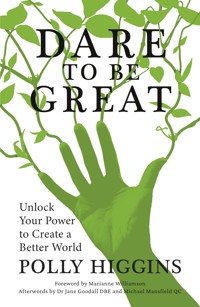
'I know it may not yet look like it, but we are sowing the seeds of greatness for countless generations to come. That is the Great Work of our times. Yours and mine.' This is a book unlike any other. It does not tell you what you must do, it does not set out a guide for the 10 definitive steps to becoming great by next Thursday. Dare To Be Great is both a playful, inspirational conversation and a heartfelt, lived call, daring each one of us and our society as a whole to become truly great. Celebrated Earth lawyer Polly Higgins was a luminary in the environmental justice movement as she worked to Stop Ecocide across the globe. She was a beacon for how to live the brave, bold lives that, at our best, we imagine for ourselves. This book shares insights from her own remarkable journey, inspiring us to recognise and step into a greatness within – that is not about grandiosity but something far more exciting: aligning with our unique purpose in service of a better world.
Sie lesen das E-Book in den Legimi-Apps auf:
Seitenzahl: 218
Veröffentlichungsjahr: 2020
Das E-Book (TTS) können Sie hören im Abo „Legimi Premium” in Legimi-Apps auf:
Ähnliche

















A share of the royalties from the sales of the book will go to Ecological Defence Integrity to fund their work to stop ecocide.
First published 2014 by Clink Street Publishing as I Dare You to be Great
This updated edition published 2020
FLINT is an imprint of The History Press
97 St George’s Place, Cheltenham,
Gloucestershire, GL50 3QB
www.flintbooks.co.uk
© The Estate of Polly Higgins 2014, 2020
Foreword © Marianne Williamson 2020
Introduction and Appendices © Jojo Mehta and Ecological Defence Integrity 2020
Afterword © Dame Jane Goodall 2020
Forward © Michael Mansfield 2020
Illustrations © Joe Magee
The right of Polly Higgins to be identified as the Author of this work has been asserted in accordance with the Copyright, Designs and Patents Act 1988.
All rights reserved. No part of this book may be reprinted or reproduced or utilised in any form or by any electronic, mechanical or other means, now known or hereafter invented, including photocopying and recording, or in any information storage or retrieval system, without the permission in writing from the Publishers.
British Library Cataloguing in Publication Data.
A catalogue record for this book is available from the British Library.
ISBN 978 0 7509 9410 1
Typesetting and origination by The History Press
Printed by Ashley House Printing Company
eBook converted by Geethik Technologies
TO ALL WHO CARE
My book is written for you; it is my exploration of what it is to dare to be great.
You have here in your hands some keys, some tools and some alchemy discovered along the route of my quest to help you as you set out on yours.
CONTENTS
Praise for Polly Higgins and Dare To Be Great
Foreword by Marianne Williamson
Introduction by Jojo Mehta
Preface
Prologue
Part One: Stepping Into Greatness
What is Greatness?
First Steps
Help Arrives
Inner Journey
Part Two: From Self-Care to Earth-Care
Self-Care
Earth-Care
Part Three: Creating a More Beautiful World
I See a World Where We Have Ended the Era of Ecocide
Greatness as a Legacy
I Know
Afterword by Dame Jane Goodall
Forward by Michael Mansfield QC
Appendix 1: Ecocide Law Timeline
Appendix 2: What’s Happening Now: Creating a Moral Mandate to Protect Life On Earth
Appendix 3: What You Can Do: Become an Earth Protector
Appendix 4: Ecocide Law
Endnotes
About this Book
More about Polly
Acknowledgements
PRAISE FOR POLLY HIGGINS AND DARE TO BE GREAT
Polly is of course known for her work on Ecocide Law; a parallel piece of work was to make it her business to encourage everyone to be their best possible selves. This she did for me and it made the world of difference to be so encouraged, especially by a fellow mischief maker. A way to tune into this encouragement and guidance is to read this book.
She was a dear friend and major personal inspiration in my life, and her attitude to the law was unlike anyone else’s. She was creative with it. She saw the potential of law to provoke fundamental societal change, both by shining a light on where it fell short and by directly pushing the envelope.
In her last months she jokingly acknowledged how XR had helped her own work on ecocide become more visible, saying, ‘I love Extinction Rebellion! They make us look moderate.’ And if we have brought the possibility of criminalising ecocide closer, we are doing our job.
Dr Gail Bradbrook, co-founder of Extinction Rebellion
A great spirit speaks through this book. The late and much beloved Polly Higgins was indomitable, unshakable in her service to the healing of Earth, no stranger to the horrors endured by people and planet, yet consistently positive, cheerful, and inspiring. Dare To Be Great embodies all these qualities; what’s more, it reveals something of their source and will awaken them in the reader. This book is a potent antidote to burnout and despair, confirming the heart’s knowledge that yes, we can do this.
Charles Eisenstein, teacher, speaker and author
Establishing the Law of Ecocide would signal a major breakthrough in the way we deal with crimes against the natural world. Polly Higgins’ groundbreaking proposal to list ecocide as the fifth global crime against peace would go a long way towards deterring and holding to account CEOs, companies and nations. Whether it’s oil drilling in the Arctic, deforestation in the Amazon, or over-fishing in the Atlantic, activities which impact severely on global ecosystems would be brought under far closer scrutiny. It could also play a significant role in encouraging companies to drop the dirty, polluting industries of old, and invest in the clean technologies and renewable energy solutions of the future.
Caroline Lucas MP, former Leader of the Green Party of England and Wales
I open this book. Again. I hear her voice. I revisit these words, stories, instructions, opinions and invitations. And I ask her out loud what do you mean by this title Dare To Be Great?
The synonyms for ‘daring’ include fearless and foolhardy. Reckless and smart. Game and rash. There is no daring without danger. There is a cost in daring. There is a rebelliousness.
And what is great? A word that has also so many terrible associations. Make … Great … again. Delusions of empire. Human grandiosity. So the use of this word is, as is typical for Polly Higgins, ‘daring’ and dangerous in itself.
Read it. And as you read it through, you will begin to see the appeal, dare I say, the summons she is making with this title … the summons, the demand, the invitation of this book is simply … to change. To change ourselves, yes, but also to dare to leave our skins and recognise that we are all part of nature. Which we cannot escape. Just as we cannot escape the planet. In these times that is dangerous possibly, demanding certainly, but perhaps the most creative act we can do. To step daringly out of ourselves into a greater world.
Simon McBurney OBE, actor, writer and director
Polly Higgins gave up her job and sold her house in order to found a campaign on behalf of all of us. She drafted model laws to show what the crime of ecocide would look like, published books on the subject and, often against furious opposition, presented her proposals at international meetings.
I believe establishing such a law would change everything. It would radically shift the balance of power, forcing anyone contemplating large-scale vandalism to ask themselves: ‘Will I end up in the international criminal court for this?’ It could make the difference between a habitable and an uninhabitable planet.
Polly started something she intuitively knew would continue beyond her own life. It could, with our support, do for all life on Earth what the criminalisation of genocide has done for vulnerable minorities: provide protection where none existed before. Let us make it her legacy.
George Monbiot, journalist, environmentalist and author
FOREWORD
by Marianne Williamson
I didn’t have the good fortune of meeting Polly Higgins during her time on Earth, yet her life force comes across strongly in the pages of this book. The Earth she loved so much is better off now, having been graced by her profound compassion and protective spirit. She felt passionately the woundedness of the Earth, and dedicated her life and career to coming to its aid. Now, after her death, the entire world is catching up with her.
I feel a strong connection to Polly because her path was one with which I can identify. What are the internal changes that we have to go through, particularly as women, in order to show up most fully in life? What is the potential we’ve been trained to keep unrealised, at the cost of giving our gifts to the world? What are the keys to dismantling habits by which we resist our greatness, and thus the part we might otherwise play in the healing of a wounded planet?
I understand the abandonment and betrayal Polly felt when her ideas were too big, too radical, too outrageous – all appropriately so, in order to get the job done – for those around her. I understand the pain she would have had to go through in order to mine the gold of her own internal nature and find the strength to keep on keeping on at a time when she was little understood. I understand how her passionate and total dedication to life gave her the strength she needed to face death unafraid.
Polly Higgins did something extremely important. She changed the way our civilisation looks at the rights of the Earth itself. By bringing the notion of ecocide into legal question, she has expanded the way we think of what is happening around us. Most importantly, as is evidenced by this book, she has guided us to the internal as well as external changes that will change us, and the Earth, enough for humanity to survive. Her illuminating and inspiring insights into the nature of personal evolution display a compassion for people as great as her compassion for the planet on which we live.
In her final words written to those who loved her, Polly made clear her belief that she knew life goes on beyond the life of the body. When it does, the gifts that were given while we were on the Earth remain to grace it. In no one’s life is that truer than in the life of Polly Higgins. The Earth literally has a greater chance of survival because of the work she did on its behalf.
To read her words is to be more than inspired; it’s also to be humbled. It’s impossible to read of her accomplishments and not ask if we ourselves are doing quite enough. If her message is anything, it’s that what she did we can do. Where she was great, we can be great. And if we strive for exactly that, I think we’ll be blessed as I believe with all my heart that she is blessed, and now living in the joy of God.
Marianne Williamson
February 2020
INTRODUCTION
by Jojo Mehta
This book is a highly unconventional combination of global crusade with personal exploration and discovery, at once deadly serious and irrepressibly playful. In other words, it’s probably the closest thing you’ll get to a conversation with Polly.
Polly was a lawyer. Her own daring was profoundly grounded in the field she had chosen. She came to law not as an undergraduate nudged by family or school, but as a mature student with two previous degrees. She paid her own way through law school and distinguished herself rapidly as a talented barrister. Her moment of epiphany, ‘the Earth needs a good lawyer’, had as its unspoken corollary, ‘and I am a good lawyer’. Her mission to answer the question, ‘How do we create a legal duty of care for the Earth?’ was fundamentally premised on her existing expertise. It was uniquely daring: she drafted a definition of a law that would criminalise the destruction of nature – ecocide – and submitted it to the UN Law Commission, embarking on a lifelong quest to establish it as a crime at the International Criminal Court.
The book you are now reading arose out of her recognition that we all have the potential to combine our talents with the difference we want to make in the world in creative and impactful ways, if only we have the courage and imagination to do so: ‘The greatness lies in self-discernment; where best to put my skills? One good indicator is whether others can step in instead. Ask yourself, who else is creating a new space with the work I am doing? If the answer is none, or very few, then you are being invited to help create the new path.’
Polly had a knack for catalysing change in people – for making them feel completely safe while subtly adjusting their view of the world and increasing their confidence to engage with it. Her indomitable spirit, good humour and sheer charm in the face of what many considered an impossible task, as well as her determined encouragement of others to find their own strength and commitment, fill this book by the bucketload and are a delight to read. (And I challenge anyone to come out of the Earth-care section unconvinced of the absolutely necessity of making ecocide an international crime.)
What is perhaps less obvious on the surface of these pages is what Polly’s husband describes as the ‘ruthlessness’ with which Polly pursued her quest. For her, everything was in service to the single purpose of putting in place a law of ecocide. There was no such thing as a ‘day off’ in Polly’s world, because she lived and breathed her work. There was often a fierce kind of joy in that: she didn’t see it as work but as life, and as an adventure. I was her closest colleague and friend during the last four and half years of her life, and it was never less than exhilarating. Truly dedicating your life to a single purpose has a powerful magnetism, and when your unique purpose is protecting the planet – arguably the biggest game in town – that’s doubly powerful.
It meant she refused to compromise her vision, and it meant she went without a salary for almost a decade because only a few enlightened individuals were brave enough to back her, and there was never a penny to spare outside the immediate requirements of the work. NGOs and grant-giving foundations considered it too much of a risk, or else wanted milestones and projections she was unable to provide by the very nature of sailing in uncharted waters.
Her dedication to and identification with her mission were relentless and took their toll. There were times of deep despair and doubt when she felt there was no hope of Ecocide Law becoming reality, and because she knew what that would mean, she deeply felt the attendant pain of what would happen to the Earth. Only those very close to her saw those moments, because her face to the world was always cheerful; she had an intuitive understanding that if she was to convince that world, she could not let her own upbeat conviction publicly waver, even for a second.
Her commitment left no room whatsoever for self-pity and gave her a remarkable perspective on the terminal cancer diagnosis she received in March 2019. Unafraid for herself, and pragmatic to the end, she smiled somewhat ruefully and said: ‘Shame I have to be on death’s door to get attention. But if this is what it takes to get this work off the ground, let’s use it.’
In the light of this, a word of caution to the reader: the concept of freedom runs like a golden thread through the text of this book, because much of Polly’s own journey was about freeing herself from constraints: the emotional scars of a difficult childhood, the isolation of long periods of hospitalisation with asthma as an adolescent, the stifling expectations of a traditional Catholic upbringing, the adversarial framework of the courtroom. And yet her own need for freedom was subsumed into the greater need she perceived around her – the need of the Earth for a good lawyer. In the end, she didn’t get to see the world from the seat of a Harley Davidson, which was her personal dream of freedom, because she had dedicated herself to a bigger dream.
What she shows us beyond the shadow of a doubt, however, is what we can accomplish when we step into our own unique greatness, with authenticity, grounded in our skills and trusting in our intuition, and with a willingness to take risks in service to something beyond ourselves. She had a profound belief in human potential, in the spirit of community and particularly in the spirit of rebellion. She was delighted, in the last week of her life, to see the call to ‘Stop Ecocide’ taken up on the streets of London during the Extinction Rebellion of April 2019. She understood – correctly – that the seed had been sown and would now take root …
The year following her death has been nothing short of extraordinary. Far from dying with her, Polly’s work has grown beyond anything we imagined a year ago. The NGO we founded together (Ecological Defence Integrity) is working with a team of diplomats, lawyers and research experts taking forward the core legal and diplomatic advocacy work at the international level. We were thrilled when in December 2019 two sovereign states members of the International Criminal Court (Vanuatu and the Maldives) dared to be great and officially called for the Assembly to consider adding a crime of ecocide to the Rome Statute.
Meanwhile the Stop Ecocide campaign has representation in a growing number of countries, raising public awareness and gathering Earth Protectors to support the cause. And more daring still, a pilot scheme for Earth Protector Communities is already under way, seeding a global collaborative movement in which towns, schools and colleges, businesses and other institutions work together to protect land, wildlife, air, soil and water, in anticipation of the eventual adoption of Ecocide Law.
A few weeks after her death, Polly’s husband Ian discovered a document on her laptop written at the time of the original publication of I Dare You to be Great in 2014, around the time I started working with her. It was simply titled ‘I Know’. It was a clear premonition of an early departure, with instructions to be read at the celebration of her life – which she specified was to be a huge party with food, music and dancing. The full text is reproduced at the end of this book, but one phrase belongs here. Polly wrote: ‘I know my work is done when others start to call in greatness too.’
This book is your invitation to do so.
Jojo Mehta
February 2020
www.EcocideLaw.com
www.StopEcocide.earth
www.EarthProtectorCommunities.net
PREFACE
This is a book to scribble on and share; it’s a book that is a seed and a book to change your life. It comes with a good-health warning: your vision of what is – and what can be – shall alter radically. Let the seed grow within you and feed it liberally. You’ll find windows suddenly open, a gust of fresh thoughts and ideas blows in, and new paths emerge to take you forward.
Ours is the journey of the questor. Make no mistake, this quest is participatory. At each juncture you will find keys denoted for you to turn: keys that open up questions for the questor to answer, visions to be brought into being and treasure to be found within. Keys are to be found throughout the book.
Part Two offers up another layer of tools to be added into your repertoire, there to pull out when required. And Part Three adds yet another layer: the alchemy – mine and yours. Each culture has their stories of greatness – what do we choose to be our stories? Not his stories (history), or her stories, but our stories. You’ll find here a few of mine, and I am sure you shall have many more that are yours.
Setting out on a quest of greatness calls for a compass, a map and a treasure trove. Only for this quest, the compass is your inner guide, your map is yours for the making and the treasure – well, only you can determine that!
My book is an invitation to you to see the crossroads and take a different path, engage in a different kind of life. This is the book I wish I’d had when I was lost and felt I had no idea where to turn. This book gives hope when there seems to be none and it’s an invitation to live a life in service to something so much greater than the self.
So, what is your vision? Dream big. This book is not a step-by-step plan. It is in part a record of my story and my quest, and in part a gift to you so that your quest can be fast-tracked. Bring forth your vision of a more beautiful world. My story is just a carrier, a bridge if you will, to provide a crossing as you step into your greatness. And my way is not the only way – but it could be a good starting point. Please feel free to vary the route map as you go.
PROLOGUE
The Devil On My Shoulder Grinned
A day that changed my life: my birthday, 4 July. Not like any other day: no emails, no writing, nothing except walking in the New Forest in southern England. Soft rain, loads of it. Shoes off, squelching mud and dripping wet. I am happy. It was as if I had become part of the woodland itself.
‘What next?’ A Law of Ecocide – an international crime to prohibit mass damage and destruction – was so much part of me that I lived and breathed it. I knew that the day would come when I could ask what next. Bizarrely, I found myself asking it on my birthday. A thought popped into my head that took my breath away: ‘Dare to be great.’
Yikes. The last time I had asked a big open question that changed my life was seven years earlier. The question then was, ‘How do we create a legal duty of care for the Earth?’ I had no idea of the journey that would take me on, nor what would come of seeking the answer and yes, I can now say, it has and continues to be a truly great journey that has led me to creating an Earth Law. That was a big question to answer, but this time round I had an answer that came boomeranging in within seconds. An answer that called on me to dare to be great. How on earth do I meet this?
But. There’s other work to do – getting a Law of Ecocide into place, for starters. The thing was, if I was to dare to be great, it seemed to me, I’d need to go public with the idea. What? Let people know what I’m thinking and say I’m daring to be great – the devil on my shoulder grinned. I have so much else to do. Or do I? That’s the thing with a big idea – once it’s out there it has a habit of resurfacing when you least expect it, as if a nudge is required to say, ‘What about the big idea?’
Push a good idea down and it has a habit of popping up again in the most unlikely of places. In public. So, I outed myself, not knowing what I would say. I hadn’t meant to, but it just popped out. My heart pounded and I just knew I had to do it – it was the unknown territory that put the heebie-jeebies up me.
I’m getting another nudge from the Universe – this is not meant to be a solo flight for just me. Like birds, it’s so much easier to fly together. We give each other support as we go. So, come, join me – I dare you to be great too. Then go dare others you meet to be great too. Together, not separate: this is one great adventure to be shared by all.
Polly Higgins,
Summer 2014
P.S. Greatness brings with it a challenge: stay safe and play safe or be open to a very different kind of adventure. It’s not about feeling better – it’s about getting better at feeling what it is to be truly alive. I can honestly say that when you dare to be great, your life will never be dull.
WHAT IS GREATNESS?
Where do I buy greatness? The thing is, greatness is not something that can be bought – it’s a state of being. I can’t put in an order on the internet for next-day delivery, to be returned if it doesn’t fit. I can’t steal it, nor can it be robbed from me. I can’t get the size of it, nor can it be weighed.
It’s intangible – it’s a soul quality. Greatness is inherent in each and every one of us from the very moment we take our first breath as humans newly entered into this strange and wonderful land called Earth. Greatness is a predilection for life itself plus a willingness to give of the self in service to something greater than all of life.
Greatness is not so easy to define, but when we are in the presence of someone great we know it. Somehow, greatness has an energetic pull all of its own – and we can sense it to some degree. That’s why some people are publicly fêted, but then for every great person in the public light, there are thousands who are equally great without the public knowing it. Those who are not seen have chosen to go about their work quietly. It is all about choice; neither path is better or worse, indeed there is no better or worse – there are just different avenues that can be taken. The choice is yours. It is the ‘why’ that determines the greatness. Why do you choose to be a public figure? Is it because you are in service to something greater than yourself, or is it because you want to enjoy fame per se? One is true greatness, the other is an aspiration built on a fear of not being valued. Let go of our fear and we can move forward without compromising our own way of being.




