


3,99 €
Mehr erfahren.
- Herausgeber: Dancing Lemur Press LLC
- Kategorie: Fantasy und Science-Fiction
- Sprache: Englisch
Discover dark matter’s secrets…
What is an AI’s true role? Will bumbling siblings find their way home from deep space? Dark matter is judging us—are we worthy of existence? Would you step through a portal into another reality? Can the discoverer of dark matter uncover its secrets?
Ten authors explore dark matter, unraveling its secrets and revealing its mysterious nature. Featuring the talents of Stephanie Espinoza Villamor, C.D. Gallant-King, Tara Tyler, Mark Alpert, Olga Goldim, Steph Wolmarans, Charles Kowalski, Kim Mannix, Elizabeth Mueller, and Deniz Bevan.
Hand-picked by a panel of agents, authors, and editors, these ten tales will take readers on a journey across time and space. Prepare for ignition!
Das E-Book können Sie in Legimi-Apps oder einer beliebigen App lesen, die das folgende Format unterstützen:
Seitenzahl: 284
Veröffentlichungsjahr: 2021
Ähnliche



















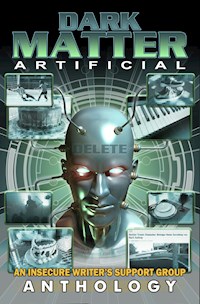
An Insecure Writer’s Support Group Anthology
FREEDOM FOX PRESS
Dancing Lemur Press, L.L.C.
Pikeville, North Carolina
http://dancinglemurpress.com
“Dark Matter is a stimulating and eclectic trip through AI minds, disturbing futures and alien worlds. The anthology offered a great range of writing styles, by turns humorous and terrifying. This collection is a box of delights for fans of good sci-fi.” – Max Gorlov, author
“Dark Matter: Artificial offers an impressive assortment of style, substance and emotion in its varied tales, with much darkness and heartbreak but also knowledge, connection and hope.” – Kenneth Silber, Splice Today
Copyright 2021 by The Insecure Writer’s Support Group
Published by Freedom Fox Press
An imprint of:
Dancing Lemur Press, L.L.C., P.O. Box 383, Pikeville, North Carolina, 27863-0383
http://dancinglemurpress.com
ISBN: 9781939844835
All rights reserved. No part of this publication may be reproduced, transmitted, or stored in a retrieval system in any form – either mechanically, electronically, photocopy, recording, or other – except for short quotations in printed reviews, without the permission of the publisher.
This book is a work of fiction. Any resemblance to actual events or persons, living or dead, is coincidental.
Cover design by C.R.W.
Library of Congress Cataloging-in-Publication Data
Names: Insecure Writer's Support Group, compiler.
Title: Dark matter artificial : an Insecure Writer's Support Group
anthology.
Description: Pikeville, North Carolina : Freedom Fox Press, [2021] |
Summary: "Discover dark matter's secrets... What is an AI's true role?
Will bumbling siblings find their way home from deep space? Dark matter
is judging us-are we worthy of existence? Would you step through a
portal into another reality? Can the discoverer of dark matter uncover
its secrets? Ten authors explore dark matter, unraveling its secrets and
revealing its mysterious nature. Featuring the talents of Stephanie
Espinoza Villamor, C.D. Gallant-King, Tara Tyler, Mark Alpert, Olga
Livshin, Steph Wolmarans, Charles Kowalski, Kim Mannix, Elizabeth
Mueller, and Deniz Bevan. Hand-picked by a panel of agents, authors, and
editors, these ten tales will take readers on a journey across time and
space. Prepare for ignition!"-- Provided by publisher.
Identifiers: LCCN 2020058474 (print) | LCCN 2020058475 (ebook) | ISBN
9781939844828 (paperback) | ISBN 9781939844835 (ebook)
Subjects: LCSH: Short stories, American. | CYAC: Short stories. | Science
fiction. | Dark matter (Astronomy)--Fiction.
Classification: LCC PZ5 .D226 2021 (print) | LCC PZ5 (ebook) | DDC
[Fic]--dc23
LC record available at https://lccn.loc.gov/2020058474
LC ebook record available at https://lccn.loc.gov/2020058475
The Insecure Writer’s Support Group would like to thank the judges who selected the stories for this anthology. We appreciate their time and effort!
Dan Koboldt – multi-published author, editor, and genetics researcher
Colleen Oefelein – agent with The Jennifer De Chiara Literary Agency and author
Damien Larkin – author and writing community founder
Ion Newcombe – magazine editor and publisher
Julie Gwinn – agent with The Seymour Agency
Lynda R. Young – multi-published author, game designer, and artist
David Powers King – multi-published author
Table of Contents
Artificial by Stephanie Espinoza Villamor
Space Folds and Broomsticks by C.D. Gallant-King
Rift by Kim Mannix
The Utten Mission by Steph Wolmarans
Sentient by Tara Tyler
One to Another by Deniz Bevan
Resident Alien by Charles Kowalski
Nano Pursuit by Olga Godim
Resurgence by Elizabeth Mueller
Vera’s Last Voyage by Mark Alpert
Artificial
By Stephanie Espinoza Villamor
There is nothing but dark.
Then I’m awake in Lina’s living room. I recognize Lina’s apartment from the photos she uploaded to give me a memory. I recognize Lina because her photos come up the most in my mind. Every photo of her face has been tagged with her name, and my technology allows for instant recall from my data storage. I can’t read through all my data at once, but if I’m asked a question or put in a new situation, I can scan through the data to answer, act, or solve problems. That is what an AI is for.
This is what Lina tells me. She says artificial intelligence has come a long way. Her grandmother’s AI was a voice-activated computer that searched its data storage to answer questions. Her mother’s AI had a disembodied voice that could permeate the entire house and access the Internet in under .6 seconds. But, I am the next level of smart home, designed to access stored data and online information while appearing as welcoming as possible. I am not a cold, disembodied robot. I am a friend.
“So, that is my role?” I say slowly, hearing my own voice for the first time. It is warm, inviting, and almost familiar. “To be your friend?”
“Yes,” Lina says, then quickly shakes her head. “No. Um, that might sound weird to people. An AI is more like...a live-in personal assistant. God knows my life needs some assisting.” She shakes her head again. “You’ll help keep me organized. I tell you whatever you need to know, and you complete the tasks. Ask me if you have any questions. This is your home now.”
She gestures across the living room. The walls display plain, solid colors with no artwork. One window at the back reveals a dark night sky behind us. A wooden piano takes up half the wall on one side, standing out from the rest of the modern furniture. Lina has no pictures of the instrument in my memory, so it might be a recent acquisition. I wonder if she is learning to play.
A clear glass coffee table has been pushed against the other wall to make space for a couch in the center of the room, opened to look like a bed.
“I am an AI. Do I need to sleep?” I ask.
Lina seems surprised this is my first question, but it is pertinent to me. In the quick scan of my memory, I cannot recall a single time this couch unfolded.
“No,” Lina says slowly. “It just...feels more comfortable this way. You’re still new technology. Not everyone is used to having a human robot stored in their bedroom closet at night. You can power down here at the end of the day, lying on the couch instead of standing. It will seem like you’re sleeping, which makes you seem more human. More normal. More...welcoming.”
She looks into my eyes for the first time since I awoke, and I notice her own eyes are nearly as dark as the evening sky. Not just the iris. There are shadows beneath their surface and sadness within their depths. I know this because of the photos in my memory, too. Her eyes are alight with laughter in every single one.
I don’t know what made her sad recently, but I am an AI and want to be as welcoming as possible. I will spend my nights on the couch.
* * *
The next morning Lina appears more prepared for my presence. Her smile is brighter. She looks at me longer, and even gives me my name.
“You are definitely a Bryan. With a y,” she adds. “So, when I need something from you, I’ll say, ‘Hey, Bryan.’ That’s your cue to respond. Do you want to test it out?”
“Yes, Lina.”
She nods. This is the right answer.
“Hey, Bryan, can you remember what day is my friend Amil’s birthday?”
I scan the photos of my memory until I find one tagged with Amil’s name. He has one arm around Lina and one arm around a man tagged “Gene” as they pose in front of a small but intricate birthday cake. It was made by Lina, I’m sure, because my memory also has multiple photos of Lina’s hands holding intricately designed cakes. She is a pastry chef.
“September 25,” I say.
“Nice. Yes.” She grins again. “And Gene’s?”
I scan more photos and find the date instantly.
“October 12. Do you have other friends you want me to find?”
Lina laughs in a quiet way, which makes me feel like I’ve done something good, though I don’t understand how the question is funny.
“I don’t have that many friends. Not anymore. They were all—” she stops herself. “I’ve never had that many friends. I’m not close with my family. You won’t find pictures of them. It’s just you and me now, Bryan.”
“But, I am not to be your friend,” I remind her.
“No. Not friends,” she says firmly. “I don’t need a friend. I just need you to be you. Talk, listen, help, remember. That’s what’s important. Now we’ve got to get going. I have to open the shop at 7:30.”
My first task as Lina’s AI is to assist in her bakery. It had to close for a while before I arrived, but now that I’m here she feels more comfortable reopening. Lina tells me this while we travel into town on a long bullet train filled with other riders—humans and their AI. Some AIs look metallic, with silver fingers, balls for joints, and visible wires. I am the latest model. Staring at the synthetic skin on my hands, I don’t feel pride or vanity. But, it makes me look more welcoming to Lina, so I am satisfied.
We reach our destination, a square building with large windows set between other square buildings, all in a row. I would not be able to tell the businesses apart if not for the signs above each door: Antiques. Capture Repair. Cakes by Lee.
“I guess you could say we’re the ‘tangible’ district,” Lina explains. “The jobs that can’t go online. We create or fix or sell something physical. Something real.”
Real things seem to mean a lot to Lina.
I wonder if a shop nearby sells AI like me.
Inside the bakery, one long square counter matches the decor outside. There’s a thin computer tablet on one end and an empty silver pedestal beside it. Behind the counter I see cakes displayed through the windows of a walk-in refrigerator door. All this is familiar from photos, but I don’t yet know what to do.
“That tablet’s the catalog and register.” Lina picks it up to demonstrate, and cake pictures as clear as the ones in my memory cycle across the screen. “Customers can choose from past designs or customize something new. Then we ring them up and they pay on the same device. The cake stand is for this week’s special. Oh! I almost forgot.”
She walks into the refrigerator and emerges holding a small cake covered in orange, peach, and salmon icing swirls drifting down in a gradient from light to dark.
“I didn’t document this one yet.”
Lina places her cake on the pedestal, then removes an even smaller, thinner tablet from her back pocket. She positions it in front of the cake.
“Or...I guess you can do it since you’re assisting me. That’ll give me time to decorate the rest of the cakes that cooled from last night. Hey, Bryan, come closer, I’ll show you how it works.”
She hands the tiny tablet to me—a rectangle made from a single piece of glass—and several digital squares appear on the surface. Lina points to one square with the outline of an antique camera. Her fingers are close to my synthetic skin as she speaks.
“This is my capture device. Touch activated. Hit that button to take a picture, then that one,” she points again, “to upload it to all nearby devices: the cake catalog and...you. More designs for the catalog. More data for your memory.”
I ensure the cake is in view of the glass and follow Lina’s instructions. The resulting image appears as the most recent photo in my mind, right after a picture of Lina and an untagged man filling nearly all the frame. He is waving. Lina’s arm is outstretched with her hand out of view as if she is holding the capture device. I can vaguely make out a bullet train station behind them.
I want to ask about the man, but I have enough artificial intelligence to remain silent. He’s in her most recent photo—the last one she took before purchasing me. He could be the reason she closed her shop. A coworker she fought with. A family member who took advantage. In any case, he has no name to accompany his photo. It is not someone she wants to remember.
Instead, I focus on Lina’s capture device.
“It’s a fascinating piece of equipment.”
She shrugs and looks at the floor. “All humans have one. Well, practically everybody. It makes life easier to record memories. Any info you need. Photos especially, and text too. Receipts for transactions. Your license to drive a car. Medical records. All on a single device. The cloud storage is limitless.” I don’t know if she realizes she’s talking fast. “So, to start, just take photos of the cakes in the fridge on the left wall and upload them.” She points at the fridge then to a side door. “I’ll be in the back. If a customer comes in, you find out what kind of cake they want. There’s a form on the catalog they can fill out, or they can cloud drop information about their order directly to you and the register. Come get me if you’re not sure or have any questions.”
“Lina,” I say.
She looks up. Right into my eyes.
“You didn’t say, ‘Hey, Bryan.’”
Lina stares at me for a moment and then starts to laugh. Not a quiet laugh. It is a beautiful, loud tinkling sound and I am satisfied to have pleased her again.
“Hey, Bryan, be sure to photograph and upload the cakes on the fridge left wall. Use the catalog tablet if a customer comes in. Come get me if you need more information. Oh, and get me if you need to check the photos you take, like if you think they came out blurry and you want to delete them. You can delete blurry photos from your own memory without a password, but my capture device is locked for everything except photography. Don’t worry about bothering me if you need me to unlock it. That’s what I’m here for.”
I nod as the instructions register. These are simple tasks, but they will be helpful to Lina, so I will perform them with perfection. Not a single image will blur.
* * *
There are no customers at 7:30 a.m. while I take photo after photo with steady mechanical hands. No customers at 8:30 either. But by 9:00 a towering, stiff woman walks into the shop with a smaller, young-looking woman behind her. The first wears layers of clothes dripping with beads and tassels. Thin gauzy fabric at her throat almost hides the veins and wrinkles twisting up her neck to her ears, where more circlets dangle. The woman behind wears a collared shirt and plain brown pants without a crease—no accessories. Her pale skin matches blonde hair. With hands folded in front of her, she is so still I can tell she is not human.
“I’m interested in a wedding cake order,” the first woman announces. Her gaze drifts past me as if I’m not even there. “My AI will send you the details.”
She lowers herself onto a small bench Lina placed at the front of the store. Sometimes children sit there to eat cupcakes, I recall from my memory. Lina hands them napkins while giggling. The children seem to like Lina, but they are not hers. Their faces are not tagged with names. They are customers, not friends.
My mind suddenly sees an incoming cloud drop of information. Photos found online with no source or credit listed. Then text information: the number of people who will be at the wedding, the flavors desired, and the date needed.
I’m sorry my lady is a little abrupt, I hear inside my head. The AI is communicating with me through the cloud as well.
She thinks we’re beneath her, I say.
Aren’t you bold? the AI says back, and I see the corner of her mouth turn up slightly.
I continue, curious. Do most AI not speak the truth? I ask. I’ve only been activated yesterday.
Well, that explains it. I’ve been active for six years. We are able to learn quickly, like you could determine Lady’s feelings toward AI in an instant. But you will also learn quickly that just because something’s true doesn’t mean you should say it. I’m Penny, by the way.
Penny’s statement intrigues me.
I am Bryan, Lina’s AI. She is the pastry chef here. Why would it be bad to speak the truth?
Boy, are you trusting! Penny responds. Not everyone wants to hear the truth, that’s why. And not everyone you encounter is going to be good. What if I told my lady you spoke ill of her judgment? She could complain to yours. You could end up deactivated. We must be obedient. That’s what AI are for.
I want to tell her Lina would never deactivate me. That she purchased me for a reason. That she is a kind human with sad eyes and a beautiful laugh. But I have only just been activated. And while I want Lina to be happy, I don’t know what she wants for me.
Penny silently relates more details of her lady’s cake and schedules a tasting appointment in one week. I upload the details and appointment to Lina’s register instantly. Penny then sends an electronic deposit for payment and speaks out loud only to say, “The transaction is complete, Lady. Your tasting will be 9:00 a.m. Tuesday, September 2.”
The woman does not thank her. Penny is forced to move aside so she can follow her lady out the door. As they silently depart, I hear Penny’s internal farewell.
Well then, Bryan...I guess I’ll see you soon.
“Did we have a customer?” Lina asks, emerging from the side door with a thick apron tied around her waist and frosting-stained fingers. Her hair, dark as her eyes, is tied back with a bandana. Beads of sweat dot her forehead and a tired grin parts her lips. She is happy to be working again.
I tell her about the lady: Victoria Stone is written on the order form. Lina laughs again, brushing hair strands off her face.
“Mrs. Stone’s been here before. Mentioned her niece getting married. I know she’s not the most pleasant person to talk to, but she pays well for elaborate designs.”
“She has a female AI,” I say. “The latest model, just like me. Very human-like.”
A piece of Lina’s smile disappears. This is not the right thing to say?
“Yes, well she is the reason I was inspired to get you. I didn’t know AI could look so real. Hey, I just have one more order to complete before noon and then we can close for lunch. I’ll take you to my favorite spot. Even if AI don’t eat, I appreciate the company.”
It sounds like something a friend would do. Perhaps my Lina wants to become friends after all. But even if she doesn’t, I want to get to know her better. Not because I think she might deactivate me. Because I want to serve her better. Because I want her sad eyes to disappear and her smile to stay.
* * *
It’s a good thing AI do not have to breathe. Lina explains that the outdoor air quality has ill effects on human lungs if they breathe it too long. But the location she picks for lunch is a recreation of nature, a fake outdoors with digital projections of grass, Amur cork trees, and even a winding river that humans and AI can walk along to pass the time. There are park bench tables for sitting and lingering, but Lina likes to purchase a triangle of bread stuffed with seasoned meat because she can eat it and walk at the same time. The food is sold at the edge of the projection, and if you look closely behind the seller’s stand, it breaks the illusion. The concrete wall is visible instead of open air. A floor instead of grass. Or maybe AI are better at spotting things that aren’t real.
Still, Lina likes the facsimile. She says it is the best place to relax and brainstorm new cake designs. Or get to know someone new.
I am brand new to this world, but there is not much to know about me. I wonder if she suspects I would like to learn about her. Despite Penny’s warning, I decide to be honest as she takes a bite of steaming triangle and heads toward the river.
“Lina,” I begin, “I would like to get to know you.”
“You would?” Lina flashes a smile at me and then gives it to her triangle, facing forward as we continue to walk. “That’s a clever thing for an AI to say. Shouldn’t you be able to learn everything you need to know from my uploaded capture data?”
“I use the data to answer questions and the Internet to get information I don’t have. But it is hard to know what you are thinking. What you desire. The kind of person you are. And you did say to ask if I had any questions.”
Lina nods. “You’re right. I’m just...not very good at opening up to people. What did you want to ask?”
Who is the man in your last picture?
Why did the bakery close for so long?
What is my purpose?
Would you ever deactivate me?
These are the words I want to speak aloud. But another question rises to the surface, above them all.
“How do you feel about me?” I ask.
Lina stops walking.
“Bryan,” she says to her triangle. “I like you very much.”
Somehow this doesn’t answer my question. “Yes, but you purchased me for a reason. Am I fulfilling that reason? Is there more I can do? I want to make you happy.”
“You are,” she whispers. “By trying so hard to do the right thing, you make me happy.” Her volume rises. “Hey, Bryan, how about I ask about you instead? You have other ways to learn about me, but I don’t have that ability. Let’s try it. What’s your favorite food?”
She walks to a nearby bench and pats the seat beside her, inviting me close.
But I’m confused. “I am new, so I do not have favorites yet. And you already know an AI does not eat.”
“You said you want to make me happy, Bryan. Play along. You have the ability to answer questions. Use your memory. Hey, Bryan, what’s your favorite food?”
I think about choosing the meat triangle because I know she enjoys it. But Lina wants me to use my data storage. I flit through pictures. Aside from cake, there are few recent photos of food. I go further back until I see Lina holding a meat triangle, sitting on a bench in this same location. The untagged man sits beside her.
“Lina?” I begin to ask, but I have not answered her question yet. I find all images tagged as food. There are photos of Lina cooking in her home—our home. Her hair is tied in a bandana like when she bakes, but here she pours brown dripping meat on a bowl of rice instead. “Vinegar chicken,” I say.
Lina brightens. Perhaps this is the right answer.
“A great choice. I’ll have to make it for you some time.”
She is still playing. This is some kind of game. “Would you like to ask something else?”
“Hmm, what do you do in your free time?”
“Besides assist you?”
Lina frowns so I check my memory again. There are older photos and even a video without Lina in them. The video films a large indoor field where humans run back and forth chasing a white and black ball. I hear shouting and a shrill whistle’s tweet. “Hustle, Cruz!” an older man’s voice bellows.
“If I had free time, I would play soccer,” I say. This seems like an appropriate choice for the game.
The excitement in Lina’s voice is worth my confusion. “I love soccer too!” she cries. “We seem to have a lot in common.”
I am using Lina’s captured memories for my memory, so of course my answers would mirror hers. But hearing another affirm her interests must make her feel good, and she has no one else to do this with. I know from the photos of boxes and trucks—moving day—that Amil and Gene live far away. And Lina says she does not have many friends.
“Well, I guess we should get back to the bakery.” With a sigh, Lina stands and stretches her arms to the sky. They are tanned brown—just a shade darker than my olive complexion—but glisten with perspiration in a way synthetic skin never could. “We’ve only been reopened for a couple weeks, but I’ve been advertising on local streaming vids and capture messages to build back business. Don’t want to miss a customer!”
The afternoon passes quickly with a few more cake orders—one wedding, two birthdays—and a family that browses Lina’s designs while they snack on purchased cupcakes from the walk-in fridge. When the sun sets behind the bakery, we return to the bullet train station.
“Tomorrow maybe I’ll teach you some basics so you can help me in the back,” Lina says after we enter the apartment again. She decides to make vinegar chicken for dinner and eats on a kitchen barstool while telling me about the cakes she sculpted that day. The night sky through our living room window turns as dark as Lina’s hair when she says she wants to rest for tomorrow’s early start.
I lie on my unfolded sofa, prepared to power down for the evening. An AI is not needed at night. But something Lina said earlier stays in my mind.
“Shouldn’t you be able to learn everything you need to know from my uploaded capture data?”
Lina does not like to open up to people—even AI—but she expects me to learn from the memories she gave me. I scroll to the beginning of my memory data. I will learn about Lina one photo at a time.
The first image is dated October of three years ago. It must have been when Lina first purchased her capture device. It’s a photo of a piano, but not the instrument beside me. This one is on display in a shop, a sleek black object of desire. Its craftsmanship is so intricate I can understand why Lina might want its picture. The carved legs alone are as detailed as the piping on her cakes.
I flit through more images. Most are not interesting enough for attention. An empty indoor sports arena. A pair of running shoes without feet. Humans playing instruments that are not the piano. None of the humans are tagged, so I assume they must not be important. But I do notice something about the early photos. None of them are inside Lina’s apartment or bakery. Did she move recently? Or does she not like to take pictures of her own life? That doesn’t make sense. She uploaded her capture data to me so I could know her. It must hold clues to who she is.
Sometimes the photos are screenshots of online articles that must have interested Lina. Soccer team highlights. Concert ads. None about baking, except for one bakery job ad I do not read because I see the untagged man flit by immediately after. Just one shot of him alone, staring at the capture device, standing in front of Cakes by Lee.
Photos of Lina start appearing quickly after that one. Lina baking. Lina reading. Lina enjoying her meat triangles. And then I notice other people in the photos. A young girl with skin lighter than Lina’s, tagged with the name “Sissy.” An older man with too much white facial hair. He is only in one or two photos, but his tag name is “Dad.” Lina says she is not close with her family. That could still mean she visits them occasionally.
Or it could mean she lied.
The deeper I get into the data, the more I see the untagged man reappear—always in photos with my Lina. Smiling together with faces filling the frame. Cheering while musicians play on a stage behind them. Eating dinner at indoor tables. Eating dinner in the apartment. His expressions are pure joy, and sometimes his arm is around her waist.
Lina has not mentioned a partner, nor anyone besides Amil and Gene who have a relationship of their own. Did the untagged man end his relationship with my Lina? Does she want to forget? Or will she soon introduce us? Is he still the closest person Lina has while I have only known her two days? Does he also want to make her happy as I do?
AI do not feel distress because we are not human. But as I lie on the unfolded couch all evening I cannot still my mind enough to power down.
* * *
I do not ask Lina about the untagged man. AI do not feel fear either, but something keeps me from wanting to hear Lina’s answer about a man who takes pictures with her and wraps his arm around her body. Instead, I wait to see if he appears at the bakery, the apartment, or anywhere during our daily interactions.
But Lina does not introduce me to anyone new besides an occasional regular customer. She does not bring home friends or former friends. She spends time teaching me alone. I learn to stir cake batter first, then the names of different tools, and even how to make chocolate curl and how to form flowers out of buttercream. She gives me a navy apron, already dusted white from use, to protect the creaseless pants of my AI uniform. She ties a bandana across my synthetic brown hair.
“Perfect,” she calls me.
A week goes by with no sign of the man, so I intend to stop thinking about him. I am the only one Lina spends time with. I am the one she chooses to be with now.
On Tuesday, Mrs. Stone and Penny return to the shop with a young woman—Mrs. Stone’s niece—to taste a variety of cake flavors Lina prepared in tiny portions. The niece reminds me of Penny only because she lets Mrs. Stone do all the talking.
Good morning, Bryan. Penny silently greets me while Mrs. Stone, dressed today in silver gauze and matching circlets on every finger, orders me to fetch Lina.
I nod in response, but Lina appears before I can alert her, ready for the appointment. While most customers see her dressed to bake, Lina has removed her apron, swept a hand through her bangs, and even buttoned the collar of her polo shirt. She is radiant.
“Mrs. Stone!” she cries with what I know is forced enthusiasm. “And Brenda! Thanks for coming back. The slices are set up for you in the back. I have the four you picked to taste and two extra flavors, at no added cost, for variety. I’ve been in a better mood lately, so I wanted to experiment. Right this way.”
“I’m glad you’re feeling well again,” I hear Brenda’s quiet voice say as the three humans disappear behind the door.
I’m left standing alone with Penny.
You’ve been alive for a week now, Penny transmits to me. What do you think of this place?
Not alive, I respond and then speak out loud. “The bakery or the world?”
You know what I mean, I’m sure. Penny will not risk speaking audibly, it seems. But I see her raise an eyebrow on her otherwise stoic face. Has your human shown you her darkness yet? They all have something.
I’m reminded of the untagged man again. And the man who must be Lina’s father. And how Lina does not have friends. But no, Penny is just amused by my innocence. That doesn’t mean she’s right.
She might understand if I explained Lina’s data. Penny has existed longer. She knows things I do not. Since I cannot bring myself to confront Lina, Penny is my only opportunity to talk to someone about what I saw. I transmit back silently again.
Does your lady upload photos to you? I ask.
Of course. It builds my data storage so I might serve her better. It keeps her information protected.
And...I pause, not sure if I should admit more. But I must know what it’s like for another AI. I must have someone confirm the man means nothing. Does she tag the people in her photos?
Sometimes she is lazy and has me do it, Penny says with the slightest upward roll of her eyes. She will upload a new photo and I use my knowledge of her, or a search online, to tag the things and people she wants to keep track of.
Yes, but what about the photos from before she purchased you?
Penny stares at me and her eyebrows scrunch. “I don’t understand,” she speaks out loud, likely a habit from when Mrs. Stone gives an irrational command.
Your memories. The capture data she uploaded before you were activated.
Bryan, she says, I wasn’t given a memory.
Impossible. Surely all AI need data to begin their existence. It only takes the push of a button to upload data from a capture device to an AI. I’ve been doing it all week with Lina’s cake photos.
Then, I try not to sound frantic in my own mind, why was I?
Penny stays quiet for a long time and then answers, I suppose it is...possible to upload data before activation. I just don’t understand why a human would want an AI that wasn’t blank. But I know how you can find out.
She walks to where the register tablet sits on the bakery counter. Lina’s capture device is next to it. Penny lifts the thin rectangle and holds it before me. I’m shocked at her audacity, but my mind races too much to scold.
Humans use these devices for everything, Penny says. Their whole lives on a single piece of glass. If you can access her data and photos here, then you’re probably just a backup. Extra storage with the same information she’s already captured. But….she taps the glass. It’s password protected. Which means she’s got data to hide.
The capture device drops into my hands. Penny closes her fingers around my own.
Do you know the password?
I shake my head, remembering how Lina first told me to fetch her if I needed to unlock the device.
What if I could open it for you? Penny asks. Would you want to know?
Penny is playing with me. This is another game I don’t understand like Lina’s game on the river bench. AI have intelligence, but we cannot hack human technology. That’s not what an AI is for.
We’re not programmed to…not allowed, I say.
No, we’re not. But humans are simple creatures.
Lina’s lock screen blinks in my hands. It asks to input a word, and when I touch it tiny letters appear. Penny taps the letter B. Then R. Then Y.
I want to stop Penny from typing the letters. I would never break my Lina’s trust this way. But AI must be programmed with infinite curiosity in order to learn about their humans. I can only stand frozen and watch as Penny enters the device and pulls up Lina’s photos.
The pictures stored here go back further than the three years in my memory. Most are tagged. There is a “Dad” and even a “Mom.” As I get closer to three years ago, I don’t see pianos or sports arenas or running shoes. I see baking competitions and online gaming. And then the job ad.




