


43,99 €
Mehr erfahren.
- Herausgeber: John Wiley & Sons
- Kategorie: Wissenschaft und neue Technologien
- Sprache: Englisch
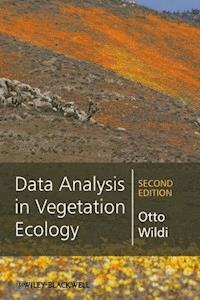
The first edition of Data Analysis in Vegetation Ecology provided an accessible and thorough resource for evaluating plant ecology data, based on the author’s extensive experience of research and analysis in this field. Now, the Second Edition expands on this by not only describing how to analyse data, but also enabling readers to follow the step-by-step case studies themselves using the freely available statistical package R.
The addition of R in this new edition has allowed coverage of additional methods for classification and ordination, and also logistic regression, GLMs, GAMs, regression trees as well as multinomial regression to simulate vegetation types. A package of statistical functions, specifically written for the book, covers topics not found elsewhere, such as analysis and plot routines for handling synoptic tables. All data sets presented in the book are now also part of the R package ‘dave’, which is freely available online at the R Archive webpage.
The book and data analysis tools combined provide a complete and comprehensive guide to carrying out data analysis students, researchers and practitioners in vegetation science and plant ecology.
Summary:
- A completely revised and updated edition of this popular introduction to data analysis in vegetation ecology
- Now includes practical examples using the freely available statistical package ‘R’
- Written by a world renowned expert in the field
- Complex concepts and operations are explained using clear illustrations and case studies relating to real world phenomena
- Highlights both the potential and limitations of the methods used, and the final interpretations
- Gives suggestions on the use of the most widely used statistical software in vegetation ecology and how to start analysing data
Praise for the first edition:
"This book will be a valuable addition to the shelves of early postgraduate candidates and postdoctoral researchers. Through the excellent background material and use of real world examples, Wildi has taken the fear out of trying to understand these much needed data analysis techniques in vegetation ecology."
—Austral Ecology
Sie lesen das E-Book in den Legimi-Apps auf:
Seitenzahl: 383
Veröffentlichungsjahr: 2013
Ähnliche



















Table of Contents
Title Page
Copyright
Dedication
Preface to the second edition
Preface to the first edition
List of figures
List of tables
About the companion website
Chapter 1: Introduction
Chapter 2: Patterns in vegetation ecology
2.1 Pattern recognition
2.2 Interpretation of patterns
2.3 Sampling for pattern recognition
2.4 Pattern recognition in
Chapter 3: Transformation
3.1 Data types
3.2 Scalar transformation and the species enigma
3.3 Vector transformation
3.4 Example: Transformation of plant cover data
Chapter 4: Multivariate comparison
4.1 Resemblance in multivariate space
4.2 Geometric approach
4.3 Contingency measures
4.4 Product moments
4.5 The resemblance matrix
4.6 Assessing the quality of classifications
Chapter 5: Classification
5.1 Group structures
5.4 Minimum-variance clustering
5.5 Forming groups
5.6 Silhouette plot and fuzzy representation
Chapter 6: Ordination
6.1 Why ordination?
6.2 Principal component analysis
6.3 Principal coordinates analysis
6.4 Correspondence analysis
6.5 Heuristic ordination
6.6 How to interpret ordinations
6.7 Ranking by orthogonal components
Chapter 7: Ecological patterns
7.1 Pattern and ecological response
7.2 Evaluating groups
7.4 Multivariate linear models
7.5 Synoptic vegetation tables
Chapter 8: Static predictive modelling
8.1 Predictive or explanatory?
8.2 Evaluating environmental predictors
8.3 Generalized linear models
8.4 Generalized additive models
8.5 Classification and regression trees
8.6 Building scenarios
8.7 Modelling vegetation types
8.8 Expected wetland vegetation (example)
Chapter 9: Vegetation change in time
9.1 Coping with time
9.2 Temporal autocorrelation
9.3 Rate of change and trend
9.4 Markov models
9.5 Space-for-time substitution
9.6 Dynamics in pollen diagrams (example)
Chapter 10: Dynamic modelling
10.1 Simulating time processes
Chapter 11: Large data sets: wetland patterns
11.1 Large data sets differ
11.2 Phytosociology revisited
11.3 Suppressing outliers
11.4 Replacing species with new attributes
11.5 Large synoptic tables?
Chapter 12: Swiss forests: a case study
12.1 Aim of the study
12.2 Structure of the data set
12.3 Selected questions
12.4 Conclusions
Appendix A: Functions in package dave
Appendix B: Data sets used
Bibliography
Index
This edition first published 2013
© 2013 by John Wiley & Sons, Ltd
Wiley-Blackwell is an imprint of John Wiley & Sons, formed by the merger of Wiley's global Scientific, Technical and Medical business with Blackwell Publishing.
Registered office: John Wiley & Sons, Ltd, The Atrium, Southern Gate, Chichester, West Sussex, PO19 8SQ, UK
Editorial offices: 9600 Garsington Road, Oxford, OX4 2DQ, UK
The Atrium, Southern Gate, Chichester, West Sussex, PO19 8SQ, UK
111 River Street, Hoboken, NJ 07030-5774, USA
For details of our global editorial offices, for customer services and for information about how to apply for permission to reuse the copyright material in this book please see our website at www.wiley.com/wiley-blackwell.
The right of the author to be identified as the author of this work has been asserted in accordance with the UK Copyright, Designs and Patents Act 1988.
All rights reserved. No part of this publication may be reproduced, stored in a retrieval system, or transmitted, in any form or by any means, electronic, mechanical, photocopying, recording or otherwise, except as permitted by the UK Copyright, Designs and Patents Act 1988, without the prior permission of the publisher.
Designations used by companies to distinguish their products are often claimed as trademarks. All brand names and product names used in this book are trade names, service marks, trademarks or registered trademarks of their respective owners. The publisher is not associated with any product or vendor mentioned in this book.
Limit of Liability/Disclaimer of Warranty: While the publisher and author(s) have used their best efforts in preparing this book, they make no representations or warranties with respect to the accuracy or completeness of the contents of this book and specifically disclaim any implied warranties of merchantability or fitness for a particular purpose. It is sold on the understanding that the publisher is not engaged in rendering professional services and neither the publisher nor the author shall be liable for damages arising herefrom. If professional advice or other expert assistance is required, the services of a competent professional should be sought.
Library of Congress Cataloging-in-Publication Data
Wildi, Otto.
Data analysis in vegetation ecology / Otto Wildi.
pages cm
Includes bibliographical references and index.
ISBN 978-1-118-38404-6 (cloth) – ISBN 978-1-118-38403-9 (pbk.) 1. Plant communities–Data processing. 2. Plant communities–Mathematical models. 3. Plant ecology–Data processing. 4. Plant ecology–Mathematical models. I.
Title.
QK911.W523 2013
581.70285 – dc23
2012047729
A catalogue record for this book is available from the British Library.
Wiley also publishes its books in a variety of electronic formats. Some content that appears in print may not be available in electronic books.
Cover image: Image supplied by Author
Cover design by Steve Thompson
Plants are so unlike people that it's very difficult for us to appreciate fully their complexity and sophistication.
Michael Pollan,
Preface to the second edition
Successful attempts to include instructions in motivated me to prepare a second edition of the book while keeping it basically unchanged in style and content. Hence, I hoped to circumvent yet another introduction to a software environment as done earlier for MULVA-5 (Wildi and Orlóci 1996), which I previously used in many of my examples. I found the syntax of to be close to ordinary mathematical notation allowing technical instructions to be minimized. Finally, this book is not an introduction to . There are many others providing this, such as Crawley (2005), Venables and Ripley (2010), or for advanced users Borcard et al. (2011), all highly recommended and referenced. The instructions I included in this second edition are aimed to serve the inexperienced in , getting technical help from colleagues or experts in installing and initializing and loading some packages and functions, including the one I specifically provide for this book (package dave). Unintendedly, doing the examples explained in this second edition may even act as a beginners course in , hopefully with minimum effort.
Writing this second edition was a delicate task too. First, various results had to be reproduced by an entirely different or newly developed software. Only after revising the very last chapter was it clear that all this could be done in . It is well known that many scientists using love it, those who avoid it, fear it. My objective is to encourage newcomers to do the examples and I put every effort into most parsimonious solutions. The instructions and functions I prepared for the book look and hopefully feel simple, hiding the tremendous complexity of the environment. In this context I thank my colleagues who gave me technical advice, Thomas Dalang, Dirk Schmatz, Meinrad Küchler and Alan Haynes. The attendees of a course held with an early version of the book, namely Angéline Bedolla, Elizabeth Feldmeyer, Ulrich Graf, Julia Haas, Alan Haynes, Caroline Heiri, Martina Hobi, Christine Keller, Meinrad Küchler, Helen Küchler, Mathieu Lévesque, Anna Pedretti, Kathrin Priewasser, Anita C. Risch, Marcus Schaub, Martin Schütz, Anna Schweiger, Andreas Schwyzer, Bastian Ullrich and Sonja Wipf, helped me to identify bugs and traps. Again, Anita C. Risch and Martin Schütz were willing to read the whole text critically.
All examples in the book are derived in version 2.15.2 (R Development Core Team 2012). Whenever a specific method was missing I wrote a new function to avoid overloading readers with cumbersome code. On the downside every new function represents yet another black box. In the current state the reader will find solutions for all methods presented in the book, although figures may appear a little different: for the book I adapted these to layout requirements using an extended set of plot parameters explained in when typing ?plot.default and further screening for par. In the end I devise an package for this book: dave, the name composed of the initials of the book title (Appendix A). An integrated part of dave consists of the many data sets listed in Appendix B. I would like to express my thanks to all authors cited there for giving the right to access these, as far as yet unpublished. Many are real world examples, although, with respect to ongoing research, fairly aged.
While elaborating this second edition I got trapped by the temptation to extend the panoply of methods where functions of other packages were ready to use. This concerns, for example, resemblance measures, classification techniques and ordination methods. In the modelling part I replaced my old fashioned heuristic approach by the now widely used logistic regression techniques including instructions for scenario building, considered important in the time of global change. For newcomers in I highly recommend following the instructions quite carefully: is very much like a programming language and for the average human brain it is extremely difficult to exactly remember all the details to get the examples running. To support proper use I extended the index considerably to facilitate quick access to all major methods covered in this book. The later will work only when all packages required are loaded, namely dave, labdsv, tree and vegan and all considered ‘related’ upon downloading from a CERAN repository found on the Internet.
I would again like to thank the publications team of Wiley-Blackwell for all the encouragement and support I have received throughout this revision. We agreed that the new edition shall serve users not only in theory but now also in practice, a combination adding to the complexity of publication. Finally, I express my thanks to my host institution, the Swiss Federal Institute for Forest, Snow and Landscape Research WSL, for providing access to its computer network and literature databases needed to complete this work.
Birmensdorf, 1 October 2012
Preface to the first edition
When starting to rearrange my lecture notes I had a ‘short introduction to multivariate vegetation analysis’ in mind. It ended up as a ‘not so short introduction’. The book now summarizes some of the well-known methods used in vegetation ecology. The matter presented is but a small selection of what is available to date. By focussing on methodological issues I try to explain what plant ecologists do, and why they measure and analyse data. Rather than just generating numbers and pretty graphs, the models and methods I discuss are a contribution to the understanding of the state and functioning of the ecosystems analysed. But because researchers are usually driven by their curiosity about the functioning of the systems I successively began to integrate examples encountered in my work. These now occupy a considerable portion of this book. I am convinced that the fascination of research lies in the perception of the real world and its amalgamation in the form of high-quality data with hidden content processed by a variety of methods reflecting our model view of the world. Neither my results nor my conclusions are final. Hoping that the reader will like some of my ideas and perspectives, I encourage them to use and to improve on them. There is a considerable potential for innovation left.
The examples presented in this book all come from Central Europe. While this was not intended originally, I became convinced the topics they cover are of general relevance, as similar investigations exist almost everywhere in the world. An example is the pollen data set: pollen profiles offer the unique chance to study vegetation change over millennia. This is the time scale of processes such as climate change and the expansion of the human population. Another, much shorter time series than that of pollen data is found in permanent plot data originating from the Swiss National Park that I had the opportunity to look at. The unique feature of this is that it dates back to the year 1917, when Josias Braun-Banquet personally installed the first wooden poles, which are still in place. Records of the full set of species have been collected ever since in five-year steps. A totally different data set comes from the Swiss Forest Inventory, presented in the last chapter of this book. Whereas many vegetation surveys are merely preferential collections of plot data, this data set is an example of systematic sampling on a grid encompassing huge environmental gradients. It helps to assess which patterns really exist, and whether some of those described in papers or textbooks are real or merely reflect the imagination or preference of researchers scanning the landscape for nice locations. In this case the data set available for answering the question is still moderate in size, but handling of large data sets will eventually be needed in similar contexts. I used the Swiss wetland data set as an example for handling data of much larger size, in this case with relevés. Although this is outnumbered by others, it resides on a statistical sampling design.
Some basic knowledge of vegetation ecology might be needed to understand the examples presented in this book. Readers wishing to acquire this are advised to refer, for example, to the comprehensive volumes Vegetation Ecology by van der Maarel (2005) and Aims and Methods of Vegetation Ecology by Mueller-Dombois and Ellenberg (1974), presently available as a reprint. The structure of my book is influenced by Orlóci's (1978) Multivariate Analysis in Vegetation Research, which I explored the first time when proofreading it in 1977. Various applications are found in the books of Gauch (1982), Pielou (1984) and Digby and Kempton (1987) and many multivariate methods used in vegetation ecology are introduced in Jongman et al. (1995). To study statistical methods used in this book in more detail, I strongly recommend the probably most comprehensive textbook existing today, the second edition of Numerical Ecology by Legendre and Legendre (1998). Several books provide an introduction to the use of statistical packages, which are referred to in the appendix. For many reasons I decided to omit the software issue in the main text; upon the request of several reviewers I added a section to the appendix where I reveal how I calculated my examples and mention programs, program packages and databases.
I would like to express my thanks to all individuals that have contributed to the success of this book. First of all Rachel Wade from Wiley-Blackwell, who strongly supported the efforts to print the manuscript in time and organized all the technical work. I thank Tim West for careful copy-editing, and Robert Hambrook for managing the production process. My colleagues Anita C. Risch and Martin Schütz revised the entire text, providing corrections and suggestions. Meinrad Küchler helped in the computation of several examples. André F. Lotter provided the pollen data set. I cannot remember all the people who had an influence on the point of view presented here: many ideas came from László Orlóci through our long lasting collaboration, others from Madhur Anand, Enrico Féoli, Valério de Patta Pillar, Janos Podani and Helene Wagner. I particularly thank my family for encouraging me to tackle this work and for their tolerance when I was working at night and on weekends to get it completed.
Birmensdorf, 1 December 2009
List of figures
2.1
Portrait of Abraham Lincoln.
2.2
Vegetation mapping as a method for assessing a pattern.
2.3
Ordination of a typical horseshoe-shaped vegetation gradient.
2.4
A natural and a man-made event.
2.5
Primary production of the vegetation of Europe.
2.6
Distribution pattern of oak haplotypes in Switzerland.
2.7
The elements of sampling design.
2.8
Organization of vegetation and site data in R.
2.9
Window view of data frame nsit.
3.1
An example of three data types.
3.2
Scalar transformation of population size.
3.3
Scalar transformation of the coordinates of a graph.
3.4
Overlap of two species with Gaussian response.
4.1
Presentation of data in the Euclidean space.
4.2
Three ways of measuring distance.
4.3
The correlation of vector j with vector k.
4.4
The average distance as a measure for homogeneity.
4.5
Similarities within and between the forest types of Switzerland.
5.1
Two-dimensional group structures.
5.2
A dendrogram from agglomerative hierarchical clustering.
5.3
Comparing different methods of linkage clustering.
5.4
Variance within and between groups.
5.5
Cutting dendrograms derived by different methods.
5.6
Silhouette plot example.
5.7
Silhouette plot of four clustering solutions.
6.1
Three-dimensional representation of similarity relationships.
6.2
Common operations in ordination.
6.3
Projecting data into ordination space in PCA.
6.4
Numerical example of PCA.
6.5
Main results of a PCA using real world data.
6.6
Projection of five-dimensional PCA ordination.
6.7
PCOA ordination using the ‘Schlaenggli’ data set.
6.8
PCOA ordinations with six different resemblance measures.
6.9
Comparison of CA and PCA.
6.10
Origin of the arch effect.
6.11
Comparing PCOA and FSPA.
6.12
Comparison of PCOA and NMDS.
6.13
Comparison of CA and DCA.
6.14
Interpretations of CA.
6.15
Surface fitting to interpret ordinations.
6.16
Relevés chosen by RANK for permanent investigation.
7.1
Distinctness of group structure.
7.2
Ordination of group structure in data set ‘nveg’.
7.3
Biplot and correlogram of 10 pH measurements.
7.4
Projecting distances in different directions.
7.5
Evaluating the direction of the main floristic gradient.
7.6
Correlograms of site factors with vegetation.
7.7
Comparison of RDA and CCA.
7.8
Using distance matrices in NP-MANOVA.
7.9
Graphical display of vegetation tables.
7.10
Structuring the meadow data set of Ellenberg.
8.1
Pairwise plot of selected site variables.
8.2
Linear and logistic regression of pH and Sphagnum recurvum.
8.3
Occurrence of Spagnum recurvum and prediction by GLM.
8.4
Prediction of Spagnum recurvum by GAM.
8.5
Regression tree to predict Spagnum recurvum by pH.
8.6
Predicting Spagnum recurvum occurrence by classification tree.
8.7
Scenarios for predicting Spagnum recurvum occurrence.
8.8
Multivariate logistic regression.
8.9
Simulated wetland vegetation.
8.10
Occurrence probability of three species.
8.11
Steps of computation in multinomial logistic regression.
9.1
Type of environmental study needed to assess change.
9.2
Temporal arrangement of measurements (pH).
9.3
Measuring rate of change in time series of multistate systems.
9.4
Ordination of data from plots in the Swiss National Park.
9.5
Rate of change in plot Tr6, Swiss National Park.
9.6
A Markov model of the Lippe et al. (1985) data set.
9.7
PCA ordination of the Lippe succession data. 198 9.8 Markov model of the time series of the Swiss National Park.
9.9
The principle of space-for-time substitution.
9.10
The similarity of time series.
9.11
Pinus mugo on a former pasture in the Swiss National Park.
9.12
Minimum spanning tree (Swiss National Park).
9.13
Ordering of 59 time series from the Swiss National Park.
9.14
Succession in pastures of the Swiss National Park.
9.15
Tree species in a pollen diagram (Lotter 1999).
9.16
Velocity profile of the Soppensee pollen diagram.
9.17
Time trajectory of the Soppensee pollen diagram.
9.18
Velocity profiles from quantitative towards qualitative content.
9.19
Time acceleration trajectory of the Soppensee pollen diagram.
10.1
Attempt to get a dynamic model under control (Wildi 1976).
10.2
Numerical integration of the exponential growth equation.
10.3
Logistic growth of two populations, model 1.
10.4
Logistic growth of two populations, model 2.
10.5
Logistic growth of two populations, model 3.
10.6
The mechanism of spatial exchange.
10.7
Overgrowth of a plot by a new guild.
10.8
Original and simulated temporal succession.
10.9
Spatial design of SNP model.
10.10
Spatial simulation of succession, Alp Stabelchod.
11.1
Alliances represented in a wetland vegetation sample.
11.2
Frequency distribution of nearest-neighbor pairs of relevés.
11.3
Ordination of mire vegetation with and without outliers.
11.4
Projecting a given sample into a new resemblance space.
11.5
Ordination of the wetland sample in the indicator space.
11.6
Indicator values superimposed on ordination.
11.7
Similarity matrices of 12 vegetation types.
11.8
Synoptic table of mire vegetation data, outliers removed.
11.9
Synoptic table of mire vegetation data, outliers not removed.
12.1
Two ordinations of the Swiss forest data set.
12.2
Vegetation map of Swiss forests (eight groups).
12.3
The effect of different plot size on similarity pattern.
12.4
Vegetation probability map (eight groups).
12.5
Observed and potential distribution of four tree species.
12.6
Ordination of forest stands. Four selected tree species marked.
12.7
Ecograms of forest stands. Four selected tree species marked.
12.8
Tree- and herb layers of three species in ecological space.
List of tables
2.1
Terms used in sampling design (International Statistical Institute 2009).
3.1
Effects of different vector transformations.
3.2
Numerical example of vector transformation.
3.3
Transformation of cover-abundance values in phytosociology.
4.1
Notations in contingency tables.
4.2
Resemblance measures using the notations in
Table 4.1
.
4.3
Product moments.
5.1
Properties of four average linkage clustering methods.
6.1
Data set and results illustrating the RANK algorithm.
6.2
Ranking relevs of the Schlaenggli data set.
6.3
Ranking species of the Schlaenggli data set.
7.1
Synoptic table of nveg and snit.
Lesen Sie weiter in der vollständigen Ausgabe!
Lesen Sie weiter in der vollständigen Ausgabe!
Lesen Sie weiter in der vollständigen Ausgabe!
Lesen Sie weiter in der vollständigen Ausgabe!
Lesen Sie weiter in der vollständigen Ausgabe!
Lesen Sie weiter in der vollständigen Ausgabe!
Lesen Sie weiter in der vollständigen Ausgabe!
Lesen Sie weiter in der vollständigen Ausgabe!
Lesen Sie weiter in der vollständigen Ausgabe!
Lesen Sie weiter in der vollständigen Ausgabe!
Lesen Sie weiter in der vollständigen Ausgabe!
Lesen Sie weiter in der vollständigen Ausgabe!
Lesen Sie weiter in der vollständigen Ausgabe!
Lesen Sie weiter in der vollständigen Ausgabe!
Lesen Sie weiter in der vollständigen Ausgabe!
Lesen Sie weiter in der vollständigen Ausgabe!
Lesen Sie weiter in der vollständigen Ausgabe!




