


8,39 €
Mehr erfahren.
- Herausgeber: Salt
- Kategorie: Gesellschafts- und Liebesromane
- Sprache: Englisch
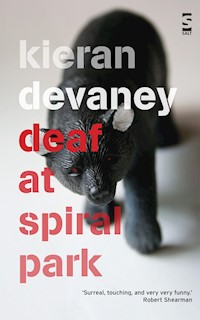
Deaf at Spiral Park is a book about a bear that shaves off his fur to join humanity. The novel uses a range of generic approaches, such as comedy and philosophy, to question the humanity of the bear, and conversely the animalistic behaviour of those around him. A cast of characters such as a clown, an invalid, a farmer and a philosopher transcend their stock types and become involved in the complex world of the bear. The antagonist, a recruitment consultant, dies several times, and, ultimately, this teaches her nothing. This is a fresh and original novel which remains accessible and funny in spite of its experimental and philosophical concerns.
Das E-Book können Sie in Legimi-Apps oder einer beliebigen App lesen, die das folgende Format unterstützen:
Veröffentlichungsjahr: 2013
Ähnliche




















Deaf at Spiral Park
Deaf at Spiral Park is a book about a bear that shaves off his fur to join humanity. The novel uses a range of generic approaches, such as comedy and philosophy, to question the humanity of the bear, and conversely the animalistic behaviour of those around him. A cast of characters such as a clown, an invalid, a farmer and a philosopher transcend their stock types and become involved in the complex world of the bear. The antagonist, a recruitment consultant, dies several times, and, ultimately, this teaches her nothing. This is a fresh and original novel which remains accessible and funny in spite of its experimental and philosophical concerns.
Praise for Kieran Devaney
“Surreal, touching, and very very funny.” —Rob Shearman
“Kieran Devaney’s brilliant first novel.” —Nicholas Royle
“Deaf at Spiral Park leaves a lingering nausea familiar to anyone who has ever had a performance review. But the dark humour of the novel sustains it. Tiny flashes of joy are there though only fleetingly, the shafts of sunlight on a pavement, a minor victory for someone on the ‘shitlist’ (only called on for the worst of jobs), and an ‘impossibly moving’ moment for the bear at a concert. All soon swallowed up, but some moments to hold on to.
Perhaps what is most telling is that I read Deaf at Spiral Park on a long commute either side of a day’s work that at times felt like just another surreal episode in the novel.” —Cultural Outpost
“It takes a vivid imagination to come up with the central premise of Deaf at Spiral Park and Kieran Devaney clearly has that imagination.
It follows the misadventures of a bear, who shaves off all his fur, clips his claws, buys the biggest clothes he can find, and tries to join the world. We find him trying to hold down a series of temporary jobs, while interacting with the recruitment consultant, whose frequent deaths have no educational value, and a myriad of other characters, add the human elements to this novel.
As you can probably tell, it is definitely in the genre of magic realism, but it is none the worse for that. This conceit, such as it is, allows for the very nature of what makes us human to be fully explored, and although the book does not have a strong plot (it is the whole grass is greener on the other side, no it isn’t type hero quest) it does pose more questions and ideas than perhaps ninety percent of the books that find their ways onto the shelves of our bookshops do.
It is a worthwhile read, and if your reading tastes fall somewhere between The Life of Pi, Vernon God Little, and Then We Came To The End, then you should definitely give this book a try.” —Ben Macnair Newbooks Magazine
Deaf at Spiral Park
Kieran Devaney was born in Birmingham in 1983. He now lives in Brighton. He is writing his second novel about a dog of infinite size. Find him at theapesofgod.blogspot.com, recollectionsofthegoldentriangle.tumblr.com, and davidcameron.tumblr.com.
Published by Salt Publishing Ltd
12 Norwich Road, Cromer, Norfolk NR27 0AX
All rights reserved
Copyright © Kieran Devaney, 2013
The right of Kieran Devaney to be identified as the author of this work has been asserted by her in accordance with Section 77 of the Copyright, Designs and Patents Act 1988.
This book is in copyright. Subject to statutory exception and to provisions of relevant collective licensing agreements, no reproduction of any part may take place without the written permission of Salt Publishing.
Salt Publishing 2013
Created by Salt Publishing Ltd
This book is sold subject to the conditions that it shall not, by way of trade or otherwise, be lent, re-sold, hired out, or otherwise circulated without the publisher’s prior consent in any form of binding or cover other than that in which it is published and without a similar condition including this condition being imposed on the subsequent purchaser.
ISBN 978 1 84471 985 3 electronic
For Rebecca
Contents
Kieran devaney deaf at spiral park
There was a bear. Life in the woods, where he lived with the other bears, had begun to sicken him.
The bear would go to the edge of the forest and watch the people who lived in the small town below. The stature of the buildings, the play of light on glass, the swish of fabric on pink, hairless flesh: these all moved this bear and he began to yearn. This was a bear that yearned.
On a cool night, this bear leaves the woods and enters the town. He breaks into a barber’s and uses an electric shaver to remove all his fur, leaving just a small clump on the top of his head. The bear then breaks into a hardware store and, with a file, pares his claws until they are flat and dull. Finally, this bear steals the biggest shirt and pair of jeans he can find and strains them over his massive frame. On this night, looking at his reflection in the flat black glass of a shop window he begins to feel better. It is in this way that this bear becomes a man.
While working, the Recruitment Consultant called Carol usually had several windows open on her computer. Though the agency she worked for forbade their temps from using the internet wherever they were sent, she used it constantly. She loved, in particular, social networking sites. She maintained profiles on any number of them, detailing her favourite films, bands, books, TV shows, clothes, what character out of any character in the Harry Potter sequence of books she was, what character out of any character in the Peanuts series of books she was, what character out of any character she was out of the original line-up of the band Funkadelic, what character out of any character she was out of the TV series Roots, what artist out of any artist she was out of the Swiss Aktionist movement of artists, what early house track out of any early house track she was out of a list of early house tracks determined by her predilection for a certain bass sound over another bass sound. The profiles similarly accumulated digital camera photographs featuring the Recruitment Consultant, or parts of the Recruitment Consultant’s body in various positions and locales. She always had her email open, both her work account and a personal account. She constantly had open the homepage of a tabloid newspaper and throughout the day she would click on stories and opinion pieces and by reading them she would learn a little something about the world.
But the Recruitment Consultant didn’t spend all her time on gossip websites and tabloid editorials. No. At least some of her time was taken up with putting people in jobs. And not just that! There was the whole business of interviewing people to see what kind of work they were suitable for, not to mention liaising with companies to see what kind of people they wanted to have working for them and what things they wanted those people to do.
Once she had a job to fill, this Recruitment Consultant had to think about all the people she had interviewed and decide which of them best suited the role that was available. This involved all kinds of sophisticated techniques such as trying to remember whether it was a particular English Literature graduate or a recent graduate of a Masters programme in French that had the more powerful forearms best suited to stacking a shelf. Or: out of a particular history graduate or a physics graduate, which has the most relevant skills for the job of putting the pieces of paper into alphanumerical order? Not just alphabetical order – that would clearly be the domain of the history graduate. Not just numerical order, which clearly suggests the physics graduate’s particular skillset. But alphanumerical! Oh, it’s a tricky one, combining as it does two potentially contradictory skills. If she sent the history guy, sure, he might be a whizz on the alpha side of things, the alpha side of things might not tax him one jot, but he could easily be an utter klutz in the numerical sphere. Then she’d be for it! Similarly, sending the physics graduate, you can sleep easy at night when considering the numerical side of putting the pieces of paper into alphanumerical order, but that alpha side is a rogue element. Who knows what might happen with it. This physics guy might ring her up from the job and probably say, Hi, Carol, how’s it going? (. . .) Good, Good, (. . .) Well I’m OK, I guess I have good news and some bad news about the job. On the numerical side – this is the good news, by the way – I’m fine, I’m good. I’ve got the bits of paper in front of me and the numerical zone as regards them I’ve got entirely covered. It’s no problem. That’s the good news. But this . . . this alpha side, it’s just not my thing, I’m out of my comfort zone with it, I don’t mind telling you. If it was just the numerical I would be fine. But the whole alpha side of things, not to mention the combining the alpha with the numerical, has just left me stumped. It would probably be the same except in reverse if you got some guy in who was really good at the alpha side of the putting the pieces of paper into order. You know, that was really his thing. He loved it. That guy would probably call you up and say, Hi, Carol, how are you? (. . .) I’m fine thanks, but I’m having a bit of trouble with the numerical side of the putting the pieces of paper into order, into alphanumerical order. The alpha side is going great – I’m having a great time with it, I could do it all the livelong day. But this numerical side is awful tricky. I’m having an absolute dog of a time with it. I just don’t get the thing. That’s what someone good at the alpha but not at the numerical aspect might say to you, Carol, about the whole thing of putting the pieces of paper in alphanumerical order. Now me, I’m just the opposite, funnily enough. With me the numerical stuff happens to be my particular forte, whereas my weakness – what lets me down in this type of situation – is the alpha side of the task. That’s what I’m telephoning you about now. And the Recruitment Consultant would be the one who had to pick up the pieces. If the company had asked for two people to sort the pieces of paper into alphanumerical order then she could have sent both the history graduate and the physics graduate and they could have worked together. The history graduate could do the alpha and then pass the piece of paper onto the physics graduate who could do the numerical. Both had in the interviews expressed their fondness for working in teams. That arrangement would work out well. It would be effective. But the company had only asked for one person and so the Recruitment Consultant had to choose. She had no one on her books with both a physics and a history degree so she would have to decide between the two. The question was, when sorting the pieces of paper into alphanumerical order, which is the most important factor? Is it the alpha or is it the numerical? She could call up the company and talk to a manager there who would probably say, Hi, Carol, what you saying? (. . .) Yes, yes, I’m good too, thanks, (. . .) I do agree, that particular actor’s career has certainly hit a downturn since he left that popular soap (. . .) No, I can’t say I’m surprised either, (. . .) The what about putting the pieces of paper into alphanumeric order? (. . .) Oh, well. You might say that the two are equally important, or even that one is no good without the other. If one of the pieces of paper is in the right alpha but the wrong numerical then it has been misfiled. Similarly, a piece of the paper that is numerically correct but alpha incorrect – I wouldn’t be able as a manager to say that that piece of the paper has been correctly filed. The Recruitment Consultant would get off the phone none the wiser, still with the same problem to solve.
The bear is in the office. He is in front of his computer. He clicks one window open and looks at the number in it. He clicks open another window, moves his mouse into one of the blank fields and types in the number. He moves the mouse and clicks a button and the screen refreshes to reveal the field blank again. The bear switches windows again and looks at the number. He clicks open another window. He moves his mouse. He runs his claws through the coarse scruff on top of his head. He gets up. He goes to the toilets and enters a stall. He puts his head against the cold formica side panel. He feels his sinew stir. He shuts his eyes. There is so much of the day left.
The bear is stood on a pallet on a wet concrete patch. Another man calls him. He gets down off the pallet and walks towards the open end of an articulated lorry trailer. It is cold. His jacket is bunched around his throat. He looks at the man inside the lorry and the man looks back. The bear grips the bottom of the refrigerator and begins to take the strain of it, hard and coarse against his palms. The man steadies the top. The bear lowers one side of the leaning fridge to the ground and lets the top tilt into him, taking its weight until it is righted. The other man turns away and rubs his eyes with the heels of his hands. The bear looks around. He can’t see the forklift. There are eight more fridges in the van. It is getting dark. The yellow forklift comes out of the warehouse and the man driving it is laughing.
The character was a farmer. You could tell by his clothes, dark green wax jacket, hat, wellingtons, his sideburns, his stick. You could tell this but, still, he lived in the town and didn’t live alone. He lived with the philosopher and he lived with the invalid. He lived with the DJ and with the clown. When they all put their clothes on and walked down the steep hill to the pub and ordered coloured drinks and sat at the big table together, it felt like they could be in LA, or Vegas. Maybe even Paris, or Egypt. The farmer liked, on certain days, to walk through the city, into the centre and further on, down to the train station which was at the bottom of a hill. Behind the station were big grey blocks of flats. Funnily enough, it was the clown that the farmer had known the longest. On those days the farmer would go into the station, fold his big coat over his arm, lean his stick up against the wall and think to himself, I could get a train back out to the fields, get it going again.
The DJ was another type all together. Though, in a different way, he was a similar type. The DJ didn’t mind being in a city which had so few good clubs for him to DJ at. He thought, with the new technology, why should I be limited to playing raves in just one place? I can sit in my bedroom and play out to raves in Stockholm and Tokyo, London, Africa, New Zealand. Thoughts like these contented the DJ.
Unsurprisingly, the philosopher and the clown got on well. Sometimes it was hard to tell the two of them apart. They wore each other’s clothes, they made the same jokes, but they were different people. The clown was tall and spindly while the philosopher had a beard. No. The other way round.
The invalid was another member of the group and, by virtue of being the only woman, was something of a focal point. It was often the invalid who cast the deciding vote over whether to go to the pub that night or stay in with the telly. Or whatever else it was that they may have been unable to decide. It was a position of power, it was a position of some loneliness, some despair. But the invalid neither enjoyed nor disliked it. The invalid had a lot of problems. For one, she couldn’t work. None of the others worked either, but the subtle difference, as the philosopher once pointed out, to the clown’s delight, was that the invalid couldn’t work, whereas the rest of them just didn’t. Hence her name, hence her status. Was the philosopher right?
Their house was always banging. The closer you got to the DJ’s room, the louder the beats got, but you could always hear them, wherever you were. The group liked nothing better than to take a picnic to the park. The DJ would bring his boombox and blast out the tunes. The invalid would sit in the middle, scoffing the foul-smelling sandwiches and uttering words like ‘rot’, ‘slump’, ‘slop’. The philosopher would laugh at something in the paper, pass it to the clown, who would laugh too. While the farmer would plant his stick in the soft earth under the rug, look past the nests of houses that made up the town and over into the always visible hills, think about getting it going again.
The Recruitment Consultant woke up. Her eyelids were stuck together with sleep. Her nose was blocked. It was cold in the room. In the bathroom, she brushed her teeth and spat. There was blood in what she spat. She brushed her tongue and gagged. She had a song in her head. She spat a yellow mucous into the sink and washed it away with the tap. The milk was off so she had to skip breakfast. Her trousers were cold on her legs when she put them on. And the blouse, too, was cold. In the mirror, her eyes were red, puffy. She regarded herself in the mirror before leaving for work. All she could think of was the song.
The bear goes to a public lecture on modern horror writing. Or that is what it purported to be. The supposed lecturer takes to the lectern and begins reciting. What he is saying, it seems to this bear to be nothing more than recycled postmodern jargon, and entirely meaningless. The people sitting around the bear are listening hard and taking it all in. After a time, from the back of the hall, behind everyone, comes a person dressed in a very convincing bear costume. It runs down the aisle, up onto the stage and slams into the aghast-looking lecturer, knocking him down. It gazes out over the audience. There are screams. It then drags the lecturer behind the curtain and there are noises. The curtains rustle dramatically. All the organisers and ushers seem to have disappeared. Moments later, it reappears, its synthetic face and paws bloodstained. It runs back down the aisle, not looking at anyone. The bear half-rises and turns to see the person in the bear costume run out the back door, then slumps back into his seat. Nothing happens for some minutes and everyone stays still. Their whispers are agitated, but no one speaks to the bear. He is on his own. The house lights go up suddenly and, when it’s clear nothing else is going to happen, people begin to numbly file out.
It turns out the whole thing was a set-up. The bear finds this out a few weeks later. The audience reactions were being filmed while the stunt took place. The footage is shown in an art gallery for one month as part of an exhibition subtitled New Visions of Shared Spaces. The bear goes down one afternoon and sees himself looking bemused, then anxious, scared and then confused. Sees his own head turn and watch the person in the bear suit leaving the auditorium. At this point the camera zooms abruptly towards the back of the bear’s head and it is alarming for him to see himself as he turns back round, still in focus, falls into his chair and stares, black eyes creased and small.




