


Erhalten Sie Zugang zu diesem und mehr als 300000 Büchern ab EUR 5,99 monatlich.
- Herausgeber: Nick Hern Books
- Kategorie: Poesie und Drama
- Serie: NHB Modern Plays
- Sprache: Englisch
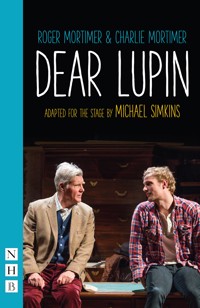
Michael Simkins' immensely charming stage adaptation of Dear Lupin, the witty and touching collection of letters from a father to his son that became a huge bestseller, winner of The Sunday Times Humour Book of the Year. Roger Mortimer's hilarious, touching, and always generous letters to his son, Charlie, are packed with crisp anecdotes and sharp observations. Spanning twenty-five years, their correspondence forms a memoir of their relationship, and an affectionate portrait of a time gone by. Dear Lupin was adapted for the stage by best-selling author and actor Michael Simkins, revealing many more undocumented stories of the trials and tribulations of Charlie's youth and adulthood. The play toured the UK in 2015, before a run in the West End at the Apollo Theatre, starring real-life father and son James Fox and Jack Fox.
Sie lesen das E-Book in den Legimi-Apps auf:
Seitenzahl: 78
Veröffentlichungsjahr: 2015
Das E-Book (TTS) können Sie hören im Abo „Legimi Premium” in Legimi-Apps auf:
Ähnliche













Roger Mortimer & Charlie Mortimer
DEAR LUPIN
adapted for the stage by
Michael Simkins
NICK HERN BOOKS
London
www.nickhernbooks.co.uk
Contents
Title Page
Original Production
Characters
A Note on the Text
Dear Lupin
About the Authors
Copyright and Performing Rights Information
Dear Lupin was first produced by Martyn Hayes, Kenny Wax, TC Beech and Michael Watt, and performed at the Theatre Royal Windsor on 14 March 2015. The cast was as follows:
ROGER MORTIMER
James Fox
CHARLIE MORTIMER
Jack Fox
Director
Philip Franks
Designer
Adrian Linford
Lighting Designer
Johanna Town
Composer and Sound Designer
Matthew Bugg
Choreographer
Simeon John-Wake
The production toured the UK, culminating in a run at the Apollo Theatre, Shaftesbury Avenue, London, from 3 August 2015.
Characters
ROGER MORTIMER
CHARLIE ‘LUPIN’ MORTIMER, his son
A Note on the Text
In the original production, the play was set in Lupin’s imagination and memory, recalling his long-dead father.
However the play is staged, the priority should be to ensure that the action flows seamlessly from one scenario to another without the need for complex scene changes or props which might slow the dramatic drive. Both characters should use whatever props and scenery is to hand to depict and inhabit the world of the play.
Similarly, any changes of costume to denote the advance of time should not be allowed to hold up the action. Apart from Lupin’s change into Army battledress in Act One and Roger’s change from his normal clothes into pyjamas and dressing gown towards the end of Act Two, changes should kept to a minimum.
ACT ONE
Darkness. A room, dimly seen.
Various items of furniture, some covered with dust sheets. A chaise longue, a wardrobe, a stepladder, a child’s rocking horse, a drinks tray, an old microwave cooker, a foldaway bed, shelves, books, paintings, tea chests, chests of drawers, general clutter; anything, in fact, which can be used to help tell the story.
We hear a chorus of the ‘Eton Boating Song’ picked out softly with one finger on a piano.
A figure is standing in the darkness, looking about him, as if visiting somewhere filled with memories from long ago. As the ‘Eton Boating Song’ reaches its last note we snap to –
Sound of the theme to Mastermind.
Simultaneously, the figure whips off the dust sheet to reveal a black-leather chair upholstered with chrome armrests now picked out by a single piercing spotlight.
Meanwhile a man approaches and sits. He’s in his mid-fifties, dressed in a rumpled cardigan, corduroy trousers and scuffed suede shoes.
The figure has now become the QUIZMASTER (note: the following exchange should commence normally but be played at increasing speed).
QUIZMASTER. Your name?
ROGER. Roger Mortimer.
QUIZMASTER. Your occupation?
ROGER. Geriatric racing hack and long-suffering father.
QUIZMASTER. Your chosen subject?
ROGER. Roger Mortimer.
QUIZMASTER. Roger Mortimer, welcome to Celestial Mastermind. You have two minutes on Roger Mortimer, your time starts… now. You once gave the definition of a gentleman as being what?
ROGER. Someone who gets out of the bath to do a pee.
QUIZMASTER. Correct. You were born in 1909 in Cadogan Gardens, Chelsea. In 1930 you joined the Coldstream Guards, fighting at Dunkirk and spending four years as a POW. Upon touching back down on English soil in 1945, what was the first thing you did?
ROGER. Went to a properly flushing lavatory with a copy of The Times.
QUIZMASTER. Correct. You met your wife Cynthia Denison-Pender in 1947. What was your most memorable wedding gift?
ROGER. A set of Viyella pyjamas. Having worn them on our honeymoon my wife sent them to a local laundry, who boiled them. I returned them with a note saying ‘Please donate these to a deserving dwarf.’
QUIZMASTER. Correct. In 1947 you became a racing correspondent and subsequently wrote the definitive history of the Derby. What did you claim were the only three uses for the book?
ROGER. It’s too large for my wife to throw at me; if the leg falls off the billiard table it’s big enough to prop it up; and in case of nuclear attack it’ll provide sufficient lavatory paper to last up to four years.
QUIZMASTER. Correct. Your wife, who in later years could be somewhat excitable, once climbed onto the roof of the family home and threatened to throw herself off. What was your advice to the children?
ROGER. Don’t worry, while she’s up there we can ask her to adjust the TV aerial.
QUIZMASTER. Correct. Who was your racing hero?
ROGER. Sir Gordon Richards.
QUIZMASTER. Your favourite racecourse?
ROGER. Newbury.
QUIZMASTER. Your least favourite?
ROGER. Goodwood. It’s more redolent of dog racing at Slough.
QUIZMASTER. Favourite hobbies?
ROGER. Forty winks.
QUIZMASTER. Favourite food?
ROGER. Salmon kedgeree –
QUIZMASTER. Favourite drink?
ROGER. A double –
QUIZMASTER. Evening out?
ROGER. One that ends early –
QUIZMASTER. Clothes?
ROGER. Anything without a tie.
QUIZMASTER. Music?
ROGER. Slow march from Figaro.
QUIZMASTER. Actor?
ROGER. Richard Briers.
QUIZMASTER. Actress?
ROGER. Ginger Rogers.
QUIZMASTER. TV programme?
ROGER. Mastermind.
QUIZMASTER. Colour?
ROGER. Yellow.
QUIZMASTER. Flower?
Beat.
ROGER. Lupin…
The lights snap up on the QUIZMASTER, who is revealed to be LUPIN.
LUPIN. Roger Mortimer, you’ve scored a record-breaking thirty-five points, with no passes…
Sound of applause.
ROGER. Sorry, I didn’t quite catch your name.
LUPIN. Your son, Dad. Lupin.
ROGER. I knew I’d seen you somewhere before…
ROGER settles back, opens a copy of The Sunday Times and disappears behind it.
LUPIN (now addressing the audience). To the racing-going public he was plain Roger Mortimer. To us, he was simply ‘Dad’, or ‘the old boot’. When he died, The Sunday Times obituary hailed him ‘one of the greats in racing journalism’, The Daily Telegraph called him ‘the pre-eminent historian of the turf’, while The Times wrote that he was ‘one of the most refreshingly candid correspondents of his or any other generation’. Not bad for a man whose only wish in life was to end up in a nursing home on Brighton seafront overlooking the nudist beach.
Lights reveal a desk, on which sits a typewriter.
(Walking across to the desk.) After his death I inherited this – his desk – at which he’d bashed out weekly articles for over thirty years. Dad always said there was no money to be had in writing about racing –
ROGER. Of course not. Half the racing world can’t read and the other half are skint –
LUPIN. – yet it allowed him to bring up a large family in some comfort, including my mother, known to everyone simply as ‘Nidnod’ – myself – my two sisters, Turpin the mongrel, Moppet the cat, Pongo the Dalmatian, Cringer the fox terrier, plus two chihuahuas, Peregrine and Baron Von Otto.
I was also bequeathed his typewriter – and his panama hat. (Produces the hat.) But the best thing about inheriting all his clobber was that I could reunite them with these…
He produces a bundle of letters. ROGER sees them and reacts with some astonishment.
ROGER. Good grief. Are those what I think they are?
LUPIN. A hundred or so letters – composed by the old boot on this typewriter, at this desk, and with that panama wedged on his head. In all honesty I don’t know how I’d managed to retain them, given what Dad always called my ‘unorthodox lifestyle’.
ROGER. That’s a euphemism for ‘unrepentant spiv’.
LUPIN (opening one at random). They’d lain in my flat for a couple of decades, and apart from reading out the odd one for the delectation of my friends, I’d hardly glanced at them.
Sound of the gentle lilt of classical music.
But then one evening I was offered a free ticket to a box at the Royal Ballet. La fille mal gardée. Choreography by Frederick Ashton. Sets by Osbert Lancaster. The one with the clog dance. Having had no previous experience of ballet, I’d always subscribed to my dad’s view – what was it you used to say about going to see ballet, Dad?
ROGER (looking up). On the whole I’d sooner have a tooth extracted without gas.
The music starts to swell.
LUPIN. I’m not quite sure what made me think of Dad’s letters that night. Was it the theme of the ballet – the efforts of a loving parent to bring up a wayward child – or Peter Hertel’s evocative music? Or simply the feeling of melancholy brought on by the all the drink and drugs sloshing about in my system? Whatever it was, upon returning home I retrieved the letters, opened one at random, and began to read. (Opens a letter.)
ROGER (quietly). Dear Lupin.
LUPIN. As I read, Dad re-emerged through the mists of time and I saw him again as I’d once known him: a patient, forbearing, long-suffering and thoroughly respectable middle-class gentleman. I also began to appreciate something I’d not noticed during my years of drunken hedonism: the affection and wisdom imparted to me over three decades in a noble, if fruitless effort to stop me from going off the rails.
ROGER (from behind the paper). All right, no need to go overboard.
LUPIN puts down the box.
LUPIN. ‘You should show these to a wider audience,’ suggested someone at a dinner party a few weeks later.
He turns to ROGER.
What do you think, Dad?
ROGER (looks up). Are you asking for my participation in an amateur theatrical?
LUPIN. Only if you’re not doing anything.
ROGER. What’s in it for me?
LUPIN. Nothing much, apart from possibly a touch of posthumous notoriety. You’re not doing much just now are you?




