


1,71 €
Mehr erfahren.
- Herausgeber: Delphi Publishing Ltd
- Kategorie: Poesie und Drama
- Serie: Delphi Poets Series
- Sprache: Englisch
A friend of Sir Walter Scott and Lord Byron, the Scottish Romantic poet Thomas Campbell was a leading literary figure of his day. He is remembered chiefly for his sentimental, historical and martial lyrics, including his 1799 masterpiece, ‘The Pleasures of Hope’, a traditional didactic poem composed in heroic couplets. The Delphi Poets Series offers readers the works of literature’s finest poets, with superior formatting. This volume presents Campbell’s complete poetical works, with related illustrations and the usual Delphi bonus material. (Version 1)
* Beautifully illustrated with images relating to Campbell’s life and works
* Concise introduction to Campbell’s life and poetry
* Images of how the poetry books were first printed, giving your eReader a taste of the original texts
* Excellent formatting of the poems
* Special chronological and alphabetical contents tables for the poetry
* The complete poetry, including rare Juvenilia verses digitised here for the first time
* Easily locate the poems you want to read
* Includes Campbell’s biography of Petrarch
* Features two biographies, including Hadden’s seminal study of the poet — discover Campbell’s literary life
CONTENTS:
The Life and Poetry of Thomas Campbell
Brief Introduction: Thomas Campbell
Complete Poetical Works of Thomas Campbell
The Poems
List of Poems in Chronological Order
List of Poems in Alphabetical Order
The Non-Fiction
The Life of Petrarch (1809)
The Biographies
Thomas Campbell (1899) by J. Cuthbert Hadden
Thomas Campbell (1900) by Thomas Wilson Bayne
Das E-Book können Sie in Legimi-Apps oder einer beliebigen App lesen, die das folgende Format unterstützen:
Seitenzahl: 985
Veröffentlichungsjahr: 2025
Ähnliche
















Thomas Campbell
(1777-1844)
Contents
The Life and Poetry of Thomas Campbell
Brief Introduction: Thomas Campbell
Complete Poetical Works of Thomas Campbell
The Poems
List of Poems in Chronological Order
List of Poems in Alphabetical Order
The Non-Fiction
The Life of Petrarch (1809)
The Biographies
Thomas Campbell (1899) by J. Cuthbert Hadden
Thomas Campbell (1900) by Thomas Wilson Bayne
The Delphi Classics Catalogue
© Delphi Classics 2025
Version 1
Browse the entire series…
Thomas Campbell
By Delphi Classics, 2025
COPYRIGHT
Thomas Campbell - Delphi Poets Series
First published in the United Kingdom in 2025 by Delphi Classics.
© Delphi Classics, 2025.
All rights reserved. No part of this publication may be reproduced, stored in a retrieval system, or transmitted, in any form or by any means, without the prior permission in writing of the publisher, nor be otherwise circulated in any form other than that in which it is published.
ISBN: 978 1 80170 290 4
Delphi Classics
is an imprint of
Delphi Publishing Ltd
Hastings, East Sussex
United Kingdom
Contact: [email protected]
www.delphiclassics.com
NOTE
When reading poetry on an eReader, it is advisable to use a small font size and landscape mode, which will allow the lines of poetry to display correctly.
The Life and Poetry of Thomas Campbell
Old Glasgow — Thomas Campbell’s birthplace
High Street, Glasgow, 1868 — Campbell was born in the High Street on 27 July 1777.
The High Street today
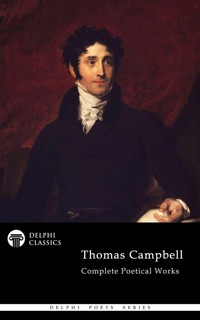
Campbell as a young man, by Sir Thomas Lawrence, c. 1800
Brief Introduction: Thomas Campbell
From ‘1911 Encyclopædia Britannica’, Volume 5
THOMAS CAMPBELL (1777-1844), Scottish poet, eighth son of Alexander Campbell, was born at Glasgow on the 27th of July 1777. His father, who was a cadet of the family of Campbell of Kirnan, Argyllshire, belonged to a Glasgow firm trading in Virginia, and lost his money in consequence of the American war. Campbell was educated at the grammar school and university of his native town. He won prizes for classics and for verse-writing, and the vacations he spent as a tutor in the western Highlands. His poem “Glenara” and the ballad of “Lord Ullin’s Daughter” owe their origin to a visit to Mull. In May 1797 he went to Edinburgh to attend lectures on law. He supported himself by private teaching and by writing, towards which he was helped by Dr Robert Anderson, the editor of the British Poets. Among his contemporaries in Edinburgh were Sir Walter Scott, Henry Brougham, Francis Jeffrey, Dr Thomas Brown, John Leyden and James Grahame. To these early days in Edinburgh may be referred “The Wounded Hussar,” “The Dirge of Wallace” and the “Epistle to Three Ladies.” In 1799, six months after the publication of the Lyrical Ballads of Wordsworth and Coleridge, The Pleasures of Hope was published. It is a rhetorical and didactic poem in the taste of his time, and owed much to the fact that it dealt with topics near to men’s hearts, with the French Revolution, the partition of Poland and with negro slavery. Its success was instantaneous, but Campbell was deficient in energy and perseverance and did not follow it up. He went abroad in June 1800 without any very definite aim, visited Klopstock at Hamburg, and made his way to Regensburg, which was taken by the French three days after his arrival. He found refuge in a Scottish monastery. Some of his best lyrics, “Hohenlinden,” “Ye Mariners of England” and “The Soldier’s Dream,” belong to his German tour. He spent the winter in Altona, where he met an Irish exile, Anthony McCann, whose history suggested “The Exile of Erin.” He had at that time the intention of writing an epic on Edinburgh to be entitled “The Queen of the North.” On the outbreak of war between Denmark and England he hurried home, the “Battle of the Baltic” being drafted soon after. At Edinburgh he was introduced to the first Lord Minto, who took him in the next year to London as occasional secretary. In June 1803 appeared a new edition of the Pleasures of Hope, which some lyrics were added.
In 1803 Campbell married his second cousin, Matilda Sinclair, and settled in London. He was well received in Whig society, especially at Holland House. His prospects, however, were slight when in 1805 he received a government pension of £200. In that year the Campbells removed to Sydenham. Campbell was at this time regularly employed on the Star newspaper, for which he translated the foreign news. In 1809 he published a narrative poem in the Spenserian stanza, “Gertrude of Wyoming,” with which were printed some of his best lyrics. He was slow and fastidious in composition, and the poem suffered from over-elaboration. Francis Jeffrey wrote to the author: “Your timidity or fastidiousness, or some other knavish quality, will not let you give your conceptions glowing, and bold, and powerful, as they present themselves; but you must chasten, and refine, and soften them, forsooth, till half their nature and grandeur is chiselled away from them. Believe me, the world will never know how truly you are a great and original poet till you venture to cast before it some of the rough pearls of your fancy.” In 1812 he delivered a series of lectures on poetry in London at the Royal Institution; and he was urged by Sir Walter Scott to become a candidate for the chair of literature at Edinburgh University. In 1814 he went to Paris, making there the acquaintance of the elder Schlegel, of Baron Cuvier and others. His pecuniary anxieties were relieved in 1815 by a legacy of £4000. He continued to occupy himself with his Specimens of the British Poets, the design of which had been projected years before. The work was published in 1819. It contains on the whole an admirable selection with short lives of the poets, and prefixed to it an essay on poetry containing much valuable criticism. In 1820 he accepted the editorship of the New Monthly Magazine, and in the same year made another tour in Germany. Four years later appeared his “Theodric”, a not very successful poem of domestic life. He took an active share in the foundation of the university of London, visiting Berlin to inquire into the German system of education, and making recommendations which were adopted by Lord Brougham. He was elected lord rector of Glasgow University three times (1826–1829). In the last election he had Sir Walter Scott for a rival. Campbell retired from the editorship of the New Monthly Magazine in 1830, and a year later made an unsuccessful venture with the Metropolitan Magazine. He had championed the cause of the Poles in The Pleasures of Hope, and the news of the capture of Warsaw by the Russians in 1831 affected him as if it had been the deepest of personal calamities. “Poland preys on my heart night and day,” he wrote in one of his letters, and his sympathy found a practical expression in the foundation in London of the Association of the Friends of Poland. In 1834 he travelled to Paris and Algiers, where he wrote his Letters from the South (printed 1837).
The small production of Campbell may be partly explained by his domestic calamities. His wife died in 1828. Of his two sons, one died in infancy and the other became insane. His own health suffered, and he gradually withdrew from public life. He died at Boulogne on the 15th of June 1844, and was buried in Westminster Abbey.
Thomas Campbell by John Henning, 1813
Thomas Reid by Henry Raeburn, 1796 – Campbell’s father was a close friend of Reid, after whom the poet was named. Thomas Reid (1710-1796) was a religiously trained Scottish philosopher best known for his philosophical method, his theory of perception, and its wide implications on epistemology.
In 1797 Campbell travelled to the University of Edinburgh to attend lectures on law. He continued to support himself as a tutor and through his writing, aided by Robert Anderson, the editor of the British Poets.
The first edition title page of Campbell’s first book, published in 1799, six months after the publication of Wordsworth and Coleridge’s ‘Lyrical Ballads’. ‘The Pleasures of Hope is a rhetorical and didactic poem in the taste of his time, owing much to the fact that it dealt with topics such as the French Revolution, the partition of Poland and slavery. Its success was instantaneous, but Campbell was slow to follow it up.
‘Massacre of Wyoming, July 3-4, 1778’ by Alonzo Chappel, 1858 — Campbell’s poem ‘Gertrude of Wyoming: A Pennsylvanian Tale’ (1809) is a romantic epic composed in Spenserian stanzas, written in the context of the Battle of Wyoming. Also known as the Wyoming Massacre, this was a military engagement during the American Revolutionary War between Patriot militia and a force of Loyalist soldiers and Iroquois warriors. The battle took place in the Wyoming Valley of Pennsylvania on 3 July 1778, in what is now Luzerne County. The result was an overwhelming defeat for the Americans.
‘The Battle of Hohenlinden’ by Henri Frédéric Schopin, 1836. The subject of another famous poem by Campbell, the Battle of Hohenlinden (situated 20 miles east of Munich) was fought on 3 December 1800 during the French Revolutionary Wars. A French army under Jean Victor Marie Moreau won a decisive victory over an Austrian and Bavarian force led by 18-year-old Archduke John of Austria. The allies were forced into a disastrous retreat that compelled them to request an armistice, effectively ending the War of the Second Coalition.
‘The Battle of Copenhagen, 2 April 1801’ by Nicholas Pocock, 1806 — the subject of Campbell’s famous 1801 poem ‘Battle of the Baltic’
The Royal Institution building on Albemarle Street, London, c. 1838 — in 1812 Campbell delivered a series of lectures on poetry in London at the Royal Institution; he was urged by Sir Walter Scott to become a candidate for the chair of literature at Edinburgh University.
Campbell took an active role in the foundation of University College London (originally known as London University), visiting Berlin to inquire into the German system of education, while making recommendations that were adopted by Lord Brougham.
Portrait of Sir Walter Scott by Thomas Lawrence, c. 1826 – Campbell’s close friend and supporter. In 1826 Campbell was elected Lord Rector of Glasgow University in competition against Scott.
Thomas Campbell by Thomas Clement Thompson, 1847
Complete Poetical Works of Thomas Campbell
CONTENTS
PREFATORY MEMOIR.
JUVENILIA
FROM ANACREON
LINES ON HIS SISTER MARY
LINES ON SUMMER
DESCRIPTION OF PRIZE-DAY (MAY 1ST) IN GLASGOW COLLEGE
LINES ON THE GLASGOW VOLUNTEERS,
VERSES ON MARIE ANTOINETTE
ON THE ORIGIN OF EVIL
ODE TO MUSIC
ELEGY
PART OF CHORUS FROM BUCHANAN’S TRAGEDY OF ‘JEPHTHES’
A FAREWELL TO EDINBURGH
LINES ON LEAVING THE RIVER CART
THE PLEASURES OF HOPE.
PART I.
ANALYSIS OF PART I.
PLEASURES OF HOPE. PART I.
THE PLEASURES OF HOPE. PART II.
ANALYSIS OF PART II
PLEASURES OF HOPE. PART II.
GERTRUDE OF WYOMING.
ADVERTISEMENT.
GERTRUDE OF WYOMING. PART I.
GERTRUDE OF WYOMING. PART II.
GERTRUDE OF WYOMING. PART III.
O’CONNOR’S CHILD; OR, THE “FLOWER OF LOVE LIES BLEEDING.”
O’CONNOR’S CHILD
THEODRIC; A DOMESTIC TALE.
THEODRIC.
LOCHIEL’S WARNING.
LOCHIEL’S WARNING.66
MISCELLANEOUS POEMS.
BATTLE OF THE BALTIC.
YE MARINERS OF ENGLAND: A NAVAL ODE.
TO THE RAINBOW.
THE LAST MAN.
VALEDICTORY STANZAS TO J. P. KEMBLE, ESQ. COMPOSED FOR A PUBLIC MEETING, HELD JUNE, 1817.
A DREAM.
LINES WRITTEN AT THE REQUEST OF THE HIGHLAND SOCIETY IN LONDON, WHEN MET TO COMMEMORATE THE 21ST OF MARCH, THE DAY OF VICTORY IN EGYPT.
STANZAS TO THE MEMORY OF THE SPANISH PATRIOTS LATEST KILLED IN RESISTING THE REGENCY AND THE DUKE OF ANGOULEME.
SONG OF THE GREEKS.
ODE TO WINTER.
LINES SPOKEN BY MR. * * *, AT DRURY-LANE THEATRE, ON THE FIRST OPENING OF THE HOUSE AFTER THE DEATH OF THE PRINCESS CHARLOTTE, 1817.
LINES ON THE GRAVE OF A SUICIDE.
THE TURKISH LADY.
THE WOUNDED HUSSAR.
LINES INSCRIBED ON THE MONUMENT LATELY FINISHED BY MR. CHANTREY
THE BRAVE ROLAND.72
THE SPECTRE BOAT. A BALLAD.
THE LOVER TO HIS MISTRESS ON HER BIRTH-DAY.
HOHENLINDEN.
GLENARA.
LINES ON RECEIVING A SEAL WITH THE CAMPBELL CREST, FROM K. M ——, BEFORE HER MARRIAGE.
GILDEROY.
ADELGITHA.
ABSENCE.
THE RITTER BANN.
THE HARPER.
SONG TO THE EVENING STAR.
SONG. “MEN OF ENGLAND.”
THE MAID’S REMONSTRANCE.
SONG. DRINK YE TO HER THAT EACH LOVES BEST
SONG. WHEN NAPOLEON WAS FLYING.
THE BEECH-TREE’S PETITION.
SONG. EARL MARCH LOOKED ON HIS DYING CHILD
LOVE AND MADNESS. AN ELEGY. WRITTEN IN 1795.
SONG. OH, HOW HARD IT IS TO FIND
STANZAS ON THE THREATENED INVASION 1803.
EXILE OF ERIN.77
LORD ULLIN’S DAUGHTER.
ODE TO THE MEMORY OF BURNS.
THE SOLDIER’S DREAM.
LINES WRITTEN ON VISITING A SCENE IN ARGYLESHIRE.
SPANISH PATRIOT’S SONG.
VERSES ON MARIE ANTOINETTE.84
DIRGE OF WALLACE.
JEMIMA, ROSE, AND ELEANORE; THREE CELEBRATED SCOTTISH BEAUTIES.
THE DEATH-BOAT OF HELIGOLAND
SONG. WHEN LOVE CAME FIRST TO EARTH
LINES ON THE DEPARTURE OF EMIGRANTS FOR NEW SOUTH WALES.
FAREWELL TO LOVE.
LINES ON A PICTURE OF A GIRL IN THE ATTITUDE OF PRAYER, BY THE ARTIST GRUSE, IN THE POSSESSION OF LADY STEPNEY.
STANZAS ON THE BATTLE OF NAVARINO.
LINES ON LEAVING A SCENE IN BAVARIA.
STANZAS TO PAINTING.
DRINKING-SONG OF MUNICH.
LINES ON REVISITING A SCOTTISH RIVER.
LINES ON REVISITING CATHCART.
THE “NAME UNKNOWN;” IN IMITATION OF KLOPSTOCK.
SONG. WITHDRAW NOT YET THOSE LIPS AND FINGERS
HALLOWED GROUND.
CAROLINE.
TO THE EVENING STAR.
FIELD FLOWERS.
LINES ON THE VIEW FROM ST. LEONARD’S.
LINES ON POLAND.
LINES ON THE CAMP HILL, NEAR HASTINGS.
LINES WRITTEN IN A BLANK LEAF OF LA PEROUSE’S VOYAGES.
THE POWER OF RUSSIA.
REULLURA.90
ODE TO THE GERMANS.
FLORINE.97
TRANSLATIONS.
SONG OF HYBRIAS THE CRETAN.
FRAGMENT FROM THE GREEK OF ALCMAN.
MARTIAL ELEGY FROM THE GREEK OF TYRTÆUS.
SPECIMENS OF TRANSLATION FROM “MEDEA.”
SPEECH OF THE CHORUS IN THE SAME TRAGEDY, TO DISSUADE MEDEA FROM HER PURPOSE OF PUTTING HER CHILDREN TO DEATH, AND FLYING FOR PROTECTION TO ATHENS.
THE PILGRIM OF GLENCOE.98
NOTES.
NOTES TO THE PLEASURES OF HOPE.
NOTES TO GERTRUDE OF WYOMING.
NOTES TO O’CONNOR’S CHILD.
NOTES TO THEODRIC.
NOTES TO LOCHIEL.
PREFATORY MEMOIR.
THOMAS CAMPBELLWASborn in Glasgow, July 27, 1777. He was of good family, his father being the youngest son of a Highland laird, Campbell of Kirnan, who could trace his descent from Gilespie le Camile, first Norman lord of Lochawe. As was (and is) usual with the younger sons of Scottish families of rank, Campbell’s father was destined for a commercial career. He commenced it in Virginia, where he entered into partnership with a kinsman, and returning with him to Scotland, carried on the business in Glasgow, till the wars between Great Britain and her American Colonies for a time seriously injured British commerce. After incurring severe losses he at length gave up business altogether, and retired into private life with diminished means and a large family.
Thomas, the poet, was the youngest of eleven children, and was born after his father had retired. At eight years of age he was sent to the Grammar School of Glasgow, and became the pupil of David Alison, who soon detected the infant genius of his pupil. The boy worked hard for his years, but his health was delicate, and, like Walter Scott, he had to be sent away for the benefit of country air. Amidst the fields and green lanes he regained health and strength, and returning to his studies made rapid progress, especially in Greek. At twelve years old, he gained prizes for his translations from the Greek poets.
In 1793 Campbell commenced the study of the law in the office of his relative Mr. Alexander Campbell, a Writer to the Signet, of Glasgow; but he soon abandoned it, and again devoted himself to more congenial pursuits. About this time his Lines on Marie Antoinette appeared in the poet’s corner of a Glasgow paper; he had already won a prize for his poem On Description from the University.
In 1795 the failure of a Chancery suit still further reduced his father’s income, and Campbell, eager to reduce the family expenses, sought and obtained a tutorship in the family of a Mrs. Campbell of Sunipol, in the Hebrides, for the summer months. The romantic beauty of his new home strongly impressed the youthful poet, and it was whilst wandering on the wild lonely shores of Mull, that the subject of his celebrated poem the Pleasures of Hope was suggested to him by his friend Mr. Hamilton Paul. A rock on the isle, on which he often sat and mused, obtained and still keeps the name of the “Poet’s Seat.”
In the autumn Campbell returned to his studies at the University, and finally closed his academic career by winning two prizes — one for the Choephorcæ of Aristophanes, and the other for the Chorus in the Medea of Euripides.
After quitting the University, he again became a tutor — this time in the family of General Napier, who was greatly interested in the gifted young man beneath his roof. It was during this residence in Argyleshire that he wrote Love and Madness, and some other poems.
In 1798 the poet proceeded to Edinburgh, determined to try his fortune in the Scottish metropolis. He had an introduction to Dr. Robert Anderson, who, struck with his ability, recommended him to Mr. Mundell, the publisher. Mr. Mundell at once gave him literary work, his first task being to compile an abridgment of Bryan Edward’s West Indies. He also obtained pupils, and thus managed to secure a comfortable livelihood. But by degrees the love of poetry grew too strong for this routine of industry, and he gradually devoted himself to the composition of the Pleasures of Hope. Campbell’s life at this time must have been a very happy one. He was enraptured with his task, and he had many and kind friends in Edinburgh — amongst them was Francis (afterwards Lord) Jeffrey. To his aunt Mrs. Campbell, and to his beautiful cousin Margaret, who resided in Edinburgh, he used to read his verses, and was cheered and encouraged by their applause.
When the poem was finished, Dr. Anderson took it to Mr. Mundell, who, after some consideration, offered the poet £60 for it, an offer which was accepted.
The poem appeared, and Campbell at once became famous. Everywhere it was read and admired, and it secured to the Author a permanent reputation at the age of twenty-one. The Pleasures of Hope went through four editions in a year. In the second edition several new and remarkably fine passages were introduced.
In 1800 Campbell left Scotland in order to visit Germany. He landed at Hamburg; and proceeded, after a short residence there, to Ratisbon, which he reached only three days before the French took it, and was, consequently, obliged to seek a refuge with the monks of the Benedictine College; from the walls of which he beheld a cavalry charge made by the German horse on the French under Grenier. The scenes of war through which it was now his fate to pass, no doubt suggested his fine lyric of Hohenlinden, though he was not a spectator of the fight (Dr. Beattie tells us) — it occurred after he had left the scene of war.
The times were now so troubled that Campbell hastened homeward, the moment he could obtain his passports. At Hamburg, where he remained for a while, he wrote the Exile of Erin. From Hamburg he proceeded to Altona, and thence to England. During his absence he had sent several small poems to the Morning Chronicle, and on his return he was received and welcomed cordially by its editor, Mr. Perry, who introduced him to the best literary society in London. But from the natural enjoyment of his popularity he was called by the tidings of his father’s death, and he hurried at once to Edinburgh. Here he found that an absurd charge of treason had been made against him, which, however, his own prompt and manly demand of an investigation of his conduct at once quashed. Moreover, his trunk, which had been seized on its way homewards, was examined, and amongst his papers was found the glorious national lyric, Ye Mariners of England, which he had written at Altona. The patriotic feeling displayed in it at once assured the Sheriff of Edinburgh of the poet’s innocence of the crime with which he was charged, and the affair ended in the young poet’s character being entirely cleared.
From the period of his father’s death it became Campbell’s duty to provide in a great measure for his widowed mother and his sister, and he worked bravely and patiently for them at literary task-work.
In 1801 he visited London at Lord Minto’s invitation, and passed a season of great gaiety in the midst of the literary celebrities of England. On his return to Edinburgh he published Lochiel, and Hohenlinden, and brought out the seventh edition of the Pleasures of Hope.
In 1802 Campbell married his cousin, Miss Matilda Sinclair, and went shortly afterwards to reside at Sydenham, then a lovely and rather aristocratic place, — where his memory was long cherished, and his dwelling is even now pointed out to strangers.
Here he supported by his literary labour his mother, his wife, and children; and was occupied and happy. He contributed to the Philosophical Magazine, the Star paper, and planned his Specimens of the British Poets.
In 1805 Campbell received a pension of £200 from the Crown, which must have greatly relieved the anxieties of a husband and father dependent on so precarious a profession as literature. But he retained only half for himself; the remainder he divided between his mother and sister; an act of generosity which afterwards, we are told, led to his receiving a handsome legacy of nearly £5,000 from a Highland cousin.
In 1809 Gertrude of Wyoming, Lord Ullin’s Daughter, and The Battle of the Baltic were published. Several prose works also appeared from Campbell’s pen; in 1807, the Annals of Great Britain from the Accession of George III. to the Peace of Amiens, was published anonymously in Edinburgh. He wrote also a Life of Petrarch in 1841, and edited numerous works. In 1818, the long-planned Specimens of the British Poets was produced in London. After this publication, Campbell delivered lectures at the Surrey Institution on English Poetry, and the public pronounced him to be as elegant a critic as he was a fine poet. In a pecuniary sense, everything he did prospered.
In 1824 Theodric was published, which, however, obtained small favour with the public. In fact a new style of poetry had superseded that of the day when the Pleasures of Hope won golden opinions; Scott had since charmed the ear with his Lay and his Lady of the Lake, and had been in turn supplanted by the fiery muse of Byron, and — though not then fully appreciated — the matchless melody and classic charm of Shelley. After the productions of these great poets, the calm and unimpassioned Theodric fell flat on the public ear; in fact there is no comparison between it and the Pleasures of Hope.
As a lyric poet, Campbell, however, continued unrivalled, and would have held his own place in our literature if he had never written more than the Mariners of England and Hohenlinden. Nor did the Pleasures of Hope lose its hold on public favour; it has retained it to this day, except in a certain clique of critics. There are passages in it which will ever have a strong hold on our sympathies; and which will be remembered when the half intelligible utterances of our more modern times shall only excite wonder and amusement.
In 1827 one of Campbell’s early day-dreams, that of being Lord Rector of his own University, was gratified. He was chosen, though no less a rival than Sir Walter Scott was in the field, and he filled the position so well, and so much to the benefit of the University, that he was re-elected the two following years.
In 1820 Colbourne offered him the editorship of the New Monthly Magazine, which he accepted and retained till 1830, at a salary of £500 per annum. His sub-editor — a very efficient one — was Mr. Cyrus Redding.
In 1831 Campbell brought out the Metropolitan Magazine, editing it himself.
Meantime much domestic affliction had fallen on him. He had lost a child, and his dear wife died in 1828, a loss which greatly affected him. But he made himself other strong interests besides domestic and literary ones. The Poles and the Greeks had enlisted his most ardent sympathies, and had the best aid of his pen. Moreover, he travelled in France and Germany, and in 1834 as far as Algiers, from whence he wrote the Letters from the South, published in the Metropolitan Magazine.
In 1838 he was presented to the Queen by the chief of his clan, the Duke of Argyle, at the first levee held by the fair young Sovereign after her accession to the throne. He had loyally offered her a present of his works; the Queen accepted them, and graciously sent him in return her picture. Campbell had been always a Liberal, but, like Leigh Hunt, he was won by the gentle lady who held the sceptre to sincere loyalty to the Crown.
Campbell moved to No. 8, Victoria Square, Pimlico, in 1840, and adopted, as the sharer of his solitary home, his niece, Mary Campbell, whose gentle ministrations soothed his declining years, and brightened the last hours of his life.
In 1842 The Pilgrim of Glencoe was published, but it was not well received, and the aged poet began to perceive that it was time to lay by his pen; that he spoke to a generation he could not charm. Nevertheless his age was honoured and prosperous. His works produced nearly £700 a year, and his means exceeded altogether £1000 per annum. But he fancied he should prefer a cheaper residence than London, and in compliance with the aged poet’s fancy, his niece accompanied him to Boulogne, where they settled, at 5, Rue Petit St. Jean.
Here he remained in a varying state of health till 1844, when he became seriously ill, and the physician, Dr. Allatt, gave no hopes of his recovery. His faithful and beloved friend, Dr. Beattie — by whom a charming memoir of the poet has been since published — came to him, and did his best to soothe the last moments of the dying poet.
His death-bed was truly Christian. Some of his last words were “Come, let us sing praises to Christ,” “Let us pray for one another.”
On the 15th of June 1844, his spirit passed calmly, without a struggle, to a better world.
The body of the poet was brought to England, and on the 3rd of July buried in Westminster Abbey, near the centre of the Poet’s Corner. His funeral was attended by numerous friends and admirers, amongst whom were his chief, the Duke of Argyle, and Sir Robert Peel, then premier.
Thus closed the life of one of the most popular poets of the beginning of our century. Prosperous in its public phase — very sad and sorely tried in its domestic one. He had refined taste and pleasing manners; and no reproach rests upon his private or public character. In his youth he was singularly beautiful in person. Leigh Hunt tells us (in his autobiography) that Campbell’s face and person were rather on a small scale, “his features regular, his eye lively and penetrating, and when he spoke, dimples played about his mouth, which, nevertheless, had something restrained and close in it. Some gentle Puritan seemed to have crossed the breed, and to have left a stamp on his face, such as we often see in the female Scotch face rather than the male.”
No poet, except Shakespeare, has been so frequently quoted as Campbell. Many of his lines have become proverbs:— “Coming events cast their shadows before,” “’Tis distance lends enchantment to the view,” &c. &c. are as familiar to us as household words. “His verses” says a writer in Chambers’s Papers for the People, “cannot be mistaken for those of any other English poet — his odes do not resemble those of Dryden, Collins, or Gray — they stand alone.... Scott said, ‘he could imitate all the modern poets but Tom Campbell,’ he could not imitate him because his peculiarity was more in the matter than the manner.” High praise this! Byron said that he believed Campbell wrote so little poetry because he was afraid of comparison with his early and famous poem: we have not the volume to quote the exact words. We are rather inclined to think that the true reason why he gave us no more poems than we possess at present was, not only that his taste was exceedingly refined and fastidious — he would not admit many charming minor poems into his collected works — but that, like Goldsmith, his time was much occupied by task-work for the publishers; and as he would not suffer hastily written lines to appear, or any which he had not carefully polished, the quantity he produced was necessarily small. We are told in Notes and Queries that he took some pains (returning to the house where he had written it for the purpose) to substitute a single word which he believed would be an improvement on another in his Stanzas to Florine! Consequently, his poems must have occupied time and thought beyond what we may imagine from their length, and his leisure could not have been great. It would have been better, perhaps, if more voluminous poets had imitated his reticence, and given us quality rather than quantity.
Campbell was a pleasant companion, and when he pleased could (we have Byron’s authority for it) talk delightfully; but he was occasionally absent and silent. His poetry is much admired by foreigners. Madame de Staël was enraptured with the Pleasures of Hope, and Goethe was a warm admirer of the Poet.
His domestic character was excellent, and his family sorrows — of which this is no place to speak — were borne by him with patient courage.
His Life, admirably given us by his friend Dr. Beattie, is well worth reading as a record of Genius, aided by patient perseverance, struggling with difficulties, and vanquishing them; and to it, for fuller and far more interesting details, we refer the readers of this brief Prefatory Memoir.
To this collection of his poems we have added his Lines on Marie Antoinette, the Dirge of Wallace, and one or two other poems, published in the New Monthly Magazine.
JUVENILIA
FROM ANACREON
I
(Written in 1788, the author being then 10 years of age)
IN sooth I’d with pleasure rehearseThe Atridae and Cadmus’s fame,If my lute would accord to my verseAnd sound aught but Venus’s name.
’Twas in vain that I changèd each stringTo alter its amorous tone,And began of Alcides to sing:My lute warbled Venus alone.
I therefore my strains must renewAnd accord to the lays of my lute;So, ye Heroes, for ever adieu!Love alone is the theme that can suit.
II
(Written in 1790)
Anacreon, the ladies sayYour pate is bald, your beard is gray!Take you a looking-glass — forsooth,You’ll find that what they say is truth.But whether it be truth or not,As little do I care as wot;But this I know— ’tis best to rimeThus o’er my jokes while suits the time.
LINES ON HIS SISTER MARY
(Written 1790, aet. 12)
LIVES there not now in Scotia’s landThe fairest of the female band?A maid adorned with every graceE’er known among the female race?Use all my aid, if that can tellHer praise and virtues that excel;No fiction here you will requireThe swelling note of praise to fire;But ah! her virtues to rehearseIs sure unequal for thy verse.Then, cease; but let resounding fameTell that Maria is her name.
LINES ON SUMMER
(Written in October, 1790, when the author was 13 years old)
A STRAIN sublime that now my breast inspires,Ye nymphs of Sicily! your aid requires...The iron age of winter, stern and dread,At length has hid his grisly baneful head;The golden age appears that Virgil sung,An age that well might claim his tuneful tongue.Unbidden flowers with bloom spontaneous grow,Wide spread the ivy for the poet’s brow,The modest lily and the full-blown roseAnd grander tulip all their sweets disclose;The feathered choir, that tune the song of love,Invite the muse’s fancy forth to rove.Now, now, ye bards! let every lyre be strung,Nor let a flower its sweets disclose unsung...’Tis true some poets, that unguarded sing,The Golden Age would fain ascribe to spring.For me, I see not how wits e’er so starchCould prove the beauties of the bleak-eyed March,Nor February clad in horrid snow,Nor April when the winds relentless blow...
DESCRIPTION OF PRIZE-DAY (MAY 1ST) IN GLASGOW COLLEGE
(Written in 1793, aet. 15; after a competition the prize for Elocution is awarded)
PHOEBUS has risen, and many a glittering rayDiffuses splendour o’er the auspicious day.This is the day — sure Nature well may smile — When present glory crowns forgotten toil,When honour lifts aloft the happy few,And laurelled worth attracts the wondering view.
The appointed hour that warns to meet is near;A mixed assemblage on the Green appear;Some in gay clubs, and some in pairs advance;An hundred busy tongues are heard at once....
At last the doors unfold: fast, fast withinCompacted numbers rush with bustling din...Now up the stairs ascend the jarring crew,And the long hall is opened to the view;There, on the left, the pulpit clad in green,And there the bench of dignity is seenWhere wisdom sits with equitable swayTo judge the important merits of the day.The doors are fastened; silence reigns within;Now, memorable day, thy joys begin...See yon bright store of volumes in a rowWhere gold and Turkey’s gayest colours glow!The first, the brightest, volume’s reared on high;Probando, prince of youths, is bid draw nigh;The youth draws nigh, and, hailed with loud applause,Receives the boon, and modestly withdraws....Tonillus next is summoned from the throng;His head light tosses as he moves along:No mean reward is his, — but why so vain?What means that strutting gait, that crested mane?Away with all thy light affected airs! — For honour vanishes when pride appears.The third gay glittering volume high is reared — Mysterious Jove! Plumbano’s name is heard!With lazy step the loiterer quits his place(While wonder gazes in each length of face),Accepts the gift with stinted scrape and nod,And slow returns with an unworthy load....Merit is brought to light, before unknown — Ah! merit truly, had it been his own!...
Thick pass the honoured victors of the day, — Ingenio shrewd, and Alacer the gay,Durando grave, Acerrimo the wit,Prof undo serious with his eyebrows knit.Countless they pass; applauded, each returns,While o’er his cheek the conscious pleasure burns.Meanwhile I see each one a joy impartTo some glad father’s, friend’s, or brother’s heart...
LINES ON THE GLASGOW VOLUNTEERS,
DAILY EXERCISING IN FULL UNIFORM ON THE COLLEGE-GREEN
(Written in 1793, aet. 15)
HARK! hark! the fife’s shrill notes arise,And ardour beats the martial drum,And broad the silken banner fliesWhere Clutha’s [the Clyde.] native squadrons come.
Where spreads the green extended plain,By music’s solemn marches trod,Thick-glancing bayonets mark the trainThat beat the meadow’s grassy sod.
These are no hireling sons of war,No jealous tyrant’s grimly band, — The wish of freedom to debarOr scourge a despot’s injured land!
Nought but the patriotic viewOf free-born valour ever firedTo baffle Gallia’s boastful crewThe soul of Northern breast inspired.
’Twas thus on Tiber’s sunny banks,What time the Volscian ravaged nigh,To mark afar her glittering ranksRome’s towering eagles shone on high.
There toil athletic on the field [Campus Martius.]In mock array portrayed alarm;And taught the massy sword to wield,And braced the nerve of Roman arm.
VERSES ON MARIE ANTOINETTE
THE QUEEN OF FRANCE
(Written in 1793)
BEHOLD where Gallia’s captive queenWith steady eye and look sereneIn life’s last awful — awful sceneSlow leaves her sad captivity.
Hark! the shrill horn that rends the skyBespeaks the ready murder nigh!The long parade of death I spy,And leave my lone captivity.
Farewell, ye mansions of despair,Scenes of my sad sequestered care;The balm of bleeding woe is near, — Adieu, my lone captivity!
To purer mansions in the skyFair Hope directs my grief-worn eye,Where sorrow’s child no more shall sighAmid her lone captivity.
Adieu, ye babes, whose infant bloomBeneath oppression’s lawless doomPines in the solitary gloomOf undeserved captivity!
O Power benign that rul’st on high,Cast down, cast down a pitying eye;Shed consolation from the skyTo soothe their sad captivity!
Now, virtue’s sure reward to prove,I seek empyreal realms aboveTo meet my long-departed love;Adieu, my lone captivity!
NOTE
[This juvenile effort, ‘inspired by the most atrocious event of the time,’ was composed in the end of 1793, when the poet was in his seventeenth year. It is notable as Campbell’s first attempt in a measure which ‘The Battle of Hohenlinden’ has made immortal.
ON THE ORIGIN OF EVIL
(PRIZE POEM, MAY, 1794)
PART I
WHILE Nature’s gifts appear a jarring strifeAnd evil balances the good in life,While varied scenes in man’s estate discloseDelusive pleasure mixed with surer woes,Bewildered reason in the dubious mazeOf human lot a feeble wanderer strays,Sees destined ills on virtue vent their force,Dash all her bliss, and wonders whence the source.Sure, Heaven is good; no farther proof we need — In nature’s page the doubtless text we read.Lo! at thy feet earth’s verdant carpet spread;Heaven’s azure vault o’ercanopies thy head;For thee the varied seasons grace the plain,The vernal floweret and the golden grain;For thee all-wise Beneficence on highBade day’s bright monarch lighten in the sky,And night’s pale chariot o’er the vault of blueWith silver wheels its silent path pursue.Yes, Heaven is good, the source of ample bliss:In spite of ills, creation teaches this.The simple, yet important, truth to spyWe need no Plato’s soul, no sage’s eye;A native faith each distant clime pervades,And sentiment the voice of reason aids.The shuddering tenant of the Arctic PoleAdores revolving suns that round him roll;No sceptic bosom doubts the hand of heaven;And, though misplaced, still adoration’s given.Search distant climates at the thirsty Une — There still devotion thanks a power divine;Still, though no Science treads on Libyan plains,The inborn gratitude to God remains;And shall the Soul, by Science taught to viewTruth more refined, call inborn faith untrue?No; should misfortune cloud thy latest daysStill view this truth through life’s perplexing maze;While Nature teaches — let not doubt intrude,But own with gratitude that God is good.
Yet whence, methinks, repining mortal cries,If Heaven be good, can human ill arise?Man’s feeble race what countless ills await!Ills self-created, ills ordained by fate!While yet warm youth the breast with passion firesHope whispers joy, and promised bliss inspires, — In dazzling colours future life arrays,And many a fond ideal scene displays.The sanguine zealot promised good pursues,Nor finds that wish but still the chase renews:Still lured by hope he wheels the giddy roundAnd grasps a phantom never to be found.Too soon the partial bliss of youth is flown,Nor future bliss nor hope itself is known;No more ideal prospects charm the breast,Life stands in dread reality confessed — A mingled scene of aggravated woesWhere pride and passion every curse disclose!
Cease, erring man! nor arrogant presumeTo blame thy lot or Heaven’s unerring doom!He who thy being gave, in skill divineSaw what was best, and bade that best be thine.But count thy wants, and all thine evils name — Still He that bade them be is free from blame.Tell all the imperfections of thy state — The wrongs of man to man — the wrongs of fate:Still reason’s voice shall justify them all,And bid complaint to resignation fall.
If Heaven be blamed that imperfection’s thine,As just to blame that man is not divine.Of all the tribes that fill this earthly schemeThy sphere is highest, and thy gifts supreme.Of mental gifts, intelligence is given;Conscience is thine, to point the will of Heaven;The spur of action, passions are assigned;And fancy — parent of the soul refined.’Tis true thy reason’s progress is but slow,And passion, if misguided, tends to woe;’Tis true thy gifts are finite in extent — What then? can nought that’s finite give content?Leave then, proud man, this scene of earthly chance;Aspire to spheres supreme, and be a god at once!
No! you reply; superior powers I claim,Though not perfection or a sphere supreme;In reason more exalted let me shine;The lion’s strength, the fox’s art be mine,The bull’s firm chest, the steed’s superior grace,The stag’s transcendent swiftness in the chase.Say, why were these denied if Heaven be kindAnd full content to human lot assigned?The reason’s simple: in the breast of manTo soar still upward dwells the eternal plan, — A wish innate, and kindly placed by Heaven,That man may rise through means already given.Aspiring thus to mend the ills of fate,To find new bliss and cure the human state,In varied souls its varied shapes appear:Here fans desire of wealth; of honour there;Here urges Newton nature to explore,And promises delight by knowing more;And there in Caesar lightens up the flameTo mount the pinnacle of human fame.In spite of fate it fires the active mind,Keeps man alive, and serves the use assigned;Without it none would urge a favourite bent,And man were useless but for discontent!Seek not perfection, then, of higher kind,Since man is perfect in the state assigned;Nor, perfect as probation can allow,Accuse thy lot although imperfect now.
PART II
But grant that man is justly frail below,Still imperfection is not all our woe.If final good be God’s eternal plan,Why is the power of ill bestowed on man?Why is revenge an inborn passion found?And why the means to spread that passion round?Whence in man’s breast the constant wish we findThat tends to work the ruin of his kind?Whence flows the ambition of a Caesar’s soul,Or Sylla’s wish to ravage and control?Whence, monster vice! originates thy course?Art thou from God? is purity thy source? No! let not blasphemy that cause pursue!A simpler source in man himself we view.If man, endowed with freedom, basely act,Can such from blameless purity detract?An ample liberty of choice is given;Man chooses ill; — and where the fault of Heaven?Say not the human heart is prone to sin — Virtue by nature reigns as strong within;The passions, if perverted, tend to woe — What then? did God perversion, too, bestow?No! blame thyself if guilt distract thy lot;Man may be virtuous — Heaven forbids it not.Blind as thou art in this imperfect state,Still conscious virtue might support thy fate;Give reason strength thy passions to control — Vice is not inborn: drive it from thy soul!Yet you reply — Though ample freedom’s mine,The fault of evil still is half divine:If Heaven foresaw that, from the scope of choice,Perversion, vice, and misery should rise,Why then on man, if prone to good, bestowThe possibility of working woe?Ask not— ’tis answered: arrogantly blindTo scan the secrets of the eternal Mind, — If Heaven be just, then reason tells us this,That man by merit must secure his bliss.Cease, then, with evil to upbraid the skies:That to the vice of mortals owes its rise.Is God to blame if man’s inhuman heartDeny the boon that pity should impart?If patriots to brutality should changeAnd grasp the lawless dagger of revenge?If frantic murderers mingle from afarTo palliate carnage by the name of war?If pampered pride disdain a sufferer’s fateAnd spurn imploring misery from her gate?No! Heaven hath placed compassion in the breast;The means are given, and ours is all the rest. But what, to ease thy sorrow, shall availFor human lot the misanthropic wail?Since all complain, and all are vicious, too,Each hates the vile pursuit, but all pursue, — Let actions then, and not complaints, prevail!Let each his part withdraw — the whole shall fail.
PART III
Yet, grant that error must result from choice,Still man has ills besides the ills of vice — Griefs unforeseen, disease’s pallid train,And death, sad refuge from a world of pain!Disastrous ills each element attend,And certain woes with every blessing blend.Lo! where the stream in quivering silver plays!There slippery fate upon its verge betrays.Yon sun, that feebly gilds the western sky,In warmer climes bids and nature die.Disgusted virtue quits her injured reign, — Vice comes apace, and folly leads her train.But not alone, if blissful all thy lot,Were vice pursued and gratitude forgot.Defects still further in the scheme we view,Since virtue, willing, scarce could men pursue.Say, if each mortal were completely blest,Where could the power of aiding woe exist?If at the gate no suppliant sufferer standCould e’er compassion stretch her liberal hand?Did never winter chill the freezing wasteCould kindness e’er invite the shuddering guest?Which boots, if good the changeless lot of man,The philanthropic wish, the patriot’s plan?Or what could goodness do? Nought else, ’tis plain,But rage to bridle, passion to restrain — A virtue negative, scarce worth the name,Far from the due reward that generous actions claim!Still less the scope of fortitude we find,Were pain dismissed and fortune ever kind.The path of merit, then, let ills be viewed,And own their power, if virtue be thy good.Nor on that scheme let lawless wishes run,Where vice had all her scope and virtue none;But rest contented with thy Maker’s planWho ills ordained as means of good to man.Nor, midst complaints of hardship, be forgotThe mingled pleasures of thy daily lot.
What though the transient gusts of sorrow come,Though passion vex, or penury benumb?Still bliss, sufficient to thy hope, is givenTo warm thy heart with gratitude to Heaven;Still mortal reason darts sufficient dayTo guide thy steps through life’s perplexing way;Still conscience tells— ’tis all we need to know — Virtue to seek and vice to shun below.Hear, then, the warnings of her solemn voice,And seek the plaudit of a virtuous choice.
NOTE
[Campbell was within a few months of completing his seventeenth year when he composed this ‘Essay on the Origin of Evil’.
It was ‘given in as an exercise in the Moral Philosophy class (taught by Prof. Arthur), April 25, 1794.’ It shows, with a few phrases from Goldsmith, greater indebtedness to Pope; and, indeed, it was mainly this essay that procured for him the honour of being called ‘the Pope of Glasgow.’
‘It gave me,’ he says, ‘a local celebrity throughout all Glasgow, from the High Churchdown to the bottom of the Saltmarket. It was even talked of, as I am credibly informed, by the students over their oysters at Luckie MacAlpine’s in the Trongate!’]
ODE TO MUSIC
(Written in 1794, aet. 16)
ALL-POWERFUL charmer of the soul,Each mood of fancy formed to please, — To bid the wave of passion roll,Or tune the languid breast to ease, — Come, in thy native garb arrayed,And pour the sweetly simple song,And all the poet’s breast pervadeAnd guide the fluent verse along.
What time the moon with silver beamShall sparkle on the light-blue lake, — And hope with sympathetic gleamAnd silent pleasure shall awake, — Then, as thy quivering notes resoundFrom lively pipe and mellow horn,And quick-paced marches breathe around,Shrill thro’ the ringing valleys borne, — Then, swelled with every winding tone,Tumultuous shall my heart rebound,And ardour o’er my bosom thrownShall kindle at the rising sound! —
Or oft at evening’s closing hourWhen deeper purple dyes the cloud,When fancy haunts the silent bower,And pensive thoughts the bosom crowd, — What time the softening zephyr fliesMy notes shall aid the gentle themeThat lonely meditation tries,And grateful soothe her placid dream.Then let the mellow warbling fluteIn slow sad numbers pour the song ——
ELEGY
(Written in Mull, June, 1795)
THE tempest blackens on the dusky moor,And billows lash the long-resounding shore;In pensive mood I roam the desert groundAnd vainly sigh for scenes no longer found.Oh, whither fled the pleasurable hoursThat chased each care and fired the muse’s powers;The classic haunts of youth for ever gay,Where mirth and friendship cheered the close of day;The well-known valleys where I wont to roam,The native sports, the nameless joys of home?
Far different scenes allure my wondering eye — The white wave foaming to the distant sky,The cloudy heavens unblest by summer’s smile,The sounding storm that sweeps the rugged isle,The chill bleak summit of eternal snow,The wide wild glen, the pathless plains below,The dark blue rocks in barren grandeur piled,The cuckoo sighing to the pensive wild!‘Far different these from all that charmed before’ — The grassy banks of Clutha’s winding shore,Her sloping vales with waving forests lined,Her smooth blue lakes unruffled by the wind.Hail, happy Clutha! glad shall I surveyThy gilded turrets from the distant way;Thy sight shall cheer the weary traveller’s toil,And joy shall hail me to my native soil.
NOTE
LINE 19. The quoted line is from The Deserted Village.
PART OF CHORUS FROM BUCHANAN’S TRAGEDY OF ‘JEPHTHES’
(Translated from the Latin in 1796)
GLASSY Jordan, smooth meanderingJacob’s flowery meads between,Lo! thy waters, gently wandering,Lave the valleys rich and green.
When the winter, keenly showering,Strips fair Salem’s holy shade,There thy current, broader pouring,Lingers in the leafless glade....
When shall freedom, holy charmer,Cheer my long-benighted soul? — When shall Israel, fierce in armour,Burst the tyrant’s base control?...
Gallant nation! nought appalled you,Bold in Heaven’s propitious hour,When the voice of freedom called youFrom a tyrant’s haughty power;
When their chariots, clad in thunder,Swept the ground in long array;When the ocean, burst asunder,Hovered o’er your sandy way.
Whither fled, O altered nation!Whither fled that generous soul?Dead to freedom’s inspiration,Slaves of Ammon’s base control!
God of heaven! whose voice commandingBids the whirlwind scour the deep — Or the waters, smooth expanding,Robed in glassy radiance, sleep —...
Grasp, O God! thy flaming thunder;Launch thy stormy wrath around!Cleave their battlements asunder,Shake their cities to the ground!
Hast thou dared in mad resistance,Tyrant, to contend with God?Shall not Heaven’s supreme assistanceSnatch us from thy mortal rod?...
Mark the battle, mark the ruin!Havoc loads the groaning plain!Ruthless vengeance, keen pursuing,Grasps thee in her iron chain!
A FAREWELL TO EDINBURGH
(Written 1797)
FAREWELL, Edina, pleasing name,Congenial to my heart!A joyous guest to thee I came,And mournful I depart.And fare thee well whose blessings seemHeaven’s blessing to portend — Endeared by nature and esteem,My sister and my friend.
LINES ON LEAVING THE RIVER CART
(Written 1798)
O SCENES of my childhood, and dear to my heart,Ye green-waving woods on the banks of the Cart!How oft in the morning of life I have strayedBy the stream of the vale and the grass-covered glade!Then, then, every rapture was young and sincere,Ere the sunshine of life had been dimmed by a tear;And a sweeter delight every scene seemed to lend — That the mansion of peace was the home of a friend.Now’ the scenes of my childhood, and dear to my heart,All pensive I visit, and sigh to depart;Their flowers seem to languish, their beauty to cease,For a stranger inhabits the mansion of peace!But hushed be the sigh that untimely complainsWhile friendship with all its enchantment remains — While it blooms like the flower of a winterless clime,Untainted by change, unabated by time!
THE PLEASURES OF HOPE.
PART I.
ANALYSIS OF PART I.
THE POEMOPENSwith a comparison between the beauty of remote objects in a landscape, and those ideal scenes of felicity which the imagination delights to contemplate... the influence of anticipation upon the other passions is next delineated... an allusion is made to the well-known fiction in Pagan tradition, that, when all the guardian deities of mankind abandoned the world, Hope alone was left behind... the consolations of this passion in situations of distress... the seaman on his watch... the soldier marching into battle... allusion to the interesting adventures of Byron.
The inspiration of Hope, as it actuates the efforts of genius, whether in the department of science, or of taste... domestic felicity, how intimately connected with views of future happiness... picture of a mother watching her infant when asleep... pictures of the prisoner, the maniac, and the wanderer.
From the consolations of individual misery, a transition is made to prospects of political improvement in the future state of society... the wide field that is yet open for the progress of humanising arts among uncivilised nations... from these views of amelioration of society, and the extension of liberty and truth over despotic and barbarous countries, by a melancholy contrast of ideas, we are led to reflect upon the hard fate of a brave people recently conspicuous in their struggles for independence1... description of the capture of Warsaw, of the last contest of the oppressors and the oppressed, and the massacre of the Polish patriots at the bridge of Prague... apostrophe to the self-interested enemies of human improvement... the wrongs of Africa... the barbarous policy of Europeans in India... prophecy in the Hindoo mythology of the expected descent of the Deity to redress the miseries of their race, and to take vengeance on the violators of justice and mercy.
ENDNOTES
1 The Poles. This Poem first appeared in 1799.
PLEASURES OF HOPE. PART I.
At summer eve, when Heaven’s ethereal bow Spans with bright arch the glittering hills below, Why to yon mountain turns the musing eye, Whose sunbright summit mingles with the sky? Why do those cliffs of shadowy tint appear More sweet than all the landscape smiling near? — ’Tis distance lends enchantment to the view, And robes the mountain in its azure hue. Thus, with delight we linger to survey The promised joys of life’s unmeasured way; Thus, from afar, each dim-discovered scene More pleasing seems than all the past hath been; And every form, that Fancy can repair From dark oblivion, glows divinely there.
What potent spirit guides the raptured eye To pierce the shades of dim futurity? Can Wisdom lend, with all her heavenly power, The pledge of Joy’s anticipated hour? Ah, no! she darkly sees the fate of man — Her dim horizon bounded to a span; Or, if she hold an image to the view, ’Tis Nature pictured too severely true. With thee, sweet HOPE! resides the heavenly light, That pours remotest rapture on the sight: Thine is the charm of life’s bewildered way, That calls each slumbering passion into play. Waked by thy touch, I see the sister band, On tiptoe watching, start at thy command, And fly where’er thy mandate bids them steer, To Pleasure’s path, or Glory’s bright career.
Primeval HOPE, the Aönian Muses say, When Man and Nature mourned their first decay; When every form of death, and every woe, Shot from malignant stars to earth below, When Murder bared her arm, and rampant War Yoked the red dragons of her iron car, When Peace and Mercy, banished from the plain, Sprung on the viewless winds to heaven again; All all forsook the friendless guilty mind, But HOPE, the charmer, lingered still behind.
Thus, while Elijah’s burning wheels prepare From Carmel’s heights to sweep the fields of air.2 The prophet’s mantle, ere his flight began, Dropt on the world — a sacred gift to man.
Auspicious HOPE! in thy sweet garden grow Wreaths for each toil, a charm for every woe; Won by their sweets, in Nature’s languid hour, The way-worn pilgrim seeks thy summer bower; There, as the wild bee murmurs on the wing, What peaceful dreams thy handmaid spirits bring! What viewless forms the Æolian organ play, And sweep the furrowed lines of anxious thought away.
Angel of life! thy glittering wings explore Earth’s loneliest bounds, and Ocean’s wildest shore. Lo! to the wintry winds the pilot yields His bark careering o’er unfathomed fields; Now on Atlantic waves he rides afar, Where Andes, giant of the western star, With meteor-standard to the winds unfurled, Looks from his throne of clouds o’er half the world!
Now far he sweeps, where scarce a summer smiles, On Behring’s rocks, or Greenland’s naked isles: Cold on his midnight watch the breezes blow, From wastes that slumber in eternal snow; And waft, across the wave’s tumultuous roar, The wolf’s long howl from Oonalaska’s shore.
Poor child of danger, nursling of the storm, Sad are the woes that wreck thy manly form! Rocks, waves, and winds, the shattered bark delay; Thy heart is sad, thy home is far away.
But HOPE can here her moonlight vigils keep, And sing to charm the spirit of the deep: Swift as yon streamer lights the starry pole, Her visions warm the watchman’s pensive soul; His native hills that rise in happier climes, The grot that heard his song of other times, His cottage home, his bark of slender sail, His glassy lake, and broomwood-blossomed vale, Rush on his thought; he sweeps before the wind, Treads the loved shore he sighed to leave behind; Meets at each step a friend’s familiar face, And flies at last to Helen’s long embrace; Wipes from her cheek the rapture-speaking tear, And clasps, with many a sigh, his children dear! While, long neglected, but at length caressed, His faithful dog salutes the smiling guest, Points to the master’s eyes (where’er they roam) His wistful face, and whines a welcome home.
Friend of the brave! in peril’s darkest hour, Intrepid Virtue looks to thee for power;




