


23,99 €
Mehr erfahren.
- Herausgeber: John Wiley & Sons
- Kategorie: Wissenschaft und neue Technologien
- Sprache: Englisch
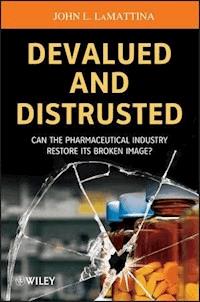
An expert's view on solving the challenges confronting today's pharmaceutical industry Author John LaMattina, a thirty-year veteran of the pharmaceutical industry and former president of Pfizer's Global R&D Division, is internationally recognized as an expert on the pharmaceutical industry. His first book, Drug Truths: Dispelling the Myths About Pharma R&D, was critically acclaimed for clearing up misconceptions about the pharmaceutical industry and providing an honest account of the contributions of pharmaceutical research and development to human health and well-being. As he toured the country discussing Drug Truths, Dr. LaMattina regularly came across people who were filled with anger, accusing the pharmaceutical industry of making up diseases, hiding dangerous side effects, and more. This book was written in response to that experience, critically examining public perceptions and industry realities. Starting with "4 Secrets that Drug Companies Don't Want You to Know," Devalued and Distrusted provides a fact-based account of how the pharmaceutical industry works and the challenges it faces. It addresses such critical issues as: * Why pharmaceutical R&D productivity has declined * Where pharmaceutical companies need to invest their resources * What can be done to solve core health challenges, including cancer, diabetes, and neurodegenerative diseases * How the pharmaceutical industry can regain public trust and resuscitate its image Our understanding of human health and disease grows daily; however, converting science into medicine is increasingly challenging. Reading Devalued and Distrusted, you'll not only gain a greater appreciation of those challenges, but also the role that the pharmaceutical industry currently plays and can play in solving those challenges. Get to know the author: Read an interview with John LaMattina or watch a video on ChemistryViews! href="http://www.chemistryviews.org/details/ezine/4286441/John_LaMattina_30_Years_in_Pharma.html">Interview: John LaMattina: 30 Years in Pharma href="http://www.chemistryviews.org/details/video/4498851/Can_the_Pharmaceutical_Industry_Restore_its_Broken_Image.html">Video: Can the Pharmaceutical Industry Restory its Broken Image?
Sie lesen das E-Book in den Legimi-Apps auf:
Seitenzahl: 302
Veröffentlichungsjahr: 2012
Ähnliche

















Table of Contents
Cover
Title page
Copyright page
Dedication
Acknowledgments
Introduction
Chapter 1 The Four Secrets The Drug Companies Don’t Want You To Know
Drug Companies Underestimate Dangerous Side Effects
Drug Companies Control Much of the Information Your Doctor Gets
You’re Often Prescribed Drugs That You Don’t Need
Drugs Target the Symptoms, Not the Cause
Conclusion
References
Chapter 2 What Has Happened to R&D Productivity?
Impact of Mergers on R&D Productivity
Heightened FDA Requirements for NDAs
Higher Hurdles Set by Payers
Conclusion
References
Chapter 3 Key Therapeutic Areas For Improving Health
Cancer
Diseases of the Brain
Cardiovascular Disease (CVD)
Diabetes
Bacterial Infections
Conclusion
References
Chapter 4 Improving R&D Output
The Views of Others
Personal Views
Conclusion
References
Chapter 5 Restoring Pharma’s Image
Illegal Detailing of Drugs
Pharmaceutical Companies Should Drop TV Ads
The Need for Greater Transparency
How Committed Is Big Pharma to Rare Diseases?
Pharmaceutical Companies and Philanthropy
Pharma Needs to Have Its Scientists Tell Their Stories
Conclusion
References
Chapter 6 Final Thoughts
References
Index
All trademarks are property of their respective owners. Lipitor® is a registered trademark of Pfizer Ireland Pharmaceuticals. Chantix®, Viagra®, Zoloft®, and Norvasc® are registered trademarks of Pfizer, Inc.
Copyright © 2013 by John Wiley & Sons, Inc. All rights reserved
Published by John Wiley & Sons, Inc., Hoboken, New Jersey
Published simultaneously in Canada
No part of this publication may be reproduced, stored in a retrieval system, or transmitted in any form or by any means, electronic, mechanical, photocopying, recording, scanning, or otherwise, except as permitted under Section 107 or 108 of the 1976 United States Copyright Act, without either the prior written permission of the Publisher, or authorization through payment of the appropriate per-copy fee to the Copyright Clearance Center, Inc., 222 Rosewood Drive, Danvers, MA 01923, (978) 750-8400, fax (978) 750-4470, or on the web at www.copyright.com. Requests to the Publisher for permission should be addressed to the Permissions Department, John Wiley & Sons, Inc., 111 River Street, Hoboken, NJ 07030, (201) 748-6011, fax (201) 748-6008, or online at http://www.wiley.com/go/permissions.
Limit of Liability/Disclaimer of Warranty: While the publisher and author have used their best efforts in preparing this book, they make no representations or warranties with respect to the accuracy or completeness of the contents of this book and specifically disclaim any implied warranties of merchantability or fitness for a particular purpose. No warranty may be created or extended by sales representatives or written sales materials. The advice and strategies contained herein may not be suitable for your situation. You should consult with a professional where appropriate. Neither the publisher nor author shall be liable for any loss of profit or any other commercial damages, including but not limited to special, incidental, consequential, or other damages.
For general information on our other products and services or for technical support, please contact our Customer Care Department within the United States at (800) 762-2974, outside the United States at (317) 572-3993 or fax (317) 572-4002.
Wiley also publishes its books in a variety of electronic formats. Some content that appears in print may not be available in electronic formats. For more information about Wiley products, visit our web site at www.wiley.com.
Library of Congress Cataloging-in-Publication Data:
LaMattina, John L.
Devalued and distrusted : can the pharmaceutical industry restore its broken image? / John L. LaMattina, PhD.
pages cm
Includes index.
ISBN 978-1-118-48747-1 (pbk.)
1. Pharmaceutical industry–Corrupt practices. I. Title.
HD9665.5.L36 2013
338.4'76151–dc23
2012032915
For Ryer Patrick LaMattina
Acknowledgments
I am particularly indebted to the scientists around the world whose dedication, insights, and acumen produced the important medicines discussed in this book. Many lives have been saved and extended by their efforts. They all deserve our respect and admiration.
I would like to thank a few people for their advice and encouragement during the preparation of this book: David LaMattina and Mary LaMattina for their guidance on key issues; Stephen Lederer and Justin McCarthy for their insightful editorial comments; and Donna Green, who pulled it all together.
J.L.
Introduction
“Hello, my name is Rosalyn Menon. I am a producer of The Dr. Oz Show. I was wondering if you’d be interested in appearing on an upcoming show.”
Rosalyn’s phone call took me by surprise. Her interest in me stemmed from the fact that I had written a book a few years earlier called Drug Truths—Dispelling the Myths About Pharma R&D. I had written Drug Truths after retiring from Pfizer, where I had worked for over 30 years and had been the President of Pfizer’s Global R&D Division. Drug Truths was written out of the frustration I had over the misperceptions about the drug industry, particularly concerning the lack of understanding that most people have regarding the value that pharmaceutical R&D brings to the health of people around the world. I had a vague familiarity with the show and understood it to be one that tried to educate the public on medical matters.
Rosalyn was now giving me an opportunity to help bring my message to the followers of Dr. Oz. She asked if I’d be willing to appear on the show to talk about issues that I addressed in Drug Truths: the safety of new drugs, the accusation that the pharmaceutical company invents diseases, that people are overmedicated, and so on. She told me that Dr. John Abramson, author of Overdosed America, would also appear. Abramson is known as a harsh critic of the pharmaceutical industry, and the opportunity to be able to debate him on some of these points appealed to me. So, I agreed to do the show.
About 40 hours later, I was at the NBC studios at Rockefeller Center for the beginning of a unique and challenging experience. I was placed in a Green Room (yes, it’s really green!) and was able to watch (on a monitor) preparations for the taping of the show, which would air three weeks later. Parts of what I observed were amusing. The audience, which was already seated, was asked to display various emotions that the show’s director would later insert into the segment. On cue, the audience was asked to laugh, express disapproval, or even gasp in horror, thereby dashing my perceptions that the audience reactions seen on talk shows are spontaneous.
My amusement faded pretty quickly as I walked onto the stage of The Dr. Oz Show. I was stunned to see the backdrop—a huge banner that read: “The Four Secrets that Drug Companies Don’t Want You to Know”! In my naiveté, I never thought to ask Rosalyn for the title of my segment. I quickly realized that the balanced debate I had expected was going to be tilted. Things got worse with the announcer’s opening statement:
It was seen as a miracle solution. The cure to obesity in a tiny pill. . . . But inside this pill could be a nightmare in disguise, linked to severe liver disease, acute pancreatic damage, and kidney stones.
The drug was orlistat, sold as either Xenical by prescription or Alli over the counter. Orlistat acts by inhibiting fat absorption from the intestine. That sounds pretty good, but here are the consequences: Fat that you eat doesn’t get absorbed but rather gets excreted directly, resulting in foul-smelling stools, diarrhea, and “anal leakage.” Orlistat can cause modest weight loss, but these toleration issues mean it’s a drug many people avoid. But what about the “nightmare” side effects? In 2010, the FDA announced that they had found 13 cases of severe liver damage, one in the United States with Alli and 12 foreign reports with Xenical, over the period of April 1999 to August 2009. It was estimated that over this timeframe, over 40 million people took orlistat. Dr. Oz mentioned this number later in the show, but by then the seeds had already been sown with the audience: Drug companies make unsafe compounds and try to hide the danger of these medicines from consumers. There were two people in the audience who were taking orlistat. Dr. Oz asked them what they thought of this new information, and they expressed shock that they had been prescribed such an unsafe drug. I wonder what they would have thought if Dr. Oz told them that acetaminophen, the active ingredient of Tylenol, is potentially far more harmful to the liver than orlistat?
It was clear from watching the faces of the audience over the next half-hour that they didn’t buy my explanations of what pharmaceutical companies do to ensure the safety and efficacy of new medicines. Their view, simply, was that drug companies are out to make money at the expense of the unsuspecting public. This assumption is a major problem facing the pharmaceutical industry today. But the problem runs far deeper than that.
As I walked off the stage after the taping, an angry woman came up to me and said: “The pharmaceutical industry killed my daughter.”
I was stunned. I felt as if I had been punched in my gut. I tried to express my sorrow, but she abruptly turned and walked away. This woman suffered an unfathomable loss. I cannot think of anything more tragic than losing a child. Yet, I had no idea what caused her daughter’s death. Did her daughter suffer a rare, unforeseen, severe adverse drug reaction? Was the drug improperly administered? How could such a horrible thing happen? Regardless of how this happened, such a loss of life is both dreadful and unintentional. The goal of anyone in pharmaceutical R&D is to alleviate pain and suffering, not cause it. Unfortunately, this woman will never believe that. I fear that many share her views.
This negative view of the pharmaceutical industry is a major problem. But it is not the only one. The industry is also being assailed for the perception that its R&D engines are broken and perhaps unfixable. Furthermore, there seems to be no shortage of “experts” with solutions on how to fix the problem. Unfortunately, many of the proposals are shockingly naïve and without merit. Yet, there are medical needs in diseases like Alzheimer’s, diabetes, mental illness, and so on, that are crying out for new drugs and where the pharmaceutical companies can add tremendous value in finding new treatments.
This book critically examines public perceptions and industry realities. Starting with “Dr. Oz’s Four Secrets,” it addresses the progress the industry has made in improving its abilities to measure both risk and benefits of its new medicines. It then tackles the issue of R&D productivity: What are the reasons for the drop-off and is it temporary or permanent? Next, where should the industry invest its R&D resources? Of the multitude of solutions being offered to fix R&D, what suggestions are of value and how should a company proceed in the difficult business climate that it is now facing? Finally, how can the industry rehabilitate its image?
We are in the midst of a period when medical science has unprecedented opportunities thanks to the knowledge being generated by the Human Genome Project and other profound advances in knowledge. The pharmaceutical industry can play an important role in converting a good deal of this knowledge into new medicines. There isn’t one of us who wouldn’t benefit from its success. But the pharmaceutical industry is facing an uphill battle in capitalizing on this knowledge. Converting science into medicines is increasingly challenging. Patients, physicians, regulators, and payers need a more accurate appreciation of these challenges plus the value that pharmaceutical R&D adds to society. Without that understanding, the pharmaceutical industry risks being isolated from these groups. That separation could destroy innovation and deprive us all of new and better therapies.
Chapter 1
The Four Secrets The Drug Companies Don’t Want You To Know
Pretending to care about our health is often just a part of the drug and other medical industries’ overall strategy to increase their sales.
—Dr. John Abramson, Overdosed America
A comic strip entitled “Off the Mark” (written by Mark Parisi) depicted the following: The Tin Man comes upon Dorothy and the Cowardly Lion in the woods. At their feet are the remains of the Scarecrow. Dorothy, who, along with the Lion, is eating the last bits of straw, says to the horrified Tin Man: “Dr. Oz said to eat more whole wheat. . . .”
Admittedly, this cartoon takes the influence of Dr. Oz to the extreme. But its premise is not too far from the truth. Dr. Oz has become America’s physician. He has the endorsement of Oprah Winfrey and his own daily show (twice a day in some markets!). In 2011, he won two Daytime Emmy awards, one for best informative talk show and the other for best talk-show host. His show on average is watched by over 4 million people each day. He is clearly beloved by his followers. He is better known and, when it comes to dispensing medical advice, he is more influential than the US Surgeon General (Dr. Regina Benjamin at the time of this writing).
Lesen Sie weiter in der vollständigen Ausgabe!
Lesen Sie weiter in der vollständigen Ausgabe!
Lesen Sie weiter in der vollständigen Ausgabe!
Lesen Sie weiter in der vollständigen Ausgabe!
Lesen Sie weiter in der vollständigen Ausgabe!
Lesen Sie weiter in der vollständigen Ausgabe!




