


3,49 €
Mehr erfahren.
- Herausgeber: David De Angelis
- Kategorie: Ratgeber
- Sprache: Englisch
INDEX
Preface
Introduction
Chapter I
THE "ZERO POINT" AND OUR CONDITIONINGS
The "zero point" and our conditionings
The Philosopher and the Architect
The universal "grand design
Appearance and reality
Animate and inanimate
Bioplasmic energy
How is the "reserve" formed?
Know how to administer
A moment of reflection
Our travel companions: plants
A few examples
A walk in the fields
Feeding minerals
Overview of the premises
Chapter II
MEN, NOT ANIMALS
Myth and strength
Golden Silence
Mechanisms
A priceless treasure
Us and others
Facing ourselves
Tools of the trade
The turning point
Chapter III
EVERYTHING HAS CHANGED
What happened when...
The point of the situation
The watch balance
This is how bamboo teaches us
Watch out for sounds and colors
The silent weapon
The right environment
The yellow friend and the white enemy
Chapter IV
PREVIEW TECHNIQUE
How should we adjust
The whole process in operation
More help
Chapter V
CONCLUSION
OUR 12 RULES OF CONDUCT
Das E-Book können Sie in Legimi-Apps oder einer beliebigen App lesen, die das folgende Format unterstützen:
Veröffentlichungsjahr: 2022
Ähnliche

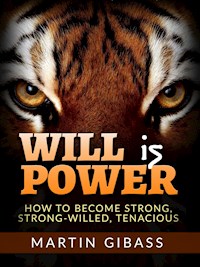














DEVELOP YOUR POWERS
TO ENHANCE THE PERSONALITY
Martin Gibass
Translation and 2022 edition by ©David De Angelis
All rights reserved
INDEX
Preface
Introduction
Chapter I
THE "ZERO POINT" AND OUR CONDITIONINGS
The "zero point" and our conditionings
The Philosopher and the Architect
The universal "grand design
Appearance and reality
Animate and inanimate
Bioplasmic energy
How is the "reserve" formed?
Know how to administer
A moment of reflection
Our travel companions: plants
A few examples
A walk in the fields
Feeding minerals
Overview of the premises
Chapter II
MEN, NOT ANIMALS
Myth and strength
Golden Silence
Mechanisms
A priceless treasure
Us and others
Facing ourselves
Tools of the trade
The turning point
Chapter III
EVERYTHING HAS CHANGED
What happened when...
The point of the situation
The watch balance
This is how bamboo teaches us
Watch out for sounds and colors
The silent weapon
The right environment
The yellow friend and the white enemy
Chapter IV
PREVIEW TECHNIQUE
How should we adjust
The whole process in operation
More help
Chapter V
CONCLUSION
OUR 12 RULES OF CONDUCT
PREFACE
Enhance
Knowing everything about Bantu, for us practical men (professionals, workers, traders, employees) is of absolutely no use, while it is of great use to us to know the "rules of the game" of this chaotic society of ours, beset by the problem of achieving something (or much) more than just our daily bread. Each one of us has been endowed by mother nature with merits and defects (unfortunately) and even the most gifted individual is such because this is how others in his environment recognize him, according to the way of thinking of the environment itself: in fact, it is an individual who has been able to transmit to others the best of himself, hiding his own defects in order to enhance and express only his good qualities.
To do this, it is necessary to identify these qualities, and once identified it is necessary to "put them out there" so that others can see and appreciate them: in other words, it is a question of exploiting them. The problem differs from one individual to another, because dividing humanity into males and females is obviously not enough and it is necessary to dig deeper to see how these men and women act and why they react in one way rather than another when faced with the same situation and in the set of circumstances that life presents.
A first consideration is suggested by the fact that there are three types of people: those who are balanced (their "sympathetic" nervous system is in balance with the "vagus") are very few, while the vast majority has an imbalance between the two systems. So we have those who get up early in the morning, are in a good mood, work hard and eat well. The "sympathetic" prevails in him and is discharged with the passing of the hours, until in the evening he only aspires to lie down, to rest to "recharge". The "vagotonic", on the other hand, behaves in the opposite way, would never get up, is ill-disposed, listless and only during the course of the day acquires liveliness and in the evening, when the other is tired, is in full force and ready for any form of activity.
This is a scientifically proven reality and we are interested in it because it directly affects the problem of the choice of life, work and interests on which we will build the realization of ourselves. We cannot ignore it, on the contrary, we must support it if we want to avoid disappointment and damage, even serious. But, although important, it is not the only reality we have to face, because there are also "the others" with their needs and willing to do anything to keep their 37 degrees of heat to live.
Thus was born this volume in which we address the solution of a specific personal problem in order to achieve what nature has given us, to all, as a right, that is, a better life.
INTRODUCTION
Reasons for an investigation
The best introduction to our work is constituted by the witty dedication that the writer Eugenio Nus prefixed to the book "Things of the Other World": To the memory of the patented, licensed, graduated, decorated and buried scientists, who have rejected the rotation of the earth, galvanism, blood circulation, vaccination, the undulation of light... the locomotive, gas lighting, magnetism and the rest, to those, living and future, who are doing the same thing right now or will do it in the future.
Clearly, a preconceived skepticism is at least as ridiculous as an equally preconceived gullible optimism. What is needed, therefore, is a panoramic view of what has been observed, ascertained, and proven, not only, but also of what originated it or what can be derived from it.
Let's start, therefore, from some basic considerations: 1) When it was believed that the sun revolved around the earth, in the sky it was exactly the opposite, as it has been noticed: Natural laws, since always, follow their course regardless of what we may think, but the fact of interpreting them in a way rather than another has radically changed the attitude of man allowing him, among other things, to reach the moon, the first step towards further, predictable achievements of greater scope; 2) This "first step" has required studies that have enriched us with new experiences with the birth of technologies for new materials and better use of those already existing, but above all has allowed us to better understand the relationship with the universe in which we live. This has resulted in a "total" open-mindedness, that is, a global vision of causes and effects without interruption, which is why it is clear that we need to insert ourselves in a "right" way in the system we are part of, if we do not want to be rejected, with all the consequences of the case; 3) It is good, therefore, to be aware of what happens around us, but it is equally important to know what happens, as a reflection, in ourselves, because, as part of a whole to which we belong, we must know "how" the exchange of actions-reactions with the outside world takes place in order to adjust accordingly. The human being, in fact, is no longer considered simply an organism with five senses, but a mechanism (so to speak) much more complex, as is the same planet earth considered in the variety and the whole of its components.
Chapter ITHE "ZERO POINT" AND OUR CONDITIONINGS
The "zero point" and our conditioning.
Let's start by establishing a precise starting point (we will call it "zero point", at the moment), of established validity. It is to consider that the individual, the man, comes into the world without his knowledge and without his knowledge he will die: woe if he were aware of it, his life would be ruined. Moreover, his essential vital functions, such as breathing, blood circulation, digestion, periodic cycles, etc. are automatic, a perfect biological clock regulated by mother nature, like the restorative sleep without which we could not survive. Paradoxically, we live because...we sleep.
Conditioned as we are, we have no reason to put on airs, and this is why the proud become ridiculous, while the man of value is humble: he knows that no one is great in an absolute sense, but it is simply the others who are smaller. Yet, in his "smallness", man is, in the context of nature, a marvelous creature and if he does not perceive the idea of it, it is because everything contributes to distracting him from himself: work and social conventions leave him little time, the mass organization flattens him. So he sticks to what he was taught at school and is content to know that he is made up of a number of organs, each of which functions in a certain way. It escapes him the concept that the individual is not only the whole of various parts, but this "whole" is something more (and different) than the union of the individual components. This "more" is constituted by bioplasm, an individual within an individual, which we will reach after a tour of the horizon to collect the various pieces of the mosaic that we intend to compose in order to focus on the most important points. A question, therefore, of information.
In this regard it is good to remember what Albert Einstein said a few decades ago, that the great revolution of the twentieth century will not be constituted by the atomic mushroom, but by information technology. The great scientist meant by "revolution" not so much the explosion of information means, but rather the balance between advantages and dangers presented by their evolution. Radio, television, newspapers, magazines more or less specialized, etc.. divulge day after day an enormous amount of news and notions, the most disparate, even from the point of view of the receptive capacity of those who perceive them, so as to constitute a tangle difficult to untangle and, therefore, cause of confusion: a disorder that joins the worries for the daily bread bringing us more or less unconsciously to exhaustion. It is the malaise of modern civilization, the fatigue of living.
At this point we bring in two characters, a psychoanalyst and an eclectic scholar interested in all fields of knowledge.




