


2,73 €
Mehr erfahren.
- Herausgeber: Dragon Moon Press
- Kategorie: Fantasy und Science-Fiction
- Serie: The Life and Times of Dick Richards: Private
- Sprache: Englisch
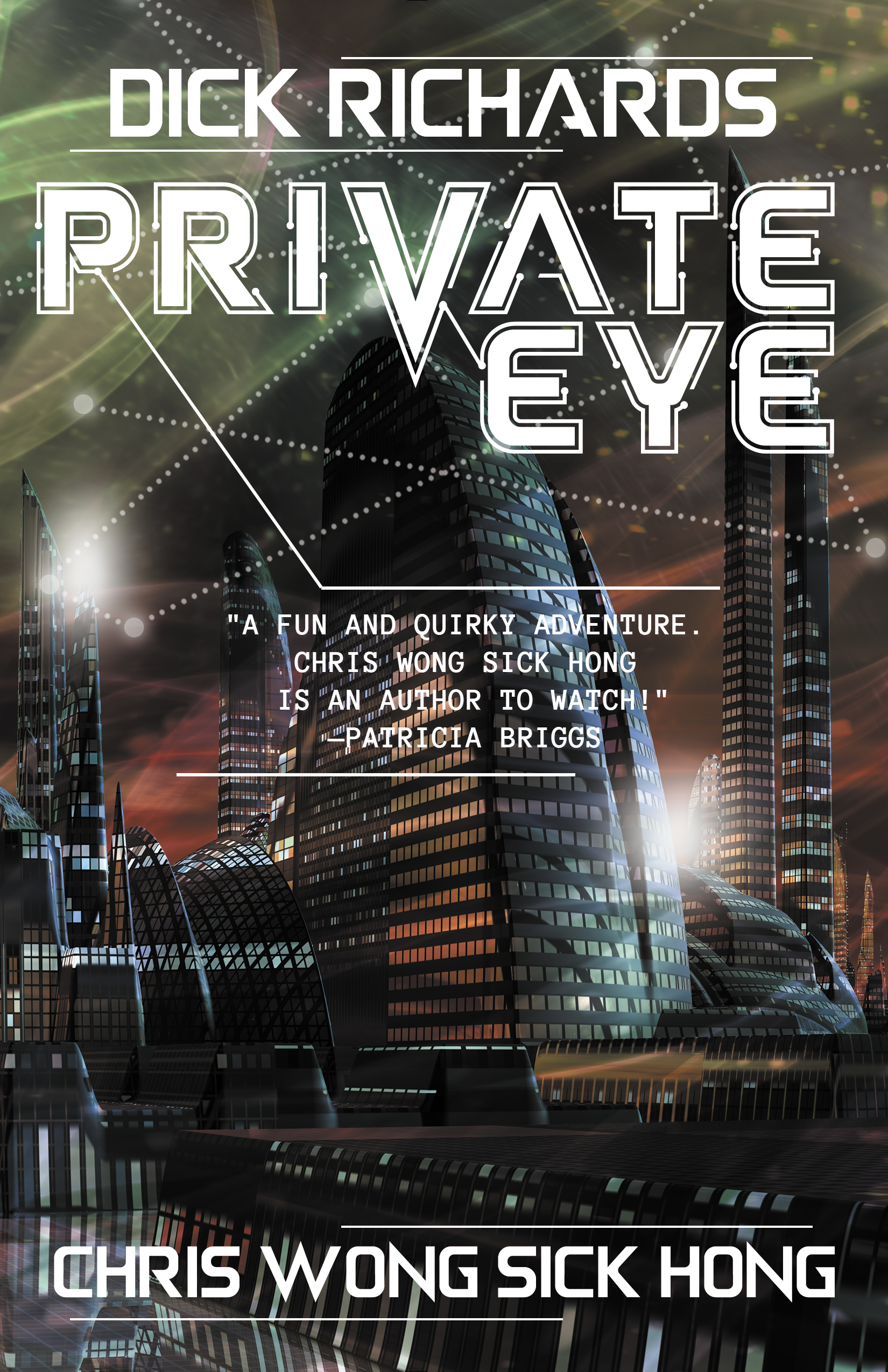
"A fun and quirky adventure. Chris Wong Sick Hong is an author to watch!" - Patricia Briggs
Does saving the world count if you do it out of spite?
They call me a dick because I am one: Dick Richards, Private Eye. Tour guides and politicians up for reelection crow about how Tipton’s “majestic skyscrapers paint a living mosaic of light against the edges of space,” blissfully ignorant of the Under seeping through society’s cracks like fluorescent mold.
Elves, dwarves, superheroes…everyone’s got secrets and what’s a little blackmail among associates? That’s just life. And while there isn’t enough cash in the universe to pay for knight-in-shining-armor suicide missions, there are lines. Tap dance across those—firebomb my apartment and kill my friends—and now it’s personal.
Some compare me to Harry Harrison’s Stainless Steel Rat or Jim Butcher’s Harry Dresden. An AI thinks I’m like Tom Rob Smith’s Child 44.
One Tom, one Dick, two-and-a-half Harrys.
The after-school special damn near writes itself.
But do you really need to be told what to think? Buy or don't. I don't have time to babysit.
____________________________________________________________
Join Dick Richards on his next adventure! The 2nd part of the series, Dick Richards: Planeswalker is now available as an ebook.
Readers' reviews
“Chris Wong Sick Hong knows his craft well and strikes a daring pose with DICK RICHARDS, PRIVATE EYE. Entertaining, informed and informing, humor and action driven, this Noir Cyberpunk adventure is sure to thrill and entertain. With tinges of Harrison’s Stainless Steel Rat and Gibson’s Burning Chrome, DICK RICHARDS forges a unique alloy of fantasy, magic, and science into an engaging and entertaining story.” - Kevin Noel Olson, author of TOCSIN CODEX
"This is such a fun, quirky book. So many authors do the noir style badly, but Chris absolutely nails it. In a futuristic world that's like Blade Runner with elves, a jaded private detective gets drawn into a case that becomes increasingly dangerous...and increasingly personal." - 5 star review on Goodreads
"I loved this book from start to finish. The world is engaging, the characters are colorful and interesting. The plot is engaging and dynamic. If you are a fan of the sci-fi genre, this is a great book to read." - 5 star review on Amazon
"I definitely recommend this to anyone looking for a fresh take on the traditional detective/mystery story." - 4 star review on Amazon
Das E-Book können Sie in Legimi-Apps oder einer beliebigen App lesen, die das folgende Format unterstützen:
Seitenzahl: 431
Veröffentlichungsjahr: 2017
Ähnliche

















Dick Richards:
Private Eye
Chris Wong Sick Hong
Dick Richards: Private Eye
Copyright © 2012 Chris Wong Sick Hong
All rights reserved. Reproduction or utilization of this work in any form, by any means now known or hereinafter invented, including, but not limited to, xerography, photocopying and recording, and in any known storage and retrieval system, is forbidden without permission from the copyright holder.
www.dragonmoonpress.com
This is a work of fiction. Names, characters, places, and incidents are the products of the author’s imagination or are used fictitiously and are not to be construed as real. Any resemblance to actual events, locales, organizations, or persons, living or dead, is entirely coincidental.
Acknowledgements
To Dragon Moon Press for taking a chance on a first-time author.
Gabrielle for her editorial acumen and inexplicable approval of some jokes I was certain would be redacted.
Maggie and Kevin for their help regarding the non-writing side of writing.
Jeff, whom I still haven’t met for lunch. I haven’t forgotten, but, well, schedules.
Andrea and Patti for their feedback, as well as Justin and MisCon. That’s where the rabbit hole opened up wide enough for me to squeeze through.
Dedication
To my wife, Joyce, who endured all the jokes that didn’t make it in here. I don’t know anyone else who would have been as patient. I love you.
Chapter 1
They call me a dick because I am one: Dick Richards, Private Eye. Though there’s more than a little truth to it, at least I’m less of a jerk than this guy:
“The issue,” Count Fantabuloso says, leaning closer across the table between us, “is armament not of my issue.” He’s mastered that tone of voice that makes you feel stupid for asking a reasonable question, or in this case simply making conversation. I’ve been working with him long enough that I should probably expect it, but it still stings.
If you didn’t know the man, you’d laugh. Outlandish hat complete with wide brim and ridiculous feather, baby-blue alligator suit, indoor sunglasses rimmed with diamonds—his dress sense would put any pimp to shame, and he likes it that way. It makes people underestimate him. They don’t see the man in the opera cloak as a threat until it’s too late. This, along with his intelligence and ruthlessness, was how he became Tipton’s sole magical weapons dealer. If a dwarf in Tipton wants to brain a goblin, he gets his runic shotgun from the Count. If an elf needs components for a magical poison, she gets them from the Count. And if a troll thug looking to go up in the world even thinks about increasing its arsenal, it first gets permission to have that thought from the Count.
That’s why he’s concerned. One of his lieutenants, the Baron Marcus, recently found a handgun in a Dumpster. Count Fantabuloso keeps meticulous records so he knows it isn’t his. He doesn’t know where it comes from either, which is where I come in.
He nods and the Baron Marcus, who’s been hovering nearby, places the gun on the table in front of me. Beyond him several esquires, grunts in the Count’s organization, maintain a cordon of privacy.
You might wonder why I work for a guy like this at all, but while he’s very much a warlord, he qualifies as an enlightened one. Since he’d supply both sides in any war, with careful accounting and the persuasive application of force he can shut troublemakers down cold. In his own words: “Peace is a fool’s dream; tranquility learned.” The Count honestly thinks people will eventually become tame enough to think twice about violence. I doubt it will work in the long run, but I can’t argue with his results so far. If weapons start freely streaming into Tipton, the delicate balance of power the Count has carefully cultivated will topple like a fat man with one leg. Millennia-old racial tensions, hanging in the air like gunpowder, will explode the first time someone fires a warning shot. All in all, he’s a lot better than the other assholes I could be working for.
I glance at the gun, then take down specifics in my field notebook. When. Where. How. The Count doesn’t have much info, but it sounds like someone dumped it to avoid getting caught. I don’t know why the Baron Marcus was snooping around in Dumpsters, but I don’t ask. Everyone has their reasons and few are beautiful under close scrutiny.
“Please find this fool,” the Count concludes, “so I can beat him like an MMA poseur wannabe.” He brandishes his omnipresent Differance Stick, a heavy-duty cane topped with a brass knob. A small plaque on the side reads, “Martin Luther King, Jr. High School. Making a Differance Since 1831.” The feather in his hat—long, bright green, and hopefully fake—wobbles in agreement. I’d hate to meet the bird it came from.
After checking the safety, I tuck the handgun under my right armpit, into the spare holster Raven insisted I wear today. It feels reassuringly heavy in my hand, but there’ll be time to inspect it in more detail later. My favorite sidearm, a business gift from the Count, is stashed under my left.
Our business concluded, I excuse myself and make my way past the cordon of esquires. Tharaveir, the owner of this fine establishment, is making a rare appearance behind the counter, checking the till and scowling daggers at the Count. While the Pub, as it’s called, gains a certain cachet from being the Count’s favorite watering hole, whenever the Count actually shows up most patrons are too scared to stick around. With his gaunt, almost hollow cheeks and aquiline features, not to mention his five-foot-eight stature, it’s not hard to make Tharaveir as elven, but there’s more than the normal amount of casual menace leering from his blue eyes. He’s managed to get kicked out of both Alfheim and Svartalfheim—the elven and dark elven homelands, respectively—and if he ever decides the Count is more trouble than he’s worth, the shit will shower down like an avalanche and the fan won’t have a chance. Tharaveir will never win, but he’ll never give up either.
I exit without incident and humanity explodes around me. Evergreen Court is only four stories tall, but the incessant squawking of specialty shops, restaurants, and ATMs, all clamoring for attention like hyperactive four-year-olds, is barely contained by the sound-absorbing foam embedded in the safety railings. A middle-aged man, in the slack-jawed, head-slightly-tilted posture that comes standard with vidscreen sunglasses, glides past on the moving walkway like a digital zombie. He’s far from the only one.
I shoulder myself into the tide of flesh, letting the walkway take me where I want to go. A “public service announcement” from a tattoo parlor informs me that the first five people to get a phoenix stenciled on their liver will win an all-expenses paid trip through the daytime talk show circuit, as if there aren’t enough attention whores already.
My next stop is an express elevator nearly filled to capacity. It smells faintly of deodorant. The corporate logos in the sound-absorbing carpet are worn flat and a kid lost in an e-book nearly elbows me in the stomach. It can be hard to tell whether those kind of moves are on purpose, but unspoken etiquette allows retaliatory knees to the junk. I don’t. Unspoken etiquette and legality are not the same. A panel near me displays the elevator’s maximum capacity and I stifle a sharp laugh. Every year, maximum occupancy goes down while maximum load goes up.
I take the Jennings Court exit and, a short walkway later, arrive at the entrance to my office. Or, more accurately, the entrance to my office complex, even though I’m the only tenant. Situated in a corporate red light district, it’s a modest beige door set into a beige wall. Self-help corporations, financial advisors, maid services, and the occasional franchised ethnic deli flaunt themselves around me, corporate whores all. Judging from the crowd gathered in the central open space, the guy in the hippo costume is about to make his annual bungee jump. It’s one of the more successful marketing promotions, and one year there was no one inside. When it hit the floor, the stuffed hippo costume exploded into coupons and vouchers to a shocked silence, and then applause. That was the year I stopped watching. I think about joining the tourists, but the odds of him getting caught in the cord are too low to make it worth my while.
I touch my door and the reactive film laminate shows a numeric keypad at eye level. I punch in the security code and the door slides aside. The narrow hallway beyond leads to six doors, three on each side, before dead-ending at a seventh. They’re all the deep, rounded red of convincingly fake wood, all sport decorative brass hinges, and each bears an inexpensive plaque with my name. The decoy doors also lead to offices, but those are trapped. Of everyone who’s tried to kill me, only one group has guessed the right door—the second on the left—on the first try, and they were as surprised as we were. The paranoia might seem like overkill, but word of mouth counts for a lot, and that word says anyone who wants to hire me presses “0” to leave a message at the outer door and waits for me to get back to them. Anyone else is probably trying to kill me. I could just move my office, true, but even though the Count pays extremely well, and even with the help of a black hat who owed me a favor, buying this much space was a hefty investment. I’m not letting it go unless absolutely necessary.
The inner door, as always, is locked. I trace a pattern on it with my finger and it swings outward.
I’m not sure why, other than her sense of humor, Raven’s office is decked out the way it is. Lightweight aluminum filing cabinets, stained a mottled brown, line the walls, but all they do is look impressive. There’s nothing inside and I don’t even know if they actually open. A ceiling fan with three blades turns slowly, churning air-conditioned air. Cheap blinds hang over two wide LED panels, filtering a dirty yellow light into the room. Raven’s desk, authentic wood from a certified, carbon-negative tree farm down in Ecuador, looms against the rear wall, its left end flush with the empty doorway to my office. For some reason, she thinks there’s still enough nature left to be worth saving.
I slide my field notebook, a thin brick with limited memory and an electrosensitive screen, into its holster in the armrest of my desk/chair. Stiffened fiber optic cables, woven into a surprisingly comfortable chair, sprout processing elements molded into arm- and headrests. A thin screen always hangs at just the right angle. The entire thing glints, beads of light moving through the cable like an ethereal ant farm, as the notebook copies itself to permanent storage. As usual, I almost forget that the stylus doesn’t stay with the notebook; it has its own slot where it can recharge.
I place the Count’s mystery gun on my table. It has a black surface, gridded with white lines, and I whip out my phone to take a few pictures of the gun from different angles. An app calculates its dimensions, distills a silhouette, and appends everything to the message I send Raven.
“You ever seen anything like this?” I say. The grip’s wooden, but the barrel is metal. There are no obvious markings, magical or otherwise, but no obvious seams either. The wood joins the metal perfectly, as if the two were grown together, and any magic capable of that usually leaves a physical trace, a sigil or at least a mark.
Raven’s head appears on the wall in front of me. Her hair is black with dark purple highlights, wound into a prim bun, and she’s wearing thick-rimmed emo glasses to match. My phone interfaces with my desk, and it’s projecting her response. Sophisticated algorithms, or so I’ve been told, filter out the background for her privacy.
“Nope,” she says. “What does it shoot?”
Biting back the urge to say people, I go with, “Haven’t checked yet. I wanted your general impression first.”
“Aww...how sweet,” is the reply. Her head morphs into a giant yellow smiley face.
I shake my head. Emoticons are back in fashion as retro kitsch, and of course Raven joined the bandwagon as soon as possible.
The face morphs back into her head, and her hair is now orange. It changes colors along with her mood, even in person, but her eyes always stay green.
I pick up the gun and pop the clip. Nine shaped-quartz rounds in a wicker magazine appear. There’s room for ten. I check the chamber. Empty. I snap pictures of the clip, then an individual bullet, and send them to Raven too. This gun is definitely odd.
Crystal rounds are typically the province of dwarves, but these show none of their trademark precision. The blunt ends still carry traces of the rock matrix they were hewn from and the facets, while they taper to a point, are ridged and glassy, like they’ve been chipped off or even melted. Plus, dwarves wouldn’t bother with wood. Living, or even once-living, things have an aura that interferes with their craftsmanship.
The metal barrel makes elves unlikely—their magic fails around iron and steel—but I can’t be sure it’s actually steel without testing. Silver can be hardened remarkably and elves love silver. (It’s shiny.) Still, there are none of the leafy decorations elves festoon absolutely everything with, like flower children deprived of Ritalin. The handgrip, while sporting a fetching two-tone effect, might as well be sanded smooth. That doesn’t leave many other factions with the technology to produce something like this.
“Dark elves?” Raven suggests. “They’ve picked up a lot of dwarven habits down there.”
“Maybe,” I say, but I hope not. Things turn vicious for absolutely no reason at all when dark elves are involved. Their glamour plugs gleefully into humanity’s bestial instincts. Thankfully, immigration agreements keep their numbers in check. If they’re making a move to change that, bloodshed will be unavoidable.
“Anyway,” Raven says, “I’ve got enough to start searching the databases. Oh, and btw,” she actually pronounces each letter, “David’s going to stop by later.” Her head morphs again into that yellow smiley face, which winks at me before dissolving.
Gee, thanks for letting me know, Raven. She really needs to stop giving David the code to the doors. I’ll be there to meet him anyway, but first I need to test-fire this thing and see what it can do.
#
Count Fantabuloso likes to spot check at least one weapon in each incoming shipment for quality, and one of the ranges built for this purpose hides behind the counter of Jimbo’s Porn-n-Pawn, down in the Sawyer district. The ones for field-testing rocket launchers and other heavy ordnance are a bit intimidating, to be honest—sleek, chrome deathtraps with unidentifiable dents and stains—but those are in sound-proofed warehouses surrounded by nightclubs. Most testing takes place after ten P.M. so no one notices a thing.
The Sawyer district itself is grungy and low-traffic. You almost always have elbow room and, in the quieter hours, you can almost stretch out your arms without hitting someone. The businesses here eschew advertising. When the signs themselves read “Five Dollar Store” or “Pawn Shop,” not much more needs to be said. The primary occupation in this area of Tipton is loitering, and the denizens are very good at what they do. Hundreds of impassive faces on five floors, perched on every available surface, swivel blankly like buzzards to watch me walk by. It’s a small fraction of the thousands here, but uncanny nonetheless.
The exterior windows of Jimbo’s Porn-n-Pawn, as well as those of Jimbo’s Foodie Mart next door, each bear a green sticker proclaiming official security protection, but grilled bars are still mounted just behind them for insurance. While the windows are security glass unbreakable by anything short of multiple .50-caliber rounds, the Count sees no reason to openly display his wealth. People have enough reasons to hate him already.
I open the door and the digital doorbell rings, an annoying techno remix of Beethoven’s Eighth. The current Jimbo—the Count swaps them out every three to four months—glances at me. There are no lines of sight or fire between the door and the black counter, but I see his head swivel in the hyperbolic mirror discreetly mounted near the ceiling. I head down an aisle filled with ancient video games and computer cables on the left and remaindered romance novels on the right. A short left later I come face to face with a very bored esquire.
Like every other esquire on duty, he wears the official street uniform. The full-length arms of a black, undermesh shirt project from an overstuffed coat whose sleeves have been ripped off. The coat lies open to display a black T-shirt with the Count’s logo, a fist over crossed lightning bolts in white outline. Black jeans and combat boots complete the ensemble, and the esquire looms among the bric-a-brac like an angry bull sent to the corner for bad behavior.
“What you want?” he says.
This one has made himself quite a nest behind the counter. A collapsible metal chair leans at an angle against a dusty, rolled-up rug. The front legs are propped atop a cooler and a thick stack of old magazines, respectively. A small dumbwaiter with a missing wheel is at just the right place and height for an armrest. He can kick back, relax with his elbow propped up, gangsta-style, and watch the antique CRT TV mounted in a pile of clothes, all while still technically keeping an eye on the door. He notices me glancing at his nest, looks me over, then glares as if daring me to say something. I don’t. He’s either good enough to pull it off or will be gone before too long.
“I have a test coming up,” I say.
He’s supposed to reply with “We don’t sell textbooks” and wait for my “Really. I must have been misinformed,” but he just reaches under the counter between us, pushes a hidden button, and a door set in the wall to my right glides silently aside. Compared to the shop’s shabby wallpaper, the metal walls in the corridor beyond gleam. I step between a power tools bin and a display case filled with musical instruments, through a softly hissing curtain of air, and the door slides shut behind me.
The Baron Rutgert, a skinny man around fifty-ish who looks extremely out of place whenever he goes to staff meetings, is in his office. Balding and bespectacled, he looks and acts like a college professor. I have no idea how he came to work for the Count, but he’s all right if you don’t mind the random jumps and pauses in his conversations. You’ll be talking and then an idea will strike him. Minutes will pass and he won’t even realize he’s stopped talking.
He’s in charge of R&D and his office has every kind of electronics known to man, all of them linked together in nearly every way known to man. He doesn’t have a desk because he doesn’t need one. Projectors in his glasses display anything he calls for as he rolls around on his chair. On four wide counters, thinfilm displays alternate with processing stations, and in the center of it all is an optical switching station that lights up like a cubist Christmas tree when things really get going. He explained it all to me once—blast pressure, emission and absorption spectra, temperature fluctuations, projectile deformation—but I’m most comfortable with the analog devices in the corner. Even dwarves haven’t figured out how to fully integrate magic and electronics and for some things you just can’t beat a crystal pendulum. Or seven of them, diamonds all the colors of the rainbow, hanging by leather thongs from a bank of wooden pegs. Below them a compass with a mithril needle, a small crystal ball, and some coins to test I Ching deviations are stacked on a Ouija board. The Ouija board is new.
I nod at the baron.
He looks blankly in my direction. I can’t tell if he’s looking at me or something projected directly onto his retinas, so I remind him why I’m here.
He blinks, his eyes refocus, and he nods. “Ah yes. The Type 5-S morphology with hand-loaded magazine. I’ve been wanting to see the emission spectrum. The metallorganic interface, do you think it’s homogenous down to the cellular level? If I could reproduce that...” He rolls his chair over a row and it seems like he’s waiting for me to reply.
“Instead of standing around here wondering, why don’t we find out?” I venture.
The Baron Rutgert breaks into a smile. “Excellent idea. Let’s get started.” He rolls himself over to the analog corner, takes the blue diamond pendulum and the crystal ball, and puts his chair on autopilot.
“Why the Ouija board?” I ask on our way to the test range.
The baron grins. “I tell the new Jimbos that if anything goes really bad, they can use it to write home one last time.”
#
The targets are pretty standard. A thin sheet of paper sprinkled with holy water leads off, followed by low-thread-count cloth-of-mithril. It already has a few holes and the baron folded it double before hanging it up. Third in line is a two-inch sheet of steel alloyed with 0.5% adamantine. And, just in case, mounted to the far wall is a panel stolen—I have no idea how and have never gotten anyone involved drunk enough to find out—from a decommissioned tank that’s supposed to stop anything less potent than depleted uranium shells.
The preparations complete, Rutgert taps the frame of his glasses and the targets slide down the range, spacing themselves at optimum intervals. A side area, outside the main lines of fire, holds a complicated pedestal that looks like a mechanical spider sexually assaulting a metal traffic cone. The baron carefully places the crystal ball atop the contraption. The spidery arms click as he fixes them into place, and with another tap to his glasses they hum to life, invisible lasers crisscrossing through the quartz.
The thing always creeps me out, moving subtly like breathing. The arms further adjust themselves. When they stop, satisfied, the baron manually pushes the contraption along its track, leaving it even with a point halfway between the sheet of paper and cloth-of-mithril.
Next, he hangs the pendulum from a metal bar attached to the ceiling a few feet from where I’ll be standing. The bar is three and a half feet across, filled with notches at half inch intervals. It lowers smoothly and Rutgert hangs the pendulum near the left side. He taps his glasses again and the bar rises, more slowly this time, until the diamond’s clear of all reasonable bullet trajectories. It swings slowly in the air, tracing tiny arcs. Rutgert leaves without a word, his chair’s motor making no noise, off to further calibrate the sensors.
As always, I feel strangely exposed. Most ranges are divided into semi-private stations and have measures, usually waist-high partitions, to keep idiots from wandering into harm’s way. Here though, the range itself is barely ninety feet from end to end, and there’s absolutely nothing between me and the targets. Spherical camera nodes studding the walls, floor, and ceiling observe everything. A red X on the floor, electrical tape helpfully marking the optimal firing point, always seems like the real target.
I don the shooting goggles the baron has left behind and adjust the fit of the integrated earguards.
They’re always tight around my temples, and they let out a stretched, electronic groan as the contacts detect a human head and boot the thing up. It always reminds me of the whistle suddenly depressurized air makes when it streams out a punctured window. A yellow tint bleeds across the world and an icon in the upper left corner of my vision indicates that a recording session has been started.
“Almost done here.” Rutgert’s voice booms in my ears, the speakers adding a nasal inflection. “Are you ready yet?”
“Just about,” I say. I lift the lapel of my jacket and draw the mystery gun. It feels solid in my hand, dependable. Not the made-for-you feeling common to magical items with an agenda, but tried and true. I toggle the safety back and forth a few times, enjoying the way it clicks. The smoothed wood feels fresh against my skin and I find myself looking forward to using it. I start to reholster it until Rutgert’s ready, but a sensation of alarm sounds inside my head.
I smile. Nice try. It’s subtle, but that flash of fear isn’t mine. This gun wants to be fired. Well, it can wait.
“The pendulum’s nearly settled into Brownian rhythm,” Rutgert says. “Just a few more seconds and the last sensors will be—damn it. Diagnostics are showing a boot error in the shrapnel accelerometer pads. I just rewired the damn things last week...Okay. I just had to smack the table. It’s probably the connection. They’re showing good now. The pendulum’s in Brownian 6b, pretty standard for blue.”
The gun tries to use my irritation at needless technobabble to convince me to fire it early. I’m smarter than that.
“Whenever you’re ready, Dick,” the baron concludes.
I nod though there’s really no reason to, and the goggles superimpose a red target on the sheet of paper. I aim and a reticule appears on the goggle display, an estimate of the bullet’s most likely point of impact. I take a deep breath and the reticule steadies. I squeeze the trigger slowly.
The world doesn’t stop, and there isn’t a huge fireball when the round punches through the targets. Instead, my vision dims slightly, probably the goggles protecting my eyes from excessive muzzle flash, and then there’s a hole in the sheet of paper. Even the gunshot report’s muffled. That’s it. A little disappointed, I holster the weapon again, ignoring the sense of alarm, and take the goggles off.
#
It will be a while before the results come back, so I leave the handgun with Rutgert and head back to my office, wondering what David’s gotten into this time. The thing you have to understand about him is that he doesn’t have much going for him. He’s more annoying than anything else, but I figure as long as he’s with me he’s not huffing bubble wrap or extorting D-List celebrities. And even though I change the door codes every month, I’m positive Raven keeps him updated. He certainly shows up often enough.
He’s into ceremonial magic, which isn’t a bad thing by itself, but somewhere along the line he decided that the hallmark of a powerful magician is wearing a goofy hat all the time. I’ve seen at least five, each a vaguely Egyptian hybrid cowl/beret dyed in primary colors. He is only sixteen at most, and how he manages to survive high school while wearing these things is beyond me.
He’s gangly, awkward, and stops by about once each week to give me dubiously useful tips. Once it was a raiding party of hobgoblins who turned out to be high on parsley, so focused on headbutting each other that the only way they could do real damage was if anyone got close enough to be knocked out by their stench. Most of them were passed out for good by the time David and I got there, lying in contorted poses like little hardcore lotus eaters. David and I just tossed them all in the Dumpster by the Italian restaurant, closed the lid with a solid clang, and let nature take its course.
If I got rid of my office I could easily avoid him, but I’m not that much of a dick. Plus, I have too much money tied up in the place and as the world gets larger and more interconnected, people’s individual worlds get smaller. I’m not so self-absorbed that I think the purpose of the Internet is to show me everything I want to know, while spam filters keep the real world handily at bay. A physical location helps ground me. It’s also nice to have a place to escape from advertising. I resent psychological manipulation of all kinds and that’s all that is. And strangely, once my enemies learn I have an office, they focus any retribution there, rather than searching out my apartment or hunting me down in the streets. Having a physical office and keeping regular hours is unusual enough that they assume I must have something extremely valuable hidden away.
It’s not a bad assumption because I do: the most expensive traps I can afford.
Raven’s back at the office when I arrive. Every day at four P.M. she waters the plastic plants with a hipster’s dedication to irony. She’s in professional mode as usual, sporting an attractive suit whose jacket follows her waist and flares out slightly at the hips. More retro. She says that the baggy, peasant style of clothing is back in style but that if she wants to look like a sack of potatoes she’ll just wear a sack of potatoes. It’s just as stylish and she’ll have lunch too.
At her insistence, I once bought what she called a “dashing, single-breasted coat with matching elbow patches and trousers, conceived in earth tones and completed with power tie.” I honestly couldn’t tell if she was being sarcastic.
My other suits are pretty much the same style, all some shade of dark brown. It helps with stains and I actually like the look. Modern business attire has literally been inspired by speed skating. “Your business moves at the speed of thought,” one ad proclaims. “Shouldn’t you?” Personally, I think a sane person has better things to do than take an early monorail to the next city to ensure that electronic paperwork’s been filed properly, but it won’t be long before the FDA approves the first subcutaneous caffeine injection system. The black market version, hacked to use amphetamines, is already a best-seller among aspiring VPs with severe emotional issues.
“How’d it go?” Raven asks. She pauses to check her work and, satisfied, sets her spritzer on her desk.
“A little disappointing,” I say. As always, I find her presence to be invigorating and a little uncomfortable.
“No demons appeared? No holes in the fabric of reality itself?”
“You know that only happened once,” I reply. “You were there.” I solved that particular problem by using the carcass of the demon to plug the hole it crawled out of. It’s amazing how many things go down when exposed to fully automatic fire.
“You’re not still sensitive about that, are you?” Raven teases.
I ignore that. “Baron Rutgert’s still analyzing. He should be done in a few days.”
Thankfully, she takes the hint. While it was technically my fault the demon was able to break through, I fixed it before it had a chance to get out of hand.
“How long do you think it’ll take the Count to get impatient this time?” she says.
“A few days.”
Raven grins wickedly. “I’ll let you know when he leaves another angry, barely understandable voicemail.”
I feel like I’ve been punched in the gut. “You don’t answer those calls?”
“Isn’t that what caller ID is for?” she says as she returns to spritzing the plastic plants. “Besides, you never interrupt a soliloquy and voicemail’s the best way to preserve them for posterity.”
“You don’t answer the Count,” I repeat, slowly.
“I’m just about ready to release a compilation, actually. The Count’s Classic Rants, Volume 1.”
Belatedly, I realize she’s yanking my chain and I relax, decide to play along. “Really? How does it start out?”
Raven perches on her desk, legs crossed, and places her left hand on her chest. She tilts her head back, hair turning the Count’s shade of black, and flings her right arm out into a melodramatic pose. “While inquiry into iniquity,” she recites, “is inevitable in time’s due course, the thrust of your course is marked by quickness. I will no coarseness yet, but hurry your—” Raven mimics the Count excellently, but she’s speaking too deeply for her voice, “—ass up,” she finishes while coughing. “Sorry, I’m out of practice.”
I give her a golf clap for effort. “When’s David showing up?”
“About an hour, I think. I have a research appointment at Miskatonic. You planning on sticking around?”
“Yeah. Paperwork. You know how it is.”
#
Along with a tendency to exaggerate absolutely everything, one of David’s many quirks is that he always announces his presence by knocking on the doorframe to my office. I’ve only drawn down on him once, and hadn’t even been close to shooting, but ever since then he’s made sure to be as conspicuous as possible. It’s a thin, weak knock, and next comes, “May I be granted leave to enter your domicile?” in a reedy voice. I doubt he knows “domicile” means “living quarters.”
“Come in, David,” I say. I get up from my desk/chair and it goes to standby, beeping once as the shaped fiber optic cables dim. The light show has nothing to do with how it works, but I like the effect anyway.
In addition to his omnipresent hat, David’s wearing dark blue jeans and a T-shirt from some obscure band I’ve never heard of. Apparently, their name’s Whimsical Death and their logo, front and center, is a skull in profile wearing a winged helmet. A laurel wreath above two crossed candy canes form the background. The broken straps of his backpack are knotted together, so close to his neck it looks like they’re trying to strangle him.
He glances around, then darts inside. His favorite place in the room is next to my tool bin; one of the strongest protective sigils is etched into the wall behind it, underneath the paint. David always stands there if he has a choice.
“What did you find this time?” I say.
He puffs himself up, easing the backpack straps away from his throat, and proclaims, “I have uncovered a Brotherhood jewel, hidden deep in the Under and most fair.”
That actually surprises me. The Brotherhood, or Brotherhood of the Unspoken Secrets, is always a wildcard. No one knows much about them. A magical fraternity sworn to silence, most people know them as street mimes, but they’re rumored to predate history, and some whisper they predate human civilization itself. Even a drunk dwarven war party would quiet down and cross the street upon spotting a Brotherhood patrol.
I’m tempted to squelch this in its tracks. There’s no reason for David to be poking into this kind of thing. He’ll just get hurt. On the other hand, my job involves poking around into exactly this kind of thing, and you never know when extra information will come in useful. Either way, he’s probably just exaggerating and it won’t hurt to humor him.
I press him for more details, but he’s preening with pride and wants to surprise me. Fair enough.
“Tell you what,” I say. “I have another place to investigate first. Why don’t you come along and then I’ll look at this jewel.” I can at least keep him out of trouble for a few hours.
His eyes light up. “With certainty. The night aids stealth.”
#
I have no idea why David talks the way he does. I assume he knows regular English, so maybe it comes with the hats. Raven thinks he’s trying to impress me but she jokes around way too much for me to take that seriously. Besides, if he wants to be an esoteric detective, why doesn’t he just say so?
According to my notes, the Baron Marcus found the gun at the old Thriftwood Shopping Court, in the Dumpster just behind Antique Motor Sandwiches. I know the place. All three stories are decked out in chrome, and pictures of hot rods line the walls. There’d been a bit of a PR disaster a few years ago when they started cutting up classic cars for booths, but since the general public has the attention span of a hyperactive three-year-old everything has already been forgotten.
David and I are unable to avoid the greeter, an attractive young woman in mechanic’s overalls. David stares just a bit too long.
“Thanks for coming to Antique Motor Sandwiches. Your grease monkey will show you to your table shortly. Your name, please?”
Instead of answering, I cast a simple spell which makes David and I much less noticeable. Power breezes lightly through me and the greeter blinks before deciding she must be seeing things. The spell doesn’t make us invisible, just so low on everyone’s list of priorities that we might as well be. Tapping David on the shoulder, I indicate he should follow me.
Weaving our way through the beginning of the dinner rush, we head for the kitchen. The sounds of conversation cover us in the fluffy blanket of everyone else’s self-absorption. Everyone has layers of thoughts and concerns that usually dominate their mind. Ask them, and they’ll call it their personality, but among other things it prevents them from seeing anything they’re not expecting to see. The spell encourages them to stay that way, then whispers in the back of their minds that we’re so far from their day-to-day concerns that we’re not worth paying attention to.
Halfway through the kitchen, David speaks. “What are we looking for?”
I shush him immediately. Just because we’re less noticeable doesn’t mean no one will notice us. True, no one would ever expect a teen to dress like David, let alone go out in public looking like that, but it’s not worth taking chances. We make it to the back exit without incident and step into another world.
Opposed to Thriftwood’s faded consumerism, the professional polish of the utility corridor is jarring. It’s one thing for what’s basically a glorified maintenance hallway to be well-kept, and another for the metal beams supporting the fifteen-foot ceiling to be noticeably gleaming. I’d heard that the dwarves were making forays into the invisible professions, mostly through front companies, but I wasn’t expecting this. When I think about it, though, it’s a perfect match. They have an aptitude for technology, don’t mind getting dirty whether it’s coal dust from mining or the efflux from a backed up sewer, and they’re almost neurotically hard-working.
The main road is a wide two-lane, paved with a shiny gray metal-ceramic blend. Each lane is marked by a series of reflectors, with long stripes of fluorescent lighting in the ceiling casting soft shadows. Garbage stoops and truck loading/unloading bays dot the corridor like apartments and, remarkably, there’s no trace of gang graffiti. Knowing dwarves, they probably spent a week or so coating every surface with spray-paint resistant coating.
I wonder briefly what the Count’s men were doing back here, then judge the question irrelevant. Everyone has their reasons, and few are beautiful under close scrutiny. There’s sporadic activity in the corridor, but we’re in no danger of being noticed.
“We’re going in the Dumpster,” I tell David.
It’s seated in a special groove, and like all city Dumpsters since time immemorial is a magnificent shade of green with a black plastic top. A readout on the side estimates it at 20% of capacity, and I’m not looking forward to jumping inside. Restaurant garbage is nasty garbage. Thank God for dry cleaners.
David lifts the top and a smell that’s best described as reluctant vomit assaults our noses like a mugger bored with parole.
“Let’s make this quick,” I say. “I hope you’ve got a change of clothes in that bag.”
He smiles uncertainly, then nods. I make a stirrup with my hands to hoist him up and in, then grab the lip myself and clamber over.
I land on something that squelches and slips under my feet. It takes me a moment to right myself, and as I do David says, “I believe I’ve uncovered the object of inquiry.”
“Satan’s biscuits!” the object in question says. “Either the trash came twice or I have company.”
The head of a gnome, poking through the upper layer of trash, is staring at David, who’s trying to carefully edge away. I nearly burst out laughing.
Gnomes are elemental spirits that, quite honestly, look and act as if the detritus from some forgotten corner of creation cobbled itself together with nothing but determination and resentment. Less than one foot tall, this one emerges completely from the trash and fixes us both with a truculent stare. With limbs carved from battery casings and woven together with small wires, it’s obviously an electronics gnome.
“Well?” the gnome insists. “I asked you a question.” It folds its arms over its chest and the small plastic fan embedded in its head whirs impatiently.
I again stifle the urge to laugh at David’s bemusement. Gnomes are as random as lava lamps and laughter has been known to set them off. They don’t negotiate, can’t be reasoned with, and rarely make sense. They also never lie, so on the rare occasions when you can get something out of them, it’s as good as gold.
“Ask it about a gun,” I whisper to David. “We’re looking for one that was dumped here a few days ago.”
The gnome turns to face me, the fan in its head picking up speed, then turns back to David. “Yes,” it says. “Ask me about your toilet paper options.”
The look on David’s face screams, What do I do now? but I stay quiet. The only way to learn to deal with gnomes is to deal with gnomes, as frustrating as that always is.
“Have you resided here a fortnight past?” David asks it.
The gnome stamps its foot. Something crinkles underneath. “Well excuse me, red-eye. I must have forgotten my breathing papers.” It spins around, arms raised in astonishment and disgust.
David just stares at it, completely nonplussed.
Me, I’m thinking. Gnomes are always looking for parts to build more gnomes, but this one shouldn’t be here. I’d expect it to be nosing around the back of an electronics store. Still, gnomes have an instinct for these things and when they’re looking for something in particular, they’re as obstinate as politicians being asked to vote against major campaign contributors. For all I know, this gnome caught a whiff of something he likes, and will now stay here for the next few decades looking for it.
It’s too much to hope for that the gnome was dumped here by the same person who dumped the gun. Judging from the readout and the level of the trash, the garbage trucks have been by since then. On the other hand, the gnome’s first comment might mean it’s been here for a while.
“If it’s in here, it’s looking for something,” I tell David. “If we help it out, it might tell us what it knows.”
“Like what?”
“A rhinoceros fart, obviously,” the gnome chimes in.
“Something electronic,” I say.
While David pokes around the garbage, avoiding the especially damp spots, I quietly cast a charm which attunes my eyes to magical auras. David glows slightly, as does the gnome, but nothing else. I scan the walls, the lid, and the top layer of garbage. Nothing but ordinary Dumpster.
“Why not just conjure the necessary parts?” David asks.
“It doesn’t work like that.” I start poking around too. The gnome starts gnawing its way through a trash bag, obviously enjoying itself. “Besides, how would you do it?”
“Like this,” he says proudly. He mutters some words filled with Ls and Rs. There’s a slight breeze and the smell of loam flirts briefly with my nose, making the stench of garbage that much stronger when it fades.
Great. Of all things, where did the kid learn elf magic?
David grins and holds up an Antique Motor Sandwich Card. The gnome, attracted by the flash of magic, stops chewing plastic and stomps over. David hands it the card. The gnome licks the magnetic strip on the back, then nods in approval.
“150 points left. Eat classy, you sons-of-bitches.”
“Was that elf magic?” I ask David. I hope I’m wrong, but his smirk tells me all I need to know. I hate to jet now, after giving the gnome what it wants but before we have a chance to get something in return, but first things first. I need to make sure David will be all right. He looks a little confused when I order him out, but he complies. As we leave, the gnome yells, “God damn pasty-faced hippies!” and starts banging ineffectually on the sides of the Dumpster.
Chapter 2
We stop back at my apartment. It’s in Waverly Court, a decent residential area with more than a touch of class, if I do say so myself. Clear boundaries between the kitchen, living room, and bathroom will do that. Much of Tipton is so space-starved that efficiencies are the name of the game. I sit David down on the couch across from the big-screen TV. My collection of tiki people watch us impassively.
They’re from those old cartoons, really old, where hostile island natives are nothing but pointy, oblong heads attached to arms and legs. They run around like crazy, poking people with spears and boiling hapless explorers alive. Pounding drums and maniacal laughs figure heavily into the soundtracks.
“You know that was elf magic, right?” I say, sharply.
Like most teenagers, David does a good job of rolling his eyes with just his voice, even with his head down. “Yes.”
I instinctively want to smack him, but instead say, “And you know that, right about now, you’re going to shit until it feels like your colon turned itself inside out?”
His eyes widen as the pain hits and he bolts for the bathroom without asking for directions. He finds it on the second try.
When he finally stumbles out I ask him if he flushed the toilet. He hasn’t, so I send him back in.
In the meantime, I rummage through the kitchen cupboards and choose a can, Beefy-Os, basically at random and pop it into the microwave. It should still be good.
I finally hear the sound of flushing, twice, and David emerges. I tell him to take a shower and get changed, toss his backpack to him. It almost knocks him over. Luckily for both of us, he does have a spare change of clothes, including an extra hat, and after his shower the Beefy-Os are ready and steaming. He takes the bowl gratefully and eats like he hasn’t seen food in days.
“Good,” I say. “Eat it all. It will keep your intestines human. If you’re still hungry, there’s more above the sink.” He nods and I continue, “So, what color was it?”
He looks at me blankly.
“The dump you just took,” I repeat. “What color was it?”
When he just stares, I say, “Come on. Don’t tell me you didn’t look.”
“Blue,” he mumbles.
“Good. As long as it’s not red or orange you’ll be fine.” Leaving him with the Beefy-Os, I head for my bedroom. After I strip down, my Dumpster-diving suit lands in the emergency dry cleaning trash bag, as does my shirt. I skirt the edge of my bed on my way to the closet and, opening the doors, I’m ambushed. A dark mass, about three feet tall, lunges from the top shelf, speeding for my face. A spell comes to mind unbidden and a concussive blast sends my assailant flying back into the row of jackets. For a moment it hangs there with wide eyes, an impossibly pleased toothy grin, and a plastic spear.
“God damn it, Beaufort,” I swear. I stashed him in there last week for reasons now lost to me.
He takes the whole closet with him on the way down, everything clattering to the floor in a heap.
My pulse pounds in my ears, I taste metal on my breath, and a sinuous whisper wends through my mind. Why stop here? All the edges in my bedroom are razor sharp yet bleed into each other dizzyingly, colors assault me, and electricity like raw nerves on my left shoulder blade lets me know without looking when David enters. I’m tempted to blast him just because, but with a nauseating, unheard click I regain control and all the extra life drains out of the world. David’s watching me with a worried look.
“I’m fine,” I say, more than a little annoyed. “I stashed one of the tiki people in here last week and it came unbalanced. That’s what you heard.”
“Oh.” He’s holding his empty bowl and steadfastly aims his gaze over my shoulder.
“If you’re still hungry, feel free to help yourself.”
“Your generosity is well received.” Without looking me in the eye, he pivots back toward the kitchen.
I look down and realize I’m still in my boxers but not, thankfully, hanging out. That would have been awkward.
This blind rage always surfaces when I use mid-level magic, especially when I’m surprised, so I try my damnedest not to. It’s like a floodgate opens in my mind, unleashing a realm of silence and psychedelic fury.
Massaging my temples, I pick some clothes off the closet floor. I’ll pick the rest up when I don’t run the risk of making them smell like garbage too. That taken care of, I head for the shower. David’s watching TV when I finish, and after I eat we head for this jewel of his.
#
It’s deep in the Under, that much I know already. We start at Orptic Court in Cirrus and wind our way down into the empty, hulking remains of a meat packing plant. Large hooks still hang from the ceiling and the remnants of white paint flake off metal walls. Most of the climate control ducts are still intact, and David follows them to where the main system used to be. He retrieves a crowbar that he’d stashed carefully out of sight and jimmies up a hatch in the floor. Traces of a yellow and black pattern still line its edges. With a grunt of exertion, he manages it open and it swings abruptly on rusty hinges, screeching. I’d help but since it’s his discovery, he might take it like I was trying to intrude.
The maintenance shaft below has obviously been reworked. Where it originally banked left to allow access under the plant, it now continues straight down in a chimney of crumbling drywall, masonry, and support superstructure. Not for the first time, I wonder how David manages to survive in the Under long enough to find anything interesting. Or, more accurately, how he manages to survive finding something interesting. He claims to only skulk occasionally, but he knows too much odd, timely information not to be sneaking around regularly. I ask him about it as we climb down and he tells me, with more than a hint of pride, that it’s his Cloak and Shield.




