


99,99 €
Mehr erfahren.
- Herausgeber: John Wiley & Sons
- Kategorie: Wissenschaft und neue Technologien
- Sprache: Englisch
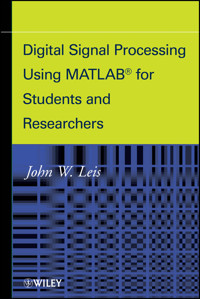
Quickly Engages in Applying Algorithmic Techniques to Solve Practical Signal Processing Problems With its active, hands-on learning approach, this text enables readers to master the underlying principles of digital signal processing and its many applications in industries such as digital television, mobile and broadband communications, and medical/scientific devices. Carefully developed MATLAB® examples throughout the text illustrate the mathematical concepts and use of digital signal processing algorithms. Readers will develop a deeper understanding of how to apply the algorithms by manipulating the codes in the examples to see their effect. Moreover, plenty of exercises help to put knowledge into practice solving real-world signal processing challenges. Following an introductory chapter, the text explores: * Sampled signals and digital processing * Random signals * Representing signals and systems * Temporal and spatial signal processing * Frequency analysis of signals * Discrete-time filters and recursive filters Each chapter begins with chapter objectives and an introduction. A summary at the end of each chapter ensures that one has mastered all the key concepts and techniques before progressing in the text. Lastly, appendices listing selected web resources, research papers, and related textbooks enable the investigation of individual topics in greater depth. Upon completion of this text, readers will understand how to apply key algorithmic techniques to address practical signal processing problems as well as develop their own signal processing algorithms. Moreover, the text provides a solid foundation for evaluating and applying new digital processing signal techniques as they are developed.
Sie lesen das E-Book in den Legimi-Apps auf:
Seitenzahl: 486
Veröffentlichungsjahr: 2011
Ähnliche


















Table of Contents
Cover
Title page
Copyright page
Dedication
PREFACE
CHAPTER 1 WHAT IS SIGNAL PROCESSING?
1.1 CHAPTER OBJECTIVES
1.2 INTRODUCTION
1.3 BOOK OBJECTIVES
1.4 DSP AND ITS APPLICATIONS
1.5 APPLICATION CASE STUDIES USING DSP
1.6 OVERVIEW OF LEARNING OBJECTIVES
1.7 CONVENTIONS USED IN THIS BOOK
1.8 CHAPTER SUMMARY
CHAPTER 2 MATLAB FOR SIGNAL PROCESSING
2.1 CHAPTER OBJECTIVES
2.2 INTRODUCTION
2.3 WHAT IS MATLAB?
2.4 GETTING STARTED
2.5 EVERYTHING IS A MATRIX
2.6 INTERACTIVE USE
2.7 TESTING AND LOOPING
2.8 FUNCTIONS AND VARIABLES
2.9 PLOTTING AND GRAPHING
2.10 LOADING AND SAVING DATA
2.11 MULTIDIMENSIONAL ARRAYS
2.12 BITWISE OPERATORS
2.13 VECTORIZING CODE
2.14 USING MATLAB FOR PROCESSING SIGNALS
2.15 CHAPTER SUMMARY
CHAPTER 3 SAMPLED SIGNALS AND DIGITAL PROCESSING
3.1 CHAPTER OBJECTIVES
3.2 INTRODUCTION
3.3 PROCESSING SIGNALS USING COMPUTER ALGORITHMS
3.4 DIGITAL REPRESENTATION OF NUMBERS
3.5 SAMPLING
3.6 QUANTIZATION
3.7 IMAGE DISPLAY
3.8 ALIASING
3.9 RECONSTRUCTION
3.10 BLOCK DIAGRAMS AND DIFFERENCE EQUATIONS
3.11 LINEARITY, SUPERPOSITION, AND TIME INVARIANCE
3.12 PRACTICAL ISSUES AND COMPUTATIONAL EFFICIENCY
3.13 CHAPTER SUMMARY
CHAPTER 4 RANDOM SIGNALS
4.1 CHAPTER OBJECTIVES
4.2 INTRODUCTION
4.3 RANDOM AND DETERMINISTIC SIGNALS
4.4 RANDOM NUMBER GENERATION
4.5 STATISTICAL PARAMETERS
4.6 PROBABILITY FUNCTIONS
4.7 COMMON DISTRIBUTIONS
4.8 CONTINUOUS AND DISCRETE VARIABLES
4.9 SIGNAL CHARACTERIZATION
4.10 HISTOGRAM OPERATORS
4.11 MEDIAN FILTERS
4.12 CHAPTER SUMMARY
CHAPTER 5 REPRESENTING SIGNALS AND SYSTEMS
5.1 CHAPTER OBJECTIVES
5.2 INTRODUCTION
5.3 DISCRETE-TIME WAVEFORM GENERATION
5.4 THE z TRANSFORM
5.5 POLYNOMIAL APPROACH
5.6 POLES, ZEROS, AND STABILITY
5.7 TRANSFER FUNCTIONS AND FREQUENCY RESPONSE
5.8 VECTOR INTERPRETATION OF FREQUENCY RESPONSE
5.9 CONVOLUTION
5.10 CHAPTER SUMMARY
CHAPTER 6 TEMPORAL AND SPATIAL SIGNAL PROCESSING
6.1 CHAPTER OBJECTIVES
6.2 INTRODUCTION
6.3 CORRELATION
6.4 LINEAR PREDICTION
6.5 NOISE ESTIMATION AND OPTIMAL FILTERING
6.6 TOMOGRAPHY
6.7 CHAPTER SUMMARY
CHAPTER 7 FREQUENCY ANALYSIS OF SIGNALS
7.1 CHAPTER OBJECTIVES
7.2 INTRODUCTION
7.3 FOURIER SERIES
7.4 HOW DO THE FOURIER SERIES COEFFICIENT EQUATIONS COME ABOUT?
7.5 PHASE-SHIFTED WAVEFORMS
7.6 THE FOURIER TRANSFORM
7.7 ALIASING IN DISCRETE-TIME SAMPLING
7.8 THE FFT AS A SAMPLE INTERPOLATOR
7.9 SAMPLING A SIGNAL OVER A FINITE TIME WINDOW
7.10 TIME-FREQUENCY DISTRIBUTIONS
7.11 BUFFERING AND WINDOWING
7.12 THE FFT
7.13 THE DCT
7.14 CHAPTER SUMMARY
CHAPTER 8 DISCRETE-TIME FILTERS
8.1 CHAPTER OBJECTIVES
8.2 INTRODUCTION
8.3 WHAT DO WE MEAN BY “FILTERING”?
8.4 FILTER SPECIFICATION, DESIGN, AND IMPLEMENTATION
8.5 FILTER RESPONSES
8.6 NONRECURSIVE FILTER DESIGN
8.7 IDEAL RECONSTRUCTION FILTER
8.8 FILTERS WITH LINEAR PHASE
8.9 FAST ALGORITHMS FOR FILTERING, CONVOLUTION, AND CORRELATION
8.10 CHAPTER SUMMARY
CHAPTER 9 RECURSIVE FILTERS
9.1 CHAPTER OBJECTIVES
9.2 INTRODUCTION
9.3 ESSENTIAL ANALOG SYSTEM THEORY
9.4 CONTINUOUS-TIME RECURSIVE FILTERS
9.5 COMPARING CONTINUOUS-TIME FILTERS
9.6 CONVERTING CONTINUOUS-TIME FILTERS TO DISCRETE FILTERS
9.7 SCALING AND TRANSFORMATION OF CONTINUOUS FILTERS
9.8 SUMMARY OF DIGITAL FILTER DESIGN VIA ANALOG APPROXIMATION
9.9 CHAPTER SUMMARY
BIBLIOGRAPHY
INDEX
Copyright © 2011 by John Wiley & Sons, Inc. All rights reserved.
Published by John Wiley & Sons, Inc., Hoboken, New Jersey.
Published simultaneously in Canada.
No part of this publication may be reproduced, stored in a retrieval system, or transmitted in any form or by any means, electronic, mechanical, photocopying, recording, scanning, or otherwise, except as permitted under Section 107 or 108 of the 1976 United States Copyright Act, without either the prior written permission of the Publisher, or authorization through payment of the appropriate per-copy fee to the Copyright Clearance Center, Inc., 222 Rosewood Drive, Danvers, MA 01923, (978) 750-8400, fax (978) 646-8600, or on the web at www.copyright.com. Requests to the Publisher for permission should be addressed to the Permissions Department, John Wiley & Sons, Inc., 111 River Street, Hoboken, NJ 07030, (201) 748-6011, fax (201) 748-6008.
Limit of Liability/Disclaimer of Warranty: While the publisher and author have used their best efforts in preparing this book, they make no representations or warranties with respect to the accuracy or completeness of the contents of this book and specifically disclaim any implied warranties of merchantability or fitness for a particular purpose. No warranty may be created ore extended by sales representatives or written sales materials. The advice and strategies contained herein may not be suitable for your situation. You should consult with a professional where appropriate. Neither the publisher nor author shall be liable for any loss of profit or any other commercial damages, including but not limited to special, incidental, consequential, or other damages.
For general information on our other products and services please contact our Customer Care Department with the U.S. at 877-762-2974, outside the U.S. at 317-572-3993 or fax 317-572-4002.
Wiley also publishes its books in a variety of electronic formats. Some content that appears in print, however, may not be available in electronic format.
Library of Congress Cataloging-in-Publication Data:
Leis, John W. (John William), 1966-
Digital Signal Processsing Using MATLAB for Students and Researchers / John W. Leis.
p. cm
Includes bibliographical references and index.
ISBN 978-0-470-88091-3
ISBN 978-1-118-03380-7(ePub)
ISBN 978-1-118-03360-9(ePDF)
1. Signal processing–Digital techniques. 2. Signal processing–Mathematics–Data processing. 3. MATLAB. I. Title.
TK5102.9.L4525 2011
621.382′2–dc22
2010048285
To Debbie, Amy, and Kate
PREFACE
I was once asked what signal processing is. The questioner thought it had something to do with traffic lights. It became clear to me at that moment that although the theory and practice of signal processing in an engineering context has made possible the massive advances of recent times in everything from consumer electronics to healthcare, the area is poorly understood by those not familiar with digital signal processing (DSP). Unfortunately, such lack of understanding sometimes extends to those embarking on higher education courses in engineering, computer science, and allied fields, and I believe it is our responsibility not simply to try to cover every possible theoretical aspect, but to endeavor to open the student’s eyes to the possible applications of signal processing, particularly in a multidisciplinary context.
With that in mind, this book sets out to provide the necessary theoretical and practical underpinnings of signal processing, but in a way that can be readily understood by the newcomer to the field. The assumed audience is the practicing engineer, the engineering undergraduate or graduate student, or the researcher in an allied field who can make use of signal processing in a research context. The examples given to introduce the topics have been chosen to clearly introduce the motivation behind the topic and where it might be applied. Necessarily, a great deal of detail has to be sacrificed in order to meet the expectations of the audience. This is not to say that the theory or implementation has been trivialized. Far from it; the treatment given extends from the theoretical underpinnings of key algorithms and techniques to computational and numerical aspects.
The text may be used in a one-term or longer course in signal processing, and the assumptions regarding background knowledge have been kept to a minimum. Shorter courses may not be able to cover all that is presented, and an instructor may have to sacrifice some breadth in order to ensure adequate depth of coverage of important topics. The sections on fast convolution and filtering, and medical image processing, may be omitted in that case. Likewise, recursive filter design via analog prototyping may be omitted or left to a second course if time does not permit coverage.
A basic understanding of algebra, polynomials, calculus, matrices, and vectors would provide a solid background to studying the material, and a first course in linear systems theory is an advantage but is not essential. In addition to the aforementioned mathematical background, a good understanding of computational principles and coding, and a working knowledge of a structured programming language is desirable, as is prior study of numerical mathematics. Above all, these should not be considered as a list of essential prerequisites; the reader who is lacking in some of these areas should not be deterred.
It is hoped that the problems at the end of each chapter, in conjunction with the various case studies, will give rise to a sufficiently rich learning environment, and appropriately challenging term projects may be developed with those problems as starting points.
John W. Leis
CHAPTER 2
MATLAB FOR SIGNAL PROCESSING
2.1 CHAPTER OBJECTIVES
On completion of this chapter, the reader should be able to:
1. use the MATLAB interactive window command line, and enter MATLAB scripts.
2. use MATLAB function files.
3. be able to display image data from a matrix.
4. be able to play back audio data from a vector.
5. understand the concepts of signal data file storage and data formats.
2.2 INTRODUCTION
MATLAB® is used extensively throughout this text to illustrate practical signal processing concepts. This tutorial chapter introduces some of the features which are useful in this regard. Note that the introductory nature of the tutorial means that it is by no means exhaustive in its examination of MATLAB’s capabilities.
Lesen Sie weiter in der vollständigen Ausgabe!
Lesen Sie weiter in der vollständigen Ausgabe!
Lesen Sie weiter in der vollständigen Ausgabe!
Lesen Sie weiter in der vollständigen Ausgabe!
Lesen Sie weiter in der vollständigen Ausgabe!
Lesen Sie weiter in der vollständigen Ausgabe!
Lesen Sie weiter in der vollständigen Ausgabe!
Lesen Sie weiter in der vollständigen Ausgabe!
Lesen Sie weiter in der vollständigen Ausgabe!




